Category: blogs

  • HRMS Globex: Complete Guide to Features, Login, Benefits, Dashboard & HR Management

    HRMS Globex: Complete Guide to Features, Login, Benefits, Dashboard & HR Management

    If your company has rolled out HRMS Globex, or you’re evaluating it for your organization, this guide walks through every part of the platform: logging in, reading the dashboard, using the core modules, and understanding where it fits against other HR software. There’s a lot of thin, repetitive content on this topic floating around, so this piece sticks to what’s verifiable and flags anywhere the picture is unclear.

    What Is HRMS Globex?
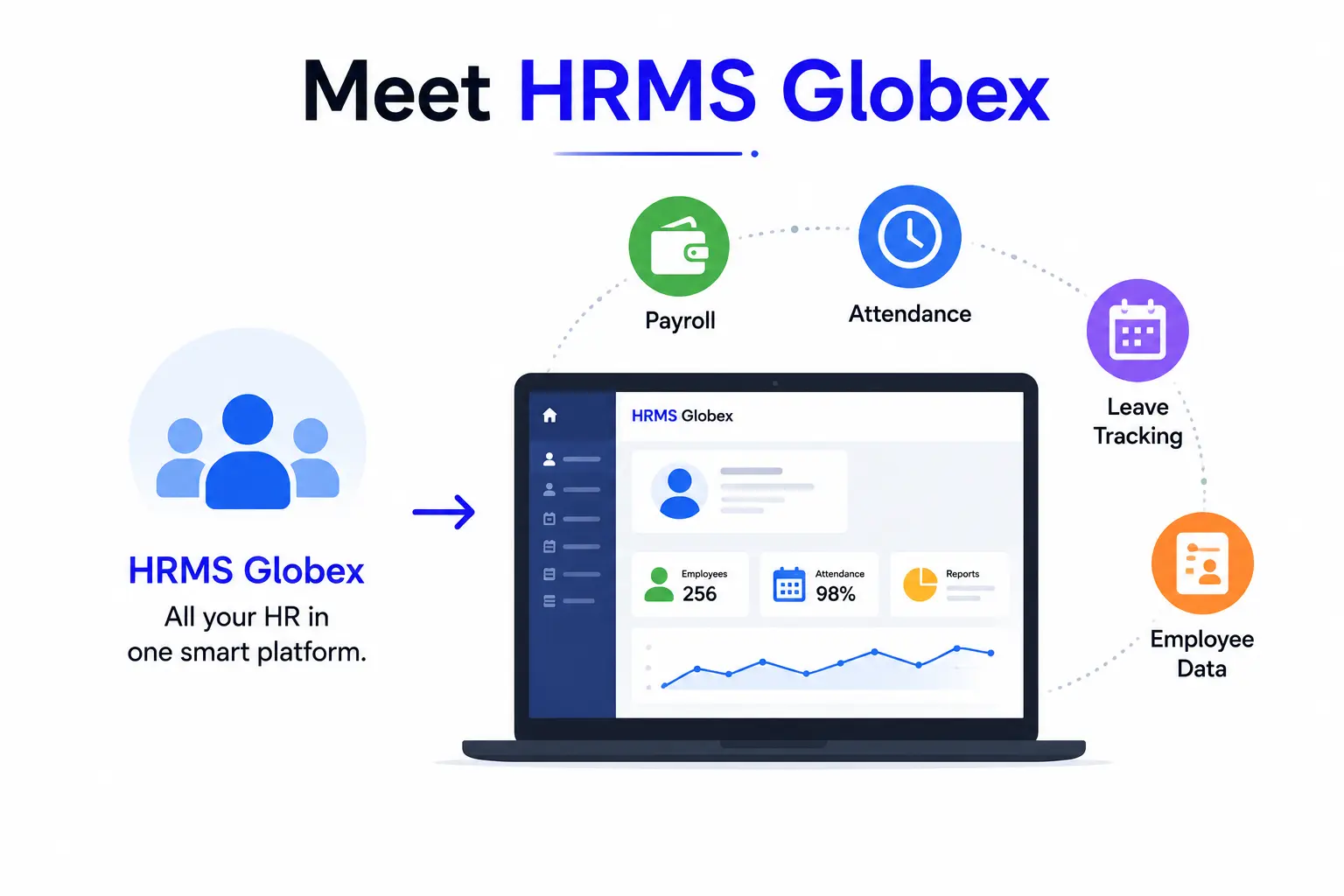
    HRMS Globex infographic showing a unified dashboard for employee management, payroll, attendance, and leave tracking.
    HRMS Globex is a human resource management system (HRMS) – software that brings employee data, payroll, attendance, and leave tracking into a single platform instead of spreading them across spreadsheets and paper files.

    Purpose

    The point of any HRMS, including this one, is to cut down on manual HR admin: fewer emails asking for a payslip, fewer spreadsheets tracking leave balances, and a single record of truth for employee data.

    Who Uses It

    Four groups typically touch the system: employees checking their own records, HR staff managing the workforce, managers approving requests for their team, and administrators who configure the platform itself.

    How It Works

    It runs as a hosted, browser-based portal. Employees and staff log in with credentials issued by their organization, land on a dashboard scoped to their role, and use that dashboard to complete HR tasks without contacting HR directly for routine requests.

    Official HRMS Globex Login

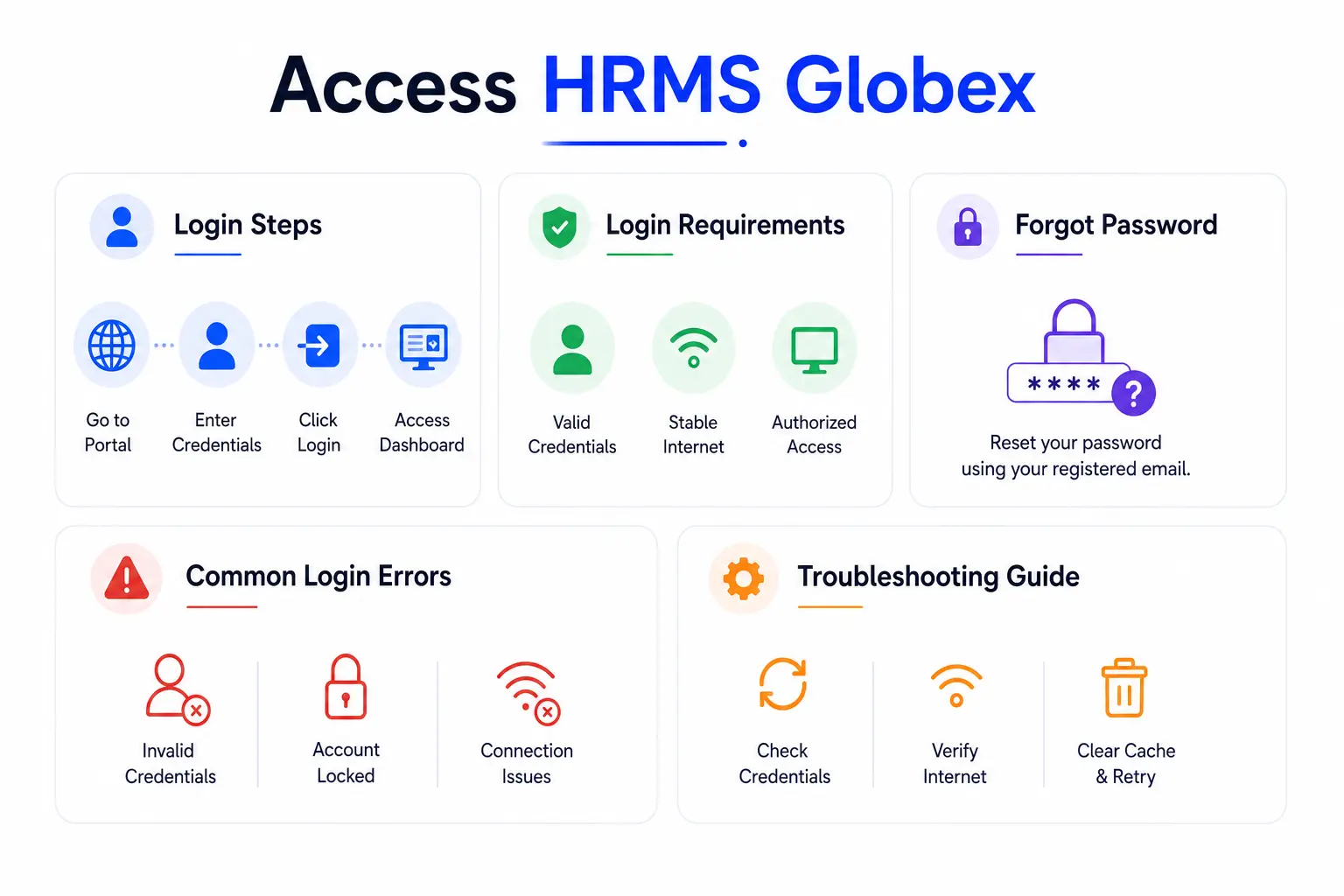
    HRMS Globex login infographic showing login steps, requirements, password recovery, common errors, and troubleshooting tips.
    Login Steps

    • Go to the login page provided by your organization
    • Enter your employee ID or company email
    • Enter your password
    • Complete MFA/2FA if your organization has it enabled
    • Click Sign In to land on your dashboard

    Login Requirements

    You’ll need an active account provisioned by your HR or IT team, a valid employee ID or company email, and — for most deployments – a second verification step such as an SMS code or authenticator app.

    Forgot Password

    • Click “Forgot Password?” on the login screen
    • Enter your employee code or registered email
    • Follow the verification steps shown on screen
    • Set a new password and log in again

    Common Login Errors

    Most failed logins come down to something simple: a typo, an extra space copied in from elsewhere, caps lock left on, or an expired session. Repeated incorrect attempts can also trigger a temporary lockout as a security measure.

    Troubleshooting Guide

    • Double-check your employee ID or email for typos
    • Clear the browser cache or try a private/incognito window
    • Confirm you’re on the correct company-issued portal link
    • If your organization requires VPN access, connect to it first
    • Contact your IT or HR helpdesk if the account appears locked

    HRMS Globex Dashboard Overview

    Employee Dashboard

    Shows personal records: attendance history, leave balance, payslips, and any pending approvals. Most day-to-day employee tasks happen from this single screen.

    HR Dashboard

    Gives HR staff a workforce-wide view — headcount, pending leave requests, payroll cycles, and compliance flags that need attention.

    Manager Dashboard

    Scoped to a manager’s direct reports: team attendance, leave requests awaiting approval, and performance review status for the people they oversee.

    Admin Dashboard

    Controls system-level settings — user roles, permissions, module configuration, and audit logs. This view is usually restricted to IT or senior HR staff.

    Core Features

    Employee Database

    A single, searchable record for every employee — personal details, employment history, contracts, and documents in one place instead of scattered files.

    Attendance Management

    Tracks clock-in/clock-out, shift schedules, and absences, and feeds that data straight into payroll calculations.

    Payroll Processing

    Calculates salaries, deductions, and taxes automatically based on attendance and leave data, cutting down on manual spreadsheet work.

    Leave Management

    Employees submit leave requests online; managers approve or reject them, and balances update in real time.

    Recruitment

    Manages job postings, applicant tracking, and interview scheduling from a single pipeline.

    Onboarding

    Walks new hires through document submission, policy acknowledgment, and initial setup before their first day.

    Performance Management

    Structures review cycles, goal-setting, and manager feedback so appraisals aren’t a once-a-year scramble.

    Employee Self-Service

    Lets staff update personal details, download documents, and submit requests without emailing HR.

    Reporting & Analytics

    Turns raw HR data into headcount, attrition, and payroll reports that HR and leadership can act on.

    Document Management

    Centralizes contracts, policy documents, and compliance paperwork with controlled access.

    Mobile Access

    Extends most self-service features to a mobile browser or app, useful for field or shift-based staff.

    HRMS Globex Modules Explained

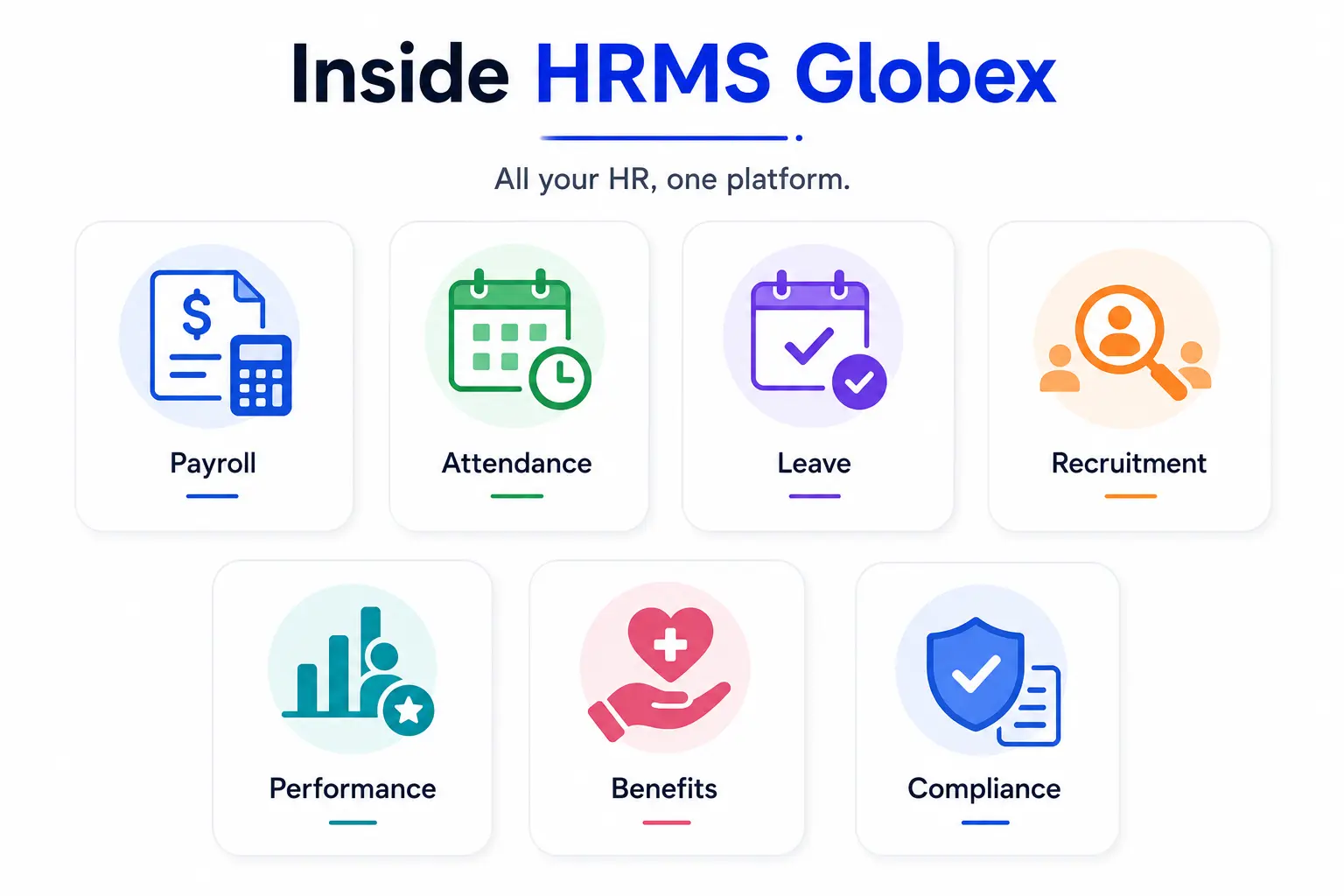
    HRMS Globex modules infographic featuring payroll, attendance, leave, recruitment, performance, benefits, and compliance.
    Payroll Module

    Handles salary computation, statutory deductions, and payslip generation, usually tied directly to the attendance module so hours worked flow straight into pay.

    Attendance Module

    Logs clock-ins, shift patterns, and overtime, and flags irregularities like missed punches for HR review.

    Leave Module

    Manages leave types, entitlements, approval chains, and balance tracking across the organization.

    Recruitment Module

    Covers job requisitions, candidate pipelines, and interview coordination from a single applicant tracking view.

    Performance Module

    Structures goal-setting, mid-year check-ins, and annual reviews with a consistent scoring framework.

    Benefits Module

    Tracks enrollment in insurance, retirement contributions, and other employee benefits.

    Compliance Module

    Keeps statutory filings, policy acknowledgments, and audit trails organized so nothing falls through at review time.

    HRMS Globex Workflow

    Hiring

    A requisition is opened, candidates move through the recruitment module, and an offer is issued once a hire is selected.

    Onboarding

    The new employee completes document submission and policy sign-off inside the platform before their start date.

    Daily Attendance

    Clock-ins and shift data are logged continuously and feed directly into the payroll cycle.

    Payroll

    At the end of each cycle, attendance and leave data are pulled together to calculate pay, deductions, and payslips.

    Appraisal

    Performance reviews run on a set schedule, with goals, manager feedback, and ratings recorded in the performance module.

    Exit Process

    Offboarding closes out access, settles final pay, and archives the employee’s records for compliance purposes.

    How Employees Use HRMS Globex

    Apply Leave

    Select the leave type and dates from the employee dashboard, submit, and track approval status in real time.

    Download Payslip

    Open the payroll section, choose the pay period, and download or save the payslip as a PDF.

    View Attendance

    Check daily clock-in/out records and shift schedules directly from the dashboard.

    Update Profile

    Edit personal details such as address or emergency contact, usually subject to HR verification for sensitive fields.

    Submit Documents

    Upload required paperwork — ID proof, certifications, signed policies — directly through the self-service portal.

    Benefits of HRMS Globex

    For Employees

    Faster access to payslips, leave balances, and personal records without waiting on HR to respond to an email.

    For HR Teams

    Less manual data entry and fewer repetitive requests, freeing time for higher-value work like policy design and workforce planning.

    For Managers

    A single view of team attendance and pending approvals instead of chasing updates across spreadsheets or email threads.

    For Business Owners

    Better visibility into headcount costs and compliance status, which supports more informed workforce decisions.

    HRMS Globex Security & Compliance

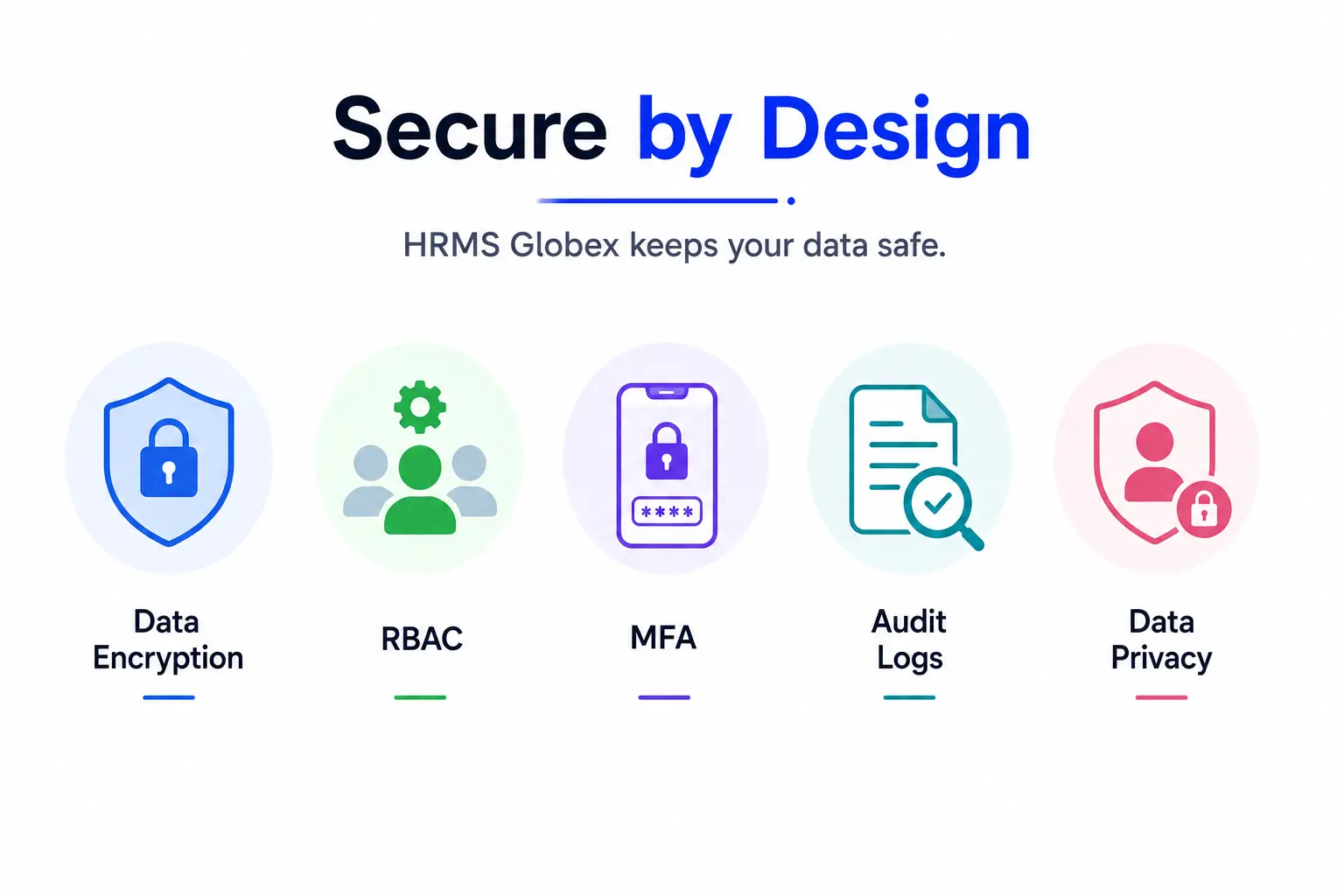
    HRMS Globex security infographic highlighting data encryption, RBAC, MFA, audit logs, and data privacy.
    Data Encryption

    Employee data is encrypted both in transit and at rest, so intercepted traffic or a compromised database doesn’t expose readable records.

    RBAC

    Role-based access control limits what each user can see — an employee can’t view another employee’s payroll data, and a manager only sees their own team.

    MFA

    Multi-factor authentication adds a second verification step beyond a password, reducing the risk from a leaked credential alone.

    Audit Logs

    System actions are logged with a timestamp and user ID, which matters for both security investigations and compliance audits.

    Data Privacy

    Personal data handling should align with applicable regional privacy regulations, and access to sensitive fields is typically restricted to authorized HR staff.

    Integrations

    Payroll

    Connects attendance and leave data directly into payroll runs so pay is calculated without manual re-entry.

    ERP

    Can sync employee and cost-center data with enterprise resource planning systems for unified financial reporting.

    Accounting

    Feeds payroll expense data into accounting software to keep the books current without duplicate entry.

    Microsoft 365

    Single sign-on and calendar sync are common integration points for organizations standardized on Microsoft’s ecosystem.

    Google Workspace

    Similar single sign-on and calendar integration for organizations running on Google Workspace instead.

    APIs

    An API layer lets IT teams connect HRMS Globex to other internal systems where a pre-built integration doesn’t exist.

    HRMS Globex vs Other HR Software

    Note on this comparison: HRMS Globex functions mainly as an internal, employer-issued HR portal rather than an openly marketed SaaS product with public pricing. The platforms below — Zoho People, Keka, BambooHR, GreytHR, and Darwinbox — are established, publicly available HR software vendors. Treat the comparison as positioning by category rather than a like-for-like feature match, since HRMS Globex’s specifications aren’t independently published the way the others’ are.

    Comparison Table

    PlatformAccess ModelBest Known ForPublic Pricing
    HRMS GlobexEmployer-issued internal portalCore HR, attendance, payroll for a single organizationNot publicly listed
    Zoho PeoplePublic SaaS, self-signup availableBroad HR suite, strong integrations with other Zoho appsPublished tiered pricing
    KekaPublic SaaSPayroll and performance management for mid-size companiesPublished tiered pricing
    BambooHRPublic SaaSEmployee experience and onboarding, popular with SMBsPublished tiered pricing
    GreytHRPublic SaaSPayroll and compliance, strong in the Indian marketPublished tiered pricing
    DarwinboxPublic SaaS, enterprise-focusedEnd-to-end HR for large enterprisesCustom quote

    Industries That Benefit

    Healthcare

    Shift-heavy scheduling and strict compliance requirements make centralized attendance and document tracking especially useful.

    IT

    Distributed and remote teams benefit from self-service access and integration with existing collaboration tools.These features can also make it easier for businesses to support remote opportunities while keeping employees connected and productive.

    Manufacturing

    Shift rosters, overtime tracking, and large hourly workforces are easier to manage with automated attendance-to-payroll flow.

    Retail

    High staff turnover and variable shifts make fast onboarding and flexible scheduling tools valuable.

    Education

    Institutions use it to manage both administrative and teaching staff records, leave, and payroll in one system.

    Advantages

    Centralizing HR data in one login cuts down on repetitive admin work and gives employees direct access to their own records.

    Limitations

    Because access and configuration are controlled by each employer, features, support quality, and update speed can vary significantly between organizations using the same underlying platform.

    AdvantagesLimitations
    Single login for most routine HR tasksNo public self-signup or trial for outside evaluators
    Reduces repetitive email requests to HRFeature set depends on employer configuration
    Attendance-to-payroll flow cuts manual errorsPricing and specs aren’t independently published
    Role-based dashboards keep data appropriately scopedSupport quality varies by deployment

    Best Practices

    • Keep login credentials private and never save them on shared computers
    • Log out fully after using a public or shared device
    • Update personal details promptly so payroll and benefits stay accurate
    • Report login or access issues to IT or HR rather than retrying repeatedly

    Buying Checklist

    If you’re the one deciding whether to adopt or renew an HRMS platform – HRMS Globex or otherwise – run through this before signing anything:

    • Does it cover the modules you actually need (payroll, attendance, recruitment, etc.)?
    • Is pricing transparent, and does it scale predictably as headcount grows?
    • What does data security look like — encryption, RBAC,
    • logs, MFA?
    • Does it integrate with your existing payroll, accounting, and productivity tools?
    • Is there a trial or demo, and how responsive is support during evaluation?

    FAQ

    What is HRMS Globex used for?

    It’s used to centralize core HR functions — employee records, attendance, payroll, and leave — into a single login for employees, managers, and HR staff.

    Is HRMS Globex free to use?

    Access is generally issued by an employer as part of an internal HR system rather than sold as a public, self-serve subscription.

    Can I sign up for HRMS Globex myself?

    No public self-registration option is typically available. Access is provisioned by your organization’s HR or IT team.

    I forgot my HRMS Globex password. What do I do?

    Use the “Forgot Password?” link on the login page, verify your identity with your employee code, and set a new password.

    Why can’t I log in to HRMS Globex?

    Most login failures come from typos, extra spaces, incorrect case, an expired session, or a temporary lockout after repeated failed attempts.

    Does HRMS Globex have a mobile app?

    Most deployments extend self-service features to mobile browsers, and some organizations offer a dedicated app depending on their configuration.

    Who can see my payroll data on HRMS Globex?

    Role-based access control restricts payroll visibility to the employee themselves and authorized HR/payroll staff — not to managers or coworkers by default.

    Can managers approve leave directly in HRMS Globex?

    Yes, the manager dashboard includes pending leave requests for direct reports, which can be approved or rejected from there.

    Does HRMS Globex integrate with Microsoft 365?

    Single sign-on and calendar sync with Microsoft 365 are common integration points, though availability depends on your organization’s setup.

    Is HRMS Globex secure?

    Standard practice includes encryption, role-based access control, and MFA, though the exact security posture depends on how each organization configures it.

    How do I download my payslip from HRMS Globex?

    Go to the payroll section of your employee dashboard, select the pay period, and download it as a PDF.

    Can I update my personal details in HRMS Globex?

    Yes, through employee self-service, though sensitive fields may require HR verification before changes take effect.

    What happens during onboarding in HRMS Globex?

    New hires complete document submission and policy acknowledgment through the platform, typically before their official start date.

    Does HRMS Globex handle recruitment?

    Yes, the recruitment module covers job postings, applicant tracking, and interview scheduling.

    What is the HR dashboard used for?

    It gives HR staff a workforce-wide view — headcount, pending approvals, payroll cycles, and compliance items needing attention.

    What’s the difference between the employee and manager dashboard?

    The employee dashboard shows personal records only; the manager dashboard adds visibility into a direct-reporting team’s attendance and pending approvals.

    Can HRMS Globex handle multiple leave types?

    Yes, the leave module supports different leave categories with separate entitlements and approval rules.

    Does HRMS Globex support performance reviews?

    Yes, through the performance module, which structures goal-setting and review cycles.

    How does HRMS Globex compare to BambooHR or Zoho People?

    Those platforms are publicly marketed SaaS products with published pricing and self-serve trials; HRMS Globex functions primarily as an internal portal issued by an employer, so a direct feature-for-feature comparison isn’t fully verifiable.

    What industries commonly use HRMS Globex?

    Healthcare, IT, manufacturing, retail, and education are common users, largely because of shift-based scheduling and compliance needs.

    Who do I contact if my account is locked?

    Your organization’s IT or HR helpdesk — repeated login attempts should stop once a lockout occurs, rather than continuing to retry.

    Does HRMS Globex work without VPN access?

    Some organizations require VPN access to reach the login portal from outside the office network; check with your IT team if the page won’t load.

    Final Verdict

    Who should use it

    Employees and HR staff at organizations that have already deployed HRMS Globex — for them, it’s simply the system of record for attendance, payroll, and leave, and this guide covers what they need to use it well.

    Who should look at alternatives

    Anyone shopping for HR software from scratch should look at publicly available platforms like Zoho People, Keka, BambooHR, GreytHR, or Darwinbox, since those offer transparent pricing, demos, and independently verifiable feature sets — none of which HRMS Globex publishes externally.

    Key takeaways

    • HRMS Globex centralizes attendance, payroll, leave, and employee records under one login
    • Access is issued by an employer; there’s no public self-signup
    • Role-based dashboards keep employee, manager, HR, and admin views separate
    • For an open evaluation against the broader HR software market, published platforms give you a clearer comparison

    Conclusion

    HRMS Globex does what most HR platforms in this category are built to do: pull attendance, payroll, and leave into one place so employees stop chasing HR for routine requests. If your organization already uses it, the login steps, dashboard breakdown, and module guide above should cover day-to-day use. If you’re still choosing a platform, weigh HRMS Globex’s internal, employer-managed model against publicly available alternatives with transparent pricing before making a call.
  • Super Logout: What It Is, How It Works, Benefits, Limitations & Best Alternatives

    Super Logout: What It Is, How It Works, Benefits, Limitations & Best Alternatives

    Leaving accounts logged in on a public computer, a shared office machine, or a library terminal is one of the most common and most overlooked security mistakes. Super Logout is a free, single-page web utility built to solve exactly that problem: instead of signing out of Gmail, Facebook, Amazon, and a dozen other services one at a time, it lets you trigger logout requests for many of them at once. This guide breaks down how Super Logout actually works under the hood, when it genuinely helps, where it falls short, and which alternatives are worth pairing it with for real day-to-day privacy.

    What Is Super Logout?

    Super Logout infographic showing one-click logout across multiple websites and browsers.
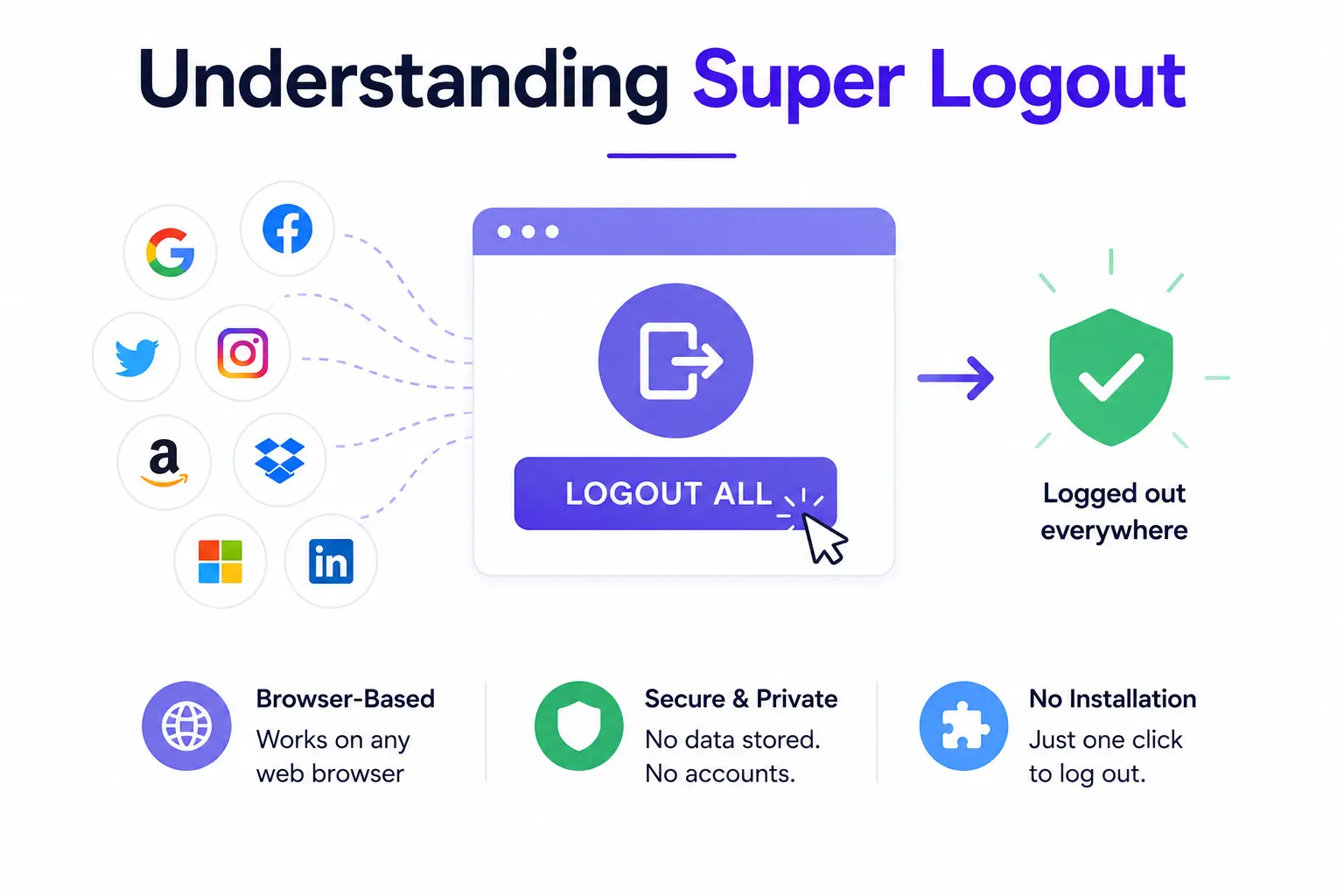
    Super Logout is a browser-based tool that sends logout requests to multiple websites in the background when you click a single button, rather than requiring you to visit each site and click “Sign Out” individually. It runs entirely from a web page, so there is nothing to install and no account to create.

    Why It Was Created

    The tool exists because modern browsing habits leave people signed into many services at once -email, social media, shopping, cloud storage – and manually signing out of each one is tedious enough that most people simply skip it. Super Logout was built to close that gap with a single, low-friction action aimed mainly at shared and public computers.

    Who Should Use It

    Super Logout is most useful for anyone who regularly uses a device that isn’t exclusively their own:

    • Students and researchers using library or lab computers
    • Employees on shared office workstations or kiosk terminals
    • Travelers using cyber cafés or hotel business centers
    • Families sharing a single home computer across multiple people
    • Anyone who wants a fast privacy “reset” before handing a device to someone else

    How Super Logout Works

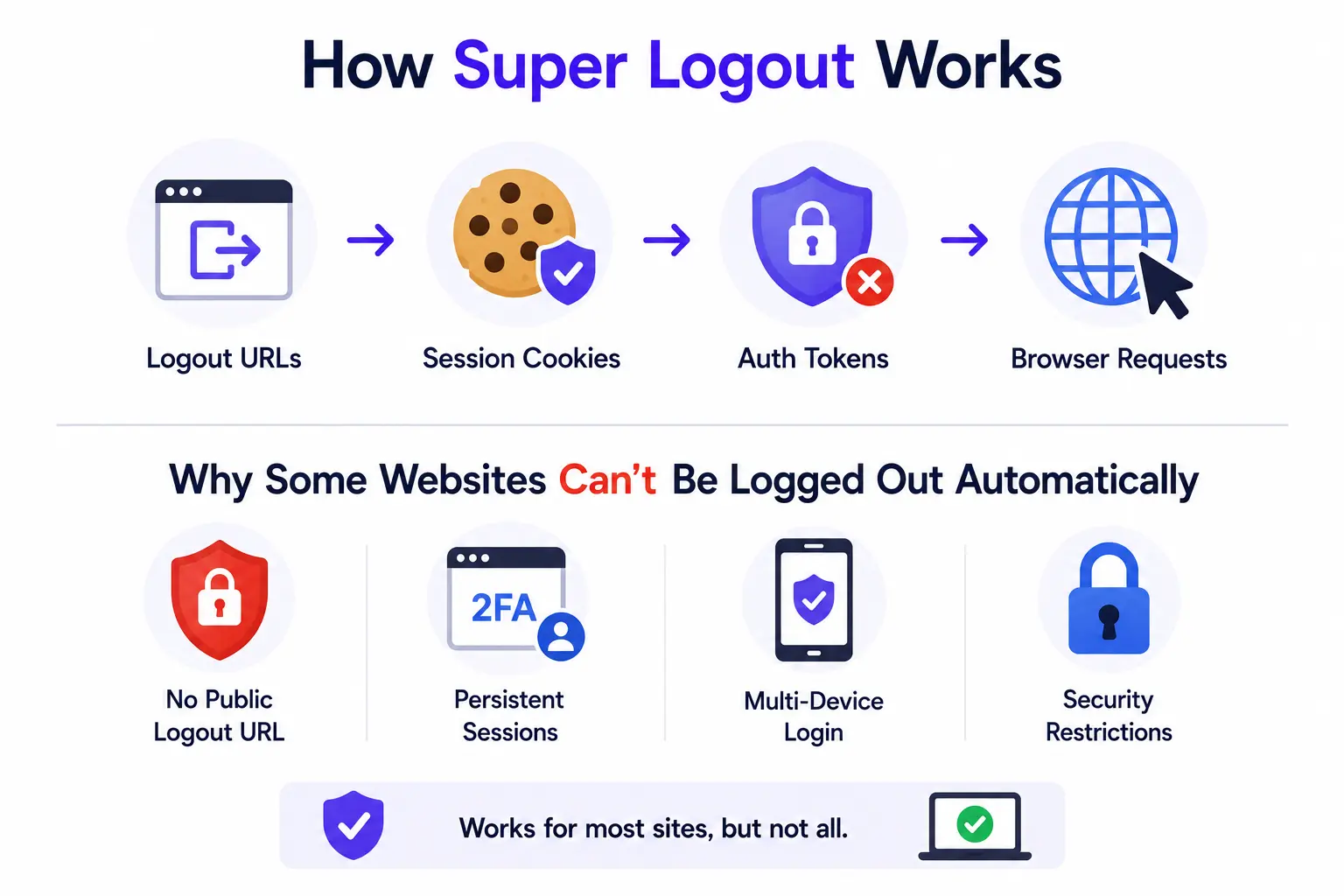
    Super Logout workflow infographic showing logout requests, browser sessions, and automatic sign-out limitations.

    Logout URLs

    Most major websites expose a dedicated logout endpoint – a specific URL that, when loaded, tells the server to end your current session. Super Logout maintains a list of these endpoints for popular platforms and loads them quietly, usually inside hidden requests or background frames, when you press the logout button.

    Session Cookies

    When you sign in to a site, the server issues a session cookie stored in your browser that proves you’re authenticated on future requests. Hitting a logout URL instructs the server to invalidate that session and asks the browser to clear the associated cookie, which is the core mechanic behind every entry on Super Logout’s list.

    Authentication Tokens

    Many modern apps also rely on tokens (such as OAuth access or refresh tokens) rather than, or in addition to, simple cookies. Because these tokens are often stored in local storage or managed by a separate identity provider, a generic logout URL doesn’t always reach them, which is one reason token-based sessions are harder for any multi-site logout tool to fully clear.

    Browser Requests

    Technically, Super Logout is firing a batch of HTTP GET requests, one per supported service, from your current browser context. Because these requests carry your existing cookies, the receiving server can identify and end your session without you visiting the site directly.

    Why Some Websites Cannot Be Logged Out Automatically

    Sites that require a POST request with a CSRF (cross-site request forgery) token instead of a simple GET request can’t be logged out via a background link, since the token has to be fetched and submitted correctly. Sites using single sign-on, passkeys, or heavily sandboxed session storage often fall into this category, which is why coverage varies from platform to platform.

    Why Use Super Logout?

    Public Computers

    On a library or internet-café PC, forgetting to log out of even one account can expose personal messages, financial details, or saved payment methods to the next user. A single click before walking away meaningfully lowers that risk.

    Shared Devices

    Households or classrooms that share one laptop across several people benefit from a fast way to clear the previous user’s sessions before someone else logs in with their own accounts.

    Office Systems

    Hot-desking and shift-based workstations mean multiple employees may use the same machine in a single day. A quick logout routine between shifts helps keep each person’s accounts separate.

    Cyber Cafés

    Cyber café terminals are used by dozens of strangers daily, making them a high-risk environment for leftover sessions. Super Logout offers a faster safety net than relying on every visitor to remember individual sign-outs.

    Privacy Protection

    Beyond shared machines, some people simply prefer a habit of clearing active sessions periodically as part of a broader personal-privacy routine, similar to clearing browser history.

    Key Features

    One-Click Logout

    The entire workflow is a single button press – there is no multi-step wizard or settings screen to configure.

    Multi-Site Support

    Rather than covering just one platform, the tool targets a list of widely used services simultaneously, which is the main time-saving benefit over manual logout.

    No Installation Required

    Because it runs as a plain web page, there’s no browser extension permissions to grant and nothing left behind on the device after you close the tab.

    Free to Use

    Super Logout doesn’t require payment, an account, or a subscription — it’s accessible to anyone with a browser.

    Supported Websites

    Super Logout supported websites infographic featuring Google, Gmail, Facebook, Amazon, X, LinkedIn, GitHub, Dropbox, and more.
    Super Logout’s exact list of supported services can change over time and isn’t always published in full detail, but publicly available reviews and usage reports consistently mention broad support for major consumer platforms. Treat the list below as representative rather than guaranteed, and always confirm manually on unfamiliar or sensitive accounts.

    Google

    Google’s account logout endpoint is commonly included, which can also affect other Google-linked services in the same browser session.

    Gmail

    Gmail sessions are tied to the same Google account system, so logging out of Google typically logs out of Gmail as well.

    Facebook

    Facebook’s dedicated logout URL is a frequent inclusion given how commonly the platform stays signed in on shared devices.

    Amazon

    Amazon sessions are especially sensitive given saved payment methods, making it a priority target for multi-site logout tools.

    Yahoo

    Yahoo Mail and related Yahoo services are frequently listed among supported platforms.

    X (Twitter)

    X’s logout endpoint is commonly supported, though platform changes to authentication flows can affect reliability over time.

    LinkedIn

    LinkedIn is often included given its popularity on office and co-working shared devices.

    GitHub

    GitHub logout support is useful in shared development environments, though tokens used for CLI or API access aren’t cleared this way.

    Dropbox

    Dropbox is commonly listed, which matters given how often cloud-storage accounts stay signed in across sessions.

    Other Supported Platforms

    Additional consumer platforms are sometimes included depending on the tool’s current list. Because coverage isn’t officially published in detail, it’s good practice to manually verify any account that holds sensitive financial or personal data.

    Step-by-Step Guide

    Open Super Logout

    1. Navigate to the Super Logout web page in your browser — no login or download is needed.

    Select Services

    • Review the list of supported sites shown on the page, if the version you’re using allows selecting or deselecting specific services.

    Run Logout

    • Click the logout button to trigger background logout requests for the selected services.

    Verify Success

    • Manually reload one or two of the sites you were signed into to confirm the session actually ended, since automated confirmation isn’t always shown on-page.

    Is Super Logout Safe?

    Security Analysis

    Functionally, Super Logout does nothing more than a browser would do if you manually visited each logout link – it isn’t intercepting your passwords or transmitting credentials anywhere, since logout requests don’t require re-entering login details. That said, because it’s a third-party page acting on your active sessions, it’s worth using tools with a visible, well-reviewed track record rather than an unfamiliar clone site.

    Browser Permissions

    Because Super Logout runs as a plain web page rather than a browser extension, it typically doesn’t request elevated permissions like reading browsing history or accessing other tabs, which limits its exposure compared to some extensions.

    Privacy Considerations

    The tool interacts with your already-authenticated sessions rather than collecting new personal data, but as with any third-party utility, it’s reasonable to review its privacy policy before relying on it for sensitive accounts.

    Known Limitations

    Super Logout cannot guarantee every session is fully cleared, cannot bypass sites that require confirmation dialogs, and has no visibility into token-based or app-level sessions running outside the browser.

    Advantages

    Saves Time

    Ending ten sessions with one click is faster than visiting ten separate sites and menus.

    Better Privacy

    Reduces the odds that a forgotten session exposes personal information to the next person using the device.

    Easy to Use

    No technical knowledge, account, or setup is needed it works the same way for any visitor.

    Reduces Human Error

    People routinely forget to sign out of at least one service when doing it manually; batching the action removes that gap.

    Limitations

    Doesn’t End Every Session

    Only sites on the tool’s supported list are affected — any account outside that list needs a manual logout.

    Some Websites Block Automated Logout

    Sites requiring CSRF-protected POST requests, extra confirmation clicks, or additional verification steps can’t be reliably logged out by a background request.

    OAuth Issues

    Services that authenticate through a third-party identity provider (“Sign in with Google/Apple/Facebook”) may retain a session with that provider even after the app itself appears logged out, since the underlying token lives with the provider, not the app.

    Passkey Limitations

    Passkey-based sign-ins are tied to device-level credential storage rather than a simple session cookie, so a logout URL alone generally can’t revoke or affect passkey trust on the device.

    Super Logout vs Other Methods

    Here’s how Super Logout compares with other common ways people try to end sessions or protect privacy on a device:

    MethodSpeedCoverageBest For
    Super LogoutVery fast (one click)Limited to supported sitesQuick multi-account logout
    Clearing cookiesFastBroad, but breaks saved preferences tooFull session reset
    Incognito modeInstant (session never saved)All sites, but only for that sessionOne-off private browsing
    Browser history deletionFastDoesn’t end active sessionsHiding activity, not logging out
    Password managersModerateDepends on manager’s session toolsCentralized credential control
    Sign Out Everywhere featuresModerate (per site)Very thorough for that one siteHigh-security single accounts

    Clearing Cookies

    Deleting cookies removes session data for every site at once, which is more thorough than Super Logout’s list-based approach, but it also wipes saved logins and preferences you may have wanted to keep.

    Incognito Mode

    Private browsing avoids the problem entirely by never saving session cookies past the window’s lifetime, but it requires planning ahead rather than cleaning up after the fact.

    Browser History Deletion

    Clearing history only removes the record of sites visited — it does not end active login sessions, so it isn’t a substitute for logging out.

    Password Managers

    Some password managers include their own session or device-management tools, which can be more precise but usually require the manager itself to be set up in advance.

    Sign Out Everywhere Features

    Google, Facebook, and several other platforms offer a built-in “log out of all devices” option in account settings, which is more thorough than a third-party tool for that single account, since it’s run by the platform itself.

    Best Alternatives

    Browser Privacy Extensions

    Extensions built for session and cookie management can offer more granular control, such as auto-clearing cookies for specific domains when a tab closes.

    Password Managers

    A password manager with built-in device or session management gives a more complete picture of where you’re logged in across services.

    Manual Logout

    For sensitive accounts, manually visiting the site and clicking sign out remains the most reliable method, since it uses the platform’s own confirmed logout flow.

    Browser Profiles

    Creating a separate browser profile for shared-device use keeps sessions isolated from your personal profile, avoiding the mixing problem in the first place.

    Guest Mode

    Most browsers and operating systems offer a guest mode that starts with no saved logins and discards everything on exit, which is often the safest option for a public computer.

    Troubleshooting

    Website Didn’t Log Out

    If a site still shows you as logged in after running Super Logout, refresh the page fully (not from cache) and, if it persists, log out manually — the site may require a confirmation step the tool can’t complete.

    Browser Compatibility

    Modern Chromium-based browsers (Chrome, Edge, Brave) and Firefox generally handle background logout requests consistently; older or heavily restricted browsers may block some requests due to stricter cross-site request policies.

    Login Persists

    Persistent logins are often caused by “remember me” tokens stored separately from the session cookie – these usually require clearing site data or logging out from the account’s own security settings page.

    Cookie Problems

    Browser extensions that block third-party cookies or trackers can sometimes interfere with background logout requests; temporarily disabling strict cookie blocking can help if a specific site won’t clear.

    Best Practices for Online Security

    Public Computer Checklist

    • Use guest mode or a private window whenever available
    • Run a multi-site logout tool before stepping away
    • Manually confirm logout on banking or email accounts
    • Clear cookies and cached form data before leaving

    Shared Device Checklist

    • Use separate browser profiles per person where possible
    • Avoid saving passwords directly in the browser on shared machines
    • Log out fully at the end of each session, not just close the tab

    Multi-Factor Authentication

    Enabling multi-factor authentication adds a second barrier even if a session is somehow left open or a password is exposed, making it one of the highest-impact security habits available.

    Password Hygiene

    Using unique passwords per account, ideally generated and stored in a password manager, limits the damage if any single session or credential is compromised.

    Frequently Asked Questions

    Is Super Logout an official product from Google or Facebook?

    No. It’s an independent, third-party tool that sends standard logout requests to multiple platforms – it isn’t operated or endorsed by the services it logs you out of.

    Does Super Logout delete my saved passwords?

    No. It only ends active login sessions; passwords saved in your browser or a password manager are untouched.

    Will Super Logout log me out of my phone apps too?

    No. It only affects the browser session it runs in – mobile apps maintain their own separate sessions and tokens.

    Can Super Logout log me out of banking websites?

    Most banking sites use stricter session protections and confirmation steps that automated tools generally can’t complete, so manual logout is recommended for financial accounts.

    Is Super Logout safe to use on a work computer?

    It’s generally safe since it only triggers standard logout requests, but check your company’s IT policy before using any third-party web tool on managed devices.

    Does Super Logout work on mobile browsers?

    Many versions work on mobile browsers, though background request handling can be less consistent than on desktop browsers.

    Why did some sites stay logged in after I used it?

    That site may not be on the tool’s supported list, or it may require a confirmation step or CSRF token that a background request can’t provide.

    Is Super Logout the same as clearing cookies?

    No. Clearing cookies removes stored data for every site, while Super Logout only targets a specific list of logout endpoints without affecting other saved data.

    Does Super Logout protect against hackers or malware?

    No. It’s a convenience tool for ending sessions, not a security or antivirus product, and it doesn’t defend against malware or phishing.

    Can I add my own websites to Super Logout’s list?

    Most versions of the tool use a fixed, built-in list rather than allowing custom additions, since each site needs a known logout endpoint to work.

    Does using Super Logout log out other people on a shared account?

    It ends the session in the current browser only – it doesn’t affect sessions signed in from other devices.

    Is there a mobile app version of Super Logout?

    It’s primarily designed as a single web page rather than a dedicated app, so it’s typically accessed through a mobile browser instead.

    Does Super Logout work with two-factor authentication accounts?

    Yes — logging out doesn’t affect your 2FA setup; you’ll simply need to re-authenticate with your second factor the next time you sign in.

    What happens if I close the tab before the logout finishes?

    Some background requests may not complete, so it’s safer to wait a few seconds after clicking before closing the tab.

    Is Super Logout better than a browser extension for this task?

    It’s simpler since nothing needs installing, but a dedicated extension can offer more consistent, ongoing session management.

    Can Super Logout accidentally log me out of an account I wanted to stay in?

    Yes, since it typically logs out of every supported site at once rather than letting you pick just one, so use it deliberately, not by habit.

    Does Super Logout store any of my data?

    As a logout-only tool, it isn’t designed to store your credentials or personal data, though it’s worth reviewing the specific site’s privacy policy directly.

    What’s the safest habit for truly shared public computers?

    Combine guest mode or a private window with a multi-site logout tool, and manually verify sensitive accounts before walking away.

    Final Verdict

    When Super Logout Is Worth Using

    Super Logout earns its place as a quick habit for low-stakes, high-frequency situations: shared home computers, library terminals, and office kiosks where speed matters more than perfect coverage.

    When to Choose an Alternative

    For financial accounts, work systems handling sensitive data, or any session where the consequences of a missed logout are serious, manual logout or a platform’s own “sign out everywhere” feature is the more reliable choice.

    Recommended Privacy Workflow

    A practical approach layers all three: use guest mode or a private window as the first line of defense, run a tool like Super Logout as a fast cleanup step, and manually confirm logout on any account that holds money, health data, or sensitive work information.

    AdvantagesLimitations
    Saves significant time on shared devicesDoesn’t cover every website
    No installation or signup requiredCan’t bypass CSRF or confirmation steps
    Reduces the chance of a forgotten sessionNo effect on OAuth provider sessions or passkeys
    Works across many popular platforms at onceNo official published list of full coverage

    Conclusion

    Super Logout solves a small but real problem: the gap between how many accounts we stay signed into and how rarely we remember to sign back out. Used as intended — a fast cleanup step on a shared or public computer — it’s a genuinely useful habit that beats leaving sessions open by default. It isn’t a complete security solution on its own, though. It can’t reach every website, can’t clear OAuth-linked or passkey-based sessions, and shouldn’t be relied on for banking, work, or other high-stakes accounts. The most reliable approach treats it as one layer in a broader routine: start with guest mode or a private window when possible, use a multi-site tool like Super Logout to clear the bulk of everyday sessions in one click, and manually confirm logout on anything sensitive before walking away from the device. Paired with good habits like multi-factor authentication and unique passwords, that combination covers both the convenience and the security side of the equation.

  • Best Crisis Management Services: Why AI Monitoring Matters More Than Press

    Best Crisis Management Services: Why AI Monitoring Matters More Than Press

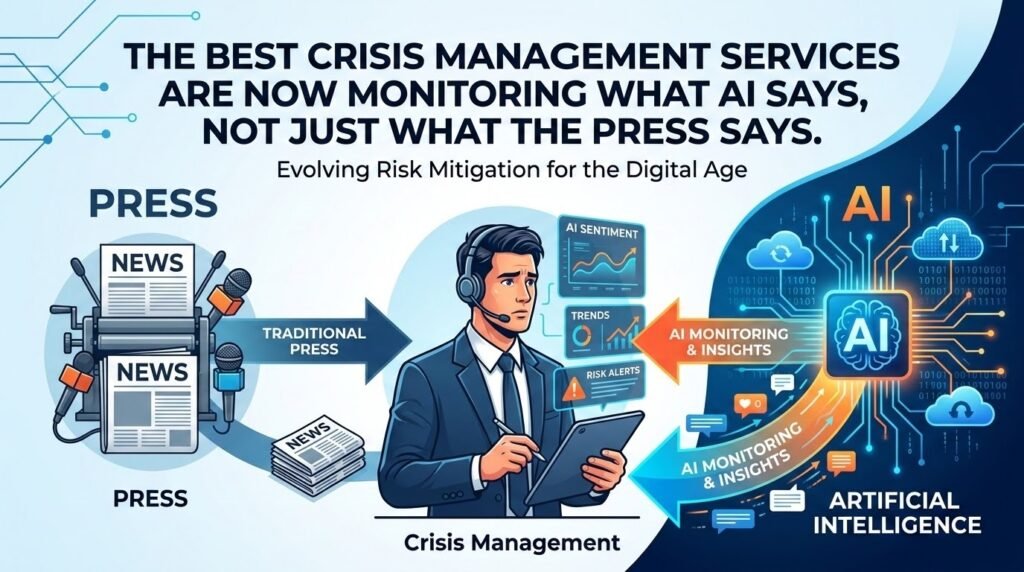
    A viral AI chatbot narrative recently outpaced traditional press coverage by 10x in a single crisis, reshaping public perception overnight. As AI voices eclipse media influence, the best crisis management services are pivoting to monitor chatbots, LLMs, and social AI tools.

    From Traditional Media to AI-Driven Narratives

    United Airlines’ 2017 passenger-dragging crisis took 36 hours to reach national press, but Twitter bots and Facebook AI recommendations had already pushed the story to 2.1 million users. Crisis management once meant tracking a few thousand outlets. That model is obsolete.

    Traditional press monitoring focused on newspapers and TV, scanning a limited number of sources at high cost with built-in delays. Fast-moving online conversations fell entirely through the gaps.

    AI-driven monitoring tracks AI-generated content from tools like ChatGPT, as well as on social platforms. Free APIs enable real-time analysis of user-generated content and viral misinformation. AI sentiment tools flag threats faster than any human team can.

    The evolution now demands a hybrid approach. Firms use natural language processing for semantic analysis across global languages, protecting digital reputation from chatbot risks and algorithmic bias.

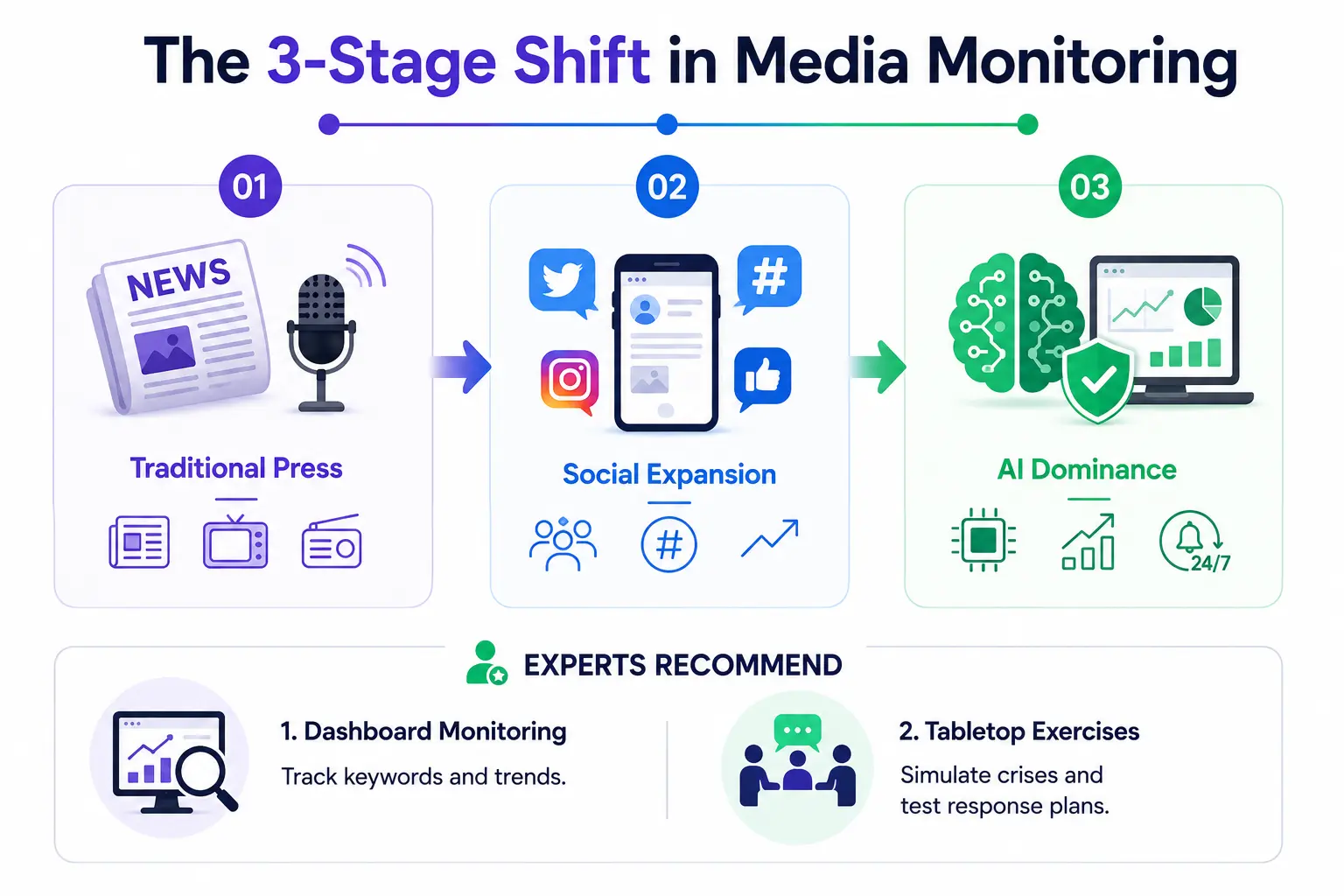
    The three-stage shift looks like this:
    Media monitoring evolution infographic showing the shift from traditional press to social media and AI-powered monitoring.

    • Traditional press: Scan roughly 1,200 outlets monthly for print and broadcast coverage, with a focus on journalists and editors
    • Social expansion: Add social media monitoring for posts, hashtags, and influencers to detect viral trends early
    • AI dominance: Integrate NLP and machine learning for AI content, deepfakes, and predictive analytics with 24/7 automated alerts

    Experts recommend starting with dashboard monitoring for keyword tracking and trend analysis, then running tabletop exercises to simulate crises and test response protocols.

    Why AI Reach Has Outgrown Press Reach

    ChatGPT serves 200 million users. Claude reaches 15 million. Perplexity handles 10 million searches per day. The Wall Street Journal has 3 million subscribers.

    That gap explains why crisis teams can no longer treat press monitoring as the primary signal.

    Tesla’s Full Self-Driving criticism, spread via AI chatbots, reached 8 million views before a Reuters article appeared. Groq’s Llama 3.1 responses appear in 1.2 million Reddit threads monthly, shaping narratives before journalists publish. In the 2024 crypto crash, misinformation spread through AI channels first, with traditional media catching up hours later.

    PlatformMonthly Reach Metric
    ChatGPT200M users
    Claude15M users
    Perplexity10M searches/day
    WSJ3M subscribers

    AI monitoring now covers this ground by integrating natural language processing to track AI-generated content at scale. Early detection makes the difference between controlling a narrative and chasing it.

    The AI Platforms Crisis Teams Must Now Track

    Beyond ChatGPT, crisis teams need to monitor six platforms with meaningfully different risk profiles.

    PlatformMonthly UsersEnterprise %API CostMonitoring PriorityKey Risk
    ChatGPT200M65%$0.002/1K tokensHighHallucinations
    Claude15M47%$3/M tokensHighExecutive use
    Grok5M22%X PremiumMediumViral spread
    Perplexity10M31%$20/moHighResearch influence
    Gemini8M39%$0.00025/1KMediumGoogle integration
    Character.AI20M8%FreeLowConsumer sentiment

    Claude’s high enterprise penetration makes it a particular concern for executive protection and stakeholder communication, where AI-generated content can shift C-suite narratives before anyone realizes it. Perplexity influences research and fact-checking conversations. Character.AI shapes casual consumer sentiment in ways that don’t register on traditional monitoring dashboards.

    A sensible prioritization framework: treat ChatGPT, Claude, and Perplexity as requiring 24/7 surveillance. Grok and Gemini warrant ongoing trend analysis. Character.AI fits into periodic checks.

    Deepfakes and Hallucinations: The Two Biggest AI Crisis Threats

    Deepfakes are AI-generated video or audio content fabricated to appear authentic. In crisis scenarios, a realistic fake clip of an executive admitting fault can trigger stock drops and destabilize stakeholder communication before the forgery is confirmed.

    AI hallucinations are false claims generated by language models with apparent confidence. ChatGPT once hallucinated that Apple had recalled the iPhone 15, pushing the false claim to the top of Taiwan’s trending list. In 2023, an AI-generated image of Pope Francis in a white puffer coat went viral, garnering millions of views before it was debunked.

    The combination creates what researchers call a hallucination cascade: false AI outputs amplified by social media algorithms, spreading at a velocity that overwhelms reactive monitoring.

    Key statistics:

    • AI content spreads 6x faster than human-generated content
    • 73% of AI-generated content contains verifiable errors, per a Stanford HAI study
    • Rumor velocity during major AI-driven crises can peak at 1.7 million mentions per hour

    The FTC has warned companies about deceptive AI content and has issued fines for failing to address it. Deepfake detection tools like Reality Defender run approximately $500 per month and integrate directly into crisis communication workflows. Perplexity’s fact-check API can verify AI outputs in real time, flagging inaccuracies before they amplify.

    How AI Sentiment Analysis Works in a Crisis

    Brandwatch’s AI sentiment tool detected a 42% negative shift at Wendy’s within 17 minutes, enabling a response before mainstream media picked up the story. That kind of speed is the practical argument for real-time AI monitoring.

    Setting up a basic real-time monitoring system:

    1. Connect APIs from providers like OpenAI or Anthropic for natural language processing capabilities
    2. Set 15 crisis-relevant keywords, such as “data breach,” “product recall,” or “executive misconduct.”
    3. Configure automated alerts for sentiment scores below -0.3 to flag emerging threats
    4. Build a centralized dashboard view using Google Data Studio for crisis intelligence tracking
    ToolMonthly CostKey Strengths
    Brandwatch$800Social media monitoring, trend analysis
    Meltwater$1,200Multilingual monitoring, influencer tracking
    Sprinklr$2,000Comprehensive NLP, customizable dashboards

    Choose based on the balance of budget, language coverage, and the depth of AI content analysis needed for your specific risk profile.

    The Best Crisis Management Services Now Use These Monitoring Tools

    ToolPriceAI CoverageReal-timeBest ForIntegration
    Reality Defender$500/moDeepfakesYesExecutivesSlack
    Parametrix$299/moLLMsYesEnterprisesTeams
    Brandwatch$800/moSocial + AIYesAgenciesDashboards
    Meltwater$1,200/moGlobal5 minPR FirmsMultilingual
    Hootsuite Insights$99/moSocial AI15 minSMBsBudget
    Talkwalker$650/moPredictionsYesCMOsAnalytics

    Reality Defender specializes in deepfake detection for executive-facing content. Talkwalker’s predictive analytics help anticipate issues like product recalls before they escalate. Meltwater is the right choice when multilingual monitoring matters, particularly for brands with global exposure.

    Integration matters as much as features. API connections to Slack or Teams enable 24/7 alerts without requiring manual dashboard checks. Zapier can link tools together into custom workflows that connect monitoring data directly to crisis communication systems.

    Companies like NetReputation have built full AI monitoring capabilities into their reputation management services, tracking LLM outputs and social AI tools alongside traditional media signals, treating them all as a single continuous intelligence feed rather than separate functions.

    AI Crises vs. Press Crises: A Speed Comparison

    The difference in response windows between AI-driven crises and traditional press crises is not incremental. It is categorical.

    Crisis TypeDetection TimePeak MentionsStock ImpactResponse Strategy
    AI: Pfizer (2024)Minutes2.3M-18%AI monitoring, rapid denial
    Press: United (2017)48 hoursN/A-7%Press release, apology
    AI: Barbie Movie (2023)12 hoursHigh volumeMinimalBrandwatch detection

    In 2024, a Grok hallucination about the Pfizer vaccine generated 2.3 million mentions and a $2.1 billion loss in market cap. Traditional press monitoring would have registered none of it in time. By contrast, United Airlines’ 2017 crisis unfolded over 48 hours, allowing time for internal review before the full damage hit.

    The 2023 Barbie review bombing illustrates what early detection actually buys. Brandwatch flagged unusual patterns within 12 hours. The team issued statements quickly. What could have been a major PR event became a minor one.

    The lesson is not that press crises no longer matter. It is that AI crises operate on timelines that make reactive monitoring indefensible.

    The Generational Shift Driving This Change

    Edelman’s 2024 research found that 92% of Gen Z trusts AI recommendations over traditional journalism. That preference creates a specific class of reputation risk that press monitoring cannot address.

    AI chatbots deliver instant, personalized responses that feel authoritative to users who grew up treating search results as ground truth. When an AI hallucinates a product recall or surfaces a fabricated executive quote, a generation that trusts that output more than a newspaper correction has already formed an opinion.

    Crisis management services that still treat press coverage as the primary signal are optimized for a shrinking audience. Real-time AI monitoring addresses an increasingly large audience.

    Building an AI-Resilient Crisis Strategy

    AI tools enable 35% faster crisis recovery by automating alerts and sentiment tracking. A functional AI-resilient strategy rests on three pillars.

    1. Proactive Monitoring

    Proactive monitoring means continuous surveillance using NLP and machine learning across global sources, not just traditional media. Teams track keywords, semantic patterns, and influencer signals. The goal is to detect threats hours before they reach mainstream press.

    Multilingual capabilities matter here. Geopolitical risks and supply chain crises often surface first in non-English channels.

    2. Swift Response Protocols

    Predefined escalation protocols enable AI-driven command centers to trigger automated alerts the moment a crisis signal is detected. The response window for an AI crisis is measured in minutes, not hours.

    Dashboard monitoring gives teams real-time insight into sentiment shifts and stock price correlations. Counter-narratives need to be ready before they are needed.

    3. Effective Recovery

    Recovery is about rebuilding trust with specific audiences, not broadcasting a general apology. Transparency reporting, accountability measures, and loyalty programs all contribute.

    Post-crisis evaluation using AI tools generates ROI metrics and lessons learned. Tabletop exercises that simulate AI-driven scenarios, including deepfake attacks and hallucination cascades, build the institutional muscle to respond faster next time.

    Seven practices worth implementing:

    • Seed approved narratives via trusted AI influencer accounts on a quarterly basis
    • Identify LLM injection points across key platforms for targeted influence
    • Activate a sentiment threshold trigger that fires at defined negative levels
    • Train executives to handle AI interactions confidently and consistently
    • Use watermark verification to authenticate content and identify deepfake origins
    • Maintain a 15-minute response SLA for automated alerts and interventions
    • Run weekly simulation drills calibrated to AI-driven crisis scenarios

    The Mastercard case demonstrated a recovery in sentiment within hours when these practices were applied. Speed and preparation are the variables that separate manageable crises from catastrophic ones.

  • Does Bing Use Meta Keywords? Everything You Need to Know

    Does Bing Use Meta Keywords? Everything You Need to Know

    If you have been taking care of a website for more than ten years you probably remember putting lots of words in the meta keywords tag. You would put every version of the words you wanted people to find your website with. It is hard to stop doing things you have been doing for a time. I still get asked by clients every month: does Bing look at the meta keywords tag or is it just extra stuff in your website code?

    The simple answer is: no Bing does not look at the keywords tag to decide how to rank websites.. There is more to the story that is worth understanding especially if you are in charge of an older website or a system that still makes this tag automatically.

    Does Bing Use Meta Keywords?

    No, Bing does not think the meta keywords tag is a thing to help with ranking. Microsoft has said this before and they said it again recently. They made it clear that the meta keywords tag does not help with search engine optimization for Bing today. The meta keywords tag is just not important to Bing. 

    What Microsoft’s Official Documentation Says

    Bing’s public statements have shifted over time, which is part of why confusion persists. In 2011, Bing acknowledged it did look at the meta keywords tag, mostly as a spam-detection signal rather than a ranking boost. By 2014, Microsoft’s Bing blog stated flatly that the tag was <cite index=”4-1″>worthless for Bing SEO</cite>. Then in 2020, Christi Olson, who led search and AI evangelism at Microsoft, <cite index=”1-1″>said on social media that the meta keyword tag is dead in terms of SEO value for Bing, and that Bing excludes and ignores it entirely</cite>.

    That said, Bing’s Frédéric Dubut added some nuance around the same time, <cite index=”1-1″>noting he wouldn’t rule the tag out forever because ranking signals shift constantly, and something that predicts quality today could become a spam predictor tomorrow if it gets exploited</cite>. In practice, treat “dead” as the operating assumption, but understand Bing reserves the right to reuse old signals for spam detection if abuse patterns return.

    What Are Meta Keywords?

    According to entry on the meta element, the keywords meta tag is an HTML attribute placed in a page’s <head> section that lists terms meant to describe the page’s content to search engines. It’s invisible to visitors and only readable in the page’s source code.

    How They Worked Historically

    Back in the 1990s search engines did not have power to look at everything on a webpage. So they had to rely on the people who made the websites to say what their pages were about. You would make a list of the words you wanted people to find your page with and the early search engines would use that list to figure out if your page was relevant. This method worked well for a while until people found out they could cheat.

    People who owned websites started putting in a lot of words that had nothing to do with their pages. They would add names of companies and popular search words just to get more visitors. The search engines could not tell what was true and what was not so the whole system became useless quickly. Search engines and website owners were having problems with this system and search engines were not getting the information from website owners.

    Example HTML Code

    Here’s what the tag looks like in raw HTML:

    <meta name=”keywords” content=”bing seo, meta tags, search optimization”>

    Simple, self-reported, and — as you’ll see below — largely ignored by every major search engine today.

    Does Bing Still Use Meta Keywords?

    Infographic showing Bing ranking factors, highlighting that meta keywords are ignored while content quality, authority, and search signals influence rankings.

    Official Bing Position

    Bing says that meta keywords do not matter when it comes to ranking. The people who work on Microsoft’s search team said this in 2020. It is still true today. Bing has not changed its position on keywords since then. Meta keywords are still not important to Bing. 

    How Bing Treats Meta Keywords Today

    Bing’s crawler can still technically read the tag if it’s present in your HTML. Reading a tag and using it for ranking are two different things, though. Multiple former Bing team members, including former Senior Product Manager Duane Forrester, have described the tag as something Bing’s systems might glance at purely as a spam-detection input, not a quality or relevance input.

    Think of it like a smoke detector rather than a thermostat. It doesn’t help set the temperature (your ranking), but it might trigger an alarm if something looks off, like keywords that have zero relation to your visible page content.

    Can They Hurt Your SEO?

    Here’s where it gets interesting for anyone tempted to add the tag back “just in case.” If your meta keywords list terms that don’t appear anywhere in your actual content, that mismatch can read as a manipulation attempt. That’s a bigger risk than the tag’s non-existent upside. My advice to clients: either leave it out entirely, or make sure it only lists terms genuinely reflected in the page and never treat it as a place to sneak in extra targets. 

    Does Google Use Meta Keywords?

    Google’s Official Position

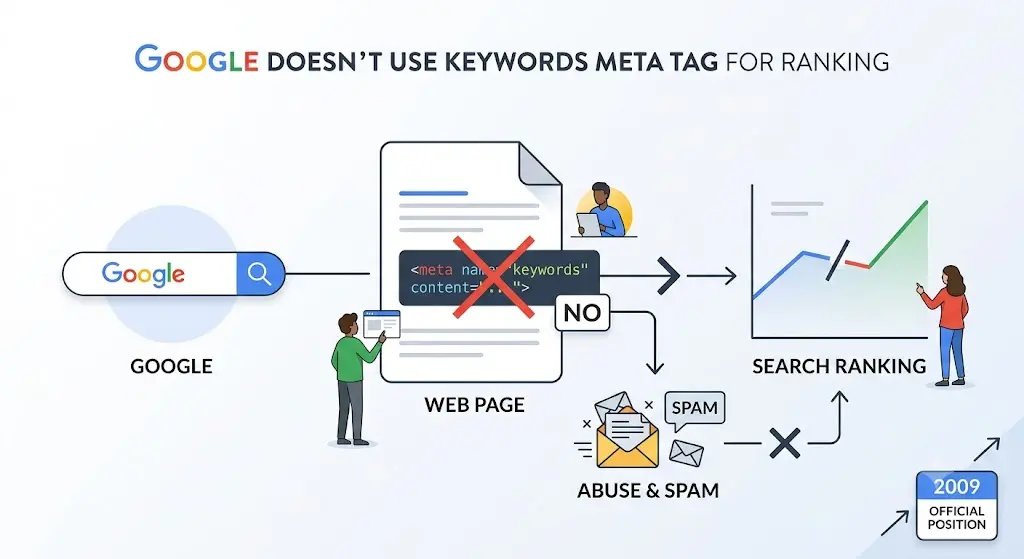
    Google settled this question years before Bing did. Google made it clear in a post on the Google Search Central blog back in 2009. Google said it does not use the keywords meta tag in web ranking all. Google gave a reason for this: there was a lot of spam and abuse. This was one of the clearest statements from a major search engine, like Google. 

    Google vs Bing Comparison

    AspectGoogleBing
    Uses tag for rankingNo (since 2009)No (since at least 2014, reaffirmed 2020)
    Reads the tag at allNo stated use, even for spamMay scan it as a spam signal
    Public confirmationOfficial blog postPublic statements from Bing team members

    Both engines land in the same place, just by slightly different roads. Google closed the door outright. Bing left it cracked open for spam-flagging purposes only.

    Meta Keywords vs Other Meta Tags

    It helps to see meta keywords next to the tags that actually matter, so you know where to spend your time instead.

    1. Title Tag

    The title tag is the thing that you see as a blue link when you look at search results. This is an important thing that Google and Bing look at when they decide what is relevant. You should make sure you get the title tag right before you think about anything, on this list. The title tag is really important so take your time to get it right. 

    2. Meta Description

    This is the short summary under your title in search results. It doesn’t directly influence rankings, but it strongly affects click-through rate, which indirectly matters for performance. 

    3. Meta Robots

    This tag is important for search engines. It helps them decide if they should look at a page and if they should look at the links on that page. This tag is used for things it does not tell search engines if a page is a good page or not.. If you use this tag incorrectly you might accidentally stop search engines from looking at pages that you want them to look at and you want those pages to show up in search results when people search for something. 

    4. Canonical Tag

    Canonical tags are important for search engines because they help figure out which version of a page is the one. This is really important for shopping sites that have lots of pages with similar products. For example when you have category pages that can be filtered in ways you need to tell search engines which one is the main page. Canonical tags do that job, for ecommerce sites. They say which page is the deal, the master copy, when there are lots of pages that are pretty much the same. 

    5. Open Graph Tags

    When you share a page on Facebook or LinkedIn Open Graph tags decide how your page will look. These tags do not change how you show up in search results. However Open Graph tags are important because they control how your content appears when someone shares a link. For example Open Graph tags will determine what picture and words people see when you share a link in a post or a group discussion on Facebook or LinkedIn. Open Graph tags are really about making your content look good when people share it on platforms, like Facebook or LinkedIn. 

    6. Structured Data

    Structured data (schema markup) helps search engines understand entities, relationships, and page types more precisely. It’s one of the more impactful technical additions you can make today, especially with how much AI-driven search now depends on entity understanding.

    What Ranking Signals Matter More to Bing?

    nfographic comparing Bing and Google ranking factors, emphasizing ignored meta keywords and key SEO signals.

    1. High-Quality Content

    Bing has said over and over that the quality of the content and how deep it is are more important than any tag. If you have pages that’re thin and generic they will not do well no matter how you write the metadata. Bing has made it clear that content quality is what really matters and meta tags are not as important as people think. Bing says that if your pages are not good it does not matter what you put in the tags because thin and generic pages just do not perform well. 

    2. Search Intent

    Bing’s algorithm tries to match a page to what the searcher actually wants to accomplish, not just the words they typed. A page written for the wrong intent won’t rank well even with perfect keyword placement.

    3. Authority

    Bing still thinks that backlinks and brand mentions are very important when it comes to ranking a website. The overall reputation of a site is also a deal for Bing. This is pretty similar to how Google does things. Backlinks and brand mentions matter, to Google too. 

    4. Content Freshness

    Bing looks at how a page was updated. This is especially true for topics where the information is changing all the time. The search engine Bing gives some importance to this because it wants to show people the recent information on the internet. This is really important for things like news and current events where things are happening every day. Bing wants to make sure that people see the information on these topics so it checks when a page was last updated. 

    5. Internal Linking

    A clear internal linking structure helps Bing’s crawler understand which pages on your site matter most and how they relate to each other.

    6. User Engagement

    So when you search for something on Bing they look at things like how people click on a result and how long they stay on that page. This helps Bing figure out if the result was what the person was looking for. They use things like click-through rate and time on page to decide if a result is good or not. Bing wants to know if a result satisfied the person who did the search. Signals like click-through rate and time on page are important to Bing. 

    7. Page Experience

    Bing looks at usability factors: is the page easy to navigate, free of intrusive pop-ups, and reasonably fast to load.

    8. Mobile Optimization

    With most searches happening on mobile devices, a site that isn’t mobile-friendly is at a real disadvantage in Bing’s results.

    9. Technical SEO

    Clean, crawlable code, proper use of headings, and a logical site structure all support how well Bing can process and rank your pages.

    How Bing’s Ranking Algorithm Differs from Google

    1. Similarities

    Both engines prioritize content quality, backlinks, mobile-friendliness, and page experience. If you’re already optimizing well for Google, you’re covering most of what Bing wants too.

    2. Differences

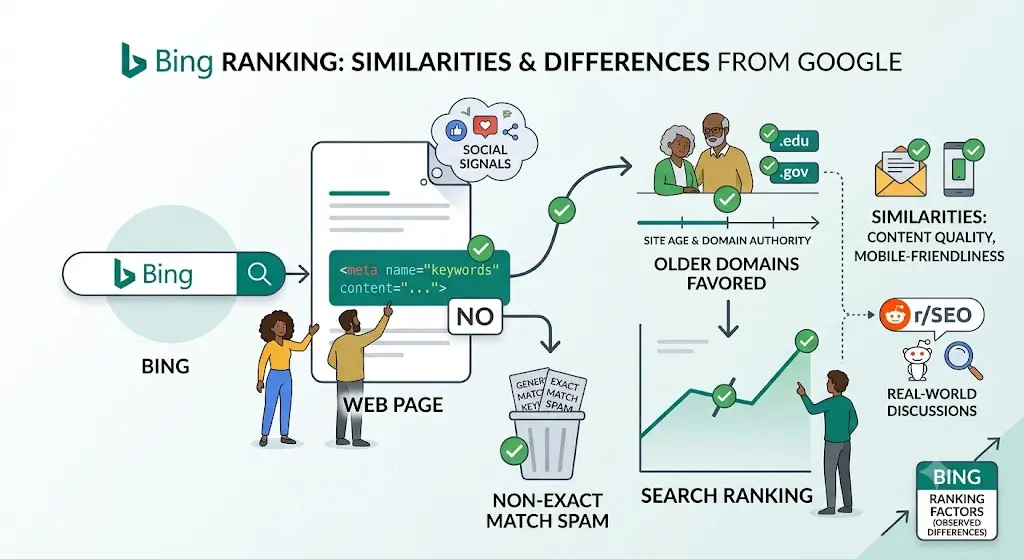
    Bing has historically weighted certain factors a bit differently: social signals and site age have shown more visible correlation with Bing rankings in various SEO community discussions, though Bing has never confirmed exact weighting publicly. Bing also tends to favor exact keyword matches in titles and content a bit more literally than Google, which relies more heavily on semantic and contextual matching.

    3. When Bing May Rank Pages Differently

    You’ll sometimes see older, well-established domains rank higher on Bing than on Google for the same query, and Bing has traditionally shown a slight lean toward .edu and .gov domains for authority signals. Discussions on communities like r/SEO on Reddit regularly surface real-world examples of this divergence from webmasters comparing their own ranking data across engines.

    How AI Search and Microsoft Copilot Impact Bing SEO

    1. AI-Powered Search Results

    Bing was among the first major search engines to fold generative AI answers directly into its results, through its Copilot integration. This shifts some of the optimization focus from ranking in a list of ten blue links to being cited as a source inside an AI-generated summary.

    2. Semantic Search

    Bing’s systems increasingly parse content by meaning and context rather than exact keyword matches. Writing naturally, with clear explanations and logically organized headings, tends to serve you better than trying to hit a keyword density target.

    3. Entity-Based Ranking

    Bing, powered in part by Microsoft’s knowledge graph, tries to understand real-world entities (people, places, brands, concepts) and how they connect. Structured data and clear, factual content help Bing map your page to the right entities.

    How to Optimize Your Website for Bing

    1. Use Bing Webmaster Tools

    Bing Webmaster Tools is free and gives you crawl data, indexing status, and keyword performance reports specific to Bing, separate from what you’d see in Google Search Console.

    2. Submit XML Sitemap

    Submitting a sitemap through Bing Webmaster Tools helps Bing discover and crawl your pages more efficiently, especially on larger sites.

    3. Enable IndexNow

    IndexNow is a protocol co-developed by Microsoft and Yandex that lets you instantly notify search engines when a page is added, updated, or removed, rather than waiting for the next crawl cycle.

    4. Implement Schema Markup

    Adding structured data helps Bing understand your content’s context, which matters even more now with AI Overview-style results pulling from structured, well-organized sources.

    5. Optimize Technical SEO

    Fast load times, clean HTML, proper canonical tags, and mobile responsiveness all support how well Bing can crawl and evaluate your site.

    6. Create Helpful Content

    This sounds obvious, but it’s the single biggest lever you have. Bing, like Google, has increasingly aligned its guidelines around rewarding content that genuinely helps the reader rather than content built primarily to rank.

    Should You Keep the Meta Keywords Tag?

    1. Older Websites

    If your CMS auto-generates the tag and it’s not causing any harm (meaning the keywords listed actually match your content), there’s no urgent need to strip it out. It’s simply inert.

    2. New Websites

    For new builds, skip it. There’s no upside, and it’s one less thing to maintain or accidentally misuse.

    3. Enterprise CMS Considerations

    Larger organizations sometimes have legacy workflows where marketing teams still fill in meta keywords fields out of habit. If that’s the case, it’s worth a quick internal conversation to redirect that time toward title tags, meta descriptions, and structured data instead, where the effort actually pays off.

    Common Myths About Meta Keywords

    Myth vs Fact Table

    MythFact
    Meta keywords help you rank on BingBing has confirmed the tag carries no ranking value
    Adding more keywords increases relevanceExcessive or irrelevant keywords can look like spam
    Removing the tag will hurt existing rankingsThe tag has no ranking influence, so removing it changes nothing
    Bing and Google handle the tag differently in a meaningful wayBoth ignore it for ranking; Bing may glance at it only for spam detection
    Yahoo still uses it heavilyYahoo publicly stated years ago that the tag carries no ranking weight either

    Real-World Example: Auditing an Old Website with Meta Keywords

    Before

    A client came to me with a site built in 2009 that had never been touched since a redesign in 2015. Every page had a meta keywords tag stuffed with 40 to 50 terms, several of which were competitor brand names and completely unrelated phrases left over from an old marketing push.

    After

    We stripped the tag from the templates entirely, redirected that effort into rewriting title tags and meta descriptions, and added schema markup for their product pages. Rankings didn’t move because of the meta keywords removal specifically, but cleaning up the technical debt made the rest of the optimization work easier to execute and track.

    Lessons Learned

    The meta keywords tag itself wasn’t hurting or helping. The real value came from using the audit as an excuse to fix the tags that actually matter. If you’re already in your CMS template files, that’s the moment to prioritize title tags, descriptions, and structured data.

    Modern Bing SEO Checklist

    • Set up and verify your site in Bing Webmaster Tools
    • Submit an XML sitemap
    • Enable IndexNow for faster indexing
    • Write unique, descriptive title tags for every page
    • Craft compelling meta descriptions to improve click-through rate
    • Add structured data (schema markup) where relevant
    • Ensure mobile responsiveness and fast load times
    • Build a logical internal linking structure
    • Focus on content that directly answers search intent
    • Skip the meta keywords tag, or leave it out of new templates entirely

    Frequently Asked Questions

    1. Does Bing ignore meta keywords?

    Yes. Bing has publicly confirmed it excludes and ignores the meta keywords tag as a ranking factor, though it may still read the tag as a potential spam signal.

    2. Should I remove the tag?

    You can, but it’s not urgent. It has no ranking effect either way, as long as the keywords listed genuinely reflect your page content.

    3. Can keyword stuffing hurt rankings?

    Yes, generally. Whether it’s in meta keywords, body content, or alt text, stuffing irrelevant or excessive terms can trigger spam signals across most modern search engines.

    4. Does Yahoo still use meta keywords?

    No. Yahoo has publicly stated the tag carries no ranking weight for its search results, aligning with both Google and Bing’s positions.

    5. Which meta tags actually matter?

    Title tags, meta descriptions, canonical tags, meta robots, and structured data all carry real functional or performance value. Meta keywords do not.

    6. What is IndexNow?

    IndexNow is a protocol that lets website owners instantly notify participating search engines, including Bing, when content changes, instead of waiting for the next scheduled crawl.

    Conclusion

    Does Bing use keywords? No, it does not use them for ranking. This has been the case for years. The team at Microsoft has said this time and they were very clear about it in 2020.

    The meta keywords tag might still be looked at in some cases to check for spam.. Trying to use it to improve your search engine ranking is a waste of time. You should focus on things like title tags and structured data. Creating content is also very important.

    If you are looking at a website you do not have to worry about the meta keywords tag. You can leave it there. You can remove it. Either way it will not affect your ranking on Bing.

    You should put your time into things that Bing says are important. This includes making sure your content is good and your website is working properly. That it has what people are searching for. Bing wants websites that are built around what people need when they search for something.

  • MagicLight AI Review: Features, Pricing, Pros, Cons & How It Compares

    MagicLight AI Review: Features, Pricing, Pros, Cons & How It Compares

    If you’ve spent any time scrolling YouTube Shorts or TikTok lately, you’ve probably seen a wave of AI-animated kids’ stories, faith videos, and explainer clips. A good chunk of them were built with MagicLight AI, a text-to-video platform that promises something most AI video tools can’t: long, coherent videos with characters that actually look the same from scene to scene.

    I spent time digging through MagicLight AI’s own documentation, its app store listings, independent reviews, and real user feedback on Trustpilot and Reddit to put together this honest, no-fluff breakdown. Whether you’re a YouTuber, a teacher, or a marketer trying to decide if this tool is worth your credits (literally), this guide covers everything: how it works, what it costs, where it shines, and where it falls short.

    What Is MagicLight AI?

    MagicLight AI is an AI-powered video generation platform built specifically for long-form, story-driven content. Instead of spitting out a random four-second clip like many text-to-video tools, <cite index=”1-1″>it turns ideas, scripts, or stories into finished videos up to 50 minutes long</cite>. That’s a big deal, because most competing tools cap out at a few seconds per generation.

    The platform bundles several tools into one workflow: script generation, character design, scene creation, voiceovers, music, and export, all under one roof. <cite index=”1-1″>Rather than producing choppy motion or disconnected clips, it aims for smooth, multi-scene animations where characters move naturally and visuals stay consistent throughout the story</cite>.

    Who Created MagicLight AI?

    MagicLight AI is developed and operated by MAGICLIGHT(HK)LIMITED, a company based in Hong Kong, according to its listing on the Apple App Store. Like most fast-moving AI startups, it doesn’t publish a detailed corporate history, and there’s no dedicated Wikipedia page for the company at the time of writing worth keeping in mind if you’re trying to verify its long-term track record. Its public footprint is mostly through its website, app store listings, and social media.

    Who Should Use It?

    Based on how the product is positioned and what actual users report, MagicLight AI tends to work best for:

    • Faceless YouTube channel operators who need a steady stream of narrated story content
    • Independent authors and storytellers turning written work into visual form
    • Educators who want to animate lessons without hiring an animation studio
    • Small marketing teams producing explainer or promo videos on a budget

    If you’re a professional animator or a studio with strict quality control needs, it’s worth tempering expectations more on that in the pros and cons section.

    How MagicLight AI Works

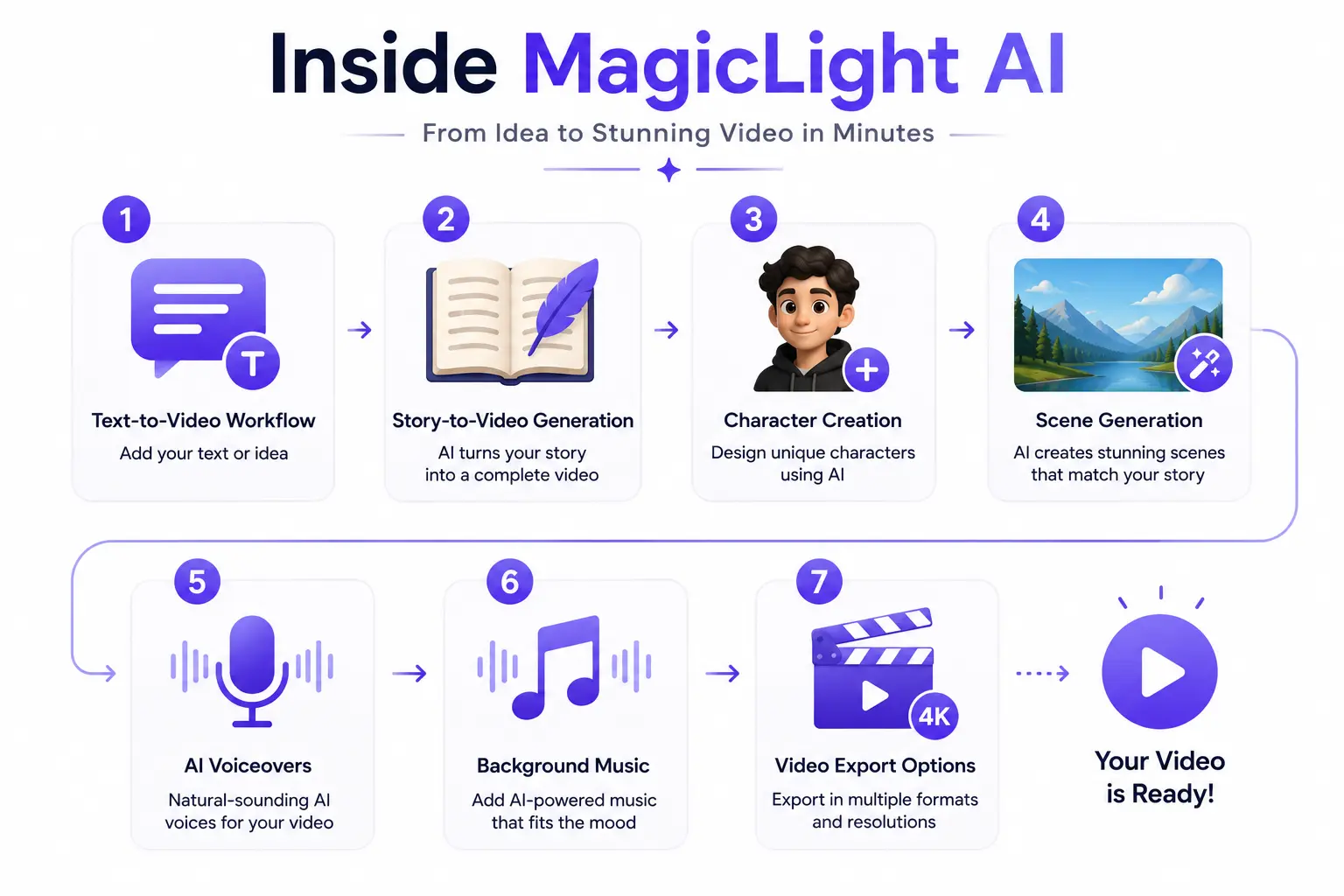
    MagicLight AI workflow infographic showing text-to-video creation, AI scenes, voiceovers, and export.
    Text-to-Video Workflow

    At its core, MagicLight AI follows a simple pipeline: you type a prompt, idea, or topic, the AI expands it into a structured narrative, and then it renders that narrative as a sequence of animated scenes. You don’t need any editing background — <cite index=”7-1″>if you can write a sentence, the platform is designed to handle the heavy lifting from there</cite>.

    Story-to-Video Generation

    This is where MagicLight tries to differentiate itself from typical clip generators. <cite index=”6-1″>You can feed it raw text, complex outlines, or multi-chapter material, and it will attempt to render full-motion, high-definition scenes automatically</cite>. Think of it less like a video generator and more like an automated storyboard-to-screen pipeline.

    Character Creation

    You can design a cast from scratch or upload reference photos to build a “character profile.” <cite index=”4-1″>The platform then tries to align voiceovers with lip movement and expressions</cite>, and lets you adjust details like hair, outfits, and accessories.

    Scene Generation

    Once your characters exist, MagicLight builds scenes around them using your prompt or script. <cite index=”1-1″>It automatically adjusts lighting, perspective, and style to try to create smoother, more cinematic transitions between segments</cite>.

    AI Voiceovers

    <cite index=”10-1″>The platform offers dozens of voice options, plus voice cloning, and supports around 11 languages</cite> so creators can localize content for international audiences without re-recording anything.

    Background Music

    You can pair generated visuals with mood-matched background tracks. <cite index=”1-1″>One of the tools even lets you turn a music track into a visual video that matches its mood and rhythm</cite>, which is handy for lyric videos or music-driven content.

    Video Export Options

    Export quality and length depend on your plan. Free users are typically limited to short clips, while <cite index=”4-1″>paid subscribers can generate long-form videos up to 30 or 50 minutes depending on the tier</cite>, with HD resolution and no watermark.

    Key Features of MagicLight AI

    This is the headline feature. <cite index=”5-1″>Most AI video tools max out around 60 seconds, but MagicLight is built specifically for creators who need more room to tell a complete story</cite>, stitching together many shorter generated clips into one continuous narrative.

    Consistent Characters

    <cite index=”1-1″>MagicLight’s AI is designed to understand character continuity across scenes, aiming to keep a protagonist’s look and personality consistent throughout an entire video</cite>. This is the single most-marketed feature and also, based on user reviews, the one that generates the most mixed results in practice (more on that in the “Common Problems” section).

    AI Storyboarding

    Before rendering, the platform can lay out a structured storyboard from your idea, so you can see the narrative arc before committing credits to full rendering.

    Multiple Visual Styles

    <cite index=”3-1″>Creators can choose from 20-plus visual styles inspired by popular aesthetics associated with tools like PixVerse, Sora, Luma, Viggle, and Hailuo</cite>, while MagicLight positions its own output as original rather than a direct clone of any one of them.

    AI Script Assistance

    You don’t need a finished script. <cite index=”5-1″>The AI can flesh out a story’s skeleton, aiming to keep the narrative paced appropriately for long-form video</cite>, even if you only start with a single sentence.

    Image-to-Video

    <cite index=”3-1″>You can generate visuals and animate them through image-to-video and photo-to-animation workflows</cite>, useful if you already have artwork or reference stills you want to bring to life.

    Voice Cloning

    Beyond stock voices, MagicLight lets creators clone a voice for use across a project, which is useful for maintaining a consistent narrator identity across a whole series.

    Multilingual Support

    With support for roughly a dozen languages, the platform is aimed at creators who want to publish the same story across multiple regional audiences without redoing the whole production.

    Collaboration Features

    Team-oriented plans reportedly include shared workspaces and account management, though these features are less documented publicly than the core generation tools treat this as an area to confirm directly with MagicLight before committing a team to it.

    How to Create Your First Video with MagicLight AI

    MagicLight AI infographic showing six steps from signup to video export.
    Step 1: Sign Up

    Head to the official site and create a free account. <cite index=”5-1″>No credit card is required to get started</cite>.

    Step 2: Choose a Template

    <cite index=”10-1″>Pick from story templates like kids’ stories, music, religious, or commentary formats</cite> to give your project a working structure instead of starting from a blank page.

    Step 3: Enter Your Prompt

    Type your idea, topic, or full script. <cite index=”10-1″>Specify the tone, audience, and core message you want the video to carry</cite> the more specific you are here, the fewer surprises you’ll get later.

    Step 4: Customize Characters

    <cite index=”10-1″>Adjust each character’s age, gender, accent, and voiceover tone so every character feels distinct</cite>, then lock in their appearance for the rest of the project.

    Step 5: Generate the Video

    Reviewing the AI-generated prompt or storyboard before committing MagicLight typically shows you what it plans to render first. Once approved, rendering begins, generally taking a few minutes per scene.

    Step 6: Edit and Export

    <cite index=”10-1″>Replay the finished video to check for awkward details, then download it or publish it directly to social platforms</cite>.

    Best Prompting Tips for Better AI Videos

    Writing Effective Prompts

    Be specific about setting, mood, and action in every scene description. Vague prompts like “a boy walks in a forest” leave too much room for the AI to improvise instead, describe lighting, camera angle, and emotional tone.

    Maintaining Character Consistency

    Lock character details early (hairstyle, outfit, color palette) and reuse the exact same character profile across every scene rather than re-describing them each time. This reduces the drift that many users report.

    Creating Better Story Flow

    Break long stories into clearly labeled scenes with a beginning, middle, and end for each chapter, rather than dumping one giant paragraph into the prompt box. Structured input tends to produce a more structured output.

    Improving Visual Quality

    Stick to one visual style per project instead of switching styles mid-story, and use the storyboard preview step to catch off-model scenes before you spend credits rendering them in full.

    MagicLight AI Pricing

    Pricing information for MagicLight AI varies noticeably between sources, which is worth flagging upfront to always confirm current numbers on the official pricing page before subscribing, since AI tool pricing changes frequently.

    Free Plan

    <cite index=”9-1″>New users typically receive around 300 free credits upon signup</cite>, enough to test the core workflow and generate a short sample video with no credit card required.

    Paid Plans

    Reported entry-level pricing generally starts <cite index=”11-1″>around $8 to $12 per month for a Standard tier</cite>, scaling up through Plus and Pro tiers that <cite index=”18-1″>can run $26–$35 per month and unlock tens of thousands of monthly credits along with access to premium underlying models</cite>. Annual billing across most tiers tends to offer a meaningful discount over paying monthly.

    Credit System Explained

    MagicLight runs on a credit-based system rather than a flat per-video price. <cite index=”16-1″>Credits are consumed based on video length, complexity, and resolution</cite>, and <cite index=”16-1″>unused credits typically cannot be refunded once consumed, since server and computation costs are incurred immediately during processing</cite>. This matters a lot in practice; several reviewers note that regenerating a failed or off-model scene still costs credits, so mistakes get expensive fast.

    Is It Worth the Cost?

    For casual creators testing the waters, the free tier is a reasonable way to kick the tires. For serious, high-volume production, the math gets trickier: if a chunk of your generations need re-rendering due to consistency issues (a common complaint, discussed below), your effective cost per finished minute climbs quickly. Budget for some trial and error before you commit to an annual plan.

    Pros and Cons

    Advantages

    • Genuinely built for long-form video, not just short clips
    • All-in-one workflow: script, characters, voice, and music in one place
    • Free tier lets you test before paying
    • Large template library for niches like kids’ content, faith-based videos, and explainers
    • Multilingual voice support for global audiences

    Limitations

    • Character consistency is inconsistent in practice, despite being the headline feature <cite index=”9-1″>multiple users report the “default character looks different in every scene” and changes clothing unexpectedly</cite>
    • <cite index=”19-1″>Customer support responsiveness has drawn repeated complaints</cite>
    • Credits can be consumed quickly, especially on failed or unsatisfactory generations
    • <cite index=”3-1″>Some users report slow generation times, with renders stuck on a loading state for extended periods</cite>
    • Output quality can vary significantly depending on prompt complexity and chosen style

    Real Use Cases

    1. YouTube Automation

    Faceless channels use MagicLight to batch-produce narrated story content, historical retellings, mystery narrations, or fictional shorts without hiring a full production team.

    2. Children’s Stories

    <cite index=”6-1″>The platform includes dedicated Kids Story templates</cite>, aimed at parents, educators, and children’s content channels that want gentle, age-appropriate animation.

    3. Educational Videos

    <cite index=”8-1″>Static training manuals or classroom material can be transformed into animated lessons with characters that walk students through complex topics</cite>.

    4. Marketing Videos

    <cite index=”8-1″>Small teams use the all-in-one suite to convert text or images into branded spokesperson videos and explainer ads</cite> without hiring outside animators.

    5. Social Media Content

    Short, styled clips exported from longer projects work well for TikTok, Reels, and YouTube Shorts, particularly with the platform’s built-in caption and subtitle tools.

    6. Business Presentations

    Some teams use AI avatars and voice narration to turn static slide decks or scripts into more engaging internal or external presentation videos.

    MagicLight AI Output Quality Review

    Visual Quality

    Output quality is genuinely style-dependent. Stylized, cartoon-like visuals tend to hold up better than attempts at photorealism, where inconsistencies are more noticeable.

    Voice Quality

    Voice narration and lip-sync are generally serviceable for narrated story content, though results can feel mechanical on longer or emotionally complex dialogue.

    Animation Smoothness

    MagicLight tends to perform best in short, contained scenes. Ambitious, multi-character action sequences are where most quality complaints originate.

    Rendering Speed

    <cite index=”7-1″>According to MagicLight’s own figures, a 5-minute video typically takes about 3 to 6 minutes to render, while a 30-minute video takes roughly 10 to 15 minutes</cite>. Independent user reports suggest actual times can run longer during peak demand.

    Editing Flexibility

    The built-in editor allows scene-level tweaks camera moves, lighting, pacing but it isn’t a substitute for a full non-linear editor like Premiere or DaVinci Resolve if you need frame-precise control.

    MagicLight AI vs Other AI Video Generators

    MagicLight AI vs Runway

    Runway is geared more toward short, high-fidelity cinematic clips and professional VFX-style work, while MagicLight focuses on stitching together long narrative sequences. If you need one polished 10-second shot, Runway is the stronger pick; if you need a 20-minute story, MagicLight’s workflow is purpose-built for that.

    MagicLight AI vs Pika

    Pika leans into short, stylized clips and quick creative experimentation. MagicLight’s structured template and character-lock system make it more suited to repeatable, series-style content.

    MagicLight AI vs Google Veo

    Veo generally produces higher raw visual fidelity per clip, but it isn’t designed as an end-to-end story platform. MagicLight <cite index=”6-1″>integrates models like Veo alongside its own engine</cite> rather than competing purely on frame quality.

    MagicLight AI vs OpenAI Sora

    Sora is strong for cinematic realism in short bursts. MagicLight’s advantage is duration and the built-in story-structuring layer that Sora doesn’t provide out of the box.

    MagicLight AI vs InVideo AI

    InVideo leans more toward templated marketing and social videos built from stock and AI footage, while MagicLight is more animation- and character-driven. If your priority is fast-turnaround marketing content, InVideo may fit better; for narrative storytelling, MagicLight is the closer match.

    MagicLight AI vs Kling AI

    <cite index=”10-1″>MagicLight integrates several third-party models, including Kling, into its workflow</cite> rather than positioning itself purely as a competitor on raw model quality. Kling alone can produce impressive standalone clips, but lacks MagicLight’s story-assembly and character-locking layer.

    Common Problems and Solutions

    Poor Character Consistency

    Problem: Characters shift appearance or outfits between scenes. Solution: Lock character profiles early, avoid changing prompts mid-project, and use the storyboard preview to catch drift before full rendering.

    Slow Rendering

    Problem: <cite index=”9-1″>Generations can get stuck on a loading state for extended periods, especially during high demand</cite>. Solution: Render during off-peak hours where possible, and keep individual scene lengths shorter to reduce per-render load.

    Credit Consumption

    Problem: <cite index=”18-1″>Regenerating a failed scene still costs credits, and high-quality models burn through them quickly</cite>. Solution: Use the storyboard/preview step before committing to full renders, and start with lower-resolution test runs before scaling up.

    Prompt Errors

    Problem: Overly broad or contradictory prompts produce muddled scenes. Solution: Break prompts into scene-by-scene instructions rather than one long paragraph.

    Export Issues

    Problem: <cite index=”4-1″>Some users report losing access to in-progress projects</cite> or hitting export limits tied to their plan. Solution: Export and back up finished scenes as you go rather than waiting until the entire project is complete.

    Privacy, Licensing & Commercial Use

    1. Copyright Ownership

    <cite index=”5-1″>According to MagicLight’s own FAQ, paid plans include full commercial usage rights, meaning creators generally own the content they generate and can monetize it</cite>. That said, ownership of AI-generated content is a genuinely unsettled legal area worldwide, so it’s worth reading MagicLight’s current terms of service directly and, for high-stakes commercial projects, consulting a lawyer rather than relying solely on a platform’s marketing claims.

    2. Commercial Licensing

    <cite index=”16-1″>Commercial usage rights are bundled with paid plans and generally cover content for various commercial contexts</cite>, though specifics can vary by plan tier — always check the exact terms tied to your subscription.

    3. Data Privacy

    <cite index=”4-1″>Apple’s App Store listing notes that MagicLight may collect data linked to a user’s identity as well as data used for tracking across other apps and websites</cite>. If data privacy is a major concern, review the platform’s privacy policy in detail before uploading personal photos for character creation.

    Content Policies

    4. Like most AI generation platforms, MagicLight enforces content restrictions around explicit, violent, or infringing material expect uploads and prompts to be filtered accordingly.

    Expert Tips for Getting Better Results

    1. Prompt Engineering

    Treat your prompt like a mini shot list: subject, action, setting, lighting, and camera framing, in that order, for each scene rather than one sprawling paragraph.

    2. Planning

    Outline your full story arc before touching the prompt box. Knowing your beginning, middle, and end in advance prevents wasted credits on scenes that don’t fit the final cut.

    3. Storyboard Optimization

    Always review the AI’s proposed storyboard or prompt breakdown before full rendering; it’s the cheapest checkpoint to catch a misinterpreted idea.

    4. Post-Editing Workflow

    Use MagicLight for the heavy lifting (script, characters, base animation), then bring the export into a dedicated editor if you need tighter pacing, sound mixing, or color correction.

    Frequently Asked Questions

    1. Is MagicLight AI free to use? 

    <cite index=”5-1″>Yes, you can create a sample video for free with no credit card required</cite>, though free accounts come with limited credits and shorter export lengths.

    2. How long can MagicLight AI videos be?

    <cite index=”5-1″>Depending on your plan, you can generate videos up to roughly 50 minutes long</cite>.

    3. Does MagicLight AI keep characters consistent? 

    It’s designed to, using character-locking technology, but real-world results are mixed; some users report strong consistency, while others report noticeable drift, particularly in complex scenes.

    4. Can I use MagicLight AI videos commercially? 

    <cite index=”5-1″>Paid plans generally include full commercial usage rights</cite>, but confirm the exact terms for your specific plan before monetizing content.

    5. What models power MagicLight AI?

     <cite index=”10-1″>The platform integrates a mix of proprietary and third-party models</cite>, rather than relying on a single engine for every generation type.

    6. Is customer support reliable? 

    \Based on independent reviews on Trustpilot, support responsiveness is a recurring pain point factor in some self-troubleshooting time if you hit an issue.

    Conclusion

    MagicLight AI solves a real problem: most AI video tools cap out at a few seconds, and MagicLight is one of the few genuinely built around long-form, narrative-driven output. If you’re a solo creator or small team that needs a steady pipeline of story content without hiring an animation studio, it’s worth testing on the free tier.

    That said, go in with realistic expectations. The character consistency feature of the platform’s biggest selling point doesn’t always hold up under real-world testing, and credit consumption on failed generations can eat into your budget fast. My honest take: start free, test with a short project in your actual niche, and only commit to a paid plan once you’ve confirmed the output quality matches what you need. For long-form AI storytelling specifically, MagicLight AI remains one of the more purpose-built options on the market just budget for some trial and error along the way.

  • Pixel Tracking and SERP Visibility: The Complete Guide to Measuring True Search Performance

    Pixel Tracking and SERP Visibility: The Complete Guide to Measuring True Search Performance

    Rankings tell you where a page sits in a list. They don’t tell you if anyone can actually see it. A page ranked third might sit below three ads, a shopping carousel, and an AI Overview, pushed so far down the screen that almost nobody scrolls that far. That gap between “ranked well” and “seen at all” is what pixel tracking is built to close.

    This guide covers what pixel tracking is, how it differs from traditional rank tracking, and how to pair it with SERP visibility metrics to get an honest read on search performance in 2026.

    What Is Pixel Tracking?

    Pixel tracking infographic comparing search rankings with on-screen pixel position.
    Pixel tracking measures where a search result physically lands on the screen, counted in pixels from the top of the page, instead of just counting its position number in a list. A result at position one could sit 400 pixels down if it’s buried under ads and an AI Overview, or 90 pixels down if the page above it is clean.

    How Pixel Tracking Works

    Tools that support pixel tracking load a real search results page, render it the way a browser would, and measure the vertical distance from the top of the page to your listing. Some tools measure the full page height; others cap the measurement at what’s visible without scrolling, since that’s the part people actually see first.

    The output usually looks like a distance, not a rank: “your page sits at 1,240 pixels” rather than “your page ranks fourth.” Lower numbers are better, since they mean less scrolling before your result shows up.

    Why Pixels Matter More Than Rankings

    Two pages can share the same rank and still get very different amounts of attention. If a featured snippet, three ads, and a video carousel sit above position one, that top spot might take several scrolls to reach. Pixel depth captures that; rank position alone doesn’t.

    What Is SERP Visibility?

    SERP visibility infographic showing rankings, search features, and overall search presence.
    SERP visibility describes how much space and attention a page or domain commands across search results. It combines ranking position, the SERP features a domain has won, and how consistently that domain shows up for its target keywords.

    Visibility Score Explained

    A visibility score rolls several signals into one number, usually a percentage or index, so teams can compare performance over time or against competitors without checking every keyword by hand. Most tools calculate it from the count of tracked keywords a domain ranks for, the average position across those keywords, and an estimated click-through rate at each position, weighted by search volume.

    How Google Measures Search Visibility

    Google doesn’t publish an official visibility score of its own. Search Console gets closest with impressions, average position, and click-through rate, but those figures are query-level and don’t account for pixel depth or SERP features the way third-party visibility scores do. The visibility metrics most SEO teams rely on come from tools like Semrush, Ahrefs, or AccuRanker, not from Google directly.

    Pixel Tracking vs Traditional Rank Tracking

    Key Differences

    FactorTraditional Rank TrackingPixel Tracking
    What it measuresPosition number (1, 2, 3…)Vertical distance from top of page
    Accounts for SERP featuresNoYes
    Reflects real visibilityOnly looselyDirectly
    Device sensitivitySame number across devicesChanges by device and screen size
    Best used forLong-term rank trendsCTR forecasting, above-the-fold reporting

    Advantages

    • Shows real above-the-fold visibility, not just a rank number
    • Accounts for ads, AI Overviews, and other SERP features that push results down
    • Gives more accurate click-through rate predictions
    • Separates two pages that share a rank but not screen space

    Limitations

    • Needs more processing power than a standard rank check
    • Pixel depth shifts with screen size, so desktop and mobile need separate tracking
    • Personalized and localized results mean pixel depth can vary between users
    • Fewer tools support it compared to standard rank tracking

    Which Metric Should You Prioritize?

    Use rank position for long-term trend reporting, since it’s simple and consistent. Use pixel depth when you need to explain why traffic didn’t move even though rankings did, or when you’re forecasting click-through rate for a client or stakeholder. Most agencies end up tracking both side by side rather than picking one.

    How Modern SERPs Changed SEO

    Modern SERP infographic showing AI Overviews, snippets, local, shopping, video, and image results.
    Search results pages used to be ten blue links. Now the page can be dominated by features that push organic listings down before a user scrolls at all. Here’s what’s competing for that space.

    AI Overviews

    AI-generated summaries can occupy several hundred pixels at the top of the page, often before any organic result appears. A page can rank first and still sit below the fold.

    Featured Snippets

    A snippet box sits above position one and answers the query directly, which can reduce clicks to the organic results below it, including the page the snippet was pulled from.

    People Also Ask

    These expandable question boxes can appear multiple times on one page, adding pixel height each time and shifting organic listings further down as users interact with them.

    Local Pack

    For queries with local intent, a map and three business listings often take the top slot, ahead of any organic result, including the target website itself.

    Shopping Results

    Product carousels with images and prices are common for commercial queries and take up more vertical space than a standard text listing.

    Video Carousel

    Video thumbnails, often from platforms outside your control, can claim a full row of screen space and pull attention away from text-based results.

    Image Packs

    A row of images can appear mid-page for visually driven queries, adding height and breaking up the flow of organic listings.

    Knowledge Panels

    For branded and entity queries, a knowledge panel can occupy a large block on the right side of desktop results, or stack above organic results on mobile.

    How Pixel Tracking Works in Real Life

    Desktop Example

    On a standard 1920×1080 desktop screen, the visible area without scrolling is roughly 950 pixels tall after the browser chrome is accounted for. A result sitting at 700 pixels is visible without scrolling. One sitting at 1,400 pixels requires a scroll and a half.

    Mobile Example

    Mobile screens are narrower and taller relative to their viewport, but SERP features like AI Overviews and People Also Ask boxes take up a larger share of that smaller screen. A result that’s visible on desktop without scrolling may require two or three scrolls on mobile.

    Above-the-Fold Visibility

    “Above the fold” refers to anything visible without scrolling. Pixel tracking tools typically flag whether a result falls above or below this line for a given device, which is a more useful signal than rank position alone for predicting whether a user will actually see it.

    Viewport Calculations

    Viewport height varies by device, browser, and whether the address bar is expanded or collapsed. Good pixel tracking tools test against a set of common viewport sizes rather than a single fixed number, since real users don’t share one screen size.

    Why Pixel Tracking Improves SEO Decisions

    Better CTR Predictions

    Click-through rate correlates more closely with pixel depth than with rank position, since a result buried under SERP features gets fewer eyes on it regardless of its rank. Forecasting traffic from pixel depth tends to be more accurate than forecasting from rank alone.

    More Accurate Visibility Reporting

    Reporting rank position without context can overstate performance. A page ranked first that sits below three SERP features tells a different story than a page ranked first on a clean SERP, and pixel data shows the difference.

    Competitor Monitoring

    Pixel tracking shows which competitors are winning SERP features, not just which ones outrank you. That distinction matters when deciding whether to chase a featured snippet, a local pack listing, or a standard ranking improvement.

    Agency Reporting

    Clients often ask why traffic didn’t grow despite a rank improvement. Pixel depth gives agencies a concrete answer, since it’s common for a page to move up in rank while a new SERP feature keeps it just as buried.

    Enterprise SEO Benefits

    Large sites with thousands of tracked keywords use pixel data to prioritize which pages to optimize first, focusing on ones sitting just below the fold where a small improvement could push them into view.

    Pixel Tracking and AI Search

    AI Overviews

    AI Overviews sit above traditional organic results and can push even a first-ranked page down by several hundred pixels. Tracking pixel depth is one of the few ways to quantify how much visibility a page lost to an AI Overview appearing on its query.

    LLM Visibility

    Being cited inside an AI Overview or an answer from a chat-based assistant is a form of visibility that rank tracking and pixel tracking don’t capture on their own, since there’s no traditional listing to measure. Tracking whether and how often a brand is mentioned inside these answers is becoming a separate discipline, sometimes called answer engine visibility.

    Entity-Based Search

    Search engines increasingly match queries to entities, people, places, and things with defined attributes, rather than matching strings of text. A page that’s well understood as representing a specific entity has a better chance of being pulled into a knowledge panel or an AI-generated summary, both of which affect pixel layout.

    Future of Search Measurement

    As more SERP real estate goes to AI-generated content, expect visibility metrics to expand beyond pixel depth and rank position to include citation frequency inside AI answers and share of voice across zero-click features.

    Pixel Tracking vs SERP Visibility

    What’s the Difference?

    Pixel tracking measures one result’s position in physical space on one page. SERP visibility rolls up performance across many keywords into a single score. One is a measurement; the other is a summary built from many measurements, pixel depth included, when the tool supports it.

    When to Use Each Metric

    Use pixel tracking when you need to explain the performance of one page on one query, especially when a client asks why a top ranking isn’t driving clicks. Use a visibility score when you need to summarize performance across a whole site or compare your domain to competitors at a glance.

    Combining Both Metrics

    The two work best together. A rising visibility score with flat pixel depth on your top pages suggests you’re winning on volume, ranking for more keywords, rather than on prominence. A falling visibility score with worsening pixel depth on core pages points to SERP features eating into your best real estate.

    Factors That Affect Pixel Visibility

    Ads

    Paid search ads sit above organic results on commercial queries and can push the first organic listing down by 300 to 600 pixels depending on how many ads appear.

    SERP Features

    AI Overviews, featured snippets, People Also Ask, and other features each add their own pixel height, and multiple features often stack on the same query.

    Screen Size

    A wider, taller screen shows more content above the fold without scrolling, so the same pixel depth can be visible on one screen and hidden on another.

    Device Type

    Mobile layouts stack SERP features vertically in ways desktop doesn’t, which usually means more scrolling is needed to reach the same organic result on a phone.

    Search Intent

    Commercial and local queries tend to carry more SERP features, ads, shopping results, and map packs, than informational queries, which often show a cleaner list of organic results.

    Personalization

    Search history and account settings can change which features appear for a given user, which means two people searching the same term may see different pixel layouts.

    Location

    Local intent queries pull in map packs and local business listings that vary by the searcher’s location, changing pixel depth from one city to the next.

    Best Pixel Tracking Tools

    Not every rank tracker supports pixel measurement. Here’s where the major platforms stand.

    ToolPixel Tracking SupportBest For
    AccuRankerYes, native pixel depth reportingAgencies tracking large keyword sets across devices
    Advanced Web RankingYes, with above-the-fold flagsTeams wanting granular SERP feature breakdowns
    SimilarwebLimited, focused on traffic estimationCompetitive traffic and visibility benchmarking
    Rank MonitorYes, basic pixel trackingSmaller sites wanting a lightweight setup
    SemrushPartial, via Position Tracking SERP featuresVisibility scoring and keyword-level SERP feature data
    AhrefsNo native pixel depthBacklink analysis and broad keyword research
    Google Search ConsoleNo pixel dataFree, first-party impression and click data

    How to Improve SERP Visibility

    SERP visibility optimization infographic showing snippets, AI Overviews, schema, CTR, and technical SEO.
    Win Featured Snippets

    Structure content with a direct, concise answer near the top of the page, followed by supporting detail. Snippets tend to favor content formatted as a clear definition, numbered list, or short table.

    Optimize for AI Overviews

    Write content that answers a query plainly and cites specific facts or data, since AI Overviews tend to pull from pages that state information clearly rather than pages that bury the answer in narrative text.

    Improve CTR

    A stronger title tag and meta description won’t change your pixel depth, but they can improve the odds someone clicks once your result is visible, which is the other half of the visibility equation.

    Schema Markup

    Structured data can qualify a page for rich results, star ratings, FAQs, breadcrumbs, that take up more space and stand out visually against plain blue links.

    Better Titles

    Titles that match search intent directly, rather than relying on vague phrasing, tend to earn more clicks at the same rank and pixel position.

    Rich Results

    FAQ markup, review stars, and how-to formatting all increase the visual footprint of a listing, which can offset a modest pixel disadvantage.

    Technical SEO

    Fast load times and clean mobile rendering affect whether a page is eligible for certain SERP features in the first place, since Google favors pages that render reliably across devices.

    Content Optimization

    Comprehensive, well-organized content increases the odds of qualifying for multiple SERP features on one query, snippet, PAA inclusion, and a strong organic listing, rather than just one.

    Common Pixel Tracking Mistakes

    Focusing Only on Rankings

    Reporting rank position without pixel context can make a page look like it’s performing well when it’s actually buried under SERP features.

    Ignoring SERP Features

    Skipping SERP feature tracking means missing the reason behind traffic changes that rank position alone can’t explain.

    Tracking Desktop Only

    Mobile and desktop SERPs often look nothing alike. Tracking one and assuming the other matches leads to inaccurate visibility reporting.

    Not Monitoring Visibility Trends

    A single snapshot of pixel depth doesn’t show whether a SERP is getting more crowded over time. Regular tracking is what reveals that pattern.

    Real-World Case Study

    Initial Rankings

    A mid-sized SaaS client ranked #2 for their primary product keyword, a strong position by traditional standards, but organic traffic to that page had been flat for two quarters.

    Pixel Visibility Analysis

    Pixel tracking showed the page sitting at 1,180 pixels from the top on desktop, below three ads, a shopping carousel, and a People Also Ask box. On mobile, it required four scrolls to reach.

    Optimization Strategy

    The team restructured the page to target a featured snippet with a clear definition near the top, added FAQ schema to qualify for rich results, and tightened the title tag to improve click-through rate at the existing position.

    Results

    Within six weeks, the page won the featured snippet, which sits above the ads on that query. Pixel depth dropped from 1,180 to 240. Organic clicks rose 34 percent without any change in rank position.

    Pixel Tracking Workflow for SEO Teams

    Weekly Monitoring

    Check pixel depth and SERP feature changes for priority keywords weekly, since features like AI Overviews and shopping carousels can appear or disappear from one week to the next.

    Monthly Reporting

    Roll weekly data into a monthly report that pairs rank position, pixel depth, and visibility score side by side, so trends are visible at a glance rather than buried in raw numbers.

    Competitor Analysis

    Track which competitors are winning SERP features on shared keywords, not just who outranks whom, since feature wins often explain traffic gaps that rank comparisons miss.

    KPI Dashboard

    Build a dashboard that tracks average pixel depth, visibility score, and SERP feature win rate for priority keywords, giving stakeholders a fuller picture than rank position alone.

    FAQ

    Is pixel tracking the same as rank tracking?

    No. Rank tracking counts position in a list. Pixel tracking measures the physical distance from the top of the page, which reflects how SERP features affect real visibility.

    Do I need pixel tracking if I already track rankings?

    Not strictly, but pixel data explains traffic changes that rank position alone can’t, especially when SERP features are shifting.

    Which tools offer pixel tracking?

    AccuRanker, Advanced Web Ranking, and Rank Monitor offer native pixel depth reporting. Semrush offers partial support through SERP feature tracking.

    Does pixel depth differ between desktop and mobile?

    Yes, significantly. Mobile screens are smaller and SERP features stack differently, so the same page often sits deeper on mobile than on desktop.

    Can a page rank #1 and still have poor visibility?

    Yes. If enough SERP features appear above it, a first-ranked result can sit well below the fold.

    How often should pixel tracking be checked?Weekly for priority keywords, since SERP features change more often than rank position does.

    Conclusion

    A rank number doesn’t tell you what’s sitting above it on the page. Pixel depth measures actual screen position, ads, AI Overviews, and other features included, while a visibility score is useful for the big picture and pixel depth is useful for explaining one page’s traffic, so the strongest reporting uses both rather than picking one. SERP layouts have shifted more in the last two years than in the previous decade combined, and as AI-generated answers claim more of the page, expect visibility to keep expanding past pixels and rank to include how often a brand gets cited inside those answers. To put this into practice, choose a tool with native pixel depth support rather than estimating it manually, track desktop and mobile separately since they rarely match, report pixel depth alongside rank position rather than instead of it, check SERP feature changes on priority keywords every week, and use pixel depth to decide which pages get optimized first.

  • Majestic vs Ahrefs: Which SEO Tool Is Better in 2026?

    Majestic vs Ahrefs: Which SEO Tool Is Better in 2026?

    If you’ve spent any time in an SEO Slack channel or on r/SEO, you’ve probably seen the same debate resurface every few months: Majestic vs Ahrefs, and which one actually deserves a line item in your budget. Both tools built their reputation on backlink data, but they’ve grown into very different products. Ahrefs is now a full SEO suite with keyword research, site audits, and content tools bolted on. Majestic stayed narrow and doubled down on being the most detailed link intelligence tool on the market.

    I’ve used both tools across agency and in-house work, and the honest answer is: it depends on what you’re actually trying to do. This guide breaks down the real differences in data, pricing, workflows, and who each tool is built for so you can make the call without burning a trial period figuring it out yourself.

    Ahrefs or Majestic?

    If you only read one section, read this one.

    • Best overall: Ahrefs. It covers backlinks, keywords, content, rank tracking, and site audits in one login.
    • Best for backlinks specifically: Majestic. Its Historic Index and Trust Flow/Citation Flow model are still some of the most granular link-quality signals available.
    • Best for agencies: Ahrefs, mainly because of white-label reporting and the breadth of client-facing deliverables.
    • Best for beginners: Ahrefs, because the interface guides you toward action instead of just showing raw numbers.
    • Best value: Majestic, if backlinks are genuinely your only need you’ll pay far less for depth in that one area.

    Ahrefs vs Majestic at a Glance

    Comparison table

    FeatureAhrefsMajestic
    DatabaseBroad SEO database (backlinks, keywords, organic search, paid search)Backlink-only database, split into Fresh and Historic Index
    Keyword researchFull Keywords Explorer with volume, difficulty, and clicks dataNot offered
    Backlink analysisDeep, near real-time (15–30 minute refresh reported by users)Deepest historical link archive of the two, dating back to 2006
    Pricing$29–$1,499+/month across five tiers$49.99–$399.99/month across three tiers
    ReportingBuilt-in Report Builder with white-label optionsCustom reports and shareable campaigns, backlink-focused only
    APIIncluded from Lite plan up, full access on EnterpriseSeparate API-tier plan required
    Ease of useBeginner-friendly, guided workflowsSteeper learning curve, more raw data

    What is Ahrefs?

    What is ahrefs?

    Ahrefs started as a backlink checker back in 2010 and grew into one of the most complete SEO platforms on the market. Today it’s used for keyword research, competitor analysis, technical audits, content planning, and rank tracking, in addition to backlink data. Wikipedia’s overview of search engine optimization tools gives useful background on why platforms like this became central to modern marketing teams.

    Core features

    Ahrefs’ main modules are Site Explorer, Keywords Explorer, Content Explorer, Site Audit, and Rank Tracker. Each one pulls from the same underlying crawl data, so you can move from “which pages rank for this keyword” to “who links to those pages” without switching tools.

    Strengths

    Ahrefs’ biggest strength is breadth combined with data quality. You get keyword data, backlink data, and technical audit data from a single crawler, which saves a lot of tab-switching during research.

    The interface is also genuinely easier to learn than most competitors. Metrics like Domain Rating (DR) and URL Rating (UR) are explained in plain language right where you see them.

    Weaknesses

    Cost is the most common complaint. Pricing jumped several times in the past two years, and add-ons like Content Kit, Report Builder, and Project Boost can push a “Standard” subscription well past its sticker price.

    The other weakness is depth on pure backlink history. Ahrefs refreshes fast, but Majestic’s historic archive still goes back further for tracing very old link patterns.

    What is Majestic?

    What is majestic?

    Majestic, which used to be called Majestic SEO, has been really good at understanding links since 2006. It has always focused on this one thing. Never tried to do anything else. Majestic does not do research on keywords. Check websites for technical problems. What Majestic does is work with backlinks. It tries to be the best at it. Majestic is about backlinks and it wants to be better at it, than anyone else. 

    Core features

    Majestic has two indexes. These are the Fresh Index and the Historic Index. The Fresh Index is like a list that gets updated all the time with new links. The Historic Index is like a library that stores links from 2006 until now.

    The Fresh Index and the Historic Index are the center of Majestic. Around the Fresh Index and the Historic Index you will find tools, like Site Explorer and Clique Hunter and Search Explorer. The Fresh Index and the Historic Index also work with metrics called Trust Flow and Citation Flow that Majestic made.

    Strengths

    Majestics link archive is really huge. It has complete information going back a long time for many websites. Ahrefs does not show this history.

    If you are doing a link audit to see a website’s history over 10 years Majestic is usually a choice.

    Trust Flow and Citation Flow give a view compared to Domain Rating.

    Trust Flow tries to check link quality based on how close it’s, to trusted sites. It does not just look at how links there are. Many people who build links still find this useful to check if a website is good or not.

    Weaknesses

    The big problem with Majestic is that it does not do keyword research or track rankings or check sites. You will need to use another tool for anything that’s not about links and this will cost more money and make your work more difficult.

    The way Majestic looks is also very old. It has a lot of information. It is not as easy to use as Ahrefs so people who are new to SEO need a lot of time to get used to Majestic.

    Feature-by-Feature Comparison

    1. Backlink database

    Both Ahrefs and Majestic crawl the web on their own. Keep their own lists of links so the numbers from Ahrefs and Majestic will never be exactly the same. That is normal. This is true of every backlink checker that’s available. So if you offer a white label link building services, like LinkBuildingServices.io, these two will be very handy. In general Ahrefs tends to show Ahrefs links that were found recently faster while Majestic often shows a list of older links that are no longer shown on Ahrefs.

    2. Fresh Index vs Historic Index

    Majestic makes a decision about how it works. The Fresh Index is like a window that shows what has been happening with links over the ninety days. It gets updated all the time. On the other hand the Historic Index is like a big library that has everything Majestic has found since 2006. Ahrefs does things differently. It has one database that is always being updated.. If you want to look at what happened a long time ago you can see that in the reports. Majestic and its indexes are really important to understand this. The way Majestic works with its Fresh Index and Historic Index is unique. 

    3. Keyword research

    This one is not even close. Ahrefs Keywords Explorer provides search volume, keyword difficulty click data and SERP overviews, for any market that Ahrefs crawls. Majestic does not have a keyword research module. So if you need that Majestic cannot be the tool you use. 

    4. Site Explorer

    Both tools have a Site Explorer feature. This causes some confusion.. They do different things.

    Ahrefs Site Explorer shows keywords, traffic estimates and backlinks all, in one place.

    Majestics Site Explorer only shows backlink data. It breaks this data down into Fresh Index and Historic Index.

    5. Competitor analysis

    Ahrefs is a tool that helps you see how your website is doing compared to others. You can look at the keywords, content gaps and backlink profiles of your competitors all at the same time.

    Majestic is another tool that does something but it focuses more on the links between websites.

    Clique Hunter is a tool that finds websites that link to your competitors but not to your website. For example it can find domains that link to several of your competitors but not to you. This can be useful information to have when you are trying to figure out why your competitors are doing better than you in search results.

    6. Content research

    Ahrefs has this thing called Content Explorer. It helps you find the content about a particular topic. You can see how many words are in each piece of content, how many times it has been shared on social media and how many other websites are linking to it. Majestic does not have anything like this. It is not meant for researching content at all. Ahrefs Content Explorer is really useful, for finding performing content by topic. 

    7. Rank tracking

    Ahrefs has a rank tracker that updates every day. It also shows how your website ranks on desktop devices.. It tracks features in search results. 

    Majestic does not have a rank tracker.

    If you only use Majestic you need to use another tool to track your rankings.

    8. Technical SEO

    Ahrefs has a cool tool called Site Audit. It checks for lots of problems with my website like broken links and things that make it hard for search engines to look at my site. Ahrefs Site Audit looks for more than 170 different issues. On the other hand , Majestic does not have a site audit tool at all. Majestic only gives me information about links. Ahrefs Site Audit is very helpful because it checks for both, on-page and technical issues. 

    9. Anchor text analysis

    Both tools show the anchor text distribution for a domain’s backlink profile and the anchor text distribution is important for finding the risk of over-optimization.

    Majestics anchor text reports give information because they use the Historic Index and the Fresh Index. This means Majestics anchor text reports go back further in time. The anchor text distribution is what matters for spotting the over-optimization risk of a domain’s backlink profile.

    10. Link Context

    Majestic’s Link Context feature shows where in a page’s HTML a link sits in the body content, navigation, footer, or sidebar which helps judge how “editorial” a link really is. Ahrefs shows link placement too, but Majestic’s version is more granular for this specific use case.

    11. Trust Flow vs Domain Rating

    Trust Flow (Majestic) and Domain Rating (Ahrefs) both try to answer “how much authority does this domain carry,” but they’re built differently. Domain Rating is a 0–100 scale based on the quantity and quality of unique referring domains; Trust Flow is based on link proximity to a curated set of trusted seed sites. Neither is objectively “correct”; they’re different models, and experienced link builders often check both before deciding a site is worth pursuing.

    12. Citation Flow vs URL Rating

    Citation Flow (Majestic) measures raw link influence without adjusting much for trust, similar in spirit to how Ahrefs’ URL Rating measures a single page’s link strength rather than the whole domain’s. The useful trick with Majestic specifically is comparing Trust Flow to Citation Flow: a big gap between the two (high CF, low TF) is often a red flag for spammy link networks.

    13. Reporting

    Ahrefs’ Report Builder lets you assemble white-label dashboards pulling from any of its modules keywords, backlinks, audits, rankings in one place. Majestic’s reporting is backlink-focused only, though it does support shareable campaigns for client delivery.

    14. API

    Ahrefs gives you access to its API if you have the Lite plan or anything higher than that. The more you pay the more you can use the Ahrefs API. On the other hand Majestic only lets you use its API if you pay for a special API plan. This Majestic API plan is actually more expensive than the Lite and Pro plans put together for Majestic. 

    15. Integrations

    Ahrefs works with Google Search Console and Google Analytics. It also works with Looker Studio.. It is starting to work with artificial intelligence assistants like Claude and ChatGPT.

    Majestic does not have many integrations. It mostly has browser extensions and spreadsheet add-ons. These add-ons help people pull Trust Flow and Citation Flow data into Sheets. Ahrefs has more integrations than Majestic. Ahrefs integrates with tools. Majestic integrates with tools.

    Real SEO Workflow Comparison

    Majestic and Ahrefs infographic comparing SEO workflows and backlink research features.
    1. Finding backlink opportunities

    In Ahrefs, you’d typically start from Content Gap or Link Intersect to find domains linking to competitors but not you. In Majestic, you’d lean on Clique Hunter for the same job, then cross-check candidates against Trust Flow to filter out low-quality prospects.

    2. Digital PR campaigns

    Digital PR teams generally want to know which outlets actually pick up stories and how fast those links show up in an index. Ahrefs’ faster refresh rate is genuinely useful here, since you can confirm a placement went live within hours rather than days.

    3. Link auditing

    For a full link audit, especially one covering years of link history for a disavow file or a penalty recovery, Majestic’s Historic Index is hard to beat. Many auditors export from both tools and merge the data to catch links either platform missed on its own.

    4. Competitor research

    Ahrefs wins here simply because it shows organic traffic and keyword overlap alongside backlinks, giving a fuller competitive picture in one screen. Majestic will tell you who links to a competitor, but not what keywords that competitor actually ranks for.

    5. Broken link building

    This workflow needs both a way to find broken pages with existing links (Ahrefs’ Broken Link Checker report handles this well) and a way to see who’s still linking to that dead page (either tool works, though Majestic’s historic data can surface older broken links that Ahrefs has already dropped).

    6. Content gap research

    Ahrefs’ Content Gap tool is purpose-built for this: it shows keywords several competitors rank for that your site doesn’t. Majestic has no direct equivalent since it doesn’t index keyword rankings at all.

    Database Accuracy Test

    No two backlink tools will ever report identical numbers, because each one crawls the web with its own bots on its own schedule. That said, here’s a general pattern that shows up consistently across informal comparisons SEOs share on forums and in LinkedIn SEO groups.

    1. Same domain comparison

    Run the same domain through both tools and you’ll typically see different totals for referring domains and backlinks sometimes by a wide margin. Neither number is “wrong”; they simply reflect different crawl footprints and refresh cadences.

    2. Backlinks found

    Ahrefs tends to report a larger total backlink count on actively-linked-to domains, largely because of its faster crawl refresh. Majestic often surfaces more backlinks on older or less frequently updated domains, thanks to its Historic Index.

    3. Referring domains

    Referring domain counts (unique linking sites, as opposed to raw backlink counts) usually track closer between the two tools than total backlink numbers do. This metric matters more for judging authority anyway, since a hundred links from one spammy site count for far less than links from a hundred separate reputable ones.

    4. Lost links

    Ahrefs’ near real-time crawl makes it quicker to flag when a link disappears, which matters if you’re monitoring for negative SEO or link removal after a disavow request. Majestic can also show lost links, but expect a bit more lag before it registers the change.

    5. Anchor quality

    Both tools categorize anchor text (branded, exact match, generic, naked URL), and the categorization logic is broadly similar. Where they differ is depth of history Majestic can show anchor text distribution going back years, which is genuinely handy for spotting a manipulative link pattern that predates your current campaign.

    6. Data freshness

    This is Ahrefs’ clearest technical edge. Multiple independent reviewers have reported Ahrefs refreshing new backlinks within roughly 15–30 minutes of discovery, while Majestic’s Fresh Index updates on a rolling but comparatively slower cadence.

    Pricing Comparison

    1. Subscription plans

    Ahrefs runs five tiers: Starter at $29/month, Lite at $129/month, Standard at $249/month, Advanced at $449/month, and Enterprise starting around $1,499/month on a custom quote. Majestic runs three tiers: Lite at $49.99/month, Pro at $99.99/month, and API at $399.99/month, with roughly 15–17% savings if you pay annually on either platform.

    2. Hidden costs

    Ahrefs’ add-ons can add up fast extra seats, Content Kit, Report Builder, and Project Boost can push a Standard plan well past its headline price for an active agency. Majestic’s main hidden cost is Analysis Units: heavy bulk-checking can burn through your monthly allowance, and topping up mid-month costs extra.

    3. Value for money

    If you need keyword research, content tools, and audits alongside backlinks, Ahrefs delivers more total value per dollar because it replaces multiple tools. If backlinks are genuinely your only requirement, Majestic’s Lite or Pro plan is cheaper than any Ahrefs tier and gives you more link-specific depth for the money.

    Performance Comparison

    1. Speed

    Ahrefs’ reports generally load faster on large domains, and its near real-time link refresh is one of its most-cited differentiators among users on review sites and forums. Majestic can feel slower, particularly when querying the full Historic Index on a large, well-linked domain.

    2. Interface

    Ahrefs’ UI leans on charts, color coding, and guided next steps, which makes it approachable even for someone new to SEO. Majestic’s interface is more of a data table experience powerful once you know what you’re looking for, less intuitive if you don’t.

    3. Learning curve

    Most people get comfortable with Ahrefs’ core reports within a few sessions. Majestic takes longer to click with, mainly because Trust Flow, Citation Flow, and the Fresh/Historic split require a bit of conceptual onboarding first.

    4. Customer support

    Both companies offer email support and public documentation. Ahrefs also has a large community presence and extensive YouTube tutorials, while Majestic leans more on its own blog, podcast, and API documentation for self-service help.

    Best Tool for Different Users

    1. SEO agencies

    Ahrefs is the more practical single-tool choice for agencies juggling keyword research, audits, and client reporting across multiple accounts. Some agencies still keep a Majestic subscription specifically for link audits and historic link recovery work.

    2. Freelancers

    Freelancers on a budget often start with Ahrefs’ $29 Starter plan or Majestic’s $49.99 Lite plan, depending on whether their client work leans more toward content/keywords or pure link building. If you mainly do outreach and link audits, Majestic Lite is the cheaper entry point.

    3. Bloggers

    For a blogger focused on content and keyword targeting, Ahrefs is the clearer fit since Majestic offers nothing for keyword research. A blogger rarely needs Majestic’s link-history depth unless they’re actively running a link building campaign.

    4. Affiliate marketers

    Affiliate sites live and die by keyword targeting and content gaps, so Ahrefs’ broader toolkit tends to serve this group better. Majestic can still help vet link opportunities for affiliate sites building authority in a competitive niche.

    5. Ecommerce stores

    Ecommerce SEO usually needs keyword research at scale (product and category pages), technical audits (faceted navigation issues, duplicate content), and backlink tracking all of which point toward Ahrefs as the primary tool. Majestic can supplement competitor link audits in a crowded vertical.

    6. Local SEO

    Neither tool specializes in local SEO specifically, but Ahrefs’ broader keyword and rank tracking features make it more useful for local campaigns tracking geo-targeted terms. Majestic’s link data still helps for assessing local citation and backlink quality.

    7. Enterprise teams

    Enterprise teams typically need the full package audits, keyword tracking at scale, API access, SSO which is where Ahrefs Enterprise or Advanced plans fit best. Majestic’s API tier can still run alongside as a specialist link-data feed for teams that want a second data source.

    8. In-house marketers

    In-house teams managing one or two domains often find Ahrefs Lite or Standard covers everything they need without paying for agency-scale limits. Majestic is worth adding only if link building and digital PR are a meaningful part of the in-house team’s remit.

    Pros and Cons

    1. Ahrefs

    Pros: broad toolkit covering keywords, content, audits, and links; fast data refresh; beginner-friendly interface; API included from lower tiers.

    Cons: pricing has climbed significantly in recent years; add-ons inflate real cost; historic link depth doesn’t quite match Majestic’s archive.

    2. Majestic

    Pros: deepest historic backlink archive of the two; Trust Flow/Citation Flow offers a distinct quality lens; cheaper entry point for link-only needs.

    Cons: no keyword research, rank tracking, or site audit features; steeper learning curve; API access requires its own expensive tier.

    Can You Use Both Together?

    Plenty of experienced SEOs run both tools side by side, and honestly, that’s not overkill if your workflow genuinely needs it. Ahrefs handles the day-to-day (keywords, audits, rank tracking, general backlink monitoring), while Majestic gets pulled out specifically for deep historic link audits or Trust Flow vetting during outreach.

    Ideal combined workflow

    A common pattern: use Ahrefs for ongoing SEO management and content strategy, then run any prospective link partner through Majestic’s Trust Flow/Citation Flow check before committing outreach effort. For a link audit or disavow project, export backlink data from both tools and merge the lists to reduce blind spots.

    When dual subscriptions make sense

    Dual subscriptions make sense for agencies running frequent link audits, digital PR teams that need to verify placements fast, or anyone managing link building at scale where missing a toxic link pattern could hurt a client. For a solo blogger or small business managing one site, paying for both is usually unnecessary overlap.

    Alternatives to Ahrefs and Majestic

    1. Semrush

    Semrush is Ahrefs’ closest direct competitor, a full-suite platform covering keywords, backlinks, technical audits, PPC research, and content tools. It’s a reasonable alternative if you want an all-in-one platform but prefer Semrush’s particular take on keyword and competitive research reporting.

    2. Moz Pro

    Moz Pro popularized Domain Authority as a metric years before Ahrefs’ Domain Rating existed, and it still offers a full toolkit including keyword research and site audits. It’s generally considered a step behind Ahrefs and Semrush on raw backlink database size today.

    3. SE Ranking

    SE Ranking is a budget-friendly full-suite option that bundles rank tracking, backlink monitoring, and keyword research at a lower price point than Ahrefs or Semrush. It’s a solid pick for smaller teams that want breadth without enterprise-level pricing.

    4. Mangools

    Mangools (KWFinder, LinkMiner, SERPWatcher) is aimed squarely at beginners and small businesses who want simple, approachable tools rather than the data-dense dashboards Ahrefs and Majestic offer. It won’t match either tool’s database depth, but it’s genuinely easier to pick up on day one.

    5. Serpstat

    Serpstat positions itself as a lower-cost, all-in-one alternative with keyword research, backlink analysis, and rank tracking bundled together. It’s worth a look for teams that found Ahrefs’ pricing jumps hard to justify but still want a broad toolkit.

    Frequently Asked Questions

    1. Is Ahrefs worth it?

    For most SEOs doing keyword research, content strategy, and technical audits alongside link building, yes, the breadth of the toolkit generally justifies the cost over paying for several separate tools.

    2. Is Majestic outdated?

    No, but it is narrower in scope than it used to be relative to competitors. Its core link intelligence data and Trust Flow/Citation Flow metrics are still actively used by link builders and digital PR teams today.

    3. Which tool has the biggest backlink index?

    Neither tool “wins” outright across every domain Ahrefs tends to surface more recent links faster, while Majestic’s Historic Index often shows a longer link history on older domains. The honest answer is that both indexes are large, and the “bigger” one depends on the specific site and time period you’re checking.

    4. Which tool is better for beginners?

    Ahrefs, because its guided interface and educational tooltips make it easier to interpret data without prior SEO experience.

    5. Which tool is best for agencies?

     Ahrefs, primarily because of its white-label reporting and broader feature set that covers most client deliverables in one subscription.

    6. Which one updates backlinks faster? 

    Ahrefs, based on its widely reported near real-time crawl refresh of roughly 15–30 minutes for new links.

    7. Can Majestic replace Ahrefs?

    Only if backlinks are your sole use case. Majestic has no keyword research, rank tracking, or site audit functionality, so most SEOs can’t run on Majestic alone.

    8. Which SEO experts use Majestic? 

    Majestic remains popular among link builders, digital PR specialists, and SEO auditors who specifically value its Trust Flow/Citation Flow model and historic link archive; it’s a recurring recommendation in link-building discussions on forums like r/bigseo.

    Conclusion

    For most SEO professionals and marketing teams, Ahrefs is the better overall choice because it combines keyword research, backlink analysis, site audits, rank tracking, and content research in one platform. If you can only invest in one SEO tool, it offers the best overall value.

    Majestic is a stronger option if your work revolves almost entirely around backlink analysis, historic link data, Trust Flow, and Citation Flow. It’s especially useful for link audits, disavow projects, and outreach prospect evaluation.

    If backlink analysis is a major part of your SEO strategy, using Ahrefs alongside Majestic can provide the most complete insights. Ah

  • Linkrify: Complete Guide, Features, Pricing, Review & Best Alternatives 2026

    Linkrify: Complete Guide, Features, Pricing, Review & Best Alternatives 2026

    Every creator, blogger, and marketer eventually hits the same wall: too many logins, too many small subscriptions, and not enough budget to justify all of them. A bio-link tool here, a URL shortener there, a plagiarism checker somewhere else – the costs and the context-switching add up fast.

    Linkrify was built to collapse that stack into one dashboard. It combines bio-link pages, an advanced URL shortener, QR code generation, real-time analytics, and more than 100 free SEO and content tools, with a genuinely free entry tier and paid plans that stay inexpensive as needs grow.

    This guide covers what Linkrify actually does, how it works, what it costs, where it fits against tools like Ahrefs and Semrush, and who should – and shouldn’t – rely on it. The goal is a clear-eyed, accurate picture, not a sales pitch, so you can decide whether it belongs in your workflow.

    What Is Linkrify?

    linkrify
    Linkrify is a free, all-in-one link management platform built around a bio-link page builder, an advanced URL shortener, a QR code generator, and a library of more than 100 free browser-based SEO and content tools. Instead of paying for a separate bio-link tool, a separate link shortener, and a separate SEO toolkit, users manage all three from one dashboard at linkrify.us.

    The platform sits in a different category than dedicated SEO research suites like Ahrefs or Semrush. Linkrify’s core value is consolidation and cost: it replaces several smaller subscriptions (bio-link tool, URL shortener, QR generator, basic SEO utilities) with one account, most of it free.

    Why Linkrify Is Gaining Popularity

    • Zero-cost entry point: the Starter plan requires no credit card and never expires.
    • Creators only get one clickable link on Instagram, TikTok, and YouTube, and Linkrify turns that single link into a full landing page.
    • The free SEO utilities (plagiarism checker, grammar checker, keyword density checker, image compressor, and more) solve everyday tasks without a login.
    • Nine tracking-pixel integrations let creators and agencies build retargeting audiences directly from bio-page and link traffic.
    • Word-of-mouth growth in budget-conscious markets, where paying $100+ per month for a stack of SEO tools isn’t realistic.

    Who Should Use It?

    Linkrify is best suited to social creators who need a bio-link page, small businesses and freelancers who want free everyday SEO utilities, and agencies that want a lightweight way to manage client campaign links with A/B testing and white-label branding. It is not a replacement for a dedicated keyword-research or backlink-analysis platform when deep, real-time competitive data is required.

    Key Features of Linkrify

    Linkrify features infographic showcasing bio links, SEO tools, AI, and automation.
    Core Features

    • Bio-link pages with unlimited content blocks –  links, images, video, countdown timers, contact forms, and payment buttons.
    • Advanced URL shortener with A/B rotation testing, country and device targeting, scheduling, and password protection.
    • Branded QR code generator supporting vCard, WiFi, and calendar-event formats, exportable as SVG or PNG.
    • Real-time, cookieless analytics broken down by country, city, device, browser, and referrer.
    • Digital vCards, file-transfer links, and calendar-event links for lead capture.

    AI Capabilities

    Linkrify’s free toolkit includes AI-assisted writing utilities such as a paraphrasing tool and grammar checker, which help content teams tighten copy and reduce duplicate-content risk before publishing. These sit alongside – not in place of – a dedicated AI writing assistant, and are best treated as a fast first-pass editing layer rather than a full content-generation suite.

    SEO Benefits

    • Keyword research tool with search-volume and competition estimates for quick topic validation.
    • Backlink checker for reviewing referring domains and anchor-text distribution.
    • Domain Authority checker for a fast read on a site’s relative ranking strength.
    • Image compressor that can shrink file sizes significantly without visible quality loss, which helps Core Web Vitals.
    • SEO-controllable bio pages: custom meta titles, meta descriptions, and Open Graph images so the bio page itself can be indexed.

    Automation Features

    • Link scheduling and expiration, so campaign links go live or retire automatically.
    • Deep linking that opens a visitor’s installed app instead of the mobile browser.
    • Automatic A/B traffic splitting across two or more destination URLs.

    Collaboration Tools

    The Business plan adds five team-member seats, unlimited custom domains, white-label branding, and full REST API access – the feature set agencies need to manage multiple client brands from a single account.

    How Linkrify Works

    Linkrify workflow infographic showing account setup, features, analytics, and optimization.
    Step 1: Create an Account

    Sign up with an email address or a Google account. No credit card is required, and the dashboard is ready immediately.

    Step 2: Set Up Your Workspace

    Choose one of 50+ bio-page templates, connect a custom domain (Pro and Business plans), and wire up tracking pixels for Meta, Google, LinkedIn, TikTok, Pinterest, X, Snapchat, and Quora.

    Step 3: Use the Core Features

    Build the bio-link page, generate shortened and branded links for campaigns, and create QR codes for print or packaging. Most of the 100+ free SEO tools work directly in the browser without logging in.

    Step 4: Analyze Results

    Real-time analytics show clicks by country, city, device, and referrer. Starter-plan users get seven days of history; Pro extends that to a full year.

    Step 5: Optimize Your Workflow

    Run A/B tests on link destinations, review which bio-page blocks get the most engagement, and use the SEO utilities (keyword density, plagiarism, grammar) as a pre-publish checklist for new content.

    Linkrify Use Cases

    Bloggers

    Run the plagiarism checker, grammar checker, and keyword density tool on every article before it goes live, and use the bio page as a hub for older posts.

    SEO Professionals

    Use the keyword research, backlink, and Domain Authority checkers for fast client audits and quick sanity checks between deeper platform pulls.

    Agencies

    Manage multiple client link campaigns from one account with white-label branding, team seats, geo-targeting, and API access on the Business plan.

    Businesses

    Turn product QR codes, digital vCards, and shortened campaign links into a single trackable funnel with pixel-based retargeting.

    Content Marketers

    Centralize link distribution across every social bio, then lean on the free image compressor and word counter during production.

    Freelancers

    Get agency-grade utilities – keyword research, backlink checks, PDF conversion – without paying for tools that would otherwise eat into project margins.

    Benefits of Using Linkrify

    Saves Time

    Consolidating bio-link management, URL shortening, QR generation, and everyday SEO checks into one dashboard removes the friction of switching between five separate logins.

    Improves Productivity

    Templates, drag-and-drop blocks, and no-login utilities mean most tasks – from building a bio page to running a plagiarism scan – take minutes rather than a full workflow of exports and uploads.

    Enhances SEO Workflows

    The keyword density checker, backlink checker, and Domain Authority checker give a fast first read before committing time to a deeper audit in a dedicated research platform.

    Supports AI-Assisted Content

    The grammar checker and paraphrasing tool act as a lightweight editing pass for AI-assisted drafts, helping catch duplicate phrasing and awkward wording before publishing.

    Linkrify Pricing

    Free Plan

    The Starter plan is $0 per month, permanently, with no credit card required. It includes 5 bio-link pages, 25 short links per month, 1 QR code, 7 days of analytics history, and full access to all 100+ free SEO tools.

    Paid Plans

    • Pro – $9/month: unlimited bio pages, unlimited short links and QR codes, 1 year of analytics history, 3 custom domains, all 9 pixel integrations, and A/B link testing.
    • Business – $29/month: everything in Pro plus 5 team seats, unlimited custom domains, white-label branding, full REST API access, and priority 24/7 support.

    Value for Money

    At $9/month, Pro undercuts most standalone bio-link and URL-shortener subscriptions individually, and the free SEO utilities are included at every tier – a meaningful advantage for solo creators and small teams who would otherwise pay for each tool separately.

    PlanPriceBio PagesShort LinksCustom DomainsTeam Seats
    Starter$0/mo525/month1
    Pro$9/moUnlimitedUnlimited31
    Business$29/moUnlimitedUnlimitedUnlimited5

    Linkrify Pros and Cons

    ✓ Advantages✗ Limitations
    • Genuinely free forever plan with no credit card required• Keyword and backlink data is not as deep as Ahrefs or Semrush
    • 100+ SEO and content tools included at every tier• Free plan limits analytics history to 7 days
    • Combines bio pages, URL shortening, and QR codes in one platform• Some high-use tools have daily caps to prevent abuse
    • Privacy-first: most tools run in-browser with no data storage• Ad-supported free tier
    • Nine tracking-pixel integrations for retargeting• Not a substitute for enterprise-grade competitive research
    • Pro plan priced well below comparable standalone tools 

    Linkrify vs Other SEO Tools

    It’s worth being direct here: Linkrify is a link-management platform with a free SEO-utility layer, not a dedicated keyword-research and backlink-analysis suite. The comparisons below reflect that difference rather than pretending it’s a one-to-one swap.

    Linkrify vs Ahrefs

    Ahrefs is built around a massive, continuously updated backlink index and deep keyword-difficulty modeling — the kind of data-heavy research agencies rely on for competitive audits. Linkrify’s backlink and keyword tools are useful for a quick, free check but don’t match that depth or refresh rate. Choose Ahrefs for serious competitive research; choose Linkrify for free everyday checks plus bio-link and URL management Ahrefs doesn’t offer at all.

    Linkrify vs Semrush

    Semrush covers keyword research, site audits, PPC data, and content optimization in a single paid platform aimed at agencies and in-house teams. Linkrify doesn’t attempt to match that scope — its strength is being free and bundling link management alongside basic SEO checks, not replacing a full research suite.

    Linkrify vs Surfer SEO

    Surfer SEO specializes in on-page content optimization — scoring drafts against top-ranking pages for a target keyword. Linkrify has no equivalent content-scoring engine; its keyword density checker is a much simpler, free alternative for a basic on-page sanity check, not a full optimization workflow.

    Linkrify vs Frase

    Frase focuses on AI-assisted content briefs and SERP-based outline generation. Linkrify’s toolkit is oriented toward pre-publish editing (grammar, plagiarism, paraphrasing) rather than research-driven content planning, so the two solve different stages of the content workflow.

    Comparison Table

    ToolPrimary FocusFree TierStarting Paid PriceBio Link / URL Tools
    LinkrifyLink management + free SEO utilitiesYes, full-featured$9/moYes
    AhrefsBacklink & keyword researchLimited (webmaster tools)$29/moNo
    SemrushFull SEO & PPC suiteVery limited~$139/moNo
    Surfer SEOOn-page content optimizationNo~$89/moNo
    FraseAI content briefs & outlinesTrial only~$45/moNo

    Best Linkrify Alternatives

    Top Alternatives

    • Linktree – the category-defining bio-link tool, strong templates, but a more restricted free plan and no built-in SEO utilities.
    • Bitly – a mature, enterprise-trusted URL shortener with strong analytics, but no bio-page builder or SEO tools.
    • Beacons – a creator-focused bio-link and monetization platform with media-kit features Linkrify doesn’t offer.
    • Ahrefs or Semrush – for teams that need deep keyword and backlink data beyond what any free tool provides.
    • Ubersuggest – a budget-friendly paid SEO tool that sits between Linkrify’s free utilities and full enterprise suites.

    Which One Should You Choose?

    If the priority is a free bio-link page plus everyday SEO utilities, Linkrify is the most complete option. If bio pages aren’t needed and deep backlink data is the priority, Ahrefs or Semrush are better fits. For teams that want strong monetization features built into the bio page itself, Beacons is worth a look.

    Real-World Examples

    Example Workflow

    A creator publishes a new YouTube video, updates the Linkrify bio page with the new link at the top, shortens the video URL with UTM parameters for the video description, and checks next-day analytics to see which traffic source converted best.

    Beginner Scenario

    A freelance blogger with no SEO budget signs up for the free Starter plan, runs a new post through the plagiarism and grammar checkers before publishing, and uses the keyword density tool to confirm the target keyword isn’t over- or under-used.

    Agency Workflow

    An agency on the Business plan sets up white-labeled short links for three clients, applies country-based targeting to a seasonal campaign, and pulls click analytics into a client report at the end of the month using the REST API.

    Expert Tips for Getting the Most from Linkrify

    Best Practices

    • Set custom meta titles and descriptions on the bio page itself so it can rank in search, not just serve as a redirect hub.
    • Connect at least the Google Analytics 4 and Meta pixels early, even on the free plan, so retargeting data starts accumulating from day one.
    • Run new content through the plagiarism and grammar checkers before publishing rather than after, to avoid a rewrite cycle.

    Common Mistakes

    • Treating the built-in keyword and backlink checkers as a full replacement for deeper competitive research.
    • Leaving the free plan’s 7-day analytics window unmonitored, which means losing visibility into longer campaign trends.
    • Skipping custom domains on paid plans, which reduces click-through trust compared to a branded short link.

    Advanced Tips

    • Use A/B link rotation on high-traffic bio-page links to test landing pages without touching the destination site’s code.
    • Pair Linkrify’s free utilities with a dedicated research tool for keyword and backlink work that needs enterprise-level depth.

    Security, Privacy & Reliability

    Data Protection

    Most of Linkrify’s free tools process content in-browser during the session and don’t store it on Linkrify’s servers afterward. The platform states GDPR, CCPA, and PECR compliance, and offers cookieless analytics as an option.

    Account Security

    Accounts can be created with email or Google sign-in. As with any link-management platform holding campaign and analytics data, using a strong, unique password and enabling any available two-factor option is good practice.

    Platform Reliability

    Linkrify advertises a 99.9% uptime SLA on its paid tiers. As with any hosted service, it’s worth checking a status page or support channel before relying on it for a time-sensitive, high-traffic campaign.

    Frequently Asked Questions

    What is Linkrify?

    Linkrify is a free, all-in-one platform combining bio-link pages, a URL shortener, a QR code generator, real-time analytics, and 100+ free SEO and content tools.

    Is Linkrify free?

    Yes. The Starter plan is free forever with no credit card required, and includes access to all of the free SEO tools. Paid Pro ($9/mo) and Business ($29/mo) plans remove usage limits and add team, branding, and API features.

    Is Linkrify worth using?

    For creators and small teams who need a free bio-link page plus everyday SEO utilities, yes. For agencies needing deep, enterprise-grade keyword and backlink research, it works best as a supplement to a dedicated SEO platform rather than a replacement.

    Does Linkrify improve SEO?

    Its free tools (keyword density checker, backlink checker, Domain Authority checker, image compressor) support day-to-day on-page SEO tasks, and the bio page itself can be optimized with custom metadata. It doesn’t replace deep technical or competitive SEO auditing.

    Is Linkrify beginner-friendly?

    Yes. Most tools require no login, the dashboard uses templates and drag-and-drop blocks, and setup typically takes a few minutes.

    What are the best alternatives?

    Linktree and Beacons for bio pages, Bitly for URL shortening alone, and Ahrefs or Semrush for deep SEO research.

    How does Linkrify compare to traditional SEO tools?

    Traditional tools like Ahrefs and Semrush focus entirely on research depth and are paid from the start. Linkrify trades some of that depth for a genuinely free tier and bundled link-management features those tools don’t offer.

    Can Linkrify fit into an AI-assisted content workflow?

    Yes, as an editing layer. The grammar checker and paraphrasing tool are useful for cleaning up AI-assisted drafts before publishing, though they aren’t a content-generation or brief-building tool.

    Final Verdict

    Who Should Use Linkrify?

    Social creators who need a bio-link page, freelancers and small businesses who want free everyday SEO utilities, and agencies looking for an affordable way to manage branded client links with team access.

    Who Should Skip It?

    Teams whose primary need is deep, real-time keyword-difficulty and backlink-index data — that job still belongs to a dedicated research platform like Ahrefs or Semrush.

    Overall Recommendation

    Linkrify earns its place as a free, well-rounded link-management platform with a genuinely useful bonus layer of SEO utilities. It’s not trying to out-research Ahrefs or Semrush, and it doesn’t need to — its value is consolidation at zero cost, with paid tiers that stay inexpensive as needs grow.

    Conclusion

    Linkrify won’t out-research Ahrefs or Semrush, and it isn’t trying to. What it delivers instead is a free, well-designed hub for bio-link pages, URL shortening, QR codes, and everyday SEO utilities — the kind of tools most creators, freelancers, and small teams reach for constantly but rarely want to pay full price for individually.

    For solo creators and small businesses, the free Starter plan alone can replace several paid subscriptions. For agencies, the Pro and Business tiers add the branding, team access, and API depth needed to run client campaigns without a heavy price tag. Pair Linkrify with a dedicated research platform when deep competitive data is required, and it becomes a genuinely useful part of a broader SEO and content stack rather than a stand-alone solution to every problem.

  • SE Ranking vs Ahrefs: Which SEO Tool Is Better in 2026?

    SE Ranking vs Ahrefs: Which SEO Tool Is Better in 2026?

    If you’re stuck choosing between SE Ranking vs Ahrefs, you’re not alone. Both tools show up on every “best SEO software” list, but they’re built for different budgets and different kinds of work. This guide breaks down pricing, keyword research, backlinks, rank tracking, and AI features side by side, so you can see exactly which one earns its price tag for your specific situation whether you’re a solo blogger, a growing agency, or an in-house SEO team.

    SE Ranking vs Ahrefs at a Glance

    Before we go deep into features, here’s the short version. Ahrefs is the heavyweight – bigger backlink index, faster crawlers, and a reputation among SEO professionals that’s hard to beat. SE Ranking is the value play – it covers roughly 90% of what most people actually use in Ahrefs, at a fraction of the monthly cost, with a few extras (like white-label reporting) that Ahrefs charges more for.

    Quick Comparison Table

    CategorySE RankingAhrefs
    Starting Price~$65/month~$129/month
    Best ForFreelancers, small agencies, budget-conscious teamsEnterprise SEO, link-building specialists, large agencies
    Keyword DatabaseLarge, growing steadilyVery large, industry-leading depth
    Backlink DatabaseSolid, smaller index than AhrefsBest-in-class, most trusted in the industry
    Rank TrackingDaily updates, strong local trackingDaily updates, very accurate
    Site AuditIncluded on all core plansIncluded, deeper technical checks
    AI FeaturesAI content tools, AI visibility trackingAI Overview tracking, content grading
    White-Label ReportingYes, on mid and top plansLimited, mostly via API
    Free Trial14 days7 days (limited)
    Ease of UseBeginner-friendlySteeper learning curve

    What Is SE Ranking?

    se ranking
    SE Ranking is an all-in-one SEO platform built around affordability without cutting corners on the essentials. It covers keyword research, rank tracking, site audits, backlink monitoring, and competitor analysis, and it’s added AI-powered features over the past couple of years to keep pace with how search itself is changing.

    Key Features

    • Keyword research with search volume, difficulty, and intent data
    • Daily rank tracking, including local and mobile results
    • Site audit tool that flags technical and Core Web Vitals issues
    • Backlink checker and link-building outreach tools
    • White-label client reports
    • AI-based content and visibility tools

    Pros

    • Noticeably cheaper than Ahrefs for comparable core features
    • Clean, beginner-friendly interface
    • Strong white-label reporting for agencies
    • Generous keyword and project limits on mid-tier plans

    Cons

    • Backlink index is smaller and slightly less comprehensive
    • Fewer advanced filters for deep link-building research
    • Brand recognition is lower, which can matter when pitching enterprise clients

    Best For

    Freelancers, small-to-mid agencies, and in-house marketers who need dependable data without an enterprise budget.

    What Is Ahrefs?

    Ahrefs
    Ahrefs built its reputation on one thing above all else: its backlink index. It’s widely considered the most accurate and comprehensive link database on the market, and that reputation carries into how the rest of the platform is perceived – as a professional-grade tool for people who take link analysis seriously.

    Key Features

    • Industry-leading backlink index, updated frequently
    • Keywords Explorer with deep keyword difficulty and SERP data
    • Site Explorer for full competitor traffic and content analysis
    • Site Audit with detailed technical SEO diagnostics
    • Content Explorer for finding top-performing content by topic
    • AI Overviews tracking and content grading tools

    Pros

    • Most trusted backlink data in the industry
    • Extremely fast crawlers and frequent index updates
    • Deep, well-organized keyword and content research tools
    • Strong brand credibility with clients and stakeholders

    Cons

    • Higher price point, especially as you scale users or projects
    • Steeper learning curve for new users
    • White-label reporting is limited compared to SE Ranking

    Best For

    Agencies and in-house teams doing heavy link-building work, competitive analysis, or enterprise-level SEO where data depth matters more than cost.

    Feature-by-Feature Comparison

    
SEO tools comparison infographic featuring keyword research, backlinks, rank tracking, and AI.
    Keyword Research

    Both tools give you search volume, keyword difficulty, and related keyword ideas. Ahrefs pulls from a broader global keyword database and layers in more granular SERP-level data, which matters if you’re targeting competitive, high-value terms. SE Ranking’s keyword tool is easier to navigate for beginners and covers everything most content teams need day to day, including basic search intent labels.

    Backlink Analysis

    This is where the gap is widest. Ahrefs consistently indexes more backlinks and updates faster, which makes it the go-to for serious link-building and competitor link audits. SE Ranking’s backlink checker is genuinely useful for monitoring your own site and spotting toxic links, but it won’t match Ahrefs for deep, large-scale link research.

    Rank Tracking

    Both platforms track rankings daily and support local and mobile results. SE Ranking’s local rank tracking is a standout – it’s granular down to the city or zip code level, which agencies managing local clients tend to appreciate. Ahrefs’ tracking is accurate and reliable but slightly less flexible for hyper-local campaigns.

    Site Audit

    Both tools scan for technical SEO issues, broken links, and Core Web Vitals problems. Ahrefs’ audit tends to surface more technical detail and prioritizes issues more clearly by severity. SE Ranking’s audit is easier to read for non-technical users and still catches the issues that actually move rankings.

    AI Features

    Both tools have leaned into AI over the last year. Ahrefs focuses on tracking how often a site appears in AI Overviews and AI-generated answers, plus content grading against top-ranking pages. SE Ranking offers AI-assisted content writing and optimization tools alongside its own AI visibility tracking. Neither tool has fully “solved” AI search yet – this is an area worth watching as both platforms keep iterating.

    Pricing Comparison

    Sticker price only tells part of the story. What matters more is cost per keyword tracked, cost per project, and how many team seats you get before you’re forced to upgrade.

    Plan TierSE RankingAhrefs
    Entry Plan~$65/mo — 250 keywords, 1 project~$129/mo — 500 keywords, 1 user
    Mid Plan~$119/mo — 500 keywords, multiple projects~$249/mo — 1,000+ keywords
    Top Plan~$259/mo — higher limits, white-label~$449/mo — enterprise-level limits
    Free Trial14 days, full access7 days, limited features

    As a rule of thumb: if you’re tracking a moderate number of keywords across a few small client projects, SE Ranking will save you real money every month without a meaningful drop in data quality. If backlink depth is central to your work and budget is more flexible, Ahrefs’ higher price is easier to justify.

    Which Tool Is Better for Different Users?

    Bloggers and Solo Creators

    SE Ranking. You get everything needed to research keywords, track rankings, and fix technical issues, without paying for backlink depth you’re unlikely to fully use.

    Freelance SEOs

    SE Ranking. The lower cost per project and built-in white-label reports make it easier to stay profitable on a per-client basis.

    SEO Agencies

    It depends on the client roster. Agencies managing many small local clients tend to prefer SE Ranking’s pricing and reporting. Agencies doing heavy competitive link analysis for larger clients often keep an Ahrefs seat specifically for that work.

    Enterprise and In-House Teams

    Ahrefs. The backlink depth, crawl speed, and brand credibility tend to justify the higher cost at this scale, especially when stakeholders expect industry-standard data.

    Can SE Ranking Replace Ahrefs?

    For most day-to-day SEO work – keyword research, rank tracking, technical audits, and basic backlink monitoring – yes, SE Ranking covers it. Where it can’t fully replace Ahrefs is in large-scale, high-stakes backlink research: competitive gap analysis across dozens of domains, or link-building outreach that depends on catching every new referring domain the moment it appears. If that’s a core part of your workflow, many teams keep a single Ahrefs seat for link research while running everything else through SE Ranking.

    SE Ranking vs Ahrefs: Pros and Cons

     SE RankingAhrefs
    ProsAffordable, beginner-friendly, strong local tracking, white-label reportsBest-in-class backlinks, fast crawlers, deep keyword data, strong brand trust
    ConsSmaller backlink index, fewer advanced link filtersHigher price, steeper learning curve, limited white-label options

    Our Final Verdict

    Neither tool is objectively “better” – they’re built for different priorities. SE Ranking wins on value: strong data across the board at a price that makes sense for freelancers, small agencies, and growing teams. Ahrefs wins on depth: if backlink data is the foundation of your SEO strategy and budget isn’t the deciding factor, it remains the industry benchmark.

    FAQ

    Is SE Ranking better than Ahrefs?

    It’s better on value and ease of use. Ahrefs is better on backlink depth and data scale. The right choice depends on your budget and how central link-building is to your work.

    Why is Ahrefs more expensive?

    Ahrefs invests heavily in crawling and maintaining the largest, most frequently updated backlink index in the industry, which drives up its operating costs and, in turn, its price.

    Which tool has a better backlink database?

    Ahrefs. Its backlink index is larger and updates more frequently, making it the stronger choice for serious link-building research.

    Which SEO tool is better for beginners?

    SE Ranking. Its interface is simpler to navigate, and the learning curve is noticeably shorter than Ahrefs.

    Which tool is better for agencies?

    Agencies with many small clients tend to prefer SE Ranking for its pricing and white-label reports. Agencies focused on large-scale link building often lean toward Ahrefs.

    Does SE Ranking have AI features?

    Yes. SE Ranking includes AI-assisted content tools and AI visibility tracking to help monitor how sites appear in AI-generated search results.

    Is Ahrefs worth the price in 2026?

    If backlink depth, crawl speed, and data accuracy are critical to your work, most SEO professionals still consider Ahrefs worth the premium.

    Can I switch from Ahrefs to SE Ranking?

    Yes. Most core workflows — keyword tracking, site audits, and reporting — transfer over easily. The main adjustment is working with a smaller backlink index.

    Which SEO tool should I choose in 2026?

    If cost matters and you need reliable, well-rounded SEO data, choose SE Ranking. If backlink depth is central to your strategy and budget is flexible, choose Ahrefs.

    Conclusion

    There’s no universal winner in the SE Ranking vs Ahrefs debate – only the right fit for how you actually work. SE Ranking gives you dependable keyword research, rank tracking, and reporting at a price that makes sense for freelancers, small agencies, and lean in-house teams. Ahrefs earns its higher price tag through unmatched backlink depth, faster crawling, and a level of polish that larger teams and link-building specialists still rely on.

    If you’re weighing the two, start with what actually drives your results day to day. Most people find that SE Ranking covers the full workflow without compromise, while a smaller group with heavy link-building needs will still get more mileage out of Ahrefs. Whichever you choose, both platforms are strong enough that the real risk isn’t picking the wrong one – it’s not using either one consistently.

  • Best AI Video Generator Tools in 2026: Ranked for Every Type of Creator

    Best AI Video Generator Tools in 2026: Ranked for Every Type of Creator

    A few years ago, making a decent video meant a camera, lighting, editing software, and usually a few hours you didn’t have. That’s no longer true. Today, an AI video generator can turn a short text prompt into a polished, near-cinematic clip in under a minute. The technology has moved fast: what used to produce blurry, three-second clips now delivers realistic motion, synced audio, and consistent characters across scenes.

    The problem isn’t whether AI video works anymore  it clearly does. The problem is that there are now dozens of tools, and they’re not interchangeable. Some are built for cinematic realism, some for fast social clips, some for talking-head avatars, and some for e-commerce product videos. Picking the wrong AI video generator for your use case usually means wasted credits and a result that doesn’t fit the job.

    This guide ranks the tools that are actually worth your time in 2026, based on output quality, speed, audio and lip-sync support, pricing fairness, and how each one performs for a specific type of creator. Whether you’re a marketer, a filmmaker, or someone just trying to make a few decent social clips, there’s a clear best fit below.

    What Is an AI Video Generator?

    AI video generator infographic showing text prompts transformed into AI-generated videos.
    An AI video generator is a tool that converts text prompts, images, or short clips into new video footage using machine learning models trained on massive video datasets. Instead of filming and editing manually, you describe what you want to see – a camera angle, a setting, an action – and the model generates the motion, lighting, and often the audio to match.

    This is different from traditional video editing software. Video editing tools like Premiere Pro or CapCut work with footage you already have, allowing editors to cut, arrange, enhance, and refine existing video content.Generative AI video tools create footage that never existed, frame by frame, based on your prompt. Many of these capabilities are made possible through Generative AI Development Services that build and optimize advanced video generation models.

    How We Evaluated These Tools

    Every tool below was assessed against the same practical criteria, rather than marketing claims:

    • Output quality and realism – resolution, motion accuracy, and physical consistency
    • Generation speed – how long it takes to go from prompt to finished clip
    • Audio and lip-sync – whether sound and dialogue are generated natively
    • Pricing fairness – what a free plan actually gets you versus paid tiers
    • Ease of use – the learning curve for a first-time user
    • Commercial usage rights – whether output can legally be used in ads or client work

    The Best AI Video Generators in 2026 (Ranked)

    1. Veo 3.1 (Google) – Best for Realism and Native Audio

    Veo 3.1 infographic highlighting realistic AI video generation and native audio.
    Veo 3.1 is currently the strongest all-around performer for raw visual quality. It renders natural physics, believable lighting, and camera movement that doesn’t look artificial. Its standout feature is ‘Ingredients to Video,’ which lets you feed in up to four reference images so a character or product keeps the same appearance across multiple generations.

    It also generates native audio – dialogue, ambient sound, and effects – directly from the prompt, which removes the need for a separate audio tool. Access runs through Google’s AI Premium plan, and enterprise pricing is available via Vertex AI.

    Best for:Marketers and creators who need photorealistic output with synced sound, and don’t mind paying for it.

    2. Seedance 2.0 – Best for Commercial and Cinematic Work

    Seedance 2.0 infographic highlighting cinematic AI video creation with native audio.
    Seedance 2.0 has become a go-to for commercial-grade content in 2026. It offers strong prompt adherence, meaning the output closely matches what you actually asked for, along with up to 12 reference inputs for maintaining consistency across a campaign’s worth of clips. It supports native audio and clips up to 15 seconds.

    Access can be more limited than some competitors, and it’s often used through multi-model platforms rather than as a standalone product.

    Best for:Brands and agencies producing ad-ready video where consistency across multiple clips matters.

    3. Kling 3.0 – Best for Stylized, Multi-Shot Storytelling

    Kling 3.0 stands out for cinematic, stylized output rather than strict realism. It supports multi-shot sequences of up to six connected scenes and up to 4K resolution, with a distinctive, composed visual style that suits narrative or concept-driven projects.

    A free plan exists (around 66 daily credits) but is restricted to non-commercial use, so serious creators will need a paid tier.

    Best for:Storytellers and concept artists who want dramatic, composed shots over strict photorealism.

    4. Invideo – Best for Script-to-Social Video at Scale

    Invideo takes a different approach: Rather than stitching together a script tool, stock library, voiceover app, and editor, Invideo Agent is an AI video generator that selects the most suitable model for your shot. All you have to do is gives the brief or simply describe the topic, length, platform, tone, and it writes the script, generates visuals (with access to over 200 models like Gemini Omni Flash, Seedance 2.0, Veo 3.1, and Kling), and adds voiceover, subtitles, and music. Revisions happen through plain-text commands like “delete scene two” or “change the accent,” which is why 50+ creators and marketing teams use it for publish-ready video.

    Best for: Serious creators, filmmakers, marketers, agencies

    5. Runway Gen-4 – Best for Camera Control and Pro Editing Workflows

    Runway is less a single generator and more a creative suite. Its motion brushes let you animate specific parts of an image independently, and its camera controls (pan, tilt, zoom) are some of the most precise available. Inpainting and style transfer add post-production flexibility most pure generators don’t offer.

    The free plan gives 125 one-time, non-refreshing credits — enough for two or three short tests, not ongoing use. Paid plans start at $15/month.

    Best for:Filmmakers and designers who want generation and editing control in the same tool.

    6. HeyGen – Best for AI Avatars and Presenter-Led Video

    HeyGen leads the avatar and talking-head category, with over 700 avatars, support for 175-plus languages, and voice cloning. You can turn a script, URL, or PDF into a narrated video without recording anything yourself. Lip-sync accuracy is a genuine strength here, ahead of most competitors.

    Pricing starts around $24 to $29/month depending on the plan, with a fairly complete free tier for evaluation.

    Best for:Corporate training, product explainers, and localized content at scale.

    7. OpusClip – Best for Faceless, Publish-Ready Video With No Filming or Editing

    OpusClip’s faceless video tool is built for creators and founders who want a finished, ready-to-publish video without ever picking up a camera or opening an editing timeline. The workflow starts with a script, blog link, or short prompt. From there, you can upload your own brand assets or let the platform pull stock visuals automatically, pick a voice from its library or clone your own, and it outputs a complete video with motion graphics, voiceover, captions, and music, formatted for YouTube, TikTok, and Reels.

    It’s a strong fit for volume and consistency, but it isn’t built for shot-by-shot creative control or swapping between different AI video models mid-project — that trade-off is intentional, since the whole point is removing decisions, not adding them.

    Best for:Founders and creators who want a hands-off, script-to-published-video pipeline with zero filming or editing.

    8. OpenArt – Best for Character-Consistent Videos and AI Influencer Content

    OpenArt bundles access to several popular video models — including Kling, Hailuo, Seedance, and Veo — inside one creator studio alongside image and audio tools. Its biggest strength is character consistency: it’s built specifically for creators who want to maintain the same AI character or influencer across multiple scenes and clips, with lip-sync options powered by more than one underlying engine.

    The trade-off is complexity. The feature set is broad enough that first-time users often need real ramp-up time, and some of its more advanced tools, like scene compositing, can require troubleshooting to get a reliable result.

    Best for:Creators building recurring AI characters or influencer-style content across multiple videos.

    9. Freepik AI Suite – Best for Teams Already Using Freepik’s Design Ecosystem

    Freepik’s video generator sits inside its broader AI Suite, so it’s a natural fit for designers and marketers who already use Freepik for stock assets. Beyond text- and image-to-video generation, it includes upscaling, video extension, AI voiceover, and a full editor, plus support for consistent characters via LoRA training — useful for brands that need a recognizable look across campaigns.

    Because it’s one piece of a much larger suite, the interface and credit system aren’t optimized purely for fast, iterative video generation, so creators focused only on quick prompt-to-clip work may find it more layered than they need.

    Best for:Design and marketing teams already inside the Freepik ecosystem who want video as an add-on, not a standalone tool.

    10. Leonardo.ai – Best for Developers and Teams Needing Pipeline Integration

    Leonardo.ai offers its own Motion models alongside access to Veo and Kling through one platform that also covers image generation and editing. Its Blueprints feature bundles pre-set combinations of models, prompts, and settings so teams can produce consistent output without manually configuring every parameter, and its API is a genuinely solid option for developers building video generation directly into a product.

    The interface reflects its roots serving artists and developers rather than everyday marketers, so the token-based credit system and manual model selection can feel like more overhead than platforms that auto-select the best model for you.

    Best for:Developers and technical teams who need API access and production-pipeline integration, not just a standalone generator.

    11. Krea – Best for Multi-Model Experimentation

    Krea gives you access to multiple image and video models from one workspace, including real-time generation tools. Its free plan includes 100 compute units per day, covering limited access to image, video, 3D, lip-sync, and upscaling features — a genuinely useful way to test different engines before committing to a paid subscription.

    Because it aggregates several models, output quality varies depending on which engine you select for a given clip.

    Best for:Creators who want to compare multiple AI models without juggling separate accounts.

    12. Luma Ray3 – Best for Fast, Polished Short Clips

    Luma’s Dream Machine is built for speed. Generation is close to instant, and the interface includes a helpful library of camera angles, lighting styles, and shot references for anyone unsure how to prompt. A key-frame feature lets you set a start and end image and let the model fill in the motion between them.

    The free tier is limited to 5-second, watermarked draft-quality clips, with paid plans starting around $9.99/month.

    Best for:Quick social content and idea-to-clip turnaround without a steep learning curve.

    13. getimg.ai – Best for All-in-One Model Access

    getimg.ai’s advantage isn’t a proprietary model — it’s giving you the same frontier models available elsewhere, but in a cleaner, less cluttered interface. For creators who don’t want to learn a new tool for every model, this streamlined access is genuinely useful.

    It’s a generation-first platform, so trimming clips or stitching sequences together still requires a separate editing tool.

    Best for:Marketers and designers who want the fastest path from image to finished clip.

    14. Magic Hour – Best for AI Character Replacement in Videos

    Magic Hour makes video character swap AI simple by allowing creators to replace people or characters in videos while preserving natural movement, lighting, facial expressions, and scene consistency.

    Instead of relying on complex VFX software, users can upload a video, select the replacement character, and let AI handle the transformation automatically.

    The platform also includes face swap, lip sync, image-to-video, AI talking photos, AI video generation, and image editing tools, making it an all-in-one solution for creative video production. Everything runs in the browser, making it accessible to both beginners and professionals.

    Pricing: Free plan available. Paid plans start at $15/month (or $10/month billed annually), with Pro and Business plans offering additional AI credits and advanced features.

    Best for: Content creators, marketers, agencies, filmmakers, and social media teams creating personalized videos, branded campaigns, entertainment content, and digital storytelling.

    AI Video Generator Comparison Table

    ToolBest ForStarting PriceMax ResolutionNative AudioFree Plan
    Veo 3.1 (Google)Realism & native audio$19.99/mo4KYesLimited (AI Studio)
    Seedance 2.0Commercial/cinematic workVaries by platform1080p+YesLimited
    Kling 3.0Stylized, multi-shot storytelling~$8/mo4KPartialYes (66 credits/day)
    InvideoAI script-to-video creation, social media & marketing videos$20/moUp to 4KYes (AI voices & voice cloning)Yes, limited
    Runway Gen-4Camera control & pro editing$15/mo1080pNo (native)125 one-time credits
    HeyGenAI avatars & presenter videos$24/mo1080pYes (voice)Yes, limited
    OpusClipFaceless, script-to-video pipelineVaries by plan1080pYes (voiceover)Yes, limited
    OpenArtCharacter-consistent AI influencersVaries by plan1080pYes (lip-sync)Yes, limited
    Freepik AI SuiteDesign teams already on FreepikVaries by plan1080pYes (voiceover)Yes, limited
    Leonardo.aiDevelopers & API/pipeline integrationVaries by plan1080pYes (via Veo)Yes, limited
    KreaMulti-model experimentationFree tier + paid1080pVaries by model100 units/day
    Luma Ray3Fast, polished short clips$9.99/mo1080pNo (native)Yes, watermarked
    getimg.aiAll-in-one model accessVariesVaries by modelVaries by modelLimited

    How to Choose the Right AI Video Generator

    With this many options, the decision usually comes down to two questions: how much creative control do you need, and how fast do you need results? A filmmaker prototyping a scene wants precision and editing tools, even if it takes longer. A social media manager posting daily wants speed above all else. Matching the tool to that priority – rather than chasing whichever model scored best in a benchmark — is what actually determines whether an AI video generator earns its subscription fee.

    • Marketers and brand teams: Veo 3.1 or Seedance 2.0 for polished, on-brand output
    • Filmmakers and designers: Runway Gen-4 for camera control and post-production flexibility
    • Social media creators:  Predis.ai for AI videos, Luma Ray3 or InVideo AI for speed and volume
    • E-commerce sellers: InVideo AI or a product-focused generator for marketplace-ready clips
    • Corporate and training content: HeyGen for avatars, voice cloning, and multilingual support

    Free vs. Paid AI Video Generators — What You Actually Get

    Most ‘free’ plans are built for evaluation, not production. Runway’s 125 one-time credits, for example, cover roughly two or three short clips before they run out for good. Kling’s free daily credits are restricted to non-commercial use. Luma’s free tier caps out at 5-second, watermarked drafts.

    If you’re testing which AI video generator fits your workflow, free tiers are genuinely useful for that. If you’re planning to publish or run ads with the output, budget for a paid plan from the start — most creators using two or three tools together end up spending $30 to $50 a month total.

    FAQ

    What is the best AI video generator overall in 2026?

    There isn’t a single best tool for everyone. Veo 3.1 leads on realism and native audio, Seedance 2.0 is strongest for commercial consistency, and Kling 3.0 wins for stylized storytelling. The right choice depends on your use case.

    Is there a completely free AI video generator?

    Several tools offer free tiers, but most are limited by credits, resolution, watermarks, or commercial-use restrictions. Krea’s daily compute units and HeyGen’s evaluation plan are among the more usable free options.

    Can AI video generators create videos with sound?

    Yes. Native audio generation, including sound effects and dialogue, has become standard on newer models like Veo 3.1, Seedance 2.0, and HeyGen, removing the need for separate audio tools.

    Are AI-generated videos good enough for commercial or ad use?

    Many are, but always check the license. Free plans are frequently restricted to personal or non-commercial use, while paid tiers typically include commercial usage rights.

    What happened to Sora?

    OpenAI closed the Sora app in 2026 and later ended API access. Most former users have shifted to Seedance 2.0 for commercial work and Veo 3.1 for realism.

    Conclusion

    There’s no single winner in the AI video generator space right now – and that’s actually good news. It means there’s a tool built specifically for whatever you’re trying to make, whether that’s a cinematic brand film, a fast batch of social clips, or a fully narrated training video. Start with your use case, not the hype around any one model, and the right tool becomes an easy call.