Organic traffic is any visit that comes to your website from an unpaid search engine result. When someone types a query into Google, scrolls past the ads, and clicks on a result that’s organic traffic landing on your site.
Search engines decide which pages to show (and in what order) based on hundreds of ranking signals: relevance to the query, content quality, page speed, authority, and more. Earning that visibility is the whole game of SEO.
Think of it this way: paid traffic is renting attention. Organic traffic is owning it. The moment you stop paying for ads, paid traffic stops. Organic traffic keeps arriving as long as your content ranks.
Organic Traffic vs. Direct, Paid, and Referral Traffic
It’s easy to mix these up in your analytics. Here’s how they’re different:
| Traffic Type | What It Means |
| Organic | Visitors from unpaid search engine results (Google, Bing, DuckDuckGo) |
| Direct | Visitors who typed your URL directly or came from an untracked source |
| Paid | Visitors from Google Ads, Meta Ads, or other paid campaigns |
| Referral | Visitors who clicked a link on another website |
| Social | Visitors from social media platforms (Facebook, LinkedIn, X, etc.) |
One important note: direct traffic is often misclassified. When GA4 can’t identify where a visitor came from for example, someone clicking a link in a PDF, a mobile app, or an email without tracking parameters it gets bucketed as direct. This means your organic numbers might actually be higher than they appear.
Why Organic Traffic Is Worth the Investment
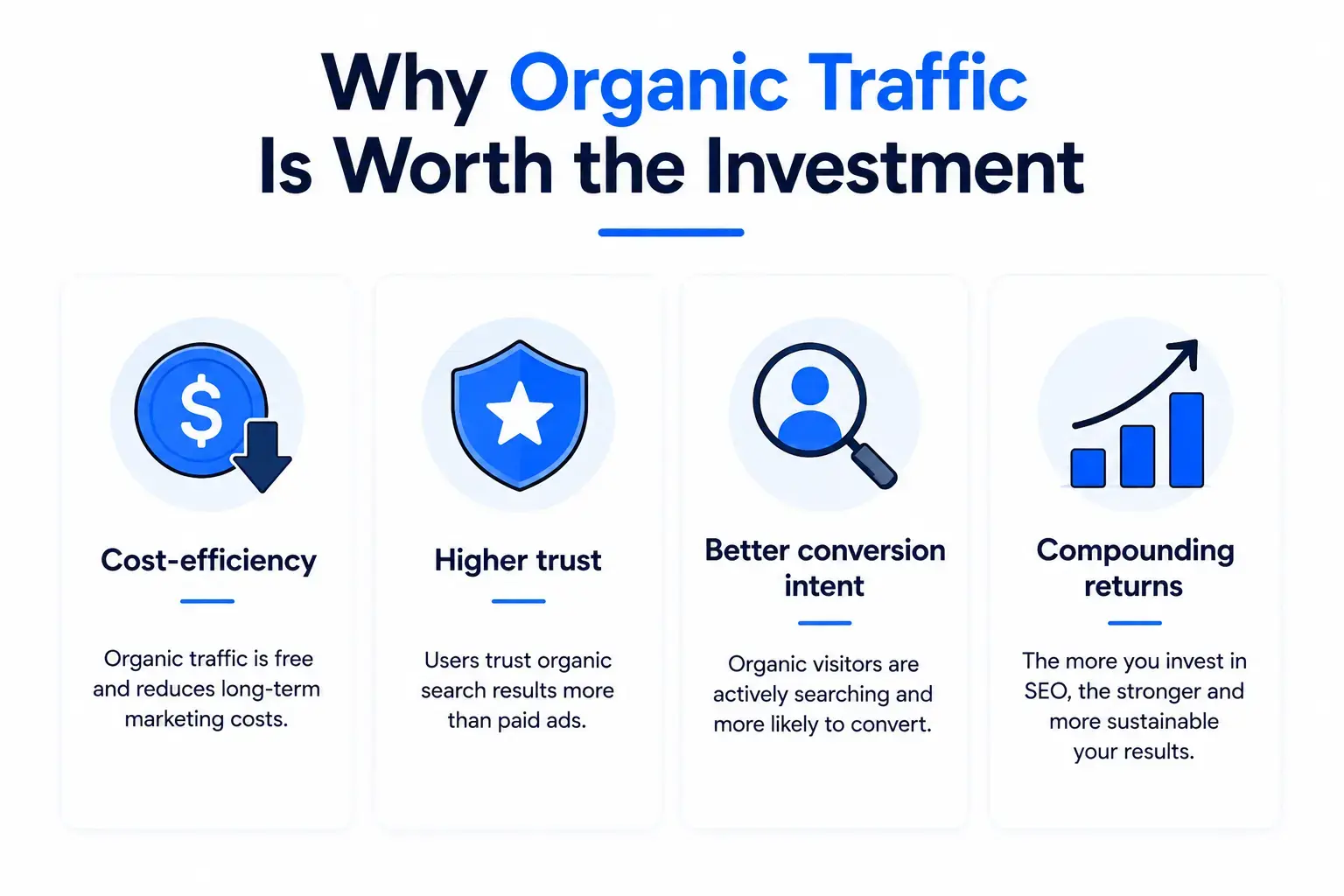
Unlike paid advertising, where visibility disappears the moment a budget runs out, organic traffic provides a more durable online presence. Think of it as investing in a digital asset that appreciates over time the opposite of renting.
- Cost-efficiency: Once content ranks, it keeps driving traffic without ongoing spend
- Higher trust: People click organic results far more than paid ads they signal authority
- Better conversion intent: Organic visitors are actively searching for something, making them more likely to convert
- Compounding returns: Content that ranks keeps ranking, often growing in traffic over months and years
What Percentage of Your Traffic Should Be Organic?
There’s no universal benchmark, but here are rough targets by business type:
| Business Type | Realistic Organic Traffic Target |
| SaaS / B2B | 40–60% of total traffic |
| eCommerce | 30–50% of total traffic |
| Local Business | 50–70% of total traffic |
| Content / Blog Site | 70–90% of total traffic |
| New Website (< 6 months) | 10–25% — building phase, be patient |
How Organic Search Actually Works
Knowing that organic traffic comes from search engines is one thing. Understanding the mechanics behind why one page ranks and another doesn’t is what separates businesses that grow consistently from those that publish without results.
Here’s how the whole system actually operates from the moment a page is created to the moment it appears in a search result.
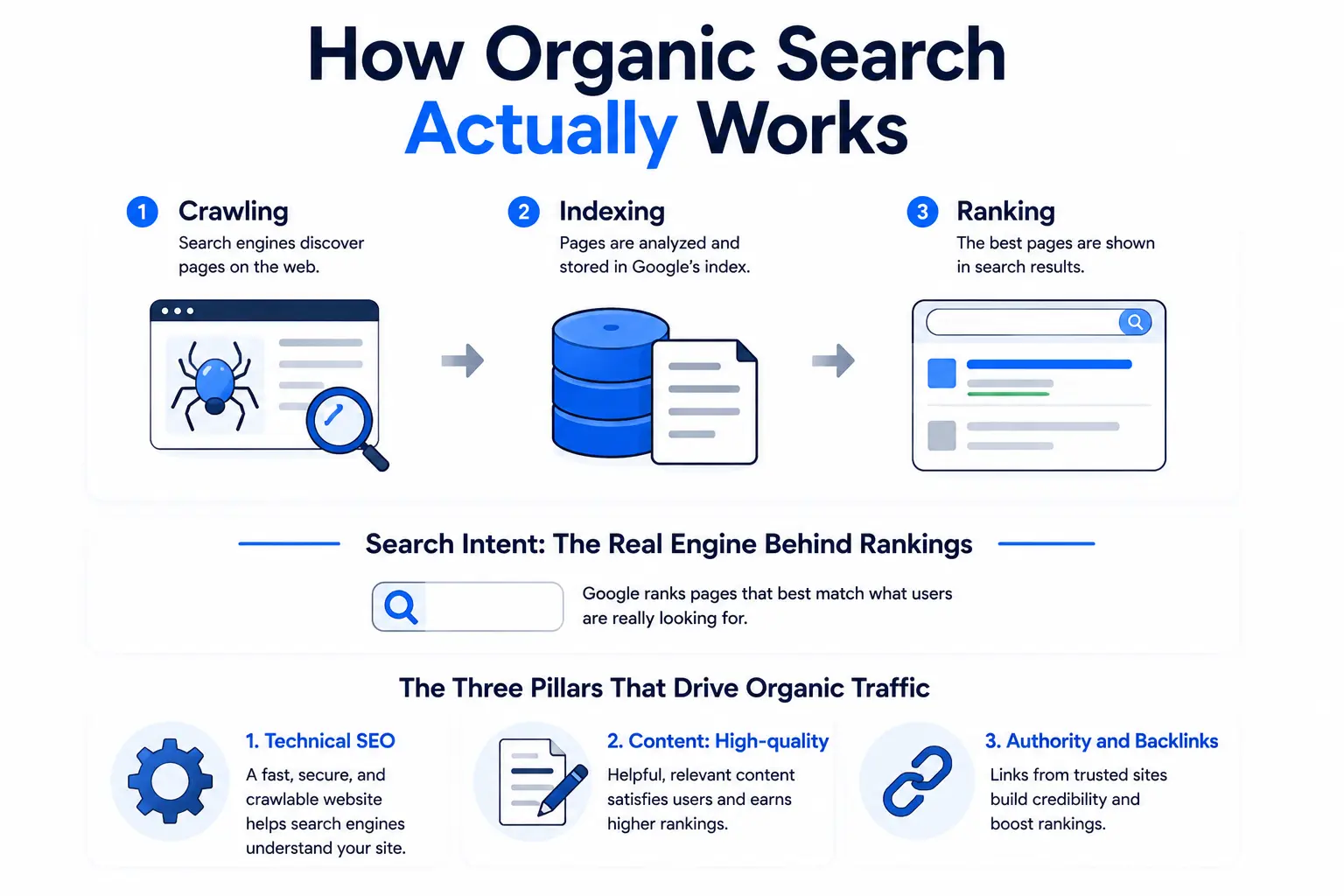
1. Crawling, Indexing, and Ranking The Basics
Before a page can receive any organic traffic, it has to go through three steps:
Crawling: Googlebot (and other search engine bots) constantly scan the web, following links to discover pages. If a page isn’t linked to from anywhere, it may never be found.
Indexing: Once a page is crawled, Google evaluates it and decides whether to add it to its index the giant database of pages it can potentially show in results. Not every crawled page gets indexed.
Ranking: When a user searches for something, Google pulls from its index and ranks the most relevant, high-quality pages for that query. This is where your SEO work pays off.
The most important thing to understand: a page can exist on your site but have zero organic traffic if it’s not indexed, not ranking, or targeting the wrong queries.
2. Search Intent: The Real Engine Behind Rankings
Here’s something many people get wrong: SEO is not about stuffing keywords into a page. It’s about understanding what a user actually wants when they type a query, and then delivering exactly that.
Content quality is one of the most significant variables influencing SEO performance. Search engines increasingly reward content that directly answers user queries rather than content optimized solely around keywords.
The four main intent types:
- Informational: ‘How does X work?’ or ‘What is Y?’ users want to learn
- Navigational: ‘Gmail login’ or ‘Ahrefs pricing page’ users want to find a specific place
- Commercial: ‘Best project management tools’ users are comparing before they buy
- Transactional: ‘Buy running shoes online’ users are ready to act
Before writing any piece of content, ask: what does the person searching this keyword actually want to do? Your content structure, tone, and depth should all answer that question.
3. The Three Pillars That Drive Organic Traffic
Every SEO strategy rests on three interconnected foundations:
- Technical SEO: Your site needs to be crawlable, fast, mobile-friendly, and properly structured. This is the foundation everything else sits on.
- Content: High-quality, intent-matched content is the fuel that drives rankings. No amount of technical work compensates for thin, generic content.
- Authority and Backlinks: Search engines use links from other websites as trust signals. The more reputable sites that link to yours, the more authority, and ranking power, you build over time.
How to Increase Organic Traffic – Strategies That Work in 2026
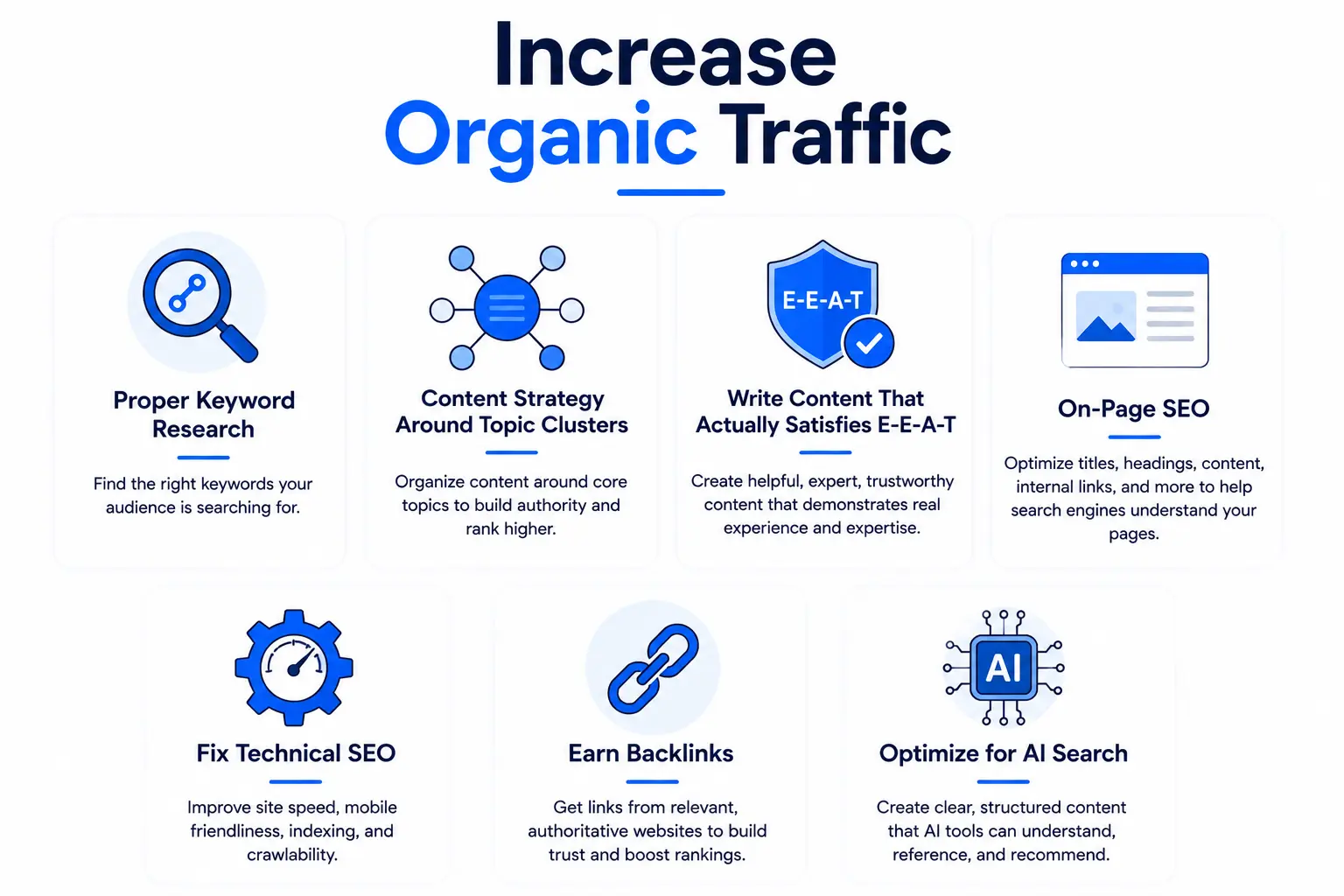
This is the core of it. Growing organic traffic isn’t about gaming algorithms or publishing content at volume it’s about doing a handful of foundational things consistently and doing them better than your competitors. These are the strategies that top-ranking sites use right now, updated for how search actually works in 2026.
Step 1. Start with Proper Keyword Research
Every piece of content you create should target a specific keyword that real people are searching for. Without keyword research, you’re essentially publishing into the void and hoping someone stumbles across it.
Here’s how to approach it properly:
- Map search intent first: Don’t just look at search volume. Ask what kind of content Google is already ranking for that keyword. If the top results are all listicles, a long-form guide probably won’t rank well and vice versa.
- Prioritize long-tail keywords: Long-tail keywords (more specific, lower volume phrases) account for around 70% of all search traffic. They’re less competitive and far more targeted which means better conversion rates.
- Run competitor gap analysis: Use tools like Ahrefs or SEMrush to find keywords your competitors rank for that you don’t. These are ready-made opportunities.
- Don’t ignore question-based queries: Phrases like ‘how to,’ ‘what is,’ and ‘why does’ are goldmines for informational content and featured snippets.
Step 2. Build a Content Strategy Around Topic Clusters
One-off blog posts are becoming less effective. What search engines really reward is topical authority demonstrating that you comprehensively cover a subject area, not just individual keywords.
The topic cluster model works like this: you create a pillar page that broadly covers a topic (this article is an example organic traffic as a subject), and then you build supporting articles around specific subtopics that link back to the pillar.
Instead of creating isolated blog posts, build a network of related content around a central topic. This structure helps search engines understand your expertise and improves your chances of ranking for multiple related keywords simultaneously.
The practical benefit is significant: internally linked clusters pass authority between pages, keep users on your site longer, and signal to Google that you’re a genuine authority on a topic — not just a site that published one article about it.
Step 3. Write Content That Actually Satisfies E-E-A-T
Google’s E-E-A-T framework (Experience, Expertise, Authoritativeness, Trustworthiness) continues to be a major factor in how content is evaluated particularly for topics that affect people’s health, finances, or major decisions.
But here’s the practical reality: E-E-A-T isn’t just about credentials. It’s about whether your content feels like it was written by someone who genuinely knows the subject. Here’s what that looks like:
- Experience: Include real-world examples, case studies, or firsthand observations
- Expertise: Cite credible data, link to authoritative sources, go deeper than surface-level explanations
- Authoritativeness: Have a clear author bio with verifiable credentials or professional background
- Trustworthiness: Keep content accurate, cite sources, be transparent about limitations
One thing to watch: publishing large volumes of thin AI-generated content without human editing or original insight is becoming a liability, not an asset. Google is getting better at identifying it, and users bounce off it fast. That’s why many marketers review AI-generated drafts manually or use an AI humanizer to make the content sound more authentic, engaging, and aligned with their brand voice before publication.
Step 4. On-Page SEO: The Details That Still Move the Needle
On-page SEO is more about content clarity and structure than keyword placement in 2026. That said, there are fundamentals that still matter a great deal:
- Title tags: Put your primary keyword near the front. Keep it under 60 characters. Make it compelling it’s competing with 9 other results for the same click.
- Meta descriptions: These don’t directly affect rankings, but they massively affect click-through rate. Write them like ad copy clear, specific, benefit-focused.
- Header structure (H1 > H2 > H3): Use headers to create a scannable hierarchy. Both users and crawlers rely on these to understand what a page is about.
- Internal linking: This is the most underused lever in SEO. Link relevant pages to each other using descriptive anchor text. It passes authority, improves crawlability, and keeps users navigating your site.
- Semantic keywords: Use related terms and synonyms naturally throughout your content. This helps search engines confirm that your page thoroughly covers a topic.
Step 5. Fix Technical SEO Before Anything Else
You can publish the best content in your industry, but if your site is slow, broken, or hard to crawl, you’ll leave a lot of organic traffic on the table. Technical SEO is the foundation.
Core Web Vitals, Google’s metrics for loading speed, interactivity, and visual stability, remain a meaningful ranking signal in 2026. Here’s where to focus:
- Page speed: Compress images, use a CDN, and minimize render-blocking JavaScript. Aim for under 2.5 seconds LCP (Largest Contentful Paint).
- Mobile optimization: Most searches happen on mobile. Your site should be fully responsive and easy to navigate on a phone.
- Crawlability: Make sure your important pages aren’t blocked by robots.txt, have clean canonical tags, and are linked from somewhere (orphan pages don’t get crawled regularly).
- Site architecture: Keep important pages within 3 clicks of the homepage. Flat, logical structures are easier for crawlers and users.
- HTTPS: Non-secure sites are flagged by browsers and can hurt rankings. If you’re still on HTTP, fix this first.
Step 6. Earn Backlinks the Right Way
Backlinks remain one of the strongest ranking signals in SEO. A link from a reputable website is essentially a vote of confidence it tells search engines your content is worth referencing.
The most effective link-building tactic in 2026? Digital PR. Nearly half of all SEOs rate it as the top approach and it makes sense. When you create genuinely useful research, original data, or expert commentary, journalists and bloggers link to you naturally. That’s far more durable than any link scheme.
Other legitimate strategies:
- Guest posting on relevant industry publications (with a genuine editorial standard)
- Creating linkable assets: original studies, free tools, comprehensive guides, templates
- Competitor backlink analysis: find who links to your competitors, then create better content that earns those same links
- Broken link building: find broken links on relevant sites and suggest your content as a replacement
What to avoid: paid link schemes, private blog networks (PBNs), and link exchanges. Google’s manual and algorithmic penalties for these have real teeth.
Step 7. Optimize for AI Search and Generative Engine Optimization (GEO)
This is the area that’s changed most dramatically in the past 12 months. AI-powered platforms like ChatGPT, Perplexity, and Google’s AI Overviews are now real discovery channels not just novelties. Brands optimizing for both traditional search and AI visibility are building compounding momentum that single-channel strategies simply can’t match.
What AI search optimization looks like in practice:
- Conversational content structure: Write content that directly answers questions in clear, complete sentences. AI models pull these as responses.
- Entity SEO: Establish who you are, what you do, and what topics you’re authoritative on — consistently, across your site and on other platforms.
- Structured data and schema markup: Help search engines understand your content structure. FAQPage, HowTo, and Article schema are particularly useful.
- Featured snippet optimization: Format answers in concise paragraphs (40–60 words), followed by supporting detail. Tables and numbered lists are also commonly pulled.
How to Beat Competitors on Organic Keywords
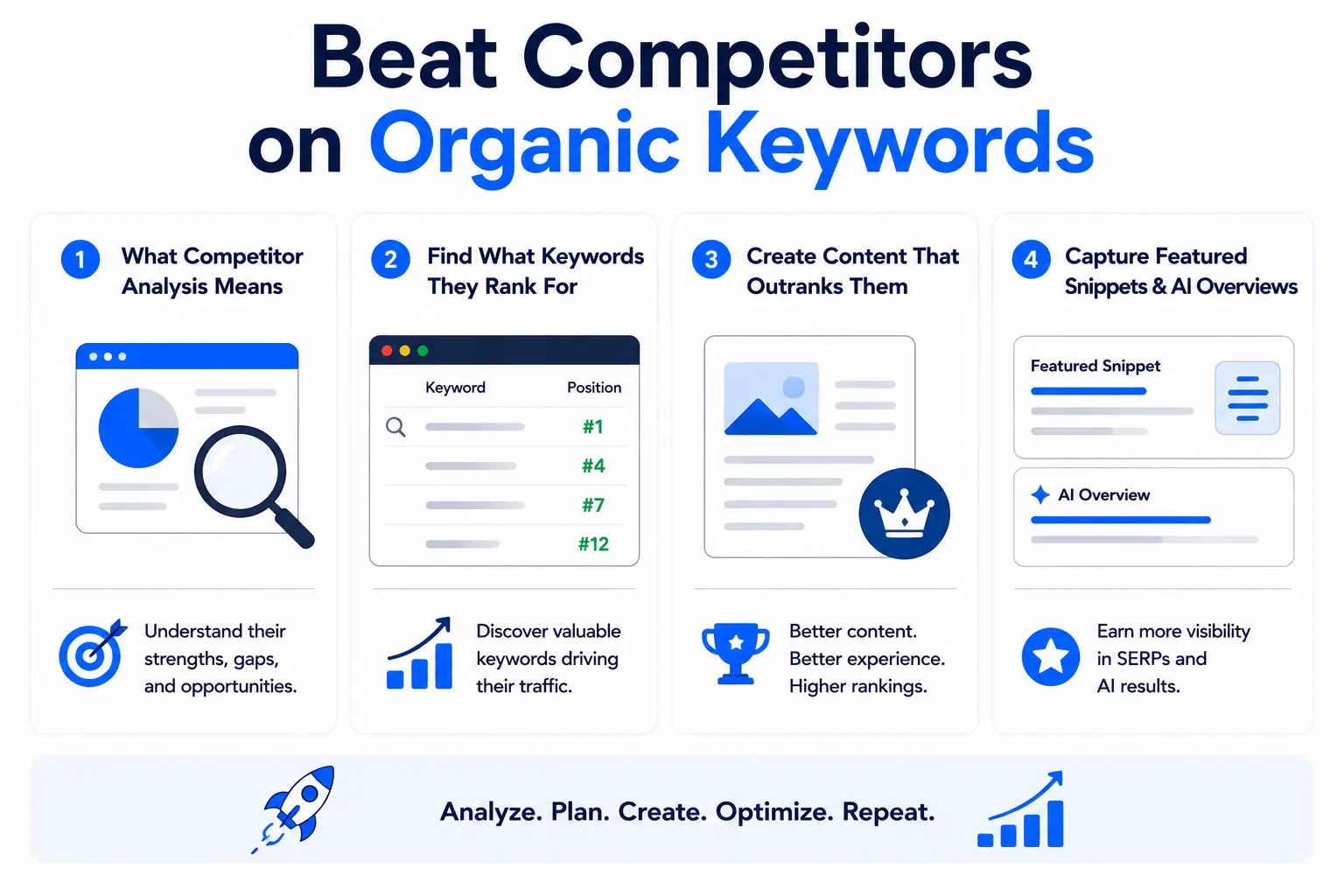
Your competitors are already ranking for keywords your ideal customers are searching. The question is what you do about it. Ethical competitive SEO isn’t about copying — it’s about finding where they’ve left gaps, where their content falls short, and where you can deliver a meaningfully better answer. Done right, this is one of the fastest ways to capture organic traffic that already exists.
What Competitor Analysis Actually Means in SEO
Competitive SEO doesn’t mean copying what your competitors do. It means understanding what’s already working in your niche, identifying the gaps they’ve left open, and creating content that’s genuinely more useful.
There’s a meaningful distinction between content gap analysis and just targeting the same keywords as everyone else. The real opportunity is finding keywords your competitors rank for that you don’t those are uncontested spots waiting to be filled.
How to Find What Keywords Your Competitors Rank For
Open Ahrefs or SEMrush, enter a competitor’s domain, and head to their organic keywords report. Filter by keywords they rank in positions 1–10. Then export this list and compare it against your own rankings.
The overlapping keywords where you both rank are your competitive battles. The keywords they rank for and you don’t are your content opportunities.
SERP overlap analysis is especially useful for identifying where you’re directly competing for the same audience. If a competitor consistently outranks you on a cluster of related terms, it’s often a sign of stronger topical authority in that area which points to content depth, not just individual page optimization.
Create Content That Actually Outranks Them
Here’s the honest truth: publishing ‘better’ content isn’t about word count. It’s about being more useful to the person searching. That can mean:
- More current data and fresher examples
- Better UX: cleaner formatting, faster load time, mobile-friendly layout
- A more complete answer: covering the topic from angles competitors missed
- Original perspective: actual experience, case studies, proprietary data
One underrated factor is user experience signals. If visitors land on your page and immediately bounce back to Google, that tells the algorithm your content didn’t satisfy the query. Time on page, scroll depth, and engagement rate all matter.
Capturing Featured Snippets and AI Overviews
Featured snippets (the answer boxes at the top of Google results) are disproportionately valuable — they sit above all organic results and can drive significant clicks even with a lower overall ranking.
To target them: identify queries that currently show a snippet, then format your content to answer the exact question in a clear, concise paragraph (under 60 words). Follow it with supporting detail in a numbered list or table. Mark it up with appropriate schema.
For AI Overviews, the same principles apply but with additional emphasis on conversational phrasing, clear entity relationships, and comprehensive topic coverage.
Organic Traffic for SaaS: A Different Playbook
SaaS companies can’t use the same content playbook as eCommerce stores or local businesses. Your buyers are more sophisticated, the sales cycle is longer, and your competitors have deep pockets. Growing organic traffic for a SaaS product requires a funnel-aware strategy that maps content to intent at every stage — from first discovery to the moment someone signs up.
Why SaaS SEO Is Different
SaaS companies face a unique challenge with organic traffic: the people who search for their product are at very different stages of awareness. Someone searching ‘what is project management software’ is nowhere near ready to buy. Someone searching ‘[Your Product] vs [Competitor]’ is probably evaluating right now.
This means a single content strategy doesn’t work you need content mapped across the entire buying journey, with different goals at each stage.
Add to this the long sales cycles, highly competitive keywords, and the fact that your competitors are often well-funded companies with mature content operations, and you understand why SaaS SEO requires a distinct approach.
Best Organic Growth Tactics for SaaS Companies
- Product-led content: Create content that naturally demonstrates your product’s value tutorials, how-to guides, use case pages. This drives organic traffic AND converts.
- Comparison and alternative pages: ‘[Your Product] vs [Competitor]’ and ‘Best [Competitor] Alternatives’ pages capture high-intent, bottom-of-funnel traffic from people actively evaluating.
- Integration pages: ‘[Your Product] + [Tool]’ pages capture queries from users of complementary tools who are looking for integrations often very high conversion intent.
- Programmatic SEO: Build templated landing pages at scale for variations of a search pattern (e.g., ‘CRM for [Industry]’). When done well, this can generate significant organic traffic efficiently.
Building an SEO Funnel for SaaS
A well-structured SaaS content funnel looks like this:
| Funnel Stage | Content Type | Example Query | Goal |
| TOFU (Awareness) | Educational guides, blog posts, definitions | ‘What is customer churn?’ | Attract relevant audience |
| MOFU (Consideration) | Comparisons, templates, use cases | ‘Best CRM for startups’ | Build trust, stay in consideration |
| BOFU (Decision) | Case studies, ROI calculators, demo pages | ‘[Product] pricing’ | Drive trial signups or demos |
How to Track Organic Traffic in Google Analytics 4
You can’t improve what you don’t measure. GA4 is the standard tool for tracking organic traffic but its interface is different enough from Universal Analytics that many marketers aren’t using it to its full potential. This section walks you through exactly where to find your organic data, which metrics actually matter, and how to connect Google Search Console for deeper keyword-level insights.
Viewing Organic Traffic in GA4
In GA4, go to Reports > Acquisition > Traffic Acquisition. You’ll see a breakdown of all traffic channels. Look for the ‘Organic Search’ row — this is your organic traffic data.
For a more granular view, use the Exploration feature (left sidebar) to build a custom report. Filter by Session source/medium = ‘google/organic’ (or whichever search engine you want to analyze) and pull metrics like Sessions, Engaged Sessions, Conversions, and Landing Page.
To see which landing pages are driving organic traffic: go to Reports > Engagement > Landing Page, then add a secondary dimension for Session default channel group and filter to ‘Organic Search.’
Metrics That Actually Tell You Something
Not all organic traffic metrics are equally useful. Here’s what to focus on:
- Sessions: The baseline volume metric — how many organic visits you’re getting
- Engagement Rate: Replaces bounce rate in GA4. A higher engagement rate (above 50-60%) means users are finding what they came for.
- Conversions: Set up conversion events in GA4 for the actions that matter — form fills, purchases, trial signups
- Average Engagement Time: How long organic visitors are spending on your pages. Low times on content pages are a signal your content isn’t satisfying the query.
- Landing Pages by organic sessions: Which pages are bringing in traffic — and which high-priority pages are not
Using Google Search Console Alongside GA4
Google Search Console gives you data GA4 can’t: what queries people searched before clicking through to your site, your average position, impressions, and click-through rate.
Connect GSC to GA4 (under Admin > Property Settings > Search Console links) and you can see keyword-level data inside Google Analytics.
The most valuable GSC report for organic traffic growth: Performance > Queries. Sort by impressions descending and look for queries where you have high impressions but low CTR. These are pages that are showing up in results but not getting clicked — often a title tag or meta description problem, not a ranking problem.
How Long Does It Take to Grow Organic Traffic?
One of the most common and frustrating questions in SEO. The honest answer isn’t what most people want to hear, but understanding realistic timelines protects you from making the mistake of abandoning a strategy that’s actually working, or doubling down on one that isn’t. Here’s what to expect, what affects speed, and how to forecast where you’ll be in 6, 12, and 18 months.
The Honest Answer
Most new websites won’t see meaningful organic traffic for 3 to 6 months, and it often takes 12 months or more to rank competitively for valuable keywords in contested niches. This isn’t a bug in SEO it’s a feature. The same time investment that makes it slow to start is what makes it hard for competitors to replicate once you’ve built it.
Organic growth is best thought of as building digital real estate. Each piece of content you create becomes an asset. Over time, those assets compound a post from 18 months ago can still be driving qualified traffic today, often without any ongoing work.
The timeline varies based on: how competitive your niche is, the age and authority of your domain, the consistency of your content publishing, and the quality of your technical SEO foundation.
What Slows Down Organic Growth
If your organic traffic is growing more slowly than expected, the most common culprits are:
- Thin content: Pages that only partially address what a user is searching for or that cover it at a shallower depth than competing pages
- Poor technical SEO: Slow page speed, crawl errors, poor mobile experience every day a page sits with technical problems is a day of potential organic traffic lost
- Weak internal linking: Pages that aren’t linked to from other pages on your site get crawled less frequently and earn less internal authority
- Slow publishing cadence: Consistency matters. Irregular publishing sends weaker freshness signals than a steady schedule.
- Targeting keywords that are too competitive too early: New sites need to earn authority before competing for high-volume head terms
How to Forecast Organic Traffic Growth
Basic organic traffic forecasting uses three inputs: target keyword search volumes, estimated CTR by position, and a timeline for when you expect to rank.
For example: if a keyword has 2,000 monthly searches and you expect to rank in position 3 (which typically earns around 10–13% CTR), you can forecast roughly 200–260 monthly organic visits once that page is ranking.
Scale this across your target keyword list, weight by realistic ranking timelines, and you have a rough traffic forecast. Tools like Ahrefs and SEMrush have built-in forecasting features that automate much of this.
The most useful use of forecasting isn’t precision it’s goal-setting. It gives you a framework to evaluate whether your current content and keyword strategy will get you where you need to go, or whether you need to adjust scope or timeline.
Common Mistakes That Kill Organic Traffic Growth
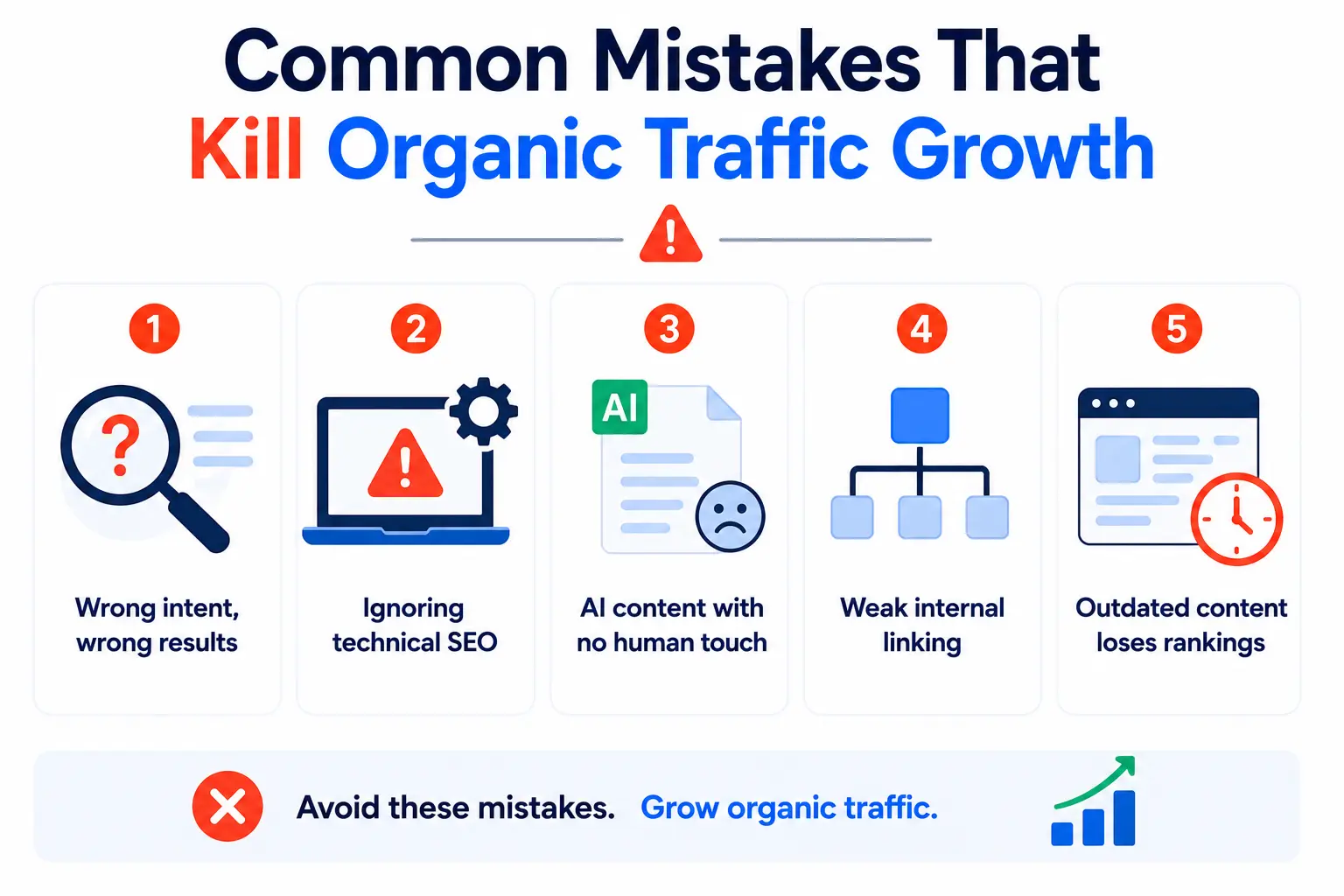
Even well-intentioned SEO efforts can plateau or backfire because of a handful of recurring mistakes that are surprisingly easy to make. Knowing what to avoid is just as important as knowing what to do. These are the most common reasons organic traffic stalls, drops, or never takes off in the first place.
Targeting Keywords Without Understanding Intent
Publishing a guide when the SERP is full of product pages or a listicle when Google is showing in-depth tutorials almost guarantees you won’t rank well, regardless of how good the content is. Always check the existing results for your target keyword before you write a word.
Ignoring Technical SEO Until Something Breaks
Technical issues don’t always produce visible errors. Slow crawl rates, duplicate content from pagination, incorrect canonical tags, or JavaScript rendering problems can quietly suppress your rankings for months before you notice. Schedule regular technical audits quarterly at minimum.
Publishing AI Content with No Human Voice or Depth
AI writing tools are genuinely useful for drafts, outlines, and research. But publishing outputs with no editing, no original insight, and no real-world experience baked in is becoming a liability. Google’s quality evaluators and algorithms are increasingly effective at identifying generic, undifferentiated content and users bounce off it faster than ever.
Neglecting Internal Linking Structure
Most sites have a handful of pages that could rank much better if they received more internal links. Audit your internal link structure periodically: which high-value pages are orphaned or under-linked? Adding 3–5 contextual internal links to a strong page is often faster and more impactful than creating new content.
Letting Old Content Go Stale
A post that ranked well 18 months ago isn’t guaranteed to keep ranking. Outdated statistics, broken links, and missing coverage of recent developments all erode content quality over time. Build content refreshes into your editorial calendar updated content often recovers rankings faster than new content earns them.
The Best Tools to Grow Organic Traffic in 2026
The right tools don’t replace strategy but they do make execution significantly faster and more precise. From finding the right keywords to auditing your site for technical issues to tracking exactly which pages are driving organic traffic, these tools cover the full SEO workflow. Here’s an honest breakdown of what each one is genuinely good for.
Keyword Research and Competitive Analysis
Ahrefs: The most widely used professional SEO tool. Excellent for backlink analysis, keyword research, content gap analysis, and site auditing. Its Keyword Explorer and Content Gap features are particularly powerful.
SEMrush: Comprehensive suite covering keyword research, competitor analysis, technical auditing, and position tracking. Strong for agencies managing multiple sites. Its Keyword Magic Tool is excellent for building large keyword lists.
Google Keyword Planner: Free and built directly into Google Ads. Best for validating search volumes and finding keyword ideas. Less depth than paid tools but a solid starting point.
Analytics and Tracking
Google Analytics 4 (GA4): The standard for website traffic analysis. Tracks organic sessions, engagement, conversions, and user behavior across your site. Free.
Google Search Console (GSC): Tracks how your site performs in Google Search — impressions, clicks, CTR, and average position by query. The single most important free tool for organic traffic monitoring.
Heatmap tools (Hotjar, Microsoft Clarity): Show how users actually interact with your pages — where they click, how far they scroll, where they drop off. Invaluable for diagnosing content quality problems.
AI SEO and Content Optimization
Surfer SEO / Clearscope / MarketMuse: These tools analyze the top-ranking pages for your target keyword and recommend the topics, headings, and terms your content should cover to be competitive. Think of them as a structured brief generator backed by SERP data.
Screaming Frog: The go-to desktop crawler for technical SEO audits. Free up to 500 URLs. Identifies broken links, duplicate content, missing meta tags, and crawl issues faster than any other tool.
The Future of Organic Traffic
Search isn’t standing still and neither is what ‘organic traffic’ actually means. AI-generated search results, voice interfaces, zero-click trends, and entity-based ranking signals are reshaping the landscape fast. The businesses that understand where things are heading will be the ones that build lasting visibility, while those still optimizing for 2020 are already falling behind.
AI Search and Zero-Click Trends
Zero-click searches now account for around 60% of Google queries overall, and even more on mobile. AI Overviews reduce click-through rates significantly when they appear. This is a real shift that SEO strategies need to account for.
The response isn’t to abandon SEO it’s to reframe what you’re optimizing for. Brand visibility, AI mentions, and being the source that AI models cite are becoming as important as raw ranking positions. Strategies that optimize for both will outperform those chasing clicks alone.
Entity-Based SEO
Search engines are increasingly moving from keyword matching to entity understanding — recognizing that ‘Apple’ the company, ‘apple’ the fruit, and ‘Apple Music’ are distinct things with distinct relationships. Building your brand as a recognized entity (via consistent mentions, knowledge graph presence, structured data, and authoritative content) will continue to grow in importance.
Voice Search and Conversational Queries
With the rise of smart speakers and AI assistants, conversational search queries are becoming more common. These tend to be longer, more natural-language phrasing, and often question-based. Structuring content to answer these queries directly in clear, concise language — serves both voice and AI search optimization simultaneously.
What ‘Organic Traffic’ Will Mean Going Forward
Organic traffic is evolving beyond just clicks from Google. As more discovery happens through AI chat interfaces, social search, and recommendation algorithms, the definition of ‘earned’ visibility is expanding. The businesses investing in topical authority, brand trust, and high-quality content today are best positioned for wherever search evolves next
FAQ
What is considered organic traffic?
Organic traffic is visitors who come to your website through unpaid search engine results like Google or Bing.
How can I increase organic traffic fast?
Improve existing pages ranking on page 2, update outdated content, add internal links, and optimize titles and headings.
Why is my organic traffic dropping?
Traffic drops usually happen because of Google updates, technical SEO issues, weaker backlinks, or stronger competitors.
How much organic traffic is good for a new website?
A new website may get 100–500 monthly organic visits in the first 6 months with consistent SEO work.
Can AI tools help improve organic traffic?
Yes, AI tools help with keyword research, outlines, and optimization, but human editing is still important.
How do I check organic traffic in Google Analytics 4?
Go to Reports → Acquisition → Traffic Acquisition and check the “Organic Search” channel.
How long does SEO take to increase traffic?
Most websites see SEO improvements within 3–6 months, while competitive rankings can take longer.
What is the difference between direct and organic traffic?
Organic traffic comes from search engines, while direct traffic comes from users typing your URL or unknown sources.
Conclusion
Organic traffic is still the most sustainable, cost-effective way to grow a website. Paid traffic stops the moment you stop paying. Organic traffic — built on strong technical foundations, genuinely useful content, and real authority — keeps compounding over time.
The core principles haven’t changed: know what your audience is searching for, create content that better answers those questions than anyone else, make sure your site is technically sound, and build authority through links and consistent expertise. What’s changed is the environment AI search, zero-click results, and higher content standards mean the bar for doing this well has risen.
The good news: most of your competitors are still doing SEO the old way. There’s a real competitive advantage available to businesses willing to invest in the fundamentals properly.
Start with an audit. Identify your three biggest technical issues and fix them. Then find your 10 highest-potential content gaps and build a publishing plan. Track everything in GA4 and GSC. Iterate based on what the data tells you.
Organic traffic isn’t a quick win but it’s the most durable one available in digital marketing. Every improvement you make reinforces the next one. Start now.