Every creator, blogger, and marketer eventually hits the same wall: too many logins, too many small subscriptions, and not enough budget to justify all of them. A bio-link tool here, a URL shortener there, a plagiarism checker somewhere else – the costs and the context-switching add up fast.
Linkrify was built to collapse that stack into one dashboard. It combines bio-link pages, an advanced URL shortener, QR code generation, real-time analytics, and more than 100 free SEO and content tools, with a genuinely free entry tier and paid plans that stay inexpensive as needs grow.
This guide covers what Linkrify actually does, how it works, what it costs, where it fits against tools like Ahrefs and Semrush, and who should – and shouldn’t – rely on it. The goal is a clear-eyed, accurate picture, not a sales pitch, so you can decide whether it belongs in your workflow.
What Is Linkrify?
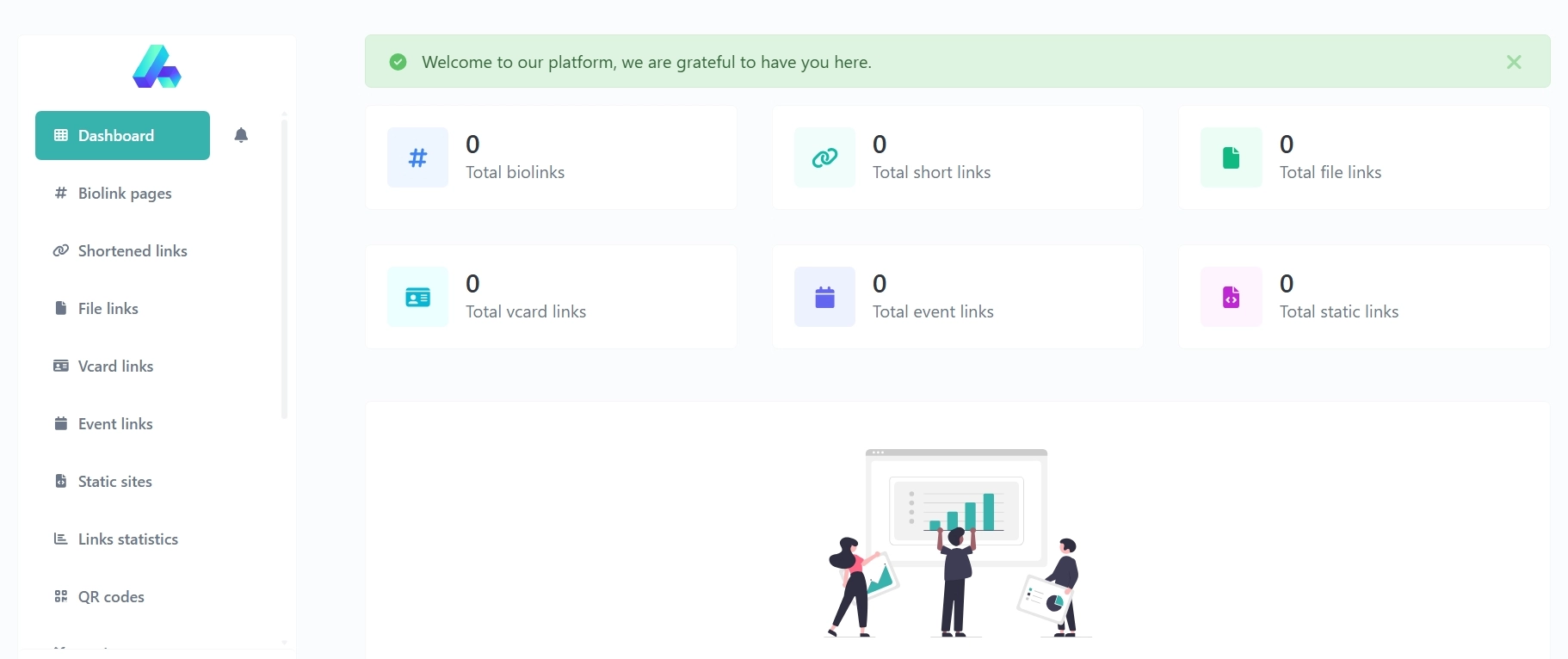
Linkrify is a free, all-in-one link management platform built around a bio-link page builder, an advanced URL shortener, a QR code generator, and a library of more than 100 free browser-based SEO and content tools. Instead of paying for a separate bio-link tool, a separate link shortener, and a separate SEO toolkit, users manage all three from one dashboard at linkrify.us.
The platform sits in a different category than dedicated SEO research suites like Ahrefs or Semrush. Linkrify’s core value is consolidation and cost: it replaces several smaller subscriptions (bio-link tool, URL shortener, QR generator, basic SEO utilities) with one account, most of it free.
Why Linkrify Is Gaining Popularity
- Zero-cost entry point: the Starter plan requires no credit card and never expires.
- Creators only get one clickable link on Instagram, TikTok, and YouTube, and Linkrify turns that single link into a full landing page.
- The free SEO utilities (plagiarism checker, grammar checker, keyword density checker, image compressor, and more) solve everyday tasks without a login.
- Nine tracking-pixel integrations let creators and agencies build retargeting audiences directly from bio-page and link traffic.
- Word-of-mouth growth in budget-conscious markets, where paying $100+ per month for a stack of SEO tools isn’t realistic.
Who Should Use It?
Linkrify is best suited to social creators who need a bio-link page, small businesses and freelancers who want free everyday SEO utilities, and agencies that want a lightweight way to manage client campaign links with A/B testing and white-label branding. It is not a replacement for a dedicated keyword-research or backlink-analysis platform when deep, real-time competitive data is required.
Key Features of Linkrify
Core Features
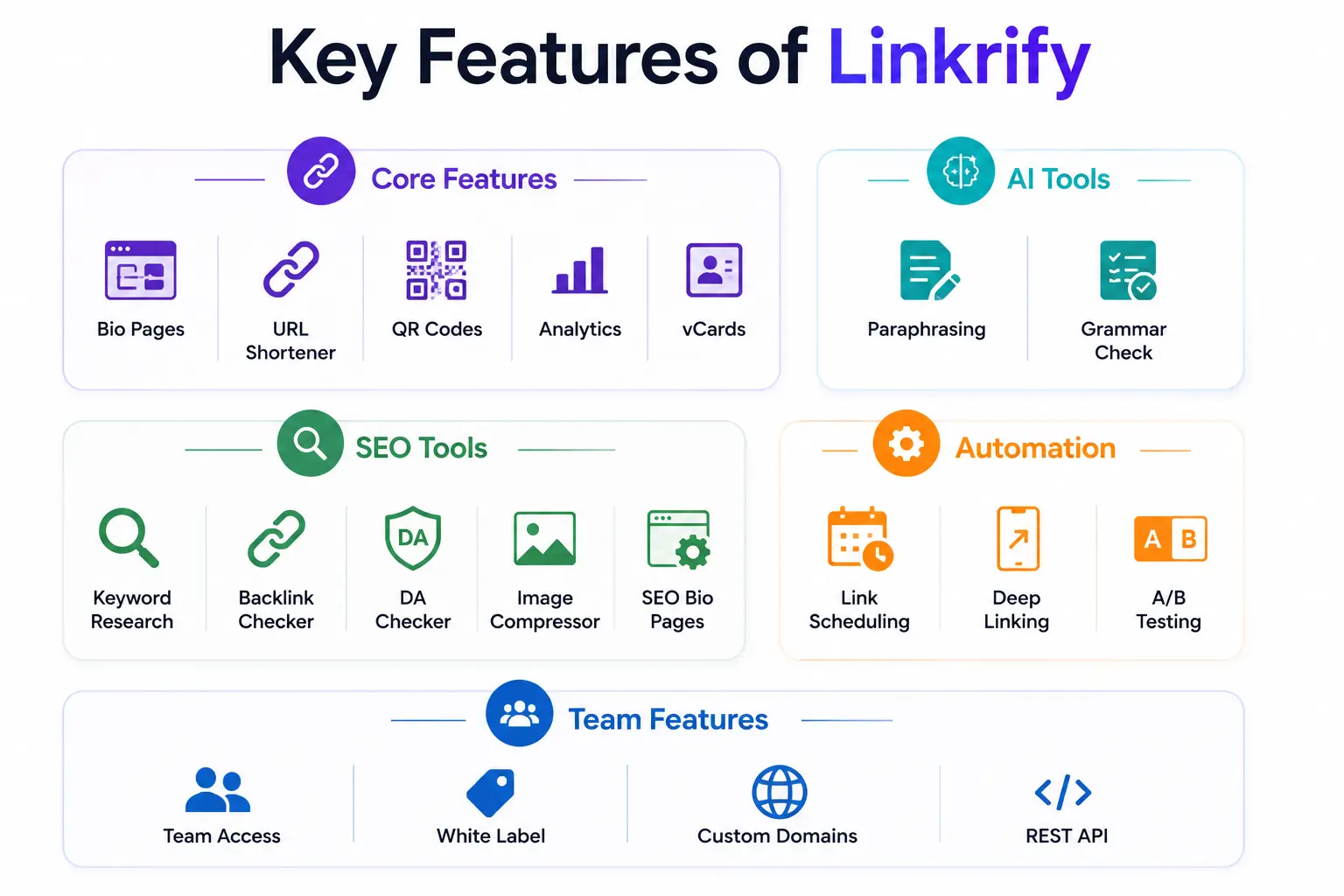
- Bio-link pages with unlimited content blocks – links, images, video, countdown timers, contact forms, and payment buttons.
- Advanced URL shortener with A/B rotation testing, country and device targeting, scheduling, and password protection.
- Branded QR code generator supporting vCard, WiFi, and calendar-event formats, exportable as SVG or PNG.
- Real-time, cookieless analytics broken down by country, city, device, browser, and referrer.
- Digital vCards, file-transfer links, and calendar-event links for lead capture.
AI Capabilities
Linkrify’s free toolkit includes AI-assisted writing utilities such as a paraphrasing tool and grammar checker, which help content teams tighten copy and reduce duplicate-content risk before publishing. These sit alongside – not in place of – a dedicated AI writing assistant, and are best treated as a fast first-pass editing layer rather than a full content-generation suite.
SEO Benefits
- Keyword research tool with search-volume and competition estimates for quick topic validation.
- Backlink checker for reviewing referring domains and anchor-text distribution.
- Domain Authority checker for a fast read on a site’s relative ranking strength.
- Image compressor that can shrink file sizes significantly without visible quality loss, which helps Core Web Vitals.
- SEO-controllable bio pages: custom meta titles, meta descriptions, and Open Graph images so the bio page itself can be indexed.
Automation Features
- Link scheduling and expiration, so campaign links go live or retire automatically.
- Deep linking that opens a visitor’s installed app instead of the mobile browser.
- Automatic A/B traffic splitting across two or more destination URLs.
Collaboration Tools
The Business plan adds five team-member seats, unlimited custom domains, white-label branding, and full REST API access – the feature set agencies need to manage multiple client brands from a single account.
How Linkrify Works
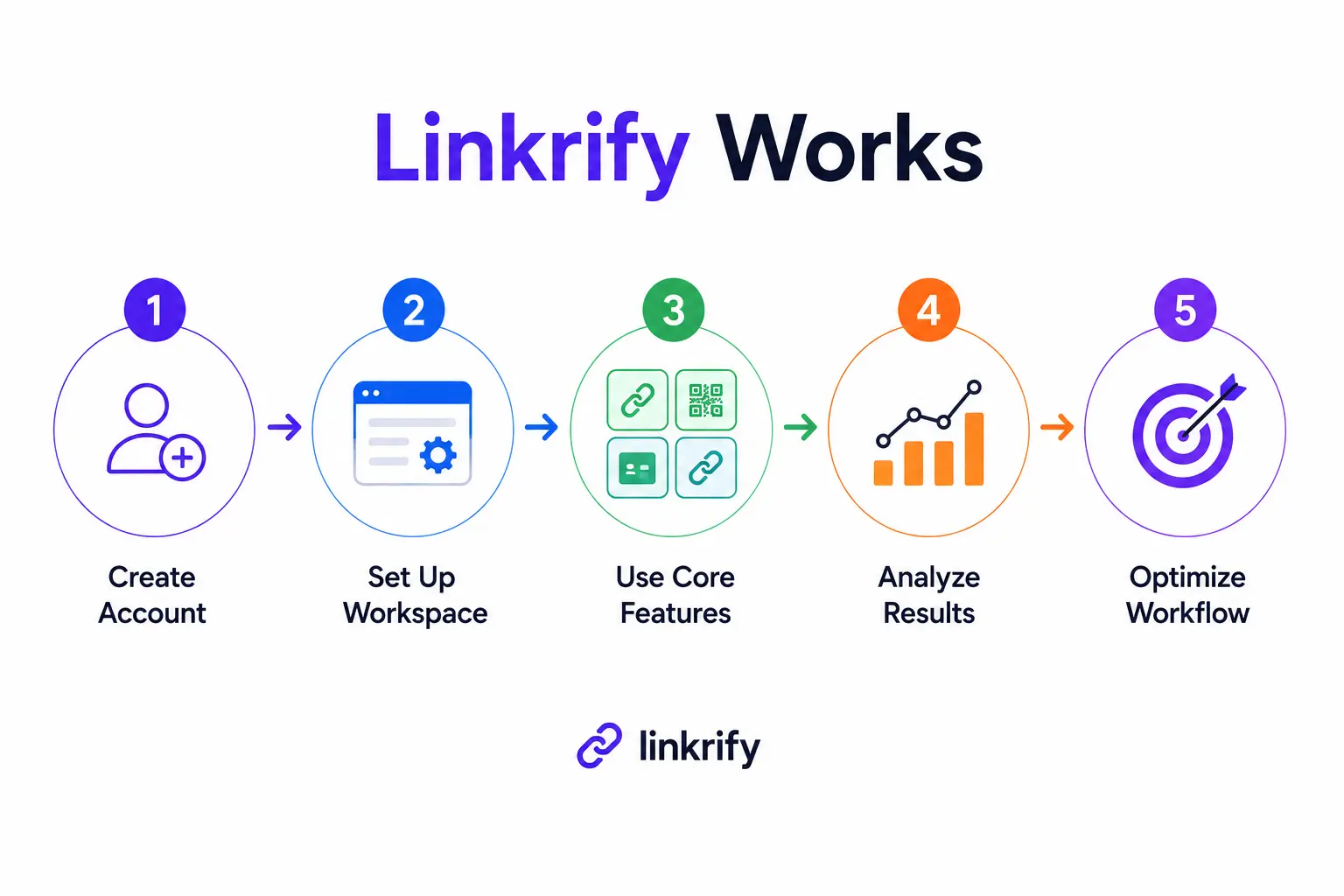
Step 1: Create an Account
Sign up with an email address or a Google account. No credit card is required, and the dashboard is ready immediately.
Step 2: Set Up Your Workspace
Choose one of 50+ bio-page templates, connect a custom domain (Pro and Business plans), and wire up tracking pixels for Meta, Google, LinkedIn, TikTok, Pinterest, X, Snapchat, and Quora.
Step 3: Use the Core Features
Build the bio-link page, generate shortened and branded links for campaigns, and create QR codes for print or packaging. Most of the 100+ free SEO tools work directly in the browser without logging in.
Step 4: Analyze Results
Real-time analytics show clicks by country, city, device, and referrer. Starter-plan users get seven days of history; Pro extends that to a full year.
Step 5: Optimize Your Workflow
Run A/B tests on link destinations, review which bio-page blocks get the most engagement, and use the SEO utilities (keyword density, plagiarism, grammar) as a pre-publish checklist for new content.
Linkrify Use Cases
Bloggers
Run the plagiarism checker, grammar checker, and keyword density tool on every article before it goes live, and use the bio page as a hub for older posts.
SEO Professionals
Use the keyword research, backlink, and Domain Authority checkers for fast client audits and quick sanity checks between deeper platform pulls.
Agencies
Manage multiple client link campaigns from one account with white-label branding, team seats, geo-targeting, and API access on the Business plan.
Businesses
Turn product QR codes, digital vCards, and shortened campaign links into a single trackable funnel with pixel-based retargeting.
Content Marketers
Centralize link distribution across every social bio, then lean on the free image compressor and word counter during production.
Freelancers
Get agency-grade utilities – keyword research, backlink checks, PDF conversion – without paying for tools that would otherwise eat into project margins.
Benefits of Using Linkrify
Saves Time
Consolidating bio-link management, URL shortening, QR generation, and everyday SEO checks into one dashboard removes the friction of switching between five separate logins.
Improves Productivity
Templates, drag-and-drop blocks, and no-login utilities mean most tasks – from building a bio page to running a plagiarism scan – take minutes rather than a full workflow of exports and uploads.
Enhances SEO Workflows
The keyword density checker, backlink checker, and Domain Authority checker give a fast first read before committing time to a deeper audit in a dedicated research platform.
Supports AI-Assisted Content
The grammar checker and paraphrasing tool act as a lightweight editing pass for AI-assisted drafts, helping catch duplicate phrasing and awkward wording before publishing.
Linkrify Pricing
Free Plan
The Starter plan is $0 per month, permanently, with no credit card required. It includes 5 bio-link pages, 25 short links per month, 1 QR code, 7 days of analytics history, and full access to all 100+ free SEO tools.
Paid Plans
- Pro – $9/month: unlimited bio pages, unlimited short links and QR codes, 1 year of analytics history, 3 custom domains, all 9 pixel integrations, and A/B link testing.
- Business – $29/month: everything in Pro plus 5 team seats, unlimited custom domains, white-label branding, full REST API access, and priority 24/7 support.
Value for Money
At $9/month, Pro undercuts most standalone bio-link and URL-shortener subscriptions individually, and the free SEO utilities are included at every tier – a meaningful advantage for solo creators and small teams who would otherwise pay for each tool separately.
| Plan | Price | Bio Pages | Short Links | Custom Domains | Team Seats |
| Starter | $0/mo | 5 | 25/month | — | 1 |
| Pro | $9/mo | Unlimited | Unlimited | 3 | 1 |
| Business | $29/mo | Unlimited | Unlimited | Unlimited | 5 |
Linkrify Pros and Cons
| ✓ Advantages | ✗ Limitations |
| • Genuinely free forever plan with no credit card required | • Keyword and backlink data is not as deep as Ahrefs or Semrush |
| • 100+ SEO and content tools included at every tier | • Free plan limits analytics history to 7 days |
| • Combines bio pages, URL shortening, and QR codes in one platform | • Some high-use tools have daily caps to prevent abuse |
| • Privacy-first: most tools run in-browser with no data storage | • Ad-supported free tier |
| • Nine tracking-pixel integrations for retargeting | • Not a substitute for enterprise-grade competitive research |
| • Pro plan priced well below comparable standalone tools |
Linkrify vs Other SEO Tools
It’s worth being direct here: Linkrify is a link-management platform with a free SEO-utility layer, not a dedicated keyword-research and backlink-analysis suite. The comparisons below reflect that difference rather than pretending it’s a one-to-one swap.
Linkrify vs Ahrefs
Ahrefs is built around a massive, continuously updated backlink index and deep keyword-difficulty modeling — the kind of data-heavy research agencies rely on for competitive audits. Linkrify’s backlink and keyword tools are useful for a quick, free check but don’t match that depth or refresh rate. Choose Ahrefs for serious competitive research; choose Linkrify for free everyday checks plus bio-link and URL management Ahrefs doesn’t offer at all.
Linkrify vs Semrush
Semrush covers keyword research, site audits, PPC data, and content optimization in a single paid platform aimed at agencies and in-house teams. Linkrify doesn’t attempt to match that scope — its strength is being free and bundling link management alongside basic SEO checks, not replacing a full research suite.
Linkrify vs Surfer SEO
Surfer SEO specializes in on-page content optimization — scoring drafts against top-ranking pages for a target keyword. Linkrify has no equivalent content-scoring engine; its keyword density checker is a much simpler, free alternative for a basic on-page sanity check, not a full optimization workflow.
Linkrify vs Frase
Frase focuses on AI-assisted content briefs and SERP-based outline generation. Linkrify’s toolkit is oriented toward pre-publish editing (grammar, plagiarism, paraphrasing) rather than research-driven content planning, so the two solve different stages of the content workflow.
Comparison Table
| Tool | Primary Focus | Free Tier | Starting Paid Price | Bio Link / URL Tools |
| Linkrify | Link management + free SEO utilities | Yes, full-featured | $9/mo | Yes |
| Ahrefs | Backlink & keyword research | Limited (webmaster tools) | $29/mo | No |
| Semrush | Full SEO & PPC suite | Very limited | ~$139/mo | No |
| Surfer SEO | On-page content optimization | No | ~$89/mo | No |
| Frase | AI content briefs & outlines | Trial only | ~$45/mo | No |
Best Linkrify Alternatives
Top Alternatives
- Linktree – the category-defining bio-link tool, strong templates, but a more restricted free plan and no built-in SEO utilities.
- Bitly – a mature, enterprise-trusted URL shortener with strong analytics, but no bio-page builder or SEO tools.
- Beacons – a creator-focused bio-link and monetization platform with media-kit features Linkrify doesn’t offer.
- Ahrefs or Semrush – for teams that need deep keyword and backlink data beyond what any free tool provides.
- Ubersuggest – a budget-friendly paid SEO tool that sits between Linkrify’s free utilities and full enterprise suites.
Which One Should You Choose?
If the priority is a free bio-link page plus everyday SEO utilities, Linkrify is the most complete option. If bio pages aren’t needed and deep backlink data is the priority, Ahrefs or Semrush are better fits. For teams that want strong monetization features built into the bio page itself, Beacons is worth a look.
Real-World Examples
Example Workflow
A creator publishes a new YouTube video, updates the Linkrify bio page with the new link at the top, shortens the video URL with UTM parameters for the video description, and checks next-day analytics to see which traffic source converted best.
Beginner Scenario
A freelance blogger with no SEO budget signs up for the free Starter plan, runs a new post through the plagiarism and grammar checkers before publishing, and uses the keyword density tool to confirm the target keyword isn’t over- or under-used.
Agency Workflow
An agency on the Business plan sets up white-labeled short links for three clients, applies country-based targeting to a seasonal campaign, and pulls click analytics into a client report at the end of the month using the REST API.
Expert Tips for Getting the Most from Linkrify
Best Practices
- Set custom meta titles and descriptions on the bio page itself so it can rank in search, not just serve as a redirect hub.
- Connect at least the Google Analytics 4 and Meta pixels early, even on the free plan, so retargeting data starts accumulating from day one.
- Run new content through the plagiarism and grammar checkers before publishing rather than after, to avoid a rewrite cycle.
Common Mistakes
- Treating the built-in keyword and backlink checkers as a full replacement for deeper competitive research.
- Leaving the free plan’s 7-day analytics window unmonitored, which means losing visibility into longer campaign trends.
- Skipping custom domains on paid plans, which reduces click-through trust compared to a branded short link.
Advanced Tips
- Use A/B link rotation on high-traffic bio-page links to test landing pages without touching the destination site’s code.
- Pair Linkrify’s free utilities with a dedicated research tool for keyword and backlink work that needs enterprise-level depth.
Security, Privacy & Reliability
Data Protection
Most of Linkrify’s free tools process content in-browser during the session and don’t store it on Linkrify’s servers afterward. The platform states GDPR, CCPA, and PECR compliance, and offers cookieless analytics as an option.
Account Security
Accounts can be created with email or Google sign-in. As with any link-management platform holding campaign and analytics data, using a strong, unique password and enabling any available two-factor option is good practice.
Platform Reliability
Linkrify advertises a 99.9% uptime SLA on its paid tiers. As with any hosted service, it’s worth checking a status page or support channel before relying on it for a time-sensitive, high-traffic campaign.
Frequently Asked Questions
What is Linkrify?
Linkrify is a free, all-in-one platform combining bio-link pages, a URL shortener, a QR code generator, real-time analytics, and 100+ free SEO and content tools.
Is Linkrify free?
Yes. The Starter plan is free forever with no credit card required, and includes access to all of the free SEO tools. Paid Pro ($9/mo) and Business ($29/mo) plans remove usage limits and add team, branding, and API features.
Is Linkrify worth using?
For creators and small teams who need a free bio-link page plus everyday SEO utilities, yes. For agencies needing deep, enterprise-grade keyword and backlink research, it works best as a supplement to a dedicated SEO platform rather than a replacement.
Does Linkrify improve SEO?
Its free tools (keyword density checker, backlink checker, Domain Authority checker, image compressor) support day-to-day on-page SEO tasks, and the bio page itself can be optimized with custom metadata. It doesn’t replace deep technical or competitive SEO auditing.
Is Linkrify beginner-friendly?
Yes. Most tools require no login, the dashboard uses templates and drag-and-drop blocks, and setup typically takes a few minutes.
What are the best alternatives?
Linktree and Beacons for bio pages, Bitly for URL shortening alone, and Ahrefs or Semrush for deep SEO research.
How does Linkrify compare to traditional SEO tools?
Traditional tools like Ahrefs and Semrush focus entirely on research depth and are paid from the start. Linkrify trades some of that depth for a genuinely free tier and bundled link-management features those tools don’t offer.
Can Linkrify fit into an AI-assisted content workflow?
Yes, as an editing layer. The grammar checker and paraphrasing tool are useful for cleaning up AI-assisted drafts before publishing, though they aren’t a content-generation or brief-building tool.
Final Verdict
Who Should Use Linkrify?
Social creators who need a bio-link page, freelancers and small businesses who want free everyday SEO utilities, and agencies looking for an affordable way to manage branded client links with team access.
Who Should Skip It?
Teams whose primary need is deep, real-time keyword-difficulty and backlink-index data — that job still belongs to a dedicated research platform like Ahrefs or Semrush.
Overall Recommendation
Linkrify earns its place as a free, well-rounded link-management platform with a genuinely useful bonus layer of SEO utilities. It’s not trying to out-research Ahrefs or Semrush, and it doesn’t need to — its value is consolidation at zero cost, with paid tiers that stay inexpensive as needs grow.
Conclusion
Linkrify won’t out-research Ahrefs or Semrush, and it isn’t trying to. What it delivers instead is a free, well-designed hub for bio-link pages, URL shortening, QR codes, and everyday SEO utilities — the kind of tools most creators, freelancers, and small teams reach for constantly but rarely want to pay full price for individually.
For solo creators and small businesses, the free Starter plan alone can replace several paid subscriptions. For agencies, the Pro and Business tiers add the branding, team access, and API depth needed to run client campaigns without a heavy price tag. Pair Linkrify with a dedicated research platform when deep competitive data is required, and it becomes a genuinely useful part of a broader SEO and content stack rather than a stand-alone solution to every problem.