You Google your own business name to check how it looks online, and you find three different Yelp listings staring back at you. One has your old address. One has a slightly different business name. The third has half your reviews. If that sounds like a nightmare, it should because those duplicates are actively working against you every single day.
So, can duplicate Yelp listings affect SEO? The short answer is yes, absolutely and the damage goes deeper than most business owners realize. Yelp isn’t just a review platform anymore. It feeds data to Apple Maps, Bing Places, and voice assistants like Siri. It shows up on Google’s first page regularly. And when your Yelp presence is fragmented, all of that local search authority gets fragmented with it.
we’ll cover exactly how Yelp factors into your local search rankings, why duplicate listings are so damaging, what causes them in the first place, and most importantly how to clean them up and keep them gone for good.
Why Yelp Carries More SEO Weight Than You Might Think
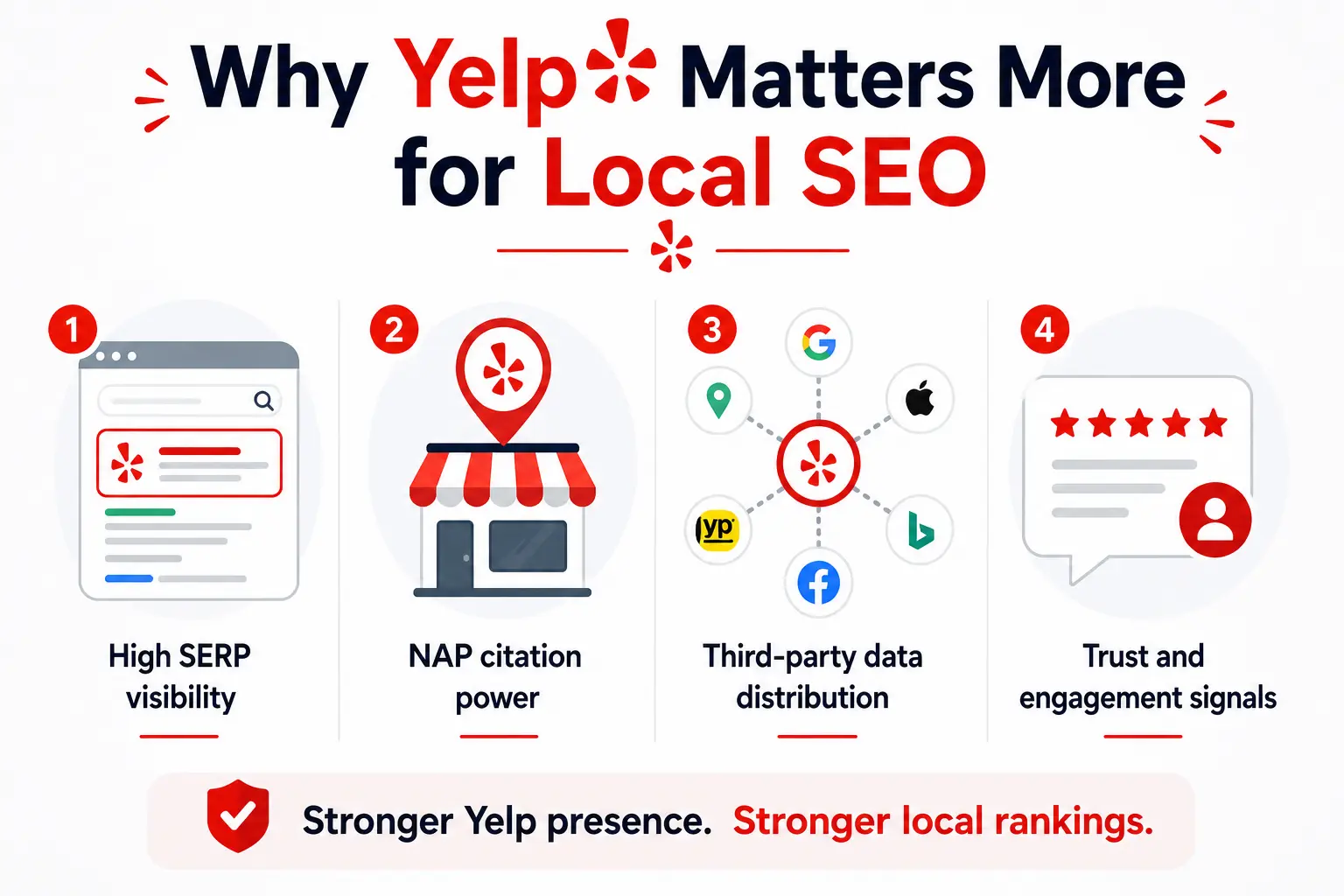
Before we get into the damage duplicates can cause, it helps to understand what’s actually at stake. Yelp isn’t just a place where customers leave reviews about their restaurant experience. From a search engine perspective, it’s a high-authority directory that Google genuinely trusts.
Here’s why that matters for your business:
- High SERP visibility: Yelp pages consistently rank on Google’s first page for local service queries. When someone searches “best Italian restaurant near me,” there’s a good chance a Yelp results page is sitting in the top five.
- NAP citation power: Yelp contributes Name, Address, and Phone Number (NAP) data across the web. Consistent NAP is one of the most fundamental pillars of local SEO.
- Third-party data distribution: Yelp shares business data with Apple Maps, Bing, and Siri. Inaccurate information on Yelp ripples outward to all of these platforms automatically.
- Trust and engagement signals: Reviews, photos, check-ins, and user engagement on Yelp send legitimacy signals that influence how search engines perceive your business.
A single, well-maintained Yelp listing is a genuine SEO asset. A fragmented one? It’s a liability that touches every layer of your local search strategy.
So, Can Duplicate Yelp Listings Affect SEO?
Yes. When duplicate Yelp listings affect SEO, they do so by creating a problem that sits at the heart of how search engines work: trust. Search algorithms are designed to find and surface the most accurate, authoritative information for users. When they encounter two or three listings for the same business each with slightly different details
they can’t confidently determine which one is real.
And when a search engine isn’t confident about your information, it pulls back. It reduces the visibility of both listings rather than risk sending users to incorrect data. You end up penalizing yourself without knowing it.
That 25% figure isn’t theoretical. That’s a quarter of your potential local customers who may never find you not because you’ve done anything wrong intentionally, but because two versions of your business exist where only one should.
It’s also worth noting that Yelp itself actively discourages duplicate listings. Creating multiple profiles for the same business location violates their Terms of Service and can result in all your listings being removed entirely a worst-case outcome that takes all your accumulated reviews with it.
5 Ways Duplicate Yelp Listings Actively Hurt Your Local SEO
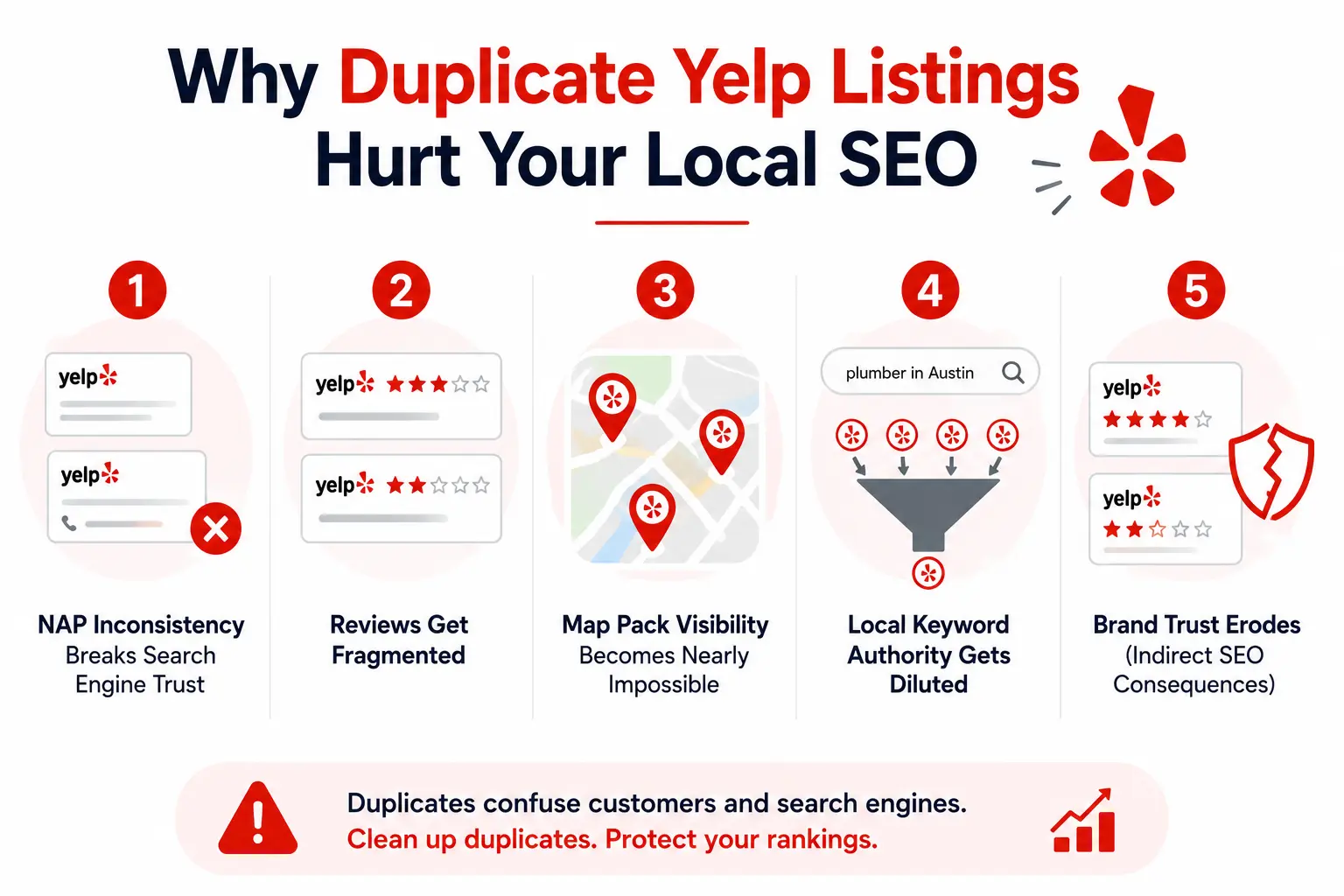
1. NAP Inconsistency Breaks Search Engine Trust
NAP- Name, Address, Phone Number is the foundation of local SEO. Search engines cross-reference your NAP data across hundreds of directories and citation sources to verify your business is real, legitimate, and located where you say it is.
When Listing A says “Suite 100” and Listing B says “Ste. 100,” or one has a local area code and another has an 800 number, those are conflicting signals. The algorithm doesn’t give you the benefit of the doubt it simply trusts your business less. And a business the algorithm doesn’t trust doesn’t rank well.
2. Reviews Get Fragmented – and Fragmented Reviews Don’t Rank
Reviews are the lifeblood of local SEO. Search engines look at review density, velocity, and total volume when deciding which businesses deserve the top local positions. Duplicate listings split all of that authority across multiple profiles.
Think about it this way: a competitor with 60 consolidated reviews on one clean Yelp listing will consistently outrank your business if your 60 reviews are spread 20-20-20 across three duplicates. None of your listings reaches the critical mass needed to be taken seriously by the algorithm.
A small bakery discovered two Yelp listings — one with 10 reviews, another with 15. After consolidating them into a single profile, their 25-review listing climbed in Yelp search rankings, website traffic increased by 20%, and foot traffic reportedly followed. The content didn’t change. The audience didn’t change. Eliminating the split was all it took.
3. Map Pack Visibility Becomes Nearly Impossible
The local map pack – that coveted three-business block that appears in Google search results for local queries is where the real local SEO battle is fought. Getting into the map pack can mean the difference between a full calendar and an empty one.
Search engines prioritize businesses they trust for map pack placement. Duplicate listings, with their conflicting information and fragmented authority, are essentially a red flag. Your competitors with clean, verified, single listings will edge you out every time.
4. Local Keyword Authority Gets Diluted
Every check-in, click, review, and category tag on your Yelp listing contributes to your local relevance for specific search terms. When that engagement is scattered across multiple listings, no single profile builds enough topical authority to rank strongly.
It’s like trying to cut wood with a butter knife instead of an axe. The mass is there it’s just distributed in a way that makes it ineffective. Your business might rank decently for two or three terms across different listings, but none of those rankings are as strong as they could be with consolidated authority.
5. Brand Trust Erodes – and That Has Indirect SEO Consequences
Beyond the algorithm, there’s a human cost to duplicate listings. Customers who call the wrong number, show up at an outdated address, or encounter contradictory information about your hours don’t usually give second chances they just leave a negative review or quietly choose a competitor.
Lower engagement rates, higher bounce rates, and negative reviews all send indirect quality signals to search engines. The algorithm notices when users aren’t sticking around — and it adjusts your rankings accordingly.
What Causes Duplicate Yelp Listings in the First Place?
Understanding where duplicates come from is the first step toward preventing them. In most cases, nobody sets out to create a duplicate listing they just appear, often from surprisingly mundane causes.
Business Relocations
This is the most common culprit. When a business moves to a new address, the old listing doesn’t automatically disappear. The owner updates their primary profile with the new address and moves on, not realizing the old listing is still sitting there complete with old contact details and accumulated reviews. Industry data suggests roughly 50% of duplicate listings trace back to address or phone number changes.
Multiple Team Members or Agencies
Your marketing manager creates a Yelp listing. Six months later, the new social media coordinator creates another one because they couldn’t find the first. Add an overeager intern to the mix, and suddenly you have three listings for the same business all created with good intentions, none of them aware of the others.
Data Aggregators Creating Listings Automatically
Third-party data aggregators scrape business information from across the web and distribute it to platforms like Yelp. When they encounter inconsistent or incomplete information from different sources, they sometimes create new listings rather than updating existing ones. This can happen entirely without your knowledge.
Business Name Variations and DBAs
If your legal entity is “Smith & Sons Plumbing LLC” but you also operate under “Smith Plumbing” and market yourself as “24/7 Emergency Plumbing Services,” each variation can generate its own listing. Each DBA (Doing Business As) registration creates another opportunity for duplicate profiles to spawn.
Multi-Location and Franchise Mix-Ups
Franchise businesses and chains with multiple locations face unique challenges. Each location requires its own dedicated listing, but without centralized listing management, individual franchisees or location managers often create duplicate profiles that conflict with corporate standards — or with each other.
How to Find Your Duplicate Yelp Listings
Before you can fix the problem, you need to find it. Here’s how to audit your Yelp presence systematically:
- Search Yelp directly: Type your business name and city into Yelp’s search bar. Try different variations abbreviations, common misspellings, DBA names, and old business names.
- Use Google: Run the search query: site:yelp.com [Your Business Name] [City]. This shows every Yelp page Google has indexed for your business name.
- Compare NAP details carefully: Look for subtle differences punctuation in the address, different phone number formats, slightly altered business names. Even small variations count as inconsistencies.
- Use citation audit tools: Platforms like rankller, Moz Local, BrightLocal, Whitespark, and Yext can scan across hundreds of directories simultaneously and flag duplicates you’d never find manually.
- Document before you act: Screenshot everything URLs, review counts, business details, photos. This documentation protects you if something goes wrong during the cleanup process.
Step-by-Step: How to Fix Duplicate Yelp Listings
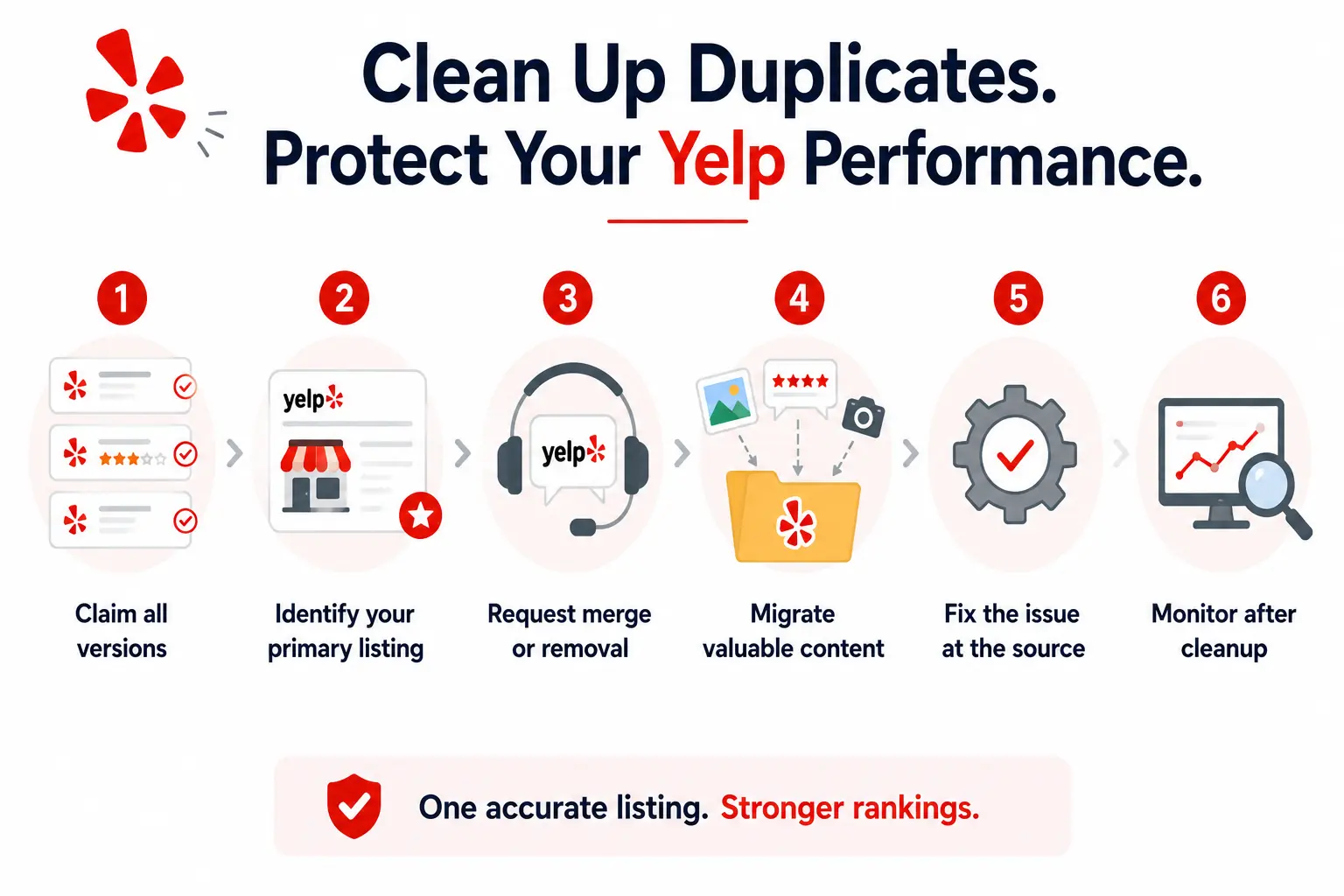
Cleaning up duplicates requires a methodical approach. Here’s exactly how to do it without losing your accumulated reviews or SEO value in the process.
- Claim all versions. You can’t properly manage what you don’t own. Go to Yelp for Business and claim every listing you find both your primary profile and any duplicates. This gives you the control needed to make changes.
- Identify your primary listing. Choose the listing you want to keep. This should be the one with the most reviews, the most accurate and complete information, and the longest history of activity.
- Request a merge or removal through Yelp Support. Submit a formal request via Yelp’s Support Center (yelp-support.com). Be specific: clearly identify which listing should be kept and which should be removed. Provide evidence that you own both and explain how the duplicate was created. Yelp’s support team typically responds within one to five business days.
- Migrate valuable content. Ask Yelp Support if reviews from the duplicate can be transferred to your primary listing this is sometimes possible and worth pursuing. Download photos and business content from the duplicate and re-upload them to your primary profile before removal.
- Fix the problem at the source. If data aggregators created the duplicate, correct your NAP information at the aggregator level platforms like Data Axle, Localeze, and Foursquare feed data to dozens of directories. Fixing it upstream prevents new duplicates from respawning.
- Monitor after cleanup. Duplicates have an annoying habit of reappearing, especially if the root cause hasn’t been addressed. Set a monthly calendar reminder to audit your Yelp presence for the first six months after cleanup.
Preventing Duplicate Yelp Listings Going Forward
The best duplicate is one that never gets created. Here’s how to build a system that keeps your listings clean long-term:
- Create a NAP master document. Even a simple spreadsheet works. Document your exact official business name, address, phone number, website, and hours. Make this the single source of truth that everyone employees, agencies, contractors must reference before touching any listing.
- Designate one listings owner. Only one person or one agency should have the authority to create or modify business listings. This eliminates the “too many cooks” problem entirely.
- Schedule quarterly citation audits. Put it on the calendar. A quarterly check using tools like BrightLocal or Moz Local takes less than an hour and catches new duplicates before they compound.
- Train new team members and agencies before they touch any platform. A five-minute onboarding conversation about your listing management policy is worth infinitely more than hours of cleanup later.
- Use a listing management tool for ongoing monitoring. Platforms like Yext, BrightLocal, and Moz Local can alert you when new listings appear or when your NAP data changes unexpectedly on any platform.
- For multi-location businesses: build an SOP. Create written standard operating procedures for how new location listings should be created, who approves them, and what information goes in each field. Consistency at scale requires process, not just good intentions.
FAQ
Can duplicate Yelp listings affect SEO?
Yes. Duplicate Yelp listings confuse search engines, split review signals, and create NAP inconsistencies that reduce your local search rankings and map pack visibility. Industry research suggests duplicates can lower local search visibility by up to 25%.
How do I find duplicate Yelp listings for my business?
Search your business name and city directly on Yelp, and run a Google search using “site:yelp.com [Business Name] [City]”. Citation tools like Moz Local, BrightLocal, and Whitespark can also detect duplicates across multiple directories automatically.
Does Yelp allow duplicate business listings?
No. Duplicate listings violate Yelp’s Terms of Service. Yelp recommends one listing per business location, and having multiple profiles for the same location can result in all your listings being removed entirely.
What happens to reviews when duplicate Yelp listings are merged?
When Yelp merges duplicate listings, reviews from both profiles are typically consolidated into the surviving listing. This is one of the most valuable outcomes of cleanup your total review count and authority increase without generating a single new review.
How long does it take to fix a duplicate Yelp listing?
Yelp’s support team typically responds within one to five business days. SEO improvements from cleanup can usually be seen within four to twelve weeks, though the timeline varies depending on how severely the duplicates have impacted your local authority.
Should I hire an agency to fix duplicate Yelp listings?
If you have duplicates across multiple platforms, complex NAP inconsistencies, or are worried about losing reviews during cleanup, working with an experienced local SEO agency is worth considering. They can handle the full audit, submission process, and long-term monitoring and ensure you don’t accidentally make things worse by deleting the wrong listing.
Conclusion
So, can duplicate Yelp listings affect SEO? Absolutely and they’re not just a minor inconvenience. They’re actively working against your local rankings, fragmenting your review authority, undermining customer trust, and handing your competitors an advantage every day they go unaddressed.
Here’s the part that surprises most business owners: fixing this is one of the faster SEO wins available to local businesses. You’re not starting from scratch you’re consolidating authority that already exists. When all of your reviews, engagement signals, and citation data are concentrated in one verified, accurate listing, search engines can finally do their job confidently. And they reward that clarity.
The best time to fix your duplicate listings was the day they appeared. The second-best time is right now before they cost you another month of visibility, customers, and rankings you should already have.