A B2B SEO audit is a systematic diagnostic of everything affecting your site’s visibility in organic search technical infrastructure, content quality, backlink authority, and how well your organic traffic actually converts. It tells you not just what’s broken, but what matters most to fix first.
Unlike consumer SEO, a B2B audit can’t be run off a generic template. The buying journey is longer. The decision-makers are multiple. The keywords are niche, low-volume, and high-intent. Get the audit wrong and you’ll spend six months optimising for traffic that never turns into pipeline.
This guide walks you through every layer of a proper B2B SEO audit what to look for, which tools to use, and how to turn findings into a prioritised action plan your team can actually execute.
Why B2B SEO Is a Different Beast Entirely
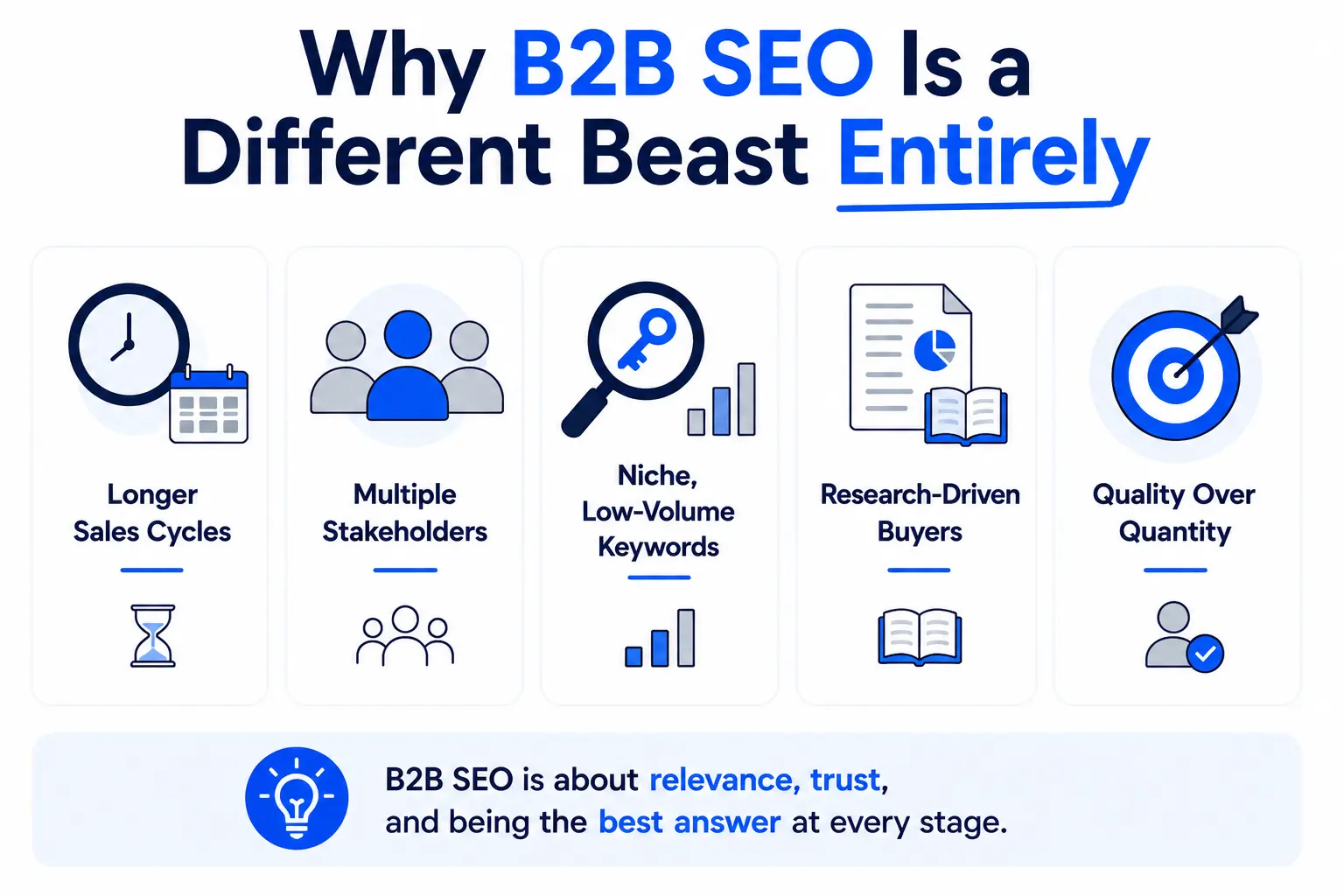
Before running an audit, it helps to understand why B2B SEO doesn’t respond to the same levers as B2C.
B2C brands chase volume. They want thousands of visitors and rely on scale to drive conversions. B2B companies don’t need millions of visitors they need the 300 procurement managers actively searching for solutions to problems their product solves. That difference changes everything.
In B2B:
- Sales cycles run weeks or months, not minutes. Your content needs to nurture, not just attract.
- Multiple stakeholders are involved. A CFO, a technical lead, and an end-user might all touch your site before a decision is made.
- Keywords are niche and low-volume. “ERP software for manufacturing” gets far fewer monthly searches than “best running shoes” but the deal value is incomparably higher.
- Buyers search like researchers. They read comparison guides, whitepapers, and case studies before they ever talk to sales.
Generic SEO advice ignores all of this. A B2B SEO audit has to account for it or it misses the point entirely.
5 Signs You Need a B2B SEO Audit Right Now
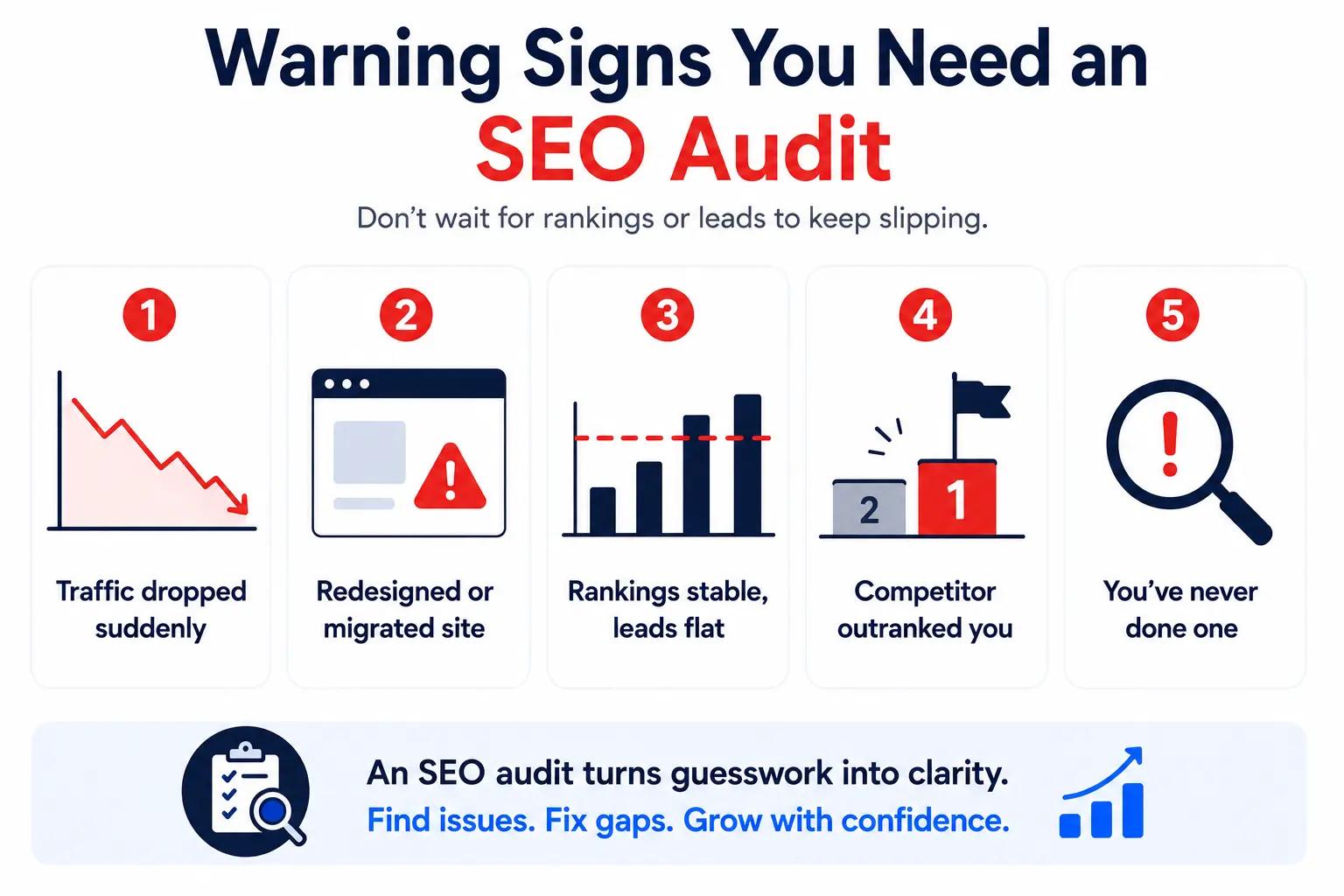
Some companies run audits proactively. Most wait for something to break. Here are the warning signs that you’ve already waited long enough.
- Organic traffic dropped with no obvious cause. Algorithm updates, technical regressions, and competitive shifts all erode rankings quietly. Without an audit, you’re guessing at the root cause and guessing wastes months.
- You redesigned or migrated your website. Redesigns are notorious SEO killers. Redirect chains break, meta data disappears, internal links point nowhere. An audit after any major site change is non-negotiable.
- Rankings are stable but leads are flat. This signals a conversion problem, not a visibility problem. The audit reveals where organic visitors fall out of the funnel.
- A competitor suddenly outranks you. When a rival takes keywords you once owned, understanding how is essential. They may have earned authoritative links, published deeper content, or fixed technical issues you still have.
- You’ve never done one. This is the most common and most costly situation. If your SEO strategy is built on assumptions rather than data, the audit doesn’t just find problems. It shows you everything you’ve been building on shaky ground.
The 4 Pillars of a Proper B2B SEO Audit
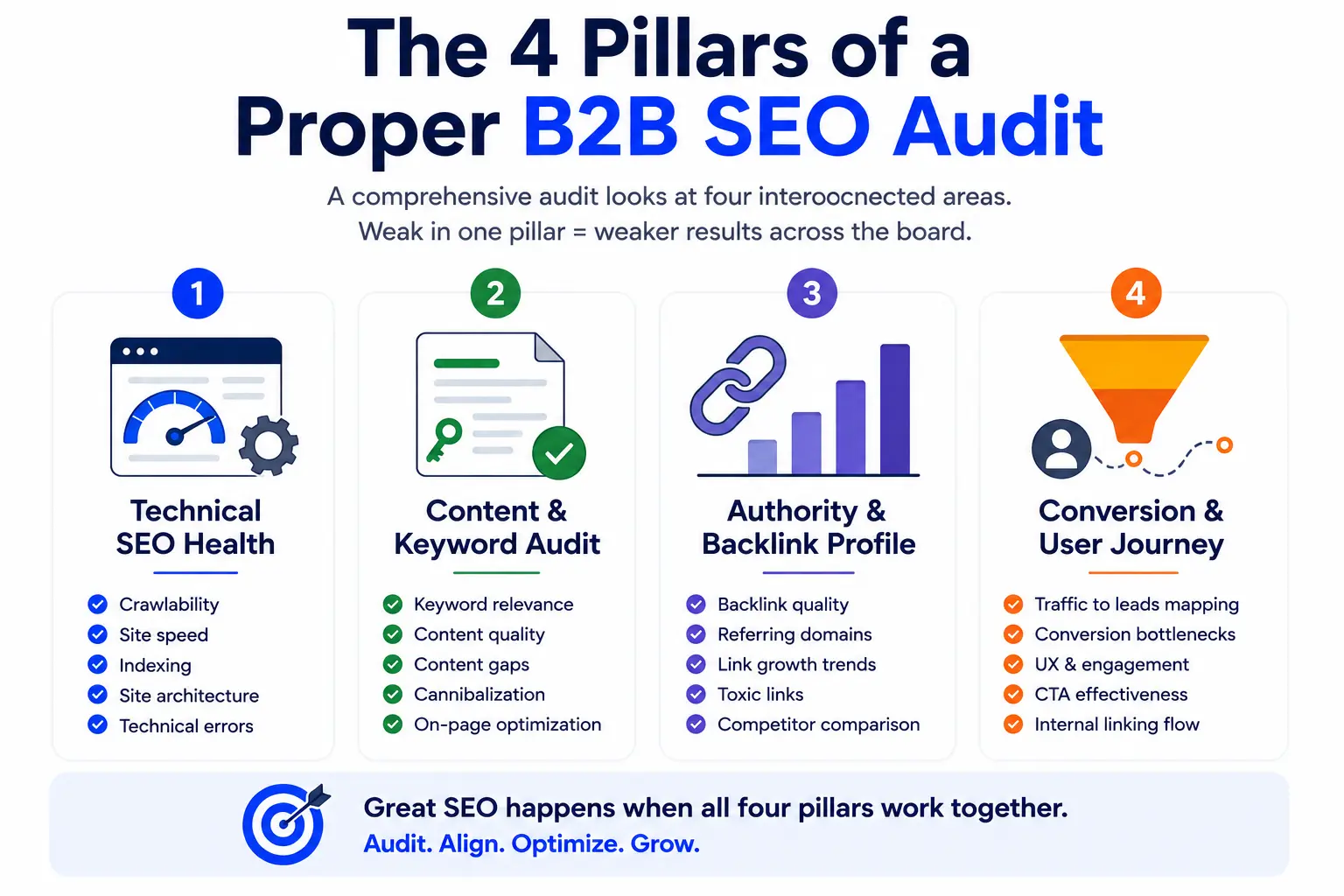
A comprehensive B2B SEO audit examines your site across four interconnected areas. Weakness in any one pillar undermines progress in the others. That’s the part most checklists don’t tell you you can’t just fix technical issues and expect rankings to recover if your content doesn’t deserve to rank.
Pillar 1: Technical SEO Health
Search engines need to crawl, render, and index your pages efficiently. Technical issues create friction at every step of that process, limiting how much of your content can actually appear in search results.
A technical audit covers:
- Site architecture and URL structure – is your most important content accessible within a few clicks from the homepage?
- Crawlability and robots.txt – are you accidentally blocking pages from search engine crawlers?
- Indexation status – which pages are actually indexed? Which important ones are missing?
- Core Web Vitals (LCP, CLS, FID) – Google uses these as ranking signals. Slow pages hurt rankings and drive visitors away.
- Redirect chains and broken links – every unnecessary hop in a redirect wastes crawl budget and dilutes link equity.
- Duplicate content and canonicalisation – multiple pages competing for the same query confuse search engines and split authority.
- Structured data (schema markup) – helps search engines understand your content and can earn rich snippets in results.
- Mobile-first indexing – Google primarily indexes the mobile version of your site. If yours isn’t optimised, your desktop efforts are only half as effective.
Many B2B sites accumulate technical debt silently over years of redesigns, CMS migrations, and plugin additions. Issues that seem minor in isolation, a slow-loading page here, a broken redirect there compound into significant ranking barriers over time.
Pillar 2: Content and Keyword Audit
Technical SEO gets you crawled and indexed. Content quality determines whether you actually rank and more importantly, whether the right buyers find you.
The content audit examines:
- Search intent alignment – are your pages matching what buyers actually mean when they type a query, or just the words themselves?
- Keyword targeting – are you using the language your buyers use, or internal terminology that nobody searches for?
- Content quality and depth – does each page genuinely answer the question better than what’s currently ranking?
- Keyword cannibalization – multiple pages targeting the same keyword split authority and confuse search engines. The audit identifies which URL should win and consolidates the rest.
- Content decay – a blog post published two years ago with outdated statistics is actively hurting you. Fresh, accurate content is a ranking signal.
- Topic cluster gaps – what are your competitors ranking for that you don’t cover? These gaps represent direct pipeline opportunities.
- E-E-A-T signals – Experience, Expertise, Authoritativeness, Trust. Author bios, linked sources, case studies, and credentials all contribute.
B2B content fails for predictable reasons. Teams create bottom-funnel product pages but neglect the educational content that builds awareness. They publish once and never revisit, allowing content to decay as markets evolve. They target broad keywords that attract the wrong audience entirely.
Pillar 3: Authority and Backlink Profile
Links from other websites remain one of the strongest ranking signals Google uses. But link building in B2B requires different tactics than consumer markets, and a different lens during the audit.
This level of structured evaluation is also reflected in enterprise decision-making systems, where teams use procurement analytics software to assess supplier performance, spending efficiency, and strategic sourcing opportunities.
The authority audit evaluates:
- Backlink profile size and growth trajectory – is your domain authority growing, stagnant, or declining?
- Referring domain quality and relevance – 10 links from respected industry publications beat 200 links from irrelevant directories.
- Anchor text distribution – over-optimised anchor text (too many exact-match keywords) can trigger algorithmic penalties.
- Toxic and spammy links – low-quality links from irrelevant or penalised sites can drag your rankings down. These need identifying for disavow.
- Competitor link gap – which authoritative sites link to your competitors but not to you? These are your highest-priority outreach targets.
B2B companies often underinvest in link building because traditional tactics feel misaligned with professional positioning. Spammy guest posts and link exchanges don’t belong in a B2B strategy. The audit instead identifies legitimate authority-building opportunities: industry publication bylines, research citations, partner ecosystems, and executive visibility content.
Pillar 4: Conversion and User Journey
Traffic without conversion is just vanity metrics. The final pillar examines how organic visitors move through your site – and where they drop off before ever becoming a lead.
This covers:
- Landing page experience for key organic entry points — do these pages have a clear next step?
- CTA placement and messaging – is the call-to-action visible without scrolling, and does it match what the visitor is looking for?
- Form friction – every unnecessary field on a form reduces completion rates. The audit identifies where forms can be simplified.
- Conversion rate by landing page – some organic pages drive significant traffic but zero conversions. That’s a content-intent mismatch.
- Content-to-lead attribution – which blog posts, guides, and landing pages appear in the path to a demo request?
B2B conversion journeys are rarely linear. A prospect might read three blog posts, download a guide, attend a webinar, and return via branded search before requesting a demo. The audit maps these paths to ensure your SEO efforts connect to actual pipeline not just traffic.
How to Run a B2B SEO Audit: Step-by-Step
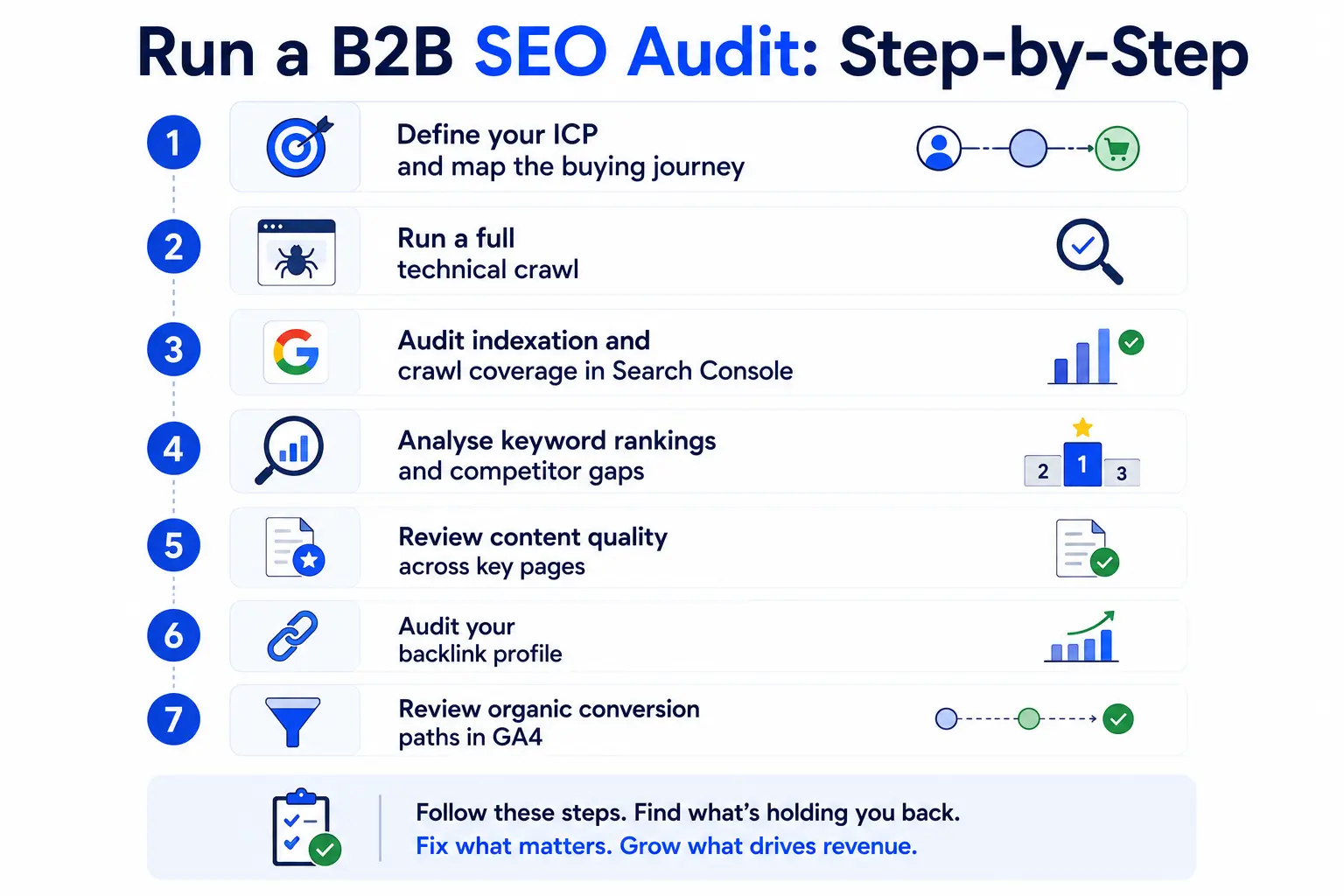
Here’s the order that works. Each step builds on the previous, so don’t skip ahead.
- Define your ICP and map the buying journey. Before touching a tool, get clear on who you’re targeting, how they search, and what content they need at each stage (awareness, consideration, decision). Keywords follow people, not products.
- Run a full technical crawl. Use Screaming Frog (free up to 500 URLs, paid beyond that) or Sitebulb. Export all URLs and flag: 4xx and 5xx errors, redirect chains (3+ hops), missing or duplicate meta titles and descriptions, pages blocked by robots.txt, and slow-loading resources.
- Audit indexation and crawl coverage in Search Console. Navigate to the Coverage report in Google Search Console. Identify: valid indexed pages, excluded pages (and why), pages with errors. Are your highest-value service and landing pages actually indexed?
- Analyse keyword rankings and competitor gaps. Pull your current ranking URLs from Search Console’s Performance report. Cross-reference with Ahrefs or SEMrush’s Keyword Gap tool against 3 direct competitors. Map every keyword opportunity to a funnel stage: top-of-funnel (awareness), middle (consideration), bottom (decision).
- Review content quality across key pages. Flag thin pages (under 300 words targeting competitive queries), cannibalised URLs competing for the same keyword, outdated data or discontinued product references, missing author bios or credentials (E-E-A-T signals), and pages with high impressions but low click-through rates.
- Audit your backlink profile. Export your full backlink profile from Ahrefs or SEMrush. Identify toxic or irrelevant links for potential disavow, your highest-authority referring domains, and the sites linking to competitors but not to you, these become your outreach priority list.
- Review organic conversion paths in GA4. Filter sessions by organic source. Review goal completions (form submissions, demo requests) by landing page. Identify high-traffic pages with zero or near-zero conversions, these are your highest-leverage CRO opportunities.
B2B SEO Audit Tools You’ll Actually Use
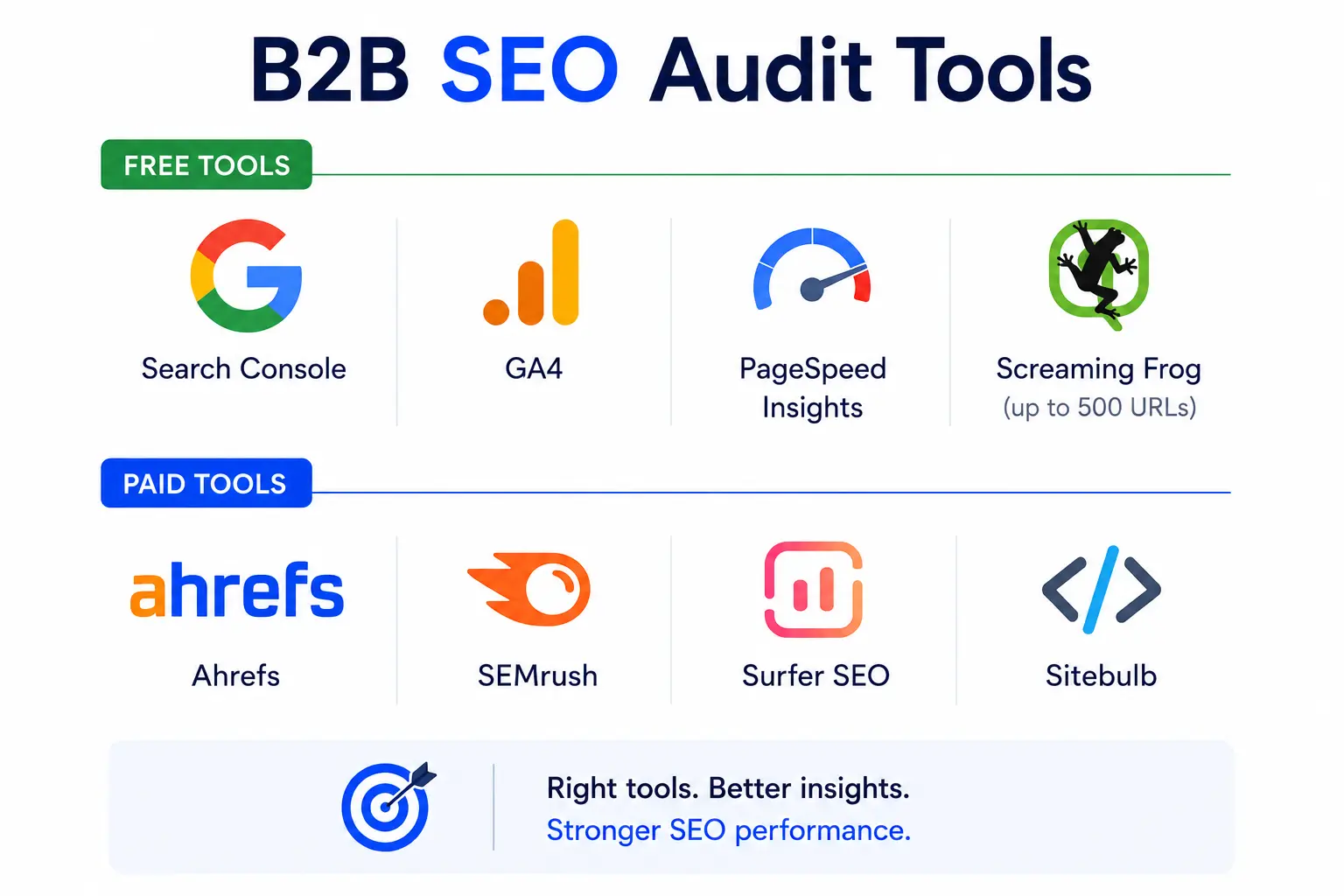
You don’t need every tool on the market. Here’s what actually moves the needle at each stage.
Free Tools
- Google Search Console – indexation, ranking queries, Core Web Vitals, link data. Start here, always.
- Google Analytics 4 – organic traffic, conversion paths, goal completions by landing page.
- PageSpeed Insights – Core Web Vitals data and specific improvement recommendations.
- Screaming Frog SEO Spider (free, up to 500 URLs) — technical crawl for errors, redirects, missing meta.
Paid Tools (Worth It at Scale)
- Ahrefs – keyword gap analysis, backlink auditing, content explorer, rank tracking. The gold standard for B2B SEO research.
- SEMrush – similar to Ahrefs, with strong competitor analysis and site audit features.
- Surfer SEO – content optimisation against top-ranking pages, useful for the content audit stage.
- Sitebulb – visual crawl reports, especially useful for larger or more complex B2B sites.
For most B2B sites in the early stages of an audit, Google Search Console, PageSpeed Insights, the free version of Screaming Frog, and one paid SEO platform covers the vast majority of what you need. Don’t let tool costs become the reason you delay starting.
Turning Audit Findings Into a Prioritised Action Plan
An audit sitting in a shared drive helps no one. The real value is in what happens next — and in being disciplined about the order you tackle things.
Quick Wins (1–2 Weeks)
These are changes that require minimal effort but deliver immediate, measurable impact:
- Fix broken links and redirect chains
- Add missing or duplicate meta descriptions to high-traffic pages
- Resolve canonical issues on duplicate or near-duplicate pages
- Improve Core Web Vitals on your top 5 organic landing pages
- Submit updated XML sitemap to Search Console
Quick wins build momentum and demonstrate value to stakeholders. They also free up crawl budget and remove friction — amplifying the impact of the larger initiatives that follow.
Medium-Term Projects (1–3 Months)
- Create new pages targeting identified keyword gaps (mapped to your buying journey)
- Consolidate thin or cannibalised content, combine weaker pages into stronger, more comprehensive ones
- Rebuild internal linking to strengthen your topic clusters
- Update decayed content with current data, examples, and statistics
- Improve CTAs and form design on high-traffic, low-conversion pages
Long-Term Initiatives (3–6 Months+)
- Systematic link acquisition: industry publications, partner content, research citations
- Executive thought leadership content to build brand authority in search
- Full topic cluster buildout for your core product or service areas
- Entering new keyword verticals as adjacent buying journeys are identified
How Often Should You Run a B2B SEO Audit?
A comprehensive B2B SEO audit every 12–18 months keeps your strategy aligned with market shifts, algorithm changes, and competitive movements.
Between full audits:
- Technical spot checks (crawl errors, indexation, Core Web Vitals) every 3–6 months
- Keyword ranking reviews monthly to catch early declines
- Backlink monitoring monthly via Search Console or Ahrefs alerts
Run an unscheduled audit immediately after any of the following:
- A website redesign or domain migration
- A significant Google Core Algorithm Update
- Sudden, unexplained traffic loss
- A major competitor entering or investing heavily in your keyword space
- Launching a new product line or entering a new market
SEO compounds in both directions. Consistent, data-driven investment builds authority that becomes increasingly difficult for competitors to overcome. Neglect accumulates debt that becomes increasingly expensive to reverse.
FAQ
What is a B2B SEO audit and why does it matter?
A B2B SEO audit reviews the key factors affecting your website’s organic search performance including technical SEO, content, backlinks, and user experience. It matters because it identifies what’s limiting rankings, traffic, and lead generation, helping you focus on improvements that actually drive business growth.
How long does a B2B SEO audit take?
The timeline depends on website size and complexity. Most mid-sized B2B websites can be audited in 2–4 weeks, while larger enterprise sites may take longer. A proper audit requires time for technical analysis, content review, and competitor research.
Can I run a B2B SEO audit myself, or do I need an agency?
You can perform a basic SEO audit yourself using tools like Google Search Console and PageSpeed Insights. However, an experienced B2B SEO agency or specialist can provide deeper insights, better prioritisation, and strategic recommendations that often lead to faster results.
What is the difference between a technical SEO audit and a full B2B SEO audit?
A technical SEO audit focuses only on website infrastructure issues like crawlability, indexing, site speed, and redirects. A full B2B SEO audit goes further by analyzing content strategy, keyword targeting, backlinks, and conversion opportunities alongside technical performance.
How much does a B2B SEO audit cost?
B2B SEO audit pricing varies based on the site size and scope of analysis. Basic audits may cost a few hundred dollars, while comprehensive audits from experienced agencies can range from a few thousand to much higher for enterprise-level websites.
Conclusion
Every month without clarity on your SEO performance is another month of misallocated resources. Content teams create pages that won’t rank. Development prioritises features over fixes that would unlock traffic. Competitors capture leads that should be flowing to you.
The companies that win in organic search aren’t always those with the biggest budgets or the largest teams. They’re the ones who understood their starting position, identified the highest-leverage opportunities, and executed systematically. That clarity starts with a B2B SEO audit.
Run it once and you’ll know exactly where you stand. Run it consistently and you’ll build the kind of compounding organic presence that your competitors will struggle to replicate.
That’s not a small advantage. In B2B, where deals are large and sales cycles are long, being the brand a buyer finds first and trusts most is often the difference between winning and losing the deal.