You’ve published content, built links, and tweaked meta tags – yet you’re still stuck on page two. Sound familiar?
Most websites don’t fail because of some missing secret trick. They fail because they’re dropping the ball on multiple basics at once. Google evaluates hundreds of signals simultaneously, and weakness in any area holds you back.
That’s exactly what this Google ranking factors SEO checklist is for a clear, actionable breakdown of what actually moves the needle in 2026. Let’s get into it.
What Are Google Ranking Factors?
Google ranking factors are the signals and criteria Google’s algorithm uses to decide where your page shows up in search results. Think of them as Google’s internal grading system for every page on the internet helping search engines determine relevance, quality, and authority, factors that many SEO Tools analyze to improve website performance and rankings.
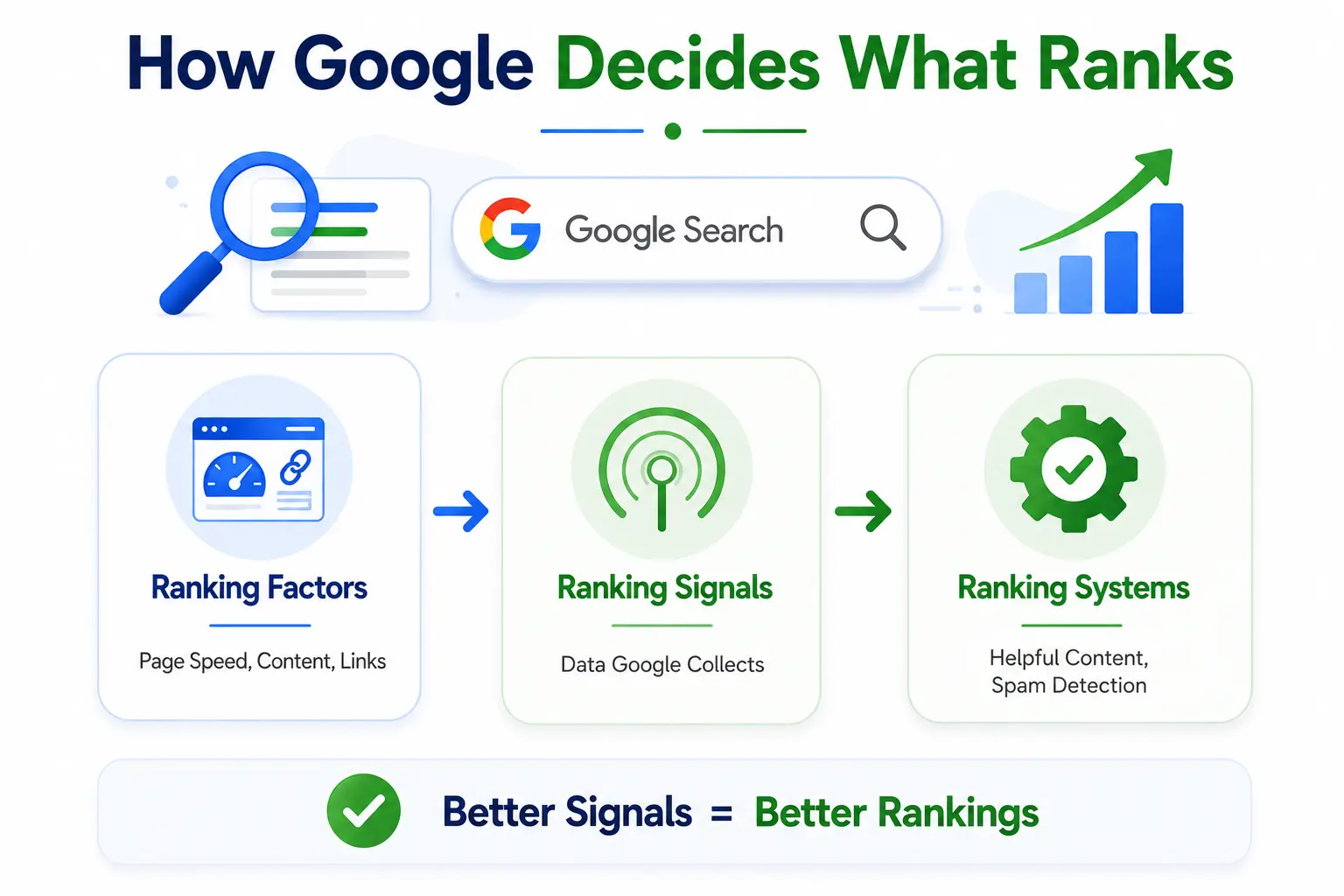
Before diving into the checklist, it helps to understand three terms that often get mixed up:
- Ranking Factors – Specific elements Google evaluates (e.g., page speed, backlinks, content quality)
- Ranking Signals – Data points Google collects from these factors to evaluate a page
- Ranking Systems – The algorithmic systems (like HelpfulContent or SpamBrain) that process and weigh those signals
Google has never published a definitive list of its ranking factors, but years of industry research, algorithm experiments, and Google’s own documentation have given us a clear picture of what matters most.
Here’s a snapshot of the top-weighted factors according to FirstPageSage’s 2026 research:
| Ranking Factor | Estimated Weight |
| Keyword Usage in Meta Titles | 18.6% |
| Searcher Engagement | 18.2% |
| Domain Trustworthiness | 15.2% |
| Mobile-Friendliness | 12.1% |
| Page Speed | 10.7% |
Source: FirstPageSage 2026 Ranking Factors Study
Now let’s turn these insights into a checklist you can actually use.
The Google Ranking Factors SEO Checklist
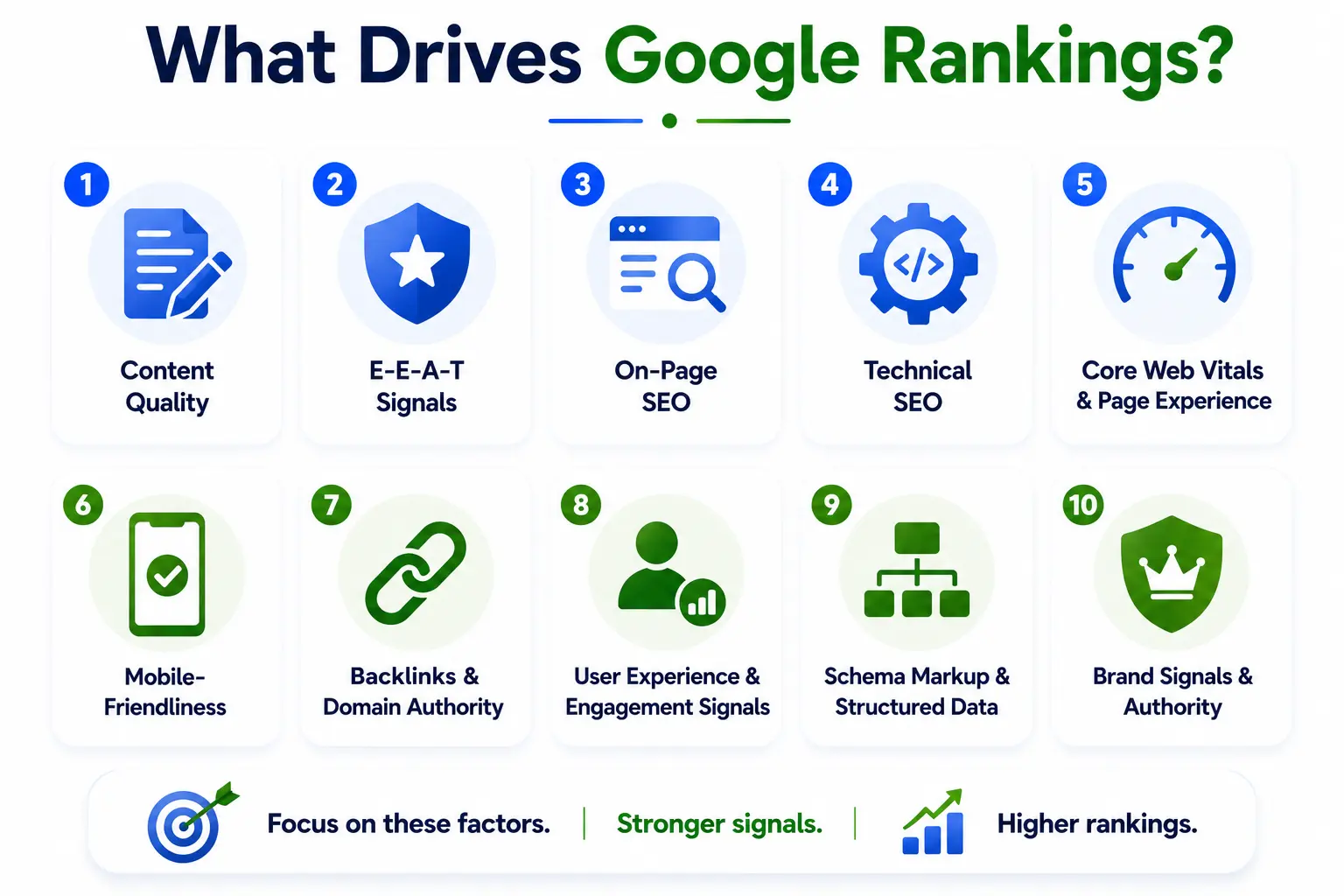
This checklist is organized into 10 core areas. Work through them in order start with the ones that have the biggest impact and build from there.
1. Content Quality
Content quality is the foundation everything else is built on. Google’s job is to match searchers with the most helpful, relevant answer – and if your content doesn’t deliver that, no amount of technical optimization will compensate.
Great content in 2026 isn’t just long – it’s genuinely useful. It directly answers the search query, covers the topic in depth, and offers something the reader can’t easily find elsewhere.
- Content fully matches the search intent (informational, navigational, or transactional)
- Offers original insights, firsthand experience, or unique data – not just recycled information
- Covers the topic comprehensively without unnecessary padding
- Minimum 1,000+ words for competitive topics; longer if the topic demands it
- Written in a clear, conversational tone that real people enjoy reading
- Refreshed periodically to reflect current information and trends
2. E-E-A-T Signals (Experience, Expertise, Authoritativeness, Trustworthiness)
E-E-A-T isn’t a direct ranking factor with a score you can measure – but it shapes how Google’s quality raters and AI systems evaluate your content over time. Pages that demonstrate real expertise and build genuine trust consistently outperform those that don’t.
This matters especially for topics in health, finance, legal, and any niche where bad information could genuinely harm someone.
- Author bio is visible, includes credentials, and links to their professional profile
- Original research, case studies, or firsthand experience is woven into the content
- Claims are backed by citations from authoritative, reputable sources
- Website has a clear About page, Contact information, and editorial standards
- Positive reviews, testimonials, or third-party mentions are visible on or off the site
- Content is regularly audited and updated – no outdated or inaccurate claims
3. On-Page SEO
On-page SEO is how you communicate relevance to Google. It’s placing the right signals in the right places so Google’s crawlers instantly understand what your page is about – and for whom.
The goal isn’t to stuff keywords everywhere. It’s to make your page’s purpose crystal clear without it feeling unnatural to a real reader.
- Target keyword appears in the meta title, ideally front-loaded
- Target keyword is in the H1 heading
- Keyword appears naturally within the first 100 words of the content
- Meta description is under 160 characters and includes the keyword naturally
- URL slug is short, readable, and contains the target keyword
- H2 and H3 headings are used logically to organize content – not just for keyword stuffing
- Internal links point to related, relevant pages on your site
- Outbound links reference authoritative, credible external sources
- Images have descriptive alt text with keywords where relevant
- LSI (Latent Semantic Indexing) and related terms are used naturally throughout the content
4. Technical SEO
You can write the most brilliant content in the world – but if Google can’t find, crawl, or index your page, it simply won’t rank. Technical SEO removes the invisible barriers that block your content from being seen.
Think of it as plumbing. Nobody sees it, but nothing works without it.
- XML sitemap is created and submitted to Google Search Console
- Robots.txt file is correctly configured – not accidentally blocking important pages
- HTTPS is enabled across the entire site (SSL certificate active)
- No broken links or redirect chains that could slow down crawling
- Canonical tags are in place to handle duplicate or similar content
- Structured data / Schema markup is implemented correctly
- Crawl errors in Google Search Console are resolved
- Site architecture is flat – most pages within 3 clicks of the homepage
- URL structure is clean, logical, and free of unnecessary parameters
- Pagination is handled correctly for multi-page content
5. Core Web Vitals & Page Experience
Core Web Vitals are Google’s way of measuring how it actually feels to use your website – not just whether it loads, but how smooth and responsive it is for real users.
Google updated its Core Web Vitals framework in 2026, making Interaction to Next Paint (INP) a primary metric alongside the existing LCP and CLS signals. If your scores are in the red, you’re actively losing rankings to faster, smoother competitors.
- LCP (Largest Contentful Paint) is under 2.5 seconds
- INP (Interaction to Next Paint) is under 200ms
- CLS (Cumulative Layout Shift) score is under 0.1
- Server response time (TTFB) is fast – ideally under 800ms
- No intrusive pop-ups or interstitials that block the main content on mobile
- Safe browsing status is clean no malware or deceptive content flagged
- Pages tested using Google PageSpeed Insights and scored
6. Mobile-Friendliness
Mobile-first indexing has been Google’s default since 2019. That means Google primarily uses the mobile version of your site to determine rankings – even for desktop searches.
If your mobile experience is clunky, slow, or hard to navigate, you’re not just losing mobile visitors — you’re actively hurting your overall rankings.
- Website uses a fully responsive design that adapts to all screen sizes
- Tap targets (buttons, links) are properly spaced – no accidental mis-taps
- Text is readable without pinching or zooming
- No horizontal scrolling required on any device
- Tested and passed Google’s Mobile-Friendly Test tool
- Mobile page speed is specifically tested – not just desktop
7. Backlinks & Domain Authority
Backlinks remain one of the most powerful ranking signals Google uses. A link from a reputable, relevant website is essentially a vote of confidence – it tells Google that other people in your industry trust your content.
The key word is quality. One link from a highly authoritative, genuinely relevant site is worth more than 100 links from low-authority, unrelated domains.
- Backlinks come from relevant, high-authority domains in your niche
- Anchor text is varied and natural – not the same keyword repeated every time
- No toxic, spammy, or unnatural links pointing to your site (use Disavow Tool if needed)
- Link-worthy content assets exist on your site: original research, tools, in-depth guides
- Active outreach strategy in place: guest posts, digital PR, expert quotes
- Competitor backlink profiles are analyzed to identify link opportunities
8. User Experience & Engagement Signals
Google measures user satisfaction in subtle but powerful ways. When visitors land on your page, stay, read, and engage – that’s a positive signal. When they bounce back to the search results immediately, that tells Google your page didn’t deliver what they needed.
Strong engagement signals amplify every other factor on this checklist. Great content ranks better when users actually enjoy consuming it.
- Content above the fold is immediately engaging – no excessive intros or fluff
- Table of contents is included for long-form articles
- Visual elements (images, infographics, videos) break up the text and add value
- Font size and line spacing are comfortable to read on all devices
- Navigation is intuitive – users can find what they need without confusion
- Related posts or internal links keep users exploring your site
- Page layout is clean – no aggressive ads, pop-ups, or distracting clutter
9. Schema Markup & Structured Data
Schema markup is code you add to your pages to help Google understand your content at a deeper level. It doesn’t directly boost rankings, but it can dramatically improve how your page appears in search results – earning rich snippets, FAQ dropdowns, star ratings, and even AI Overview inclusions.
In 2026, structured data is increasingly important for visibility in AI-generated answers and featured snippets – making it a high-value item on this checklist.
- Article or BlogPosting schema is implemented for editorial content
- FAQ schema is added for Q&A sections to earn dropdown rich results
- Breadcrumb schema is in place for improved navigation display in SERPs
- Review or Rating schema used where applicable (products, services, tools)
- HowTo schema added for step-by-step instructional content
- Schema is validated using Google’s Rich Results Test tool
10. Brand Signals & Authority
Google rewards entities that demonstrate consistent, real-world authority. Brand signals help Google understand that your website represents a legitimate, trusted organization — not just a faceless content farm.
This is especially relevant as Google increasingly uses entity-based understanding to evaluate websites in the context of AI-powered search.
- NAP (Name, Address, Phone number) is consistent across all directories and listings
- Active, linked social media profiles reinforce brand identity
- Brand name search volume is growing (more people searching for you directly)
- Unlinked brand mentions appear on reputable sites — consider claiming them
- Google Business Profile is fully optimized (for local businesses)
- Wikipedia or Wikidata entry exists if the brand is large enough
How to Prioritize This Checklist
Not everything can be fixed overnight – and trying to do everything at once usually means nothing gets done properly. Here’s the recommended priority order, based on how Google’s systems actually evaluate pages:
| Step | Focus Area | Why It Matters |
| 1 | Technical SEO | Fix crawl/index blockers first – everything else is pointless if Google can’t access your pages |
| 2 | Search Intent Match | Content that doesn’t match intent won’t rank, no matter how well-optimized it is |
| 3 | E-E-A-T Signals | Trust compounds over time – author credentials, citations, and original insights all help |
| 4 | On-Page Optimization | Keywords in the right places send clear relevance signals to Google’s algorithm |
| 5 | Core Web Vitals | Poor page experience hurts rankings directly – fix LCP, INP, and CLS scores |
| 6 | Backlink Building | High-quality links from authoritative sites remain one of the strongest ranking signals |
Think of it this way: technical issues are blockers, content is the foundation, and links are the amplifier. Fix the blockers first, build the foundation strong, then amplify with authority.
Common SEO Mistakes to Avoid
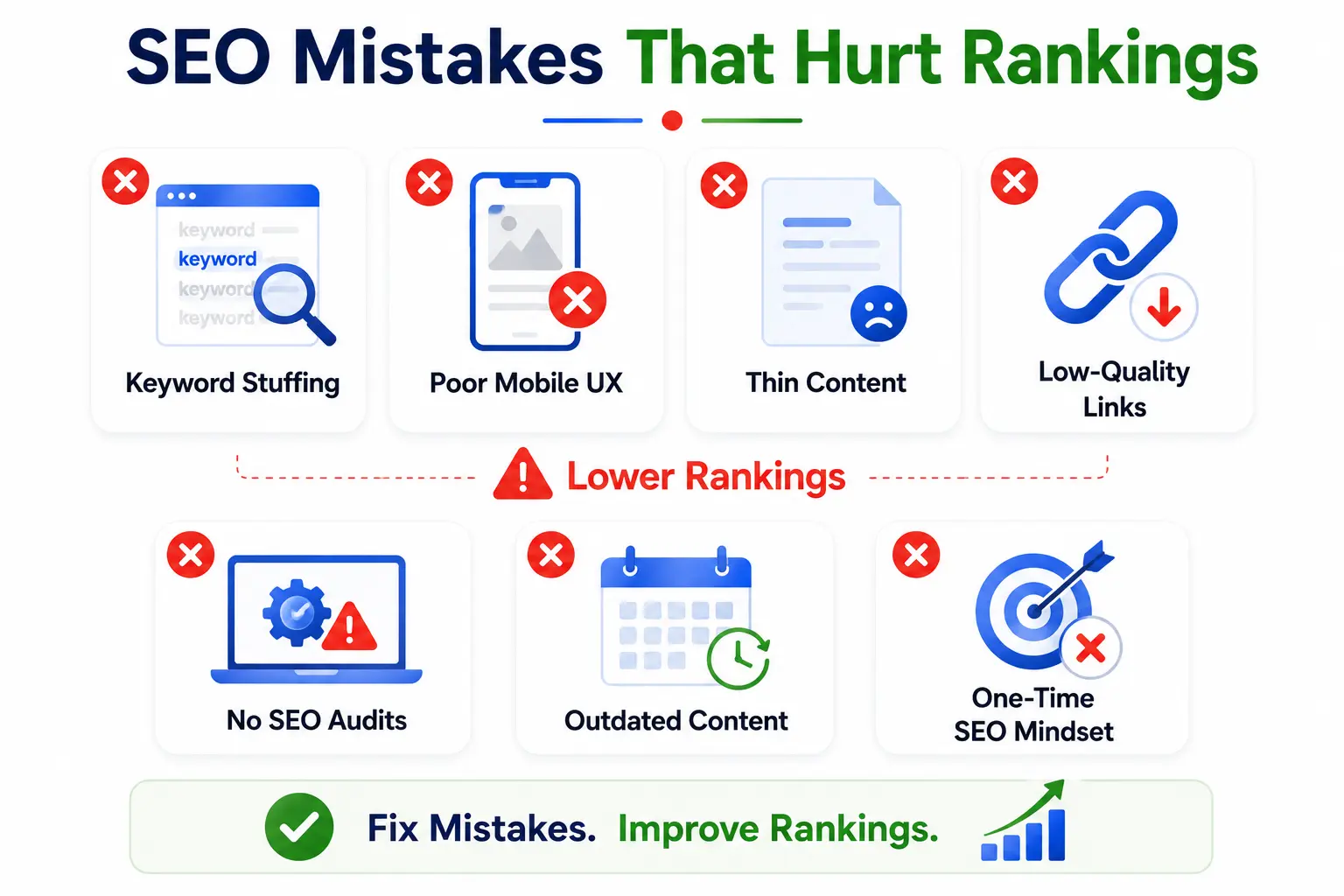
Knowing what to do is half the battle. Knowing what not to do can save you from months of wasted effort — or worse, a manual penalty from Google.
- Keyword stuffing – Forcing keywords unnaturally ruins readability and gets penalized
- Ignoring mobile UX – A poor mobile experience directly damages your rankings
- Publishing thin content – Short, shallow pages rarely rank for competitive terms
- Chasing backlink quantity over quality – 100 bad links hurt more than they help
- Skipping technical SEO audits – Hidden crawl and indexing issues silently cap your potential
- Never updating old content – Stale articles lose rankings to fresher, more accurate competitors
- Treating SEO as a one-time project – Search optimization requires ongoing attention and adaptation
Essential Tools for Tracking Google Ranking Factors
You can’t improve what you can’t measure. These tools will help you monitor, audit, and track every factor on this checklist:
| Tool | Best For |
| Google Search Console | Crawl errors, index coverage, keyword performance, Core Web Vitals |
| Google PageSpeed Insights | Core Web Vitals scores and specific performance improvements |
| Ahrefs / Semrush | Backlink analysis, keyword research, competitor gap analysis |
| Screaming Frog | Full technical site audit — broken links, redirects, missing tags |
| Google’s Rich Results Test | Validating structured data and Schema markup |
| Google Mobile-Friendly Test | Testing and diagnosing mobile usability issues |
FAQ
Q: What are the most important Google ranking factors in 2026?
A: The most critical factors are content quality, E-E-A-T signals, backlinks, Core Web Vitals, mobile-friendliness, and on-page optimization. According to FirstPageSage’s 2026 research, keyword usage in meta titles (18.6%) and searcher engagement (18.2%) carry the heaviest weight in the algorithm.
Q: How many Google ranking factors are there?
A: Google uses 200+ ranking signals, but most SEO experts agree that a much smaller cluster of factors drives the majority of ranking outcomes. Rather than trying to optimize for all 200, focus on the core pillars: content quality, trust, authority, and technical performance.
Q: Is page speed a Google ranking factor?
A: Yes, page speed is a confirmed ranking factor. Google’s Core Web Vitals — including LCP, INP, and CLS — directly impact your search rankings. Slow, unstable pages drag down your visibility even when other factors are strong.
Q: How often should I update my SEO checklist?
A: Ideally every 6 months, or after any major Google algorithm update. SEO is not a one-time task — search algorithms evolve, competitors improve their pages, and your own content naturally becomes stale over time. Regular audits keep you ahead.
Q: Does social media affect Google rankings?
A: Social media is not a direct Google ranking factor. However, a strong social presence helps amplify your content, build brand signals, and attract natural backlinks from people who discover your content through social channels — all of which indirectly influence your rankings.
Q: What is E-E-A-T and why does it matter?
A: E-E-A-T stands for Experience, Expertise, Authoritativeness, and Trustworthiness. It’s the framework Google’s quality raters use to evaluate content quality, and it informs how the algorithm rewards or demotes pages. Sites with strong E-E-A-T signals consistently outperform those without — especially in competitive niches.
Conclusion
Ranking on Google in 2026 isn’t about finding tricks or hacking the algorithm. It’s about consistently delivering what search engines and real users actually want: helpful content, a smooth experience, and a trustworthy brand.
This Google ranking factors SEO checklist isn’t meant to be done once and forgotten. The websites that consistently rank at the top treat SEO as an ongoing process – auditing regularly, improving continuously, and building authority steadily over time.
Start with your technical foundation. Make sure Google can access and understand your pages. Then build content that genuinely earns its ranking. From there, grow your authority through real backlinks and a trusted brand presence.