
If you have tried to get more people to visit your website from search engines you know that links from websites are still very important to Google. The hard part is finding a way to get these links that’s safe and actually helps your website. That is where SERP Insight Guest Post comes in. It is a way of guest posting that uses websites that have high standards and creates content that people want to read.
This guide will tell you what SERP Insight Guest Post is and how it works. It will also show you how to choose a website for guest posting and what mistakes to avoid. If you have a website by yourself or if you work for a company that helps websites get more visitors you will learn how to use guest posting in a good way by the end of 2026. SERP Insight Guest Post is a way to get links from other websites and it can really help your website.
What Is SERP Insight Guest Post?
A SERP Insight guest post is a strategic SEO technique that involves analyzing top-ranking search results to uncover content gaps. Instead of creating generic guest post pitches, you develop a highly authoritative and value-focused article that aligns with what search engines are currently rewarding. This approach helps attract natural backlinks while strengthening your website’s topical authority.
They do not just send emails to a lot of low quality blogs. First they check the websites to see if they are good. They look at how many people visit the website if the website is related to their content and if the website has a lot of spam.
The goal of the SERP Insight Guest Post is not just to get a link to their website. They want to get a link that a real person who runs a website would approve of. This is what makes guest posting different from buying links. The SERP Insight Guest Post service does guest posting the way.
How It Works
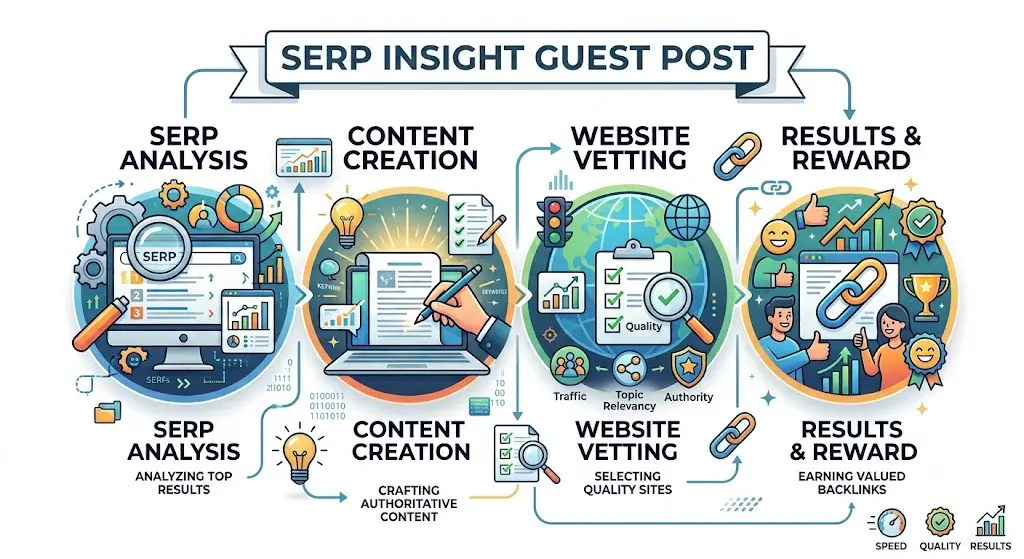
The basic idea is really simple: you choose a publisher that’s relevant to your niche, you write a really useful article or you pay someone to write it for you. You get the article approved by the people in charge of the website and then you get a link to your website in the article. You can see how everything is working because you get reports that show you where your link is and how it is doing.
When you actually start doing it you will see that most of the work happens before you even start writing. You need to check how many people visit the website you need to see who else has written articles for them and you need to make sure they allow links to websites. You have to do all of this because this is where most people make mistakes when they are trying to get their articles on other websites.
Who Should Use It
SERP Insight Guest Post works best for site owners, in-house marketers, and agencies who want link building that can survive a Google algorithm update. It’s a good fit if you’re building topical authority in a specific niche, launching a new site that needs credible early signals, or diversifying a backlink profile that’s leaned too heavily on one tactic.
It’s less useful as a shortcut. If you’re looking for the cheapest, fastest volume of links, this approach will feel slow and that’s by design.
How to Plan a SERP Insight Guest Post
The planning stage is where SERP Insight guest posting differs the most from traditional guest posting methods. Instead of relying on assumptions, every decision is guided by real search data and current SERP analysis.
Step 1: Map the Search Intent
Begin by searching your target keyword and reviewing the top five to ten results to identify their primary search intent. Determine whether they are informational guides, commercial comparisons, tutorials, or step-by-step articles. For example, if most of the ranking pages are how-to guides, pitching a thought leadership article is unlikely to perform well. Your content format should align with the type of content Google is already rewarding for that keyword.
Mapping search intent helps you avoid one of the biggest guest posting mistakes creating content that doesn’t match what users are actually looking for. Even an exceptionally written article may struggle to rank if it addresses the wrong question or uses a format that doesn’t align with search intent.
Step 2: Build a Gap Map
Carefully analyze the top-ranking articles and look for three types of content opportunities. First, identify missing sections where important subtopics haven’t been covered. Second, find areas that are only briefly explained and could benefit from additional steps, examples, or practical guidance. Third, look for outdated recommendations that rely on old tools, obsolete strategies, or no longer reflect current SEO practices.
Your guest post succeeds by filling at least one of these gaps with meaningful, original value. There’s no need to recreate everything that’s already available. Instead, focus on contributing something unique and genuinely helpful that existing content fails to provide. Although many ranking pages appear comprehensive at first glance, a closer review often reveals valuable opportunities for improvement.
When creating your prospect list, make sure to verify each website’s authority before reaching out. A free Domain Rating checker can help you eliminate low-DR websites and focus your outreach efforts on higher-quality opportunities.
Step 3: Score for Editorial Fit
Before pitching your article to any publication, evaluate your topic using five criteria, scoring each on a scale from one to five. Consider whether the audience is genuinely interested in the topic, whether your angle aligns with current page-one search results, whether you’re adding an original framework, checklist, or data point, whether the backlink fits naturally as a helpful citation, and whether you can reference two or three relevant articles already published on the host website through internal links.
Aim for a total score of 18 or higher out of 25. This benchmark helps eliminate opportunities that may result in a published article but provide little long-term SEO value. A guest post scoring around 15 may still earn a backlink, but it’s far less likely to rank well, attract meaningful traffic, or make a lasting impact on your backlink profile.
Why Guest Posting Still Matters for SEO
A lot of people ask whether guest posting is “dead.” It isn’t, but the version that still works looks very different from the guest posting of a decade ago. Google’s own guidance on link spam has made low-effort guest posts far less effective, while high-quality, editorially-placed content keeps performing.
Editorial Backlinks
An editorial backlink is a link placed because an editor genuinely thinks it adds value for readers, not because someone paid for a slot on a link farm. These are the links Google’s algorithm is designed to reward, since they act as a vote of confidence from one site to another.
Editorial links are harder to get, which is exactly why they carry more weight. A site that has to approve your content before publishing is signaling that the link passed some kind of quality bar.
Authority Building
Publishing on respected sites in your niche builds what SEOs call topical authority, the sense, from Google’s perspective, that your site is a credible source on a given subject. Each relevant guest post adds another data point supporting that theme.
Over time, this compounds. A handful of guest posts on strong, relevant sites will usually do more for your authority than dozens of posts on unrelated, low-quality domains.
Brand Visibility
Guest posting is a way to get your name and your brand out there. It puts your brand in front of people who already trust the person who is publishing the post. These people may not click on your link. They will still remember your brand name. This is important because it can affect how people search for things online. When people search for your brand it tells Google that your brand is trustworthy. Guest posting helps with this because it gets your brand name in front of a lot of people. Your brand name is what people will remember. That is what matters.
Referral Traffic
When you write a guest post for a website that people actually visit you get real people coming to your website. This is not about getting a link to your site. If a website does not have any visitors then getting a link from that site is not really worth much. The website might look good on paper. If nobody is visiting it then the link is not that valuable. A good way to think about this is to ask yourself if the website is a place where people actually go to read things. If not then it is probably not an idea to write a guest post for that site.
How SERP Insight Guest Posting Works
1. Publisher Selection
The process starts by making a list of publishers that’re in your niche or close to it. This is not about searching for any old directory. You need to look at the content that’s already on the site. You have to think about whether the people who visit the site’re the kind of people you want to reach. You also have to check if the site has a history of publishing guest content in a responsible way. The publishers you choose should be in or near your niche.
2. Website Vetting
Every candidate site gets checked against a set of quality signals before it’s approved for outreach: organic traffic trends, spam score, backlink profile, and indexing status. Sites that fail these checks get dropped, even if they look attractive on surface-level metrics like Domain Rating alone.
3. Content Creation
Once a publisher is confirmed, content gets written specifically for that site’s audience and editorial voice. Generic, reused articles tend to get rejected or worse, accepted onto a low-quality site that will hurt more than help.
4. Editorial Approval
The publisher’s own editorial team reviews the piece, just like they would for any other contributor. This step matters because it’s the difference between a guest post and a paid link placement. A real editorial review means a real human judged the content worth publishing.
5. Link Placement
When someone says yes to the link it gets put into the article where it makes sense for the person reading it. We try to use words to describe the link instead of just using the main keyword over and over to help with search results. The link should be, in a spot that helps the reader understand what is going on.
6. Reporting
After the article is published you will get a report that shows the URL, the exact words used as the link and where the link appears. Great reports also check if the page remains online and appears in search results over time because guest posts might get removed or changed on.
How to Evaluate Guest Posting Websites
Not every site that accepts guest posts is worth the placement. Here’s the checklist experienced link builders actually use before saying yes to a site.
1. Domain Rating
Domain Rating, which is a metric that Ahrefs made popular, gives us an idea of how strong a website’s backlinks are on a scale from 0 to 100. Domain Rating is a starting point when we are looking at websites. However we should not just look at Domain Rating. There are websites that get a high Domain Rating score by buying backlinks that are not very good. This does not tell us much about the quality of the website. Domain Rating is one thing to consider when we are looking at the quality of a website’s backlinks.
2. Organic Traffic
A site with strong domain metrics but almost no organic traffic is a warning sign. Tools like Ahrefs or Semrush can show estimated monthly organic visits; if that number has been flat or declining for months, the site’s audience and its SEO value may already be fading.
3. Topical Relevance
A link from a site that covers your exact niche is worth more than a link from a high-authority site in an unrelated field. Google’s algorithms weigh topical context, so a marketing blog linking to a marketing tool makes more sense than a random lifestyle site doing the same.
4. Spam Score
Spam Score (a Moz metric) flags sites that show patterns common among low-quality or penalized domains, thin content, excessive outbound links, or a history of being deindexed. A high spam score doesn’t guarantee a site is bad, but it’s a reason to dig deeper before committing.
5. Indexed Pages
Check how many of the site’s pages are actually indexed by Google versus how many exist. A site with thousands of pages but only a fraction indexed may be dealing with quality or technical issues that could eventually drag your link down with it.
6. Outbound Links
Look at how many outbound links a site hands out, and how often. A site that links out to dozens of unrelated businesses on every page is behaving more like a link farm than a publisher, regardless of what its Domain Rating says.
7. Editorial Standards
The clearest sign of a healthy guest posting site is a real editorial process, a submission guideline, an actual review before publishing, and evidence that some pitches get rejected. If a site accepts anything for a fee with no review, treat any link from it as a low-trust signal.
SEO Benefits of SERP Insight Guest Posts
1. Higher Rankings
The most direct benefit is improved rankings for target keywords, driven by the added link equity and relevance signals a quality guest post provides. This isn’t instant expect the impact to show up over weeks or months, not days.
2. Topical Authority
Guest posts on relevant sites reinforce the topics your site is known for. This is part of why niche relevance matters more than raw authority scores when picking where to publish.
3. Brand Mentions
Even unlinked brand mentions across the web are believed to contribute to how search engines understand your site’s reputation. Guest posts naturally generate these mentions as a byproduct of the placement itself.
4. EEAT Signals
EEAT stands for Experience, Expertise, Authoritativeness, and Trustworthiness the framework Google’s <a href=”https://en.wikipedia.org/wiki/Search_engine_optimization” target=”_blank” rel=”noopener”>quality rater guidelines</a> use to judge content quality. Well-placed guest posts on respected sites help build the “Authoritativeness” piece by association, showing that other credible sources vouch for you.
5. Link Equity
Link equity is the value passed from one page to another through a hyperlink, and it remains one of the core inputs in how Google ranks pages. Quality guest posts on relevant, well-linked sites pass more of this value than posts on obscure, poorly-linked domains.
SERP Insight vs Manual Outreach vs Digital PR
Comparison Table
| Factor | SERP Insight Guest Post | Manual Outreach | Digital PR |
| Time investment | Moderate | High | High |
| Cost | Moderate | Low (time-heavy) | High |
| Link quality control | High (pre-vetted) | Variable | High |
| Scalability | Good | Poor | Moderate |
| Best for | Ongoing niche authority | Small, targeted campaigns | Brand + PR-driven links |
Pros & Cons
Manual outreach gives you full control and can be cheap in cash terms, but it’s slow and success rates are often low; many campaigns see reply rates in the single digits. Digital PR can land powerful links from major publications, but it usually needs a newsworthy hook and a bigger budget.
SERP Insight Guest Post sits in between: faster and more predictable than cold outreach, more affordable and repeatable than most digital PR campaigns, with vetting built in so you’re not gambling on unknown sites.
Best Use Cases
Manual outreach makes sense when you have a very specific target site in mind and time to build the relationship yourself. Digital PR is the right call when you have a genuine story, data study, or newsworthy angle to pitch. Guest posting through a vetted process like SERP Insight fits best when you need consistent, relevant links on a schedule you can plan around.
Common Guest Posting Mistakes
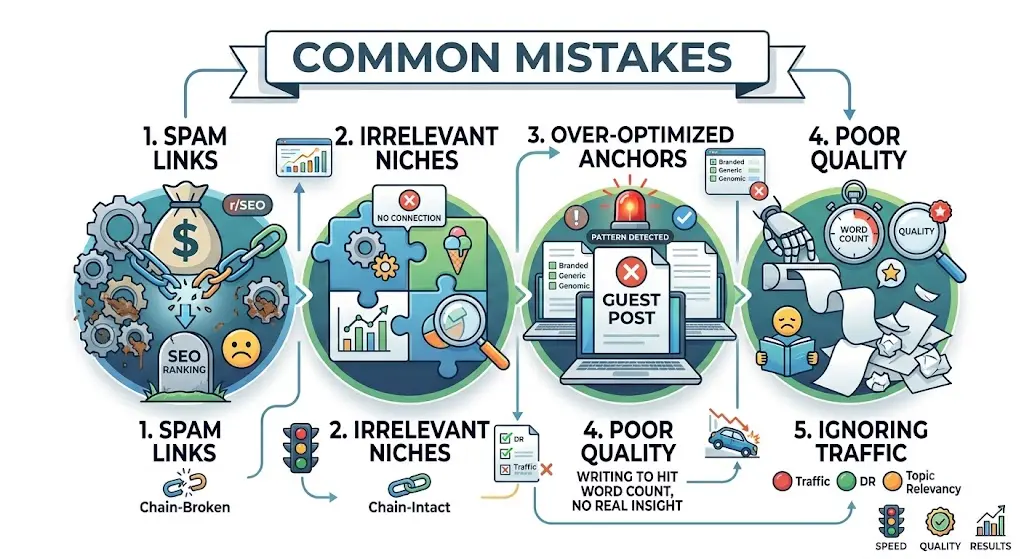
1. Buying Spam Links
The fastest way to hurt your site is paying for links on low-quality, high-spam-score domains just because they’re cheap. A large discussion thread on <a href=”https://www.reddit.com/r/SEO/” target=”_blank” rel=”noopener”>r/SEO</a> regularly features site owners describing ranking drops traced back to exactly this kind of link buying.
2. Irrelevant Niches
A link from a site with zero topical connection to your business rarely helps and can look unnatural to Google’s algorithms. Relevance should always outrank a slightly higher Domain Rating when you’re choosing between two sites.
3. Over-Optimized Anchors
Using the exact same keyword-rich anchor text across dozens of guest posts is one of the clearest patterns Google’s spam systems look for. Natural link profiles have a healthy mix of branded, generic, and partial-match anchors.
4. Poor Content Quality
A guest post that’s clearly written to hit a word count, with no real insight or original thinking, does little for rankings and can damage your brand’s reputation with the publisher’s audience. Content quality is not optional just because the primary goal is a backlink.
5. Ignoring Traffic Metrics
Some link builders only check Domain Rating and skip organic traffic entirely. This misses sites that have high authority from years ago but have since lost most of their real audience. A link from a site like that is far less valuable than the DR number suggests.
Pricing Guide
Guest post pricing varies widely based on the strength and traffic of the publishing site. These ranges reflect what’s typical in the market, though exact pricing depends on niche, region, and site quality.
1. Low Authority Sites
Sites with modest traffic and Domain Ratings in the 10-30 range typically charge somewhere in the $50-$150 range per placement. These can be useful for volume in a diversified link profile but shouldn’t be your only source of links.
2. Mid-Tier Publishers
Sites with solid, consistent traffic and Domain Ratings around 30-60 usually fall in the $150-$400 range. This tier tends to offer the best balance of cost and quality for most ongoing campaigns.
3. Premium Editorial Sites
Well-known publications with high traffic, strict editorial review, and Domain Ratings above 60 can run anywhere from $400 to well over $1,000 per placement. These links carry more weight but come with longer lead times and lower acceptance rates.
4. Agency Pricing
Agencies managing guest posting campaigns on your behalf typically charge a service fee on top of placement costs, or bundle everything into a monthly retainer. Retainers commonly range from a few hundred to several thousand dollars a month depending on volume and site quality targets.
Best Practices
1. Outreach Tips
Personalize every pitch reference something specific about the site’s recent content rather than sending a generic template. Editors can spot a mass email instantly, and personalization measurably improves response rates.
2. Content Guidelines
Write for the publisher’s audience first and your SEO goals second. Follow their existing tone, format, and depth, and always check their contributor guidelines before drafting anything.
3. Anchor Text Strategy
Favor branded and natural-phrase anchors over exact-match keywords. A healthy link profile for a SaaS link building agency looks like it happened organically, which means variety matters more than precision-targeting a single keyword phrase.
4. Link Velocity
Spreading out link acquisition over time looks far more natural than a sudden spike of dozens of new links in a single week. Steady, sustainable link velocity is safer and tends to correlate with more stable rankings.
5. Relationship Building
The best guest posting results often come from repeat relationships with the same handful of publishers, rather than one-off placements across unrelated sites. A publisher who trusts you is more likely to approve future pitches faster and give you better placement.
Tools for Successful Guest Posting
1. Ahrefs
Ahrefs is one of the most widely used SEO platforms for checking Domain Rating, organic traffic estimates, and a site’s existing backlink profile before you commit to a placement.
2. Semrush
Semrush offers similar site-auditing capabilities to Ahrefs, plus strong keyword research tools that help you decide which topics to pitch to a given publisher.
3. Moz
Moz is the source of the Domain Authority and Spam Score metrics that many link builders use as a quick first-pass filter when screening potential guest posting sites.
4. BuzzStream
BuzzStream is built specifically for outreach management tracking who you’ve contacted, follow-up timing, and response status across a large list of prospective publishers.
4. Pitchbox
Pitchbox is another outreach and campaign management platform, often used by agencies running guest posting and link building at scale across multiple clients.
5. Hunter.io
Hunter.io helps you find and verify email addresses for site editors and contributors, which speeds up the outreach process considerably compared to manual searching.
Measuring Guest Posting ROI
Rankings
Track keyword position changes for your target terms over the weeks following a placement. Rankings rarely move overnight, so give it at least four to eight weeks before drawing conclusions.
Organic Traffic
Watch overall organic traffic to the linked page, not just rankings. A page can gain positions on secondary keywords that don’t show up in your primary tracking but still drive meaningful traffic.
Referral Traffic
Check your analytics for direct referral visits coming from the publisher’s domain. This tells you whether the post is actually being read, not just sitting on a page for SEO purposes.
Leads
For business sites, tie guest post traffic to lead form submissions or sign-ups using UTM tracking on any links back to your site. This is the clearest way to connect a placement to real business impact.
Conversions
Go one step further and track which guest-post-driven visitors eventually convert into paying customers. This is the metric that ultimately justifies (or doesn’t justify) the cost of a placement.
Brand Authority
Some benefits are harder to measure directly increased branded search volume, social mentions, or simply being recognized in your niche. These are worth tracking qualitatively even if they don’t fit neatly into a spreadsheet.
Future of Guest Posting
AI Outreach
AI tools are increasingly used to draft outreach emails, personalize pitches at scale, and even help identify relevant publishers. Expect this to speed up the process, though editorial vetting on the receiving end will likely tighten in response to lower-quality AI-generated pitches.
Digital PR
As pure guest posting gets more scrutiny, more link building budgets are shifting toward digital PR original research, data studies, and newsworthy campaigns that earn links rather than request them.
Entity SEO
Search engines are getting better at understanding brands and websites as entities, connected across mentions, citations, and structured data, not just links. Guest posting increasingly plays a role in building that entity presence, not just passing link equity.
Topical Authority
Expect topical relevance to matter even more going forward. A tightly focused guest posting strategy within one niche will likely outperform a scattershot approach across unrelated industries.
EEAT
Google’s EEAT framework, discussed extensively across SEO communities such as <a href=”https://www.linkedin.com/pulse/” target=”_blank” rel=”noopener”>LinkedIn’s SEO publishing community</a>, will likely keep shaping which guest posts actually move rankings favoring content written by credible authors on genuinely relevant sites.
Frequently Asked Questions
1. Is SERP Insight safe?
Yes, when it follows a proper vetting process checking traffic, spam score, and editorial standards before any placement. The risk in guest posting comes from skipping vetting, not from guest posting itself.
2. Does Google approve guest posting?
Google doesn’t endorse guest posting as a link-building tactic when it’s done purely to manipulate rankings, but it doesn’t penalize legitimate guest contributions written for genuine audience value. The distinction is intent and quality, not the format itself.
3. How long until rankings improve?
Most site owners start seeing measurable ranking movement within four to twelve weeks of a quality placement going live, though timelines vary by niche competitiveness and site authority.
4. Are backlinks permanent?
No. Publishers can update, unpublish, or remove articles at any time, which is why ongoing link monitoring and reporting matter as much as the initial placement.
5. Can beginners use guest posting?
Yes, but beginners should start with a small number of highly relevant, well-vetted sites rather than chasing volume, since a few quality links outperform many low-quality ones.
6. How many guest posts should I publish?
There’s no universal number; it depends on your niche, competition, and existing link profile. A steady pace of a few relevant placements per month is generally safer than large bursts.
7. What industries benefit most?
Competitive, content-driven industries like SaaS, finance, health, and e-commerce tend to see the strongest returns, since these niches rely heavily on organic search for customer acquisition.
8. What is the best anchor text?
A natural mix of branded terms, generic phrases like “click here” or “this guide,” and occasional partial-match keywords works best. Avoid repeating exact-match keyword anchors across multiple posts.
9. How much should I pay?
Pricing should reflect the site’s real traffic and editorial quality, not just its Domain Rating. Expect a wide range from roughly $50 for low-tier sites to $1,000+ for premium editorial placements.
10. Is manual outreach better?
It depends on your goals. Manual outreach offers more control but takes far more time; a vetted guest posting process trades a bit of control for speed and consistency.
Conclusion
Guest posting hasn’t lost its value, it’s just gotten more demanding. The sites, the content, and the process all need to hold up to real editorial scrutiny, not just SEO shortcuts.
SERP Insight Guest Post works because it front-loads the vetting traffic, relevance, and spam checks before any content gets written. Editorial approval and natural link placement are what separate this from riskier link-buying tactics.
Prioritize relevant, real-traffic sites over raw authority scores, diversify your anchor text, and pace your link acquisition instead of rushing it.
Start by auditing your current backlink profile, identify gaps in topical relevance, then build a shortlist of publishers worth pitching using the evaluation checklist in this guide.