Google Ads for doctors SEO is the strategic combination of paid search advertising (PPC) and organic search engine optimization, built specifically for medical practices. Most clinics try one or the other. The ones consistently growing their patient base use both and they are not interchangeable.
Google Ads get you to the top of search results immediately. The moment your campaign goes live, your practice can appear when someone searches for a cardiologist, urgent care clinic, or dermatologist in your city. That visibility is real, but it stops the moment you stop paying.
SEO works the opposite way. It is slower usually three to six months before you see real traction but the traffic it builds is free, and it compounds over time. A well-optimized service page for “knee pain doctor in Chicago” can bring in patients every single month for years without an ongoing ad spend.
Together, these two channels create something neither can create alone: a patient acquisition engine that works around the clock. Ads fuel immediate growth. SEO builds the long-term foundation. Medical practices using both consistently see up to three times more patient growth than those relying on a single channel.
Are Google Ads and SEO Really Different Strategies?
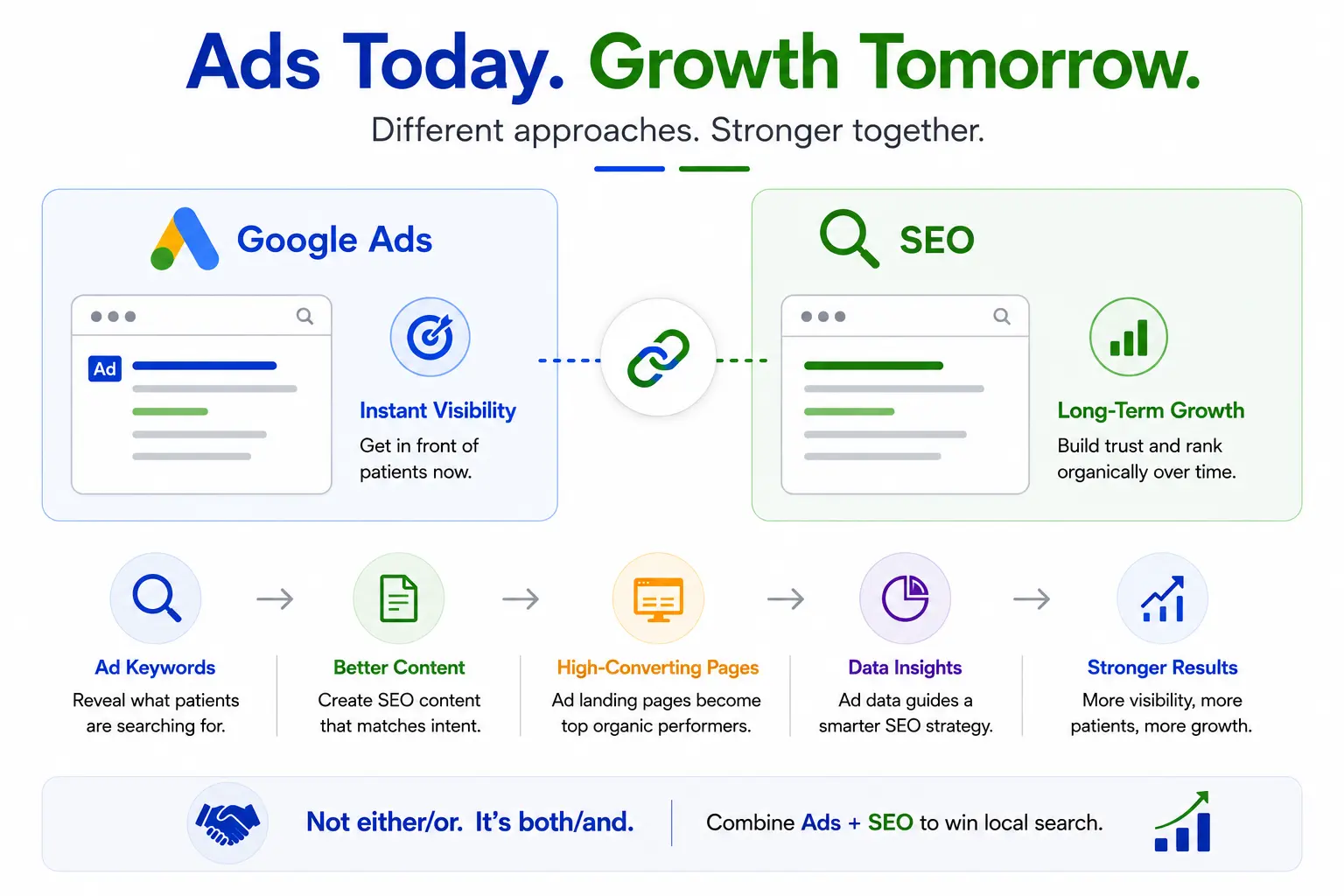
They operate differently, but they are more connected than most people realize. The keywords that perform best in your paid campaigns often become the foundation of your most valuable SEO content. The landing pages you build for ads become your highest-converting organic pages over time. The data from your ads tells you exactly which services patients are actively searching for and your SEO strategy should follow that signal
So no, this is not an either/or decision. It is a both/and strategy, and the practices that treat it that way are the ones winning local search.
Why 77% of Your Future Patients Start on Google Not on a Referral
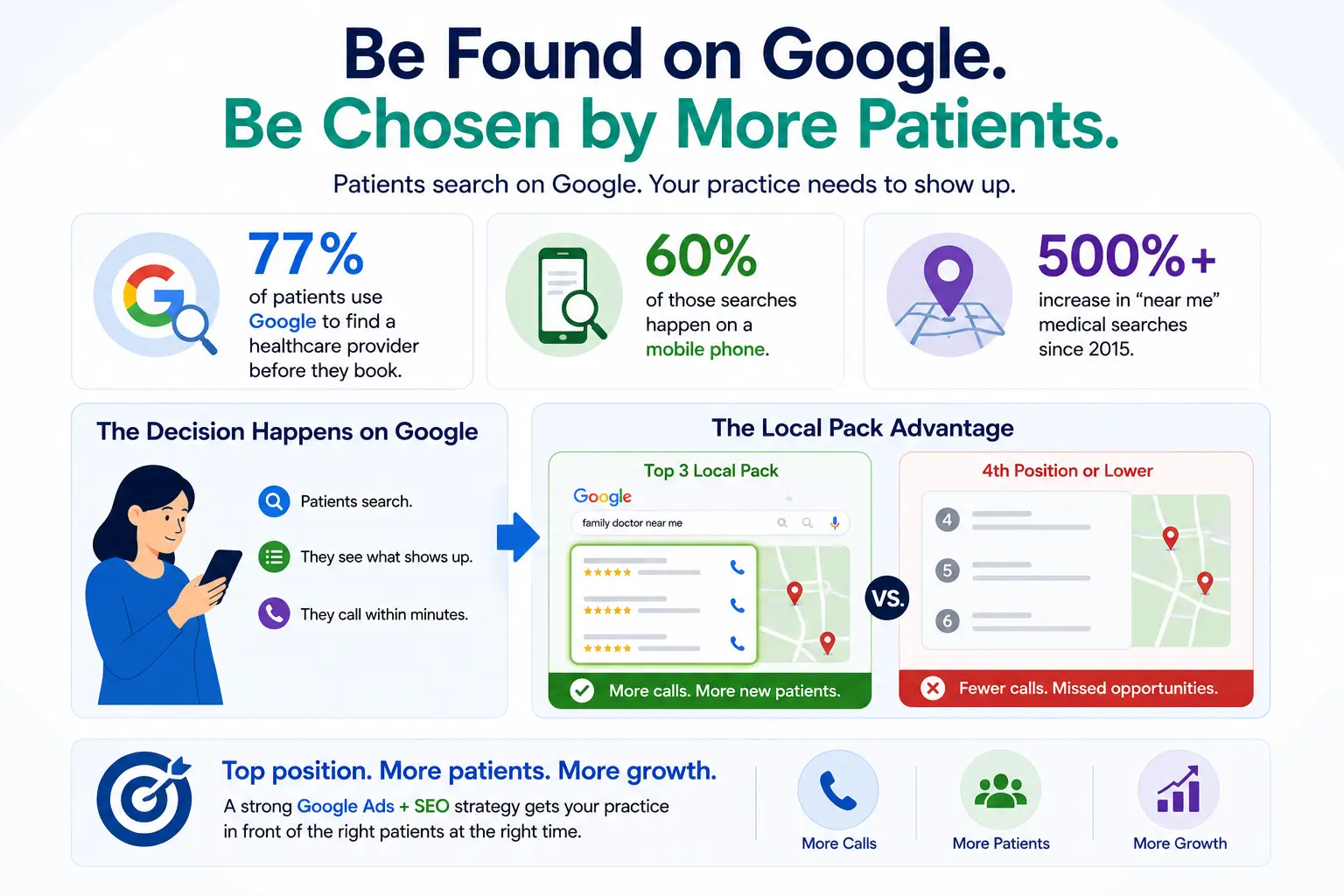
Referrals still matter. But the way patients find doctors has fundamentally changed, and the numbers make that undeniable. Seventy-seven percent of patients now use Google to find a healthcare provider before they book. Sixty percent of those searches happen on a mobile phone. And searches with the phrase “near me” attached to a medical query have grown more than five hundred percent since 2015.
What this means practically is that the majority of the new patients you could be seeing every week are making their decision on Google not based on a friend’s recommendation, not from a billboard, not from your practice’s yellow pages listing. They are typing a search, looking at what comes up, and calling within minutes.
The critical battleground is Google’s Local Pack the three business listings that appear at the top of local search results, accompanied by a map. If your practice is in one of those three spots, your phone rings. If you are in the fourth position or lower, it barely rings at all. Studies consistently show that practices in the top three Local Pack results receive the overwhelming majority of calls, while those just outside that window see dramatically less patient traffic even if their actual clinic is geographically closer.
Think about what that means for a family practice competing against five other clinics in the same zip code. The practice in the first Local Pack position might receive twenty or more calls a week from new patients. The one in the fourth spot might get two or three — not because the care is better or the location is more convenient, but simply because Google chose one to show over the other.
Getting into that top position and staying there is exactly what a well-executed SEO strategy is designed to achieve. Many healthcare practices also combine SEO with AI Ads to increase their visibility, attract more qualified patients, and maintain a strong presence in competitive local search results.
The Right Keywords Are the Foundation of Google Ads for Doctors SEO
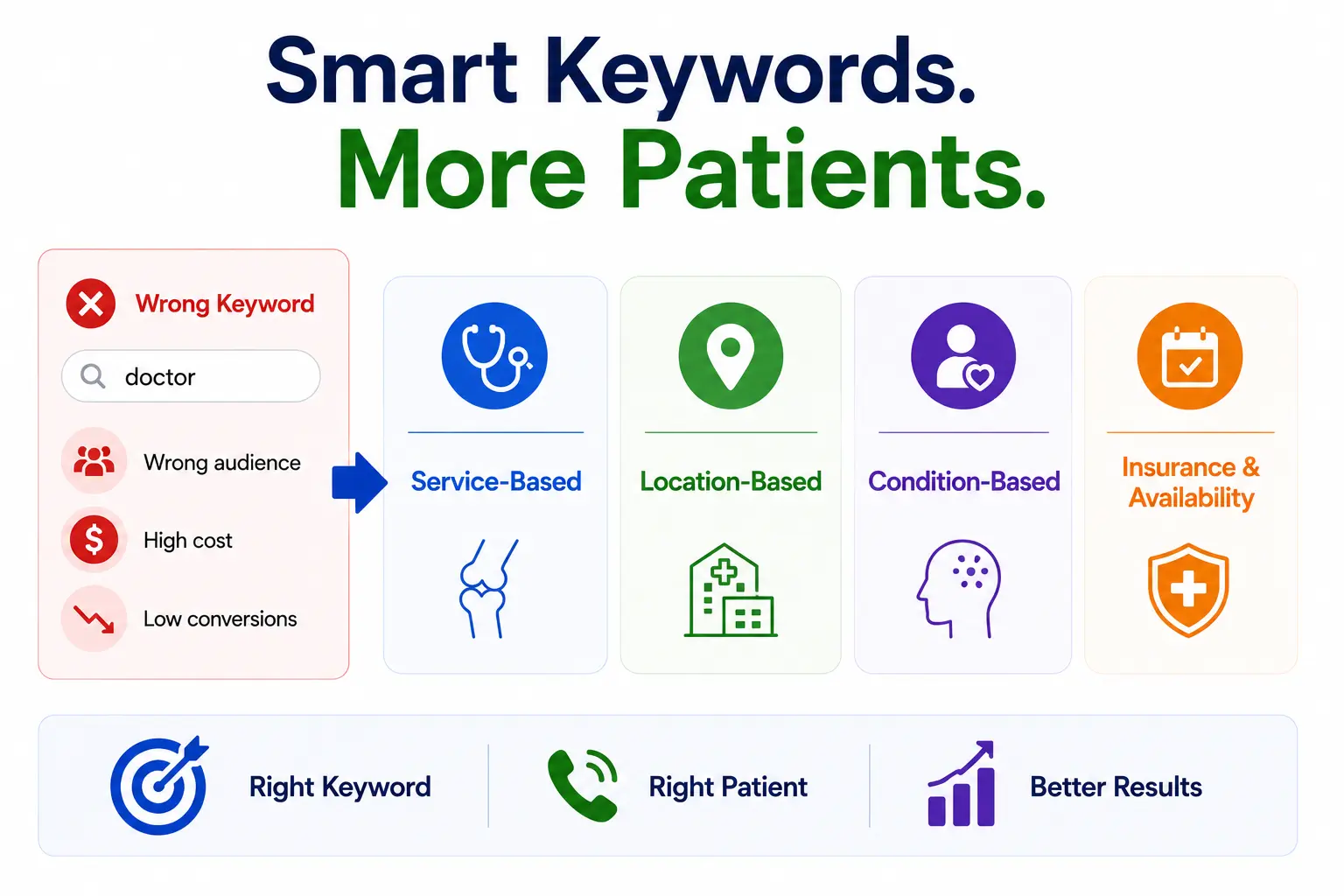
Here is one of the most expensive mistakes a medical practice can make with Google Ads: bidding on the word “doctor.” That single keyword attracts everyone from patients looking for urgent care to medical students searching for residency programs to people looking for a TV show called “The Doctor.” You pay for all of them and convert almost none.
Effective keyword research for doctors starts with understanding how patients actually search and they search with specificity and intent. A patient ready to book an appointment does not type “doctor.” They type “rheumatologist accepting new patients Houston” or “pediatric urgent care open Saturday near me.” Those are the searches worth bidding on.
Four Types of Medical Keywords Your Practice Needs
- Service-Based Keywords – These describe what you do. Examples: “knee replacement surgeon,” “LASIK eye surgery,” “IV infusion therapy.” These should form the core of your ad campaigns.
- Location-Based Keywords – These anchor your service to geography. Examples: “cardiologist in Houston,” “dermatologist near me,” “family doctor Dallas TX.” Local intent is built in.
- Condition-Based Keywords – These match how patients describe their problem, not your specialty. Examples: “treatment for sleep apnea,” “doctor for diabetes management,” “chronic back pain specialist.”
- Insurance and Availability Keywords – These capture high-intent searches from patients with specific constraints. Examples: “doctor accepting Medicare,” “urgent care open Sundays,” “same-day appointment doctor.”
High-Intent vs. Low-Intent: Knowing Which Keywords to Use Where
High-intent keywords signal that someone is ready to book right now. Phrases like “book appointment cardiologist” or “urgent care near me open now” belong in your Google Ads campaigns these patients are at the bottom of the decision funnel and ready to act.
Low-intent keywords signal someone who is still researching. “What is atrial fibrillation” or “do I need to see a dermatologist for acne” are great for SEO blog content. Writing helpful articles around these questions builds your authority and earns organic traffic over time — but they are not the right fit for paid ads because the reader is not yet ready to book.
Specialty-Specific Keyword Starting Points
To give you a sense of how this plays out across different specialties, here are examples of high-intent keyword phrases for common medical practices:
- Primary Care: “primary care doctor accepting new patients [city],” “annual physical exam near me”
- Pediatrics: “pediatrician for newborn near me,” “child doctor accepting Medicaid [city]”
- Dermatology: “dermatologist for acne near me,” “skin cancer screening [city]”
- Orthopedics: “orthopedic surgeon for knee pain,” “sports medicine doctor near me”
- Cardiology: “cardiologist accepting new patients,” “heart palpitation doctor [city]”
- Urgent Care: “urgent care open now near me,” “walk-in clinic no appointment needed”
- Mental Health: “therapist accepting new patients near me,” “psychiatrist for anxiety [city]”
How to Structure Google Ads for Doctors the Right Way
A lot of medical practices set up one Google Ads campaign, stuff every service into it, set a daily budget, and hope for the best. That approach burns money. The right structure is more deliberate, and it makes the difference between Google Ads that generate appointments and Google Ads that generate bills.
Campaign-Level Segmentation by Specialty or Location
Your top-level campaigns should be organized by specialty or clinic location never lumped together. If you run a multi-specialty practice, you might have separate campaigns for primary care, dermatology, and orthopedics. If you have multiple clinic locations, each location gets its own campaign so you can control geography and budget independently.
You should also run a brand campaign one that bids on your own practice name. This protects you from competitors who might bid on your name and intercept patients who are specifically searching for you.
Ad Group Breakdown by Condition or Treatment
Within each campaign, your ad groups should be organized by specific condition or treatment. A dermatology campaign, for example, might contain separate ad groups for acne treatment, skin cancer screenings, eczema, rosacea, and cosmetic procedures like Botox. Each ad group has a tight cluster of related keywords and its own set of ads written specifically for that condition.
This level of specificity matters because it directly impacts your Quality Score Google’s rating of how relevant your ad is to the search. A higher Quality Score means you pay less per click and appear higher in results. Tightly themed ad groups consistently outperform broad, mixed ones.
Ad Copy That Speaks Directly to Patient Intent
Your ad copy needs to do two things: speak to what the patient is searching for, and give them a clear reason to click on you instead of the three other ads next to yours. That means being specific and credible rather than generic.
“Board-Certified Cardiologist in Dallas Accepting New Patients Book Online Today” will outperform “Heart Doctor in Texas Call Us Now” every time. The first version tells the patient exactly who you are, confirms you have availability, and gives them an action to take. Specificity builds trust before they even click.
For urgent care and walk-in practices, call-only ads which show a phone number instead of a website link work especially well. Patients searching for urgent care are often in the moment and ready to call rather than browse.
Negative Keywords: The Budget Protector Most Practices Ignore
Negative keywords are the words you tell Google not to show your ads for. Without them, you will pay for clicks from people searching for medical jobs, free clinics, medical school admissions, and home remedies. None of those people are booking appointments.
Add a core list of negatives on day one words like “free,” “jobs,” “salary,” “DIY,” “home remedy,” “medical school,” and “research.” Then review your search term report every week and keep expanding the list. A disciplined negative keyword strategy can reduce wasted spend by twenty to thirty percent on its own.
What Does Google Ads Actually Cost for Doctors in the USA?
Medical advertising is competitive, and that competition drives up costs. Here is a realistic breakdown of cost-per-click (CPC) ranges by specialty:
| Specialty | Estimated CPC Range |
| Family Practice / Primary Care | $2 – $8 |
| Pediatrics / Urgent Care | $5 – $15 |
| Dermatology / Orthopedics | $10 – $30 |
| Cardiology / Neurology | $15 – $40 |
| Plastic Surgery / Fertility | $25 – $60+ |
On top of ad spend, most practices also pay a management fee to an agency or specialist — typically $1,000 to $3,000 per month depending on the scope of work. The total monthly investment for a local practice usually falls between $3,000 and $12,000 when you combine both. That might sound like a lot until you calculate the lifetime value of a new patient in your specialty.
Why Sending Patients to Your Homepage Is Costing You Appointments
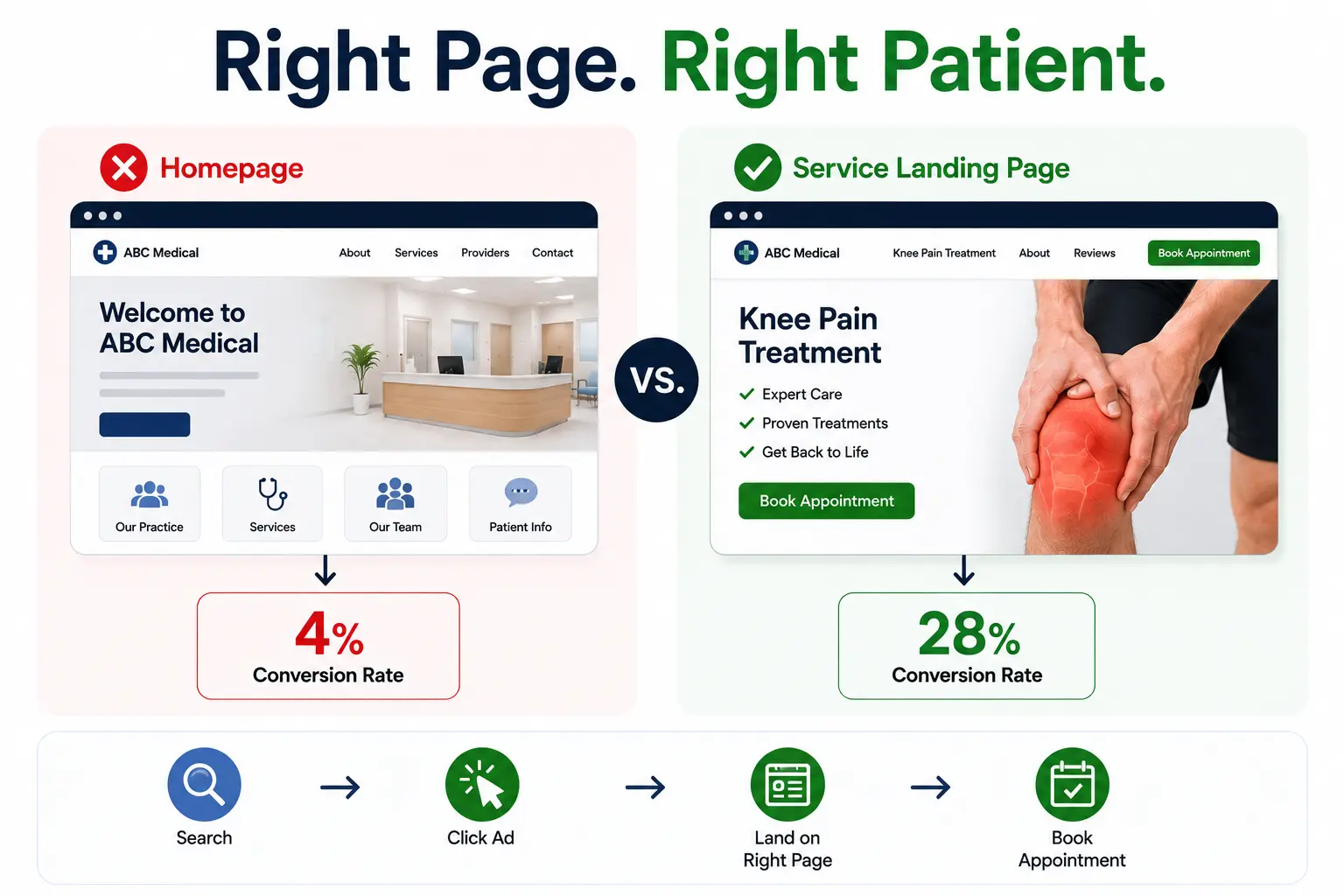
This is one of the most common and most expensive mistakes in medical advertising. A doctor runs Google Ads, gets clicks, and sends everyone to the homepage of their website. Then they wonder why the phone is not ringing more.
Here is why it does not work: your homepage is designed for everyone. It introduces your practice, your team, your story. It is not designed to convert a patient who just clicked an ad for a specific service. The average homepage converts at around four percent. A dedicated service landing page converts at around twenty-eight percent. That is a seven-fold difference and it is entirely in your control.
Every service you advertise needs its own landing page. If you are running ads for knee pain treatment, the patient who clicks that ad should land on a page specifically about knee pain treatment not your general orthopedics homepage and not a page that also talks about shoulder surgery and sports rehab.
What Every High-Converting Doctor Landing Page Must Include
- A headline above the fold that matches exactly what the ad promised, if the ad said ‘Knee Pain Specialist in Dallas,’ the page should open with those words
- Doctor credentials and board certifications visible without scrolling, patients want to know immediately that you are qualified
- A specific description of the service, written in plain language, explaining what the patient can expect
- Real patient reviews and star ratings, social proof matters enormously in healthcare
- Insurance information, this is one of the first things patients look for
- A prominent, friction-free call to action: ‘Book an Appointment Today’ or ‘Call Now’ with a click-to-call button on mobile
- A brief FAQ section that addresses the most common concerns or objections before the patient has to ask
The Message-Match Rule
Everything on your landing page should feel like a natural continuation of the ad the patient clicked. If your ad says “Dermatologist for Acne in Chicago” and the patient lands on a generic dermatology page that mentions acne in the third paragraph, you have broken the message-match. The patient feels like they clicked on the wrong link and leaves. That lost click cost you real money.
HIPAA Compliance on Landing Pages
Medical practices have an added responsibility that most industries do not: HIPAA. Your landing page forms must be HIPAA-compliant meaning the data patients submit through appointment request forms cannot be stored or transmitted in ways that violate patient privacy. Standard contact form plugins often do not meet this requirement. Work with a healthcare marketing agency or developer who understands the distinction, or you risk both patient privacy violations and significant fines.
The Long Game SEO for Doctors That Builds Free Traffic Over Time
If Google Ads is the accelerator pedal, SEO is the engine. Once you have built real organic authority for your practice, it works for you without an ongoing cost per click. A page that ranks #1 for “cardiologist near me [city]” can bring in new patient inquiries every single week without you spending a dollar on that specific click.
But organic rankings do not happen overnight, and they do not happen by accident. Here is what a working medical SEO strategy actually requires.
On-Page SEO for Medical Websites
Every service your practice offers should have its own dedicated, optimized page not a brief mention in a list on a general services page. Each page needs a keyword-focused title tag, a compelling meta description, a clear H1 heading, and content that thoroughly addresses what a patient searching for that service actually wants to know.
Beyond content, Google is also looking at schema markup structured data you add to your website that tells search engines exactly what your page is about. For medical practices, schema should include your practice name, address, phone number, specialty, doctor credentials, hours of operation, and review data. Schema markup is one of the most underused tools in medical SEO, and implementing it correctly gives you a clear advantage over competitors who skip it.
Google Business Profile: Your Free Patient Magnet
Your Google Business Profile (formerly Google My Business) is arguably the single most important digital asset your practice controls and it is free. A complete, well-maintained profile is what gets you into the Local Pack, earns you calls directly from Google Maps, and builds trust before a patient ever visits your website.
Make sure every field is filled in accurately: your practice name, address, phone number, website, hours, and services. Add real photos of your clinic, your team, and your waiting room. Add your appointment booking link. Respond to every review the positive ones and the negative ones. Post regular updates, health tips, or seasonal reminders.
Many patient journeys now begin on the Google Business Profile rather than on your website. A patient may see your ad, click through, and then check your GBP before deciding to call. If your profile has outdated hours, no photos, and a handful of old reviews, they will call the practice next to yours instead.
Local SEO for Doctors: The Citation Foundation
Local SEO is the practice of making sure Google understands exactly where you are and who you serve. A core part of this is NAP consistency your practice Name, Address, and Phone number must appear identically across every online directory, your website, your Google Business Profile, and any other platforms where your practice is listed.
Medical directory listings on platforms like Healthgrades, Zocdoc, Vitals, and WebMD are particularly important for doctors. These platforms carry significant domain authority, and having an accurate, complete profile on each one sends strong local trust signals to Google. They also put your name in front of patients who search specifically on those platforms.
YMYL Standards: Why Google Holds Medical Content to a Higher Bar
Google classifies healthcare content under what it calls “Your Money or Your Life” guidelines a category reserved for content that could significantly impact someone’s health, finances, or safety. Because the stakes are high, Google applies extra scrutiny to medical websites, looking for clear signals of expertise, authoritativeness, and trustworthiness (known as E-E-A-T).
For doctors, this means your content needs to be written or reviewed by a credentialed professional, your author bios need to include qualifications, your information needs to be accurate and regularly updated, and your site should cite reputable medical sources where appropriate. A practice blog full of thin, generic articles is not going to rank well for competitive medical terms and it should not.
Blog Content Strategy: Building Topical Authority Over Time
One of the most effective long-term SEO plays for medical practices is answering the questions patients actually search for before they are ready to book. Articles like “How do I know if I need to see a dermatologist?” or “What should I expect at my first cardiology appointment?” attract patients earlier in their decision journey and position your practice as the trusted authority by the time they are ready to choose a doctor.
A useful shortcut: look at which keywords are converting in your Google Ads campaigns, then build SEO content around those same terms. What works in paid search often maps directly to valuable organic content and eventually, you can earn organic rankings for searches you are currently paying for.
Set It and Forget It Does Not Work How to Keep Google Ads Profitable
The practices that get the best return from Google Ads are not the ones with the biggest budgets. They are the ones that actively manage their campaigns week over week. Google Ads optimization is an ongoing process, and the difference between a well-managed campaign and a neglected one can easily be twenty to forty percent of your spend going either to waste or to results.
A Simple Optimization Schedule for Medical Practices
- Daily: Check budget pacing and flag any unusual spend spikes or drops
- Weekly: Review the search term report, add new negatives, pause keywords with zero conversions, check ad performance by device and location
- Monthly: Review Quality Score by ad group, run A/B test analysis, adjust bids based on conversion data, revisit landing page performance
Bid Strategy: Choosing the Right Approach for Your Practice
If your campaign is new and you do not yet have enough conversion data, start with Maximize Conversions bidding and let Google learn from your traffic. Once you have accumulated at least thirty to fifty conversions per month, switch to Target CPA (Cost Per Acquisition) bidding and set a target cost per new patient lead that makes sense for your practice economics.
Adjust your bids by time of day and day of week based on your call tracking data. Most medical practices see peak booking intent on Monday mornings and around the lunch hour — those windows may warrant higher bids. Evenings and weekends are often lower intent for non-urgent specialties and can be bid down to conserve budget.
A/B Testing: Never Stop Improving Your Ad Copy
Run at least two to three variations of your headlines at all times and give them enough impressions to draw real conclusions typically four to six weeks. Test urgency-led headlines (“Accepting New Patients This Week”) against credential-led ones (“Board-Certified Specialist — 20 Years Experience”). Test location-specific wording against benefit-focused wording. The results often surprise even experienced marketers.
Responsive Search Ads let you input up to fifteen different headlines and four descriptions, and Google automatically tests combinations to find what drives the most clicks and conversions. This is the easiest way to run ongoing tests without manual effort.
Conversion Tracking: The Absolute Non-Negotiable
Without conversion tracking, you have no idea which keywords, ads, or landing pages are generating real patient inquiries. You are spending money and guessing at what is working. This is the single most common and most damaging mistake in medical Google Ads and it is completely avoidable.
Track every meaningful action a patient can take: phone calls (including mobile click-to-call), appointment form submissions, online booking completions, and live chat initiations. Your call tracking must be set up in a HIPAA-compliant way do not let conversion data include any protected health information (PHI) in your analytics tools.
Google Ads vs. SEO for Doctors: This Is Not an Either/Or Decision
Every few months, someone publishes a piece arguing that Google Ads are overpriced and SEO is the only sustainable strategy or the opposite, that SEO is too slow and paid search is the only way to grow quickly. Both arguments are wrong, and believing either one will cost you patients.
Google Ads is immediate fuel. SEO is a long-term engine. Together they create something neither channel can produce alone. Here is how they compare across the factors that matter most to a medical practice:
| Factor | Google Ads | SEO |
| Speed of results | Immediate (days) | Slow (3–6+ months) |
| Cost structure | Ongoing per click | Upfront then compounds |
| Trust signal | Labeled ‘Ad’ | Organic = higher trust |
| Patient intent captured | High-intent only | All stages of search |
| When it stops | Traffic stops instantly | Traffic continues |
| Best for | New practices, fast growth | Sustainable long-term growth |
The most successful medical practices use Google Ads to generate appointments immediately while their SEO strategy builds in the background. Over time, as organic rankings develop, some of the paid budget can be redirected because now free traffic is handling what ads used to cover. Practices running both channels consistently generate twenty-eight or more new patients per month. Those relying on a single channel generate three to five.
6 Google Ads Mistakes That Drain Your Budget Without Filling Your Calendar
Most of the money wasted on medical Google Ads is not lost to high CPCs or competitive markets. It is lost to avoidable mistakes that are easy to fix once you know what to look for.
1. Running Ads With No Conversion Tracking
If you do not know which clicks are turning into appointments, you cannot improve your results. You are spending money and essentially guessing. Setting up proper call tracking and form tracking before your campaign goes live is not optional it is the foundation everything else is built on.
2. Sending All Traffic to the Homepage
A four percent conversion rate versus twenty-eight percent. That is the difference between your homepage and a dedicated service landing page. If every ad sends patients to your homepage, you are leaving more than eighty percent of your potential appointments on the table.
3. Targeting Too Broad a Keyword List
A $5,000 monthly budget spread across fifty loosely related keywords produces weak, unfocused results for every single one of them. It is far better to dominate five to ten high-intent keywords than to show up inadequately for fifty. Narrow your focus, increase your bids on what matters, and watch your conversion rate climb.
4. Ignoring Local SEO While Running Ads
This is more common than you might think. A patient clicks your ad, visits your landing page, then opens a new tab to check your Google Business Profile. They find outdated hours, eight reviews from four years ago, and no photos. They close the tab and call the practice listed right next to yours. Your ad spend generated a click that your GBP lost. Ads and local SEO must work together.
5. Skipping Negative Keywords
Without a robust negative keyword list, your ads will show for people searching for doctor jobs, free clinics, medical school requirements, and TV medical dramas. None of those people are booking appointments. Yet you pay the same rate for their click as you do for a genuine patient. Negative keywords are free to add and can save twenty to thirty percent of your monthly budget.
6. Choosing the Cheapest Agency
Healthcare advertising has rules that general marketing agencies often do not know: HIPAA compliance in tracking, Google’s healthcare advertising policies, the nuance of YMYL content standards. An agency without medical marketing experience will make expensive mistakes on your account — and you will pay for those mistakes in wasted spend and missed patients, long after you have switched to someone better.
What to Look for When Hiring a Google Ads Agency for Your Medical Practice
Choosing the wrong agency is one of the most expensive decisions a medical practice can make. Not just because of the management fee, but because a poorly managed campaign can waste thousands in ad spend every single month while producing nothing. Here is how to tell the difference between an agency that knows healthcare and one that is learning on your dime.
Green Flags Signs You Have Found the Right Partner
- A verifiable portfolio of fifty or more medical clients, with case studies that show patient growth numbers, not just website traffic or impressions
- A clear, documented process for HIPAA-compliant conversion tracking, they should be able to explain exactly how they protect patient data
- Weekly reporting dashboards that show cost per new patient, not just cost per click or impressions
- Demonstrated experience with YMYL content standards and medical E-E-A-T requirements
- Transparent, flat-rate pricing with no long-term lock-in contracts
Red Flags – Walk Away If You See These
- “Guaranteed #1 on Google” promises – no one can guarantee organic rankings, and anyone who says otherwise is being dishonest
- No healthcare-specific case studies – being good at marketing a restaurant does not translate to marketing a cardiology practice
- Vague answers about strategy (“we have a proprietary method”) – good agencies explain exactly what they do and why
- Tracking setups that capture patient data in analytics in ways that could violate HIPAA
- Monthly reporting only – proper campaign management requires weekly review and optimization, not a monthly glance
Five Questions to Ask Before You Sign
- How many active medical practices are currently in your client portfolio, and can you share two or three relevant case studies?
- Can you walk me through exactly how your tracking setup ensures HIPAA compliance?
- What does the first ninety days with your agency look like, week by week?
- Who specifically will be managing my account and how do I reach them?
- What does success look like at six months, and how will you measure it?
What Google Ads for Doctors SEO Actually Delivers Real-World Results
Strategies sound good on paper. What matters is what they produce in the real world. Here are three examples of what an integrated Google Ads for doctors SEO approach looks like when it is working correctly.
Primary Care Practice Owning the Local Pack
A family medicine practice in a competitive suburban market invested in a combined Google Ads and local SEO strategy. Within seven months, they ranked in the top position of the Google Local Pack for “primary care doctor near me” in their city. The result: twenty-three new appointment bookings per week attributable to Google search alone — a number that has held consistently without additional ad spend increases, because organic rankings now carry much of the load.
Dermatology Clinic Cutting Cost Per Patient in Half
A dermatology practice was running Google Ads but sending all traffic to a single general page. After restructuring campaigns by condition, building dedicated landing pages for their top five services, and adding local SEO optimization, their cost per acquired patient dropped from forty-three dollars to eighteen dollars over six months. The same monthly ad spend now generates more than twice as many appointments.
Orthopedics Practice Building Long-Term Organic Growth
An orthopedic surgery group invested in a full SEO overhaul,schema markup implementation, medical directory citation building, condition-specific service pages, and a structured blog content program. By the end of year one, organic search traffic had grown by three hundred seventeen percent. That traffic now brings in a steady stream of new patient inquiries every month at zero per-click cost.
FAQ
How much should a doctor spend on Google Ads per month?
Most practices invest $2,000–$10,000 in ad spend plus $1,000–$3,000 in management fees monthly. The right budget depends on your specialty, city competition, and growth goals.
Is Google Ads or SEO better for doctors?
Neither alone is enough. Ads deliver patients immediately. SEO builds free traffic that compounds over time. The most successful practices use both together.
How long does SEO take for a medical practice?
Expect measurable ranking improvements within 3–6 months and meaningful patient volume by months 9–12. It is slow to start but often delivers a better return per patient than paid ads over time.
Do I need separate landing pages for each service?
Yes. Generic or shared pages convert poorly. Service-specific landing pages convert up to seven times better than sending patients to your homepage.
Are medical Google Ads expensive?
It depends on specialty. Family practice clicks run $2–$8. Plastic surgery or fertility in major cities can exceed $50. Always measure cost-per-patient, not cost-per-click.
Can a new practice use Google Ads?
Absolutely. Google Ads is often the best first move for a new clinic — it delivers top-of-search visibility from day one while your SEO authority is still building.
Conclusion
Google Ads and SEO are not competing strategies they are two halves of the same system. Ads bring patients in today. SEO keeps your name visible for free tomorrow. Together they create consistent, compounding patient growth that neither channel produces alone.
The practices winning local search are not the ones with the biggest budgets they are the ones who optimize relentlessly and never stop improving.
Start today: audit your Google Business Profile, pick your top keywords, build one strong landing page, and track everything from day one.
Your next patient is already searching. Make sure they find you.