When patients search for healthcare providers online, showing up first can make all the difference. PPC for healthcare helps your practice appear at the top of search results exactly when potential patients need care. But unlike other industries, healthcare advertising comes with strict compliance and privacy rules. In this guide, we’ll cover how healthcare PPC works, how to stay compliant, and how to turn clicks into real patient appointments.
What Is PPC for Healthcare?
PPC stands for Pay-Per-Click a type of digital advertising where you only pay when someone actually clicks your ad. You’re not paying to show up; you’re paying when a potential patient takes action. That alone makes it very different from traditional advertising like billboards, print, or TV.
In the healthcare space, PPC ads most commonly appear at the very top of Google search results above all the organic listings and are labeled as “Sponsored.” They can also appear on Microsoft Bing, Google’s Display Network (banners across websites), and YouTube.
Here’s a simple example: A dermatology clinic in Chicago runs a Google Ads campaign targeting the keyword “dermatologist in Chicago.” Every time someone searches that phrase, the clinic’s ad appears at the top. When the patient clicks and books an appointment, the clinic pays Google a small fee for that click.
What makes this powerful for healthcare is intent. When someone Googles “knee pain specialist near me,” they’re not casually browsing they want help now. PPC puts you in front of people who are actively looking for your services, not just scrolling past an ad.
Why Healthcare Practices Need PPC Right Now
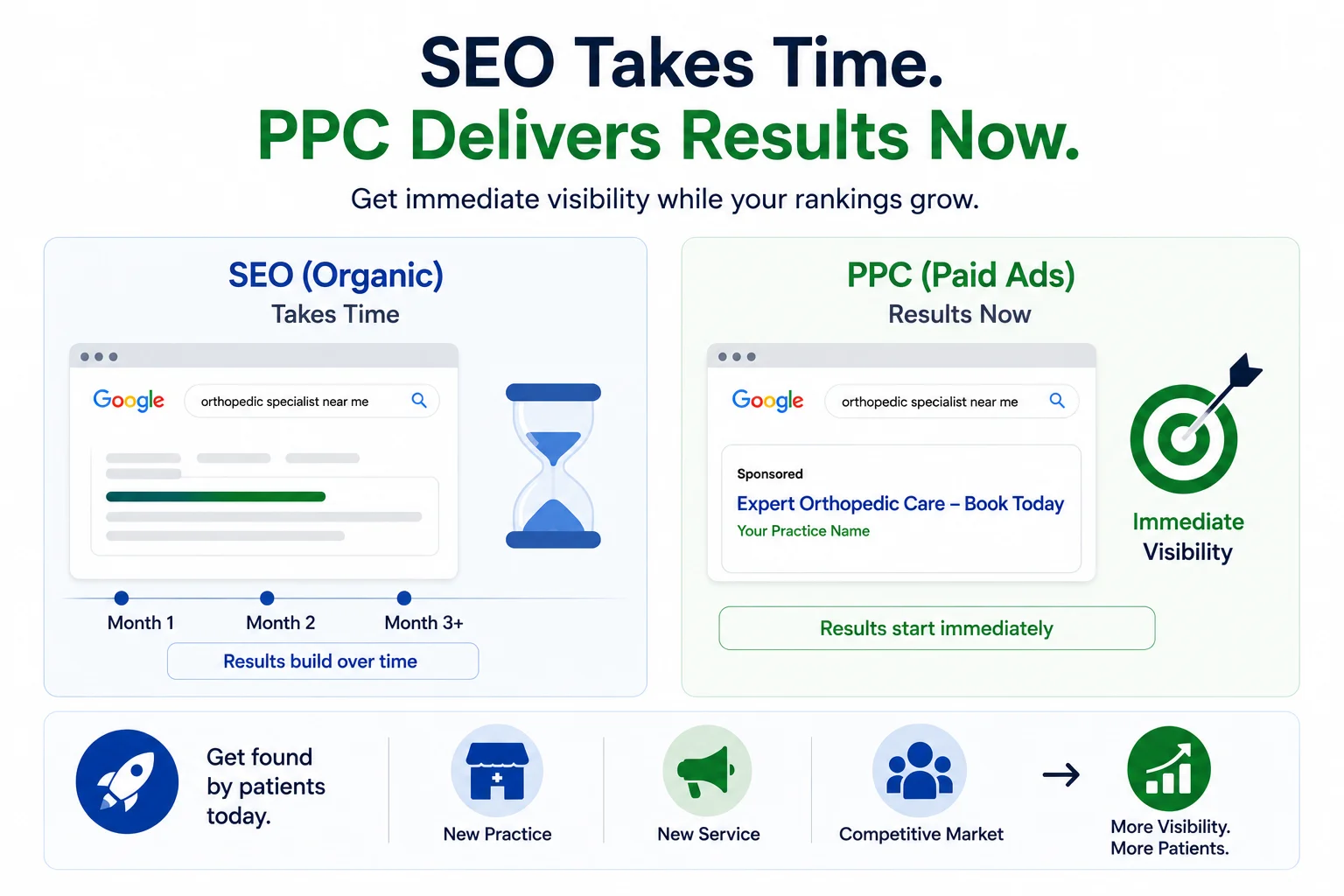
Organic SEO is important but it takes months to show results. If you’ve just opened a new practice, launched a new service, or entered a competitive market, you can’t afford to wait. PPC delivers immediate visibility while your organic rankings are still building.
The numbers back this up:
- 65% of all healthcare clicks come from paid search ads
- The average conversion rate for healthcare PPC campaigns is 3.78% – higher than the cross-industry average
- The top 10% of healthcare PPC campaigns achieve a click-through rate of 11.72%
- Mobile healthcare PPC ads see 23% higher click-through rates than desktop ads
- Healthcare and pharma digital ad spend is projected to hit $24.71 billion by 2026
The competition is growing. Practices that invest in PPC now are building a competitive advantage that will be much harder and more expensive to catch up to later.
How Healthcare PPC Campaigns Actually Work
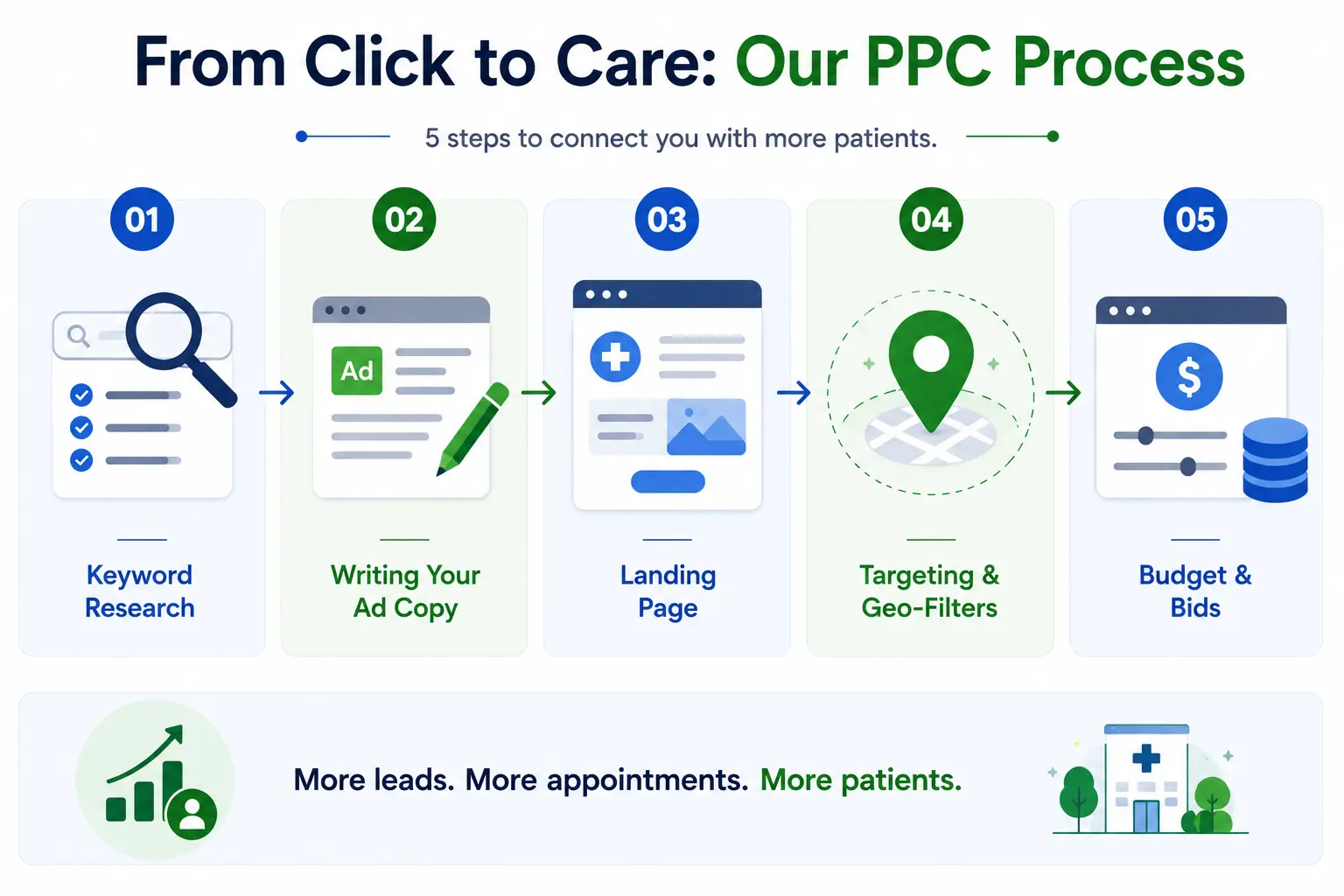
Running a healthcare PPC campaign isn’t as simple as writing an ad and spending money. There are five key components that determine whether your campaign generates appointments or burns through your budget.
Step 1: Keyword Research
Keywords are the foundation of any PPC campaign. You need to target the terms that real patients actually type into Google, not just the clinical terminology you use internally.
High-intent examples that tend to convert well:
- “same-day appointment [city]”
- “pediatric dentist near me”
- “urgent care open now”
- “primary care doctor accepting new patients”
Equally important: negative keywords. These prevent your ads from showing for irrelevant searches like “free clinic,” “healthcare jobs,” or “home remedies.” Without them, you’ll waste money on clicks that will never convert.
Step 2: Writing Your Ad Copy
Your ad copy needs to do three things: grab attention, communicate trust, and encourage action all within Google’s strict character limits. Writing effective healthcare ad copy means balancing professional credibility with emotional appeal, while avoiding specific medical claims that could violate Google’s advertising policies.
Elements that consistently perform well:
- Credentials and certifications (e.g., “Board-Certified Cardiologist”)
- Availability highlights (“Same-Day Appointments,” “Open Weekends”)
- Insurance info (“Most Insurances Accepted”)
- A direct call to action (“Book Online Today,” “Call Now”)
Step 3: Building a Dedicated Landing Page
This is where most healthcare practices make their biggest mistake: they send ad traffic to their general homepage. The patient clicked on an ad for “sports injury treatment” and landed on a homepage talking about everything from pediatrics to dermatology. Confusing and they leave.
Every ad needs a dedicated landing page that matches the ad’s promise. If you run multiple service lines orthopedics, behavioral health, dermatology, each one should have its own landing page. Message consistency between ad, keyword, and page is one of the biggest factors in conversion rate.
Your landing page checklist:
- Headline that mirrors the ad (not just your practice name)
- Clear, prominent call to action (book now, call, request appointment)
- Trust signals: reviews, credentials, awards
- Fast load speed – every extra second reduces conversions by up to 20%
- Mobile-optimized layout
Step 4: Targeting and Geo-Filters
Unlike national brands, most healthcare practices serve a specific geographic area. PPC lets you target by city, zip code, or a custom radius around your practice, so you’re only paying for clicks from people who can actually become patients.
You can also use dayparting showing your ads only during hours when your office is open and staff can answer calls. This avoids spending money on clicks at 2 AM when nobody can book an appointment.
Step 5: Setting Your Budget and Bids
Healthcare is a competitive PPC environment, which means cost-per-click is generally higher than other industries. Depending on your specialty and location, you might pay anywhere from $3 to $15+ per click. But the math still works in your favor — a single new patient is worth far more than a few clicks.
Start with a modest budget, track which keywords and ads convert, then scale up what’s working. Throwing a large budget at an untested campaign is one of the most common ways practices waste money on PPC.
HIPAA Compliance in Healthcare PPC: What You Need to Know
This is the section that separates healthcare PPC from every other industry, and it’s one most general marketing guides gloss over entirely. Ignore compliance, and you risk far more than wasted ad spend.
Here’s what that means in practice:
- You cannot build audience lists based on specific medical conditions or diagnoses
- You generally cannot use remarketing for sensitive health services based on a user’s website activity
- Contact forms on your landing page should not collect detailed health information
- Any third-party tools you use — call tracking, CRMs, EHR platform, analytics – must be HIPAA-compliant and covered by a BAA
- Standard Google remarketing tags on pages discussing specific health conditions can potentially violate HIPAA
The safest setup for healthcare PPC includes: HIPAA-safe website forms (collecting only name, email, phone), PHI-safe conversion tracking, location and intent-based keyword targeting (not health condition targeting), and compliant call tracking systems.
This isn’t designed to scare you away from PPC. It’s designed to help you run campaigns that grow your practice without putting patient privacy or your license at risk.
5 Common PPC Mistakes Healthcare Practices Make
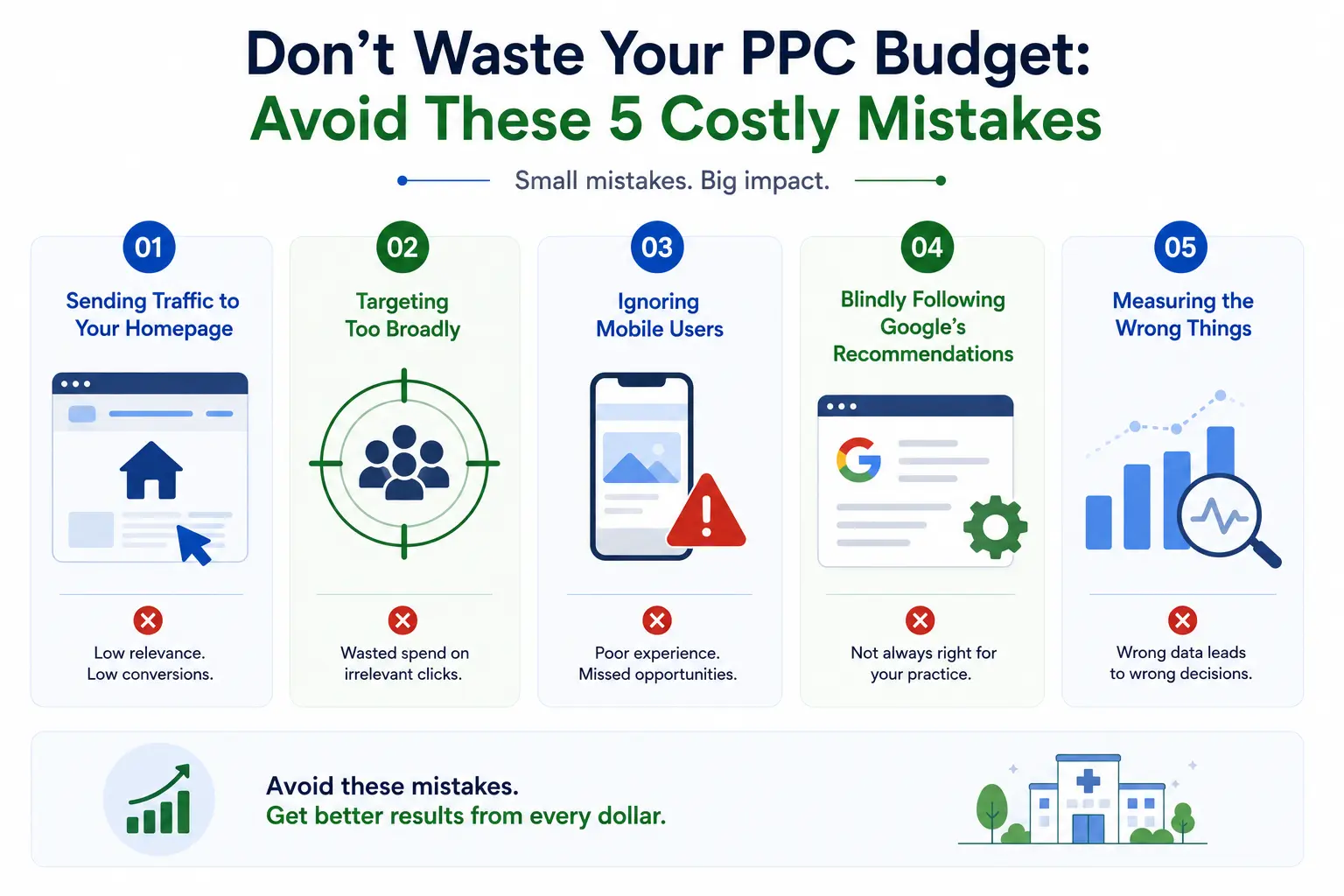
Even experienced marketers make these. Here’s what to watch out for and why each one matters.
1. Sending Traffic to Your Homepage
When a patient clicks an ad for “sports injury treatment” and lands on a generic homepage, the message match is broken. They don’t see what they came for and leave. Always send ad traffic to a specific, relevant landing page.
2. Targeting Too Broadly
Bidding on “doctor” or “health” without qualifiers will get you clicks from people researching symptoms, looking for home remedies, or searching in cities you don’t serve. Specific, geo-targeted, intent-driven keywords are far more efficient.
3. Ignoring Mobile Users
More than 60% of healthcare searches happen on mobile. If your landing page isn’t mobile-optimized fast loading, easy to tap, click-to-call button prominent you’re paying for clicks that bounce immediately.
4. Blindly Following Google’s Recommendations
Google account managers can be helpful, but they often lack healthcare marketing experience. Recommendations designed for e-commerce frequent campaign changes, AI-driven optimization, broad match everything don’t translate well to healthcare, where patient decision cycles are longer and more personal. Most experts recommend at least one full quarter of data before making major campaign changes.
5. Measuring the Wrong Things
Clicks and impressions are vanity metrics. What actually matters is how many of those clicks became booked appointments. If you’re not tracking call conversions, form submissions, and actual scheduled patients, you have no idea whether your campaign is working.
Healthcare PPC Metrics That Actually Matter
Here’s a quick reference for the KPIs worth tracking in your healthcare PPC campaigns:
| Metric | What It Tells You | Healthcare Benchmark |
| Cost Per Appointment | The true ROI metric — not just cost per click or lead | Varies by specialty |
| Conversion Rate | % of clicks that become form fills or calls | 3.78% industry avg |
| Click-Through Rate (CTR) | % of people who click your ad after seeing it | Top 10%: 11.72% |
| Quality Score | Google’s rating of your ad relevance (1–10) | Aim for 7+ |
| Return on Ad Spend (ROAS) | Revenue generated per dollar spent on ads | Varies by practice |
PPC vs. SEO for Healthcare: Do You Need Both?
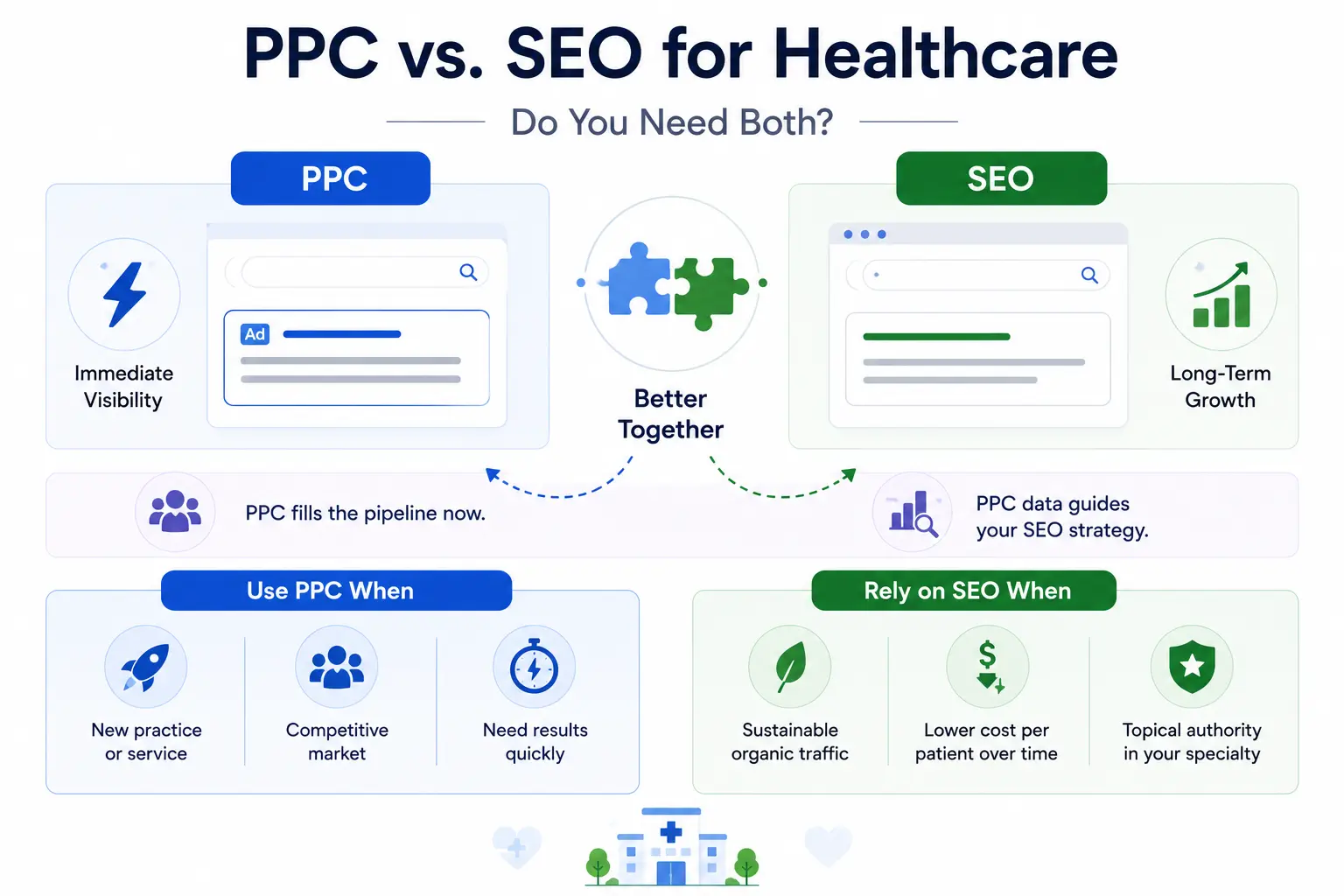
Short answer: yes. Here’s why they’re better together than apart.
PPC gives you immediate visibility you can go live today and start appearing at the top of results tomorrow. SEO builds long-term organic authority over months, resulting in sustainable, lower-cost traffic over time.
The smartest practices use them in tandem: PPC fills the pipeline immediately while SEO matures. And here’s a bonus: PPC data tells you which keywords actually convert patients, which you can then use to guide your SEO content strategy.
Use PPC when:
- You’ve just launched a practice or new service line
- You’re in a competitive market with established players
- You need results quickly
Rely on SEO when:
- You want to build sustainable, compounding organic traffic
- You want to lower your cost per patient acquisition over time
- You’re establishing topical authority in your specialty
Should You Manage Healthcare PPC Yourself or Hire an Agency?
This depends on your time, budget, and risk tolerance. Here’s an honest breakdown:
Managing It Yourself
It’s possible Google Ads has good documentation and tutorials. But the learning curve is steep, especially in healthcare where compliance errors can have serious consequences. You’ll also spend significant time on campaign management that could go toward patient care.
Working with a Healthcare PPC Agency
The right agency brings HIPAA knowledge, healthcare-specific campaign experience, and ongoing optimization so you’re not learning from expensive mistakes. Look for these things when evaluating agencies:
- Proven experience with your specialty or a similar one
- Clear understanding of HIPAA compliance in digital advertising
- Transparent reporting they should show you cost per appointment, not just clicks
- No long-term lock-in contracts
- Case studies from healthcare practices (not just general businesses)
Questions to ask: “How do you handle HIPAA-compliant conversion tracking?” “What’s your experience with [my specialty]?” “Can you show me results from a similar-sized practice?”
FAQ
How much does healthcare PPC cost?
It varies widely by specialty, location, and competition. Cost per click can range from $3 to $20+, and monthly ad budgets for small practices often start around $1,000–$3,000. The more competitive your market, the more you’ll need to spend to remain visible.
Is Google Ads HIPAA compliant?
No Google does not offer a HIPAA BAA for Google Ads. Healthcare marketers must configure campaigns carefully to avoid PHI in targeting, tracking, and remarketing. HIPAA-compliant PPC is absolutely possible; it just requires the right setup and expertise.
How long does it take to see results from healthcare PPC?
Unlike SEO, PPC can generate traffic and leads almost immediately after launch. However, meaningful optimization data enough to make confident campaign decisions typically takes 60–90 days to accumulate.
Which platform is best for healthcare PPC?
Google Ads is the dominant platform for healthcare PPC due to its search volume and targeting capabilities. Microsoft (Bing) Ads can be a cost-effective supplement, particularly for older demographics. Facebook and Instagram ads work well for awareness and certain elective services, but they differ from search PPC in intent and approach.
Conclusion
Absolutely when it’s done right. PPC for healthcare is one of the most direct, measurable ways to grow your patient base in a competitive digital landscape. You’re not hoping patients stumble across your website. You’re showing up exactly when they need you, with exactly the message they need to see.
But healthcare PPC demands more care than PPC in other industries. The compliance requirements, the longer patient decision cycle, the importance of trust these all make it a discipline that rewards expertise and patience. Start with clear goals, invest in proper tracking, stay HIPAA-compliant, and give your campaigns enough time to gather real data before making changes.
Whether you manage it yourself or partner with a healthcare marketing specialist, the practices that invest in smart PPC for healthcare today will be the ones with full appointment calendars tomorrow.