

When someone is arrested, hurt in a crash, or handed divorce papers, the first thing most of them do is search. They type “criminal defense lawyer near me” or “what to do after a car accident,” skim a few results, and call one or two firms. The firms that appear in that short window get the call. The rest never learn they were considered.
That is the business case for SEO for law firms. Search engine optimization is the work of making your website easier for Google to understand and easier for people to trust, so it shows up when potential clients look for the services you offer. Done well, it brings in inquiries from people who already know what kind of help they need, without paying for every click.
This guide goes through the work in the order you would actually do it: how legal SEO works, how to build a strategy, on-page and technical fixes, local search and Google Maps, content, links, trust signals, AI search, tools, measurement, cost, timelines, and the mistakes that waste the most money. It is written for attorneys, firm owners, and legal marketers who want practical steps more than theory.
What Is SEO for Law Firms?
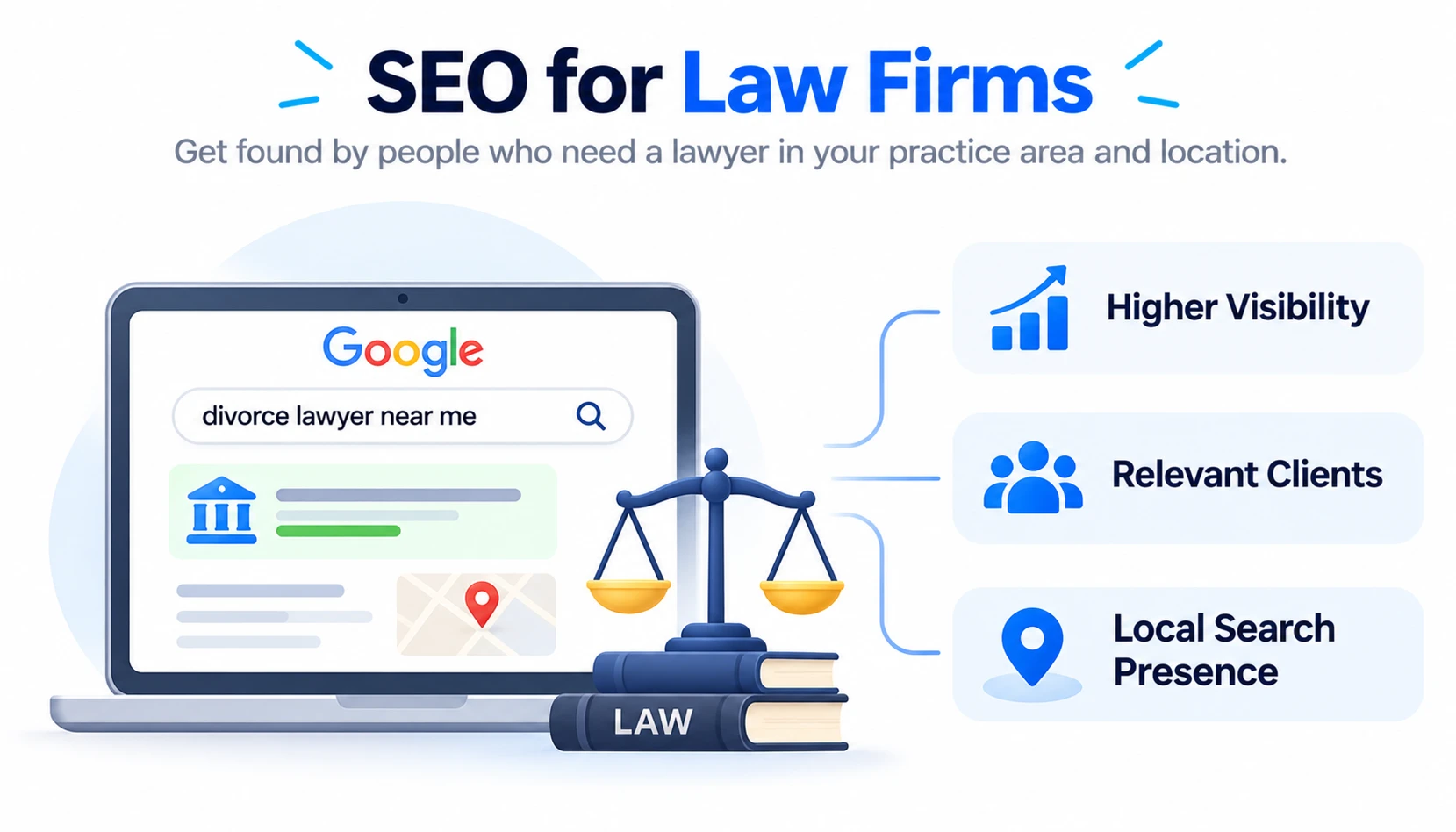
SEO for law firms (also called law firm SEO, attorney SEO, or SEO for lawyers) is the practice of improving a legal website’s visibility in organic search results, including Google’s local map listings. The goal is not traffic for its own sake. The goal is to be found by people who need a lawyer in your practice area and your location.
Search engines send crawlers to follow links and read pages. Pages that can be crawled are added to an index. When someone searches, Google selects pages from that index using many signals: how well the content matches the question, how trustworthy the site looks, how other sites link to it, how quickly it loads on a phone, and, for local searches, how close the business is to the person searching.
Legal SEO follows the same basic rules as SEO in any other field, but the stakes on the page are higher and the competition is tighter, which is why generic tactics often fall short. The next three subsections explain how.
How Does SEO Work for Law Firms?
The work moves in four stages. First you decide which practice areas and locations matter most. Second you build pages that answer what people in those situations are asking. Third you make the site technically sound so Google can read it, and you earn credibility signals such as reviews and links from reputable sites. Fourth you measure which of those efforts produce calls and signed cases, and you adjust.
Results arrive slowly and unevenly. A new practice-area page may take months to climb, while a corrected Google Business Profile category can sometimes shift local visibility sooner. Good legal SEO treats these as parallel tracks instead of waiting on one.
Why Is Legal SEO Different From Other Industries?
Three differences matter. First, Google treats legal content as a “Your Money or Your Life” topic, meaning advice that can affect someone’s finances, safety, or legal standing is held to a higher standard for accuracy and expertise. Second, intent is urgent and local: most clients hire someone within a reasonable distance, and many search while under stress. Third, advertising rules differ by jurisdiction. State bar rules can limit how you describe results, specialization, and testimonials, so copy that works for an online store can get a lawyer into trouble.
Organic Search vs. Paid Search for Law Firms
Paid search puts your ad at the top of the page the day a campaign starts and removes it the day the budget stops. Organic search takes longer to build but keeps producing without a per-click charge. Clicks on legal terms are often expensive, so many firms run both: ads for immediate volume in a high-value practice area, and SEO as an asset that lowers reliance on ads over time.
Why Is SEO Important for Law Firms?
Referrals still matter, but search now sits in the middle of almost every hiring decision. Here is what that means in practice.
Increase Online Visibility and Brand Awareness
Even people who were referred to you will usually search your name before calling. If your site does not appear, or a directory outranks it, you lose control of the first impression. Appearing steadily for practice-area searches also makes your firm name familiar before anyone needs you.
Attract High-Intent Legal Clients
Someone searching “chapter 7 bankruptcy attorney in Tampa” wants to hire a bankruptcy attorney in Tampa. Someone who saw a display ad was interrupted while doing something else. Search reaches people at the moment they are looking for help.
Generate Consistent Client Inquiries
Referral work comes in waves. A well-built set of practice-area and location pages produces inquiries week after week, which makes staffing and cash flow easier to plan.
Build Trust and Professional Credibility
Searchers use rankings, reviews, and the quality of your content as shortcuts for judging a firm. A page that explains what happens after an arrest, written by a named attorney, is evidence of competence before the first phone call.
Reduce Long-Term Dependence on Paid Advertising
Ad costs in legal markets climb as competitors bid against each other. A ranking you have earned carries no per-click fee, so each page that keeps ranking lowers your average cost of acquiring a client over time.
Compete With Larger Law Firms
Large firms usually have bigger budgets, but their sites often cover every practice area in every city with generic pages. A smaller firm with a focused practice, detailed local pages, and strong reviews can outrank them for specific searches.
How to Build an Effective SEO Strategy for Law Firms
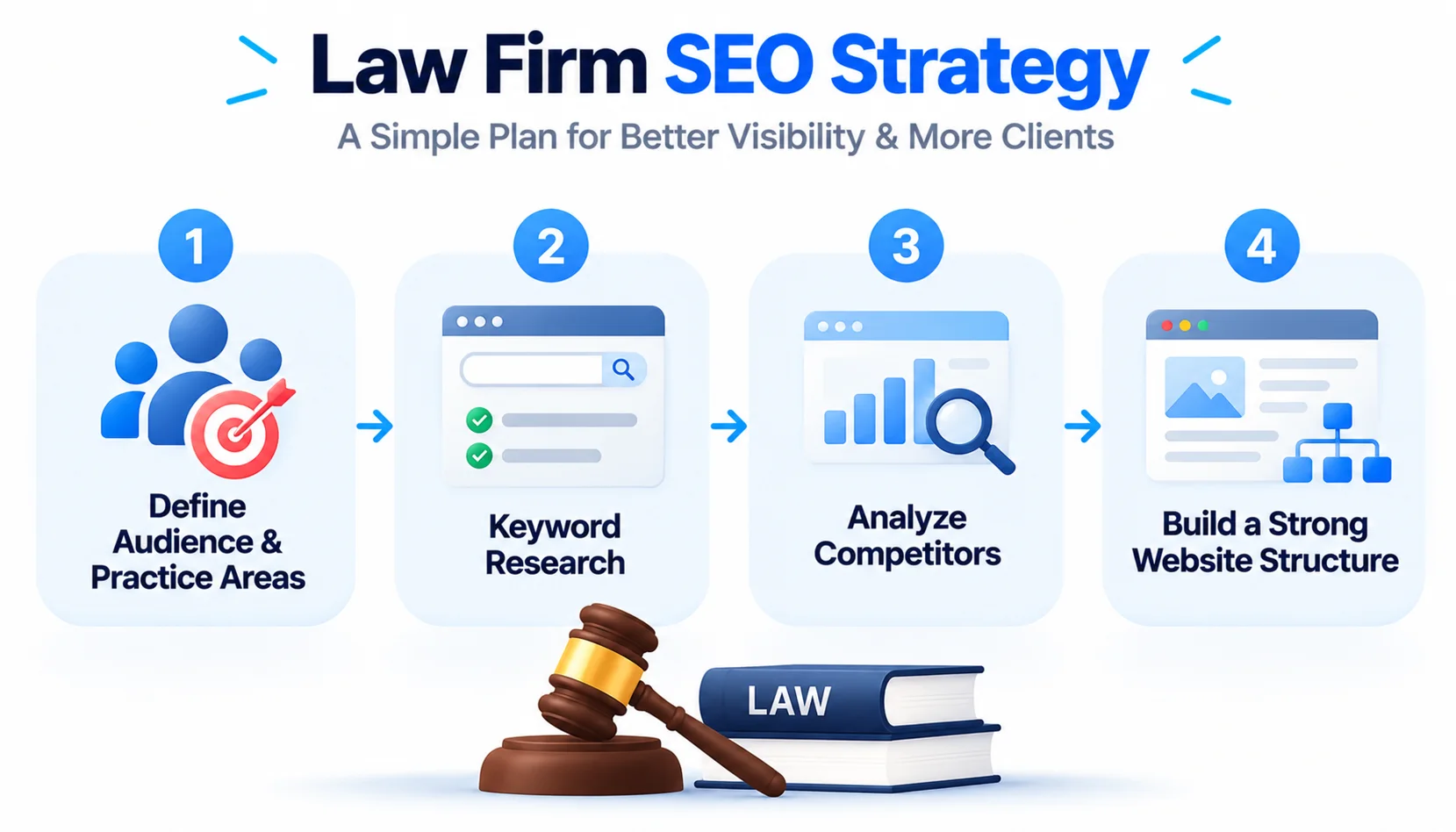
This is the part of the guide you can act on first. Four steps come before any writing or technical work: knowing who you want to reach, finding the searches they use, studying who already ranks, and organizing your site so it can compete.
1. Define Your Target Audience and Practice Areas
Start with the clients you want more of, not the ones who are easiest to reach.
- Ideal clients: the type of case, the typical client situation, and the case value that makes the work worthwhile.
- Profitable services: rank practice areas by revenue per case, available capacity, and how much you want to do the work. A firm with two strong areas should not spread content across ten.
- Search behavior: pay attention to the words clients use, which are rarely legal terms. People search “my landlord won’t return my deposit,” not “security deposit statute.”
- Geographic markets: list the cities, counties, and courthouses you actually serve. Your location pages will be built from this list.
2. Conduct Keyword Research for Lawyers
Keyword research shows what people type and how hard it will be to rank for it. Work through these steps in order.
Identify Practice-Area Keywords
Begin with core service terms such as personal injury lawyer, divorce attorney, DUI defense, and estate planning attorney. These are competitive, so treat them as targets for your main practice pages rather than your first quick wins.
Find Local and Location-Based Keywords
Add the city, neighborhood, county, or court. “Family law attorney in Austin” and “family law attorney Travis County” can be separate searches with different competition. Google’s autocomplete suggestions and the local map pack show which versions people actually use.
Target Long-Tail Legal Keywords
Longer, more specific phrases such as “truck accident lawyer contingency fee Houston” have lower volume but often convert better, because the searcher knows exactly what they need. They are also easier to rank for while a site is young.
Find Informational and Question-Based Keywords
People ask “how long do I have to file a personal injury claim” long before they hire anyone. The People Also Ask box, online forums, and the questions your intake team hears every week are good sources. These queries feed blog content that earns trust before the inquiry arrives.
Analyze Search Intent and Keyword Difficulty
Search the keyword yourself. If page one is mostly directories and legal-aid sites, a law firm page may struggle. If it is mostly firm pages, you are in the right market. Compare the difficulty scores from your SEO tool against the strength of your own site instead of chasing the highest-volume term.
Map Keywords to Individual Website Pages
Each page should target one main topic. Two pages competing for the same keyword split their strength. Build a map before you write anything. A simple version looks like this:
| Page | Primary keyword | Secondary keyword | Intent |
| /practice-areas/car-accidents/ | car accident lawyer Denver | auto accident attorney Denver | Commercial |
| /blog/how-long-to-file-a-car-accident-claim/ | how long to file a car accident claim | car accident statute of limitations | Informational |
| /locations/aurora/ | personal injury lawyer Aurora | injury attorney Aurora CO | Local commercial |
| /attorneys/attorney-name/ | attorney name + Denver | attorney name + personal injury | Navigational |
3. Analyze Competitor Law Firm Websites
Identify Your Main Search Competitors
Your search competitors are not always the firms you compete with for cases. Directories, legal publishers, and law firms in neighboring cities may all outrank you for the same terms. Search your ten most important keywords in a private browser window and note who appears repeatedly.
Analyze Competitor Keywords and Rankings
Enter two or three of those domains into Ahrefs or Semrush to see which keywords bring them traffic. Pay special attention to terms they rank for where you have no page at all.
Review Their Practice-Area Pages
Open the top-ranking pages and note length, structure, the questions answered, media used, calls to action, and whether an attorney is named. You are looking for what searchers have come to expect, and for what is missing.
Analyze Backlinks and Content Gaps
Check where competitor links come from: bar associations, local news, directories, community sponsorships. List the sources you could realistically earn too. Then list topics every competitor skips or covers thinly, such as local court procedures or how fees work. Those gaps are where a new page can stand out.
4. Create a Strong Law Firm Website Structure
Organize Pages by Practice Area
Give each major practice area its own page, and give significant sub-areas their own pages beneath it. A single “Our Services” page that lists everything cannot rank well for any of it.
Build Location-Specific Pages
If you serve several cities or run several offices, build a distinct page for each place with real local content. The local SEO section below covers this in detail.
Create a Logical Internal Linking Structure
Link from each practice-area page to related sub-pages, blog posts, attorney profiles, and location pages, and link back. Use descriptive anchor text. Visitors and crawlers should be able to reach any important page within three clicks of the homepage.
Develop Topic Clusters Around Legal Services
A topic cluster is one main page on a practice area supported by several articles on narrower questions, all linked together. It shows search engines how deeply you cover a subject. A sample structure for a personal injury and family law firm with two offices:
Home
└ Attorneys (one profile page per attorney)
└ Practice Areas
└ Personal Injury: Car Accidents, Truck Accidents, Wrongful Death
└ Family Law: Divorce, Child Custody, Support
└ Locations (one page per office)
└ Blog and Resources
└ Reviews and Case Results
└ Contact
On-Page SEO for Law Firm Websites
On-page SEO covers everything you control on the page itself. Most of it is basic hygiene, and most law firm sites still get some of it wrong.
Optimize Title Tags and Meta Descriptions
The title tag is the clickable headline in search results. Keep it near 60 characters, lead with the main keyword and location, and write it so a person would want to click. Meta descriptions do not affect rankings directly, but they influence clicks. Aim for about 155 characters that say what the visitor will find and invite them to call or book a consultation. Every page needs its own.
Create SEO-Friendly URLs
Keep URLs short, lowercase, and readable, with hyphens between words. /practice-areas/divorce/ is better than /page?id=482. Do not change a live URL without setting up a redirect from the old one.
Use Proper H1, H2, and H3 Headings
Use one H1 per page that states the topic plainly, H2s for main sections, and H3s for subsections. Headings exist for structure and accessibility first. Put keywords in where they fit, not in every line.
Optimize Legal Content With Relevant Keywords
Write for the client first, then check coverage. Mention the main keyword early, use natural variations, and answer the questions a person in that situation would ask: the process, the timeline, the costs, what to bring, what to avoid. Repeating the exact phrase more often does not help.
Improve Internal Linking Between Practice Areas and Blogs
Each blog post that answers a question about a practice area should link to that practice page with descriptive anchor text, and the practice page should link out to its best supporting articles.
Optimize Images and Alt Text
Use real photographs of your office and attorneys instead of stock images of gavels and scales. Compress files, name them descriptively, and write alt text that says what is in the image. Alt text also helps visitors who use screen readers.
Add Relevant Schema Markup
Schema is code that labels the content on a page so search engines can interpret it. It does not guarantee rich results, but it removes guesswork. Several types apply to law firms.
LegalService Schema
Describes the firm as a legal service: name, address, phone number, areas served, practice areas, and hours. Use it on the homepage and location pages.
Organization Schema
States the firm’s official name, logo, website, and profiles on other platforms such as LinkedIn and bar directories. This helps connect the firm across the web.
Attorney and Person Schema
Marks up each lawyer’s name, job title, education, bar admissions, and links to their profiles elsewhere. Use it on attorney biography pages.
Article and Breadcrumb Schema
Article schema labels blog posts with their author and dates. Breadcrumb schema shows where a page sits in the site hierarchy. Test all of your markup with Google’s Rich Results Test and fix any errors it reports.
Local SEO for Law Firms: How to Rank in Google Maps
For most firms, local search is where clients come from. When Google detects local intent, it often shows a map with a few listings above the standard results, known as the local pack. Appearing there depends on relevance, distance, and prominence, which Google describes as how well known and well regarded a business is across the web. You cannot change where the searcher is standing, but you can influence the other two.
Optimize Your Google Business Profile
Your Google Business Profile is the listing that appears in maps and in the panel beside search results when someone looks up your firm. Claim and verify it, then complete every field accurately.
Choose the Right Business Categories
Pick the most specific primary category that fits your main practice, such as “Personal injury attorney” or “Divorce lawyer,” instead of a general “Law firm” if a better match exists. Add secondary categories only for areas where you really practice.
Add Accurate Business Information
Your name, address, phone number, and website must match what appears on your site and everywhere else. Use the business name as it appears on your signage, without added keywords. Keyword stuffing in business names breaks Google’s guidelines and can get a listing suspended.
Add Legal Services and Business Descriptions
Use the services and description fields to list practice areas in plain language. Write the description for people, not algorithms, and say who you help and where.
Upload Real Office and Attorney Photos
Add photos of the building exterior, reception area, conference room, and the attorneys. Real photos help clients recognize the office and know who they will meet.
Keep Business Hours Updated
Update hours for holidays and any changes. If you offer after-hours consultations or round-the-clock intake, say so. Wrong hours lead to missed calls and angry reviews.
A short Google Business Profile checklist:
- Profile claimed and verified
- Specific primary category chosen, secondary categories added only where accurate
- Name, address, and phone number match the website exactly
- Website link and appointment link added
- Description and services written in plain language
- Real photos of the office and attorneys uploaded
- Regular and holiday hours set
- Every review answered, positive and negative
- Profile reviewed monthly for edits suggested by users or Google
Build Consistent NAP Citations
NAP stands for name, address, and phone number. A citation is any mention of them on another site: general directories, legal directories such as Avvo, Justia, and FindLaw, and local chambers of commerce. Inconsistencies, like “Suite” in one place and “Ste.” in another, or an old phone number, can leave search engines unsure which details are correct. Audit your existing listings, correct the errors, and then add new listings on reputable sites. Tools such as BrightLocal can speed this up.
Get More Authentic Client Reviews
Reviews affect both rankings and decisions. Ask satisfied clients at a natural moment, such as when a case closes well, and send a direct link to your review page. Reply to every review in a professional tone. Never reveal confidential details in a reply, even to correct the record. Do not offer incentives or screen who you ask, since both can violate Google’s policies and, in some places, ethics rules. Check your state bar’s guidance on client testimonials.
Create Location-Specific Practice-Area Pages
A page for “Divorce Lawyer in Tacoma” should contain content that exists only because it is about Tacoma: the local courthouse, how family court runs there, the neighborhoods you serve, directions and parking, and the attorneys who work in that office. Copying one page and swapping city names produces thin content that rarely ranks.
Build Local Backlinks and Community Authority
Links from local organizations tell Google your firm belongs to the community. Sponsor a youth team, join the chamber of commerce, speak at a neighborhood event, or contribute a legal explainer to a local news outlet. Each can earn a link and a real connection.
Optimize for Near-Me Searches
Searches such as “lawyer near me” depend mostly on the searcher’s location and your listing, not on the words on your page. Keep the Google Business Profile accurate, make location pages clear, and make sure the site is fast on mobile. A tap-to-call button removes a step.
Manage Multiple Law Firm Locations
Each office that clients can visit should have its own profile, location page, and ideally its own local phone number. Do not create listings for virtual offices or addresses you do not staff, since Google can suspend them. Use consistent naming across offices and assign someone to watch reviews at each.
Content Marketing Strategy for Law Firms

Content gives search engines something to rank and gives potential clients a reason to trust you before they call.
Create Dedicated Practice-Area Pages
Each practice page should describe the service, who it is for, the process, a typical timeline, what a client should do first, and how fees work. Name the attorneys and give a clear way to get in touch. Match or exceed the depth of the pages already ranking.
Publish Educational Legal Blog Articles
Write about the questions you hear in consultations. “What happens at a first custody hearing” will do more for you than “Five reasons to hire a lawyer.” Answer directly, and be honest about what depends on the facts and the jurisdiction.
Build Legal Topic Clusters and Pillar Pages
A pillar page gives a complete overview of a practice area and links to supporting articles, and each supporting article links back. Build clusters around the practice areas you most want to grow.
Answer Common Client Questions
Write headings as questions, put a short direct answer first, and add detail after it. This format also suits featured snippets and AI summaries.
Create Location-Based Legal Content
Cover local topics: how a particular county handles traffic court, local filing procedures, differences in local practice, community legal resources. Firms in other cities cannot copy these pages.
Update Existing Legal Content Regularly
Laws change. Review your main pages at least once a year, correct anything outdated, and show the date of the last review. Out-of-date legal information is a risk to readers and to your reputation.
Develop Attorney-Led Content
Have attorneys write or review content, and put their names and credentials on it. Short videos or recorded Q&A sessions can be transcribed and added to the page. Readers respond to a real person explaining something.
Use Internal Linking to Strengthen Topical Authority
Internal links tell search engines which pages are related and which matter most. When you publish a new article, add links to it from two or three relevant older pages.
A sample content cluster for personal injury:
| Page type | Topic | Intent |
| Pillar page | Personal Injury Lawyer in [City]: What to Expect and How to Choose | Commercial |
| Supporting article | What to do in the first 48 hours after a car accident | Informational |
| Supporting article | How long you have to file a personal injury claim in [State] | Informational |
| Supporting article | How personal injury settlements are typically calculated | Informational |
| Supporting article | How contingency fees work | Informational |
| Supporting article | Dealing with insurance adjusters after a crash | Informational |
| Supporting article | Truck accident claims: who can be held responsible | Informational |
| Supporting article | Slip and fall liability for property owners | Informational |
| Location page | Personal injury lawyer in [Suburb or Nearby City] | Local commercial |
Technical SEO for Law Firm Websites
Technical SEO makes sure search engines can reach, read, and index your pages and that visitors have a smooth experience once they arrive.
Improve Website Speed and Core Web Vitals
Core Web Vitals measure loading speed, responsiveness, and visual stability. Test your main pages with PageSpeed Insights and the report in Search Console. Common fixes are compressing images, using a lightweight theme, removing unused plugins and scripts, and moving to better hosting.
Make Your Website Mobile-Friendly
Most legal searches happen on phones. Check that text reads without zooming, buttons are easy to tap, forms are short, and the phone number is tappable. Google indexes the mobile version of your site first, so a weak mobile page weakens the whole site.
Fix Crawling and Indexing Problems
The Pages report in Search Console shows which URLs are indexed and why others are not. Look for important pages marked “Crawled, currently not indexed” or “Excluded by noindex tag,” and fix the cause.
Optimize XML Sitemaps and Robots.txt
A sitemap lists the pages you want indexed. Submit it in Search Console. The robots.txt file tells crawlers what to avoid, and a misplaced rule can hide an entire site, so review it after any redesign.
Implement HTTPS and Website Security
Use HTTPS on every page, keep your CMS and plugins updated, and set up regular backups. Law firm sites receive sensitive inquiries, so security is also a matter of protecting clients.
Fix Broken Links and Redirect Errors
Run a crawl with Screaming Frog to find 404 errors and redirect chains. When a page is moved or removed, use a 301 redirect to the closest relevant page.
Optimize Website Architecture
Keep important pages close to the homepage, use clean navigation, and avoid orphan pages that no other page links to.
Improve Website Accessibility
Add alt text, use enough color contrast, support keyboard navigation, label form fields, and caption videos. Accessibility widens who can use the site and lowers the chance of complaints.
Audit Duplicate Content and Canonical Tags
Duplicate content appears when location pages share identical text, when URL parameters create copies, or when both HTTP and HTTPS or www and non-www versions load. Use canonical tags to point to the preferred version and rewrite pages that are near copies of each other.
Link Building Strategies for Law Firms
Links from other sites remain one of the strongest authority signals. In legal marketing, quality matters far more than quantity: a few links from relevant, reputable sources beat hundreds from unrelated sites.
Get Backlinks From Legal Directories
Listings on established legal directories such as Justia, Avvo, FindLaw, and Martindale-Hubbell, along with state and local bar directories, are a reasonable starting point. Some are paid. Treat them as citations that happen to include links, not as a complete strategy.
Earn Links From Bar Associations and Legal Organizations
Membership pages, committee work, speaking at CLE events, and event sponsorships often come with a profile or mention that links to your site. These are among the most relevant links a law firm can have.
Use Digital PR to Build Legal Industry Authority
Journalists need legal explanations for their stories. Offer expert commentary on topics in your practice area through platforms where reporters request sources, or contact local reporters directly. A quote in a regional paper usually comes with a link.
Publish Expert Contributions and Guest Articles
Write for legal publications, local business sites, or industry blogs read by your target clients. Offer real insight, not a promotional piece with a link attached.
Build Relationships With Local Organizations
Partnerships with nonprofits, universities, and community groups can produce links through event pages, scholarship listings, and sponsor lists.
Create Link-Worthy Legal Resources
People link to things they can cite or use: a plain-language guide to your state’s process for a common legal problem, a summary of local data, a checklist, a timeline explainer. Original and useful resources get linked without being asked.
Monitor and Audit Your Backlink Profile
Review new links monthly in Ahrefs, Semrush, or Search Console. Watch for sudden spikes of irrelevant links. Google has said most sites never need to disavow links, so reserve that tool for a clear pattern of manipulative links you cannot get removed.
The table below contrasts links worth pursuing with links that put a site at risk.
| Link source | Example | Verdict |
| Bar association member profile | State or county bar directory listing | Worth pursuing |
| Local news quote | Attorney commentary in a regional paper | Worth pursuing |
| Guest article on a legal publication | Practical guide written by a named attorney | Worth pursuing |
| Chamber of commerce or community sponsor page | Listing on a local organization’s site | Worth pursuing |
| Paid link packages on unrelated blogs | A casino blog linking to a DUI page | Avoid |
| Private blog networks | Dozens of near-identical sites created to pass links | Avoid |
| Exact-match anchors spread across forums | “best car accident lawyer” posted repeatedly in comments | Avoid |
| Mass directories with no editorial review | Hundreds of listings bought in one batch | Avoid |
E-E-A-T for Law Firms: How to Build Trust and Authority
E-E-A-T stands for experience, expertise, authoritativeness, and trustworthiness. It is the framework Google’s quality raters use to judge content, and it is applied most strictly to topics like law. Google has said E-E-A-T is not a direct ranking factor, but the qualities it describes match what tends to perform well.
Demonstrate Attorney Experience and Expertise
Show what you have actually done: years in practice, types of cases handled, courts you appear in, and any speaking, teaching, or writing. Specifics carry more weight than “experienced and aggressive.”
Create Detailed Attorney Biography Pages
Each attorney should have a page with a professional photo, practice focus, background, education, bar admissions, memberships, publications, and contact details. Link it to the articles that attorney wrote or reviewed.
Highlight Education, Licenses, and Bar Admissions
List jurisdictions of admission and link to the bar’s own verification page. Where the rules allow, include bar numbers. Accurate credentials are easy to check, and that is part of why they build trust.
Add Author and Legal Reviewer Information
Display the author’s name and credentials on each article. If a non-attorney drafted it, name the attorney who reviewed it and the date of the review.
Publish Accurate and Updated Legal Content
Cite statutes, court rules, and official sources. Keep a review schedule. Say so when a point depends on jurisdiction, instead of writing as though one rule applies everywhere.
Showcase Testimonials and Case Results Responsibly
Many states require disclaimers on case results, such as a statement that past results do not guarantee future outcomes, and some restrict testimonials. Check your bar’s advertising rules, include the required language, and never imply a guaranteed result.
Follow Google’s YMYL Content Quality Expectations
Google applies a stricter standard to Your Money or Your Life topics. In practice that means named authors with credentials, accurate and sourced information, clear contact details, an about page that says who runs the firm, and no misleading claims.
How to Optimize Law Firm Websites for AI Search

AI search tools now answer legal questions directly, sometimes before a person clicks anything. That changes how some clients first meet a firm, but it does not replace the fundamentals. The sites these tools cite tend to share traits with the sites that rank well: accurate, well-organized, clearly attributed content. Treat AI visibility as an extension of good SEO, not a separate discipline.
How AI Search Is Changing Legal Discovery
People now ask conversational questions such as “Do I need a lawyer if the other driver was uninsured?” and receive a summary with a handful of sources. Some will never visit a website. Others will click through to a firm named in the answer. Behavior is changing quickly and tools differ, so measure what you see instead of assuming.
Optimize Content for Google AI Overviews
Google’s guidance has been that its AI features draw on the same foundation as Search, so pages need to be indexable, helpful, and well written. Give direct answers near the top of a page, organize content under clear headings, and support claims with sources. No special markup is required.
Improve Visibility in ChatGPT, Gemini, and Perplexity
These tools draw on different indexes and sources, and their behavior shifts often. Common ground exists: do not block their crawlers by accident, keep information consistent across your site and profiles, and earn mentions on reputable sites. Test by asking each tool the questions your clients ask and noting which sources it uses.
Use Clear Questions and Direct Answers
Write a question as a heading, answer it in one or two sentences, then add the nuance. Keep answers factual and specific to your jurisdiction.
Strengthen Attorney and Law Firm Entity Signals
An entity is something search systems recognize as distinct, such as a firm or a person. Consistent names, addresses, schema markup, attorney bios, bar profiles, and directory listings help those systems connect separate mentions and treat them as one firm.
Publish Authoritative and Citation-Worthy Legal Resources
Original explainers, local legal guides, and well-sourced analysis are what get cited. A thin summary of a statute that appears on a hundred other sites is not.
Monitor Brand Mentions and AI Search Visibility
Set alerts for your firm and attorney names, check Search Console for impressions on question-style queries, and periodically run a fixed list of client questions through the AI tools and record the results. Some SEO platforms now track AI visibility, but their methods differ, so read the numbers as directional.
None of this replaces traditional SEO. A site that cannot be crawled, does not earn trust, or contains inaccurate statements will not be rescued by an AI-specific tactic. Accuracy, credible sourcing, and clarity serve both.
Best SEO Tools for Law Firms
You do not need every tool on this list. A small firm can do a great deal with the free Google tools and one paid platform.
Google Search Console
Free. Shows the queries that earn impressions and clicks, indexing status, mobile and speed reports, and any manual actions. It is the first place to look when traffic changes.
Google Analytics 4
Free. Tracks sessions, traffic sources, and conversions such as form submissions and phone clicks. Set up conversion events early. Without them you cannot tie SEO work to leads.
Google Business Profile
Free. Besides managing the listing, its performance data shows calls, direction requests, and website clicks from Maps and Search.
Ahrefs
Paid. Strong for backlink analysis, competitor research, and keyword exploration.
Semrush
Paid. Combines competitor analysis, keyword research, site audits, and position tracking in one platform.
Screaming Frog SEO Spider
A desktop crawler for technical audits: broken links, redirect chains, missing titles, duplicate content. Free for small crawls and paid beyond that.
Google PageSpeed Insights
Free. Reports Core Web Vitals and gives specific speed recommendations for each page.
BrightLocal
Paid. Local rank tracking, citation audits, and review monitoring, which suits firms with several locations.
| Tool | Main purpose |
| Google Search Console | Search performance and indexing |
| Google Analytics 4 | Traffic and conversions |
| Ahrefs | Backlinks and keyword research |
| Semrush | Competitor and keyword analysis |
| Screaming Frog | Technical website audits |
| BrightLocal | Local SEO and citations |
| PageSpeed Insights | Performance analysis |
How to Measure Law Firm SEO Performance
A report full of ranking charts can look excellent while the phone stays quiet. Measure what leads to cases.
Organic Traffic and Search Visibility
Track organic sessions and impressions in Google Analytics 4 and Search Console, broken out by practice-area page where you can. Read trends over months, not days.
Keyword Rankings
Track a fixed set of priority terms in a rank tracker, by city. Rankings are a diagnostic tool, not the goal.
Local Map Pack Performance
Use Business Profile insights and a local rank tracker to see where you appear across your service area. Visibility can differ noticeably from one part of a city to another.
Organic Leads and Consultation Bookings
Count calls, form submissions, chat conversations, and scheduled consultations whose source is organic search or Google Maps. Call tracking with dynamic numbers helps, and so does a plain question at intake: how did you find us?
Conversion Rate and Cost Per Lead
Conversion rate is leads divided by visits. Cost per lead from SEO is total SEO spend divided by organic leads in the same period. Compare it with paid channels, keeping in mind that SEO’s cost per lead usually falls as ranking pages accumulate.
Qualified Leads and Signed Cases
Not every inquiry is a case. Track how many leads meet your criteria, how many sign, and what those cases are worth. Ask intake staff to tag the source on every new matter.
Calculate SEO ROI
The basic formula is:
SEO ROI (%) = (Revenue from SEO − SEO cost) ÷ SEO cost × 100
As an illustration only, suppose organic search produced $90,000 in fees from signed cases over a year and the SEO investment was $30,000. The calculation is ($90,000 − $30,000) ÷ $30,000 × 100, which equals 200 percent. Contingency cases can take a long time to pay, so estimate expected value at signing and update it as cases resolve.
This is why qualified cases and revenue matter more than traffic. Traffic can climb because a blog post attracted readers who live in another state and will never hire you. A firm with five hundred fewer visits and five more signed cases is doing better.
How Much Does SEO Cost for Law Firms?
There is no honest single number. Prices depend on your market, your competition, and what needs doing, so be wary of anyone who quotes a fixed price without looking at your site and your competitors.
Factors That Affect Law Firm SEO Pricing
- Practice-area competition: personal injury in a large city costs more to compete in than estate planning in a small town.
- Geographic location: bigger markets mean more competitors with larger budgets.
- Website condition: a site with technical problems needs repair work before growth work.
- Number of practice areas: each one needs its own pages, content, and links.
- Number of office locations: each office needs its own profile, page, citations, and reviews.
- Content and link-building requirements: the volume and quality you need drives the largest share of effort.
In-House SEO vs. SEO Agency
An in-house marketer knows the firm well and is available every day, but covers a narrower range of skills and needs tools and training. An agency brings specialists in technical work, content, and links, but needs clear direction and has other clients. Some firms combine the two, with an in-house coordinator working alongside an outside specialist.
DIY SEO vs. Professional SEO Services
A solo attorney can handle the Google Business Profile, review requests, and basic page optimization at low cost, though it costs time. Technical fixes, competitive keywords, and link building often benefit from professional help. Do what you can do well and hire for the rest.
How to Evaluate an SEO Agency
- Ask for case studies from legal clients and call the references.
- Ask who will actually do the work, and whether it is outsourced.
- Ask how they report. Reports should cover leads and cases, not just rankings.
- Be cautious of any promise to guarantee rankings.
- Ask how they build links, and what they will not do.
- Check that they understand your state bar’s advertising rules.
- Insist that you own the website, Business Profile, and analytics accounts.
SEO Pricing Models and Expected Deliverables
Rather than quoting prices, the table below compares the common ways SEO is sold.
| Model | How it works | Typical deliverables | Watch for |
| Monthly retainer | Fixed monthly fee for ongoing work | Audits, content, local SEO, links, reporting | Vague deliverables or no clear scope |
| Project-based | One fee for a defined project | Site audit, redesign SEO, content cluster, migration support | Work that ends before results appear |
| Hourly consulting | Pay for expert time as needed | Strategy sessions, audits, team training | Needs an in-house team to carry it out |
| Performance-based | Fee tied to leads or results | Lead generation, sometimes bundled services | Lead quality, and bar rules that restrict paying per referred client |
How Long Does SEO Take to Work for Law Firms?
Expect months, not weeks. Timelines depend on competition, your site’s existing authority, your market, and the quality of the work. Nobody can honestly promise a ranking by a set date.
Initial Technical and Website Improvements
The first stretch, often the first one to three months, goes to audits, fixing crawl errors, cleaning up the Business Profile, setting up tracking, and rewriting the most important pages. Some changes show quickly, but none are guaranteed.
Local SEO Progress
Local visibility can improve before organic rankings do, particularly after a profile cleanup, citation fixes, and a steady flow of reviews. Competitive markets still take time.
Content and Keyword Ranking Growth
New and updated pages typically need a few months before Google tests them and settles on a position. Long-tail terms often move first, with competitive head terms following later.
Long-Term Authority and Lead Generation
Authority builds gradually through links, reviews, and consistent publishing. Firms that keep going for a year or more are usually better placed than those that stop after a few months, though results vary by market.
Common Law Firm SEO Mistakes to Avoid
Targeting Broad Keywords Without Search Intent
“Lawyer” or “attorney” on its own attracts people looking for definitions, careers, and jokes. Target terms that name a service and a place.
Creating Thin or Duplicate Location Pages
Fifty cities with the same paragraph and a swapped name read as spam. Google’s spam policies cover doorway pages, which this pattern can resemble. Build fewer pages with real local content.
Ignoring Google Business Profile
For local searches the profile often matters as much as the website. An unclaimed or neglected one hands those clicks to competitors.
Publishing Unverified Legal Information
A wrong statement of law can harm a reader and damage your standing. Have an attorney check every legal claim and cite the source.
Buying Low-Quality Backlinks
Cheap link packages can trigger penalties or simply do nothing. Spend the same effort on local and professional links that a real person would click.
Ignoring Mobile User Experience
If the site is slow or awkward on a phone, visitors leave and the call never happens. Test on an actual phone, not only a desktop browser.
Neglecting Internal Linking
New articles that no other page links to are hard for search engines to find and give visitors nowhere to go next.
Measuring Rankings Instead of Qualified Leads
A first-page ranking for a term nobody hires on is worth nothing. Tie reporting to consultations and signed cases.
Making Noncompliant Advertising Claims
Phrases such as “best lawyer,” “guaranteed result,” or “specialist” can violate bar rules in some states. Have your content reviewed against your jurisdiction’s rules before it goes live.
Law Firm SEO Implementation Checklist
Use this list to track progress. The order roughly follows priority.
- Keyword research: practice-area, local, and question keywords identified and mapped to pages
- Competitor analysis: main search competitors, their keywords, links, and content gaps documented
- Website architecture: clear hierarchy by practice area and location, with internal links in place
- Practice-area pages: one dedicated, in-depth page for each service you want to grow
- On-page SEO: titles, meta descriptions, URLs, headings, images, and schema reviewed on every key page
- Technical SEO: speed, mobile usability, indexing, sitemap, HTTPS, and redirects checked
- Local SEO: location pages written with real local content
- Google Business Profile: complete, accurate, and updated for every office
- Reviews and citations: a steady review process running and listings consistent across directories
- Legal content: educational articles published, reviewed by an attorney, and dated
- Link building: relevant local, legal, and editorial links being pursued
- E-E-A-T: attorney bios, credentials, author and reviewer information visible
- Conversion tracking: calls, forms, and bookings tracked, with source recorded at intake
- Performance reporting: monthly review of leads, signed cases, and revenue from organic search
Frequently Asked Questions About SEO for Law Firms
What Is SEO for Law Firms?
It is the process of improving a law firm’s website and online presence so it appears in Google results and map listings when potential clients search for legal help. It covers keyword research, page content, technical fixes, local search, reviews, and links.
How Much Does SEO Cost for a Law Firm?
It varies widely with your market, competition, and scope. Many firms pay a monthly retainer, while others buy projects or consulting hours. Ask for proposals that list specific deliverables, and treat quotes without any review of your site as a warning sign.
How Long Does Law Firm SEO Take to Show Results?
Often several months before results become steady. Local improvements can show sooner, and competitive practice areas in large cities can take longer. Be wary of guaranteed timelines.
Is SEO Worth It for Small Law Firms?
Often yes, especially local SEO. A small firm with a focused practice, a well-kept Business Profile, and good reviews can compete for local searches against larger firms. The return depends on case value and how well the firm converts inquiries.
How Can a Lawyer Rank Higher on Google?
Build pages around specific services and locations, complete and maintain the Business Profile, collect genuine reviews, publish accurate educational content, earn links from relevant sites, and keep the website fast and mobile-friendly.
How Do Law Firms Get More Google Reviews?
Ask at a natural moment, send a direct link, make the request easy, and reply to every review. Do not offer incentives or pick who to ask, and follow your bar’s rules on testimonials.
What Are the Best SEO Tools for Lawyers?
Start with Google Search Console, Google Analytics 4, and Google Business Profile, all free. Add Ahrefs or Semrush for research, Screaming Frog for technical audits, and BrightLocal for local tracking if you need them.
Can Law Firms Do Their Own SEO?
Partly. Business Profile management, review requests, and basic page optimization are manageable in-house. Technical work, competitive link building, and large content programs often benefit from specialist help.
Is Local SEO Important for Attorneys?
Yes. Most clients want a lawyer nearby, and Google often shows map results first for legal searches with local intent.
How Can Law Firms Appear in AI Search Results?
Use the same fundamentals that support ordinary search: accurate, well-structured content, named attorneys with verifiable credentials, consistent firm details across the web, and mentions from reputable sources. Then test the AI tools with real client questions to see what they cite.
Conclusion
Law firm SEO is several jobs at once. The website has to be technically sound, the content has to answer real questions, the local presence has to be accurate and well reviewed, and other reputable sites have to vouch for you through links and mentions. Neglect one and the others carry less weight.
Trust sits underneath all of it. Searchers are choosing someone to handle a serious problem, and Google is trying to send them to a source that will not mislead them. Named attorneys, verifiable credentials, accurate law, and honest claims serve both audiences.
Keep the target in view: qualified clients, not traffic. Track consultations, signed cases, and revenue, and let those numbers decide where to spend next.
If you want to know where your firm stands today, RANKLLER can run a law firm SEO audit covering your technical setup, local presence, content, and competitors, and finish with a prioritized plan. Get in touch at rankller.com to request a consultation.