
You write a blog post, wait three months, and still land somewhere on page five of Google. If that sounds familiar, you are not alone. The truth is, most people target the wrong keywords ones that big brands have already dominated for years.
The smarter move? Go after low competition keywords.
Low competition keywords are search phrases that fewer websites are competing for. They may not have millions of monthly searches, but they are far easier to rank for and they bring in real, targeted traffic that actually converts. If your website is new, growing, or struggling to break through, these keywords are your fastest path to page one. you will learn exactly what low competition keywords are, why they matter more than ever in 2025, and the step-by-step methods to find them both free and paid. By the end, you will have a clear plan to start ranking faster and building lasting organic traffic.
What Are Low Competition Keywords?
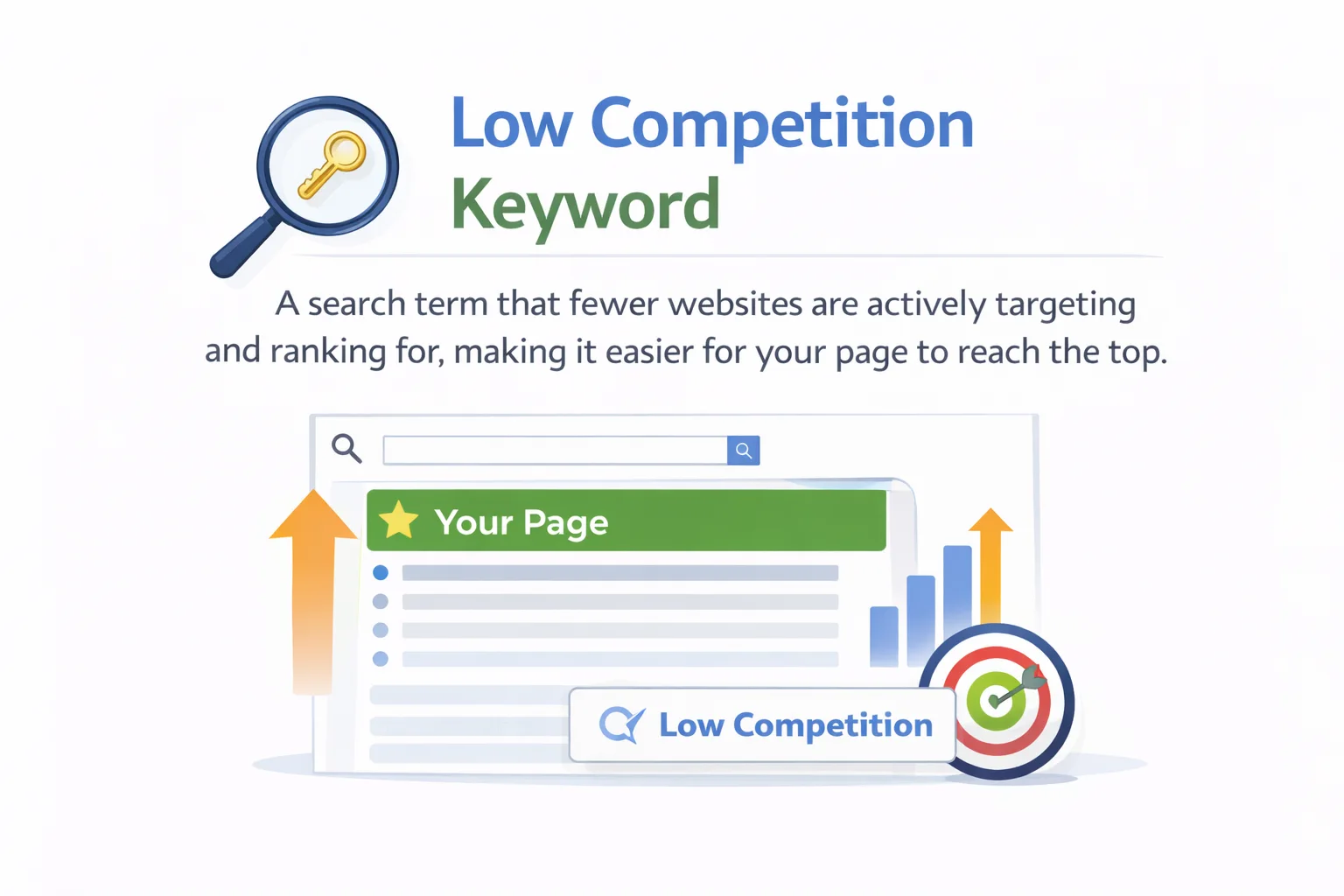
A low competition keyword (sometimes called a low difficulty keyword) is a search term that fewer websites are actively targeting and ranking for. Because there is less competition in the search results, it is significantly easier for your page to climb to the top.
Think of it like this: trying to rank for “best laptop” is like opening a coffee shop next to Starbucks. But ranking for “best laptop for college students under $500” gives you a real fighting chance because the competition is thinner and the audience is more specific.
What Makes a Keyword Low Competition?
In most SEO tools, a keyword is considered low competition when:
- Its Keyword Difficulty (KD) score is below 20 out of 100
- The pages currently ranking have low domain authority or thin backlinks
- The search results contain outdated or poorly written content
- The search intent is clear but not well-served by existing pages
Why Should You Target Them?
Here are the real-world benefits of going after low competition keywords:
- Faster rankings you can realistically reach page one within 3 to 6 months instead of years
- Better conversion rates specific keywords attract visitors who know exactly what they need
- Lower content costs you need fewer backlinks and less domain authority to compete
- Ideal for new websites you do not need an established brand to rank
- Builds authority over time winning small keywords helps you gradually take on bigger ones
How to Spot a Low Competition Keyword
Before you start building your keyword list, it helps to know what signals to look for. A low KD score in a tool is a good start, but it is not the whole story.
SERP Signals That Indicate Low Competition
Open a browser, search your target keyword, and look for these green flags in the results:
- Low-authority websites ranking on page one (check their Domain Rating in Ahrefs or Authority Score in SEMrush)
- Weak or zero backlinks pointing to the top-ranking pages
- Thin content short articles, no images, barely any depth
- Pages that do not directly answer the search query
- Forum threads (Reddit, Quora) ranking on the first page
If you see any of these signs, that keyword is very likely beatable with a well-written, focused article.
Common Keyword Modifiers That Signal Low Competition
Certain phrases almost always indicate a long-tail, lower competition keyword. Watch out for modifiers like:
- “for beginners” or “for small businesses”
- “how to” or “step by step”
- “best [product] under $50” or price-specific phrases
- “[tool] alternative” or “[tool] vs [tool]”
- “near me” or city/location-specific terms
- “template”, “checklist”, “guide”, or “tutorial”
Free Methods to Find Low Competition Keywords
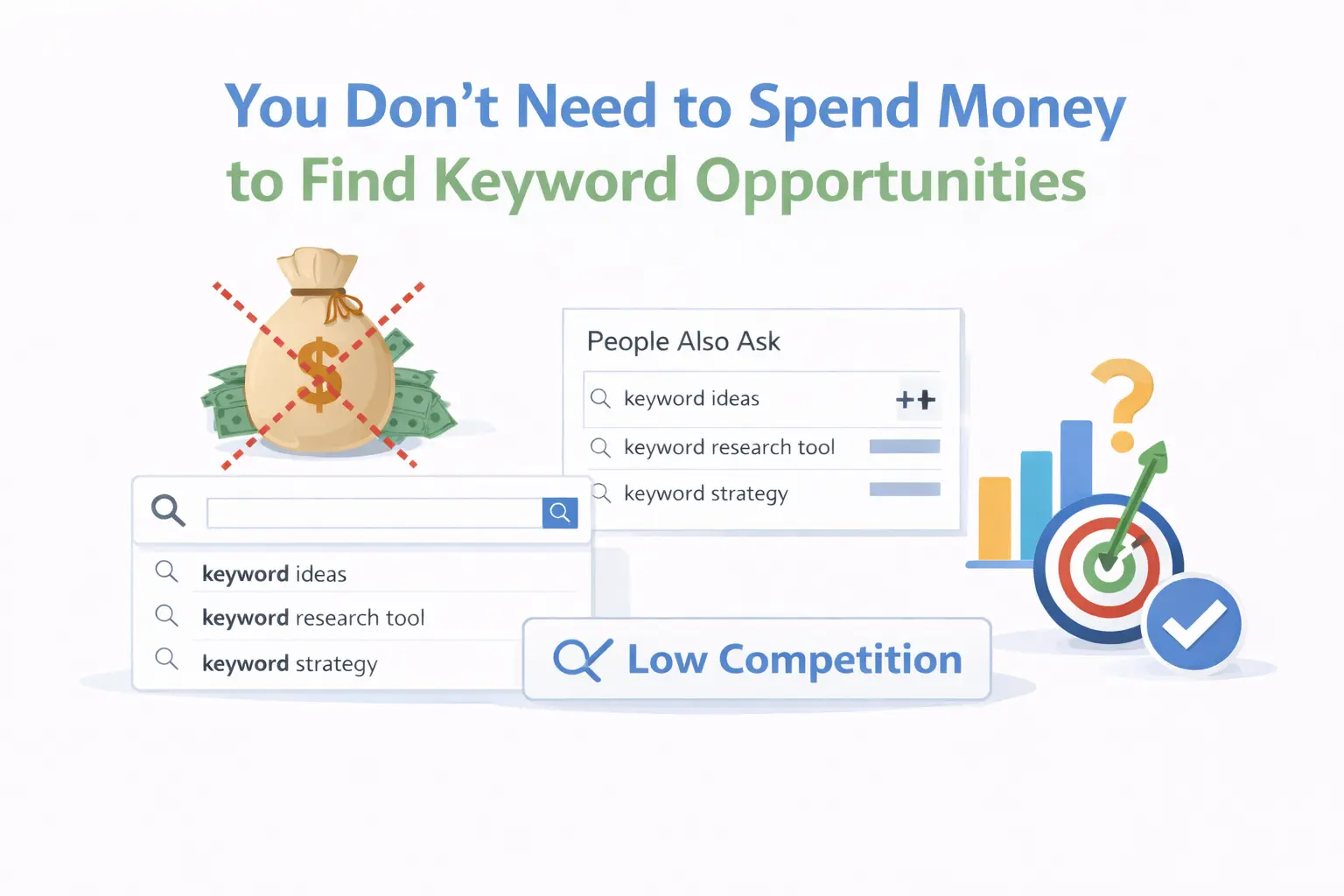
You do not need to spend money to find great keyword opportunities. These free methods are surprisingly powerful, especially when you are just starting out.
Method 1: Google Autocomplete
Start typing your seed keyword into Google’s search bar and watch what suggestions appear. These auto complete suggestions are based on real searches people make. They are almost always longer, more specific, and less competitive than the root keyword.
For example, if you type “email marketing”, Google might suggest “email marketing for small businesses free”, “email marketing tips for beginners”, or “email marketing examples that convert”. Each of these is a potential low competition keyword.
Method 2: People Also Ask (PAA)
The People Also Ask box in Google is an absolute goldmine for finding low competition question-based keywords. These are questions real users are typing into Google, and each one can become a standalone article or a section of a longer post.
Even better: when you click on a PAA question, new related questions appear. You can keep drilling down to uncover a long chain of low competition keyword ideas connected to your main topic.
Method 3: Google Search Console
If your website already has some content, Search Console is one of the best free tools available. Go to the Performance tab and look for keywords where your pages are getting impressions but low clicks — especially keywords where you rank between positions 11 and 30.
Those are your easiest wins. You are already showing up; a small content improvement or SEO tweak can push you from page two to page one.
Method 4: Reddit, Quora, and Niche Forums
Forums reveal how real people phrase their questions — and real-people language is almost always less competitive. Browse subreddits in your niche, search Quora for topics related to your content, and look at what questions keep coming up.
For example, instead of targeting a broad keyword like “project management”, you might find people in forums asking “project management tips for solo freelancers” — a far more specific and winnable phrase.
Method 5: Answer The Public and AlsoAsked
These free tools visualize what questions and phrases people search around a topic. Answer The Public creates a visual map of questions, comparisons, prepositions, and alphabetical variations of your seed keyword. AlsoAsked pulls directly from Google’s People Also Ask data to show you topic clusters.
Both are excellent for finding long-tail keyword ideas you would never think of on your own.
Paid Tools to Find Low Competition Keywords Faster
Free tools are great for getting started, but paid SEO tools give you hard data keyword difficulty scores, monthly search volumes, click-through rates, and competitive analysis. Here are the top ones worth knowing.
Ahrefs Keywords Explorer
Ahrefs is widely considered the gold standard for keyword research. Use Keywords Explorer to enter your seed keyword, then filter results by KD (Keyword Difficulty) to show only keywords with a score under 20. Pay special attention to the SERP overview — you can see the exact backlink count and domain rating for each page currently ranking.
- Best for: deep SERP analysis and backlink data
- Filter: KD under 20, volume above 100
- Bonus: check “Parent Topic” to see what keyword your page could also rank for
SEMrush Keyword Magic Tool
SEMrush’s Keyword Magic Tool lets you enter a broad topic and immediately generates thousands of related keyword ideas. You can then filter by keyword difficulty and sort by search volume to quickly identify the best low competition opportunities. The platform also has an On-Page SEO Checker that compares your content to competitors and suggests improvements.
KWFinder by Mangools
KWFinder is beginner-friendly and uses a color-coded difficulty system (green = easy, red = hard). It is one of the most straightforward tools for finding low competition keywords without needing a deep technical background. Perfect for bloggers and small business owners.
Ubersuggest
Built by Neil Patel, Ubersuggest has a free tier that gives you solid keyword data including difficulty scores, search volume, and content ideas. It is a solid choice if you are on a tight budget.
How to Find Low Competition Keywords by Analyzing Competitors
Your competitors have already done a lot of the keyword research for you — you just need to know where to look.
Step 1: Identify Your Real SEO Competitors
Your SEO competitors are not necessarily the businesses you compete with in real life. They are the websites that rank for the same keywords you want to target. Use Ahrefs or SEMrush to search a core keyword in your niche and see which websites appear most often in the results. Those are your true SEO competitors.
Step 2: Find Their Weak Rankings
In any keyword research tool, look for pages on your competitors’ sites that rank on page two or page three of Google. These are keywords where they have some presence but have not fully invested in winning. If they are struggling to rank well for something, it is usually an easier keyword for you to target with a better piece of content.
Step 3: Run a Content Gap Analysis
A content gap tool (available in both Ahrefs and SEMrush) compares your website to a competitor and shows keywords they rank for that you do not. This reveals entire topic areas and keyword opportunities you may be completely ignoring. It is one of the fastest ways to build a list of low competition keywords worth targeting.
How to Evaluate and Choose the Right Keywords
Not every low competition keyword is worth targeting. A low KD score alone does not make a keyword valuable. Here is a simple four-part filter to decide whether a keyword belongs on your list.
Filter 1: Keyword Difficulty (KD)
Aim for a KD score below 20 for new websites, and below 35 for websites with some established authority. These numbers vary slightly by tool, but the principle is the same — the lower the score, the easier it is to rank.
Filter 2: Search Volume
The sweet spot for low competition keywords is 100 to 2,000 monthly searches. Keywords with zero searches are not worth the effort (even if they are easy to rank for), and keywords with high volume are usually highly competitive. That 100–2,000 range is where you can realistically win traffic.
Filter 3: Search Intent
Always match your content format to what the searcher actually wants. There are four main intent types:
- Informational — User wants to learn (“how to find low competition keywords”). Write a detailed guide.
- Commercial — User is comparing options (“best keyword research tools”). Write a comparison or review.
- Transactional — User wants to buy (“buy SEMrush plan”). Write a landing page or product page.
- Navigational — User wants a specific site (“Ahrefs login”). Not usually worth targeting for content.
Filter 4: SERP Quality
Before writing anything, manually check the top 10 results for your keyword. Ask yourself: Is the content thin? Are the rankings held by low-authority sites? Is there a clear gap in what the existing articles cover? If the answer is yes, you have found a keyword worth targeting.
How to Use Low Competition Keywords in Your Content
Finding the keyword is half the battle. The other half is using it correctly in your content so search engines can understand what your page is about.
Keyword Placement Checklist
- Title tag (H1) — Include the keyword naturally near the beginning
- Meta description — Mention it within the first 20 words
- First paragraph — Use it within the opening 100 words
- URL slug — Keep it short and keyword-inclusive
- 2–3 subheadings (H2/H3) — Use variations and related phrases
- Image alt text — Describe images using related keywords
- Body text — Use it naturally 3–5 times throughout the article
Build Topic Clusters for More Authority
Instead of writing a single article and hoping for the best, build a content cluster. Pick one main topic (your pillar page) and then write several supporting articles that target related low competition keywords. Connect all of them with internal links.
For example, if your pillar page is about “keyword research”, your supporting articles might target: “how to find low competition keywords”, “best free keyword research tools”, “what is keyword difficulty”, and “long-tail keywords for beginners”. This structure signals topical authority to Google.
Optimize for Featured Snippets
For question-based keywords, write a concise answer (40–60 words) directly after the H2 heading. Use a numbered list for step-by-step processes. This format is exactly what Google pulls into featured snippets, which can dramatically increase your click-through rate even without a number one ranking.
Common Mistakes to Avoid
Even experienced SEOs make mistakes when targeting low competition keywords. Here are the most common ones — and how to avoid them.
Mistake 1: Targeting Keywords with Zero Search Volume
Low competition does not always mean low volume. However, some people chase KD scores so aggressively that they end up targeting keywords nobody actually searches for. Always cross-reference with search volume data before committing to a topic.
Mistake 2: Ignoring Search Intent
You could rank number one for a keyword and still get almost no clicks — if you wrote the wrong type of content. A user searching “best running shoes for flat feet” wants a comparison list, not a history of running shoe design. Match the format to the intent.
Mistake 3: Sorting by KD and Picking Blindly
The most common mistake is opening a keyword tool, filtering by low difficulty, grabbing the biggest volume numbers, and hitting publish. Without SERP analysis and intent matching, this approach rarely leads to rankings. The tool gives you candidates — you still need to qualify them manually.
Mistake 4: Keyword Stuffing
Using your keyword dozens of times in hopes of ranking faster will actually get your content penalized by Google. Write naturally. If your article is genuinely about the topic, the keyword will appear the right number of times on its own.
Mistake 5: Never Updating Old Content
Low competition keywords that ranked six months ago may slip if you never refresh the content. Update your posts every 6–12 months to keep information current, add new data points, and maintain your rankings.
Your 4-Week Action Plan to Start Ranking
Here is a practical roadmap to go from zero to published content targeting low competition keywords — in just one month.
Week 1: Discover and Collect
- Pick 2–3 seed topics in your niche
- Use Google Autocomplete, PAA, and Reddit to collect 100–200 keyword ideas
- Log everything in a spreadsheet with topic, keyword idea, and intent
Week 2: Validate and Shortlist
- Run your top candidates through an SEO tool to check KD and volume
- Manually check the SERP for your top 20 keyword ideas
- Shortlist 8–10 keywords where competition looks beatable and intent is clear
Week 3: Write and Publish
- Draft and publish your first 3–4 articles, each targeting one primary keyword
- Include related LSI (Latent Semantic Indexing) terms naturally throughout
- Optimize titles, meta descriptions, headings, and internal links
Week 4: Monitor and Expand
- Submit all new pages to Google Search Console for indexing
- Track rankings weekly for the first 8–12 weeks
- Publish 3–5 more articles and build internal links between related pieces
Frequently Asked Questions
What KD score is considered low competition?
Most SEO professionals consider a Keyword Difficulty score below 20 to be low competition, especially for newer websites. Sites with some authority can target keywords up to KD 35 and still rank relatively quickly.
Can I find low competition keywords for free?
Yes. Tools like Google Autocomplete, People Also Ask, Google Search Console, Answer The Public, and forum research (Reddit, Quora) can generate excellent keyword ideas at no cost. Paid tools add speed and precision but are not required to get started.
How long does it take to rank for low competition keywords?
With well-optimized content and basic on-page SEO, many pages targeting low competition keywords start ranking within 3 to 6 months. Some simpler keywords in very low-competition niches can rank in as little as a few weeks.
Are low competition keywords worth targeting in 2025?
Absolutely. In fact, they are more valuable than ever in 2025. With AI overviews changing the search landscape and big brands dominating broad keywords, finding specific, intent-driven, low competition keywords is the most reliable strategy for growing organic traffic — regardless of your website’s age or authority.
How many low competition keywords should I target per article?
Focus on one primary keyword per article. You can naturally incorporate 3–6 related secondary keywords throughout your headings and body text. Trying to target too many keywords in one piece of content dilutes your focus and usually hurts rankings.
Conclusion
Chasing the most popular keywords in your industry is tempting, but for most websites it is a recipe for frustration. The smarter strategy especially when you are building authority from scratch is to go after low competition keywords that give you a real, achievable shot at page one.
Start with a clear definition of what your audience is actually searching for. Use the free methods in this guide to build your initial keyword list. Validate your best ideas with SERP analysis. Then write genuinely helpful, well-structured content around each one.
It does not have to be complicated. Pick one low competition keyword today. Research it, write a helpful article around it, and watch what happens. That first ranking is often all the motivation you need to keep going and over time, those small wins stack up into serious organic traffic.