
You’ve published your content. You’ve optimized your pages. But somehow, your competitors keep showing up above you on Google. Sound familiar? The problem might not be your writing it might be that you’re targeting the wrong keywords. That’s exactly where a solid competitor keyword research strategy comes in. Instead of guessing which terms will work for you, you look at what’s already driving traffic to your competitors and use that data to build a smarter content plan.
Think of it as competitive intelligence for SEO. You’re not copying your competitors you’re learning from what’s working in your niche and finding the gaps they’ve left open for you to fill. you’ll learn the full step-by-step process: how to find your real SEO competitors, extract their top keywords, run a keyword gap analysis, and turn those insights into content that ranks. And yes, organic search accounts for 44.6% of all B2B revenue so getting this right matters.
What Is Competitor Keyword Research and Why Does It Matter?

Competitor keyword research is the process of identifying the search terms your competitors rank for in Google, then using that information to improve your own SEO strategy. It’s one of the fastest ways to find keyword opportunities because you’re starting with proven data not hunches.
Unlike traditional keyword research where you start with a seed word and brainstorm outward, competitor keyword research starts with what’s already working. You’re looking at terms that are actively sending traffic to other websites in your niche.
What can you learn from your competitors’ keywords?
- Content gaps: Topics that competitors are ranking for that you haven’t covered yet
- Traffic opportunities: Keywords with real search volume that you could realistically rank for
- Audience intent: What your potential customers are actually searching for at each stage of their journey
- Quick wins: Low-competition terms where competitors rank weakly, giving you an easy path in
Here’s a simple way to think about it: if a travel blogger keeps showing up on page one for ‘best hiking trails in Patagonia,’ that keyword is a proven traffic driver. You don’t need to guess the data tells you it works. Your job is to create something better.
Find Who You’re Actually Competing Against in Search
Before you can analyze competitor keywords, you need to know who your real SEO competitors are — and they might surprise you.
Your SEO competitors are not necessarily your business competitors. A local bakery’s business competitor might be the shop down the street. But their SEO competitor could be a food blog that ranks for ‘best croissants in [city]’ and sends readers their way instead.
How to identify your SEO competitors
- Google your main keywords manually the sites that consistently appear on page one are your SEO competitors.
- Use Ahrefs or SEMrush both tools auto-identify which domains compete with yours for the same keywords.
- Check the ‘Competing Domains’ feature in your SEO tool of choice it gives you a ranked list of overlapping keyword targets.
Aim to identify 3 to 5 strong competitors. Too few and you’ll miss opportunities; too many and the data becomes overwhelming.
Direct vs. indirect competitors what’s the difference?
A direct competitor offers the same product or service to the same audience. An indirect competitor targets overlapping keywords from a different angle think industry blogs, news sites, or aggregators.
Both types are worth analyzing. Indirect competitors often rank for informational keywords that can drive top-of-funnel traffic your way.
Extract the Keywords Your Competitors Are Ranking For
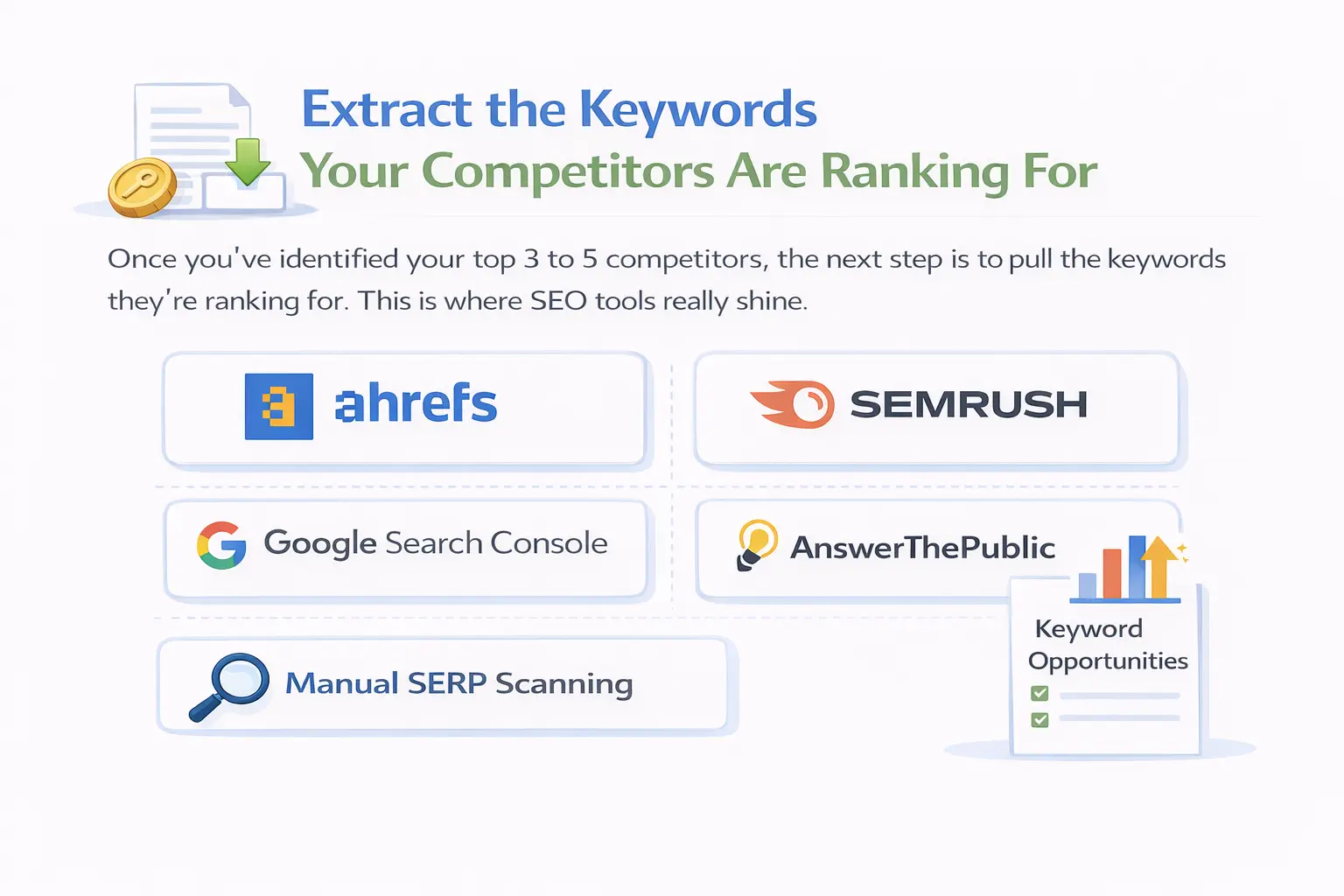
Once you’ve identified your top 3 to 5 competitors, the next step is to pull the keywords they’re ranking for. This is where SEO tools really shine.
Using Ahrefs
- Open Ahrefs Site Explorer and enter your competitor’s domain
- Navigate to the ‘Organic Keywords’ tab
- Filter by position 1–10 to see their strongest-performing keywords
- Sort by estimated traffic to find the keywords driving the most visits
- Export the list to a spreadsheet for easy analysis
Using SEMrush
- Go to SEMrush and open the ‘Organic Research’ tool
- Enter your competitor’s URL
- Click the ‘Positions’ tab to see every keyword they rank for
- Use the filter to narrow by keyword difficulty and search volume
- Export results and combine data from multiple competitors into one master list
Free alternatives if you’re not ready for paid tools
- Google Search Console: Shows what keywords your own site ranks for useful for comparison
- Manual SERP scanning: Search your main keywords and note which URLs consistently appear
- AnswerThePublic: Great for finding question-based keywords your competitors might be targeting
What data to capture for each keyword
When building your competitor keyword list, record these key data points for each term:
- Search volume how many people search for it per month
- Keyword difficulty (KD) how hard it is to rank for (scale of 0–100)
- Competitor’s current ranking position
- Content format they used (blog post, landing page, product page, video)
- Search intent type (informational, commercial, transactional)
Run a Keyword Gap Analysis to Find Your Biggest Opportunities
A keyword gap analysis is where things get really interesting. It’s the process of comparing your keyword rankings against your competitors’ to find terms they rank for but you don’t. Those gaps are your opportunities.
How to run a keyword gap analysis with SEMrush
- Go to SEMrush and select ‘Keyword Gap’ from the left sidebar
- Enter your domain in the first field, then add 2–3 competitor domains
- Click ‘Compare’
- Select the ‘Missing’ filter to see keywords all your competitors rank for, but you don’t
- Export the list and review it in a spreadsheet
Using Ahrefs Content Gap
- Go to Ahrefs Site Explorer and enter your own domain
- Click ‘Content Gap’ in the left panel
- Add your competitors’ URLs in the fields provided
- Hit ‘Show keywords’ this reveals terms competitors rank for that your site doesn’t
Types of keyword gaps to prioritize
Not all gaps are equal. Here’s how to categorize what you find:
- Missing gaps: Keywords where you have zero ranking at all the easiest wins to target
- Weak gaps: You rank positions 11–30 but competitors are in the top 5 strong candidates for content improvement
- Untapped gaps: Low-competition keywords that even your competitors are ignoring a great place for new content
Understand Search Intent Before You Target Any Keyword
Here’s a mistake a lot of people make: they find a keyword with decent volume, write a piece of content about it, and wonder why it never ranks. The problem is usually search intent the ‘why’ behind a search query.
Google’s job is to match what a user wants with the most relevant content. If you create a how-to guide for a keyword where Google is showing product pages, you’re fighting upstream.
The four types of search intent
- Informational: The user wants to learn something. Example: ‘how does keyword research work’
- Navigational: The user wants to find a specific site. Example: ‘Ahrefs login’
- Commercial: The user is comparing options before buying. Example: ‘best SEO tools for small businesses’
- Transactional: The user is ready to take action. Example: ‘buy SEMrush subscription’
How to identify intent from SERP results
The fastest way to understand search intent for any keyword is to look at the top 5 results on Google:
- Are they all blog posts? Publish a blog post.
- Are they comparison pages or listicles? Create a ‘best of’ article.
- Are they product or landing pages? Build a dedicated service or product page.
- Are they YouTube videos? Consider a video-first approach.
For example, if you’re targeting ‘best CRM tools for freelancers,’ every top result is a comparison listicle. Publishing a narrative blog post about CRM history will not rank for that term no matter how well written it is.
Prioritize Your Keyword List the Smart Way
By now you’ve probably accumulated a large list of competitor keywords. Not all of them deserve your time and attention. The goal is to focus on keywords where you have a realistic shot of ranking and where ranking would actually benefit your business.
The three-factor scoring system
Score each keyword across three dimensions:
- Search volume: Is there enough demand to make it worth the effort?
- Keyword difficulty: Can your site realistically compete given your current domain authority?
- Business relevance: Will ranking for this keyword bring in the right audience people likely to buy, sign up, or engage?
Quick-win keywords to target first
These are the sweet spots to go after immediately:
- Keywords where competitors rank positions 4–15 they’re close enough that better content can displace them
- Long-tail keywords with 3+ words lower competition, higher intent, easier to rank
- Keywords with KD under 30 and volume over 100 a realistic combination for most sites
If your competitors have significantly higher domain authority, don’t go head-to-head on their trophy keywords right away. Start with the long-tail variations and adjacent topics where competition is lighter. Build authority over time, then level up to the harder terms.
The Best Tools to Power Your Competitor Keyword Research Strategy
The right tools make this entire process much faster and more reliable. Here’s an honest breakdown of what’s worth your time.
Ahrefs
Ahrefs is widely considered the gold standard for competitor analysis. Its Site Explorer lets you enter any domain and instantly see their top organic keywords, estimated traffic, ranking positions, and backlink profile. The Content Gap feature is particularly powerful for identifying keywords your competitors rank for that you don’t. Great for deep research and bulk keyword exports.
SEMrush
SEMrush is the best all-rounder. The Keyword Gap tool, Organic Research section, and Domain Overview report give you a clear picture of any competitor’s SEO strategy at a glance. It also includes content marketing tools, making it easier to bridge keyword research and content planning in one platform.
SpyFu
SpyFu specializes in competitive intelligence for both organic and paid search. If your competitors are running Google Ads alongside their SEO, SpyFu shows you their PPC keywords, ad spend estimates, and historical ad copy — valuable data you won’t find in Ahrefs or SEMrush.
KWFinder (Mangools)
KWFinder is beginner-friendly and excellent for finding low-competition, long-tail keywords. You can enter any competitor domain and it pulls their top-ranking keywords with difficulty scores and volume data. More affordable than Ahrefs or SEMrush — a solid choice if you’re just getting started.
Free tools worth using
- Google Search Console free and gives real data on what your own site ranks for
- Google SERP features People Also Ask, Related Searches, and ‘Searches related to’ at the bottom of results pages are goldmines for keyword ideas
- AnswerThePublic shows question-based keyword variations your competitors might be targeting
- Ubersuggest Neil Patel’s tool, limited but useful for quick competitive keyword lookups
You don’t necessarily need all of these. Start with one paid tool (SEMrush or Ahrefs offer free trials) and supplement with free options. Once you’re getting consistent results and have content in the pipeline, the paid tool pays for itself pretty quickly.
Create Content That’s Built to Outrank Your Competitors

Finding the right keywords is only half the battle. Now you have to create content that’s genuinely better than what’s already ranking not just longer, but more useful, more specific, and more aligned with what the reader actually needs.
Don’t just replicate improve
Look at the top 3 ranking pages for your target keyword and ask yourself honestly: what’s missing? What questions do they leave unanswered? What angle haven’t they taken? That’s your content opportunity.
Some common ways to improve on competitor content:
- Go deeper on a subtopic they only scratched the surface of
- Add original data, case studies, or examples they didn’t include
- Create visuals comparison tables, diagrams, screenshots — that make the content easier to scan
- Update outdated information that competitors haven’t refreshed
- Answer related questions from People Also Ask that competitors ignored
On-page SEO checklist for each piece
- Include the focus keyword in the H1, meta title, meta description, and first 100 words
- Use related/LSI keywords naturally throughout (not stuffed)
- Structure content with clear H2 and H3 headers that mirror common search questions
- Add internal links to related pages on your site
- Optimize image alt text with relevant descriptive terms
- Match content length to what’s already ranking if competitors are at 2,000 words, don’t publish 400
E-E-A-T signals that Google looks for
In 2026, Google’s algorithm places significant weight on Experience, Expertise, Authoritativeness, and Trustworthiness (E-E-A-T). This matters especially in competitive niches.
- Add an author bio with real credentials
- Cite credible sources and link to authoritative external sites
- Include an ‘Updated on’ date to show freshness
- Use first-hand experience where possible — write like someone who has actually done the thing
Monitor Competitor Moves and Refine Your Strategy Over Time
A competitor keyword research strategy isn’t something you do once and forget about. Competitors update their content. New websites enter your niche. Search algorithms evolve. Your strategy needs to evolve with them.
Set a regular review cadence
- Monthly: Track ranking positions for your target keywords using Google Search Console or SEMrush
- Quarterly: Run a fresh keyword gap analysis to find new opportunities that have opened up
- Bi-annually: Do a full competitor audit check if new competitors have entered the space and if your existing ones have changed their strategy
Key metrics to watch
- Organic traffic growth on the pages you’ve optimized
- Ranking position changes for target keywords both yours and your competitors’
- New keywords your competitors are starting to rank for (potential early signals of trending topics)
- Content gap closures keywords you’ve newly started ranking for after publishing new content
Pay special attention when a competitor drops in rankings for a keyword you care about. That’s usually your cue to move in with updated or improved content and capture the position they’ve lost.
Also, don’t neglect your existing content. Pages sitting at positions 11 to 20 are often one solid update away from breaking into the top 10. Refreshing these ‘almost there’ pages is often more efficient than publishing brand new content.
Frequently Asked Questions
Q: What is a competitor keyword research strategy?
A: It’s a method of finding keywords your competitors rank for and using that data to improve your own SEO and content strategy.
Q: How do I find keywords my competitors rank for?
A: Use tools like Ahrefs or SEMrush, enter a competitor’s domain, and check their top-ranking organic keywords.
Q: What is a keyword gap analysis?
A: It compares your keywords with competitors to find missing opportunities you can target.
Q: How often should I do competitor keyword research?
A: Every 3 months is ideal; monthly for fast-changing industries.
Q: Can I do competitor keyword research for free?
A: Yes, using Google Search Console, manual SERP checks, and tools like AnswerThePublic—but data is limited.
CONCLUSION
A well-executed competitor keyword research strategy is one of the most reliable ways to grow your organic traffic because you’re building on data that already works, not starting from scratch with guesswork.To recap the process: start by identifying your real SEO competitors, then extract their keywords using tools like Ahrefs or SEMrush. Run a keyword gap analysis to find where opportunities are hiding, study search intent so your content matches what Google expects, prioritize the terms with the best balance of volume and realistic difficulty, and then create content that’s genuinely better than what’s already ranking.
Don’t treat this as a one-time project. The best results come from making competitor keyword analysis a regular part of your content workflow — quarterly at minimum, more often in competitive niches. Start today: pick your top 3 SEO competitors, run a keyword gap analysis, and find 5 keywords you’re not ranking for that you realistically should be. That’s all you need to get momentum going. Your competitors are leaving gaps. Go fill them.