Ask ten people what a digital marketer does and you will get ten different answers. Some will say ads, some will say Instagram, and some will say writing blog posts. All of them are partly right, which is why the scope of digital marketing is hard to pin down and easy to underestimate.
Billions of people now find products, jobs, courses, and services on a phone screen. Businesses that once relied on a shop sign and word of mouth now need to appear in search results, in social feeds, and increasingly inside AI-generated answers. Someone has to run all of that, and that work is where the career and business opportunities come from.
This guide covers what digital marketing includes, which industries use it, what the jobs typically pay, how freelancing works, which skills and tools matter, how AI is changing the work, and how to get started. It also covers the downsides, because the field has them.
What Is Digital Marketing?
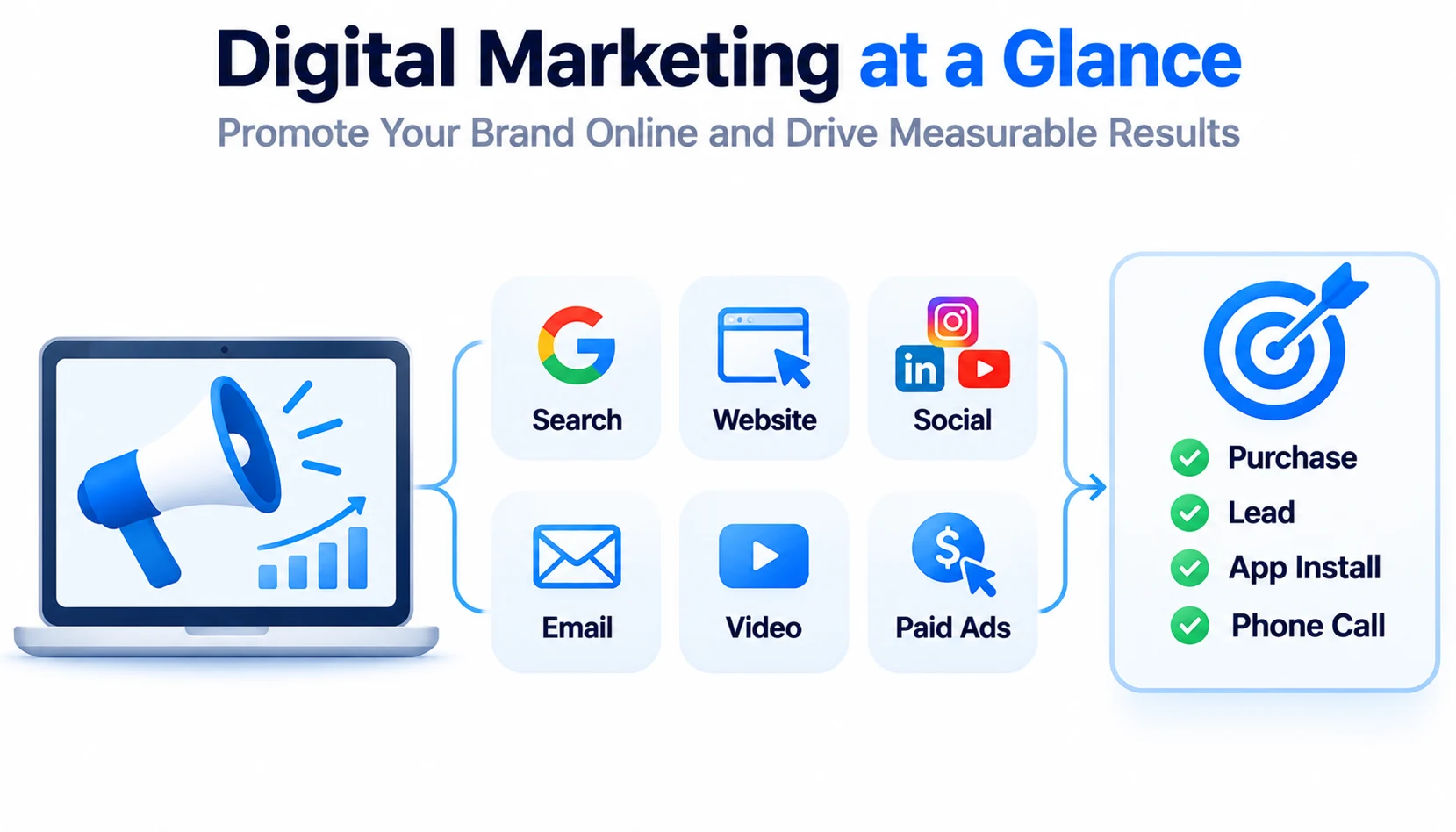
Digital marketing is the promotion of products, services, and brands through online channels: search engines, websites, social platforms, email, video, messaging apps, and paid ads. The goal is usually a measurable action, such as a purchase, a form submission, an app install, or a phone call.
How Digital Marketing Works
Every channel follows the same loop. You reach a person where they already spend time, give them a reason to pay attention, move them toward an action, and then measure what happened. A business selling running shoes might rank in search for “best running shoes for flat feet,” run Instagram ads to people who follow marathon accounts, and email a discount to anyone who left items in a cart. Each piece produces data, such as clicks, cost per click, and conversions, that tells the marketer what to keep, change, or cut.
Digital Marketing vs Traditional Marketing
Traditional marketing (television, print, hoardings, radio) buys broad exposure and offers limited tracking. Digital marketing lets you target by location, interest, search intent, and past behavior, and it shows results within days. The cost structure differs as well. A newspaper ad has a fixed rate card, while a Google Ads campaign can start at a few hundred rupees a day. Traditional channels still work for mass awareness and local trust, and many brands run both.
Why Businesses Are Moving Toward Digital Marketing
Customers research online before they buy, even when the final purchase happens in a store. Digital spend can be tied to revenue, which makes budgets easier to defend. And a small business with a good Google Business Profile can compete for local customers against a national chain, something that was hard to do with a hoarding budget.
What Is the Scope of Digital Marketing?
The scope of digital marketing covers every activity that attracts, converts, and retains customers online, plus the jobs, agencies, and freelance work built around those activities. It has a business side (how companies grow) and a career side (how individuals earn). The sections below deal with the business side first.
Growing Demand for Online Marketing
Any business with a website or a social page needs someone managing it. Job portals list digital marketing roles in most major cities, and a good share of them are remote. Demand has also split into specialties. Companies that once hired one “digital marketing executive” now hire separate people for SEO, paid ads, content, and analytics.
Expansion of Digital Advertising
Advertisers keep shifting budgets from print and television to search, social, video, and marketplace ads. Google, Meta, YouTube, and Amazon sell ad products at almost every budget level, from a local tutor spending a few dollars a day to a national brand spending millions a year. More ad spend means more people are needed to plan campaigns, run them, and report on them.
Increasing Internet and Smartphone Adoption
Cheap mobile data and digital payments have made it normal to browse, compare, and pay on a phone. Many new users come from smaller cities and towns and prefer content in their own language. Brands that publish in local languages reach buyers that English-only competitors miss.
Opportunities for Small and Large Businesses
A neighborhood clinic needs local SEO, a reviewed Google Business Profile, and WhatsApp appointment booking. A national retailer needs multi-channel campaigns, attribution across them, and a team that can read the numbers. The skills overlap, but the scale and tools differ, so there is room for beginners and specialists alike.
Global Reach and International Market Opportunities
Digital marketing work is not tied to where the customer lives. Marketers manage campaigns for clients on other continents, and direct-to-consumer brands sell abroad with Shopify stores and Meta ads. International clients usually pay more, though they expect strong English, clear reporting, and overlap with their working hours.
Main Areas of Digital Marketing and Their Scope
Digital marketing is a group of related specialties. Most professionals go deep in one or two and keep working knowledge of the rest. Here is what each area covers and where the work is.
Search Engine Optimization (SEO)
SEO earns unpaid visibility in search results. It stays in demand because search remains the first stop for many buying decisions, and the traffic compounds over time instead of stopping when a budget ends.
Technical SEO
Technical SEO makes sure search engines can crawl, render, and index a site. The work includes site speed, mobile usability, structured data, redirects, and fixing indexing errors in Google Search Console. Large ecommerce and publishing sites hire for this specifically, and it is one of the better-paid SEO paths.
On-Page and Off-Page SEO
On-page SEO covers the content, titles, headings, internal links, and keyword targeting of individual pages. Off-page SEO covers signals from outside the site, mainly backlinks and brand mentions. Content writers, editors, and outreach specialists all work in this area.
Local SEO and AI Search Visibility
Local SEO helps businesses appear in map results and “near me” searches through Google Business Profile, reviews, and consistent listings. A newer branch of the work involves checking how a brand appears in AI search tools such as Google’s AI Overviews, ChatGPT, and Perplexity, and improving the odds of being cited there.
Search Engine Marketing (SEM) and PPC Advertising
SEM means paying to appear in search results and on other ad networks. It delivers traffic quickly, which is why businesses with sales targets lean on it.
Google Ads
Google Ads covers search, Shopping, YouTube, Display, and Performance Max campaigns. Practitioners write ads, select keywords, set bids, and review search term reports to cut wasted spend.
Paid Search Campaigns
A paid search campaign starts with keyword research and ends with landing page tests. A lead generation business may target high-intent terms such as “CA near me,” while an online store may rely on Shopping ads that show price and product images directly in results.
Conversion and Budget Optimization
Most of the skill is in the numbers: cost per click, conversion rate, cost per lead, and return on ad spend (ROAS). A PPC specialist decides where the next rupee should go and which campaigns to pause.
Social Media Marketing
Social media marketing builds audiences and drives sales on Instagram, Facebook, LinkedIn, YouTube, X, and Pinterest. The right platform depends on the buyer. LinkedIn suits B2B and hiring, Instagram suits fashion, food, and lifestyle, and YouTube suits anything that needs demonstration.
Organic Social Media Marketing
Organic work means planning content calendars, posting, replying to comments, and watching which formats get saved and shared. It is slow, and it depends on consistency and a clear voice.
Paid Social Advertising
Paid social uses Meta, LinkedIn, and YouTube ad tools to reach people by interest, behavior, job title, or a custom list. Creative testing matters most here, because the ad image or video usually decides whether the campaign works.
Influencer Marketing
Influencer marketing pays creators to promote a product to their audience. Brands use it heavily for beauty, fashion, food, gadgets, and apps. The work involves finding creators, negotiating rates, checking audience quality, and tracking sales through codes or links.
Content Marketing
Content marketing attracts and keeps customers by publishing useful material instead of ads. It supports almost every other channel, since SEO, social, and email all need something worth reading or watching.
Blog and Website Content
Blog posts, landing pages, product descriptions, and guides answer questions that buyers search for. Good writers who understand search intent are consistently in short supply.
Video and Visual Content
Short videos, long YouTube explainers, infographics, and podcasts fall here. Video skills such as scripting, shooting, and editing open doors in agencies and in-house creative teams.
Content Strategy and Distribution
Strategy decides which topics to cover, for whom, and where the content will be promoted. Distribution gets the finished piece in front of readers through search, email, social posts, and partnerships.
Email Marketing and Automation
Email remains one of the cheapest channels per conversion because the audience has already opted in. It also depends on a list the business owns, which makes it less exposed to algorithm changes.
Email Campaign Management
This covers writing newsletters and promotions, building templates, scheduling sends, and monitoring open rates, click rates, and unsubscribes. Deliverability matters a great deal, since an email that lands in spam earns nothing.
Customer Segmentation
Segmentation splits a list by behavior, purchase history, location, or stage in the buying process. A first-time buyer and a repeat customer should not get the same message.
Automated Lead Nurturing
Automation sends a sequence of messages triggered by an action, such as signing up, abandoning a cart, or downloading a guide. Tools like HubSpot, Zoho, Klaviyo, and Mailchimp run these flows.
Affiliate Marketing
Affiliate marketing pays partners a commission for sales or leads they send. Publishers, coupon sites, and review bloggers earn from it, and brands like it because they pay only for results. Affiliate managers recruit partners, set commission rates, and watch for fraud.
Ecommerce and Social Commerce Marketing
Ecommerce marketing focuses on product listings, marketplace ads on Amazon and other marketplaces, Shopify store optimization, and abandoned cart recovery. Social commerce adds buying inside Instagram, WhatsApp, and live-stream shopping. Sellers who understand both marketplace rules and paid ads are hard to find and well paid.
Online Reputation Management
Reputation management covers reviews, brand mentions, and what appears when someone searches for a company or a person. It matters most to clinics, hotels, restaurants, and service businesses where trust decides the sale. The work includes asking for reviews, answering complaints in public, and pushing outdated or unfair results down.
Marketing Analytics and Conversion Optimization
Analytics turns campaign data into decisions. Analysts set up tracking in Google Analytics 4 and Google Tag Manager, build dashboards in Looker Studio, and report on the numbers that tie marketing to revenue: customer acquisition cost (CAC), ROAS, conversion rate, and lifetime value. Attribution, which asks which channel deserves credit for a sale, is the hard part. A customer may see an Instagram ad, search the brand name on Google a week later, and buy after an email, and each tool will claim the sale differently.
Conversion rate optimization (CRO) sits next to analytics. It tests page layouts, headlines, forms, and checkout steps to raise the share of visitors who act.
To compare the five specialties most people choose between, the table below sets out the work, the skills, and the usual career path.
| Specialization | Core work | Main skills | Typical entry role | Growth path |
| SEO | Rankings, site health, content optimization, link building | Keyword research, technical audits, writing, Search Console | SEO Executive | SEO Specialist, SEO Manager, Head of Organic Growth |
| PPC / performance marketing | Running and optimizing paid campaigns | Google Ads, Meta Ads, budgeting, A/B testing | PPC Executive | Performance Marketing Manager, Head of Growth |
| Social media | Content, community, paid social, creators | Content planning, design basics, copywriting, platform tools | Social Media Executive | Social Media Manager, Brand Manager |
| Content marketing | Articles, video, email, content strategy | Writing, editing, research, SEO basics | Content Writer | Content Strategist, Content Head |
| Marketing analytics | Tracking, reporting, attribution, CRO | GA4, Tag Manager, Excel or SQL, dashboards | Marketing Analyst | Senior Analyst, Analytics Manager |
Scope of Digital Marketing Across Different Industries
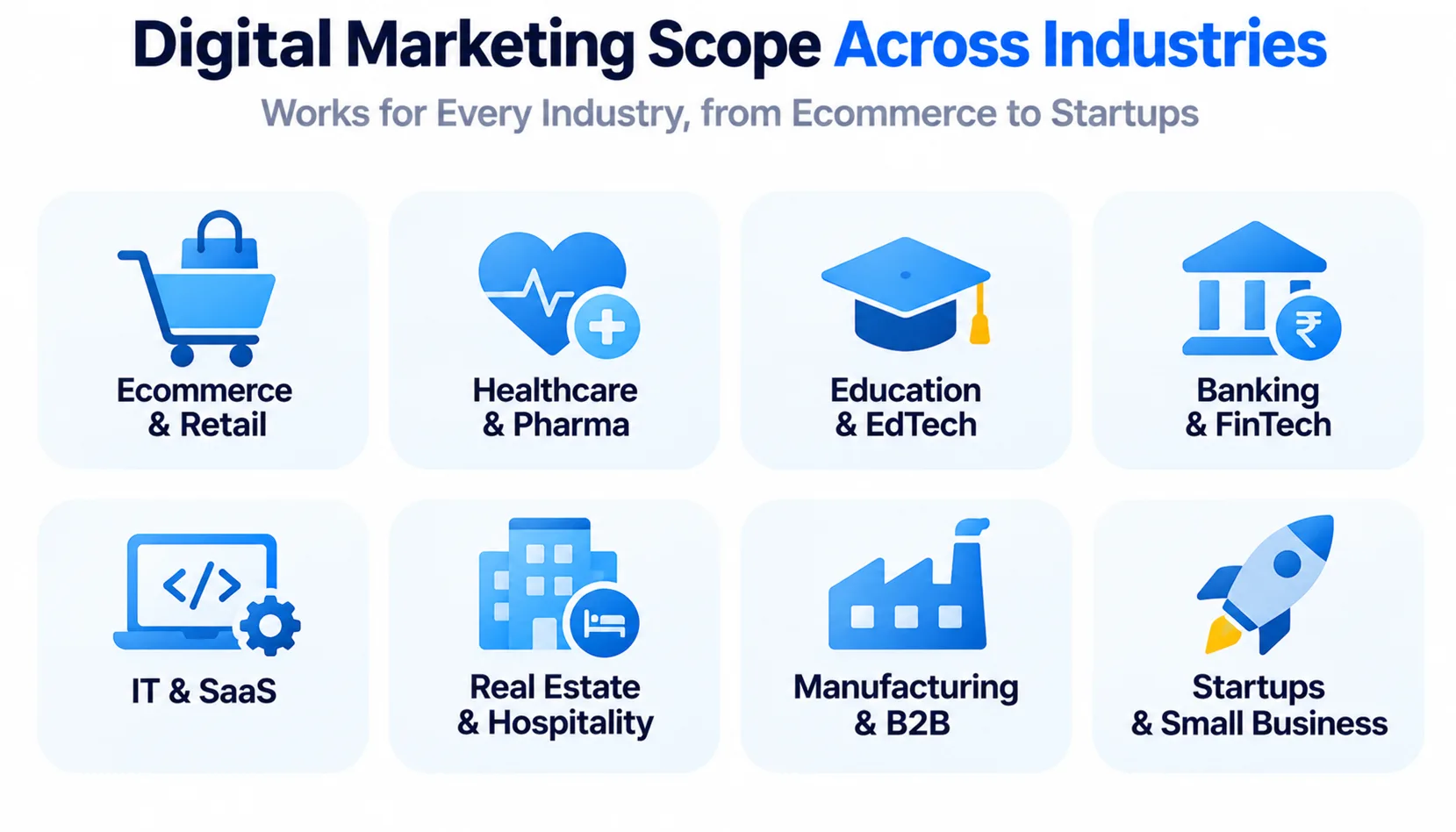
Different industries lean on different channels. The examples below show how that plays out.
Ecommerce and Retail
Online stores depend on paid ads, marketplace listings, email, and retargeting. Take a small business selling handmade candles on its own Shopify store. It might run Instagram Reels ads to build awareness, Google Shopping ads for people already searching for scented candles, and an email flow that offers 10 percent off to anyone who abandons a cart. The owner checks ROAS weekly and drops any ad set that spends without selling.
Healthcare and Pharmaceuticals
Patients search symptoms, doctors, and clinics before they book. Hospitals and clinics lean on local SEO, Google Business Profile reviews, informational content, and appointment booking through WhatsApp or web forms. Medical advertising is regulated, so claims need careful wording and often a compliance check before publishing.
Education and EdTech
Colleges, coaching centers, and online course platforms run campaigns around admission seasons. Lead generation through search ads, YouTube content, webinars, and email nurture sequences is standard. The sales cycle is long, so tracking a lead from first click to enrollment is a core skill.
Banking, Finance, and FinTech
Banks, insurers, lending apps, and investment platforms compete on trust and compliance. SEO for terms like “personal loan interest rate,” paid search, and educational content are all common. Financial claims face strict rules, which slows approvals and rewards marketers who know what can be said.
IT and SaaS Companies
A SaaS company selling project management software might publish comparison pages and tutorials for SEO, run LinkedIn ads to decision makers, offer a free trial, and use email sequences to move trial users to paid plans. Success is measured by trial sign-ups, activation, and cost per paying customer. This is also where technical SEO and product-led growth roles pay best.
Real Estate and Hospitality
Builders and hotels depend on lead generation, virtual tours, video, and reviews. Property developers run Meta and Google lead ads and hand leads to sales teams, while hotels invest in Google Hotel ads, TripAdvisor presence, and direct booking campaigns that reduce commissions to travel portals.
Manufacturing and B2B Businesses
Manufacturers and industrial suppliers once relied on trade fairs and distributors. Many now use SEO for product searches, LinkedIn outreach, B2B marketplace listings such as Alibaba, and gated catalogs to collect leads. B2B buying cycles are long, so email nurturing and CRM follow-up carry a lot of weight.
Startups and Small Businesses
Startups have small budgets and big targets, so they hire people who can handle several channels and show quick results. For a beginner, a startup can offer faster learning than a large company, though processes and mentorship tend to be thinner.
Career Opportunities in Digital Marketing
The job titles below cover most of what employers commonly hire for. Responsibilities overlap in smaller companies, where one person may hold two or three of these roles at once.
SEO Specialist
SEO specialists audit sites, research keywords, brief writers, fix technical problems, and report on rankings and organic traffic. Employers expect comfort with Search Console, GA4, and a tool such as Ahrefs, Semrush, or SE Ranking. Progression runs from SEO Executive to Specialist to Manager, with technical and content-focused tracks branching off.
Social Media Manager
Social media managers plan content calendars, work with designers and video editors, run paid campaigns, and respond to the community. Skills include copywriting, platform analytics, and an eye for what a particular audience shares. Many move on to brand management or head up a content team.
Content Marketing Strategist
Content strategists decide what gets published, for which audience, and how it will be measured. They work with writers, designers, SEO specialists, and product teams. Strong writing and editing skills matter, along with the ability to link content to sales.
PPC and Performance Marketing Specialist
Performance marketers manage paid campaigns on Google, Meta, LinkedIn, and marketplaces, and are judged on cost per lead, ROAS, or revenue. They test creatives, adjust bids, and report weekly. Reported pay is among the highest in the field because the link to revenue is visible.
Email Marketing Specialist
Email specialists build campaigns and automated flows, manage lists, and test subject lines and send times. They need to understand segmentation and deliverability, along with the tools used to run them. Career paths lead toward CRM, lifecycle marketing, or marketing automation roles.
Digital Marketing Analyst
Analysts set up tracking, build dashboards, and explain what the numbers mean. They work in GA4, Tag Manager, Looker Studio, Excel, and often SQL. The role suits people who like data more than creative work, and it feeds into growth, product analytics, and business intelligence jobs.
Affiliate Marketing Manager
Affiliate managers recruit publishers, negotiate commissions, supply creative assets, and track performance and fraud. The job suits people who like relationship building and numbers. Experienced managers often move to partnerships or business development.
Digital Marketing Manager
Digital marketing managers oversee several channels, set budgets, manage a small team or agency, and report to senior leadership. They need breadth across SEO, paid media, content, and analytics, plus people management. Most reach this role after four to seven years in a specialty.
Marketing Automation Specialist
Automation specialists build workflows in tools such as HubSpot, Zoho, Marketo, and Klaviyo. They connect forms, CRM data, email, and WhatsApp messaging so leads get the right follow-up without manual work. The role fits people with a mix of marketing and light technical skills.
Growth Marketing Manager
Growth marketers run experiments across the customer journey, from acquisition to retention, and care about metrics such as CAC and payback period. Startups and product companies hire for this role. It usually follows experience in performance marketing, product analytics, or lifecycle marketing.
Digital Marketing Salary
Pay for digital marketers depends heavily on the country, so this section describes how pay is structured and what moves it instead of quoting one set of figures. Check current salary data for your own market on job boards and salary sites before you set expectations or negotiate.
Entry-Level Digital Marketing Salary
Interns and junior executives are paid the least, since they handle supporting tasks such as scheduling posts, pulling reports, and running small campaigns under supervision. Pay at this level rises fastest in the first two years if you add a skill employers value, such as paid ads or analytics. Large cities and well-funded employers pay more.
Mid-Level Digital Marketing Salary
After a few years, specialists own a channel or a budget. Pay climbs noticeably, especially for people in performance marketing, technical SEO, and analytics, because the link between their work and revenue is easy to see.
Senior-Level Digital Marketing Salary
Managers and heads of function lead teams, set strategy, and answer for results. Pay at this level often includes bonuses tied to performance, and at startups it may include equity. People who move into growth or marketing leadership roles are at the top of the range.
Salary Comparison by Job Role
The table below shows how roles generally compare with each other. It describes relative pay, because the actual numbers change from country to country.
| Role | Relative pay | Why |
| SEO Specialist | Moderate to high | Technical SEOs at software and ecommerce companies earn more than content-focused SEOs |
| Social Media Specialist | Lower to moderate | Entry is easy and competition is high, though senior managers and paid social specialists earn more |
| Email Marketing Specialist | Moderate | Rises with automation and CRM skills |
| Digital Marketing Analyst | Moderate to high | Higher with SQL and business intelligence tools |
| Digital Marketing Manager | High | Manages budgets, teams, and several channels |
| Performance Marketing Manager | Highest among channel roles | Spend and results are directly tied to revenue |
Factors That Influence Digital Marketing Salaries
- Specialization. Performance marketing and technical SEO usually pay more than generalist executive roles.
- Country and city. Pay differs between countries and between large cities and smaller ones, though remote roles are narrowing the gap.
- Employer type. Funded startups, product companies, and multinationals tend to pay more than small agencies.
- Budget and scope. Managing a large monthly ad budget pays differently from managing a small one.
- Proof of results. A portfolio with real numbers, such as cost per lead cut by a third, carries more weight than a certificate.
Freelancing and Business Opportunities in Digital Marketing
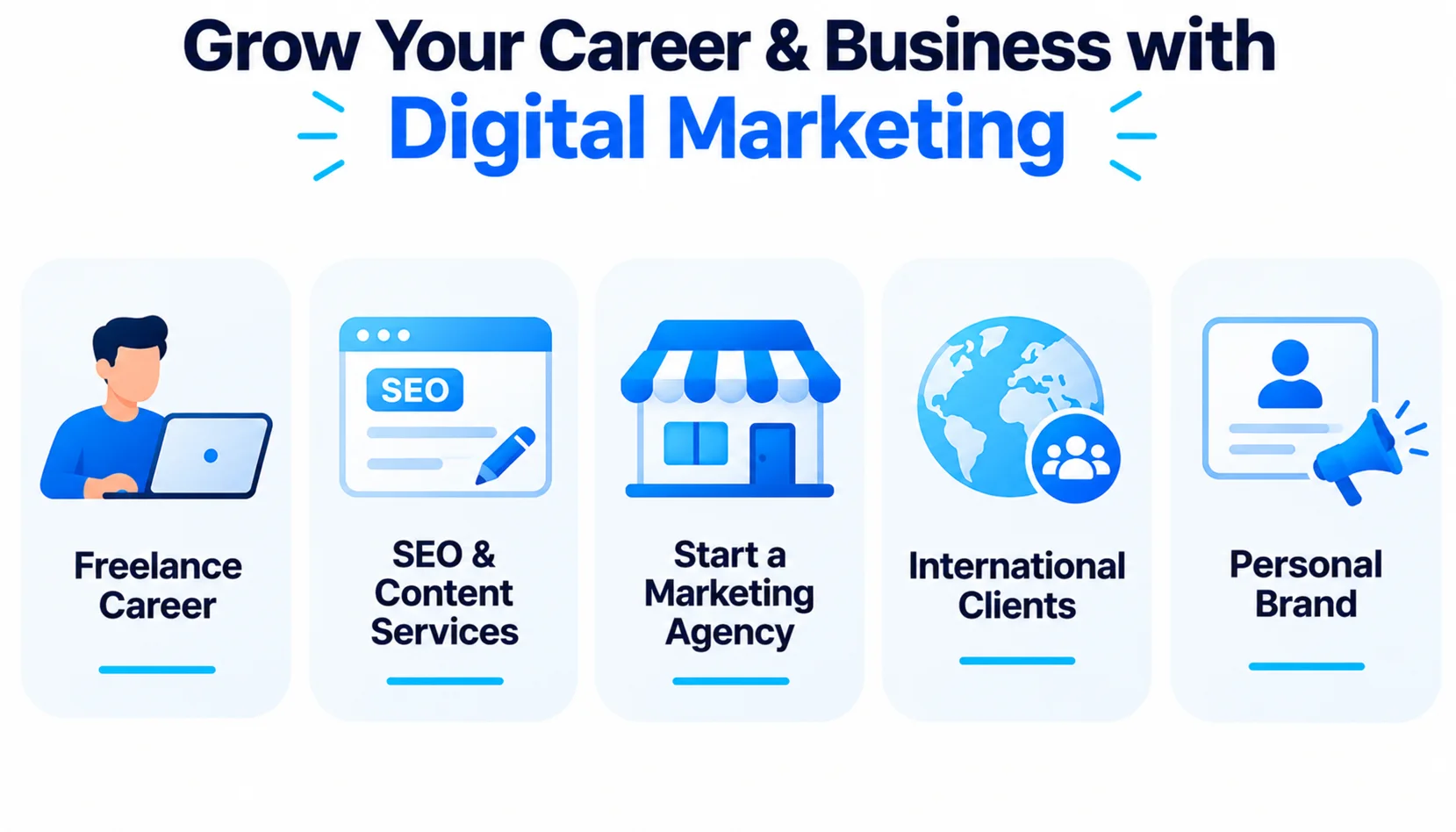
Digital marketing is one of the easier fields to work in independently. You need a laptop, a few tools, and clients who will pay for results. It is not easy money, though. Finding clients and keeping them takes as much effort as the marketing itself.
Starting a Freelance Digital Marketing Career
Most freelancers start with one service they can deliver well, such as Google Ads management, blog writing, or Instagram content, and a handful of local clients: coaching classes, clinics, restaurants, boutiques. Early work is often cheap or free in exchange for a case study. Income is uneven in the first year, so many freelancers keep a job until the monthly retainers cover expenses.
Offering SEO and Content Marketing Services
SEO and content are among the most common freelance services because clients can see the output. Common packages include monthly SEO retainers, per-article writing, technical audits, and local SEO setup. Clear scopes and monthly reports prevent most disputes.
Starting a Digital Marketing Agency
Agencies usually start as freelancers who take on more work than they can handle and bring in contractors. Before growing, set up contracts, invoicing, a reporting template, and a standard onboarding process. Specializing in one industry, such as dentists or D2C skincare brands, makes selling easier than offering everything to everyone.
Working with International Clients
Clients in other countries find freelancers through LinkedIn, Upwork, referrals, and agency subcontracting. Working across borders brings its own tax, invoicing, and currency rules, so talk to a local accountant about them before you sign the first contract.
Building a Personal Brand Through Digital Marketing
A marketer who publishes consistently on LinkedIn or a personal site gets inbound inquiries. Writing about campaigns you have run, with real numbers, builds more trust than generic tips. A personal brand also gives you leverage when you apply for jobs.
Skills Required to Build a Career in Digital Marketing
Employers do not expect mastery of every area. They look for depth in one skill, working knowledge of two or three others, and evidence that you have used them on real projects.
Technical and Analytical Skills
Basic HTML, understanding how websites load, and comfort with spreadsheets go a long way. You should be able to set up tracking, read a GA4 report, and spot when a number looks wrong.
Content Creation and Communication
Writing clearly, explaining results to non-marketers, and editing your own work are valued in every role. Basic design in Canva or Figma and simple video editing help you move faster.
SEO and Keyword Research
Keyword research tells you what people are searching for and how hard it is to rank. Learn to read search intent, group keywords by topic, and match each page to one clear purpose.
Paid Advertising and Campaign Management
This skill means structuring campaigns, writing ad copy, setting budgets, and diagnosing poor performance. Google Ads and Meta Ads Manager are the starting points, and both platforms offer free certification courses.
Data Analysis and Reporting
Marketers who can explain which numbers matter, and why, get promoted. Learn the metrics that connect to money: conversion rate, cost per lead, CAC, ROAS, and lifetime value. Practice building a simple dashboard in Looker Studio.
AI and Marketing Automation Skills
Employers increasingly expect candidates to use AI tools for research, drafting, data cleanup, and ad variations, and to check the results. Learning how to write good prompts, verify output, and build simple automations is becoming part of the baseline.
Essential Digital Marketing Tools
Tools change often, so learn what each category does before you commit to a brand name. Most have free tiers or trials.
SEO and Website Analysis Tools
Google Search Console and Google Analytics are free and essential. For research and audits, marketers use Ahrefs, Semrush, SE Ranking, and Screaming Frog. PageSpeed Insights covers site speed.
Paid Advertising Tools
Google Ads, Meta Ads Manager, and LinkedIn Campaign Manager are the main platforms. Google Keyword Planner helps with search volume, and Meta Ad Library shows what competitors are running.
Social Media Management Tools
Buffer, Hootsuite, Sprout Social, and Later schedule posts and track engagement across accounts. Canva handles most design tasks for small teams.
Analytics and Reporting Tools
GA4 and Google Tag Manager handle tracking. Looker Studio builds dashboards, and Microsoft Clarity or Hotjar show how visitors move around a page through heatmaps and recordings.
CRM and Marketing Automation Tools
HubSpot, Zoho, Mailchimp, Klaviyo, and Brevo manage contacts, email, and automated workflows. Many businesses also use WhatsApp Business tools to follow up with leads.
AI-Powered Marketing Tools
General-purpose assistants such as ChatGPT, Claude, and Gemini help with research, outlines, and data analysis, and Perplexity is used for source-backed research. AI features are also built into Google Ads, Meta, and most SEO tools. Treat the output as a draft that needs a human check for accuracy.
How to Start a Career in Digital Marketing
You do not need a particular degree. You need skills you can demonstrate. This is a workable order of steps.
Step 1: Understand Digital Marketing Fundamentals
Spend the first few weeks learning how each channel works. Google’s Skillshop, HubSpot Academy, and Meta Blueprint offer free courses, and reading a few well-run marketing blogs shows how practitioners think.
Step 2: Choose a Specialization
Try a small task in several areas, such as writing a blog post, setting up a test ad, and building a simple dashboard. Notice which one you enjoy and do well, then go deeper on that one.
Step 3: Learn Industry-Standard Tools
Pick the tools used in your chosen specialty and learn them properly. Most platforms have sandbox accounts or free versions for practice.
Step 4: Work on Practical Projects
Build a website and rank it for a low-competition term. Run a small ad budget for a local business. Offer to manage a friend’s Instagram page. Real projects teach more than courses and give you results to show.
Step 5: Build a Professional Portfolio
A portfolio can be a simple website or a LinkedIn profile with case studies. For each project, describe the problem, what you did, and the result in numbers. Even a small result, like doubling traffic on a small blog, is worth showing.
Step 6: Apply for Internships or Entry-Level Jobs
Agencies and startups hire freshers more often than large companies. Apply directly, message hiring managers on LinkedIn, and attach your portfolio. Expect a practical task as part of the interview.
Step 7: Continue Learning and Specializing
Platforms, algorithms, and tools change every few months. Follow official blogs, test new features, and revisit your skills each year. Specializing after a year or two on the job usually raises pay.
Future Scope of Digital Marketing
Digital marketing will keep changing, and some current tasks will be automated. The areas below are where the work is moving.
Artificial Intelligence in Digital Marketing
AI now drafts copy, generates ad variations, clusters keywords, summarizes reports, and suggests bids. This speeds up production and lowers the value of basic, repetitive work. Marketers who can set direction, check accuracy, and judge quality gain more from AI than those who only produce volume.
Generative Engine Optimization (GEO) and AI Search
People increasingly ask questions to AI assistants and read the generated answer instead of clicking ten links. GEO is the practice of making a brand more likely to be mentioned or cited in those answers. Nobody outside the platforms knows the exact rules, and the approaches in use today are still experiments. Practitioners focus on clear, factual content, strong brand mentions on trusted third-party sites, structured data, and original research that others cite.
Voice Search and Conversational Marketing
Voice assistants and chat interfaces reward content that answers a question directly. Conversational marketing, through chatbots and WhatsApp, lets customers ask questions and book or buy inside the chat. In many countries WhatsApp is a primary channel for business, so skills with it are practical.
Video Marketing and Short-Form Content
Short videos on Instagram Reels, YouTube Shorts, and similar formats drive discovery for many brands. Longer YouTube videos still do well for explanation and search. People who can script, shoot, and edit video are in demand.
Influencer and Creator Economy
Brands are moving from one-off celebrity endorsements to long-term work with smaller creators whose audiences trust them. Creator marketing roles, from sourcing to contract management to performance tracking, are growing in agencies and brands.
Marketing Automation and Predictive Analytics
Automation handles routine follow-up, and predictive tools estimate which leads are likely to convert or which customers may leave. Marketers who understand the data behind these models can use them well and spot when they go wrong.
Personalization and Omnichannel Marketing
Customers move between app, website, email, social, and store. Omnichannel marketing tries to deliver a consistent experience across all of them, and personalization adjusts messages to the individual. Both require clean customer data and tools that connect.
Data Privacy and First-Party Data
Browsers are limiting third-party cookies in various ways, and laws such as the EU’s GDPR and California’s CCPA, along with similar rules elsewhere, set obligations for how businesses collect and use personal data. Brands are investing in first-party data, such as email lists, app users, and loyalty programs, and in consent management. Marketers who understand privacy rules are useful to any company.
Challenges and Limitations of Digital Marketing
The field has real downsides, and anyone entering it should know them.
Increasing Online Competition
More businesses are online every year, so it costs more effort to stand out. Ranking for broad keywords, or getting attention on a crowded platform, takes sustained work.
Rising Advertising Costs
As more advertisers compete for the same audiences, the cost of a click or a lead tends to rise. Marketers have to improve landing pages, targeting, and creative to keep returns steady.
Changing Search and Social Media Algorithms
A Google update or a platform policy change can cut traffic or reach overnight. Diversifying across channels, and building an email list, reduces that risk.
Data Privacy and Regulatory Requirements
Privacy rules, advertising standards, and platform policies limit what can be collected and claimed. Violations can lead to account bans or legal trouble, so marketers need to follow the rules, especially in healthcare, finance, and education.
Continuous Learning and Skill Development
The tools and tactics that work today may not work in two years. The job needs regular practice and some tolerance for having your skills go out of date. People who enjoy learning tend to do well here.
Is Digital Marketing a Good Career Choice?
For most people with good communication skills and some curiosity about numbers, yes. It has low barriers to entry, a clear path from entry level to management, and room for both employment and independent work. Pay starts modest and rises mainly with skill and proven results.
Opportunities for Freshers and Graduates
Agencies, startups, and ecommerce companies hire freshers regularly, and a degree in any subject is usually accepted. A portfolio and a few completed projects matter more than the stream you studied.
Career Growth and Specialization
Growth comes from picking a specialty, building a record of results, and then widening into management or strategy. People who stay generalists for too long tend to plateau on pay.
Remote and International Job Opportunities
Many agencies and product companies hire remotely, and some pay in dollars or pounds. Remote roles usually require strong written English, self-discipline, and proof of work, since employers cannot supervise closely.
Who Should Consider a Career in Digital Marketing?
It suits students and graduates looking for a skill-based career, working professionals moving from sales, journalism, design, or IT, and business owners who want to market their own products. If you dislike measuring results or repeating tests, the work may frustrate you.
Frequently Asked Questions About the Scope of Digital Marketing
What is the scope of digital marketing?
It covers every online activity that helps a business attract, convert, and retain customers, including SEO, paid ads, social media, content, email, affiliate marketing, and analytics. It also covers the jobs, freelance work, and agencies built around those activities. Demand exists across industries and company sizes.
Is digital marketing a good career?
Yes for most people who are willing to learn tools and track results. Entry is easy, and salaries tend to rise sharply once you specialize and can show outcomes. Competition at the entry level is high, so portfolios matter.
What is the future of digital marketing?
AI will automate routine tasks, search will include more AI-generated answers, and short video and creator marketing will keep growing. Privacy rules will push brands toward first-party data. Marketers who can combine strategy, data, and judgment will have the most options.
What is the salary of a digital marketer?
It depends on the country, the specialty, and the employer. Entry-level roles pay the least, mid-level specialists earn noticeably more, and senior managers and performance or technical specialists earn the most. Check salary data for your own country and city.
Which digital marketing skill is most in demand?
Performance marketing (paid ads tied to revenue) and analytics are among the most sought after, along with technical SEO and AI-assisted content workflows. Demand shifts, so check current job listings in your area.
Can I learn digital marketing without a degree?
Yes. Employers mostly look at skills and proof of work. Free courses from Google, HubSpot, and Meta, plus real projects, can be enough to get an internship or an entry-level job.
Can digital marketers work remotely?
Many can. Content, SEO, paid ads, and social media roles are often remote, and some companies hire across countries. Remote work usually needs a track record, so a first job in an office or hybrid setting helps.
Will AI replace digital marketing jobs?
AI will replace some tasks, such as first drafts, basic reporting, and routine bid changes. It is less likely to replace the people who set strategy, understand customers, check accuracy, and take responsibility for results. The roles will change, and people who use AI well will be in a better position.
Which industry has the highest demand for digital marketers?
Ecommerce, SaaS, fintech, education technology, and healthcare hire heavily, along with digital agencies. Demand moves with funding and seasons, so look at who is hiring in your city rather than relying on a single ranking.
How long does it take to become a digital marketer?
Most people can learn the basics in three to six months of steady study and practice. Becoming job-ready usually takes a little longer because you need projects to show. Mastery of a specialty takes years.
Conclusion
The scope of digital marketing is wide. Businesses of every size need customers online, and that need supports specialist jobs, agency work, freelancing, and international contracts. Pay is modest at the start and rises with skill, results, and a clear specialty.
The field also changes fast. AI search, short video, and privacy rules are already altering daily work, so the people who keep practicing do better than the people who finish one course and stop.
A useful next step is to pick one specialty this week and build one small project in it within the next month: a ranking page, a tiny ad test, or a month of posts for a local business. Write down what you did and the numbers, and that becomes the first entry in your portfolio.