
Choosing between EHR integration companies starts with a plain question: what has to move, and between which systems? A lab sending results to 300 physician offices needs something different from a software startup that wants patient data out of Epic, and both need something different from a hospital IT team replacing an old interface engine.
The problem is not solved yet. A decade of ONC survey data shows that the share of U.S. hospitals that were routinely interoperable grew from 28% to 43% between 2018 and 2023. Put the other way, most hospitals still do not send, receive, find, and use outside patient data as a routine part of the day.
We compared seven EHR integration vendors a buyer is likely to shortlist this year. The list includes a hosted lab connectivity service, two lean interface engines, two enterprise engines, one API platform, and one well-known engine that recently changed its license. Each entry gives a public rating, the price signal we could find, and the place where it falls short.
Top 7 EHR Integration Companies At A Glance
| Rank | Company | Type | Best fit | Price signal |
|---|---|---|---|---|
| 1 | Lifepoint Informatics | Hosted lab outreach and EHR interface service | Labs connecting one LIS to many physician-office EHRs | Quote-based |
| 2 | Qvera Interface Engine (QIE) | Interface engine | Small and mid-size teams that build their own interfaces | From $9,980 per year for 2 channels |
| 3 | Iguana by iNTERFACEWARE | Interface engine | Developer-led integration teams | Gold edition from $10,000 per year for 2 integrations |
| 4 | Rhapsody | Enterprise interface engine | Health systems with large interface counts | Corepoint as a Service listed at $60,000 per 12 months |
| 5 | InterSystems HealthShare Health Connect | Enterprise engine and data platform | Large health systems and HIEs | Quote-based; free IRIS for Health Community Edition |
| 6 | Redox | API-first integration platform | Software companies connecting to many health systems | Platform from $35,000 per 12 months plus transactions |
| 7 | NextGen Connect (Mirth Connect) | Interface engine | Teams already running Mirth | Commercial license, price not published |
What EHR Integration Vendors Actually Sell: Four Different Jobs
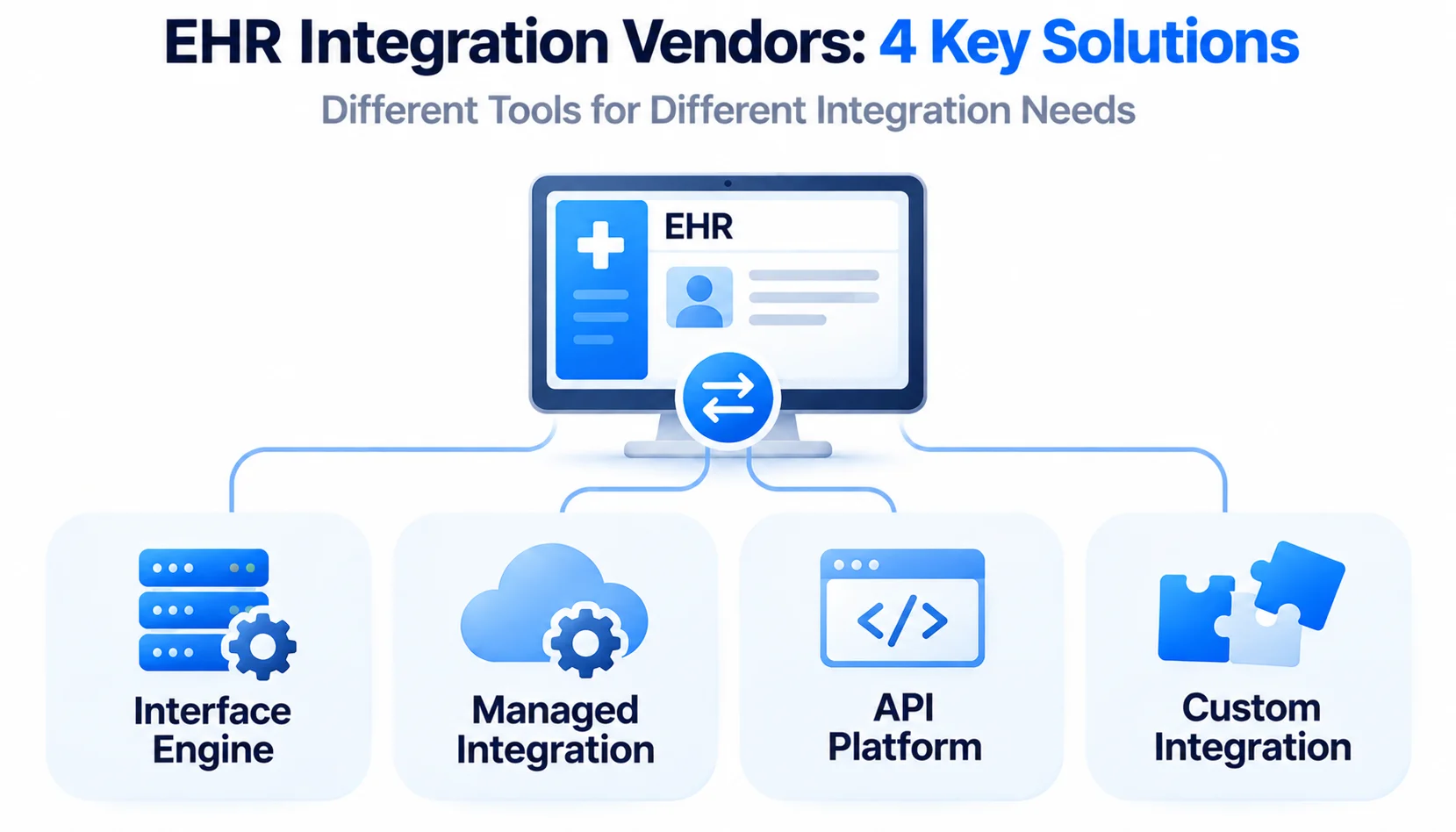
Most “best of” lists put very different products in one ranking. That is how a hospital ends up comparing an interface engine it must staff with a service that runs everything for it. There are four categories, and knowing which one you need removes half the shortlist.
- Interface engine. Software that sits between systems, receives messages, changes their format and routes them to the right place. You (or a consultant) build and maintain each interface. InterSystems, Rhapsody, NextGen Connect, Qvera and Iguana are the engines that show up on most EHR integration software shortlists.
- API-first integration layer. A vendor-run platform that hides the differences between EHRs behind one API (application programming interface, the connection point software developers write code against). It translates HL7 v2, FHIR and each EHR’s own API into one data model, so a developer writes to one format instead of twenty. Redox is the name most buyers know.
- LIS-native integration. The lab’s own laboratory information system (LIS) vendor supplies the outreach interfaces. Epic Beaker, Clinisys (which now includes Sunquest) and Orchard Software’s Copia are the usual examples. This tends to work best when the ordering practices sit on the same EHR as the hospital that owns the lab.
- Lab outreach and physician connectivity. A service that connects a lab’s LIS to the many different EHRs used by outside physician offices that send it tests, and gives offices without an interface a web portal instead. Lifepoint Informatics works here, and Ellkay is another company in this space.
One opinion we will stand behind: Epic and Oracle Health do not belong on a list of EHR integration companies you hire. They are the systems on the other end of the interface. Lists that rank them next to Redox or Rhapsody are answering a different question.
The Standards Inside An EHR Interface, In One Line Each
Every vendor below will quote these to you, so it helps to know them before the first demo.
- HL7 v2: The pipe-delimited message format most hospital systems still use; HL7 International’s own product brief states that 95% of US healthcare organizations use HL7 V2.x.
- ORM and ORU: The two HL7 v2 message types that carry lab work. ORM carries the order from the EHR to the lab, and ORU carries the result back.
- FHIR: The newer HL7 standard that exchanges data through web APIs in JSON, and payers are being pushed toward it: under the CMS interoperability final rule, the Prior Authorization API must be implemented beginning January 1, 2027.
- ASTM: The older standard many lab instruments use to send results to the LIS, which matters if your project starts at the analyzer.
- X12: The format for billing and insurance transactions such as eligibility checks and claims.
- DICOM: The standard for medical images and imaging workflow.
- LOINC: A code set that gives each lab test a universal identifier, so “glucose, serum” means the same thing in every system.
How we compared these EHR integration solutions
We looked at five things for each vendor. First, which of the four categories above it really belongs to. Second, how deep its HL7 v2 and FHIR support goes. Third, who keeps the interfaces running after go-live, your staff or the vendor. Fourth, whether there is a price a buyer can plan around. Fifth, where it is weakest.
Pricing comes from published rate cards, G2 pricing pages and AWS Marketplace listings checked in November 2026. Where a vendor publishes nothing, we say so and describe the pricing model. Ratings come from G2 and are shown with the review count, because several samples are very small (one review is not a verdict). We did not rank anyone by star rating. Two lesser-known engines rank above bigger names because they fit more buyers at a price those buyers can see.
The 7 best EHR integration companies, ranked
- Lifepoint Informatics

- Best for: hospital outreach labs, reference labs and pathology groups that need EHR integration solutions to connect one LIS to the many EHRs their ordering physicians use.
Lifepoint Informatics runs EMRHub, a hosted EHR interface hub that sits between a lab’s LIS and the physician offices that send it orders. The lab connects its LIS to the hub once. The hub then translates and delivers to each office’s EHR, so the lab does not build a separate point-to-point interface for every practice. The company, based in Glen Rock, New Jersey, has worked in lab connectivity since 1999, and it treats lab outreach (winning and keeping the business of outside physician offices) as the job its software exists to do.
In practice, an Epic practice sends its order as an HL7 v2 ORM message and the result goes back as an ORU, and the lab does not need its own Epic interface specialist. Lenco Diagnostic Laboratories, a Brooklyn reference lab handling close to 2,000 orders a day, went live on more than 100 EMR interfaces within three months on EMRHub. The second practice is usually faster than the first, because the lab’s test compendium is already mapped.
- What you get: uni-directional (results only) and bi-directional (orders and results) interfaces; compendium management covering test mapping, AOE (ask at order entry) questions and codes; a dashboard that shows each interface as green, yellow or red with 24/7 monitoring by the vendor; a brandable provider web portal and patient portal for offices that have no EHR interface yet.
- Standards: HL7 v2 (ORM and ORU), FHIR, CCD and CCR; results as discrete data, PDF or HTML; transport over VPN or SFTP.
- Vendor-stated scale: 20,000+ interfaces across 500+ EHR vendors.
- Rating: 4.0 out of 5 on G2 (1 review).
- Pricing: quote-based, with no public price list. It is run as a managed service, so there is no interface-engine license, hardware or interface analyst on the lab’s side.
- Where it falls short: it is built around lab, pathology and imaging orders and results. A team that wants scheduling data or clinical notes out of Epic for its own app will get more from an API platform or a general interface engine.
- Qvera Interface Engine (QIE)
- Best for: small and mid-size IT teams that want EHR integration software they can build on and own, without an enterprise license bill.
Qvera is one of the few EHR integration vendors with a starting price in public. QIE is an interface engine that you run on your own servers, in containers, or in your own AWS, Azure or Google Cloud account. Your team builds channels, each one a pipeline that takes data in, maps it and sends it out. Qvera says it has 600+ sites and 25,000+ interfaces in production, and it has been developing the product since 2008.
Two details stand out from the buyer’s side. It can convert a Mirth Connect export, JavaScript included, into QIE channels, which matters to the many teams reconsidering Mirth after its license change. It also ships an AI assistant that drafts mapping scripts and helps debug failed messages.
- What you get: HL7, FHIR, DICOM (including native DIMSE) and X12 in one engine; several QIE servers can share one database so interfaces keep running if one server fails; 24/7 support for system-down emergencies; SOC 2 Type 2 attestation.
- Rating: 4.9 out of 5 on G2 (25 reviews).
- Pricing: channel-based licensing from $9,980 per year for 2 channels; enterprise and OEM licensing by quote.
- Where it falls short: someone on your side still builds and maintains every channel, and per-channel pricing climbs as the interface count grows.
- Iguana by iNTERFACEWARE
Iguana is the engine for teams that would rather write code than click through screens. It is an interface engine from iNTERFACEWARE, a Toronto company, and its transformation logic is written in Lua, a small scripting language. That gives a developer fine control over odd data, which is common in EHR integration work.
- Best for: integration teams with at least one developer who wants scripted control over how each EHR interface maps and tests data.
- What you get: support for HL7, FHIR, CDA, CCD, X12, JSON, XML, CSV and other formats; on-premises, cloud or hosted deployment; alerts you configure on your own criteria; IguanaX as the newer product generation alongside Iguana 6.
- Rating: 4.5 out of 5 on G2 (40 reviews).
- Pricing: Gold edition from $10,000 per year, covering 2 integrations with production and development licenses; Platinum by quote.
- Where it falls short: the scripting approach is a strength for developers and a hurdle for an analyst-only team. You also monitor and support your own interfaces.
- Rhapsody
Rhapsody is the company formerly called Lyniate, and it sells two engines, Rhapsody and Corepoint, mostly to hospitals and health systems running hundreds of interfaces. It is an enterprise EHR integration platform with a long track record in large health systems.
The detail most buyers will care about is that a price is now visible. Corepoint as a Service, the hosted version of the Corepoint engine, is listed on AWS Marketplace at $60,000 per 12 months for one production license with up to five communication points (the connection endpoints the engine talks to).
- Best for: health system IT teams that want a supported enterprise engine and plan to keep interface work in-house.
- What you get: a choice of two engines; a hosted option through Corepoint as a Service; HL7 v2 and FHIR support; tooling sized for large interface inventories.
- Rating: 4.5 out of 5 on G2 for Rhapsody Integration Engine (1 review, too few to read much into).
- Pricing: Corepoint as a Service at $60,000 per 12 months as listed; larger deployments and on-premises licensing by quote.
- Where it falls short: it is priced and staffed for health systems. A small lab or clinic will pay for capacity it never uses.
- InterSystems HealthShare Health Connect
- Best for: large health systems, health information exchanges (HIEs) and governments that need an interface engine and a data platform from one vendor.
InterSystems is one of the oldest names in healthcare interoperability platforms, and its technology sits under Epic’s own database. HealthShare Health Connect is its integration engine, built on InterSystems IRIS for Health. It handles HL7 v2, FHIR and the other standards above, and InterSystems also sells HIE and data-aggregation products on the same base. A cloud version, Health Connect Cloud, launched on AWS Marketplace in 2023.
- What you get: an integration engine plus database in one product; FHIR server capability through IRIS for Health; a managed cloud option; a large global installed base.
- Rating: 4.2 out of 5 on G2 for InterSystems Health Connect (21 reviews).
- Pricing: commercial Health Connect licensing is quote-based. InterSystems lists IRIS for Health Community Edition on AWS Marketplace free of charge, with AWS infrastructure billed separately.
- Where it falls short: it usually needs engineers who know the platform well, either on staff or through a consultant, and the enterprise licensing is hard to justify for a small project.
- Redox
If you are a software company and every new hospital customer means a new EHR integration, Redox is built for you. Redox is an API-first EHR integration platform: your developers connect to Redox once, and Redox maintains the connections to each health system’s EHR and translates the data, including transformation to FHIR R4.
It ranks sixth here because most of the buyers this list is written for are providers and labs, not software vendors. For a digital health company, it would sit much higher.
- Best for: digital health and software companies that need to connect to many health systems without building each interface.
- What you get: one API in place of many HL7 v2 feeds and EHR APIs; normalized data models; network connections managed by Redox; a provider listing on AWS Marketplace.
- Rating: 3.9 out of 5 on G2 (42 reviews).
- Pricing: the AWS Marketplace listing starts the Redox Engine Platform at $35,000 per 12 months for the platform only, with transaction tiers on top (an example tier is $7,500 per 12 months). Final pricing is set in a private offer.
- Where it falls short: costs scale with transaction volume, which makes a high-volume feed (such as lab results) harder to budget, and Redox does not offer a free trial.
- NextGen Connect (Mirth Connect)
Mirth Connect was the free interface engine that taught a generation of analysts HL7, and that history is why it still appears on every list. The change buyers need to know: starting with version 4.6, NextGen moved Mirth Connect from a dual open-source and commercial license to a single commercial, proprietary license. Version 4.5.2 is the last open-source release.
- Best for: teams that already run Mirth channels and want to stay on a supported version of a familiar EHR interface engine.
- What you get: a mature HL7 v2 and FHIR engine with a large pool of experienced analysts; an Enterprise package that adds SSL Manager, Channel History and Message Generator; a free research license for approved non-profit studies.
- Rating: 5.0 out of 5 on G2 (3 reviews).
- Pricing: commercial license, with no public price. The old “free engine” budget assumption no longer holds for current versions.
- Where it falls short: your team builds and supports everything, and anyone choosing it fresh in 2026 is buying a commercial product without a visible price.
Which EHR Integration Platform Fits Your Situation
Start with who will run the interfaces after go-live. That one answer sorts most buyers.
If you are a lab and the systems on the other end are dozens or hundreds of physician-office EHRs, you are buying lab outreach connectivity, not an engine. The work is in compendium mapping, order questions, result formats per EHR and keeping each office connected. A hosted service carries that work for you. An engine leaves it on your desk.
Teams with two or three integration analysts and a mixed list of projects (ADT feeds, billing, imaging, a few lab feeds) get the most from a general engine. Qvera and Iguana publish starting prices, which makes them easy to test against a budget. Rhapsody and InterSystems make sense once the interface count is in the hundreds and uptime targets are written into contracts.
When you are a software company selling into hospitals, an API layer like Redox saves you from learning each EHR’s quirks. Budget for transaction growth from day one.
Already on Mirth? Price a supported NextGen Connect license and a migration side by side before you decide. Qvera’s Mirth export converter makes that comparison cheaper to run.
A few questions to ask every vendor on the shortlist:
- Which HL7 v2 message types and FHIR resources do you support today, in production?
- Who watches the interfaces at 2 a.m., and how do we see their status?
- What does the second connection cost and how long does it take, compared with the first?
- What happens to our interfaces and data if we leave?
Frequently Asked Questions
What do EHR integration companies do?
They connect an EHR to other systems so data moves without retyping. Some sell software your team runs (interface engines), some run a platform you call through one API, and some deliver a managed service for a specific workflow such as lab orders and results.
Which EHR integration vendors support both HL7 and FHIR?
All seven on this list handle HL7 v2 and FHIR in some form. Depth varies, so ask for the specific message types and FHIR resources in production, not on a roadmap.
How much does an EMR integration project cost?
Published entry prices on this list run from about $10,000 per year for a two-channel engine license to $60,000 per year for a hosted enterprise engine, and API platforms start around $35,000 per year before transaction fees. Managed lab connectivity services are usually quoted per project. Staff time to build and run interfaces is often the larger cost.
Does a lab need its own interface engine to connect to physician EHRs?
Not always. A hosted connectivity hub can connect the LIS once and manage each physician EHR on the lab’s behalf, so the lab does not buy engine software or hire an interface analyst.
Is Epic an EHR integration company?
No. Epic is an EHR. Epic Beaker is its lab system, and outside labs connect to Epic practices through HL7 v2 orders and results or FHIR, usually through one of the companies above.
How long does an EHR interface take to go live?
It depends on the category. A single feed on an engine your team already runs can take weeks. A lab rolling out to many practices through a hosted hub moves faster after the first few, because the test compendium is mapped once.
The Bottom Line
The right choice depends less on brand and more on who does the work after go-live. Engines give you control and give you the job. API platforms suit software companies. Hosted connectivity suits labs whose customers are physician offices on many different EHRs.
If your lab’s growth depends on outside practices ordering from you, the decision is about how quickly each new office can send orders and get results back in its own system. For hospital outreach labs and regional reference labs that want EHR integration companies to handle that work end to end, with one hosted hub for every ordering practice’s EHR, HL7 v2 orders and results with mapped compendiums, and a branded provider portal alongside, Lifepoint Informatics offers its EMRHub service on quote-based pricing.