There are hundreds of AI image tools online right now, and most of them look almost identical on the surface. So when gramhir.pro started picking up attention in the creator community, the obvious question was: what makes this one any different?
Before diving into the platform itself, it’s worth understanding how modern AI image discovery works. If you’re interested in finding better visual content online, check out our guide on image search techniques to learn how creators and marketers uncover high-quality images more efficiently.
In this review, we dig into exactly that. We tested gramhir.pro across real use cases- blog graphics, social media posts, product mockups, and more to give you a straight answer on whether it holds up.
By the time you finish reading, you will know what gramhir.pro is, how it works under the hood, what it costs, where it falls short, and how it compares to the bigger names like DALL-E 3 and Midjourney. No fluff, no marketing spin just an honest breakdown.
What Is Gramhir.pro?
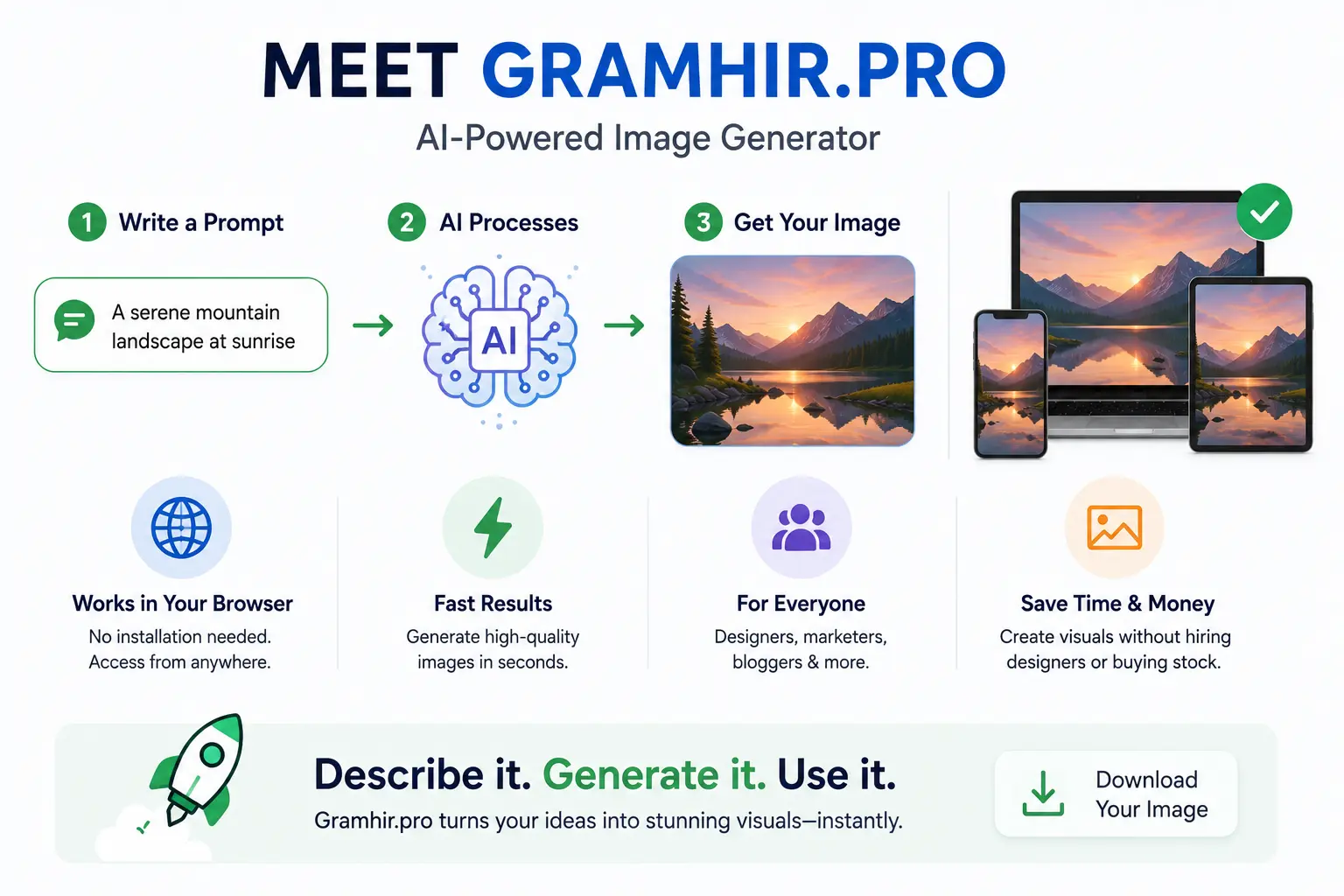
Gramhir.pro is an AI-powered image generator that converts written text descriptions into finished visuals. You type a prompt, the tool processes it, and within seconds you have an image ready to download.
It runs entirely in your browser, so there is nothing to install. That alone makes it more accessible than tools like Stable Diffusion, which require a local setup. Whether you are on a desktop, tablet, or phone, the platform loads and works without any friction.
The platform is built for a wide audience, from professional designers who need to iterate quickly, to bloggers and marketers who just need decent visuals without hiring a designer or paying for stock photos.
The Technology Behind Gramhir.pro
The engine powering gramhir.pro is built on Generative Adversarial Networks (GANs). If that sounds complicated, here is a simple way to think about it:
Imagine two people working against each other. One is a forger whose job is to create an image from scratch. The other is an art expert whose job is to spot fakes. They go back and forth,the forger tries to fool the expert, and the expert keeps pushing back – until the image is good enough that the expert cannot tell the difference.
That is essentially what GANs do. The generator network creates images, the discriminator network evaluates them, and the loop repeats until the output meets a quality standard.
On top of that, gramhir.pro uses natural language processing (NLP) to understand your text prompt. Before any image is rendered, the system parses your words, maps them to visual concepts, and builds a kind of blueprint for the image. This is why detailed prompts consistently produce sharper results than vague ones.
How to Use Gramhir.pro – A Step-by-Step Walkthrough
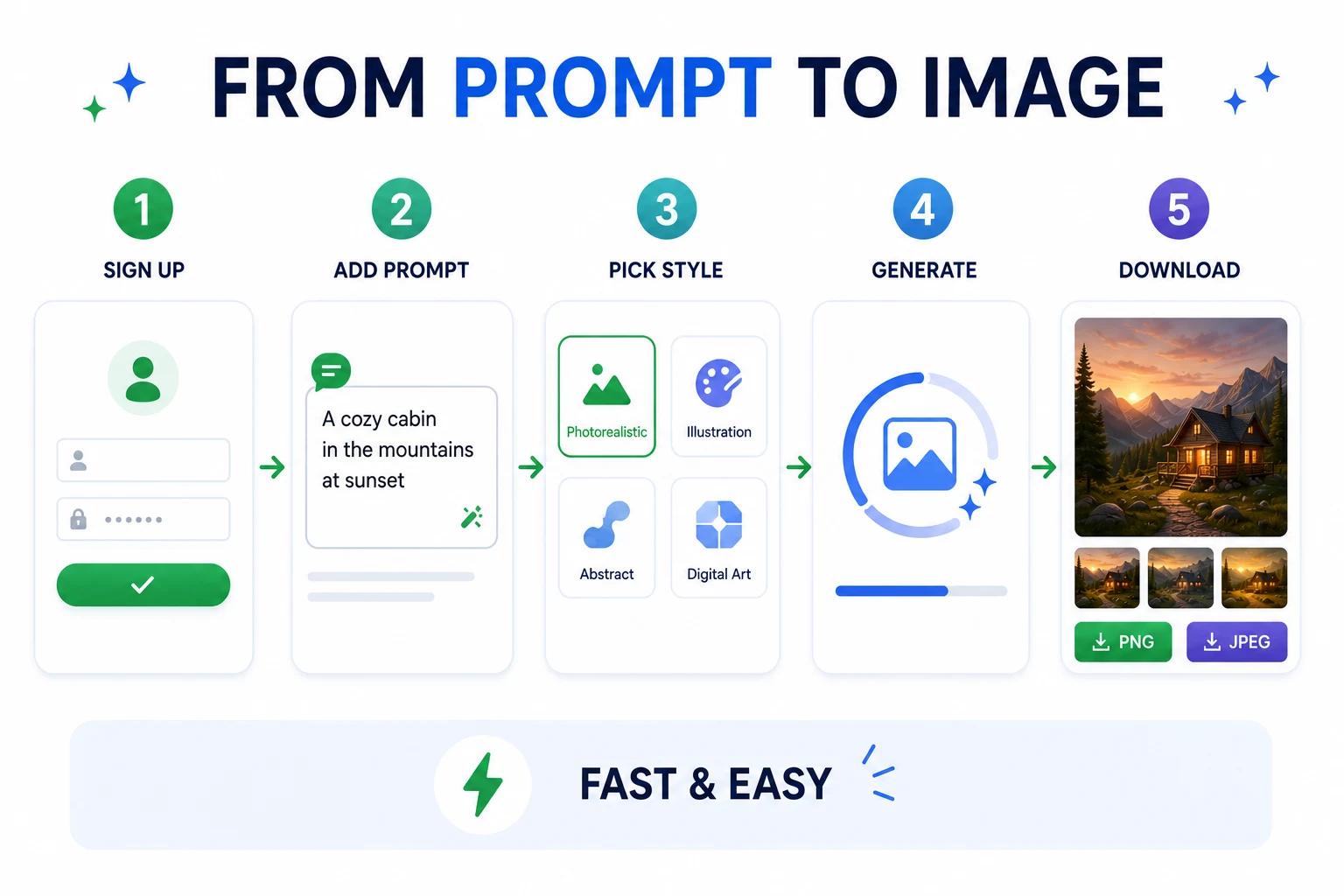
Getting started with gramhir.pro takes about two minutes. Here is the exact process:
- Visit gramhir.pro and create a free account. No credit card required for the free tier.
- Once logged in, the dashboard loads directly in your browser. It is clean and minimal — no learning curve.
- Type your text prompt in the input field. Be as descriptive as you can. Include the subject, setting, lighting, mood, and art style.
- Select your preferred style if the platform offers style options (photorealistic, illustration, abstract, etc.).
- Hit generate. The tool processes your request and returns one or more image variations.
- Review the results, pick your favourite, and download in PNG or JPEG format at high resolution.
Writing Better Prompts – What Actually Works
The single biggest factor in output quality is your prompt. Here is how to get better results consistently:
- Be specific about the subject. ‘A dog’ gives a generic output. ‘A golden retriever sitting in autumn leaves, warm afternoon light, shallow depth of field’ gives something you can actually use.
- Name the art style. Saying ‘photorealistic’, ‘flat illustration’, ‘cinematic’, or ‘watercolour’ helps the model understand the visual language you are going for.
- Add mood and lighting. Words like ‘moody’, ‘bright and airy’, ‘dramatic shadows’, or ‘golden hour’ make a significant difference.
- Avoid contradictions. Asking for ‘minimalist and highly detailed’ in the same prompt often produces inconsistent results.
Gramhir.pro Features – What You Actually Get
Here is a breakdown of the main features the platform offers:
| Feature | What It Does |
| Text-to-Image Generation | Converts written prompts into finished visuals in seconds |
| Multiple Art Styles | Supports photorealistic, illustration, abstract, and more |
| Variation Mode | Generates multiple takes on the same prompt for comparison |
| High-Resolution Export | Downloads in PNG/JPEG suitable for web, print, and social media |
| Browser-Based Access | No installation needed; works on any device with a browser |
| Real-Time Processing | Fast generation times without long wait queues |
| NLP Prompt Parsing | Understands natural language so you can write prompts conversationally |
Style Customization and Output Quality
One of the things that sets gramhir.pro apart from more barebones generators is the range of visual styles available. You are not locked into one look. Whether you need something photorealistic for a product listing or a flat illustration for a blog header, the platform adapts to what you specify.
Quality is consistently strong for landscape shots, abstract visuals, and product-style images. Where it gets a bit shaky and this is true of most AI image tools is with complex human portraits and any image that requires precise text rendering.
Who Is This Tool Best Suited For?
Based on our testing, gramhir.pro works best for:
- Content creators and bloggers who need featured images, thumbnails, and social graphics without a design budget.
- Small marketing teams looking to speed up visual content production.
- E-commerce sellers who want quick product lifestyle images or mockups.
- Freelancers who need a fast way to sketch out visual concepts for client presentations.
Gramhir.pro Pricing – Free vs. Pro Plan
Gramhir.pro offers a free tier, which is a good starting point if you just want to test the platform. Here is how the two plans compare:
| Feature | Free Plan | Pro Plan |
| Daily Image Generations | Limited (basic quota) | High-volume access |
| Image Resolution | Standard | High-resolution export |
| Art Style Options | Core styles | All styles + advanced |
| Commercial Use | Restricted | Full commercial rights |
| Variation Mode | Limited | Unlimited variations |
| Priority Processing | No | Yes |
| Customer Support | Community only | Priority support |
| Watermark | May apply | No watermark |
Is the Pro Plan Worth It?
For casual personal use, the free plan is genuinely usable. You get enough daily generations to experiment with and get a feel for the tool.
Where the Pro plan starts to justify itself is when you are producing content at volume – say, a marketing team that needs 20+ graphics per week, or a content creator posting daily. The higher resolution output is also a real differentiator if your images are going to be printed or displayed at large sizes.
If you are still on the fence, the sensible move is to run the free plan for a week, see how often you hit the generation limit, and upgrade only if you find yourself consistently bumping against it.
Where Gramhir.pro Falls Short
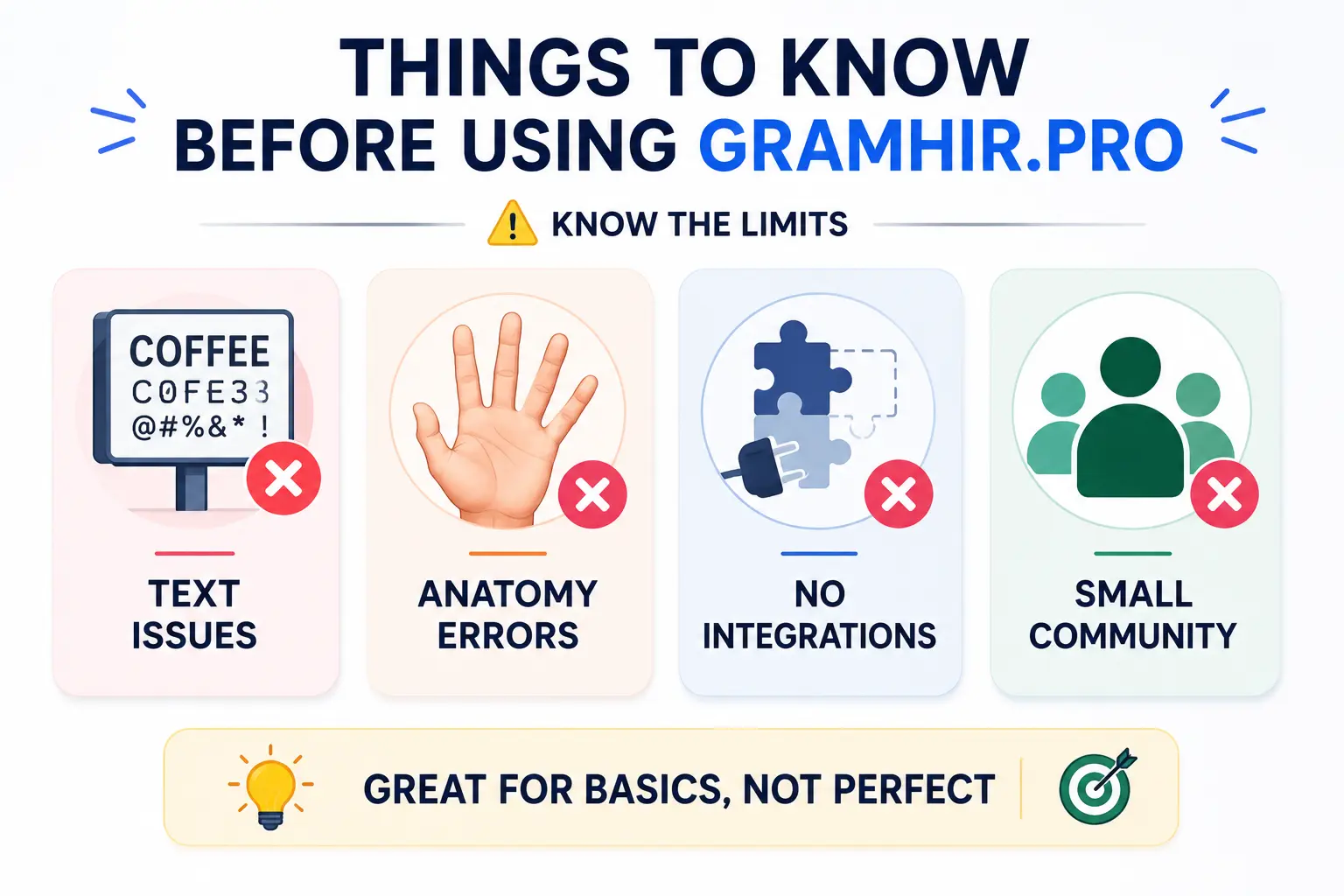
No tool is perfect, and gramhir.pro has some real limitations you should know about before you commit.
Text in Images
If your prompt asks for readable text inside the image a billboard, a product label, a sign the results are often garbled or illegible. This is a known weakness across virtually all GAN-based generators, not just gramhir.pro. If you need text in images, plan to add it in post with a tool like Canva or Photoshop.
Human Anatomy
Hands are notoriously difficult for AI image generators, and gramhir.pro is no exception. Fingers get strange, proportions go off, and detailed portrait work can feel slightly uncanny. For simple headshots or figures in the background, it is fine. For close-up human portraits with precision, it struggles.
Limited Integrations
Unlike Midjourney (which integrates into Discord) or DALL-E 3 (which plugs directly into ChatGPT), gramhir.pro sits as a standalone web tool. If you are building an automated content workflow, the lack of API access or native integrations is a meaningful constraint.
Smaller Community
Part of what makes tools like Midjourney so powerful is the massive community sharing prompts, tips, and workflows. Gramhir.pro does not have that ecosystem yet, which means you are more on your own when figuring out what works.
Gramhir.pro Alternatives – How It Stacks Up in 2026
If gramhir.pro does not quite fit your needs, here are the main alternatives worth considering:
DALL-E 3
Built by OpenAI and integrated directly into ChatGPT, DALL-E 3 is the easiest option for anyone already in the OpenAI ecosystem. It handles text-in-images better than most competitors, and prompt accuracy is excellent. The downside is that the free tier is limited and quality drops noticeably compared to the paid version.
Midjourney
If visual quality is your top priority and you do not mind a steeper learning curve, Midjourney produces some of the most aesthetically striking AI images available. It operates through Discord, which feels clunky at first, but the output quality is difficult to beat for artistic and editorial work. There is no free plan.
Stable Diffusion
The open-source choice. Stable Diffusion gives you more control than any other option, but it requires technical setup unless you are using a hosted version like DreamStudio. If you want to run things locally on your own hardware, this is your best bet.
Leonardo AI
Particularly strong for game assets, concept art, and illustration-heavy workflows. Leonardo AI has a generous free tier and excellent style fine-tuning options. If your work skews artistic or fantastical, it is worth exploring.
Side-by-Side Comparison
| Tool | Best For | Free Plan | Ease of Use | Best At |
| Gramhir.pro | Quick, accessible image gen | Yes | 5/5 | Simplicity & speed |
| DALL-E 3 | GPT/ChatGPT integration | Limited | 4/5 | Prompt accuracy |
| Midjourney | Artistic, high-quality visuals | No | 3/5 | Aesthetic quality |
| Stable Diffusion | Open-source power users | Yes | 2/5 | Customization |
| Leonardo AI | Game & concept art | Yes | 4/5 | Style fine-tuning |
Gramhir.pro holds its own as an accessible, browser-based option with no install friction. It is not the most powerful tool on this list, but it is arguably the quickest to start using – and for many creators, that is exactly what they need.
Real Use Cases: What People Are Actually Using Gramhir.pro For
Based on our research and hands-on testing, here are the scenarios where gramhir.pro consistently delivers value:
- Blog featured images and article thumbnails – generate custom visuals that are on-brand without touching stock photo libraries.
- Social media graphics for Instagram, LinkedIn, and Twitter/X – quick iterations for content calendars.
- E-commerce lifestyle shots – place your product concept in a setting without a photo shoot.
- YouTube thumbnails – generate background visuals and combine with text overlays in Canva.
- Presentation mockups – rough visual ideas for pitch decks or client proposals.
- Ad creative testing – generate multiple visual concepts before committing to a full production shoot.
Pro Tips for Better Results on Gramhir.pro
A few habits that will save you time and get you to better outputs faster:
Think Like a Film Director, Not a Search Engine
The biggest mistake beginners make is typing single-noun prompts. ‘Mountain’ or ‘city at night’ gives you something generic. Instead, describe the scene the way a director would brief a cinematographer: subject, setting, lighting, mood, and camera perspective.
Layer Your Descriptors
Subject + art style + mood + lighting is the formula that works. Example: ‘a minimalist coffee shop interior, flat illustration style, warm soft lighting, morning light coming through large windows.’
Use Variation Mode Before Refining
Before you rewrite your entire prompt, generate a few variations on the same one. Often a different interpretation of the same words is exactly what you were looking for.
Download at Maximum Resolution
Always download at the highest resolution available, even if your immediate use case does not require it. You can always scale down; you cannot scale up without quality loss.
Test Multiple Style Settings
Run the same prompt through two or three different style settings and compare. The same scene can look dramatically different between photorealistic and painterly modes – and one of them will almost always surprise you.
FAQ
Q: What is gramhir.pro and what does it do?
A: Gramhir.pro is a browser-based AI image generator. You type a text description of an image – called a prompt – and the platform uses AI to produce a finished visual based on your input. No design skills or software installation required.
Q: Is gramhir.pro free to use?
A: Yes, gramhir.pro offers a free plan that lets you generate a limited number of images per day. A Pro plan is also available with higher generation limits, better resolution output, commercial usage rights, and no watermarks.
Q: How does gramhir.pro compare to Midjourney and DALL-E 3?
A: Gramhir.pro is easier to start using than either Midjourney or DALL-E 3 since it runs in a browser with no extra setup. However, Midjourney produces higher-quality artistic images, and DALL-E 3 handles text within images more accurately. Gramhir.pro wins on simplicity and accessibility.
Q: Can I use gramhir.pro images commercially?
A: Commercial usage rights depend on the plan. The free tier typically restricts commercial use, while the Pro plan grants full commercial rights. Always review the current terms of service on the platform before using images in paid projects.
Q: Is gramhir.pro the same as the Gramhir Instagram viewer?
A: No. They are completely separate products. Gramhir.pro is an AI image generator. If you are looking for an Instagram profile viewer, that is a different tool entirely.
Q: What are the main limitations of gramhir.pro?
A: The three main limitations are: (1) text rendered inside images is often illegible, (2) complex human portraits – especially hands – can be anatomically inconsistent, and (3) there are no native API integrations for automated workflows.
Q: Does gramhir.pro require any technical skills or software?
A: None at all. The platform runs in a browser and is designed for users with zero design or technical background. If you can type a sentence, you can use gramhir.pro.
Q: What is the best AI image generator for beginners in 2026?
A: For pure ease of use, gramhir.pro is one of the more beginner-friendly options because it requires no installation and has a minimal learning curve. DALL-E 3 (via ChatGPT) is also very beginner-friendly if you are already a ChatGPT user.
Conclusion
Gramhir.pro does what it promises. It generates images quickly, it works in any browser without setup, and the output quality is solid enough for most content creation use cases.
It is not trying to compete with Midjourney on artistic sophistication, and it does not have DALL-E 3’s text-rendering accuracy. But if you are a content creator, marketer, or small business owner who needs visuals on a regular basis and does not want to deal with complicated tools or stock photo licensing, gramhir.pro is a genuinely useful addition to your toolkit.
The free plan is enough to judge for yourself. Spend a week with it, push it across a few different use cases, and you will know fairly quickly whether it earns a spot in your workflow.