If you’ve ever sat through a team workshop and walked away with a colorful chart describing your personality, there’s a good chance you were holding a Discovery Profile. It’s one of the most widely used personality tools in corporate training rooms today, and for good reason. It turns something as fuzzy as “how people work” into a language that teams can actually use.
This guide breaks down what a Discovery Profile is, how it works, the psychology behind it, and how to actually put it to use at work, not just file it away in a drawer after the workshop ends.
What Is a Discovery Profile?
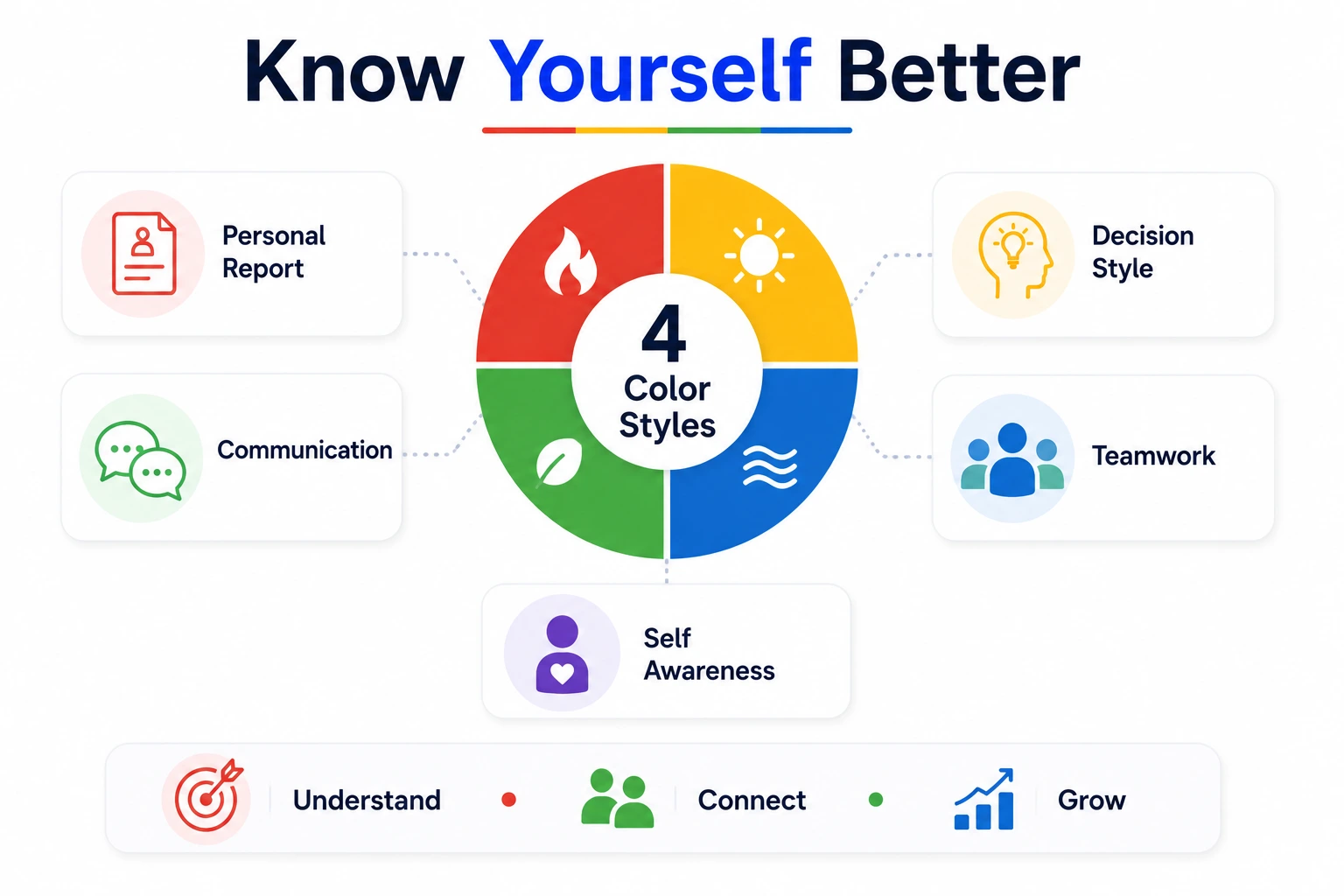
A Discovery Profile is a report that is made just for you, based on the Insights Discovery assessment. This report talks about the things you naturally like to do and it uses colors to make it easy to understand: there is Fiery Red, Sunshine Yellow, Earth Green and Cool Blue.
The Discovery Profile does not just give you a label. Leave it at that. It actually tells you how you usually talk to people, how you make decisions and how you get along with others. You can think of the Discovery Profile as a mirror that shows you what you are like.
It is not like a horoscope that tells you what you should be but like a reflection of what you already know about yourself explained in a way that makes sense and that other people can understand too. The Discovery Profile is like a tool that helps you see your patterns and habits and it uses simple language to explain them so you can understand yourself better and communicate with others more easily.
Why Organizations Use Discovery Profiles
Companies use Discovery Profiles because they help teams talk about differences in a way that everyone understands. If someone says it is hard to work with a team, they can say that person is a high Cool Blue. They need more information before making a decision, which is really helpful and does not feel like a personal attack.
HR. Managers like Discovery Profiles because they do not judge people. With Discovery Profiles there is no color that’s better than the others so people feel more comfortable using them without feeling like they are being labeled or criticized.
Who Should Use One?
A Discovery Profile is really useful for everyone in an office. New employees use the Discovery Profile to learn how they can do their job best. Managers use the Discovery Profile to find ways to manage their team.
Teams use the Discovery Profile to understand each other and avoid problems.The Discovery Profile helps people work together and get along.
The Discovery Profile is very helpful in some situations. For example when new employees are starting their job the Discovery Profile is very useful.The Discovery Profile is also useful when teams are first coming together.
It is useful during training programs that help leaders become better.The Discovery Profile is also helpful when people are trying to resolve their issues with each other.
How Does a Discovery Profile Work?
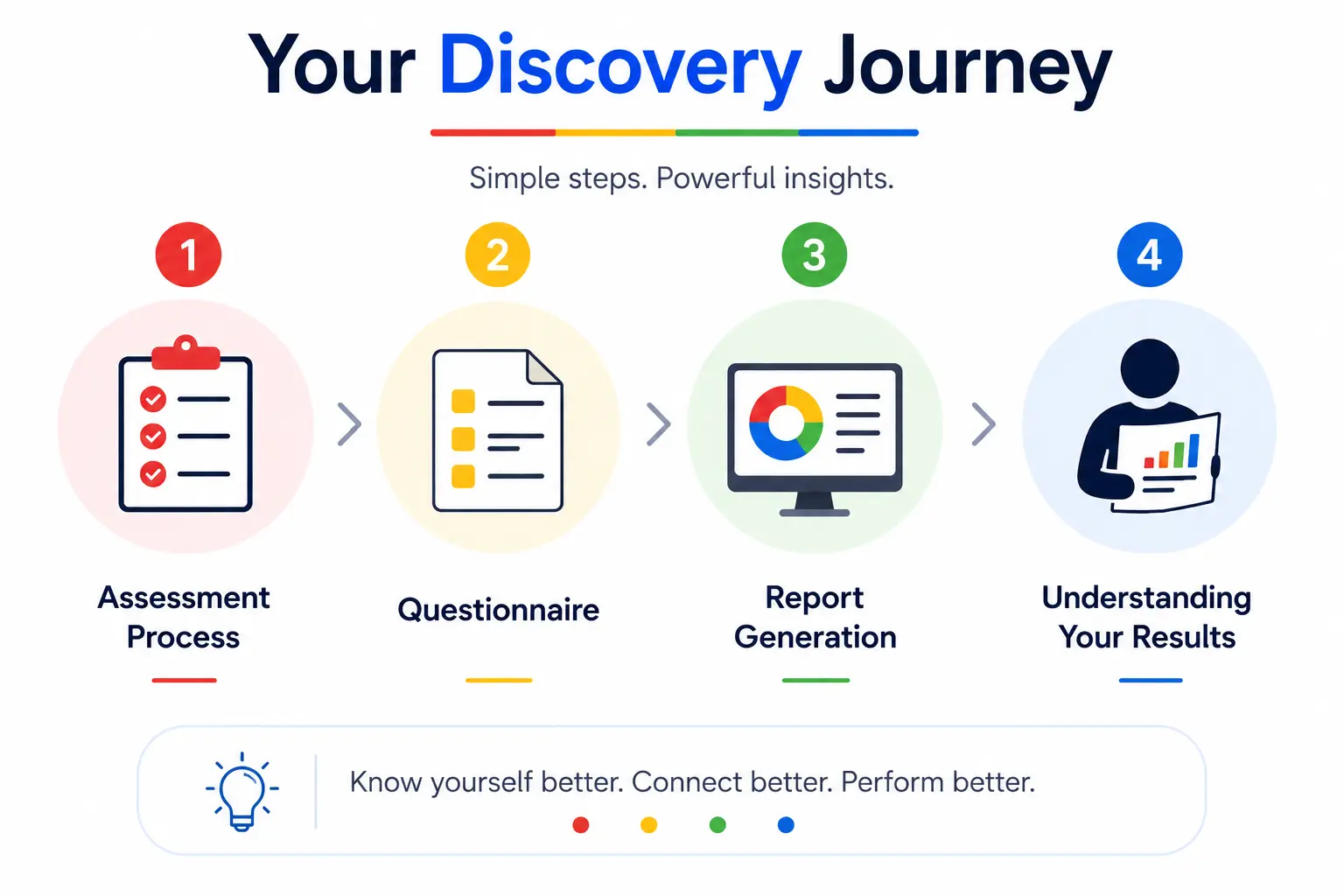
1. Assessment Process
The process starts with an online questionnaire, usually taking 15 to 25 minutes to complete. There’s no prep needed; you’re simply asked to respond honestly, based on instinct rather than overthinking each question.
Once submitted, the responses are processed and turned into a personalized report, typically within minutes.
2. Questionnaire
The Insights Discovery questionnaire asks you to choose statements that feel most and least like you across a series of word groups. It’s designed to capture instinctive preferences rather than skills or job performance.
There are no right or wrong answers here. The goal is to capture how you naturally prefer to behave, not how you think you should behave.
3. Report Generation
The system analyzes your response pattern and maps it against the four color energies. Most people are a blend of all four, with one or two colors showing up more strongly than the others.
The result is a report often 20 or more pages covering your strengths, possible blind spots, communication style, and more.
4. Understanding Your Results
Your Discovery Profile isn’t a label to memorize; it’s a starting point for reflection. Most people read their report and recognize themselves immediately, which is part of why the tool has stuck around in corporate training for so long.
It helps to read your profile with a specific question in mind, like “how does this affect how I run meetings?” rather than reading it purely as trivia about yourself.
The Psychology Behind Insights Discovery
1. Carl Jung’s Theory
Insights Discovery is built on the work of Swiss psychiatrist Carl Jung, particularly his theory of psychological types. Jung proposed that people have consistent preferences in how they perceive the world and make decisions.
Jung’s original framework included concepts like introversion and extraversion, along with functions such as thinking, feeling, sensing, and intuiting. Insights Discovery translated these ideas into a color-based model that’s easier for non-psychologists to apply in everyday work settings.
2. Behavioral Preferences
The key idea is “preference,” not ability. Just because someone prefers a more reflective, data-driven approach (Cool Blue) doesn’t mean they can’t be spontaneous when needed. It just means it’s not their default setting.
This distinction matters. Preferences describe comfort zones, not fixed limitations.
3. Why Personality Profiles Matter
Understanding behavioral preference matters because most workplace friction isn’t about ability it’s about style mismatch. A fast-talking, big-picture thinker and a detail-oriented planner can both be excellent at their jobs while frustrating each other constantly.
A shared framework, like the one a Discovery Profile provides, gives people a neutral way to talk about these differences without it turning into a personal complaint.
Understanding the Four Color Energies
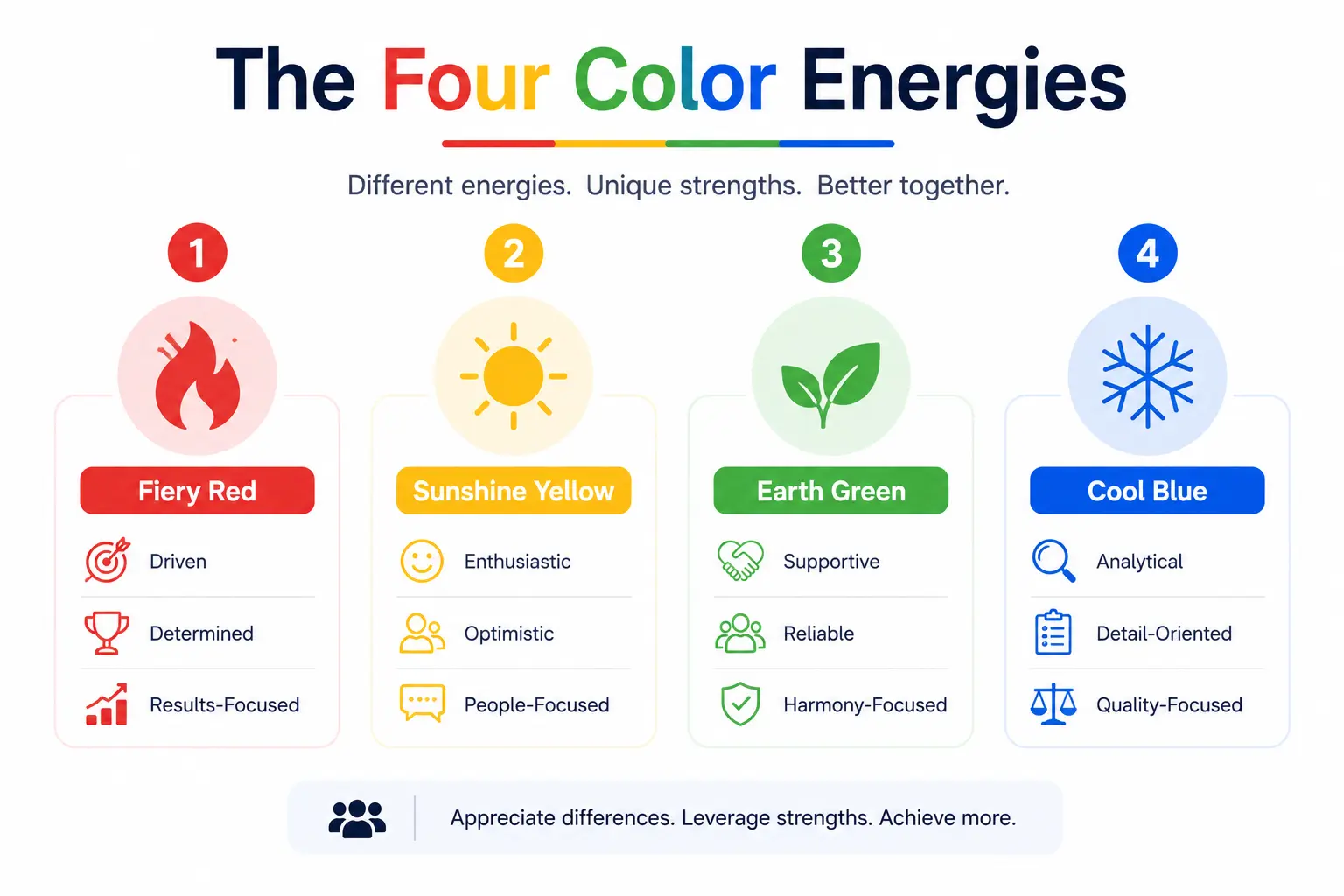
1. Fiery Red
Strengths
Red energy is really about being straightforward and making decisions. When someone has a lot of energy they are usually okay with being in charge and getting things done fast. Red energy helps people take control and move forward quickly with energy.
Challenges
The other side of the story is that Red energy people can seem impatient or say things that are too straight especially when they are under a lot of pressure. Some Red energy people are very strong. They need to make an effort to slow down so that other people can keep up with them. Red energy people have to remember to do this.
Communication Style
I want to get to the point. The Fiery Reds do a job when they know what to do and can work quickly. They like it when things are simple and we can move fast. The Fiery Reds are good at finishing tasks when we give them instructions and let them work at their own pace.
2. Sunshine Yellow
Strengths
Sunshine Yellow energy brings enthusiasm, sociability, and big-picture thinking. These are often the people who keep team morale up and generate new ideas.
Challenges
The challenge is follow-through. High Yellow energy can mean great ideas that lose momentum once the initial excitement fades.
Communication Style
Make space for conversation and enthusiasm before diving into details. Yellows respond to energy and personal connection.
3. Earth Green
Strengths
Earth Green energy is about steadiness, empathy, and loyalty. People with strong Green energy are usually the ones holding a team together and making sure everyone feels heard.
Challenges
Strong Greens can struggle with conflict avoidance and may take longer to voice disagreement, even when they have real concerns.
Communication Style
Give them time to process, and be genuinely warm rather than purely transactional. Greens value sincerity over speed.
4. Cool Blue
Strengths
Cool Blue energy shows up as analytical thinking, precision, and careful decision-making. These are typically the people who catch the details everyone else missed.
Challenges
The risk is overanalysis or appearing overly critical, especially when others just want to move forward.
Communication Style
Come prepared with data and give them time to think before expecting a decision. Cool Blues dislike being rushed.
The Eight Insights Discovery Personality Types
1. Overview of Each Type
Beyond the four color energies, Insights Discovery further breaks people down into eight personality types, each representing a blend of two adjacent color energies: Director, Motivator, Inspirer, Helper, Supporter, Coordinator, Observer, and Reformer.
Each type reflects a more nuanced combination; for example, a Motivator blends Fiery Red and Sunshine Yellow energy, showing up as someone driven and outgoing at the same time.
2. Common Characteristics
While every individual profile is unique, people within the same type tend to share recognizable tendencies in pace, focus, and communication preference. This is where the model becomes genuinely predictive and useful for teams.
3. Workplace Behaviors
In practice, these eight types explain a lot of common office dynamics: why some people jump straight into brainstorming while others want an agenda first, or why some prefer quick check-ins while others want a formal one-on-one.
What’s Included in a Discovery Profile Report?
1. Personal Strengths
The report opens with a clear description of your natural strengths, written in a positive and affirming tone.
2. Blind Spots
It also covers potential blind spots the behaviors that can trip you up, especially under stress.
3. Communication Preferences
There’s a dedicated section on how you like to give and receive information, which is one of the most practically useful parts of the report.
4. Leadership Style
For people in or moving toward management, the report outlines a natural leadership style and how it might land with different team members.
5. Team Dynamics
The report also touches on how you typically show up in a team setting as a driver, a connector, a supporter, or an analyzer.
6. Development Areas
Finally, most reports suggest specific areas for growth, tailored to your color energy mix rather than generic advice.
How to Read and Apply Your Discovery Profile
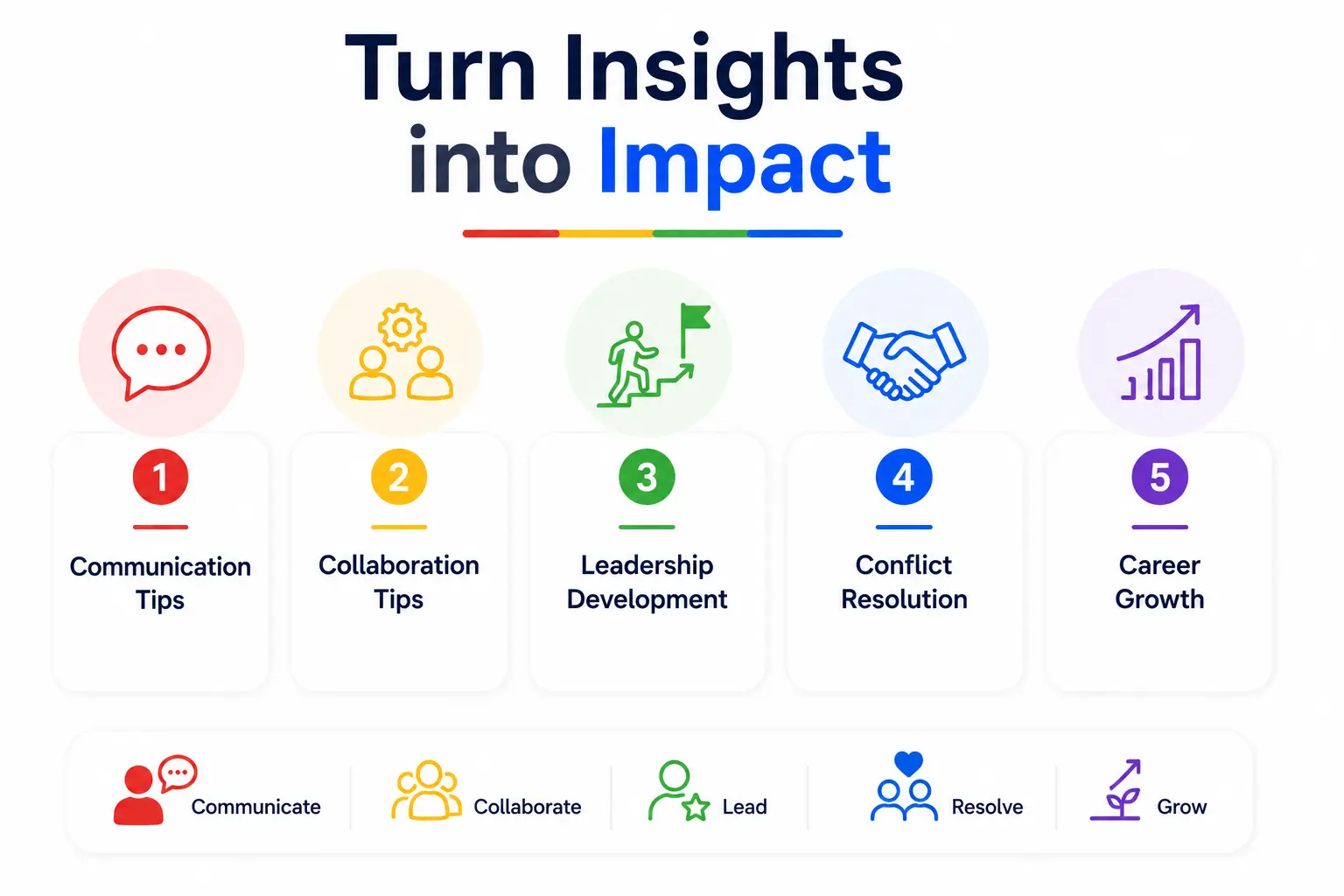
1. Communication Tips
Use your report to identify one or two adjustments you can make immediately, like slowing down for detail-oriented colleagues or being more direct with results-focused ones.
2. Collaboration Tips
Share color energy insights with your immediate team so everyone understands each other’s working style, not just their own.
3. Leadership Development
Managers can use Discovery Profiles to adapt delegation and feedback style person by person, instead of using a one-size-fits-all approach.
4. Conflict Resolution
When conflict shows up, revisiting each person’s Discovery Profile can help separate “this is who they are” from “this is a personal attack,” which often defuses tension quickly.
5. Career Growth
Understanding your natural energy can also guide career decisions — for example, a strong Earth Green might thrive in people-focused roles, while a strong Cool Blue might prefer analytical or technical paths.
Discovery Profile Benefits
1. For Individuals
Individuals get a clearer sense of self-awareness and language to describe their own working style to others.
2. For Managers
Managers get a practical tool for adapting communication and delegation to each team member.
3. For Teams
Teams get a shared vocabulary that reduces misunderstandings and personal friction.
4. For HR Professionals
HR professionals get a scalable, repeatable tool for onboarding, training, and culture-building initiatives.
5. For Executive Leaders
Executives get insight into how leadership style is actually being received across the organization, which can shape coaching priorities.
Real Workplace Examples
1. Sales Teams
A sales team that has a mix of Fiery Red closers and Sunshine Yellow relationship-builders can use Discovery Profiles to divide roles on purpose. This means Fiery Red closers can be on high-pressure calls to deals. On the other hand Sunshine Yellow relationship-builders can be in charge of building relationships and taking care of accounts. This way Fiery Red closers do what they are good at which is closing deals and Sunshine Yellow relationship-builders do what they are good at, which is building relationships and nurturing accounts.
2. Customer Support
Support teams often benefit from Earth Green energy, since patience and empathy matter more than speed in de-escalating frustrated customers.
3. Project Management
Project managers often lean on Cool Blue energy for planning and risk assessment, while relying on Fiery Red team members to keep momentum going when deadlines tighten.
4. Remote Teams
Remote teams can use Discovery Profiles to compensate for the loss of in-person cues, making it clearer why a colleague prefers async written updates (often Cool Blue) versus quick video calls (often Sunshine Yellow).
5. Leadership Coaching
Executive coaches frequently use Discovery Profiles as a starting point for one-on-one coaching, helping leaders see how their natural style affects the people around them.
Discovery Profile vs Other Personality Assessments
1. Discovery Profile vs DISC
Both models share roots in similar behavioral theory and use comparable four-quadrant structures. The main difference is presentation Insights Discovery uses colors and Jungian language, while DISC uses the Dominance, Influence, Steadiness, Conscientiousness framework.
2. Discovery Profile vs MBTI
The Myers-Briggs Type Indicator sorts people into 16 fixed types based on four binary dimensions. Discovery Profiles instead show a spectrum of blended color energy, which some practitioners argue better reflects real-world behavior since most people don’t fit neatly into one box.
3. Discovery Profile vs Big Five
The Big Five personality model is the most research-backed framework in academic psychology, measuring traits like openness and conscientiousness on a continuous scale. Discovery Profiles are more workplace-friendly and easier to apply in a team workshop, but they don’t carry the same depth of peer-reviewed validation as the Big Five.
4. Discovery Profile vs CliftonStrengths
CliftonStrengths focuses on identifying and ranking your top talents from a list of 34 themes. Discovery Profiles focus more on behavioral style and communication preference rather than ranking specific strengths.
Is the Discovery Profile Accurate?
1. Scientific Foundation
The model draws from Jung’s psychological types, which have influenced decades of personality research. That said, Insights Discovery itself is a commercial adaptation, not a peer-reviewed academic instrument.
2. Reliability
Insights Discovery reports reasonably strong internal reliability in its own research, and many users find their results resonate strongly. Still, like most self-report assessments, results can shift somewhat depending on mood, context, or life stage.
3. Strengths
Its biggest strength is practical usefulness. It’s easy to understand, easy to apply, and generates genuine “aha” moments in teams which is exactly what it’s designed for.
4. Limitations
Its biggest limitation is scientific rigor compared to academically validated tools like the Big Five. It’s best treated as a communication and team-building tool, not a clinical or hiring instrument.
How to Get a Discovery Profile
1. Assessment Providers
Discovery Profiles are usually given to people by companies that have a license to provide Insights Discovery and by partners who have been certified. This often happens when people attend a training workshop where they get to learn things. The Discovery Profiles are often part of the package when people go to these training workshops.
2. Certified Practitioners
A lot of people who work with companies to help them manage their staff are trained to use Insights Discovery. These people, like HR consultants and leadership coaches, know how to give the Insights Discovery assessment and then go over the results, with the person who took it. They are certified Insights Discovery practitioners, which means they have learned how to use Insights Discovery the way.
3. Costs
The cost of this service is different for each company. It really depends on what you want to buy. If you want to buy a report for yourself or a package, for your whole team the price will be different. It is an idea to ask the company how much it will cost. You should ask them for a quote so you know how much you will have to pay for the report or the team workshop package.
4. What to Expect
You will get a questionnaire, a detailed written report and it would be great to have a conversation with a certified practitioner to help you understand the results of the online questionnaire and the detailed written report. This will help you make the most of the questionnaire and the detailed written report.
Best Practices for Using Discovery Profiles
1. Team Building
We should have a team workshop where everyone talks about their color energy and how it affects their work. This way people can really understand each other. Running a workshop like this is usually better than reading about it in reports. When we all share our color energy we can see how it shows up in our work and that is really helpful.
2. Leadership Development
To get an idea of how a leader’s natural style is really affecting their team we should use Discovery Profiles along with 360-degree feedback. This way we can see the picture. The leader’s style is one thing. How it is actually landing with their team is what really matters. We need to use Discovery Profiles and 360-degree feedback to understand this.
3. Coaching
When you are talking to someone in a coaching session you can use their profile to get the conversation started. Do not think of the profile as a final description of who that person is. The profile is a way to begin the conversation in coaching sessions about the person and it is not the final word on the person. Use the person’s profile to start talking in the coaching sessions.
4. Employee Development
You should go back. Look at profiles from time to time. This is because profiles can change in ways as people take on new roles and grow. People’s preferences can change a bit as they get used to these new roles. You need to revisit profiles to see these changes in people’s preferences. Revisit profiles to stay updated on the people and their new preferences.
5. Change Management
When a company is changing it is an idea to think about how different people will feel about it. Some people, like the ones who like Cool Blues will want to know all the details. On the other hand people who like Sunshine Yellows will need to feel safe and be around other people. Color energy insights can help you figure out how people, like Cool Blues and Sunshine Yellows will react during this time.
Common Misconceptions About Discovery Profiles
People often think that the color energy they have is all their life.. Actually most people have a mix of different color energies and what they like can change depending on their job, where they are and what happens to them.
Some people use Insights Discovery in a way like a test to decide who to hire. This is not what it was made for.
Others think that one color energy is better than the others. The thing is, every color energy is special and brings its good things and teams that do well usually have all four color energies.
Sometimes people look at the report. Think that is all there is.. The report is just the beginning. The good stuff happens when people talk about what the report says, not the report itself.
FAQ
1. Is a Discovery Profile the same as Insights Discovery?
The term Discovery Profile is basically a report that is made just for you. This report is generated from the Insights Discovery assessment. So the Discovery Profile is, like a report that comes from the Insights Discovery assessment.
2. How long does the assessment take?
Most people complete the questionnaire in 15 to 25 minutes.
3. Can my color energy change over time?
Yes, to a degree. While people tend to have a consistent core preference, life stage, role, and environment can shift how strongly certain energies show up.
4. Is it scientifically validated like the Big Five?
It is not the same. This thing is based on the ideas of Jung. It has its own research but the Big Five model is still considered better because it has been studied and approved by a lot of experts. The Big Five model has been looked at. Accepted by many people in the academic world, which is not the case, with this thing that is based on Jungian theory.
5. Can a Discovery Profile be used for hiring decisions?
No, it isn’t designed or recommended for hiring or selection purposes. It’s built for development, communication, and team-building.
6. Do I need a certified practitioner to understand my report?
So it is not really necessary. Talking to a certified practitioner after you get your results can really help you understand how to use them. This is usually better than reading the report by yourself. A certified practitioner can help you apply the results in an effective way.
Conclusion
A Discovery Profile will not tell you everything about a person. It is not meant to do that. The Discovery Profile does a job of giving teams a simple way to talk about how people think, communicate and work together.
The Discovery Profile can be used to start conversations not to label people. When teams use the Discovery Profile in a way it can really help teams work together better, help managers lead their teams and help individuals understand their own way of working. This is something that not many tools can do for a workplace.