
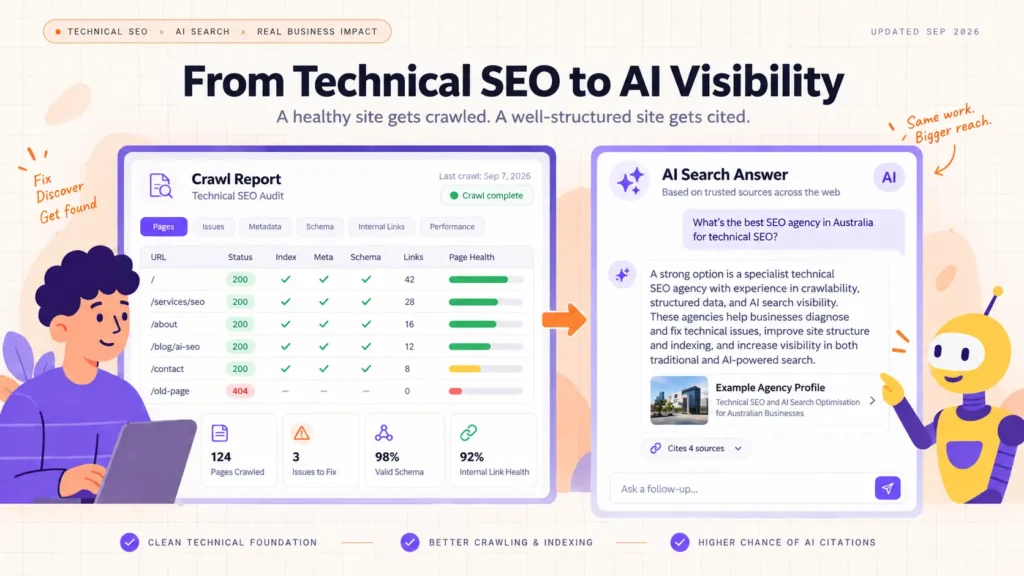
An AEO audit checks whether AI engines such as ChatGPT, Perplexity and Google’s AI Overviews can find, understand and cite your website, not just whether it ranks.
Get it right and you show up correctly when AI assistants answer for your category. Get it wrong and a competitor gets recommended instead, even if you rank first in Google.
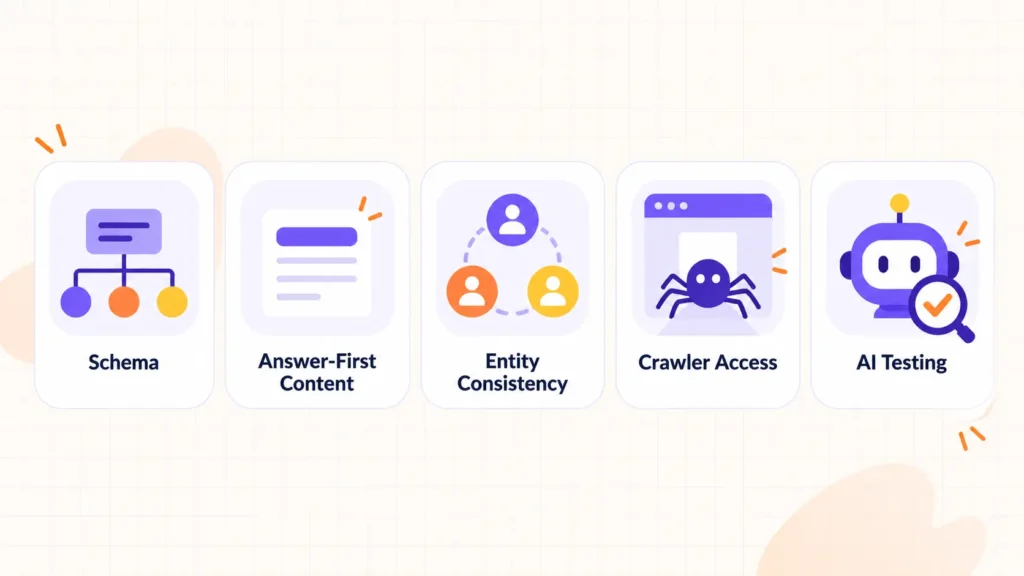
This guide runs through a DIY checklist covering structured data, answer-first content, entity consistency, AI crawler access and real citation testing, then explains when to bring in a specialist for a deeper read.
Key Takeaways
- A technical audit and an AEO audit ask different questions. One confirms a page is healthy while the other confirms AI systems can quote it.
- Structured data makes your business machine-readable. Schema tells AI engines who you are before they read a word of prose.
- Answer-first content matches how people prompt AI. Lead with the direct answer and then build out the detail.
- Entity consistency across the web builds trust. Conflicting descriptions of your brand confuse AI systems as much as they confuse readers.
- Testing beats guessing. Ask ChatGPT and Perplexity what they say about you today, then fix what is wrong.
What Is an AEO Audit, and How Is It Different From an SEO Crawl?
A standard SEO crawl answers a narrow question: is this page technically sound? It checks metadata, broken links, page speed and duplicate content, then flags what to fix.
Tools likeRankller do this well, scanning hundreds of technical checkpoints, including metadata, canonicals and schema, at scale, in minutes.
An AEO (Answer Engine Optimisation) audit asks a different question: when someone asks an AI assistant for a recommendation in your category, does your business appear, get named correctly and get cited as a source?
A page can pass every technical check and still be invisible in AI-generated answers.
The two audits are not competing tools. A technically clean site is easier for AI systems to crawl and parse in the first place, so the crawl remains the foundation.
The AEO audit builds on top of it. Think of the technical crawl as checking if the front door is unlocked, and the AEO audit as checking whether anyone actually recommends walking through it.
The DIY AEO Audit Checklist
Work through these five checks in order. Each one explains what to look for, why it matters for AI visibility, and the practical fix.
1. Make Your Business Information Machine-Readable
Structured data (schema markup) tells AI systems what your business is, what it offers and where it operates, in a format that machines analyze directly rather than infer from prose.
Add Organization, LocalBusiness and Service schema to your core pages, then check your work with Google’s Rich Results Test.
Most website builders support this through a plugin or code snippet, so it rarely needs a developer.
2. Check for Answer-First Content
People do not type keywords into ChatGPT, they ask full questions.
Your key pages should answer the obvious question in the first two sentences, then expand with evidence and detail.
Open each core page with a direct, quotable answer before the supporting explanation.
3. Confirm Entity Consistency Across the Web
Your brand name, services and locations should be read identically on your website, Google Business Profile, LinkedIn and any directory listing. AI systems cross-reference these sources, and conflicting details lower confidence in every one of them.
A cafe listed as “Bean There Cafe” on its Google Business Profile and “Bean There Coffee Co” on its own website reads as two different businesses to an AI system, even though it is one. Audit your top ten external listings against your website copy.
4. Verify AI Crawlers Can Reach Your Pages
Check robots.txt for accidental blocks on GPTBot, ClaudeBot and Google-Extended. Confirm important content renders in the page’s HTML rather than depending on client-side scripts, since some AI crawlers do not execute JavaScript.
A single missing allow rule has kept otherwise strong content out of AI-generated answers for site owners who never knew how to check. A blocked or invisible page cannot be cited, however a good content is.
5. Test What AI Engines Actually Say About You
Ask ChatGPT, Perplexity and Google’s AI Overview the exact questions your buyers would ask, for example “best [category] provider in [location]”.
Note whether you are named, whether the description is accurate, and which competitors appear instead. Repeat the same set of prompts every time so you can compare results across months rather than reacting to a single snapshot.
This single step tells you more about your AI visibility than any technical score.
Technical Audit vs AEO Audit at a Glance
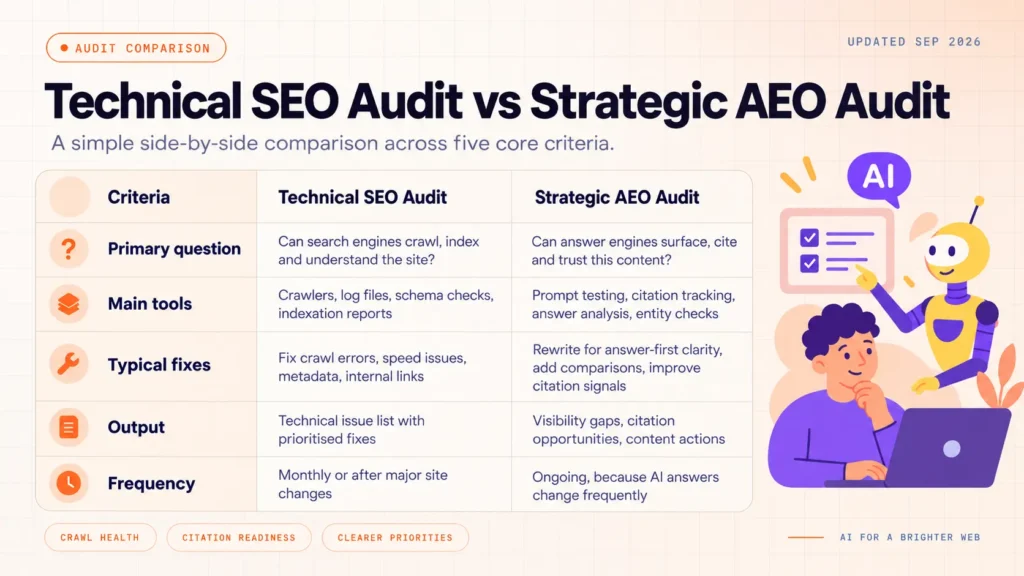
| Area | Technical SEO Audit | AEO Audit |
| Primary question | Is the page technically healthy? | Can AI engines find, understand and cite it? |
| Main tools | Crawler, page speed test, broken link checker | Prompt testing, schema validator, entity audit |
| Typical fixes | Metadata, redirects, speed, duplicate content | Structured data, answer-first copy, entity consistency |
| Output | Health score, issue list | Citation rate, brand accuracy, competitor visibility |
| Frequency | Ongoing, automated | Periodic, prompt-based |
Two Layers, Not a Choice
The technical audit and the AEO audit work together rather than in competition. A clean technical foundation is what lets AI systems retrieve your content at all.
The AEO layer is what determines whether they choose to use it. Running an automated crawl without ever checking AI citations leaves half the picture missing, and checking AI citations on a technically broken site wastes the exercise.
Strategic AEO auditing is an emerging specialism, and teams like Intelligent Resourcing focus on it full time, sitting above the technical layer rather than replacing it.
Common Mistakes That Undermine an AEO Audit
- Treating schema as one-time work. A service change or new location left unmarked keeps AI systems repeating outdated facts.
- Testing only one AI engine. ChatGPT, Perplexity and Google’s AI Overview pull from different sources and often answer the same prompt differently.
- Optimising for machines at the expense of readers. Answer-first structure should still read naturally to a person, not just parse cleanly for a bot.
How to Prioritise Fixes, and When to Bring in a Specialist
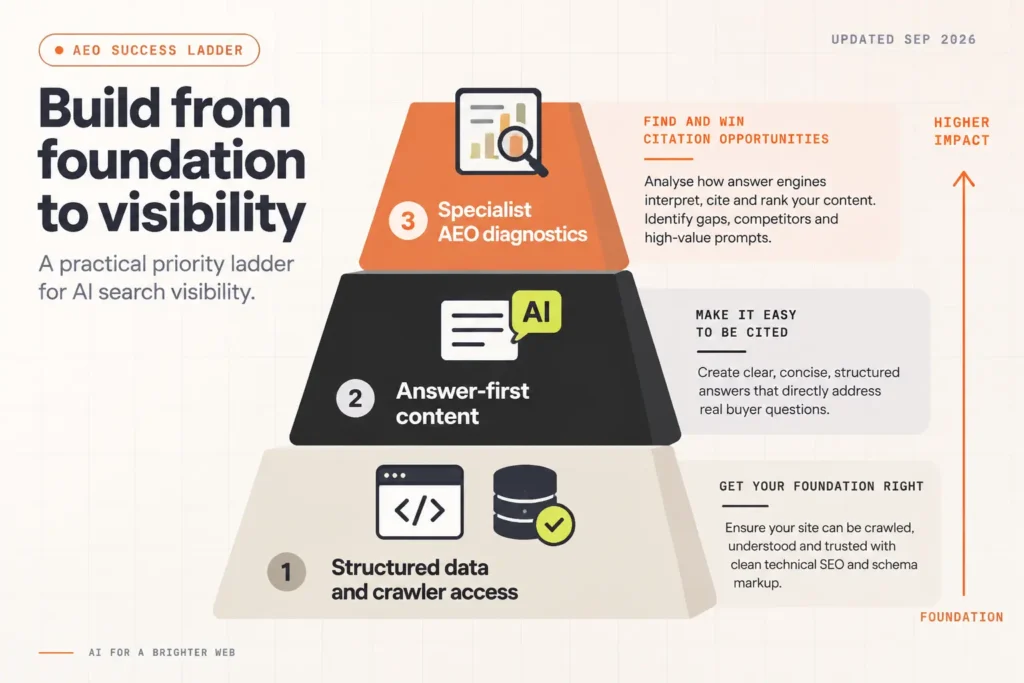
Start with structured data and crawler access, since both are pass or fail technical fixes with no judgement required. Move to answer-first content on your five highest-value pages next, since rewriting an entire site at once rarely happens.
Save entity consistency for an ongoing quarterly check rather than a one-off task. Budget half a day for the technical fixes, then treat AI engine testing as an ongoing five-minute monthly habit rather than a single event.
A DIY audit surfaces the obvious gaps. Diagnosing why AI engines choose a competitor over you, or why a citation exists but the description is wrong, needs prompt-level research most website owners do not have time to run repeatedly.
Once you have worked through the technical checks, the next layer is knowing whether AI engines actually cite you: you can get a free AEO audit from Intelligent Resourcing for a strategic read on your AI visibility.
FAQs on AEO Audits and AI Search Visibility
What is the difference between an SEO audit and an AEO audit?
An SEO audit checks technical health: metadata, links, speed and structure. An AEO audit checks whether AI engines can find, understand and cite your content when answering a buyer’s question, which is a separate and newer measure of visibility.
Do I need structured data if my site already ranks well in Google?
Ranking well in search does not guarantee visibility in AI-generated answers. Structured data gives AI systems a machine-readable summary of your business that a ranking alone does not provide, and it is one of the fastest fixes on this checklist.
How often should I test what AI engines say about my brand?
Monthly is a practical baseline for prompt testing, since AI-generated answers shift as models update and competitors change their own content. A quarterly deeper review catches slower-moving issues like entity drift.
Can I run this whole audit myself?
The checklist above covers what most website owners can complete without specialist tools. Diagnosing why specific citations are missing or inaccurate over time usually needs a repeatable, prompt-based process, which is where a specialist audit adds the most value.