Every few months, someone in the SEO world announces a “secret” that moves a page from position nine to position three. Lately, that secret is CTR manipulation: paying people to search for your keyword and click your result.
It sounds logical. If Google rewards pages that people click, then more clicks should mean better rankings. Vendors say real human clicks make it even safer than bots.
So does CTR manipulation work, or does it just create a short spike that fades? This guide looks at how it works, what experiments have found, what Google has and hasn’t said, and what you can do instead.
Before choosing a service, explore some of the best CTR bots for search SEO to understand the available tools, their features, and how different platforms approach CTR manipulation.
What Is CTR Manipulation in SEO?
CTR manipulation is the practice of artificially increasing the click-through rate of a search result to make it look more popular or relevant to a search engine. It can use paid human clickers, microtask workers, or automated bots that search for a keyword and click a specific listing.
That is the short version. To see why people try it, you first need to understand the metric itself.
1. Understanding Click-Through Rate (CTR)
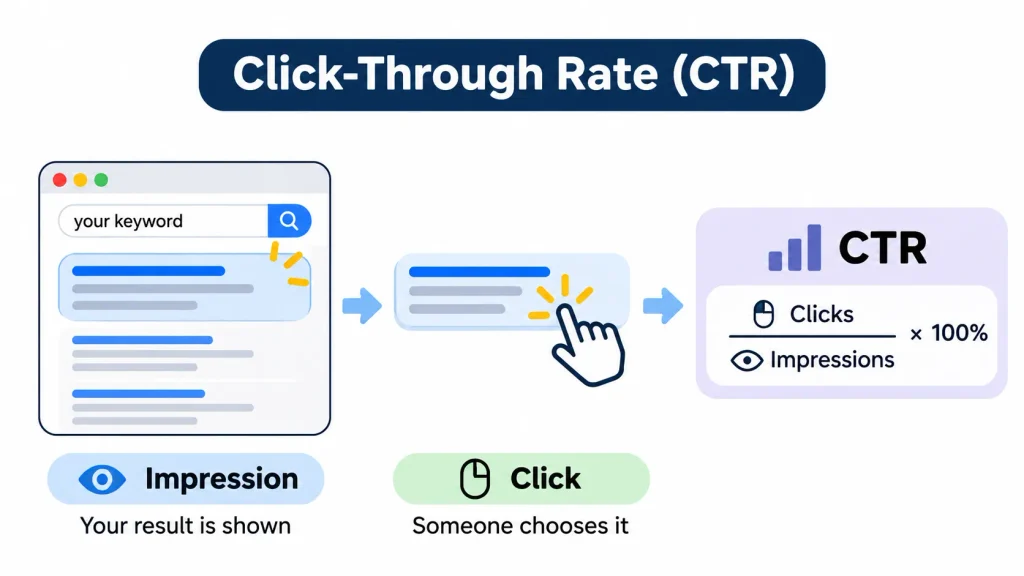
Click-through rate is the share of people who click your result after seeing it. CTR is one of several important SEO performance metrics that help website owners understand search visibility, traffic, and overall website performance. An “impression” means your listing appeared on a results page. A “click” means someone chose it.
Organic CTR refers to clicks on unpaid search results, not ads. Wikipedia’s overview of click-through rate notes that some SEOs have claimed since the mid-2010s that CTR affects organic rankings. That claim is the root of this whole debate.
2. How Is CTR Calculated?
The formula is simple:
CTR = (Total Clicks ÷ Total Impressions) × 100
Say your page appeared 2,000 times in search results last month and got 60 clicks. Your CTR is (60 ÷ 2,000) × 100 = 3%.
Google Search Console reports this number for you. It is a performance metric first. Whether it is also a ranking input is a separate question, which we cover below.
3. Why Do SEO Professionals Try CTR Manipulation?
Most people try it for one of four reasons:
- They are stuck on page two and want a quick push.
- They compete in a crowded local market, such as restaurants or plumbers.
- They believe engagement signals matter and want to “feed” them.
- They enjoy testing Google’s limits.
Some are curious testers. Others are under pressure from a client or boss who wants fast results. Both groups tend to ask the same question: will it stick?
How Does CTR Manipulation Work?
Here is the basic idea in plain English. A person (or program) searches a keyword, finds your listing, clicks it, and sometimes stays on the page for a while. Repeat that enough times, and the theory says Google will read your result as a popular answer.
Notice the word “theory.” Nothing in that chain is guaranteed.
1. How Real Human Clicks Are Used
Service providers use a few different models. I’m describing them so you can recognize them, not recommending them.
Human click services. A company recruits people to run searches and click specific results. Some let you set location, device, and a “search then click” pattern.
Microtask platforms. These are open marketplaces where workers complete small paid tasks. Searching a phrase and clicking a result can be one of those tasks.
Incentivized search interactions. Here, people receive rewards for taking actions, often without any real interest in the business. The click exists because someone was paid for it, not because they needed the answer.
That last point matters. A “real human” click is not the same as a real customer’s click.
2. How Automated CTR Manipulation Works
Bots follow a script. They load Google, enter a query, click a listing, and may scroll or wait to look human. Often they route traffic through many IP addresses.
Google’s own spam policy page lists automated access to Search without permission as a violation of its terms. So bot-based CTR tools carry a clear policy problem on top of the usual doubts about whether they work.
3. What Happens After a Result Gets More Clicks?
Your Search Console numbers will show more clicks and a higher CTR. Your analytics may show more sessions. You might even see a ranking change.
But a ranking change does not prove cause and effect. Rankings move for dozens of reasons, including competitors’ updates, new links, seasonality, and Google’s own changes. A rise during a paid click campaign can be coincidence.
Does CTR Manipulation Actually Improve Google Rankings?
This is the question that matters most, so let’s treat it carefully.
1. Is CTR a Google Ranking Factor?
The honest answer has two parts.
First, Google’s public documentation does not list organic CTR as a ranking factor. Its guide to ranking systems describes many automated systems, but it does not say that buying clicks will raise a page.
Second, Google has acknowledged in court that it uses click data. During the U.S. Department of Justice antitrust trial in 2023, Google engineers and executives described systems that learn from user interactions. Reporting on the testimony by Search Engine Land says a system called Navboost uses aggregated click data from roughly the past 13 months. A former Google engineer, Eric Lehman, also said that using clicks in ranking is widely understood inside the company.
So clicks are not irrelevant. But “Google uses click data” and “you can buy your way up with paid clicks” are very different claims.
Why the gap? Think about what a click means. It is only useful if it reflects a real person with real intent. Paid clicks are exactly the kind of noise a system built on millions of genuine searches would want to filter out.
2. How Google’s Ranking Systems Look at Search Results
Google does not use one algorithm. It uses many systems working together. Here are the pieces most often mentioned in CTR debates.
Search relevance. Google first tries to understand what a query means and which pages match it. Titles, content, links, and context all feed into this.
User interaction data. This is the category where clicks live. The data helps Google learn which results satisfy people over time.
Navboost. Based on trial testimony, this system uses historical click data to adjust results. In 2024, leaked internal API documentation gave SEOs more detail about click-related data fields. Treat leaked documents with caution, though. They show that data exists, not how heavily it is weighted or how fraud is filtered.
RankBrain. This is a machine learning system that helps Google interpret queries, especially unfamiliar ones. It is not a click-buying target. You can read the background on RankBrain on Wikipedia.
The key point: knowing these systems exist does not tell us that purchased clicks improve rankings. Anyone who says it does is guessing.
3. Can Real Human Clicks Influence Organic Rankings?
In theory, maybe in narrow cases. In practice, the evidence is thin and mixed.
Here are three experiments the SEO community often cites:
- Rand Fishkin’s 2014 test. He asked his audience to search for a phrase and click the result. The result moved up temporarily. Fishkin himself said the evidence was not enough to conclude Google ranks by click volume, and other experts argued it could reflect how Google surfaces trending topics. (Search Engine Journal)
- Bartosz Góralewicz’s 2015 test. He tried to isolate CTR from other human behavior. His rankings stayed flat for about two months and then dropped. He concluded CTR was not a direct factor. (Search Engine Land)
- A competing 2015 test. Cesarino Morellato and Andrea Scarpetta ran an experiment and argued CTR does act as a signal. (Search Engine Land)
These tests are small, old, and hard to control. They are interesting, but none is a clean answer.
4. Does CTR Manipulation Work Long Term?
The best-documented long-term test we have points one way: any gain is short-lived. We cover it in detail in the experiments section below.
There is also a logical problem. If a ranking depends on continuous paid clicks, you are renting your position. Stop paying and the support disappears. That is not an SEO strategy. It is an ongoing expense with no asset at the end.
Real Human Clicks vs. Bot Clicks: What’s the Difference?
Vendors love this comparison, because “real humans” sounds safer. Here is a fair side-by-side.
| Factor | Real Human Clicks | Bot Clicks |
| Source | People performing a paid task | Automated software |
| Behavior | Varies, but task-driven | Often follows scripted patterns |
| Typical cost | Usually higher | Usually lower |
| Real intent | Rarely a real customer | None |
| Conversion potential | Very low | None |
| Proven ranking benefit | No guarantee | No guarantee |
| Policy exposure | Still an attempt to manipulate results | Also may breach Google’s terms on automated access |
Notice the last two rows. Human clicks are not “clean” just because a human made them. The purpose is still to manipulate results.
1. Why Some SEOs Prefer Human Clicks
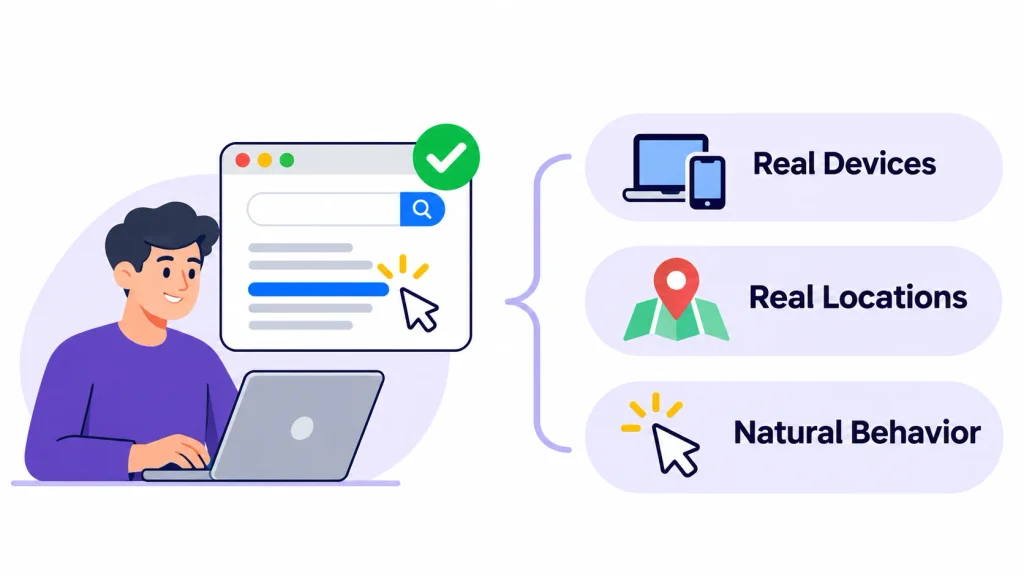
Humans are harder to spot than simple scripts. They use real devices, real locations, and unpredictable behavior. Providers argue this makes the signal look natural.
That is a fair technical point. But “harder to spot” is not the same as “rewarded.”
2. Can Google Identify Artificial Human Engagement?
Nobody outside Google knows exactly. Google says it fights spam with a mix of automated systems and human review, and it is open about not revealing every detail.
Think about the patterns a detection system could use. Many searches from accounts with no history. Clicks that never lead to purchases, calls, or return visits. Searches that follow a suspiciously regular schedule. A real customer base looks messier than a paid panel.
I can’t tell you Google catches every campaign. I can tell you the risk exists, and you would carry it.
3. Are Human Click Services Worth the Money?
Consider a hypothetical. A small business spends a few hundred dollars a month on clicks for one keyword. Rankings rise for three weeks, then slide back. The business now has a monthly bill, no lasting gain, and traffic that never converted.
That hypothetical is not a measured result. It simply shows the trap: the cost recurs, and the benefit may not.
CTR Manipulation Experiments: What Do the Results Show?
This is where independent evidence matters more than vendor claims.
1. Sterling Sky’s Restaurant Experiment
Sterling Sky is a local SEO agency run by Joy Hawkins. It tested CTR manipulation on a restaurant’s Google listing, using people to search for the restaurant and click its listing.
The listing climbed quickly, reaching position two. At first, it looked like a win.
Then the team kept tracking rankings daily for months. The gains faded over the following weeks and months. Sterling Sky’s conclusion was that CTR manipulation acts like a band-aid. It covers a symptom without fixing the underlying reason a business doesn’t rank well. You can read their full write-up on Sterling Sky.
2. Marketing House Media’s Six-Month Test
Marketing House Media published a six-month CTR experiment. As summarized in public coverage and in the research behind this guide, the agency reported early traffic gains and some local ranking movement, followed by decline and sustainability concerns. It then shifted its focus to conventional SEO.
I could not independently verify the underlying data for this one, so treat it as an agency’s own account rather than controlled research. You can see their write-up at Marketing House Media.
3. Community Experiences on Reddit and BlackHatWorld
Community threads give the practitioner a view. On r/localseo, people compare notes on CTR tactics for Google Business Profiles. On BlackHatWorld, members trade opinions about click consistency, branded searches, and cost.
What stands out is disagreement. Some report gains. Others report nothing. Many mention that results fade when spending stops.
That is useful for understanding sentiment. It is weak for proving anything, because nobody is controlling for other variables.
4. What These Experiments Teach Us
Four lessons come through clearly:
- Results vary. Different niches, markets, and keyword types behave differently.
- Control groups matter. Without them, you can’t separate click effects from everything else.
- Movement is not causation. A rise during a campaign proves little by itself.
- Time exposes the truth. The short window is where CTR manipulation looks best. Longer tracking is where it looks worst.
5. How to Design a Fair Test (Hypothetical Example)
Suppose you wanted to test this honestly. Here is a sound setup, labeled clearly as a hypothetical.
Pick 20 similar keywords. Randomly split them into two groups of 10. Apply the manipulation to one group only. Make no other SEO changes to either group. Track rankings daily for at least three months, including a long period after you stop.
Then compare both groups against seasonality, competitor activity, and algorithm updates. Almost nobody runs tests this carefully, which is why so many “case studies” prove very little.
CTR Manipulation for Google Business Profile and Local SEO
Local search is where CTR manipulation is discussed most often. It is also where the picture gets more complicated.
1. What Is Google Business Profile CTR Manipulation?
It means paying people to search for a local service, find a business in the map results, and interact with the listing. Interactions can include clicking the website button, requesting directions, or calling.
2. Organic vs. Local: Why They Differ
Google says local results are based mainly on relevance, distance, and prominence. Distance is a big deal. A searcher two miles away sees different results from one ten miles away.
That makes local manipulation harder to pull off. Paid clickers must be in the right place, on the right devices, searching the right way. And a boost in one neighborhood may disappear in the next.
3. Does CTR Manipulation Improve Google Maps Rankings?
Sterling Sky’s restaurant test is the best public data point, and it showed a temporary lift. I’m not aware of any independent, controlled evidence of lasting local ranking gains.
4. Real Customers vs. Paid Activity
Picture a dental clinic. A real patient searches “emergency dentist near me,” taps the listing, reads reviews, and calls. That action reflects real demand.
A paid clicker does the same steps without needing a dentist. The activity looks similar. The meaning is completely different, and the business still gets no new patient.
5. What Local Businesses Should Do Instead
These steps build real prominence and lead to real clicks:
- Keep your name, address, phone number, and hours accurate.
- Choose the most precise primary category.
- Ask real customers for reviews, and reply to them.
- Add genuine photos and list your services.
- Build local landing pages that match what people search.
- Earn mentions from local organizations and news sites.
Is CTR Manipulation Safe for SEO?
Short answer: it carries real risk, and the reward is uncertain.
1. Does It Violate Google’s Spam Policies?
Google defines spam as techniques meant to deceive users or manipulate its Search systems into ranking content highly. Its spam policies say sites that violate them may rank lower or disappear from results. They also say Google may act against any type of spam it detects, not just the examples listed.
One fair caveat: the policy page does not name “CTR manipulation” as a separate category. So I won’t claim it is a listed violation.
But the logic is plain. Paying people to click so your listing looks more relevant is an attempt to influence ranking systems rather than serve users. That puts it at odds with the spirit of the policy, and automated versions can also run into the terms on automated access.
2. Potential Risks
- Wasted budget. You pay for activities that may not move anything.
- Unreliable results. Gains can vanish or never arrive.
- Misleading analytics. Fake traffic clouds your data. You can’t tell real demand from purchased noise.
- Policy exposure. If Google treats it as manipulation, it could discount or demote results.
- Poor ROI. Paid clickers don’t buy, book, or call.
3. What Happens When You Stop?
In the best-documented public test, rankings drifted back down after the campaign. That is the pattern to expect if the ranking boost depended on the clicks rather than on real quality.
4. Why Fake Demand Doesn’t Replace Real Demand
Clicks are a symptom of interest. If you manufacture the symptom, you haven’t treated the cause. Your page still needs to answer the query, load fast, and earn trust. Otherwise the best you can hope for is a temporary bump.
How to Evaluate CTR Manipulation Services
I don’t recommend buying these services. But if you’re researching them, a clear checklist keeps you from being misled.
1. What Is SerpClix?
SerpClix is a well-known service that sells human-powered clicks. It markets the idea that real people, not bots, perform the searches and clicks, and it highlights geographic targeting. Its own articles, such as its CTR manipulation guide, are marketing content and should be read that way.
I haven’t verified any of its ranking claims, and I haven’t seen independent controlled research that confirms them.
2. Questions to Ask Any Provider
- Where does the traffic actually come from?
- Are the clickers paid or incentivized to click?
- How do you measure success, and is it independent of your own reports?
- Can you show verified ranking results from controlled tests?
- What happens to rankings after the campaign ends?
- Do you guarantee rankings? (If yes, walk away. Nobody can guarantee rankings.)
Also check pricing clarity, refund terms, cancellation rules, and reporting detail. Vague answers are a warning sign.
3. So, Are They Worth It?
Based on the evidence we have, I would say no for most businesses. The public data shows temporary gains at best, the policy risk is real, and the money is better spent on things that compound.
CTR Manipulation vs. Organic CTR Optimization
The goal of getting more clicks is fine. The method is what matters.
| Factor | CTR Manipulation | Organic CTR Optimization |
| Goal | Inflate click numbers | Attract more relevant searchers |
| Method | Paid or automated clicks | Better titles, snippets, and content |
| User intent | Often missing | Genuine |
| Traffic quality | Uncertain | Relevant |
| Long-term value | Fades when spending stops | Builds over time |
| What you measure | Click volume | CTR, engagement, and conversions |
| Recommendation | Avoid as a ranking shortcut | Recommended |
How to Improve CTR Without Manipulation
Write titles for people. Lead with the benefit or the answer. Match the words searchers use. Keep it concise so it doesn’t get cut off. Google may also rewrite titles, so make the page itself clear.
Improve meta descriptions. Google doesn’t always use them, but a good one can still win the click. Say what the reader will get, in plain words.
Match search intent. If people want a comparison, don’t serve a sales page. A click that bounces right back doesn’t help anyone.
Use structured data where it fits. Markup can make results eligible for richer displays, such as review stars or FAQ-style details, though Google decides what to show.
Strengthen the content. Answer the question directly near the top, then go deeper.
Target useful SERP features. Featured snippets, image results, and local packs can all capture attention.
Refresh old content. An outdated year or stale statistic in a title can quietly reduce clicks.
Here is a realistic scenario. A page ranks fifth for a product keyword and gets 4,000 impressions a month but only 80 clicks (2%). The title is generic: “Running Shoes | Brand Name.” You rewrite it to say what makes the page useful, such as who the shoes suit and what the page compares. If CTR rises to 3.5%, that is about 60 more genuine visitors a month. That is a modest example, but those visitors came because the result earned them.
How to Measure Organic CTR in Google Search Console
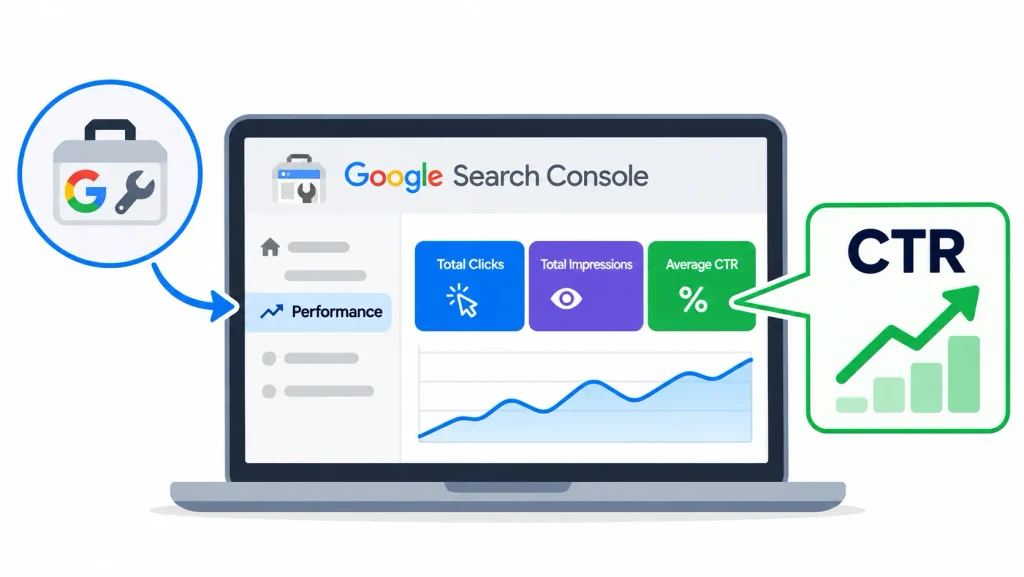
Google Search Console is free and shows your real CTR. Here is how to use it. Following a structured Google Search Console workflow also helps you monitor impressions, clicks, average positions, and changes in organic search performance.
- Open Search Console and choose Performance > Search results.
- Turn on Average CTR and Average position alongside clicks and impressions.
- Open the Queries tab to see CTR by search term.
- Sort by impressions, then look for queries with high impressions and low CTR. Those are your best opportunities.
- Switch to the Pages tab to spot underperforming URLs.
- Filter by a single query and compare CTR to your position. A page in position three with a CTR far below its peers may need a better title.
- After you update a title or description, use the date comparison feature to check results over several weeks.
- Pair CTR with conversions in Google Analytics 4, so you measure business results, not just clicks.
Keep one caution in mind: CTR changes with position, device, and SERP layout. Compare like with like.
Common Mistakes to Avoid
- Assuming every extra click helps rankings.
- Assuming paid human clicks are automatically “genuine.”
- Treating more traffic as proof of better rankings.
- Ignoring search intent.
- Judging success by clicks alone, without conversions.
- Trusting provider guarantees.
- Treating a short-term jump as a permanent gain.
Frequently Asked Questions About CTR Manipulation
What is CTR manipulation in SEO?
It is the practice of artificially boosting a result’s click-through rate, using paid people or software, to try to influence rankings.
Does CTR manipulation actually work?
It sometimes shows temporary ranking movement. The best-documented public test showed gains that faded. No independent, controlled research I know of proves lasting results.
Is CTR a direct Google ranking factor?
Google doesn’t list organic CTR as a ranking factor in its public documentation. Court testimony shows Google uses aggregated click data in some systems. That doesn’t mean purchased clicks work.
Are real human clicks better than bot clicks?
They may be harder to detect, but nothing proves they work better. They also don’t change the purpose, which is still to manipulate results.
Can Google detect artificial clicks?
Google says it uses automated systems and human review to fight spam. Exact detection methods aren’t public, so no one can promise a campaign is undetectable.
How long does CTR manipulation take to show results?
Reports vary. In Sterling Sky’s test, the lift appeared quickly and then faded. Treat any promised timeline with suspicion.
Does it work for Google Business Profile?
It has produced temporary movement in at least one documented test. Lasting local gains aren’t backed by independent controlled evidence.
Can CTR manipulation hurt my rankings?
It can. Google may treat attempts to manipulate Search as spam, and sites that violate its policies may rank lower or not appear at all. Outcomes depend on what Google detects.
Do rankings drop after you stop?
In the documented restaurant test, yes. Rankings declined over the following weeks and months.
How can I increase organic CTR without manipulation?
Improve your titles and descriptions, match search intent, add useful structured data, refresh old content, and measure the results in Search Console.
Final Verdict
Here is where the evidence points. CTR manipulation can produce a short-lived bump, and the best public experiment shows that bump fading within weeks and months. Real human clicks don’t change that. They are still paid activities, not real demand.
Google does use click data in its systems, so earning clicks matters. But the way to earn them is to deserve them. Better titles, clearer answers, stronger local profiles, and genuine reviews build gains that stay.
If you’re tempted by CTR manipulation, run the numbers first. Then put the same budget into measuring your real CTR in Search Console and fixing the pages where people see you but don’t click. That work costs less risk and pays off longer.