This CTR Booster review covers what the software does, what it really costs, and whether it can deliver rankings that last. I did not install or run the tool for this article. Everything here comes from the vendor’s own pages, earlier reviews, Google’s documentation and independent experiments, and I mark vendor claims as claims.
CTR Booster is Windows software, sold by TurboWare, that automates Google and YouTube searches and clicks to imitate real visitors. It aims to influence click and engagement signals. No independent evidence shows it creates lasting ranking gains, and Google’s spam policies prohibit automated queries.
CTR Booster is cheap to buy, but the purchase price is not the real cost. You also need proxies, and you take on policy risk that Google’s documentation spells out. If you want rankings that survive, spend the money on titles, content and brand instead.
Below, I walk through how it works, its pricing, the evidence on CTR manipulation, the risks, and the alternatives.
What Is a CTR Booster?
CTR Booster is desktop-based software designed to automate search activities and imitate the behavior of real search engine users. It searches for specific keywords on Google, locates a targeted website or listing in the search results, clicks on it, and stays on the page for a predefined period. The primary goal is to increase click-through rates (CTR) and create the appearance of higher user engagement.
1. Who Made CTR Booster?
Earlier reviews published by Craig Campbell and FatRank identify Abbas Ravji as the software’s owner.
The official sales page presents the product under the TurboWare name and promotes it as a CTR manipulation tool designed for Google Search, Google Maps, and YouTube. These platforms allow users to target different types of search engagement activities.
2. What Is It Designed to Do?
CTR Booster is marketed as a tool for generating additional clicks, increasing website visit duration, and simulating user engagement. Some earlier reviews also describe a feature known as the “pogo-sticking” routine. This involves visiting a competitor’s website briefly, returning to the search results, and then clicking the targeted listing.
The idea is to imitate how a person might compare multiple search results before choosing a website. However, these capabilities are based on vendor descriptions and third-party reviews, not independent testing.
3. Who Might Consider Using It?
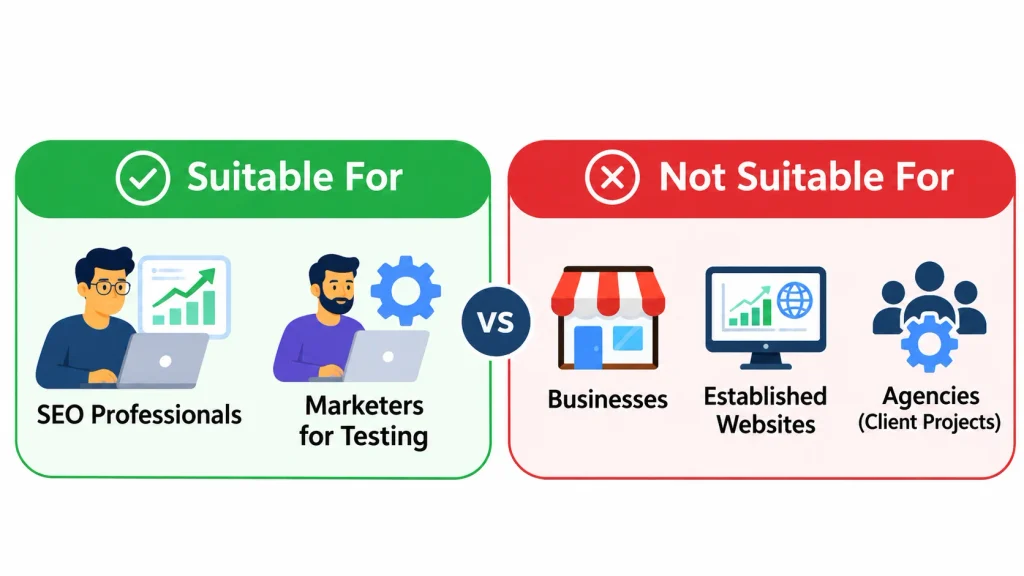
CTR Booster is primarily aimed at SEO professionals and marketers interested in experimenting with automated search engagement. However, it may not be suitable for businesses, established websites, or agencies managing client projects because artificial engagement introduces potential search policy risks.
Anyone considering the software should understand its limitations and the lack of independent evidence supporting long-term ranking improvements before making a purchase.
How Does CTR Booster Work?
Think of it as a robot that plays the part of a searcher. Based on the vendor page and earlier reviews, a typical run looks like this:
- You create a project with a keyword and a target, such as a web page, a Maps listing or a YouTube video.
- The software sends searches through proxy IP addresses, so the visits appear to come from different people and places. Reviewers say you need residential proxies, and a captcha-solving service too.
- It searches Google for your keyword, finds your result and clicks it.
- It stays on the page for a time you set, then repeats within your daily limits.
Why proxies matter. Without them, thousands of searches would come from one IP address, which looks exactly like it is. The proxy bill is the first cost most buyers do not budget for.
Google, Maps and YouTube. The same logic applies to all three. For Maps, the target is a business listing. For YouTube, the target is a video, and the session is meant to include watching. The vendor says it works on all three; I found no independent test that shows how well.
A note on Search Console. One review says the clicks appear in Google Search Console. Even if that is true, a click showing up in a report is not the same as real demand. Search Console only records what happened, not who or what caused it.
CTR Booster Review: Features and What the Software Offers
The table below lists the features that the vendor and earlier reviewers describe. I did not test any of them, so treat the right-hand column as “claimed,” not “confirmed.”
| Feature | What it does | Source of claim |
| Google search projects | Searches a keyword and clicks your result | Vendor page, reviews |
| YouTube projects | Searches and clicks for video targets | Vendor page, Craig Campbell |
| Google Maps targeting | Aims clicks at business listings | Vendor page |
| Session controls | Visit length, bounce behavior, competitor visits, search delay, and the pause between Google result pages | FatRank |
| Mobile and desktop profiles | Imitates both device types | Reviews |
| Daily limits and scheduling | Caps and spreads visits across the day | Reviews |
| Proxy support | Routes sessions through your own proxy provider | Vendor FAQ, reviews |
Two cautions apply. First, the best-known reviews are several years old, and software like this changes often. Second, a long feature list says nothing about whether the output looks human to Google. That is the question that decides everything, and nobody has shown an answer in public.
CTR Booster Pricing: How Much Does It Cost?
The vendor’s sales page lists CTRBooster Enterprise at $197 one time plus $15 a month, with a crossed-out “usual” price of $277 plus $37 a month (ctrbooster.com). The vendor’s signup form also shows a yearly option of $347 for the first year, then $150 a year (TurboWare signup). The copy of the sales page I could read may not be current, so confirm the numbers at checkout.
| Cost item | Amount | Notes |
| License (Enterprise) | $197 | Listed as a one-time payment |
| Monthly fee | $15 | Vendor says it funds developer updates |
| Yearly option | $347 first year, then $150 | From the signup form |
| Proxies | Varies by provider | Not included; the vendor says you need them |
| Captcha solving | Varies by provider | Mentioned by reviewers, not included |
| Refund | 30-day guarantee | Reported by a third-party roundup; check the terms |
Why you will see other prices. Older pages quote $97, including FatRank’s review, and some older blogs mention a $127 upgrade tier. Those look like earlier pricing, so do not rely on them.
Total cost of ownership. The license is only the start. Year one costs about $360 to $380 for the software, depending on how the first charge is billed, plus whatever proxies and captcha credits you buy. You decide the proxy spend, so the real total is higher than the sticker price.
Is it worth the price? The software is cheap. The question is whether the outcome is worth the policy risk, and the evidence section below suggests the gains do not last.
CTR Booster Pros and Cons
The pros are real but narrow. The cons go to the heart of the product.
| Pros | Cons |
| Low entry price compared with managed click services | Proxies and captcha solving cost extra, and the amount is up to you |
| One tool covers Google, Maps and YouTube projects | Windows software, so you need a Windows machine to run it |
| Detailed session controls such as visit length and delays | No independent proof that it produces lasting ranking gains |
| You run it yourself and keep control of the settings | Automated queries break Google’s spam policies |
| Monthly fee is said to fund updates | Needs setup time and regular maintenance |
Technical limits to know. Software that imitates people has to keep up with Google’s changes. A tool that went stale a year ago can do harm quietly, because you would not see it failing.
The SEO risk in one line. You pay for an effect that may fade when you stop, while the policy exposure stays.
Does CTR Booster Actually Work for SEO?
Short answer: it may move a ranking briefly, mostly for local listings, but no independent evidence shows CTR Booster delivering lasting gains.
CTR in plain English. Click-through rate is the share of people who click a result after seeing it. Wikipedia’s entry on click-through rate notes that SEO practitioners have claimed since the mid-2010s that it influences organic rankings. The formula is simple:
\text{CTR} = \frac{\text{clicks}}{\text{impressions}} \times 100
A page shown 1,000 times and clicked 50 times has a CTR of 5%.
CTR, dwell time and bounce rate. They measure different things. CTR is about the click. Dwell time is how long someone stays before going back to the results. Bounce rate is the share of visits that leave after one page. Tools like this one try to fake all three.
Does Google use CTR directly? Google has not said it uses CTR as a simple ranking lever. Perficient’s recap of a 2016 Q&A with a Google representative says Google uses click data in controlled tests of search quality. Understanding other important Google ranking factors can help website owners focus on content quality, technical SEO, backlinks, and user experience instead of relying on artificial clicks. That is a very different thing from rewarding any click it sees.
What the best experiment shows. Sterling Sky, a local SEO agency led by Joy Hawkins, tracked a restaurant listing after a test run with Rand Fishkin. The ranking jumped, then slid back to where it started over the following weeks and months. Sterling Sky concluded that the effect is not sustainable and can be risky.
Two limits matter here. It was one listing, and it did not use CTR Booster. Do not treat it as proof for every site or every tool.
What practitioners say. In a long Moz community thread, some SEOs say the effect shows up fast but fades if you cannot keep the clicks going. Others say Google spots the pattern. That matches the experiment above, and it is still opinion, not controlled data.
Is CTR Booster Safe to Use?
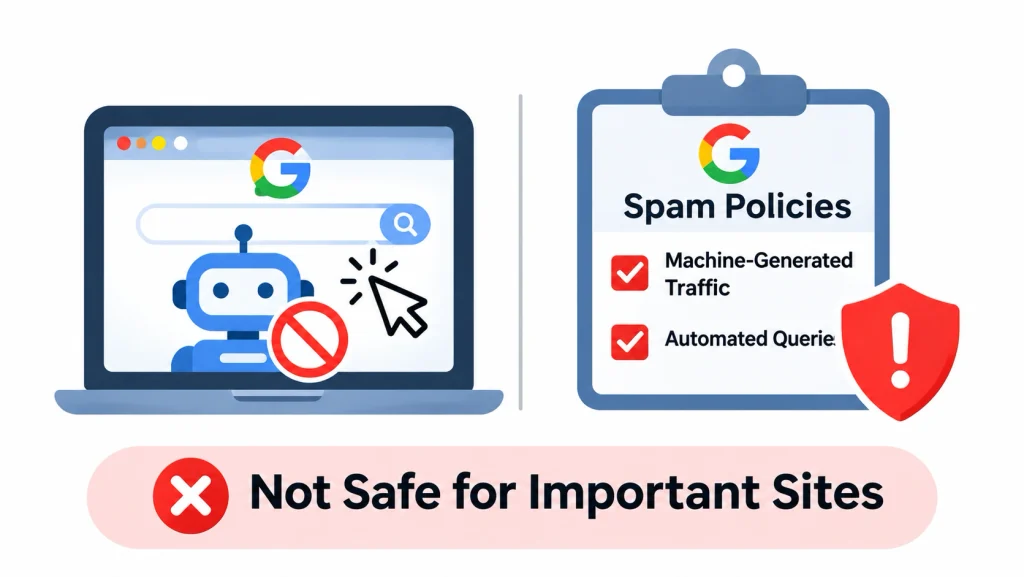
It is not safe for a site you care about. Google’s spam policies list “machine-generated traffic” as spam and cover sending automated queries to Google. They also say automated access to Search without permission violates the policies and Google’s Terms of Service.
What can happen? Google says that sites breaking its spam policies may rank lower or not appear in results at all. It detects violations through automated systems and, when needed, human review. The policy does not name CTR Booster, and I cannot tell you how often any given campaign is caught. What I can say is that the rule is clear and the enforcement tools exist.
Can Google detect artificial clicks? Nobody outside Google can say for certain. Patterns are the usual giveaway, such as many searches with identical timing or sessions that never behave like real visitors. The more you run, the more patterns you create.
Local businesses carry extra risk. A Google Business Profile is tied to a real business. A suspension can cost you calls and walk-ins, and that is a worse outcome than a ranking dip.
Other risks. You are running third-party automation and buying proxy access. Treat the software as untrusted, keep it away from machines holding client data, and check the vendor’s update history before you pay.
Before you use any CTR tool, ask yourself three things:
- Could I live with a drop in rankings or a profile suspension?
- Is this site mine alone, or do clients depend on it?
- Would I still use it if the gains faded in a month?
CTR Booster for Google Maps and Local SEO
Local listings are where the tool is most often pitched, and where the temporary effect shows up most in public experiments. The Sterling Sky test above was a local listing.
What Google says drives local rankings. Google’s Business Profile help page says local results rely mainly on three factors:
- Relevance: how well your profile matches the search.
- Distance: how far you are from the searcher.
- Prominence: how well known you are, including reviews, links and your web results position.
Notice what is missing. Clicks from automated sessions are not on the list. You also cannot buy your way around distance.
Safer ways to move up in the map pack. Verify the profile and keep the details current. Pick the most specific primary category. Add services and photos. Ask real customers for reviews and reply to them. Each of these feeds relevance or prominence, so the gain is real and it stays.
CTR Booster for YouTube
The vendor says the software works for YouTube as well as Google. I found no independent test of CTR Booster on YouTube, so I cannot say how well it works.
A click on a video is only the first step. What the platform ultimately wants is for viewers to find a video worth watching. A bot that clicks and sits there does not create that. It also does not create comments, shares, subscribers or repeat viewers.
If your goal is more views, put the effort into the parts viewers actually see: a clear title, a strong thumbnail, a promise that the first 30 seconds keep, and a topic people are searching for.
CTR Booster vs. Other CTR Manipulation Tools
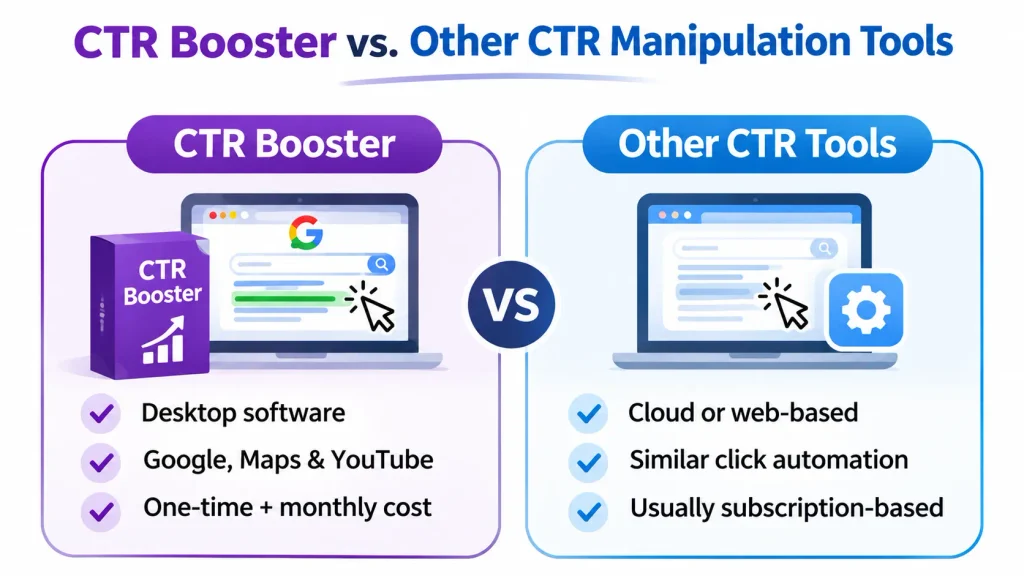
These tools do not all work the same way. Some use bots, and some use paid people. Sources also disagree about several of them, so I list what is reported and flag what I could not confirm.
If you want to explore more options, check out our guide to the best CTR manipulation tools, where we compare popular platforms, their traffic models, pricing, features, and potential SEO risks.
| Tool | Reported traffic model | Reported pricing | Main caveat |
| CTR Booster | Automated software with your proxies | $197 plus $15 a month (vendor) | No independent performance evidence |
| SerpClix | Network of real users (DEV Community review) | $197 to $2,497 a month (Ranktracker) | Still artificial engagement |
| SERP Empire | Bot-style visits | From $59 a month for 1,000 daily visits (third-party roundup) | Traffic quality unverified |
| ClickSEO | Sources disagree: human clickers in one, automated bot in another | About $30 to $50 a month (Ranktracker) | Unclear traffic model |
| SearchSEO | Described as residential proxies | Not confirmed | Limited public detail |
| Viper SEO Tools | Community-discussed | Not confirmed | I found no solid public data |
The real difference is cost and control, not risk. A human click network costs more per click and can look more natural, but it is still paid engagement, and Google’s rules do not carve out an exception. Third-party tool roundups also tend to push a favorite, so read them with that in mind.
What Do Users Say About CTR Booster?
Public feedback is thin, scattered and mostly promotional. Here is what I could find.
Positive. The vendor’s sales page carries testimonials, and Craig Campbell’s review calls it a tool that does what it promises. Both are friendly sources, and neither shows ranking data.
Common worries. The recurring concerns across reviews and forums are the extra proxy and captcha costs, the setup effort, and whether results last. The Moz community discussion on CTR services shows the same split: quick but short-lived gains on one side, and Google catching the pattern on the other.
How reliable are these reviews? Treat them with care. Many CTR tool reviews come from sites that promote CTR tools, and some come from rival tool makers. I did not cite BlackHatWorld because I could not open its threads for this article. A screenshot of a rank jump is also not a controlled test, because rankings move for many reasons.
CTR Booster Installation and System Requirements
The vendor and earlier reviews present it as Windows software that you download and run yourself. I did not install it, so I cannot describe the dashboard or the setup experience first-hand.
Here is what to check before you pay:
- Operating system: confirm Windows support for your version before buying.
- Updates: the vendor says the monthly fee pays for developer updates, so ask when the last release shipped.
- Support: find out how to reach it, and whether the 30-day refund window covers a failed setup.
- Proxies and captcha: price these before you commit, because they are not in the license.
If the vendor cannot answer the update question clearly, that is your answer.
How to Improve Organic CTR Without CTR Manipulation
A higher click rate from real searchers helps in a way fake clicks cannot: those clicks bring real visitors. Start with the pages that already show up in search.
- Find the gap. In Google Search Console’s Performance report, sort queries by impressions and look for pages with a high position but a low CTR.
- Rewrite the title tag. Lead with what the searcher wants, keep it clear, and match the words they use. Google may rewrite titles, so test and watch.
- Tighten the meta description. Treat it as a short pitch. Say what the page delivers.
- Match search intent. If people want a price or a comparison, the page should open with it.
- Earn rich results. Add structured data where it fits, such as reviews, FAQs or product details.
- Build brand recognition. People click names they know, and no tool can fake that at scale.
- Measure properly. Change one thing, wait a few weeks, and compare the same period before and after.
Along with improving organic CTR, following practical SEO strategies can help you improve Google rankings through regular website audits, content optimization, internal linking, and technical improvements.
A quick scenario. Say a local bakery ranks fourth for “birthday cakes near me” but gets a few clicks. Rewriting the title to mention same-day pickup and adding fresh photos can lift clicks without any fake traffic. The ranking may stay put, but the visits go up, and visits are what pay the bills.
For background reading, see Wikipedia on search engine optimization.
Final Verdict: Is CTR Booster Worth Buying?
For most people, no. This CTR Booster review finds a low-priced, automated tool with a long list of claimed features, no independent proof of lasting results, and a direct conflict with Google’s spam policies.
| Assessment | |
| Price | $197 plus $15 a month listed, plus proxies and captcha costs |
| Evidence | None independent for CTR Booster; the best public experiment shows a temporary lift that faded |
| Risk | Automated queries violate Google’s spam policies |
| Requirements | Windows machine, proxies, setup time |
Who might find it useful: an experienced SEO who tests on disposable sites, understands the policy risk and treats any gain as temporary.
Who should avoid it: brands, agencies running client sites, and local businesses with a real Business Profile.
If the aim is rankings that last, the better spend is on titles, content, reviews and brand. Those gains stay when you stop paying.
Frequently Asked Questions About CTR Booster
What is a CTR Booster?
Windows software that automates Google and YouTube searches and clicks to imitate real visitors and influence click and engagement signals.
Does CTR Booster really work?
It might move a ranking briefly, mostly for local listings. No independent evidence shows lasting gains, and the best public experiment saw the effect fade.
How much does CTR Booster cost?
The vendor lists $197 one time plus $15 a month, or a yearly option of $347 for year one. Proxies and captcha solving cost extra.
Is CTR Booster safe for SEO?
Not for a site you depend on. Google’s spam policies prohibit automated queries, and sites that break them may rank lower or disappear from results.
Does CTR Booster work with Google Maps?
The vendor says yes. Google’s local ranking relies on relevance, distance and prominence, and the tool does not change distance.
Can CTR Booster improve YouTube rankings?
The vendor claims so. I found no independent test, and a bot click does not create real viewer interest.
Does CTR Booster require residential proxies?
Reviewers say you need proxies that work with Google, and the vendor’s FAQ says proxies are required.
Is CTR Booster better than SERP Empire?
I cannot say. I found no head-to-head test, and the two differ in pricing and traffic setup.
Does CTR Booster offer a money-back guarantee?
A third-party roundup reports a 30-day guarantee. Check the terms at checkout.
What are the best CTR Booster alternatives?
Other CTR tools carry the same policy risk. The safer alternative is improving organic CTR with better titles, descriptions and search intent matching.
Final verdict
CTR Booster offers several automation features, including Google search engagement, Google Maps targeting, and YouTube functionality. However, its ability to deliver consistent, long-term SEO improvements remains unproven. Additionally, the software involves ongoing subscription fees, extra proxy costs, and potential risks associated with Google’s policies on automated search activity.
For businesses, established websites, and SEO agencies, these risks may outweigh the potential benefits. Instead, investing in better title tags, compelling meta descriptions, high-quality content, and search intent optimization is a safer and more sustainable way to improve organic CTR, attract genuine visitors, and achieve long-term SEO growth.