An SEO company in India is an agency, based in India, that helps websites earn more visits from search engines like Google. Most work with clients at home and abroad. The good ones tie their work to leads and revenue, not just rankings.
Picking one is harder than it looks. Directories list dozens of agencies, every agency site says it’s the best, and the pitches sound alike. This guide gives you a way to sort through them: what agencies do, how pricing works, how to check claims, and which warning signs to walk away from.
Here’s the new section. I built it from Clutch’s India SEO listings (ratings updated September 27, 2026), plus a few details from agency and directory snippets. It replaces the “Two agencies to start your research” subsection and slots in right after the comparison scorecard.
Top SEO companies in India
This shortlist is a starting point. It isn’t a ranking. I picked agencies that are SEO-led, based in India, and have a meaningful number of verified client reviews on Clutch. Two cautions apply. Clutch marks some placements as featured and may earn fees from them, so a top slot doesn’t prove quality. And reviews say a lot about communication and delivery, but less about whether SEO actually lifted revenue.
1. WebSpero Solutions
WebSpero is based in Mohali and has the most Clutch reviews of the group. Clutch lists SEO as just over half of its work, with web development, PPC and AI development making up the rest. Reviewers come from 16 industries, including retail, healthcare, real estate and education, which is broad for an agency this size.
It looks like a fit for mid-sized businesses that want SEO plus development under one roof. Ask whether the SEO team is separate from the development team, and who will run your account day to day.
2. PageTraffic
PageTraffic is a New Delhi agency with a long track record. A LinkedIn roundup describes it as having more than two decades of experience, though that’s a third-party claim to confirm. On Clutch, most of its listed projects come from the United States, with smaller numbers from India, England, Canada and Australia.
Its Clutch package listing shows entry-level plans and describes them as proven to rank page #1. Treat that wording with care, and ask the sales team to explain what “ranking” means in practice, because nobody can promise a top position.
3. EvenDigit

EvenDigit is an Indore agency with 106 Clutch reviews. SEO is only about a fifth of its listed services, with PPC, ecommerce marketing and social media making up most of the rest. It suits businesses that want search and paid ads managed together.
One Clutch review summary mentions a client dispute over low-quality backlinks. It’s a single data point, but it’s a reason to ask how the agency vets link sources.
4. SEO Tech Experts

Based in Gurugram, this agency has 53 Clutch reviews, and the reviews that mention SEO are all five stars. Its Clutch profile says clients value how it connects SEO work to growth metrics. Its hourly rate band is higher than most agencies here, at 50–99 per hour.
That pricing may suit businesses that want closer strategic input rather than the cheapest package. Ask for a sample report to see how it ties SEO to leads.
5. e intelligence
Vadodara-based e intelligence is a smaller team with half its work in SEO and the rest in PPC and development. Its Clutch projects lean toward India and the US, and reviews highlight clear communication. One project summary mentions keyword expansion, backlink work and blog setup for a vacation rental company.
It looks suited to small businesses that want hands-on service from a compact team. Confirm how much capacity it has if your site is large.
6. eSearch Logix
eSearch Logix, in Noida, is the most SEO-focused agency in this group, with SEO listed as all of its work. All nine of its SEO-tagged reviews are five stars. Its listed entry packages are among the lowest priced in this list.
Like PageTraffic, its package text talks about assuring top Google results. Ask it to define that in writing before you sign.
7. Growth Accelerators
This Gurugram agency is a smaller team and lists SEO as about 70% of its work. Its package descriptions cover local SEO, international SEO, GEO, link building, technical SEO and on-page SEO, and pricing is tiered by site size, from small sites under 15 pages to multi-location businesses.
The size-based tiers make it easy to compare quotes. Ask for examples from healthcare or ecommerce if you work in those areas, since those appear in its Clutch project highlights.
8. Seotonic Web Solutions
Seotonic, from Bhopal, says it has worked since 2005 and optimized more than 3,000 websites worldwide. That figure comes from its Semrush directory listing, so treat it as a claim. On Clutch, 90% of its work is SEO, and clients mention prompt communication and good value.
It appears aimed at small and mid-sized businesses on limited budgets. With only 17 reviews, ask for extra references.
9. AM Web Insights
AM Web Insights is another Mohali agency, with 80% of its work in SEO and the rest in public relations. Recent Clutch reviews praise weekly progress updates and on-time delivery, and its project mix includes real estate, ecommerce and logistics.
It’s a candidate if you want regular contact and a smaller agency. Its review count is low, so verify with a call to a past client.
Quick comparison
| Agency | Base | Team size* | Share of work that is SEO* | Clutch rating (reviews)* |
| WebSpero Solutions | Mohali | 50–249 | 55% | 5.0 (122) |
| PageTraffic | New Delhi | 50–249 | 40% | 4.9 (116) |
| EvenDigit | Indore | 50–249 | 20% | 4.9 (106) |
| SEO Tech Experts | Gurugram | 50–249 | 35% | 5.0 (53) |
| e intelligence | Vadodara | 10–49 | 50% | 4.9 (31) |
| eSearch Logix | Noida | 50–249 | 100% | 5.0 (25) |
| Growth Accelerators | Gurugram | 10–49 | 70% | 4.9 (18) |
| Seotonic Web Solutions | Bhopal | 10–49 | 90% | 4.9 (17) |
| AM Web Insights | Mohali | 10–49 | 80% | 5.0 (12) |
*Self-reported or Clutch-calculated figures as of late September 2026. Ratings and counts change often.
SEO companies in India at a glance
The market is crowded. Semrush’s agency directory alone lists 57 SEO agencies in India, and you can filter it by service, industry and budget. Other sources, like Clutch and GoodFirms, add reviews from clients.
Directories are good for discovery. They can’t tell you which agency fits your business. That part is on you, and the rest of this guide helps with it.
1. How to compare agencies side by side
Build a simple scorecard before you talk to anyone. Use the same columns for every agency, so you compare like with like.
| Factor | What to record |
| Location and team size | City, headcount, who does the work |
| SEO focus | Technical, content, local, ecommerce, enterprise, international |
| Industries served | Any experience in your sector |
| Case studies | Real clients, timeframes, business results |
| Pricing model | Retainer, project, hourly |
| Reporting | Sample report, tools used |
| Contract terms | Minimum term, exit clause |
| Reviews | Third-party sources, not their own site |
Most agencies will fill in some rows and dodge others. The gaps tell you something.
2. How this guide approaches agency selection
I don’t rank agencies as “the best.” Nobody can honestly do that without knowing your budget, market and goals. Instead, this guide sets out criteria you can apply yourself.
Agency details in this article come from the agencies’ own public websites. Treat those as claims to verify, not proof. Pricing changes often, so confirm every figure directly with the agency.
3. Two agencies to start your research
These two came up in current search results. Both describe themselves on their own sites, so check the details yourself.
- SEO Discovery says it has more than 22 years in business. Its site lists technical audits, local, global and enterprise SEO, ecommerce SEO, link building, digital PR and AI search services.
- Ranking By SEO lists on-page, off-page, technical, ecommerce, local, international and white-label SEO on its site, plus AI search visibility work.
Neither listing tells you whether the agency suits your business. Ask each for case studies in your industry before you shortlist.
What services does an SEO company in India provide?
A full-service SEO company usually covers these areas:
- Technical SEO
- Keyword research
- On-page SEO
- Content strategy
- Link building and digital PR
- Local SEO
- Ecommerce SEO
- International SEO
- Analytics and reporting
- AI search optimization
Not every agency does all ten well. Here’s what each one means in plain terms.
1. Technical SEO
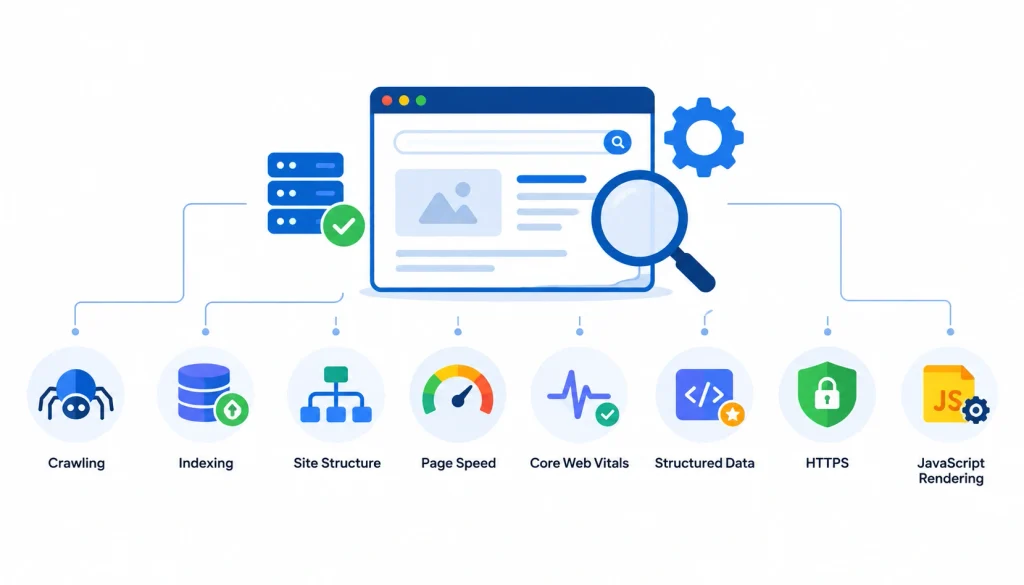
This is the plumbing. Can Google find your pages, read them and store them? Technical SEO covers crawling, indexing, site structure, page speed, Core Web Vitals, structured data, HTTPS and JavaScript rendering. For ongoing site checks, an on-page SEO checker can help identify technical and on-page issues that need attention.
It also covers site migrations, where a redesign can wipe out years of traffic if it’s handled badly. If you’re planning a relaunch, ask about migration experience first.
2. On-page SEO
On-page work is what you do to individual pages. It includes matching pages to what people are searching for, writing clear title tags and meta descriptions, using headings properly, and linking pages together sensibly.
Search intent matters most here. Someone searching “buy running shoes” wants a product page. Someone searching “how to choose running shoes” wants a guide. A page that mixes them up won’t rank well for either.
3. Content strategy
Good content answers real questions better than what’s already ranking. An agency should research topics, group them into clusters, plan an editorial calendar and refresh old pages that have slipped.
Be careful with agencies that promise a fixed number of blog posts each month and nothing else. Volume isn’t a strategy.
4. Off-page SEO and link building
Search engines treat links from other sites as a signal of trust. Building them takes real effort: outreach, digital PR, useful resources that people want to cite. A structured link building workflow can help organize prospecting, outreach, acquisition and performance tracking.
Bad link building can hurt you. Google’s spam policies cover paid links and link schemes, so ask any agency exactly how it earns links.
5. Local SEO
Local SEO helps a business show up when people search nearby. It centers on your Google Business Profile, consistent listings across directories, reviews and location-specific pages.
A dental clinic in Anantnag has different needs from a national online store. Local SEO suits the clinic. The store needs something broader.
6. Ecommerce SEO
Online stores have their own problems. Thousands of product pages, filtered navigation that creates duplicate URLs, out-of-stock items and thin category pages all need handling. Product schema markup can also help your listings appear with richer details in search.
7. Enterprise SEO
Big sites need process as much as skill. Enterprise SEO deals with templates, governance across many teams, and technical work at scale. If your site has hundreds of thousands of pages, ask how the agency handles that.
8. International SEO
Many Indian agencies serve clients in the US, UK, Middle East and Australia. International SEO adds country and language targeting, hreflang tags and content that reflects regional search behavior.
Ask whether the team has worked in your target market. Search habits in Dubai differ from those in Toronto.
9. AI SEO, AEO and GEO
AI search is now part of the conversation. Google’s AI features documentation explains how AI Overviews and AI Mode work with your content.
Here’s how the terms line up:
- AEO (answer engine optimization) means structuring content so search and AI tools can pull direct answers from it.
- GEO (generative engine optimization) means improving your visibility inside AI-generated answers, such as those from ChatGPT, Gemini or Perplexity.
Both build on ordinary SEO. Clear content, a healthy site and real authority still do most of the work. Be skeptical of any agency that sells AEO or GEO as a separate secret method. Google’s own guidance says the same fundamentals apply to AI features.
How much does an SEO company in India cost?
There’s no single price. Anyone who quotes one without looking at your site is guessing. Costs depend on what you need, how competitive your market is and how much work your site requires.
What affects SEO pricing
- Website size and number of pages
- Competition in your industry
- Target geography (city, country or global)
- Content volume and quality
- Technical problems that need fixing
- How much link building is involved
- Local versus international scope
- Enterprise needs like multiple teams or languages
A ten-page service site in a quiet local market needs far less than a 50,000-product store competing with major brands.
Common pricing models
Monthly retainer. You pay a fixed fee for an agreed scope. This is the most common model for ongoing SEO.
Project-based. You pay once for a defined job, like a technical audit or a migration.
Hourly consulting. You pay for expert time. It works well for advice, training or reviewing an existing agency’s work.
Performance-related. Part of the fee depends on results. Read these contracts carefully. Ask how “results” are defined and who controls the measurement.
Enterprise contracts. These are custom, with larger teams and longer terms.
What should an SEO package include?
Scope usually grows with the price. This table shows a typical pattern, not a fixed standard.
| Deliverable | Basic | Growth | Enterprise |
| Technical audit | ✓ | ✓ | ✓ |
| Keyword research | ✓ | ✓ | ✓ |
| Content strategy | ✓ | ✓ | ✓ |
| Link acquisition | Limited | ✓ | ✓ |
| Reporting | ✓ | ✓ | ✓ |
| Strategic consulting | Limited | ✓ | ✓ |
If a quote looks cheap, compare the deliverables line by line before celebrating. A low price with vague scope often means little real work.
How to choose an SEO company in India
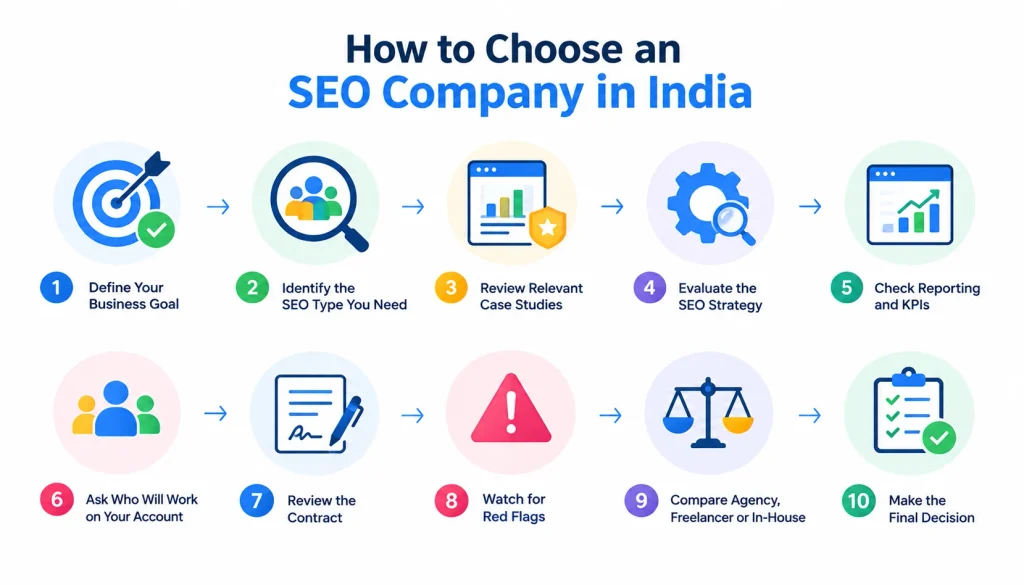
Follow these steps in order. Skipping the first two is the most common mistake.
- Define your goal. Pick one main outcome: more leads, more online sales, more calls to a local shop, or more brand visibility. “More traffic” alone is too vague.
- Identify the type of SEO you need. Local, ecommerce, B2B, SaaS, enterprise and international work call for different skills.
- Review case studies. Ask for examples from businesses like yours. Ask what changed, how long it took and which metrics moved.
- Evaluate the strategy. A serious proposal covers technical fixes, content, internal linking, authority building and measurement. If it only talks about keywords and backlinks, it’s thin.
- Check reporting and KPIs. Agree on what gets measured before you sign.
- Ask who does the work. Some agencies sell you a senior strategist and hand your account to a junior team or a subcontractor. Ask for names and roles. You can check team members’ backgrounds on LinkedIn.
- Read the contract. Look at the minimum term, cancellation terms, deliverables, who owns the content and accounts, and how you’ll communicate.
An example of why step 1 matters
Picture a Bengaluru software company that hires an agency and asks for “more traffic.” Six months later, traffic is up 60%. But most of it comes from students reading a how-to article, and demo requests haven’t moved.
The agency did what was asked. The goal was wrong. If the company had asked for demo requests from qualified visitors, the agency would have targeted different pages and different keywords.
Red flags when hiring an SEO company
Watch for these during sales calls:
- Guaranteed #1 rankings. Google’s own guidance on hiring an SEO warns that no one can guarantee a top position. Rankings depend on factors nobody outside Google controls.
- Unusually cheap packages. SEO takes skilled hours. A price far below others usually means shortcuts.
- Vague link-building methods. If they won’t explain where links come from, assume the worst.
- No relevant case studies. Confidentiality is a fair reason for missing names. A complete absence of evidence is not.
- Vanity metrics. Reports full of impressions and keyword positions, with no leads or revenue, hide whether anything worked.
- Opaque reporting. You should be able to see your own data in Google Search Console and Google Analytics 4.
- Long contracts with unclear deliverables. A 12-month lock-in with no defined outputs favors the agency.
- Promises of instant results. Google’s own guidance says SEO changes can take months to show up.
SEO agency vs freelancer vs in-house team
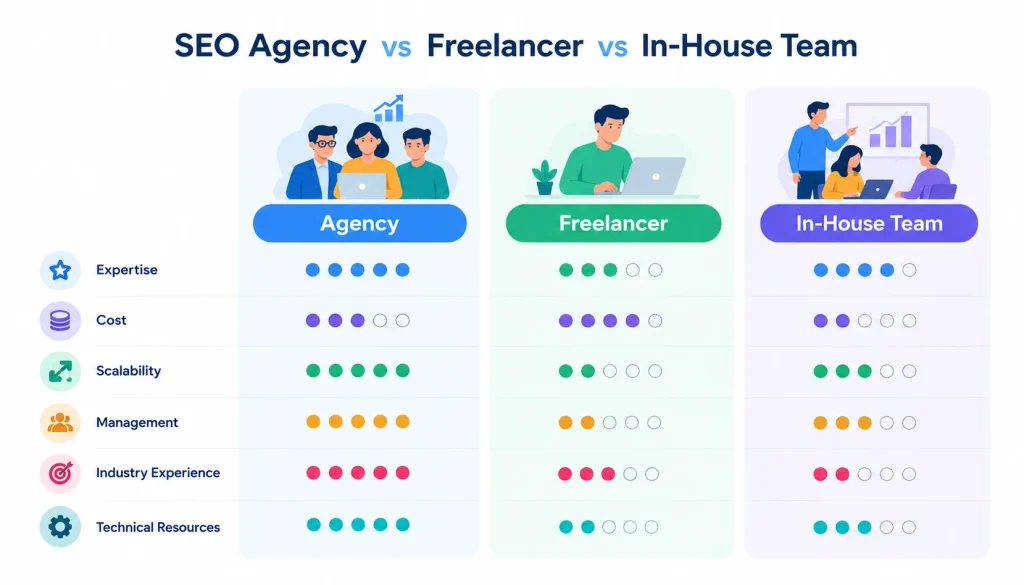
Each option has trade-offs. This table shows the general pattern.
| Factor | Agency | Freelancer | In-house |
| Breadth of skills | Wide (team of specialists) | Narrow to moderate | Depends on hires |
| Cost structure | Monthly fee | Usually lower, flexible | Salaries and tools |
| Scalability | Easy to add capacity | Limited by one person | Slow, needs hiring |
| Management | Account manager handles it | You manage directly | You manage the team |
| Industry knowledge | Varies | Varies | Deep, once trained |
| Technical resources | Shared tools and developers | Often limited | Your own dev team |
A small business with one site often does well with a good freelancer or small agency. A large business with many products usually needs a team, either hired or contracted.
How an SEO company should report results
Reports should answer one question: is SEO helping the business?
Monthly KPIs worth tracking
- Organic clicks and impressions (from Google Search Console)
- Organic conversions and leads (from Google Analytics 4)
- Revenue from organic traffic, for ecommerce
- Keyword rankings, as a supporting metric
- Indexed pages and technical health
- New and lost backlinks
- Performance of individual content pieces
Why rankings alone don’t tell the story
A page can rank third for a keyword and bring no customers. Another page can rank eighth for a phrase that brings buyers every week.
The chain that matters runs like this: rankings lead to clicks, clicks lead to qualified visitors, qualified visitors lead to leads or sales, and those lead to revenue. Ask your agency to show where each link in that chain stands.
What to expect in the first 90 days of SEO
Timelines vary with competition, site condition, resources and search demand. Google says that SEO changes often take months to show their effect, so a three-month window is early. Still, a decent agency should show visible progress on the work itself.
Days 1–30: research and audit. The agency gets access to your analytics and Search Console, audits the site, researches keywords and competitors, and agrees on priorities with you.
Days 31–60: implementation. Technical fixes go live. Existing pages get improved. New content gets planned and started. Tracking gets checked to make sure conversions are recorded correctly.
Days 61–90: measurement and refinement. The agency reviews early data, adjusts the plan and begins outreach or content promotion. You should see clear progress on tasks, even if traffic gains are modest.
If you reach day 90 with no audit, no roadmap and no clear report, raise it directly.
Questions to ask an SEO company before you sign
Use this list on your shortlist calls:
- Can you show case studies from businesses like mine?
- What changed on those sites, and over what period?
- Who will work on my account, and are they employees or contractors?
- Will I have direct access to my Google Search Console and Analytics?
- How do you build links, and can you give examples?
- What does your first 90-day plan look like for my site?
- How will we measure success?
- What does a sample monthly report look like?
- How often will we meet?
- What’s included in the fee, and what costs extra?
- What’s the minimum contract term?
- How do I cancel, and what happens to the work if I do?
- Who owns the content and the accounts you set up?
- How do you handle site migrations or redesigns?
- Do you use AI tools to create content, and how is it reviewed?
- What would make you say SEO isn’t right for my business?
The last question is a good test. An honest agency will have an answer.
SEO tools a professional agency may use
Tools help, but they don’t replace judgment. Any agency can buy a subscription.
- Google Search Console shows how your site performs in Google Search. It’s free, and you should own the account.
- Google Analytics 4 tracks what visitors do on your site, including conversions.
- Semrush and Ahrefs support keyword research, competitor analysis and backlink review. For larger outreach campaigns, link building software solutions can help manage prospects, outreach and campaign tracking at scale.
- Screaming Frog crawls your site to find broken links, redirect problems and missing tags.
- PageSpeed Insights tests page speed and Core Web Vitals.
- Google Business Profile manages how your business appears in local search and on maps.
Ask how the agency uses these tools to make decisions, not just which ones it has.
Frequently asked questions about SEO companies in India
What is an SEO company in India?
It’s an agency based in India that helps websites rank better in search engines. Services usually include technical fixes, content, link building and reporting. Many serve international clients as well as Indian businesses.
How much does an SEO company charge in India?
Prices vary by scope, competition, business size and agency model. Get quotes based on a real review of your site, and compare deliverables, not just totals.
Which SEO company is best for small businesses?
It depends on your goal and location. Look for agencies with case studies from small businesses, flexible contracts and clear reporting. Local shops often need local SEO specialists.
How do I choose an SEO company in India?
Define your goal, shortlist agencies with relevant experience, check case studies, review their strategy and reporting, and read the contract carefully before signing.
What services do SEO companies provide?
Common services include technical SEO, keyword research, on-page optimization, content strategy, link building, local SEO, ecommerce SEO, international SEO and reporting.
Final checklist before hiring an SEO company in India
- ☐ Clear business objectives
- ☐ Relevant case studies reviewed
- ☐ Transparent pricing
- ☐ Defined deliverables in writing
- ☐ Named account team
- ☐ Clear reporting format agreed
- ☐ A strategy that fits your site and market
- ☐ Ethical link-building practices explained
- ☐ No ranking guarantees
- ☐ Contract read and understood
- ☐ KPIs agreed on both sides
Conclusion
Choosing an SEO company in India comes down to fit and evidence. Start with your own goal, shortlist agencies with relevant experience, and ask for proof. Then check how they build links, who does the work and how they report.
The best agency for a Delhi ecommerce brand may be wrong for a Srinagar clinic. Use the scorecard, ask the hard questions and start with clear KPIs. If you want a sanity check on your shortlist, communities like r/SEO and r/bigseo are useful places to ask. For background on how search optimization works overall, the Wikipedia article on SEO is a neutral starting point.