
An international SEO audit fails in a predictable way. The crawler reports a healthy site, the local team reports flat traffic, and both are right. The crawler tested the site against English rules. The market runs on different ones.
Most audit tools, rank trackers and keyword databases were built around three assumptions: Latin script, Google as the only search engine, and hosting that answers every request the same way no matter where it comes from. Those assumptions hold in the US and the UK. They break, one at a time or all together, in Japan, Germany, Brazil, Turkey, Vietnam and Korea.
The seven checks below cover the gaps we find most often when a site has passed a standard crawl and still does not rank in its home market. Each one takes minutes to run and none of them show up in a default report.
1. Measure title and description length by pixel width, not characters
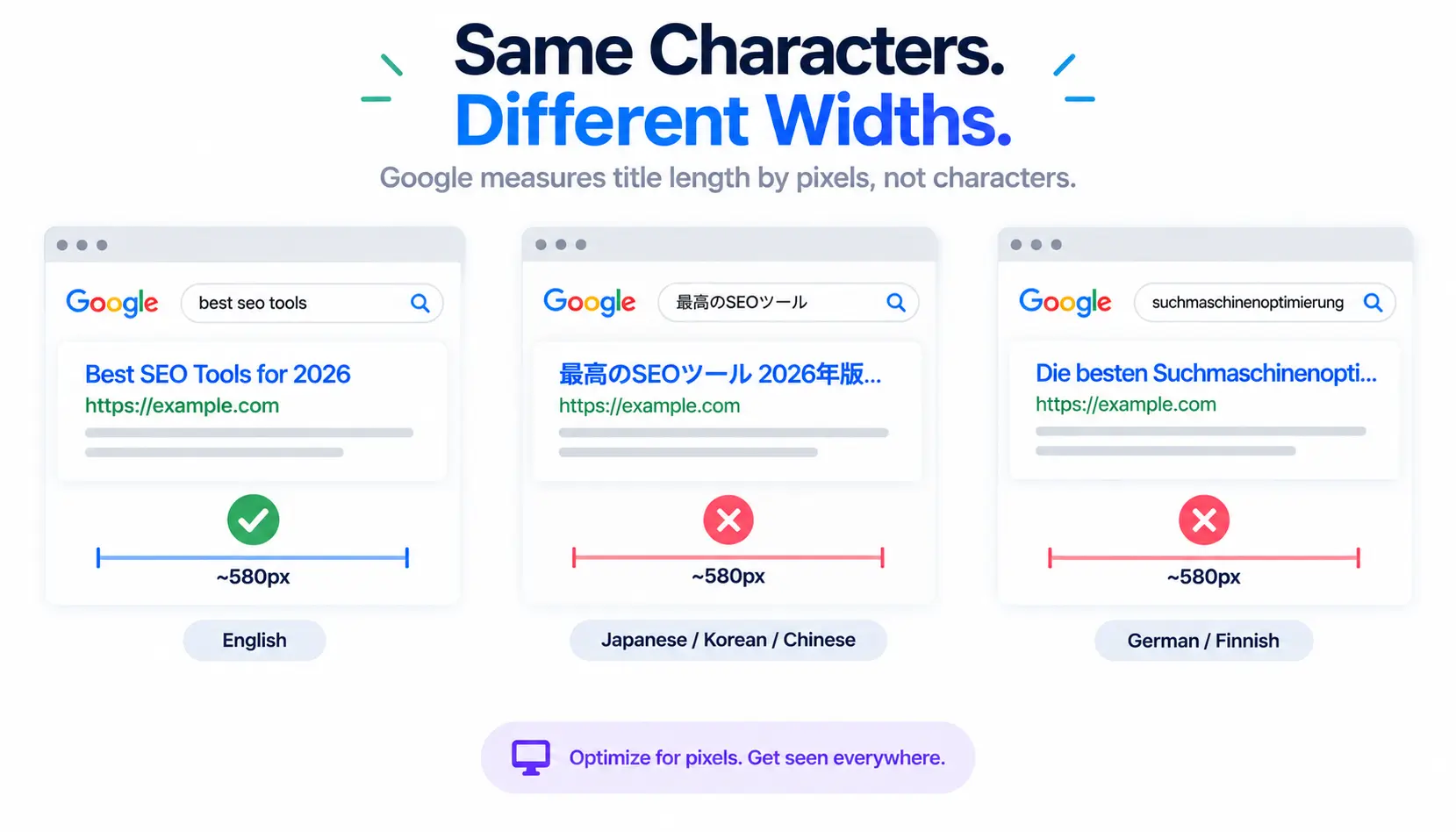
The 60-character title rule is an English rule. Google cuts titles by pixel width, and full-width scripts such as Japanese, Korean and Chinese take roughly twice the space per character that Latin letters do. A 35-character Japanese title passes every English-built checker and still gets truncated in the results page.
The reverse problem hits German and Finnish: long compound words push past the width limit at a character count that looks safe, and the cut lands mid-word.
Check: count CJK characters as two units and Latin characters as one, and flag titles above about 30 units for full-width scripts. Confirm that the keyword sits in the part of the title that survives the cut, not the tail.
2. Test robots.txt against every crawler that matters in the market
Google is not the only crawler that needs access. Yandex still matters in Russian-speaking markets, Baidu in China, Seznam in the Czech Republic, and Naver’s Yeti bot in Korea. Each reads robots.txt on its own terms and none of them read Google Search Console.
The common failure is a template robots.txt that allows Googlebot and disallows everything else. A global audit tool sees a valid file. A third of the market sees no site at all.
Check: parse robots.txt per user agent and test the local crawlers explicitly. Confirm the site is registered with each engine’s webmaster tools, not only Search Console, and that a sitemap has been submitted to each.
3. Fetch the site from inside and outside the country
Hosting providers in several markets sell a one-click “block overseas traffic” option as a security feature. Some CDN plans ship with country rules enabled. Site owners turn them on and forget them.
Googlebot crawls from US addresses. So does almost every SEO crawler. The site loads instantly for anyone at home, the owner sees nothing wrong, and Search Console fills with fetch errors that nobody connects to the hosting panel. A crawler run from a US data center reports the site as unreachable, which is true and useless, because the client will test it locally and watch it load.
Check: request the homepage from a local IP and a foreign IP and compare status codes and response bodies. If they differ, look at the hosting control panel, CDN country rules and WAF policy, in that order.
4. Cross-check search volume against local advertising data
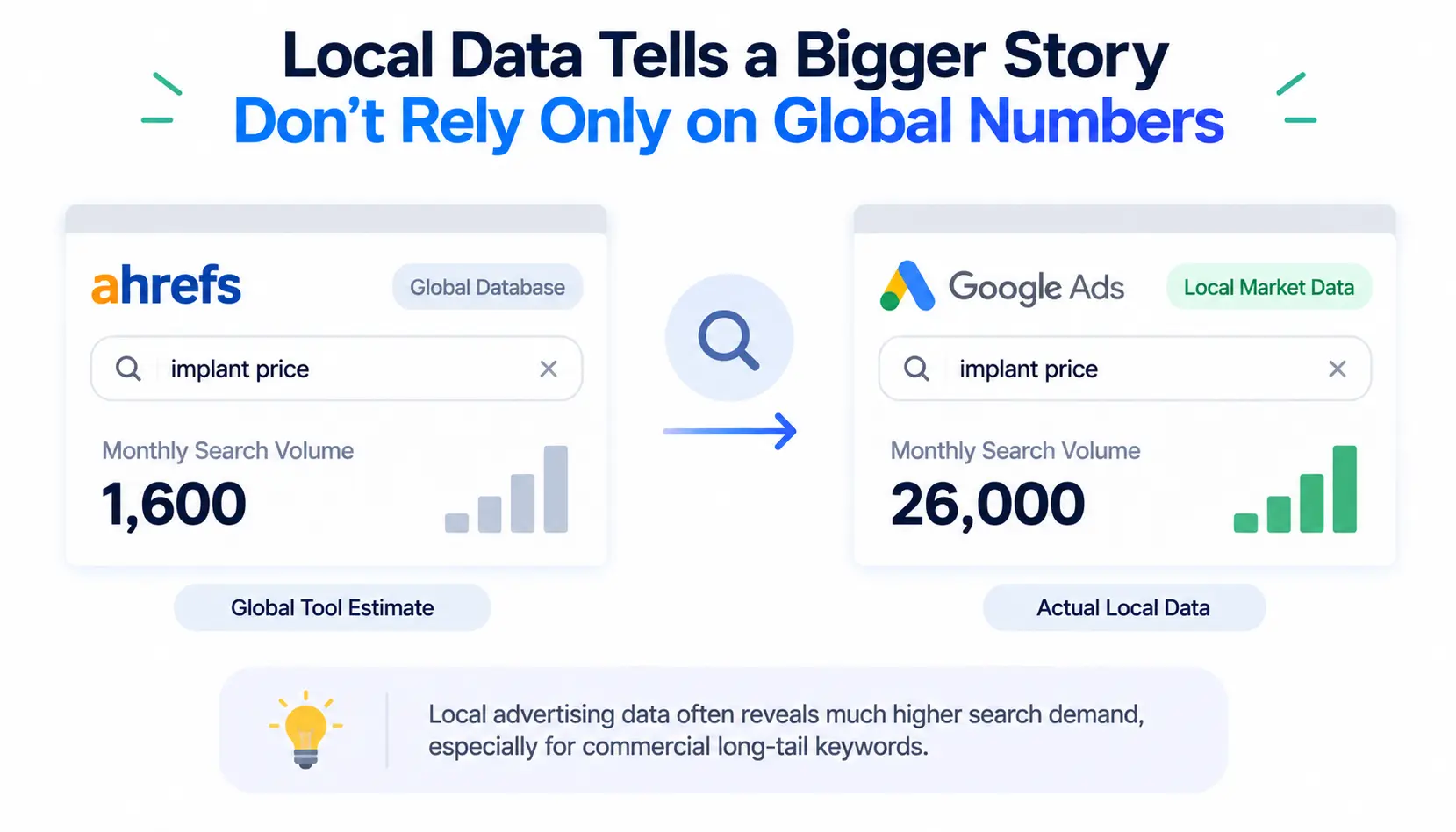
Global keyword databases estimate volume from clickstream panels that thin out fast outside the US and Western Europe. Head terms are usually close enough. Commercial long-tail queries can be off by ten times or more.
One example: the local query for “implant price” in a dental campaign showed about 1,600 monthly searches in a global database. The market’s own advertising platform, which reports actual query counts, showed around 26,000. A content plan built on the global number would have skipped the most valuable topic on the list.
Check: wherever a local advertising platform publishes query counts, pull volume from there and show it next to the global estimate. Rebuild the priority list on local numbers before committing to a content calendar. The keyword research process stays the same; only the source of the numbers changes.
5. Request the canonical URL and confirm it returns 200
This failure is language-independent but it clusters on sites built with static generators and modern hosting, which is where a lot of newer international sites live.
The pattern: pages are served at /faq/ with a trailing slash, /faq redirects to /faq/, but the canonical tag, the sitemap and the Open Graph URL all say /faq. Google follows the sitemap, hits a redirect, lands on a page whose canonical points back at the redirecting URL, and files the page under “Page with redirect.” On one site we reviewed, 56 of 66 pages sat in that bucket for a month.
Most crawlers report “canonical present” and move on without requesting it.
Check: issue a HEAD request to every canonical URL. Fail the page if the canonical returns a 3xx or 4xx. The fix is a few lines in the build script; finding it is the hard part.
6. Verify hreflang against what the server actually serves
Hreflang tags are easy to generate and easy to get wrong. The tags point at /de/ while the server redirects /de/ to /de-de/. The x-default points at a page that no longer exists. The return tags are missing on half the language versions because a template was updated in one place.
Audit tools validate hreflang syntax. Few of them follow each URL and confirm it returns 200 with a matching return tag.
Check: for every hreflang URL, fetch it, confirm a 200 status, and confirm the target page links back. Treat a redirecting hreflang target the same as a redirecting canonical.
7. Look for local tools that already encode the market’s rules
None of this argues against a global crawler. A full-site crawl with an on-page auditor such as Rankller remains the fastest way to surface broken internal links, index bloat, orphaned pages and Core Web Vitals problems, and those issues look the same in every language.
The argument is that an English-built crawl needs a second layer for a market it cannot read, and in most large non-English markets that layer already exists. German agencies have audit tools tuned to compound-word title limits. Japanese tools test against Yahoo Japan as well as Google. Korean site owners searching for 구글 SEO 최적화 (Google SEO optimization) find audit tools that measure title width in full-width units, test robots.txt against Yeti, detect hosting geo-blocks, verify that canonicals return 200 and pull keyword volume from the local advertising API instead of a global panel.
Check: before signing off on a foreign-language site, run it through at least one tool built in that market, or replicate checks 1 through 6 by hand. Compare the two reports. The differences are the audit.
How to run the two-pass international SEO audit
Run the standard crawl first and fix everything that does not depend on language: indexation blockers, redirect chains, internal linking, page speed. Then run the seven checks above as a second pass. Rebuild the keyword list from local advertising data. Register the site with every search engine that has a share in the market and confirm each one can fetch the homepage from its own crawler.
The second pass takes an afternoon. It regularly explains months of flat traffic that the first pass is called healthy.
Frequently asked questions
What is an international SEO audit?
An international SEO audit reviews a site against the search engines, scripts, hosting conventions and keyword data of each market it targets, rather than against a single English default. It adds market-specific checks on top of a standard technical crawl.
Why does my crawler say the site is down when the client says it loads fine?
Almost always a hosting-level or CDN-level geo-block that rejects foreign IP addresses. Your crawler and Googlebot both connect from abroad. Ask the client to check the hosting panel for an overseas-access setting.
How far off can global keyword volume be in a non-English market?
Head terms are usually within a reasonable range. Commercial long-tail queries have shown differences of ten times or more between a global database and the market’s own advertising figures. Cross-check before building a content plan.
Do I need to care about search engines other than Google?
In several markets, yes. Yandex, Baidu, Seznam, Naver and Yahoo Japan each hold meaningful shares for specific query types, run their own crawlers and publish their own webmaster tools. A site that only one engine can crawl loses the intent that the others carry.
Which check should I run first?
The inside-versus-outside fetch. If Googlebot cannot reach the site, nothing else in the audit matters, and this is the failure most often hidden from the site owner.
What to do next
Add the seven checks to your audit template as a separate section that runs after the standard crawl. Title width, crawler access, fetch origin, volume source, canonical status, hreflang status and a local-tool comparison. A site that passes the first pass and fails three of these is not healthy; it has passed an English test. The second pass is what tells you whether it will rank where the client sells.