
If you have spent any time building backlinks you already know that the rules of the game have changed. It takes weeks to get guest posts approved. People usually ignore outreach messages.. Google is getting better at finding links that seem to be bought instead of links that are earned.
That is where SERP Insight link insertion comes in. SERP Insight link insertion is a more targeted way to get your links placed on pages that are already ranking, already indexed and already sending traffic to websites. In this guide I will walk you through what SERP Insight link insertions, how SERP Insight link insertion works, when to use SERP Insight link insertion and how to avoid the mistakes that get websites penalized.
What Is SERP Insight Link Insertion?
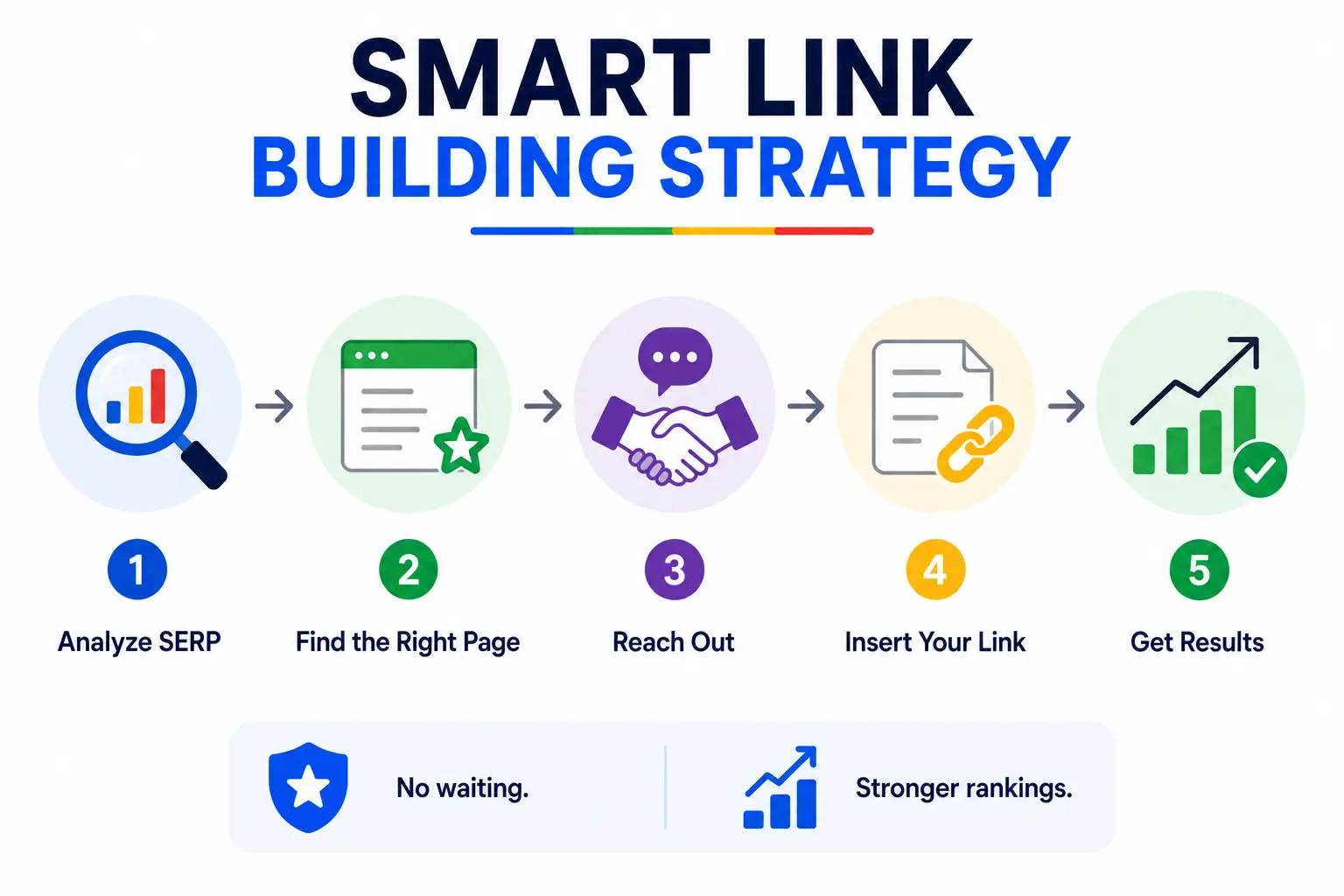
SERP insight link insertion is an SEO strategy where a backlink is added to an existing article that already ranks in search results, with the page selected based on SERP data.
Rather than publishing a new article and waiting for Google to index and rank it, this approach places your link on a page that Google already recognizes and trusts. The idea of SERP Insight is to look at what people’s are searching for on Google and find articles that are already popular.
You find an article that is ranking for a keyword that’s relevant to your business then you talk to the person who owns the website or the people who help them. You ask them to add a link to your website in the article. This is a way to get a link because Google already likes the article so you do not have to wait for a new article to be posted. You just make a change to the old one and it is done. SERP Insight link insertion is a way to get your link on a website that people are already visiting.
Why It Matters for Modern SEO
Search engines look at links in ways depending on the page they are on. A link that is hidden in a guest post that is not indexed yet does not have as much power as a link that is on a page that already gets traffic from people searching and has been visited by search engines many times before.
When you put a link on a page that’s already well known it gets a boost right away. This is why a lot of companies and people who work on making websites rank higher have started using this method. It helps links start working to improve rankings sooner so the time between when a link’s added and when it starts to help is shorter.
How It Differs from Traditional Link Building
Traditional link building, guest posting, HARO responses, resource page outreach usually means creating new content or waiting on an editorial calendar. Link insertion skips that step entirely.
Here’s the core difference:
- Guest posting: You write a new article; it goes live; then it needs to rank on its own before it fully “counts.”
- Link insertion: You place a link inside a page that’s already ranking, so it benefits from existing authority right away.
Both are legitimate tactics when done correctly. Neither is inherently better. They solve different problems, which we’ll cover later in this guide.
How a SERP Insight Link Insertion Works in 5 Stages
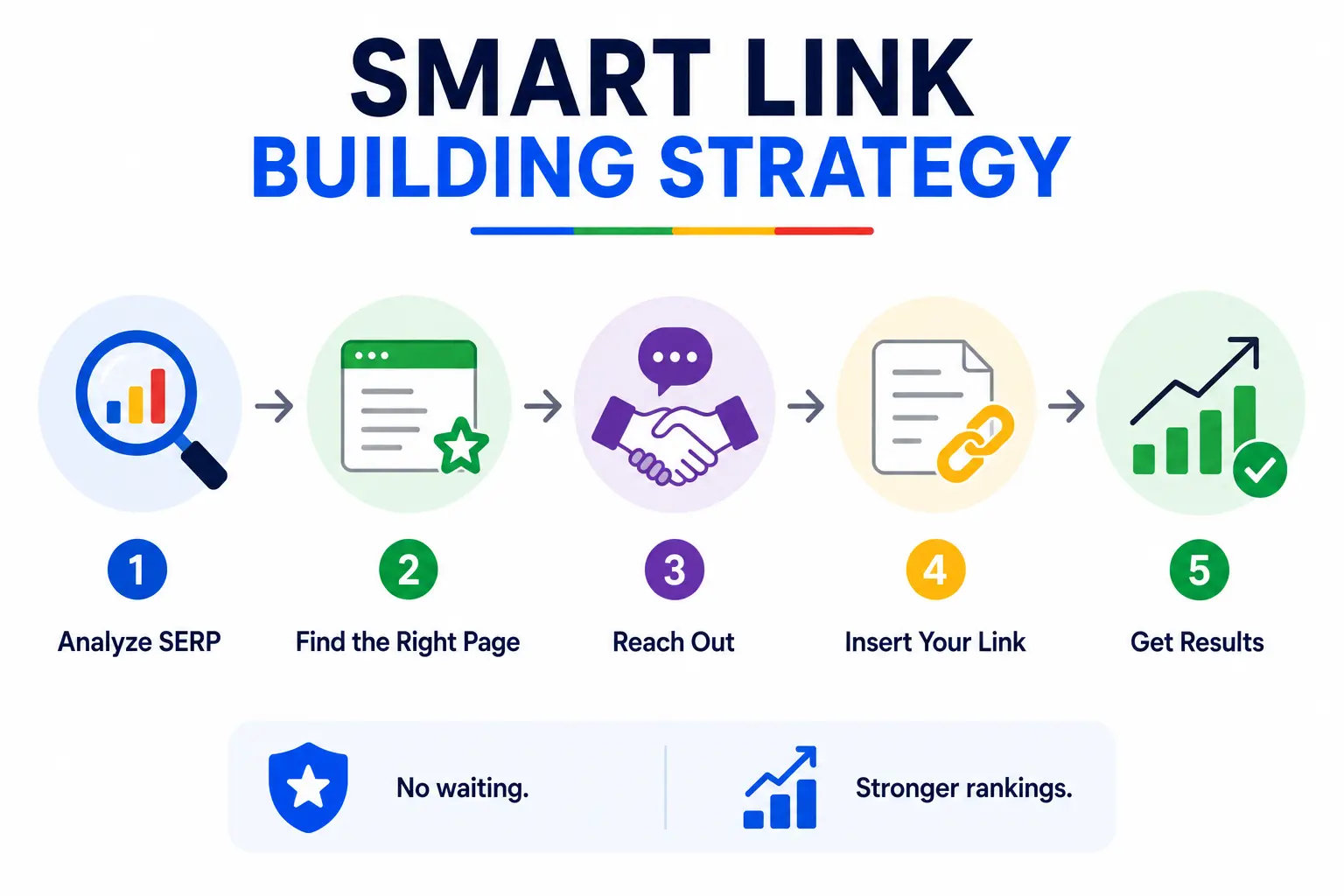
A SERP insight link insertion follows five key stages: identifying pages that already rank for your target keyword, evaluating the quality of each page, ensuring there’s a natural place to add the link, selecting anchor text that fits naturally, and placing the backlink within the relevant section of the content.
1. Find Pages That Already Rank for Your Keyword
Begin by searching Google for the keyword you want to improve rankings for, then compile a list of pages appearing in the top 10–30 results. Since Google already considers these pages authoritative, your goal is to find one that closely matches your topic and where linking to your content would provide genuine value to readers.
2. Evaluate the Page, Not Just the Domain
A strong Domain Rating (DR) alone doesn’t guarantee a valuable backlink. DR is an Ahrefs metric ranging from 0 to 100 that estimates the overall backlink strength of an entire domain, not an individual page.
It’s possible for a DR 80 website to have pages that receive little or no traffic because they haven’t been updated or no longer rank well. In those cases, the backlink carries far less value.
Instead, assess the page itself by asking:
- Does it receive organic traffic?
- Does it rank for the target keyword?
- Have its rankings remained stable over time?
A page with consistent traffic and strong keyword visibility is far more valuable than one backed only by a high domain score.
3. Make Sure There’s a Natural Place for the Link
Not every article is suitable for link insertion. If the backlink feels forced or doesn’t genuinely help the reader, it may appear manipulative. Focus on pages where your link naturally complements the existing content. If a natural placement isn’t possible, it’s better to skip the opportunity.
4. Select Anchor Text That Sounds Natural
Anchor text is the clickable portion of a hyperlink, and poorly chosen anchors can make a paid placement look obvious. Repeated use of exact-match commercial keywords is a common signal of unnatural link building.
Instead, use descriptive phrases, partial-match keywords, or branded anchor text that flows naturally within the sentence.
The best anchor text should feel like it was written by the original author. As Google’s spam detection continues to improve, natural anchor text remains an important quality signal.
5. Insert the Link and Monitor It
Place the backlink within the main body of the content, ideally inside the relevant paragraph you identified not in the author bio or footer.
After placement, continue monitoring the backlink. Links can disappear when websites update content, change ownership, or remove outbound links.
A backlink that isn’t monitored is one you may lose without realizing it. Regular backlink tracking helps you detect removed placements as soon as they happen.
Why Businesses Use Link Insertions
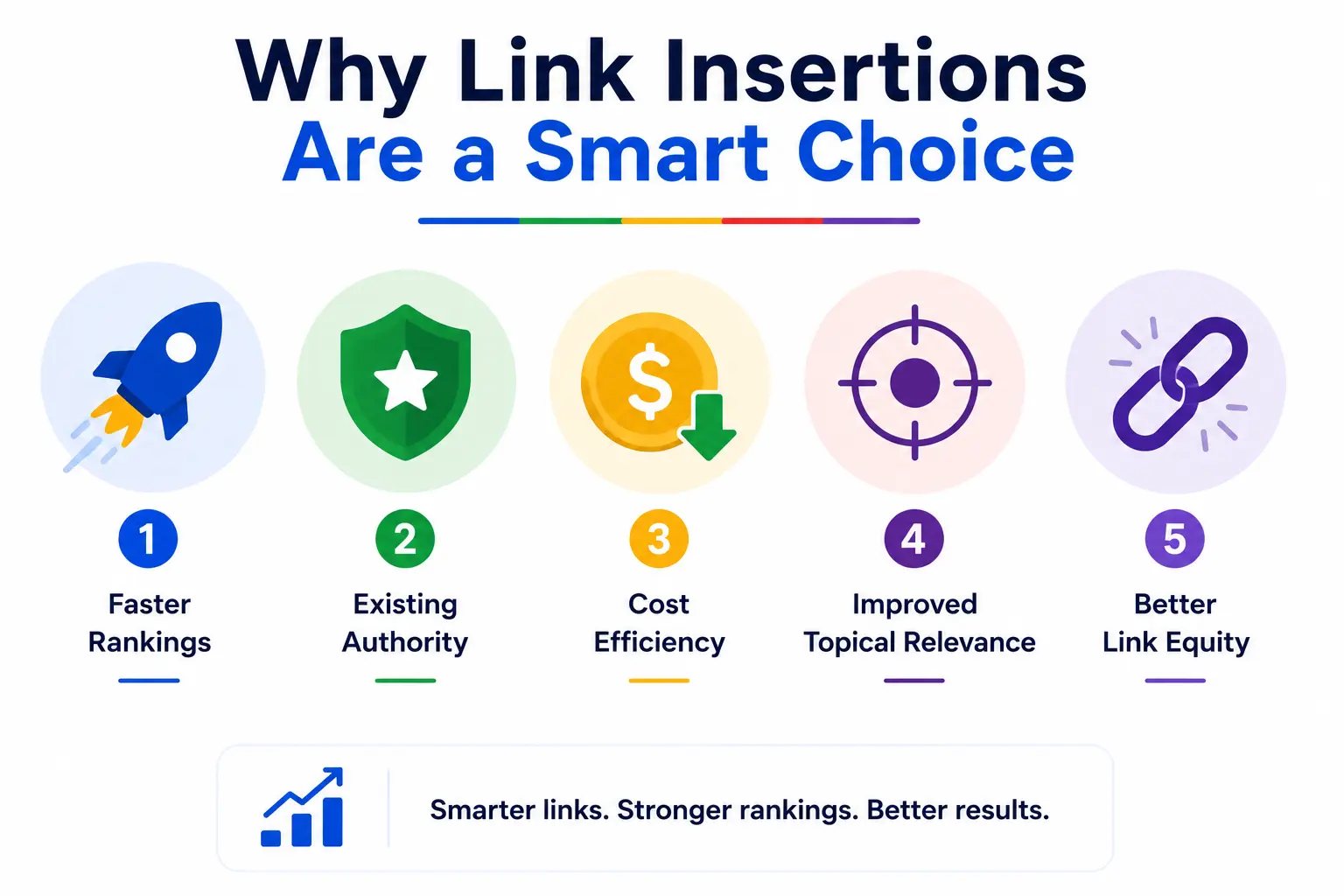
Faster Rankings
The host page is already. Trusted by people. This means the new link does not have to wait for a new page to become popular and trusted first. This is the reason why businesses like to use insertions instead of making fresh content placements. Businesses choose insertions because the host page is already trusted.
Existing Authority
A two-year-old article with steady organic traffic has already proven itself to Google. Piggybacking on that authority is more efficient than starting from zero with a new post.
Cost Efficiency
Writing a guest post and then editing it and pitching it to people takes a lot of time and money. If you just put a link in something that is already written you do not have to spend time making content, which usually makes it cheaper to get a link as long as you are not paying too much money for links that are not very good.
Improved Topical Relevance
You have the power to be picky. Then waiting to see if an editor likes your guest post idea you get to decide exactly where your link goes. The specific page and the specific paragraph. This makes it a lot easier to make sure your link is really relevant to the topic of the page. You can make sure your link is in a place where it really fits in with the rest of the content, on the page and the paragraph, which is pretty great.
Better Link Equity
The value that goes from one page to another through a link is called link equity. Some people also call this link juice. When you put a link on a page that has a lot of links to parts of the site and also has links from other sites it usually gives more link equity than a new guest post that is all, by itself.
SERP Insight Link Insertions vs Guest Posts
Key Differences
Guest posts require writing full articles and going through an editor’s approval process. Link insertions require finding existing pages and negotiating small edits. One creates new content; the other modifies content that already exists.
Pros and Cons
Link insertions:
- Pro: Faster to execute, taps into existing authority
- Pro: Lower content production cost
- Con: Harder to scale ethically (limited quality inventory)
- Con: Some publishers charge high prices for “just adding a link”
Guest posts:
- Pro: You control the full narrative and can build brand authority
- Pro: Easier to find willing publishers at scale
- Con: Slower — new pages take time to rank and build trust
- Con: More content production effort
Comparison Table
| Factor | Link Insertion | Guest Post |
| Speed to live | Fast (days) | Slower (weeks) |
| Content required | None or minimal | Full article |
| Authority source | Existing page | New page, builds over time |
| Typical cost | Varies, often lower | Includes writing cost |
| Control over context | Limited to existing article | Full control |
Which Strategy Is Better?
Neither wins outright, it depends on your goal. If you need a quick authority boost on an established niche site, insertions usually win. If you want to build brand visibility, showcase expertise, and control the full message, guest posting is the better fit.
Most solid link-building strategies use both, in a blended mix, rather than relying on one exclusively.
Link Insertions vs Other Link Building Methods
Niche Edits
“Niche edits” is actually another name commonly used for link insertions — the terms overlap heavily in the SEO community. If you see either term in a vendor pitch, they usually mean the same underlying tactic.
HARO
HARO (Help a Reporter Out, now rebranded under Connectively) connects journalists with expert sources for quotes. It produces links on fresh, often high-authority publications, but response rates are low and timing is unpredictable.
Digital PR
Digital PR earns links through newsworthy campaigns, data studies, or expert commentary picked up by media outlets. It’s slower and more resource-intensive than link insertion but tends to produce higher-authority, more natural-looking links.
Broken Link Building
This method involves finding dead links on relevant pages and suggesting your content as a replacement. It’s genuinely white-hat and editor-friendly, but it takes more manual research per link earned.
Resource Pages
Resource pages are curated lists of helpful links on a specific topic. Getting added is similar to link insertion in mechanics, but the context is a list rather than a body paragraph, which usually passes less contextual relevance signals.
How to Evaluate a Quality Link Insertion
Domain Metrics
You should look at the Domain Rating from Ahrefs or the Domain Authority from Moz to get a sense of how strong a website’s overall. These scores are made by Ahrefs and Moz; they are not made by Google so you should think of them as a guide, not something that is always right. Domain Authority from Moz and Domain Rating from Ahrefs are like signals that can help you.
Organic Traffic
A website that has real traffic (checked using Ahrefs or Semrush or even better Google Search Console if the owner allows access) sends a much stronger message, than just looking at domain scores. Traffic shows that real people are visiting and that the site is being crawled regularly by just focusing on how many links it has.
Referring Domains
Look at how many unique domains link to the target page and the site overall. A healthy, diverse referring domain profile suggests the site earned its authority naturally rather than through link schemes.
Topical Relevance
The single most important factor in a quality link insertion is topical relevance between your site and the host page. A link about project management software sitting inside an article about home renovation looks unnatural to both readers and Google’s algorithms.
Anchor Text
Natural anchor text blends into the sentence like branded terms, naked URLs, or generic phrases like “this guide” mixed in with occasional keyword-rich anchors. Over-optimized exact-match anchors on every single link is one of the fastest ways to trigger spam signals.
Page Authority
Beyond the domain as a whole, evaluate the specific page’s authority, its own backlinks, ranking keywords, and traffic. A weak page on a strong domain still passes limited value.
Spam Signals
Watch for signs like excessive outbound links, thin content, expired domains repurposed as link farms, or a suspicious pattern of unrelated niches all linking from the same site. These are classic footprints of manipulative link networks.
Indexation Status
If the host page isn’t indexed by Google, the link isn’t worth much yet. Always confirm indexation with a quick site: search or Search Console before finalizing a placement.
Google’s Guidelines on Link Insertions
Paid Links
Google’s official <a href=”https://developers.google.com/search/docs/essentials/spam-policies” target=”_blank” rel=”noopener”>spam policies</a> are clear: buying or selling links that pass PageRank, without proper nofollow or sponsored tags, violates their guidelines. This applies to link insertions just as much as guest posts.
Link Spam
Google’s link spam policy targets any link scheme designed purely to manipulate rankings rather than help users. Mass link insertions across unrelated, low-quality sites fall squarely into this category.
SpamBrain
SpamBrain is Google’s AI-based spam detection system, and it’s specifically built to catch unnatural link patterns at scale including bulk link insertions from private blog networks or link farms. It’s gotten noticeably better at spotting insertion patterns over the past few years.
rel=”nofollow” and rel=”sponsored”
If a link insertion is paid for, Google expects it to be marked with rel=”sponsored” or at minimum rel=”nofollow”. Skipping this tag on a paid link is a direct guideline violation, even if the placement itself looks natural.
Best Practices to Stay Compliant
Focus on relevance over volume, disclose paid placements properly, and avoid vendors who guarantee dofollow links on command across huge site networks. If a deal sounds too easy or too cheap, it usually violates guidelines somewhere in the process.
Best Practices for SERP Insight Link Insertions
Choose Relevant Pages
Prioritize pages topically close to your niche, not just pages with high metrics. Relevance protects you from both algorithmic penalties and reader distrust.
Diversify Anchor Text
Mix branded anchors, naked URLs, generic phrases, and partial-match anchors. A natural link profile rarely uses the exact same keyword phrase over and over.
Maintain Natural Context
The inserted sentence should read like it was always part of the article not bolted on. If it feels forced when you read it out loud, an editor (and eventually Google) will notice too.
Prioritize Editorial Quality
Work with publishers who actually review and approve insertions rather than accepting anything for a fee. Editorial standards are what separate legitimate link insertion from link spam.
Monitor Performance
Track whether the page stays live, stays indexed, and whether your target keywords move after the insertion. Link building without measurement is just guessing.
Common Mistakes to Avoid
Buying Low-Quality Links
Cheap, bulk link insertions from irrelevant or spammy sites can do more harm than good. A handful of relevant, well-placed links consistently outperforms dozens of low-quality ones.
Over-Optimized Anchors
Repeating the same exact-match keyword anchor across multiple insertions is one of the clearest unnatural-link footprints Google’s systems look for.
Ignoring Relevance
A backlink from an unrelated site rarely moves the needle, no matter how high its domain metrics look. Relevance beats raw authority almost every time.
Chasing DR Alone
Domain Rating is a helpful shortcut, but it’s not a Google ranking factor. Chasing high-DR sites while ignoring traffic and relevance is a common — and costly — mistake.
Poor Vendor Selection
Not all link-building vendors operate the same way. Vet any agency or marketplace carefully, ask for sample placements, and confirm they follow editorial standards rather than running a link farm.
Real Examples of Effective Link Insertions
High-Quality Example
Picture a SaaS company selling project management software getting a link inserted into an established productivity blog’s “best tools for remote teams” article, a page already ranking on page one, with genuine organic traffic and topical overlap. The link fits naturally into an existing sentence about team collaboration tools.
Low-Quality Example
Compare that to the same company buying a link insertion on an unrelated site about pet care, on a page with declining traffic and dozens of unrelated outbound links already crammed in. Even if the domain metrics look decent on paper, this kind of placement carries real risk and little upside.
Before-and-After SEO Impact
In practice, a well-placed insertion on a relevant, trafficked page tends to show measurable movement in rankings and referral clicks within a few weeks of indexing. A poorly placed one usually shows nothing or, worse, gets flagged in a future spam update and needs to be disavowed.
Measuring Link Insertion Success
Rankings
Track keyword position changes for your target pages before and after the insertion goes live and gets indexed. Give it at least four to six weeks before drawing conclusions.
Organic Traffic
Look at whether organic sessions to the linked page increase over time, not just rankings in isolation. Rankings without traffic gains usually mean the keyword volume was too low to matter.
Keyword Growth
Watch for growth in the total number of ranking keywords for the target page, not just your primary target term. Strong link equity often lifts related long-tail terms too.
Referral Traffic
A good insertion also sends direct referral clicks from readers of the host page. This is a nice secondary benefit that pure ranking metrics miss.
Conversions
Ultimately, rankings and traffic should translate into leads, signups, or sales. Tie link insertion campaigns back to conversion data whenever possible to prove real ROI.
ROI
Calculate cost per link against the traffic and conversion value it generates over time. This turns link insertion from a vague “SEO activity” into a measurable line item in your marketing budget.
Recommended SEO Tools
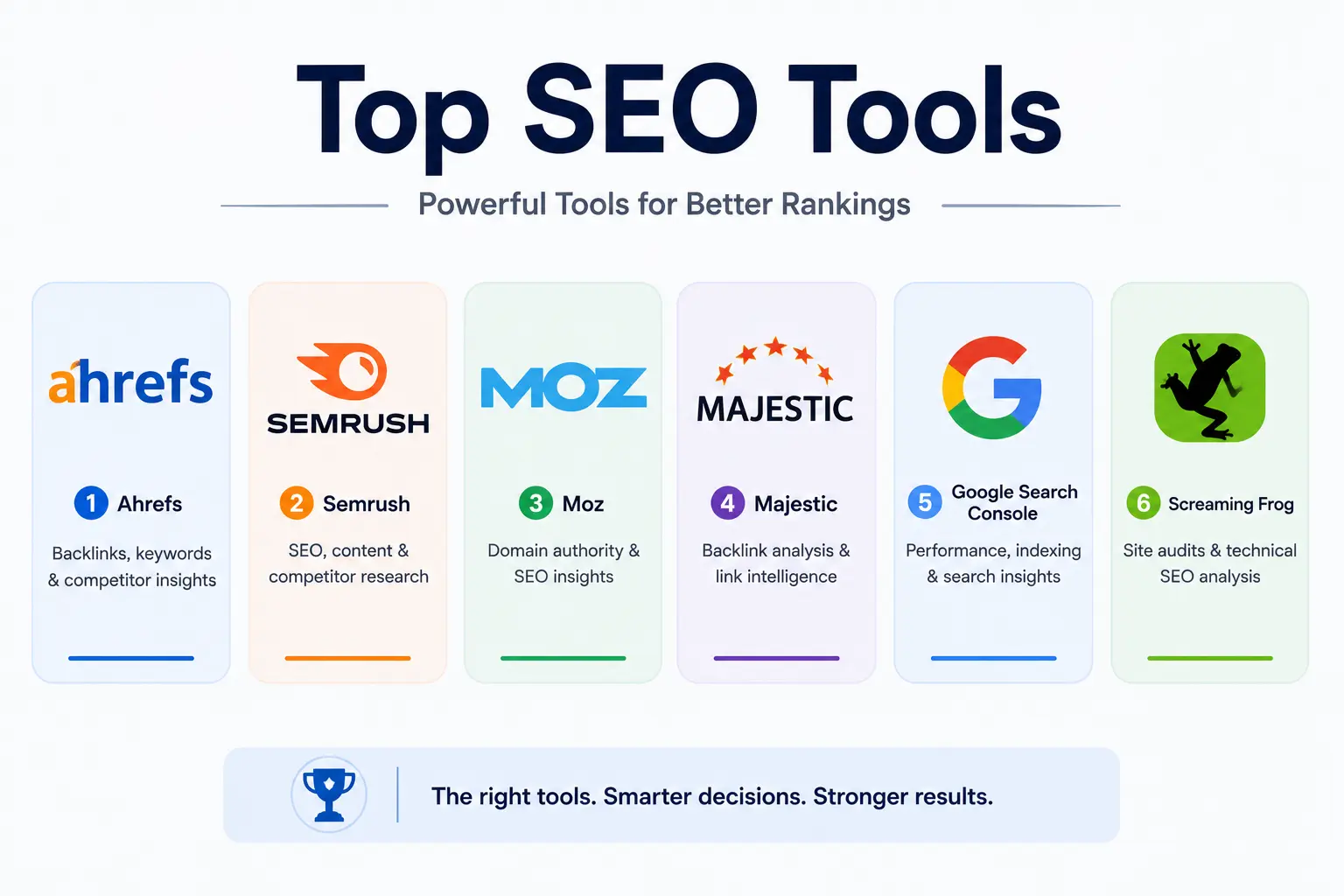
Ahrefs
Best for backlink research, Domain Rating checks, and finding relevant link insertion targets based on ranking keywords.
Semrush
Strong for competitive backlink gap analysis and traffic estimation on prospective host pages.
Moz
Useful for Domain Authority and Page Authority scoring, plus its long-standing <a href=”https://en.wikipedia.org/wiki/Moz_(marketing_software)” target=”_blank” rel=”noopener”>link explorer database</a>.
Majestic
Known for its Trust Flow and Citation Flow metrics, which are particularly useful for spotting unnatural link patterns.
Google Search Console
The only tool that shows you real indexation status, real click data, and real Google-reported backlinks not estimates.
Screaming Frog
Handy for auditing a host page’s on-page structure, outbound link count, and technical health before agreeing to a placement.
Who Should Use SERP Insight Link Insertions?
SaaS Companies
SaaS brands often benefit because niche software review and comparison blogs already rank well and welcome relevant product mentions.
eCommerce Brands
Product-focused insertions work well on buying guides and “best of” list articles that already rank for commercial-intent keywords.
Agencies
Agencies use link insertions to deliver faster, measurable results for clients without waiting on lengthy guest post pipelines.
Local Businesses
Local service businesses can benefit from insertions on regional blogs and local resource pages, though volume is naturally more limited.
Affiliate Websites
Affiliate sites often lean heavily on insertions since fast link velocity directly supports fast-moving content and keyword targeting strategies.
Enterprise SEO Teams
Larger teams use link insertions as one channel within a broader, diversified backlink portfolio never as the sole strategy.
Future of Link Insertions in AI-Driven Search
AI Overviews
As Google’s AI Overviews pull from a blended set of trusted sources, being cited within an already-authoritative, well-linked page increases the odds of that content (and by extension, your linked brand) getting surfaced in AI-generated summaries.
Topical Authority
Search engines increasingly reward sites that build depth across a topic cluster, not just individual high-ranking pages. Link insertions that reinforce topical clusters tend to age better than one-off placements.
Entity SEO
Modern search relies heavily on <a href=”https://en.wikipedia.org/wiki/Entity_linking” target=”_blank” rel=”noopener”>entity recognition</a> connecting your brand, product, and topic as a consistent entity across the web. Contextual link insertions help reinforce those entity associations when done on genuinely relevant pages.
EEAT Signals
Google’s Experience, Expertise, Authoritativeness, and Trustworthiness framework rewards links that come from genuinely knowledgeable sources, not just high-metric ones. Relevance and editorial quality matter more under EEAT than raw link volume ever did.
Sustainable Link Building
The long-term winners in this space will be teams that treat link insertion as one part of a diversified, white-hat strategy combining it with digital PR, guest posting, and genuine content marketing rather than relying on it alone.
Frequently Asked Questions
1. What is SERP Insight link insertion?
It’s the practice of adding a contextual backlink into an already-published, already-ranking article instead of creating brand-new content to host the link.
2. Is link insertion against Google’s guidelines?
Not inherently but paid link insertions must use rel=”sponsored” or rel=”nofollow”, and mass unnatural insertions can trigger spam penalties.
3. How much does a link insertion cost?
Prices vary widely based on domain authority, traffic, and niche, often ranging from around $100 to $500+ per placement, though highly authoritative sites can charge more.
4. Is link insertion better than guest posting?
Neither is universally better. Insertions offer speed and existing authority; guest posts offer full content control and brand-building value.
5. How long does it take for a link insertion to impact rankings?
Typically a few weeks after the page is recrawled and indexed, though it varies based on the host page’s crawl frequency and overall authority.
6. What’s the difference between link insertion and a niche edit?
Nothing significant these terms are largely used interchangeably in the SEO industry.
Conclusion
SERP Insight link insertion is one of the fastest, most efficient ways to build contextual backlinks by tapping into pages that already rank and already have Google’s trust. Done right with relevance, editorial quality, and compliant tagging it can meaningfully accelerate your SEO results.
- Relevance and page-level authority matter more than raw domain metrics
- Paid insertions need proper sponsored or nofollow tags to stay compliant
- Editorial quality separates legitimate insertions from spammy link farms
Choose link insertions when you need faster results from existing, trusted pages and have a limited content production budget.
Choose guest posting when you want full narrative control, brand visibility, and are building long-term thought leadership.
Next steps: audit your current backlink profile, identify 5–10 genuinely relevant host pages in your niche using a tool like Ahrefs or Semrush, and start with a small, high-quality batch of insertions before scaling. For ongoing discussion and vendor recommendations from other practitioners, communities like <a href=”https://www.reddit.com/r/SEO/” target=”_blank” rel=”noopener”>r/SEO on Reddit</a> and SEO-focused groups on <a href=”https://www.linkedin.com/” target=”_blank” rel=”noopener”>LinkedIn</a> are worth following for real-world case studies as this tactic keeps evolving alongside AI-driven search