Marketing keeps changing all the time. New digital tools come out every year. Search engine rules get updated. Social media trends move fast. Artificial intelligence keeps changing how businesses talk to customers.
Even with all these changes the basic marketing rules stay the same. Successful businesses are not always the ones using the trend. They are the ones that get their customers and know how to give them what they want.
If you own a business in marketing and understanding marketing basics can help you make better choices. Knowing what customers need, what makes them choose something and how to talk to them can make your marketing work better.
In this guide you’ll learn the marketing principles that make businesses grow. You’ll see how they work in today’s world. You’ll find ways to use them to get customers, build trust and succeed in the long run.
What Are Marketing Fundamentals?
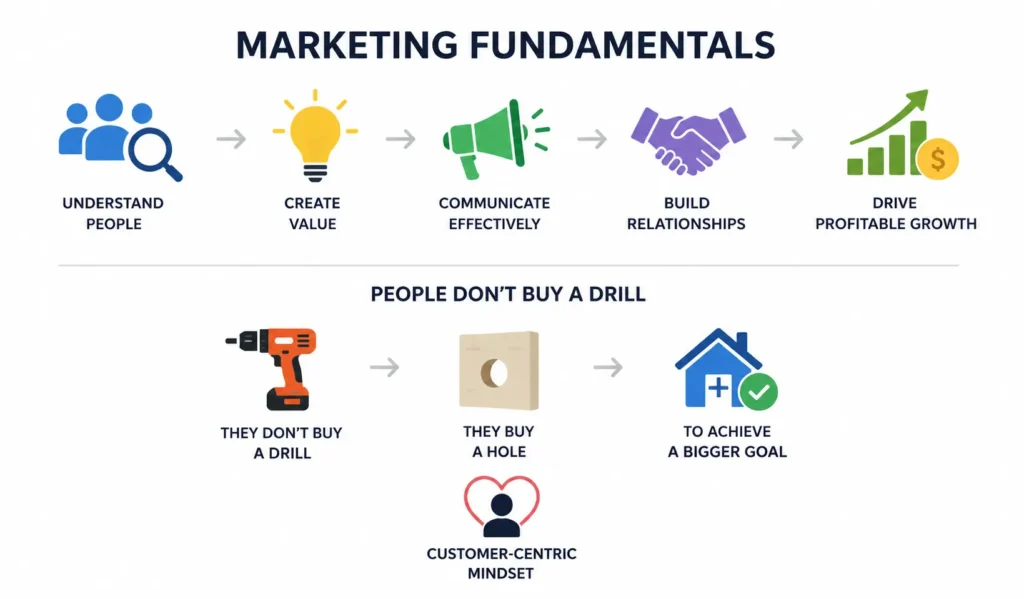
Marketing fundamentals are the foundational principles that help businesses identify customer needs, create valuable solutions, communicate effectively, and build profitable relationships.
At its core, marketing is not about selling products.
It is about understanding people.
Customers don’t buy products simply because they exist. They buy products and services because they solve problems, fulfill desires, save time, reduce risk, or improve their lives.
For example:
- People don’t buy a drill because they want a drill.
- They buy a drill because they need a hole in the wall.
- They buy the hole because it helps them achieve a larger goal.
This customer-centric mindset forms the basis of all successful marketing efforts.
Why Marketing Fundamentals Matter More Than Ever
Many businesses focus exclusively on tactics.
They chase trends, experiment with platforms, and invest heavily in advertising without understanding why customers buy.
This often leads to wasted budgets and disappointing results.
Strong marketing fundamentals provide:
- Clear customer understanding
- Better decision-making
- Stronger brand positioning
- Higher conversion rates
- Sustainable growth
- Improved customer loyalty
When fundamentals are strong, every marketing channel performs better.
The Evolution of Marketing in the Digital Age
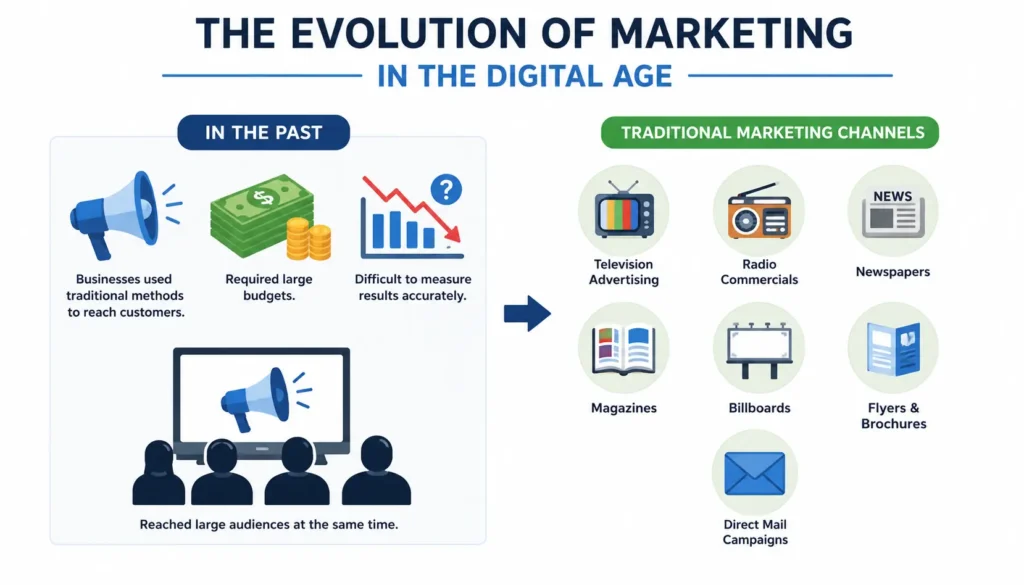
Marketing has changed a lot over the years. In the past businesses mainly used methods to reach customers. These traditional methods worked well. They often required large budgets and made it difficult to measure the results of marketing accurately.
Traditional marketing relied heavily on communication channels that reached large audiences at the same time and this was a key part of traditional marketing.
Traditional Marketing Channels
Some of the most common traditional marketing methods included:
- Television advertising
- Radio commercials
- Newspapers
- Magazines
- Billboards
- Flyers and brochures
- Direct mail campaigns
For example, a company might place an advertisement on television and hope that the right people would see it. While these methods helped businesses build brand awareness, they often lacked precise targeting.
The Rise of Digital Marketing
The internet and modern technology have changed the way businesses communicate with customers. Companies can now reach people online anytime and from almost anywhere in the world. This makes it easier to share information, promote products, and connect with potential customers.
Digital marketing also helps businesses reach their target audience more effectively and track campaign performance in real time. By measuring results and making improvements when needed, businesses can build stronger customer relationships and grow their online presence.
Today’s marketers use many digital channels, including:
- Search engines
- Social media platforms
- Email marketing
- Content marketing
- Video-sharing platforms
- Mobile applications
- Online communities and forums
- AI-powered marketing tools
These channels provide businesses with more opportunities to reach potential customers where they spend most of their time online.
Why Digital Marketing Is Different
Digital marketing offers several advantages over traditional marketing.
The Role of Technology in Marketing
Technology has made marketing more efficient and data-driven.
Today, marketers can use tools to:
- Analyze customer behavior
- Track website visitors
- Automate email campaigns
- Schedule and create social media posts
- Personalize customer experiences
- Measure campaign performance
- Predict customer needs using AI
These tools help businesses make smarter decisions and improve their marketing results.
What Has Not Changed
Although marketing channels have evolved, the core purpose of marketing remains the same.
Successful businesses still need to focus on the fundamentals.
Businesses Must Still:
- Understand their customers
- Identify customer needs and problems
- Create valuable products and services
- Communicate clear messages
- Build trust and credibility
- Develop long-term relationships
- Generate sustainable revenue
No matter how advanced technology becomes, customers still want solutions to their problems and positive experiences with brands.
The Importance of Building Relationships
People who buy things have a lot of options these days. This means that companies need to focus on building relationships with their customers rather than just trying to make a sale.
Companies that give customers value, useful information and good customer service are more likely to get customer loyalty from their customers and this is what companies like these companies need to do to keep their customers happy, with the customer service and value that these companies provide.
Relationship-building can be achieved through:
- Helpful content
- Personalized emails
- Social media engagement
- Customer support
- Community building
- Consistent communication
Strong customer relationships often lead to repeat purchases and positive word-of-mouth referrals.
Looking Ahead
Marketing will continue to evolve as technology advances. New tools such as artificial intelligence, automation, and data analytics are already changing how businesses reach and serve customers.
However, the most successful marketers will always focus on understanding people and delivering value.
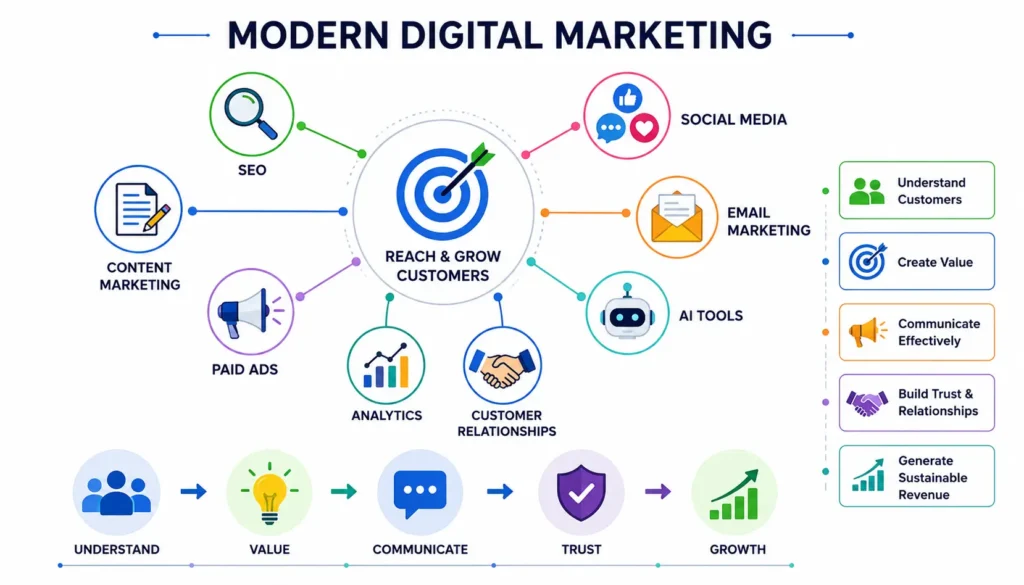
Modern Digital Marketing Channels
Today companies have a lot of ways to get in touch with people who might want to buy from them. These ways help businesses get noticed, build trust with customers, get people interested in what they have to offer and make more sales.
The businesses that do the best usually use different marketing channels, like social media and websites instead of just using one marketing channel. They use a combination of these marketing channels to reach customers and grow their sales and their businesses.
Search Engine Optimization (SEO)
When you look for something on the internet you use a search engine like Google. Search Engine Optimization or SEO for short is the way to make a website better so it shows up higher in the search results on Google.
This is really helpful for businesses because SEO makes them easier to find when people are searching for things to buy or learn about. SEO is important because it helps businesses become more visible to people who are looking for the things they offer.
Benefits of SEO
- Drives organic (free) website traffic
- Increases brand credibility and trust
- Supports long-term business growth
- Reduces dependence on paid advertising
- Generates qualified leads from search engines
SEO Best Practices
- Publish helpful and high-quality content regularly
- Use keywords naturally throughout content
- Improve website loading speed
- Create mobile-friendly web pages
- Build backlinks from trusted websites
- Optimize titles, headings, and meta descriptions
- Provide an excellent user experience
SEO takes time, but it often delivers one of the highest returns on investment because traffic continues to come even after content is published.
Content Marketing
Content marketing is about making stuff that people find useful on the internet. This kind of marketing helps people solve problems or figure out answers to things they do not know. It is also about teaching people things by trying to sell things right away.
Content marketing gives people information that helps them trust the business. Content marketing does this by giving information they need which helps build trust with the people who are looking at the product or solution.
Popular Content Formats
- Blog posts and articles
- Videos and tutorials
- E-books and guides
- Podcasts
- Case studies
- Infographics
- Webinars
Why Content Marketing Works
People prefer learning before making a purchase decision. When a business consistently shares helpful information, customers begin to trust the brand. With an AI powered video translation tool like invideo, businesses can easily adapt existing video content into multiple languages, helping them reach global audiences while keeping production time and effort low.
Benefits of Content Marketing
- Builds trust and credibility
- Educates potential customers
- Improves SEO performance
- Generates leads naturally
- Encourages customer loyalty
- Supports other marketing channels
The more value a business provides through content, the more likely customers are to choose that brand when they are ready to buy.
Social Media Marketing
Social media marketing is a way for companies to use media platforms to talk to people, share things and tell them about the things they sell. This helps businesses talk to their customers directly. Make friendships with them that last a long time. Social media marketing is really good at helping companies build bonds with the people who use their products or services.
Popular Social Media Platforms
- X (formerly Twitter)
- TikTok
- YouTube
Benefits of Social Media Marketing
- Increases brand awareness
- Builds online communities
- Encourages customer engagement
- Generates leads and sales
- Provides customer support
- Helps businesses understand audience preferences
Tips for Success
- Post consistently
- Share valuable and relevant content
- Respond to comments and messages
- Use images and videos to increase engagement
- Focus on helping and educating audiences
Successful social media marketing is about building relationships, not just promoting products.
Email Marketing
Email marketing remains one of the most effective digital marketing channels. It allows businesses to communicate directly with customers through personalized messages.
Benefits of Email Marketing
- Direct access to customers
- Personalized communication
- Marketing automation opportunities
- High return on investment (ROI)
- Strong customer retention
Effective Email Marketing Practices
- Send useful and relevant content
- Personalize emails whenever possible
- Segment audiences based on interests
- Use clear and engaging subject lines
- Maintain a consistent email schedule
- Include strong calls to action
Email marketing works best when businesses focus on helping subscribers rather than constantly selling to them.
Paid Advertising
Paid advertising allows businesses to quickly reach targeted audiences by paying for online visibility. Unlike SEO, which can take time, paid ads can generate traffic almost immediately.
Popular Paid Advertising Channels
- Google Ads
- Facebook Ads
- Instagram Ads
- LinkedIn Ads
- YouTube Ads
- Display Advertising Networks
Benefits of Paid Advertising
- Immediate visibility
- Highly targeted audience reach
- Faster lead generation
- Measurable results
- Flexible budgeting options
- Supports product launches and promotions
Best Practices for Paid Advertising
- Define clear campaign goals
- Target the right audience
- Create compelling ad copy
- Use attractive visuals
- Test multiple ad variations
- Track and optimize performance regularly
Paid advertising works best when combined with strong content, SEO, and effective landing pages.
Choosing the Right Marketing Channels
Not every marketing channel is suitable for every business. The best strategy depends on your audience, goals, industry, and budget.
Consider the following:
- Use SEO for long-term growth.
- Use content marketing to build trust.
- Use social media to engage with customers.
- Use email marketing to nurture relationships.
- Use paid advertising for quick visibility and faster results.
Many successful businesses combine all of these channels to create a balanced and effective digital marketing strategy.
Understanding the Core Marketing Concept: Customer Value
Customer value is the foundation of marketing.
Value represents the benefits customers receive compared to the costs they incur.
These costs may include:
- Money
- Time
- Effort
- Risk
Customers choose brands that provide the highest perceived value.
How to Increase Customer Value
Businesses can increase value by:
Improving Product Quality
Offer solutions that perform better than alternatives.
Enhancing Customer Experience
Make interactions simple, enjoyable, and convenient.
Providing Better Support
Help customers achieve desired outcomes quickly.
Building Trust
Customers prefer brands they believe in.
When businesses consistently deliver value, marketing becomes easier because customers become advocates.
The Marketing Mix: Understanding the 4 Ps
One of the most important marketing fundamentals is the marketing mix.
The 4 Ps help businesses create effective marketing strategies.
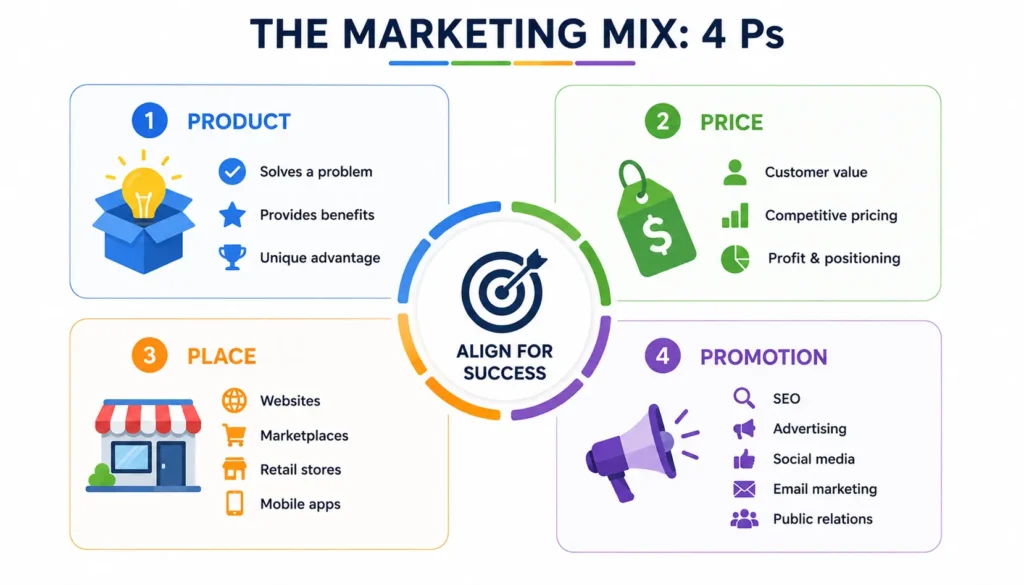
1. Product
The product is the solution offered to customers.
Questions to ask:
- What problem does it solve?
- What benefits does it provide?
- How is it different from competitors?
2. Price
Pricing influences customer perception and profitability.
Consider:
- Customer willingness to pay
- Competitive pricing
- Profit margins
- Market positioning
3. Place
Place refers to how customers access your product.
Examples include:
- Websites
- Online marketplaces
- Retail stores
- Mobile apps
4. Promotion
Promotion includes all communication activities used to attract customers.
Examples include:
- SEO
- Advertising
- Social media
- Email marketing
- Public relations
The most successful marketing strategies align all four elements.
Market Research: The Foundation of Effective Marketing
Marketing without research is guesswork.
Market research helps businesses understand:
- Customer behavior
- Industry trends
- Competitor activities
- Market opportunities
Types of Market Research
Primary Research
Information collected directly from customers.
Examples:
- Surveys
- Interviews
- Focus groups
Secondary Research
Information collected from existing sources.
Examples:
- Industry reports
- Government statistics
- Market studies
Research reduces uncertainty and improves marketing performance.
Understanding Your Target Audience
One of the biggest marketing mistakes is trying to market to everyone.
Effective marketing focuses on specific audiences.
Key Audience Factors
Demographics
- Age
- Gender
- Income
- Education
Psychographics
- Interests
- Values
- Lifestyle
- Attitudes
Behavioral Data
- Purchase habits
- Brand loyalty
- Usage patterns
The more you understand your audience, the more relevant your marketing becomes.
Brand Positioning: Why Customers Choose You
Brand positioning defines how customers perceive your business relative to competitors.
Strong positioning answers a simple question:
Why should customers choose you instead of someone else?
Examples of Positioning
- Premium quality
- Lowest price
- Best customer service
- Innovation leader
- Industry specialist
Clear positioning helps customers make purchasing decisions faster.
The Role of Customer Experience in Marketing
Marketing does not end when a customer makes a purchase.
Customer experience influences:
- Retention
- Reviews
- Referrals
- Lifetime value
Modern consumers share experiences widely through social media and review platforms.
Positive experiences become powerful marketing assets.
How AI Is Transforming Modern Marketing
Artificial intelligence is changing how marketers analyze data, create content, and personalize experiences.
AI applications include:
- Content generation
- Customer support chatbots
- Predictive analytics
- Marketing automation
- Personalization engines
However, AI does not replace marketing fundamentals.
Understanding customer needs remains the most important skill.
AI simply helps marketers execute more efficiently.
Common Marketing Mistakes to Avoid
Even experienced marketers make mistakes.
Ignoring Customer Research
Assumptions often lead to ineffective campaigns.
Weak Positioning
Customers need a clear reason to choose your brand.
Inconsistent Branding
Mixed messages create confusion and reduce trust.
Focusing Only on Sales
Strong marketing builds relationships before pursuing transactions.
Neglecting Data Analysis
Marketing decisions should be guided by evidence, not guesswork.
Practical Steps to Build a Strong Marketing Strategy
Follow these steps:
Step 1: Understand Your Audience
Research customer needs, goals, and pain points.
Step 2: Define Your Value Proposition
Explain why customers should choose you.
Step 3: Create Valuable Content
Educate, inform, and solve problems.
Step 4: Select Appropriate Channels
Focus on platforms your audience uses.
Step 5: Measure Results
Track performance and optimize continuously.
Conclusion
Marketing tools and technologies will continue to evolve, with new platforms, digital trends, and AI tools emerging over time. However, the reasons people buy products and services remain the same. Customers still look for solutions to their problems, value, and brands they can trust.
Businesses that understand their customers, provide real value, and build strong relationships are more likely to succeed. You do not need to follow every new trend. Successful marketing comes from applying proven marketing principles through modern channels such as SEO, content marketing, social media, and email marketing.
Frequently Asked Questions (FAQ)
What are marketing fundamentals?
Marketing fundamentals are the core principles that help businesses understand customer needs, create value, communicate effectively, and build profitable customer relationships.
Why are marketing fundamentals important?
They provide the foundation for successful marketing strategies, improve decision-making, increase customer satisfaction, and support sustainable business growth.
What are the 4 Ps of marketing?
The 4 Ps are Product, Price, Place, and Promotion. Together, they form the marketing mix used to create effective marketing strategies.
What is the difference between traditional and digital marketing?
Traditional marketing uses channels such as TV, radio, and print media, while digital marketing uses online channels including search engines, social media, email, and websites.
How does SEO fit into marketing fundamentals?
SEO helps businesses increase online visibility, attract qualified traffic, and connect customers with valuable content through search engines.
Is content marketing part of digital marketing?
Yes. Content marketing is a key digital marketing strategy that focuses on creating valuable content to attract, engage, and convert audiences.
Can small businesses benefit from marketing fundamentals?
Absolutely. Understanding marketing fundamentals helps small businesses compete effectively, build customer trust, and maximize marketing budgets.