Droven.io is an online platform covering enterprise technology topics, and “enterprise tech innovation” is the umbrella term for how large organizations adopt AI, automation, cloud, and data systems to run more efficiently. This guide checks what Droven.io actually offers against what enterprise tech innovation means as a business practice, since the two get conflated in search results.
Part of the confusion comes from the site itself: it is not always clear whether Droven.io is a software product, a research hub, or a content publisher. This guide separates the platform from the concept, walks through the technology that sits behind real enterprise innovation work, and gives a plain answer on when Droven.io is worth your time and when you need a different source entirely.
What Is Droven.io Enterprise Tech Innovation?
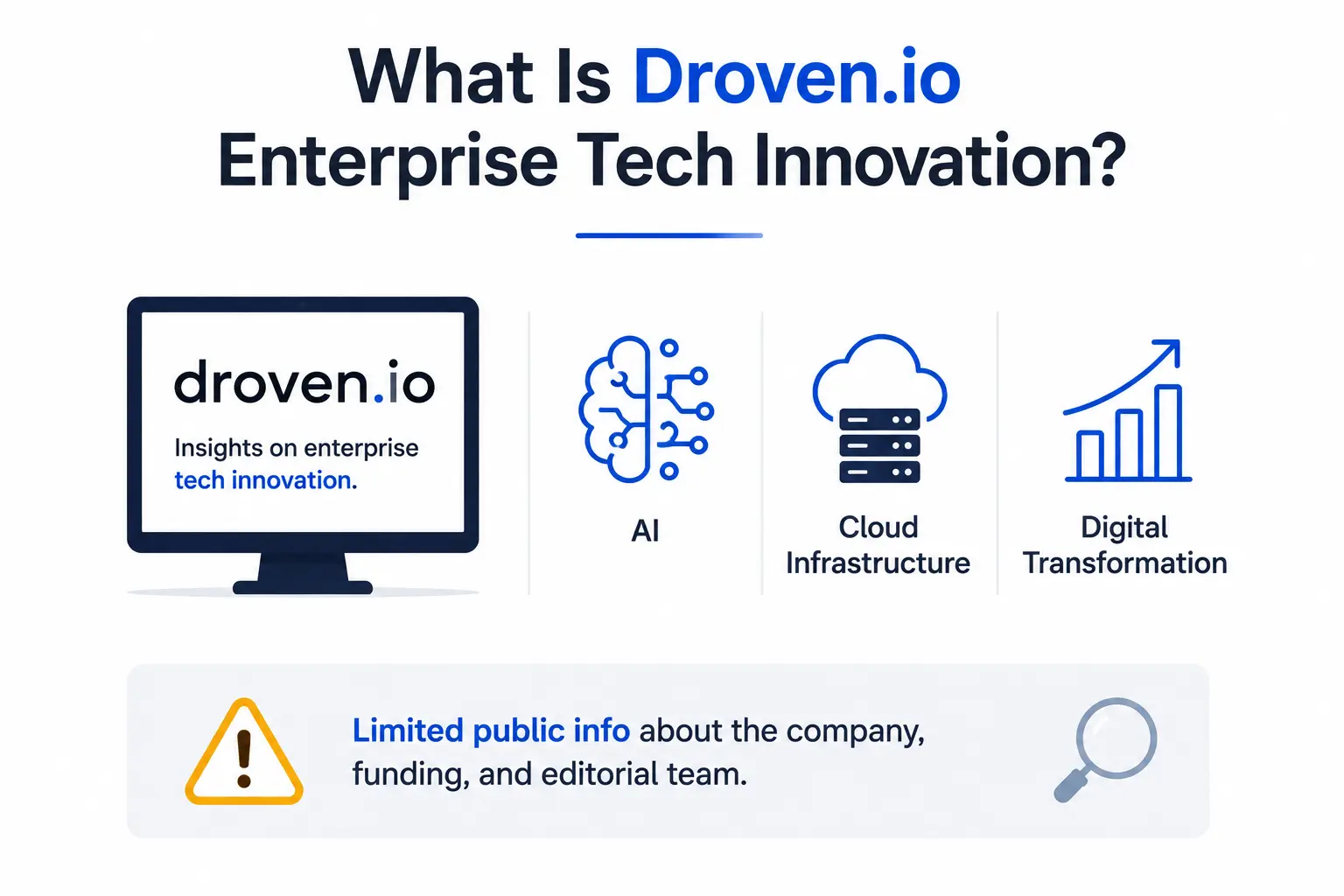
Droven.io positions itself as a resource for enterprise technology topics such as AI, cloud infrastructure, and digital transformation. Public information about the company behind it, its funding, or its editorial team is limited, which is worth knowing before you treat it as an authority on par with established analyst firms.
What “Enterprise Tech Innovation” Means
Enterprise tech innovation refers to how a company introduces new technology into its operations at scale: piloting a tool, integrating it with existing systems, and rolling it out across departments without breaking what already works. It is a business discipline first and a technology topic second.
Is Droven.io a Software Product or Knowledge Platform?
Based on the site structure, Droven.io functions as a content and knowledge platform rather than a software tool you install or subscribe to for automation. There is no dashboard, no account-based product, and no deployable feature set tied to the domain.
What Is Confirmed vs What Is Assumed?
What can be confirmed: the site publishes articles on enterprise technology categories including AI, cybersecurity, and cloud computing. What remains assumed without direct verification: the size of its editorial team, its sourcing standards, and whether content is reviewed by subject-matter practitioners before publication. Treat any specific claim on the site as something to cross-check against a primary source.
Droven.io enterprise tech innovation, in short, describes a content platform that publishes on the topic of enterprise technology adoption, not a product that performs that adoption for you.
What Does Droven.io Cover?
Artificial Intelligence and Generative AI
Coverage in this category typically includes generative AI use cases, large language model applications, and how businesses are testing AI tools in day-to-day workflows.
AI Automation and RPA
This spans robotic process automation and AI-driven workflow tools that handle repetitive tasks such as data entry, invoice processing, and routine approvals.
Machine Learning
Content here generally touches on predictive models, pattern detection, and how machine learning supports forecasting and recommendation systems inside a business.
Cloud Computing
Cloud topics cover infrastructure choices, migration strategy, and the tradeoffs between public, private, and hybrid deployment models.
Cybersecurity
Security coverage tends to focus on enterprise-scale concerns: identity management, threat detection, and the shift toward zero-trust architectures.
Data and Analytics
This category addresses how companies collect, clean, and act on data, including business intelligence tooling and the reporting layer that sits on top of raw data.
Digital Transformation
Digital transformation content covers the broader organizational shift toward technology-first operations, including change management and legacy system modernization.
Emerging Technologies
This is the catch-all for newer categories such as agentic AI, physical AI and robotics, and quantum computing, framed at a conceptual level rather than an implementation one.
The Core Technologies Behind Enterprise Tech Innovation
AI and Intelligent Automation
AI and automation form the layer that removes manual steps from a process. This ranges from simple rule-based bots to models that adapt based on new data.
Cloud and Hybrid Infrastructure
Cloud infrastructure provides the computing and storage capacity that AI and analytics workloads need, and most enterprises run a mix of public cloud, private cloud, and on-premises systems rather than a single environment.
Data Analytics and Business Intelligence
Analytics turns raw operational data into dashboards and reports that inform decisions, closing the loop between what a business does and what it learns from doing it.
Cybersecurity and Zero Trust
Zero trust assumes no user or device is automatically trustworthy, even inside the corporate network, and verifies every request instead of granting broad access by default.
APIs and System Integration
APIs connect otherwise separate systems, letting a CRM, an ERP, and an AI tool exchange data without manual export and import work.
IoT and Edge Computing
Internet of Things devices generate data at the point of use, and edge computing processes some of that data locally instead of sending everything to a central server first.
Robotics and Digital Twins
Robotics handles physical tasks on a factory floor or warehouse, while digital twins create a virtual model of a physical asset or process so teams can test changes without touching the real thing.
Agentic AI
Agentic AI refers to systems that can carry out multi-step tasks with limited human oversight, such as researching an issue, drafting a response, and routing it for approval in one sequence.
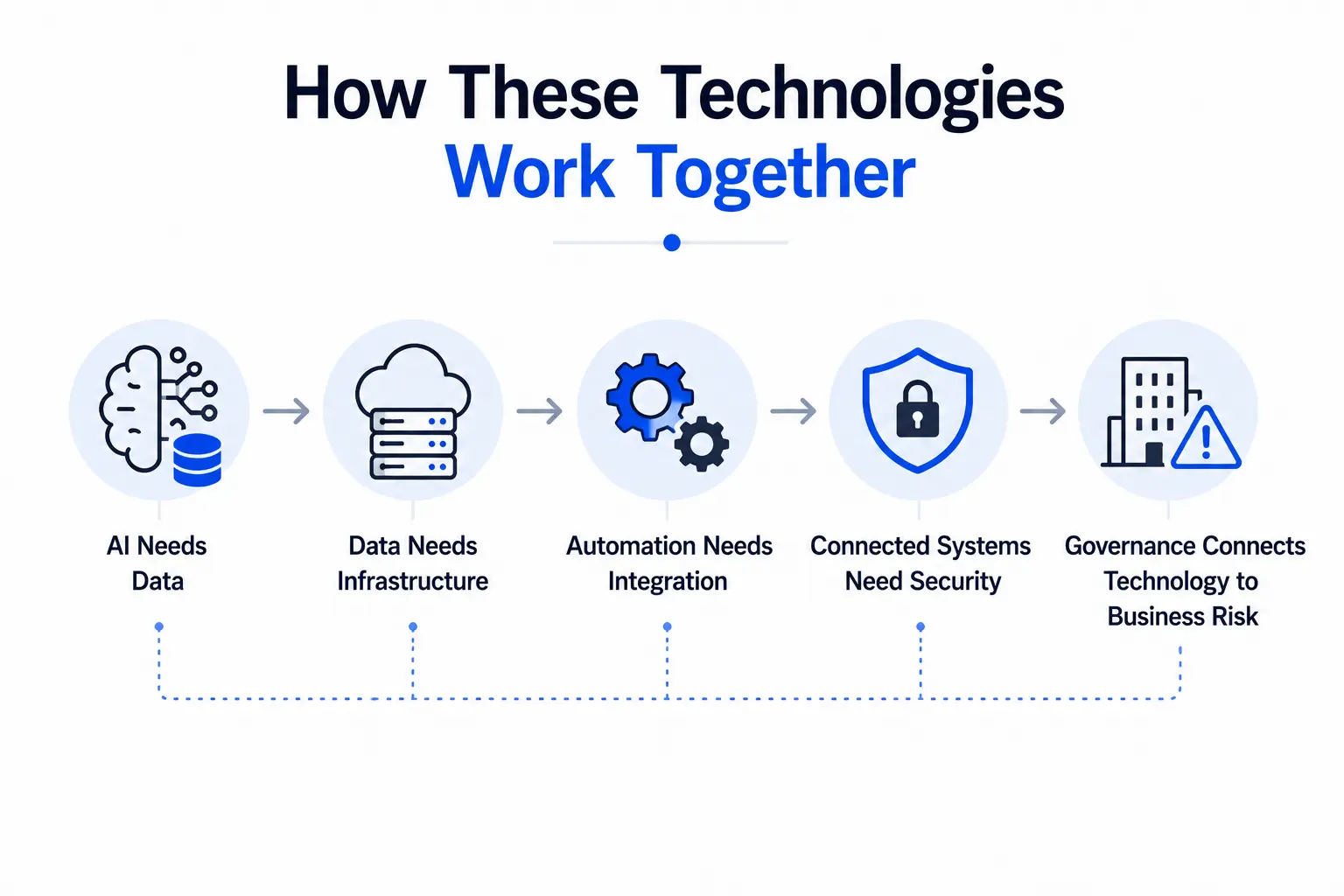
How These Technologies Work Together
AI Needs Data
An AI model is only as useful as the data it learns from. Without clean, relevant data, even a well-built model produces unreliable output.
Data Needs Infrastructure
Data has to live somewhere and be processed somewhere, which is why cloud and hybrid infrastructure sits underneath every analytics or AI initiative.
Automation Needs Integration
Automation only saves time when it can move data between systems on its own. Without APIs and integration, automation stalls at the edge of each individual tool.
Connected Systems Need Security
Every integration point is also a potential entry point for an attacker, which is why zero trust and identity management become more important as systems become more connected.
Governance Connects Technology to Business Risk
Governance is the layer that ties all of this back to accountability: who owns a model, who approves a data source, and who is responsible when something goes wrong.
A useful way to picture the flow: data flows into infrastructure, infrastructure supports AI and automation, automation runs through integrated systems, and security and governance wrap around all of it. Each layer depends on the one below it, so skipping a layer, such as automating without integration or scaling AI without governance, is where most enterprise technology projects run into trouble.
Why Enterprise Tech Innovation Matters in 2026
Moving From AI Experiments to Production
Many companies spent the last few years piloting AI tools. The current phase is about moving those pilots into systems that run reliably at scale, which is a harder engineering and organizational problem than the pilot itself.
Improving Operational Efficiency
Automated workflows reduce the time staff spend on repetitive tasks, freeing up hours for work that actually requires judgment.
Reducing Manual Work
Manual data entry, reconciliation, and status updates are common targets for automation because they are high-volume, low-variance, and easy to measure.
Improving Customer Experience
Faster response times and more consistent service come from systems that can handle routine requests without a person in the loop for every step.
Faster Decision-Making
Real-time dashboards and predictive models shorten the gap between a business event happening and a decision-maker knowing about it.
Building Scalable Infrastructure
Cloud-based systems let a company add capacity as demand grows, instead of over-provisioning hardware years in advance.
Creating New Workforce Capabilities
New tools also require new skills. Teams that learn to work alongside AI and automation tend to get more out of the investment than teams that treat it as a replacement for existing roles.
Enterprise Tech Innovation Use Cases by Industry
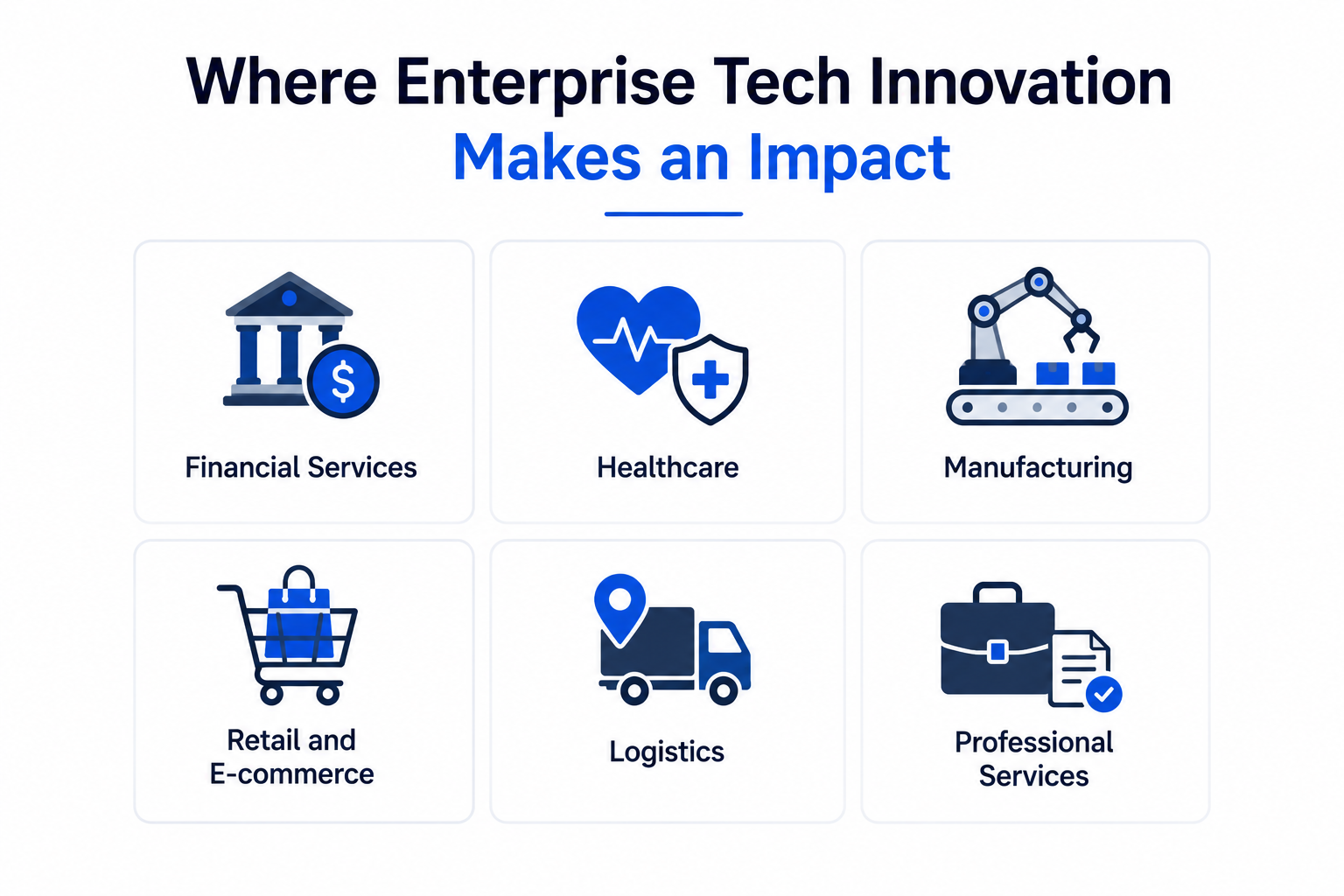
Financial Services
- Fraud detection
- Risk analysis
- Customer service automation
Healthcare
- Administrative automation
- Data analysis
- Predictive systems
Manufacturing
- Robotics
- Digital twins
- Predictive maintenance
Retail and E-commerce
- Demand forecasting
- Personalization
- Inventory optimization
Logistics
- Route optimization
- Fleet monitoring
- Automated exception handling
Professional Services
- Document processing
- AI research
- Workflow automation
Enterprise Technology Maturity: What Is Ready Now?
| Technology | Maturity | Typical Enterprise Use |
| Cloud | Mature | Infrastructure |
| RPA | Mature | Process automation |
| Generative AI | Rapid adoption | Knowledge work |
| AI copilots | Rapid adoption | Employee productivity |
| Agentic AI | Emerging | Multi-step workflows |
| Digital twins | Growing | Simulation |
| Physical AI | Emerging | Robotics |
| Quantum computing | Experimental | Research and optimization |
How to Implement Enterprise Tech Innovation
Step 1 – Define the Business Problem
Start with the problem you are solving, not the technology you want to use. A clear problem statement keeps the project grounded in a measurable outcome.
Step 2 – Audit the Existing Technology Stack
Map out what systems are already in place, what they connect to, and where the gaps are before adding anything new on top.
Step 3 – Assess Data Readiness
Check whether the data you need is available, accurate, and accessible. Most delays in enterprise AI projects trace back to data problems discovered late.
Step 4 – Identify the Highest-Value Use Case
Pick the use case with the clearest path to measurable value rather than the one that sounds most impressive in a slide deck.
Step 5 – Select the Right Technology
Match the tool to the problem and the team’s existing skill set. The most advanced option is not always the one that ships fastest or gets adopted.
Step 6 – Run a Controlled Pilot
Test the solution with a limited group and a defined timeframe before committing to a full rollout.
Step 7 – Measure ROI
Track the metrics that matter to the business, not just usage statistics, before deciding whether to scale.
Step 8 – Scale and Integrate
Once a pilot proves out, connect it to the rest of the technology stack and extend it to additional teams or locations.
Step 9 – Establish Governance
Set clear ownership, approval processes, and monitoring before the system is handling business-critical work at scale.
Step 10 – Continuously Optimize
Revisit performance regularly. A system that works well at launch can drift as data, usage patterns, and business needs change.
How to Measure Enterprise Tech Innovation ROI
Cost Savings
Compare the cost of running a process before and after the change, including labor hours reallocated elsewhere.
Productivity Gains
Measure output per employee or per team before and after implementation to see whether the same staff are accomplishing more.
Revenue Impact
Where the technology touches sales or customer retention, track the change in revenue tied directly to that workflow.
Error Reduction
Fewer manual errors often translate into fewer corrections, fewer customer complaints, and less rework downstream.
Customer Experience
Response time, resolution time, and satisfaction scores are practical indicators of whether a customer-facing change is working.
Employee Adoption
A tool that technically works but that staff avoid using will not deliver the ROI a business case assumed. Adoption rate is worth tracking on its own.
Total Cost of Ownership
Factor in licensing, integration work, training, and ongoing maintenance, not just the upfront purchase price.
A simple starting formula for ROI is: ROI = (Value Gained − Total Cost) ÷ Total Cost, expressed as a percentage. Value gained should include both hard savings, such as reduced labor cost, and softer gains, such as faster turnaround, valued conservatively.
Common Enterprise Technology Innovation Mistakes
Adopting Technology Without a Use Case
Buying a tool because competitors have one, without a specific problem it solves, tends to produce low adoption and wasted spend.
Automating Broken Processes
Automation speeds up whatever process it is applied to, including a process that was flawed to begin with. Fix the process first.
Ignoring Data Quality
Poor data quality undermines AI and analytics projects regardless of how sophisticated the model is.
Underestimating Integration
Connecting a new tool to existing systems is often the most time-consuming part of a project, and it is frequently underestimated during planning.
Treating AI as a Standalone Tool
AI delivers the most value when it is embedded into an existing workflow, not bolted on as a separate step employees have to remember to use.
Ignoring Security and Governance
Skipping governance to move faster tends to create larger problems later, once a system is handling sensitive data at scale.
Scaling a Pilot Too Quickly
A pilot that worked with ten users does not automatically work with a thousand. Scaling introduces new failure points that a small test will not reveal.
Measuring Activity Instead of Business Outcomes
Login counts and usage dashboards are not the same as business impact. Tie metrics back to cost, revenue, or customer outcomes.
Enterprise Tech Innovation Risks
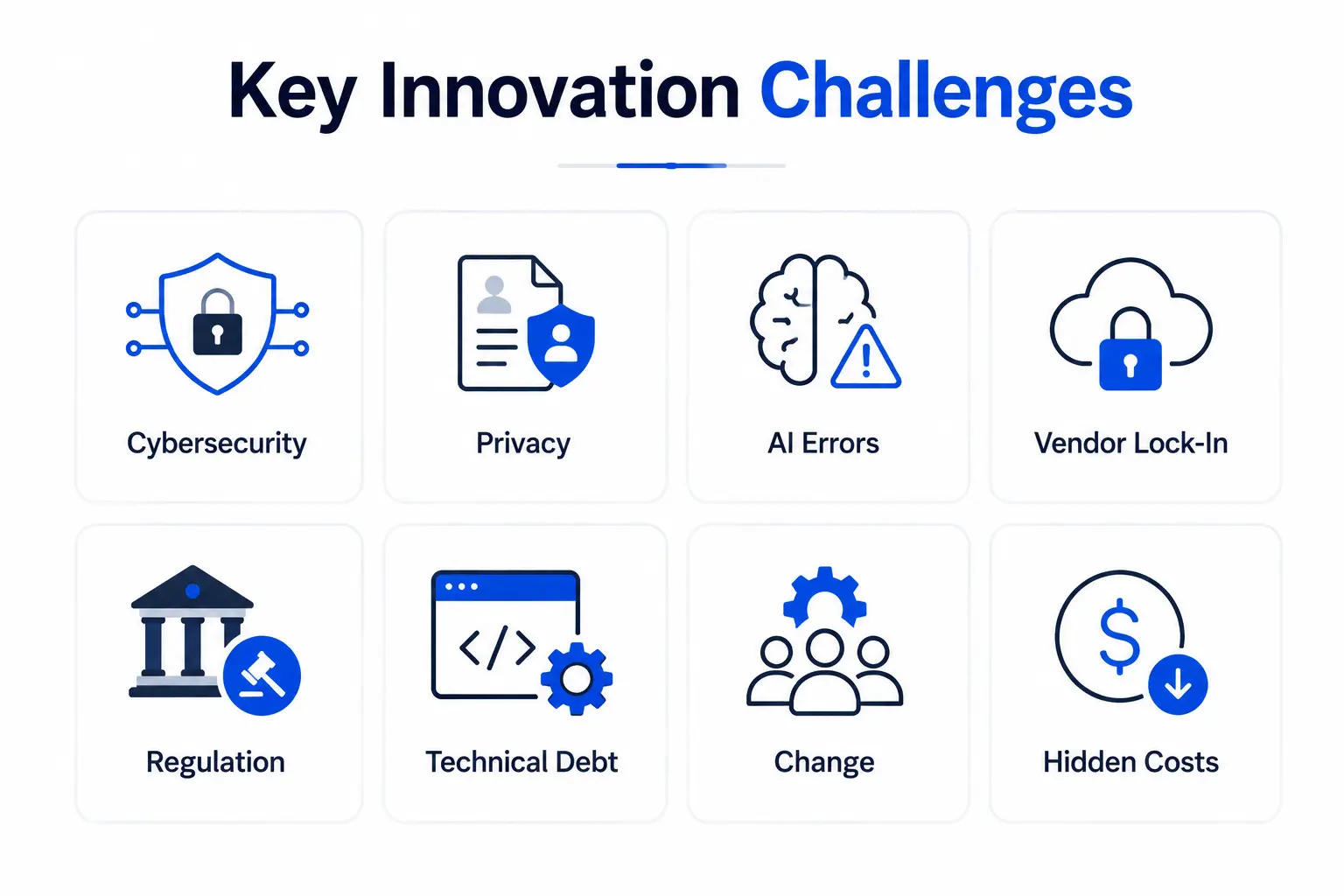
Cybersecurity Risk
New systems widen the attack surface, particularly when they are integrated with core business data.
Data Privacy
Handling customer or employee data through new tools raises compliance questions that need to be addressed before deployment, not after.
AI Hallucinations
AI models can generate plausible but incorrect output, which is a particular risk in workflows where accuracy matters, such as compliance or customer communication.
Vendor Lock-In
Building deeply around one vendor’s tools can make it costly to switch later if pricing changes or the product direction shifts.
Regulatory Risk
Rules around AI use, data handling, and automated decision-making are still developing in many jurisdictions, which means compliance requirements can shift during a project.
Technical Debt
Quick integrations built under deadline pressure often need to be rebuilt properly later, at a higher cost than doing it right the first time.
Change Management
Staff resistance to new tools is a common and underestimated risk. Technology projects can fail on adoption even when the technology itself works.
Hidden Costs
Training, ongoing maintenance, and unplanned integration work often add up to more than the initial licensing cost.
Droven.io vs Traditional Tech Information Sources
Droven.io vs Vendor Blogs
Vendor blogs are written to support a specific product, so they tend to favor that product’s framing. Droven.io is not tied to a single vendor, but it also does not carry the primary-source weight of a company’s own technical documentation.
Droven.io vs Analyst Research
Firms such as Gartner or Forrester publish research based on structured methodology, named analysts, and paid access to detailed reports. Droven.io offers freely accessible overview content, which is useful for orientation but not a substitute for that level of rigor.
Droven.io vs Technical Documentation
For implementation details, a vendor’s own documentation or API reference is the accurate source. Droven.io works better for conceptual background before you get to that stage.
When Droven.io Is Useful
It is a reasonable starting point for getting oriented on a topic, understanding terminology, or scanning the landscape of options before diving into primary sources.
When You Need Primary Sources Instead
For a purchasing decision, a compliance requirement, or anything with financial or legal consequences, verify against vendor documentation, analyst reports, or direct product testing rather than relying on a single overview article.
Who Can Benefit From Droven.io?
Business Owners
Owners who want a general sense of what enterprise tech innovation covers, without committing to a deep technical read, can use it as a starting point.
IT Managers
IT managers already familiar with the technical details may find the content too high-level, but it can still be a quick way to check how a topic is being framed for a non-technical audience.
Developers
Developers looking for implementation guidance will likely need to go elsewhere, since the content here stays conceptual rather than code-level.
Founders
Founders evaluating where to invest technology budget can use it for early orientation before commissioning a more detailed internal analysis.
Students and Learners
Anyone building general knowledge of enterprise technology terms and categories will find the breadth of topics useful as a study aid.
Digital Transformation Teams
Teams already running transformation programs will likely find the content too introductory for day-to-day use, though it can help align vocabulary across departments.
Who Should Look Beyond an Educational Platform?
Anyone making a purchasing decision, a compliance call, or a technical architecture choice needs vendor documentation, analyst research, or a qualified consultant, not a general overview site.
2026 Enterprise Technology Trends to Watch
Agentic AI
Systems that can execute multi-step tasks independently are moving from demos into production use in customer service and internal operations.
AI Governance
As AI use expands, formal governance structures, including model documentation and audit trails, are becoming a standard requirement rather than an optional extra.
AI Infrastructure
Demand for compute capacity dedicated to AI workloads continues to shape enterprise cloud spending and data center planning.
Hybrid and Multi-Cloud
Fewer companies are committing to a single cloud provider, opting instead for a mix that balances cost, performance, and vendor risk.
Zero-Trust Security
Zero trust is shifting from a security buzzword to a baseline expectation in enterprise procurement conversations.
AI-Powered Cybersecurity
Security teams are using AI for anomaly detection and faster threat response, addressing the growing gap between the volume of alerts and available analyst time.
Physical AI and Robotics
AI is increasingly moving off the screen and into physical systems, from warehouse robotics to autonomous inspection equipment.
Digital Twins
Manufacturing and logistics companies are using digital twins more widely to test changes in a virtual environment before applying them physically.
FinOps and Technology Cost Optimization
As cloud and AI spending grows, more companies are formalizing how they track and control that spend rather than treating it as a fixed cost.
How to Evaluate Any Enterprise Technology Platform
Use this checklist when assessing Droven.io, a competing content platform, or any technology vendor:
- Business fit – does it address a real, specific problem your organization has
- Technical fit – does it work with your current systems and skill set
- Integration – how much work is required to connect it to existing tools
- Data requirements – what data does it need, and do you have it in usable form
- Security – what protections are in place around data and access
- Compliance – does it meet the regulatory requirements for your industry
- Scalability – will it hold up as usage grows
- Total cost – including licensing, integration, training, and maintenance
- Vendor or platform maturity – track record, transparency, and stability
- Measurable ROI – a clear way to track whether it delivered value
Is Droven.io Worth Using?
Best Reasons to Use It
It is free, broad in scope, and useful for getting oriented on enterprise technology terminology without committing to a paid research subscription.
Limitations to Consider
Limited transparency about authorship and sourcing means content should be treated as a starting point, not a final answer, especially for anything with financial stakes.
What You Should Verify Independently
Any statistic, product claim, or vendor comparison should be checked against the original source before it informs a business decision.
Who Will Get the Most Value From It?
Readers who are early in their research, looking for a plain-language overview before going deeper, are the best fit for what the site offers.
Frequently Asked Questions
Is Droven.io a legitimate website?
Droven.io appears to function as a content platform covering enterprise technology topics. It is not a scam in the sense of requesting payment for nothing, but it also has limited public information about its ownership and editorial process, so claims on the site should be verified independently before you rely on them for a business decision.
What is enterprise tech innovation?
Enterprise tech innovation is how large organizations adopt new technology, such as AI, cloud infrastructure, and automation, and integrate it into existing operations at scale. It covers the full path from piloting a tool to scaling it across departments with proper governance in place.
Does Droven.io offer software or tools?
No. Based on its site structure, Droven.io functions as an informational content platform rather than a software product. There is no account-based tool or dashboard tied to the domain that performs automation or analysis on your behalf.
Is Droven.io a good source for enterprise technology research?
It works as a starting point for general orientation on a topic, but it should not replace vendor documentation, analyst research, or a qualified consultant for decisions with financial or compliance consequences.
What technologies fall under enterprise tech innovation?
The category typically includes AI and automation, cloud and hybrid infrastructure, data analytics, cybersecurity, APIs and system integration, IoT and edge computing, robotics and digital twins, and emerging areas like agentic AI.
How is enterprise tech innovation different from enterprise software?
Enterprise tech innovation is the strategy and process of adopting new technology across an organization. Enterprise software refers to the specific tools, such as a CRM or ERP system, used to carry out that strategy day to day.
Conclusion
Three separate things get blended together in searches for this topic, and it helps to keep them apart. Droven.io is a technology knowledge and research resource: useful for orientation, not for final decisions. Enterprise tech innovation is the broader business and technology strategy an organization follows to adopt new tools responsibly. Enterprise software is the actual set of products a company deploys to carry that strategy out.
Use Droven.io, or any similar overview platform, as a starting point. For anything that touches budget, compliance, or system architecture, move to primary sources, vendor documentation, or a qualified consultant before you commit.