AI SEO means two related things: using artificial intelligence to do SEO work faster, and optimizing your content so AI-powered search tools like Google AI Overviews, ChatGPT, and Perplexity can find it, understand it, and cite it. Most guides pick one meaning and run with it. That’s where the confusion starts.
This guide covers both sides. You’ll learn how AI changes the mechanics of search, how to adjust your content and technical setup for it, and how to use AI tools without losing the judgment that good SEO still requires.
What Is AI SEO?
1. AI SEO in simple terms
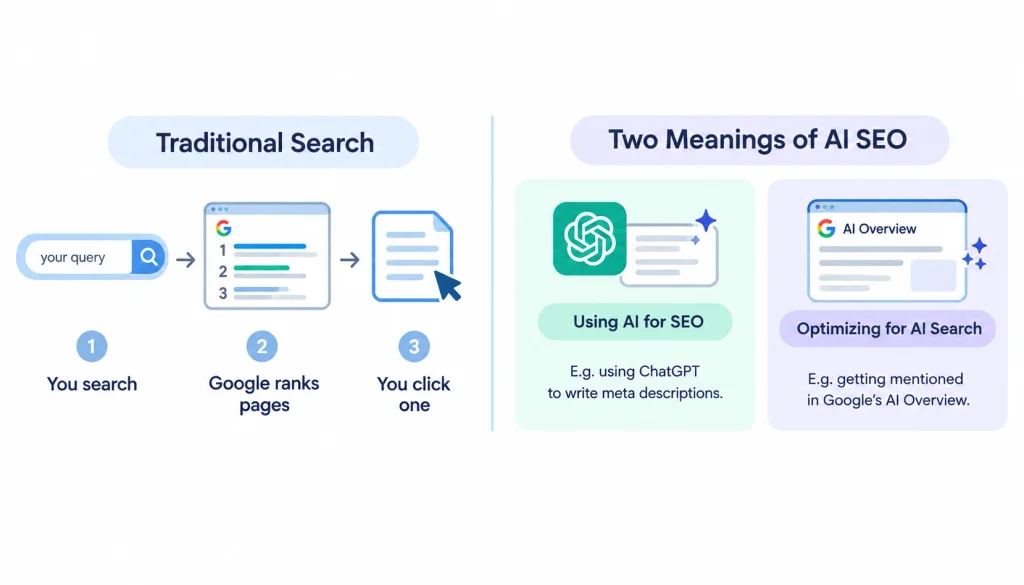
Search used to work like this: you type a query, Google ranks a list of pages, you click one. AI SEO covers everything that’s changing about that process, plus the tools people now use to keep up with it.
If you search r/SEO or r/TechSEO on Reddit for “AI SEO,” you’ll notice practitioners use the term loosely. Some mean “I used ChatGPT to write my meta descriptions.” Others mean “I’m trying to get mentioned in Google’s AI Overview.” Both are valid, but they’re different problems with different solutions.
2. The two meanings of AI SEO
Using AI to improve traditional SEO
This is AI as a tool. You use it to cluster keywords, draft content outlines, spot technical issues, or summarize competitor pages. The end goal hasn’t changed: you still want to rank in traditional search results and earn organic clicks.
Optimizing content for AI-powered search
This is AI as the audience. Google’s AI Overviews, ChatGPT, and Perplexity don’t just rank your page, they read it, extract facts from it, and decide whether to cite it in a generated answer. Optimizing for that process is closer to what some marketers call generative engine optimization, or GEO.
Most companies need to do both at once. Treating them as separate projects usually wastes time.
3. What AI SEO is not
A few things AI SEO doesn’t mean, despite how it’s sometimes marketed:
- It isn’t publishing large volumes of unedited AI-generated text and hoping it ranks.
- It isn’t a replacement for the SEO fundamentals: intent matching, site structure, and links.
- It isn’t a guarantee that an AI system will cite your page, no matter how well you optimize.
- It isn’t keyword stuffing with an AI label attached.
How Does AI SEO Work?
1. How traditional search works
A search engine crawls pages, indexes them, and ranks them for a query using hundreds of signals: relevance, links, page experience, and more. You’ve probably seen this diagram before: query goes in, ranked list comes out, user clicks a link.
2. How AI-powered search works
AI search adds steps. When someone asks ChatGPT or uses Google’s AI Mode, the system typically retrieves a set of relevant sources, reads through them, and synthesizes an answer in its own words. Some systems cite sources directly; others just absorb the information into a generated response with no link at all.
The Wikipedia entry on retrieval-augmented generation describes this retrieve-then-generate pattern, which is the basic mechanism behind most AI search products today.
3. From ranking pages to retrieving and synthesizing information
The practical shift for SEO: a page doesn’t just need to rank. It needs to contain something specific and extractable enough that an AI system can pull a clean fact or claim out of it. A page full of vague marketing language gives the model nothing usable to quote.
Here’s the flow in plain terms:
User query → AI retrieves candidate sources → AI reads and selects relevant passages → AI generates an answer → AI may cite or link the source
4. Why entities, context, and relationships matter
AI systems reason about entities (people, companies, products, concepts) and how they relate to each other, not just the words on a page. If your brand, your product, and your claims aren’t clearly and consistently described across the web, the model has a harder time trusting or representing you accurately. This is why entity consistency, using the same name, description, and facts everywhere, has become a bigger deal than it used to be.
AI SEO vs. Traditional SEO
| Factor | Traditional SEO | AI SEO |
| Primary goal | Rank in search results | Rank and get cited or summarized accurately |
| Search experience | List of links | Generated answers, sometimes with links |
| Keywords | Match query phrasing | Match intent and underlying questions |
| Content structure | Headings, readability | Extractable facts, clear entities, concise answers |
| Links | Ranking signal | Ranking signal and trust signal for citation |
| Technical SEO | Crawlability, speed | Same, plus structured data for machine reading |
| Measurement | Rankings, clicks, traffic | Rankings, clicks, plus AI mentions and citations |
AI SEO extends traditional SEO rather than replacing it. Everything that made a page rankable, clear intent match, solid technical setup, credible links, still matters. AI search just adds a second layer of requirements on top.
AI SEO vs. GEO vs. AEO vs. LLMO
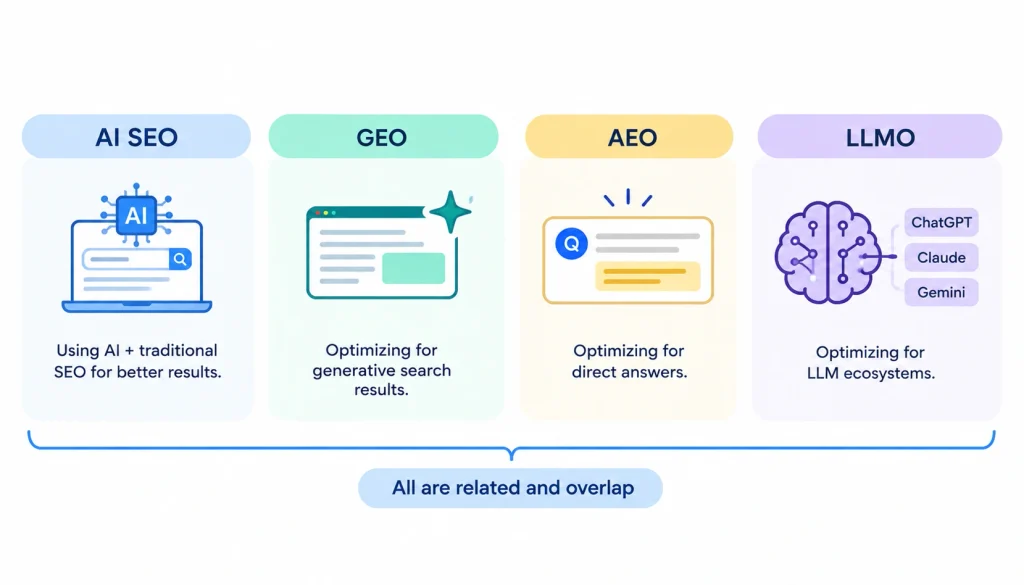
These terms overlap enough to cause real confusion, so here’s a working breakdown.
1. What is AEO?
AEO stands for answer engine optimization. It focuses on getting your content featured as a direct answer, think featured snippets, voice assistant responses, or the “answer box” at the top of a search page.
2. What is GEO?
GEO stands for generative engine optimization. It’s specifically about visibility inside AI-generated answers, like Google’s AI Overviews or a ChatGPT response, rather than in a traditional list of links.
3. What is LLMO?
LLMO stands for large language model optimization. It’s the broadest of the three, covering how your brand and content get represented across LLM ecosystems generally, including in contexts where the model isn’t doing a live web search at all, just drawing on what it learned during training.
4. How these concepts overlap
In practice, AEO, GEO, and LLMO all describe pieces of the same shift: search results are increasingly generated rather than listed. AI SEO is the umbrella term most people use in conversation to cover all of it, plus the AI-assisted workflows on the production side.
5. AI SEO terminology comparison table
| Term | Primary focus | Typical output |
| Traditional SEO | Organic search rankings | Ranked list of links |
| AEO | Direct answer visibility | Featured snippets, answer boxes |
| GEO | Generative search visibility | AI-generated summaries and citations |
| LLMO | Representation across LLMs | Model-generated mentions, even without a live search |
| AI SEO | Umbrella term | AI-assisted SEO work plus visibility across all the above |
Why Does AI SEO Matter?
1. Search behavior is becoming more conversational
People increasingly type full questions instead of short keyword phrases, especially when they’re using a chat interface instead of a search box. That changes what “matching the query” actually requires from your content.
2. AI-generated answers can reduce traditional clicks
When a search result page shows a generated answer above the organic listings, some users get what they need without clicking through to any site. That’s a real change in the value of a given ranking position, not just a theoretical one.
3. Search visibility now extends beyond blue links
Being cited inside an AI Overview or a ChatGPT answer is a form of visibility that doesn’t show up in a traditional rank tracker. Ignoring it means missing part of the picture.
4. Brand and entity visibility matters
If someone asks an AI assistant to recommend a product in your category and your brand never comes up, that’s a lost opportunity a rank tracker won’t catch, because there was no search results page involved at all.
5. AI makes SEO analysis more scalable
On the practical side, AI tools genuinely speed up work that used to take hours: clustering hundreds of keywords, summarizing competitor content, or spotting technical patterns across a large site.
How AI Is Changing SEO
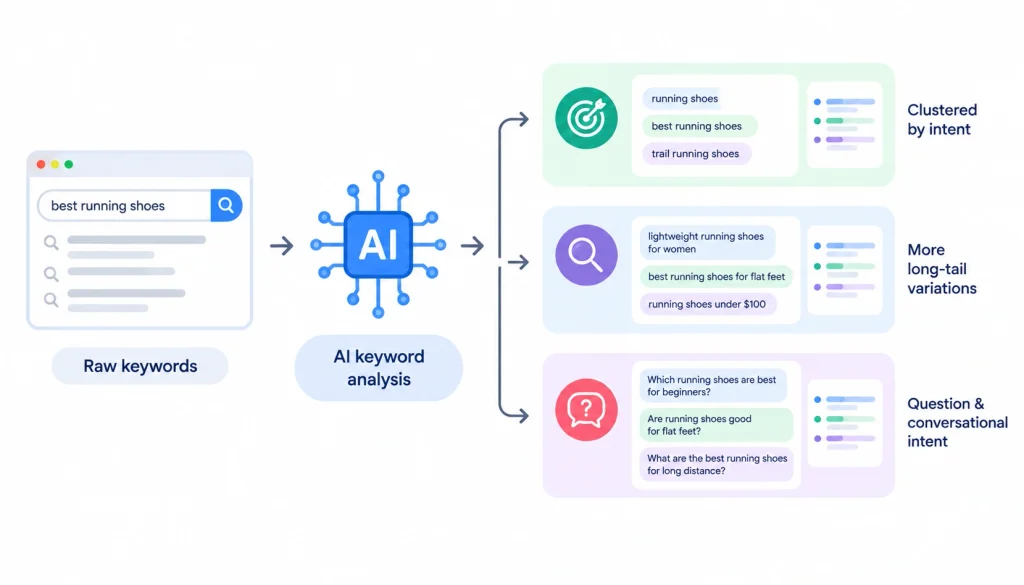
1. Keyword research
AI tools can cluster keywords by intent much faster than manual grouping, surface long-tail variations you’d otherwise miss, and flag which queries likely have conversational or question-based intent. For a deeper look at how to evaluate search results and build a keyword strategy, see our guide to [keyword research and SERP analysis].
2. Content research and creation
AI can summarize what’s already ranking, draft an outline, or produce a first pass at a section. It’s genuinely useful for speed. It’s not a substitute for someone who actually knows the topic reviewing and correcting the output.
3. On-page optimization
AI tools can suggest heading structure, flag missing subtopics, and check readability. Some platforms will also flag whether your page answers common related questions, which matters more now that those questions often get answered directly by an AI Overview.
4. Competitor analysis
AI can summarize what competitors cover, how they structure content, and where their gaps are, turning a task that used to take an afternoon into something you can review in minutes.
5. Technical SEO
AI-assisted crawlers can flag issues (broken links, duplicate content, missing schema) at scale and, increasingly, suggest fixes in plain language instead of just a raw error log.
6. Link building and SEO reporting
AI can help identify relevant sites for outreach and draft reporting summaries, though the actual relationship-building and quality judgment behind link building still needs a person.
How to Optimize Your Website for AI Search
This is the practical core of AI SEO. Here’s what actually moves the needle.
- Match search intent precisely. Before anything else, confirm what the searcher actually wants. AI systems are good at detecting mismatched or generic content and will skip it in favor of a source that answers the specific question asked.
- Build topical depth, not just individual pages. A site with genuine coverage of a topic, not just one article but a cluster of related pages, signals expertise more convincingly than a single standalone post.
- Make entities clear and consistent. Use the same name, description, and facts about your brand, product, or organization everywhere they appear online. Inconsistency makes it harder for an AI system to trust what it finds.
- Write concise, extractable answers. Put the direct answer to a question near the top of the relevant section, in a sentence or two, before you expand on it. That’s the part most likely to get pulled into a generated answer.
- Add information that isn’t already everywhere else. If your page says exactly what the top five competitors already say, there’s no reason for an AI system to prefer you. Original data, a real example, or a specific detail from direct experience gives it a reason to.
- Show first-hand expertise, not just knowledge. A sentence like “in our testing, this took eighteen minutes to set up” carries more weight than a generic description of the process.
- Use descriptive, specific headings. Headings that state the actual question or subtopic (not vague labels like “More Info”) help both readers and AI systems scan your structure accurately.
- Strengthen internal linking. Clear internal links help both crawlers and AI retrieval systems understand how your pages relate to each other and which one is the authoritative source on a given subtopic. For a broader look at technical SEO, internal linking, site structure, and other advanced SEO techniques, see our detailed SEO guide.
- Implement relevant structured data. Schema markup doesn’t guarantee an AI citation, but it gives machines an unambiguous, labeled version of your facts, which lowers the risk of misinterpretation.
- Build authoritative mentions and backlinks. Being referenced by credible third-party sites still functions as a trust signal, for traditional rankings and, increasingly, for AI systems weighing which sources to trust.
- Keep important information current. Outdated facts get either ignored or, worse, cited incorrectly. Revisit and update pages that contain time-sensitive information.
- Monitor your AI visibility. Periodically check how AI tools describe your brand or answer questions in your space. If they’re getting something wrong, that’s worth correcting at the source.
How to Use AI in Your SEO Workflow
A realistic workflow looks something like this:
- Research. Use AI to help identify relevant topics and questions, then verify against actual search data.
- Analyze competitors. Summarize what’s ranking and where the gaps are.
- Build keyword clusters. Group related terms by intent, not just by similarity.
- Create a content brief. Outline the structure, key questions to answer, and any data points to include.
- Draft with AI assistance. Generate a first pass to work from, not a finished piece.
- Add human expertise. Bring in specific examples, opinions, or data an AI model couldn’t produce on its own.
- Fact-check everything. Verify every claim, statistic, and named source before publishing.
- Optimize on-page elements. Headings, meta descriptions, internal links, and schema.
- Publish and build authority. Earn mentions and links through genuinely useful content, not shortcuts.
- Measure and improve. Track both traditional metrics and AI visibility, then revise underperforming pages.
What AI Can Do for SEO vs. What Humans Should Do
| SEO task | AI assistance | Human judgment needed |
| Keyword clustering | High | Some, to verify intent |
| Content briefs | High | High |
| Fact-checking | Some | High |
| Technical auditing | High | High, to prioritize fixes |
| Original research | Low | Very high |
| Expert opinions | Low | Very high |
| Content editing | High | High |
| Strategy | Some | Very high |
The pattern here is consistent. AI is strong at pattern recognition and speed. It’s weak at judgment, original insight, and knowing what’s actually true. That gap is exactly where human review earns its place.
Best AI SEO Tools by Use Case
Rather than a long generic list, here’s what different tool categories are actually good for:
AI visibility tracking: a newer category of tools built specifically to monitor how often and how accurately your brand appears in AI-generated answers.
Keyword and competitor research: platforms like Semrush and Ahrefs, now with AI-assisted clustering and content-gap features.
Technical auditing: crawlers like Screaming Frog, which flag site issues at scale.
Content research and ideation: AI assistants like ChatGPT, Claude, or Gemini, useful for summarizing and drafting, not for final copy.
Content optimization: tools like Surfer or Clearscope, which check content against what’s currently ranking.
Link building and SEO reporting: AI can help identify relevant sites for outreach and draft reporting summaries, while link building software solutions can streamline prospecting, outreach, monitoring, and reporting.
Performance tracking: Google Search Console and Google Analytics, still the foundation for measuring actual traffic and conversions.
How to Measure AI SEO Success
1. Traditional SEO metrics
Rankings, impressions, clicks, organic traffic, conversions, and backlinks are all still relevant. None of them have stopped mattering.
2. AI-search metrics
These are newer and less standardized, but worth tracking where you can:
- AI mentions and citation frequency
- Share of AI visibility within your category
- Accuracy of how AI systems represent your brand
- Referral traffic that originates from AI platforms
- Conversion activity tied to that traffic
3. Why rankings alone are no longer enough
A page can rank well and still lose visibility if an AI Overview answers the query before anyone scrolls down to organic results. Tracking rankings alone won’t show you that. You need both sets of metrics side by side to see the full picture.
Common AI SEO Mistakes to Avoid
- Publishing large volumes of generic AI content without editing or fact-checking.
- Optimizing exclusively for exact-match keywords instead of the underlying question.
- Writing for AI crawlers in a way that makes the content worse for actual readers.
- Ignoring entity consistency across your site and other platforms.
- Neglecting basic technical SEO because AI feels like the new priority.
- Trusting AI-generated facts or statistics without verifying them.
- Measuring success by rankings alone.
- Assuming that following best practices guarantees an AI citation. It doesn’t.
Does AI-Generated Content Help or Hurt SEO?
1. When AI-generated content can be useful
AI is genuinely helpful for first drafts, outlines, and summarizing research you’ve already gathered. Used that way, it speeds up production without lowering quality, as long as a knowledgeable person reviews the output.
2. When AI-generated content creates problems
Publishing AI output with no editing, no fact-checking, and no added expertise tends to produce generic pages that don’t rank well and don’t earn citations either. Search engines and AI systems are both getting better at recognizing that pattern.
3. Human expertise, originality, and editorial review
The deciding factor isn’t whether AI touched the content. It’s whether a knowledgeable person verified the facts, added something original, and took responsibility for what’s published.
4. A practical AI content quality checklist
- Does this page say something a competitor’s page doesn’t?
- Has every fact and statistic been verified?
- Would a genuine expert in this field agree with what’s written here?
- Is there a named author or clear source of authority behind the content?
- Has a human actually read the whole thing before publishing?
What Does the Future of AI SEO Look Like?
Search is likely to keep moving toward conversational, multi-step interactions rather than single keyword queries. Entity authority, being clearly and consistently recognized as a credible source on a topic, will probably matter more over time, not less.
Measurement will keep expanding past rankings and traffic into visibility across AI-generated answers. None of that changes the underlying requirement: content still needs to answer a real question accurately and demonstrate that someone with actual knowledge stood behind it. That part of SEO isn’t going away.
AI SEO Example: From Traditional Blog to AI-Ready Content
Original page: A blog post titled “Best CRM for Small Business” with generic descriptions of five tools, no first-hand testing, and thin comparison detail.
Problems identified: No original data, no clear answer near the top, inconsistent naming of tools and features, no schema markup, and no updates since publication.
AI-assisted research: Used to quickly summarize how competitor articles structured their comparisons and which subtopics they covered.
Entity and topic expansion: Added consistent product names, added a comparison table, and expanded coverage to include a few commonly asked follow-up questions (pricing tiers, integrations, setup time).
Content restructuring: Moved the direct recommendation and reasoning to the top of each section instead of burying it under a long intro.
Human expertise added: Included specific notes from actually testing two of the tools, along with setup time and a concrete limitation found in testing.
Final measurement framework: Tracked rankings and organic traffic as before, and added monthly checks of how ChatGPT and Google’s AI Overview described the recommended tools, correcting any inaccuracies found.
Frequently Asked Questions About AI SEO
What is AI SEO?
AI SEO covers using AI tools to do SEO work faster and optimizing content so AI-powered search systems can find, understand, and cite it accurately.
Is AI SEO the same as traditional SEO?
No, but it’s closely related. AI SEO builds on traditional SEO fundamentals and adds requirements specific to how AI systems retrieve and generate answers.
What is the difference between AI SEO and GEO?
GEO (generative engine optimization) is a narrower term focused specifically on visibility inside AI-generated answers. AI SEO is the broader umbrella term that includes GEO along with AI-assisted SEO workflows.
Does AI SEO replace traditional SEO?
No. Rankings, technical health, and backlinks still matter. AI SEO adds a second layer of considerations on top of the same foundation.
How do I optimize my website for AI search?
Focus on clear intent matching, consistent entity information, concise and extractable answers, original content, and solid technical SEO, including structured data.
Final Takeaway
AI SEO isn’t a separate discipline you need to build from scratch. It’s better understood as an extension of strong traditional SEO, combined with genuinely useful and original content, consistent entity information, a technically sound website, real authority, and ongoing monitoring of how AI-powered search systems understand and represent your brand.
The fundamentals still matter: search intent, crawlability, internal linking, content quality, topical relevance, backlinks, and user experience provide the foundation.
The AI-specific layer builds on that foundation by making your content easier for AI systems to understand, retrieve, summarize, and cite.
This can include clearer answers, stronger entity relationships, structured information, and content that demonstrates first-hand expertise.
In other words, don’t abandon the SEO practices that already work just because search is becoming more AI-driven. Get the fundamentals right first, then adapt your content and measurement approach to the way modern search experiences work.
AI SEO is most effective when it strengthens an already solid SEO strategy rather than trying to replace it.