If you own a business you have probably noticed that it is getting harder to rank on Google every year. Big companies have budgets, big teams and a lot of backlinks that you are just starting to build now.
This does not mean you cannot compete with the companies. It just means you need to be smart about which SEO services you pay for.
A lot of people who own businesses sell SEO packages that look good on paper. These packages say they will track hundreds of keywords and build dozens of backlinks.. A lot of the time these things do not turn into phone calls, people filling out forms or sales.
The real problem with SEO packages is that they think getting your website seen is the most important thing.. Getting your website seen should just be the first step to making money.
This guide will tell you what small business SEO services should include. It will also tell you how much they cost and how to find a SEO provider. You will learn how to make a plan for the next 90 days. This guide will give you the facts, without any stuff or promises that your website will be number one on Google. It will just tell you what really works for small business SEO services, like yours.
What Are the Best SEO Services for Small Businesses?
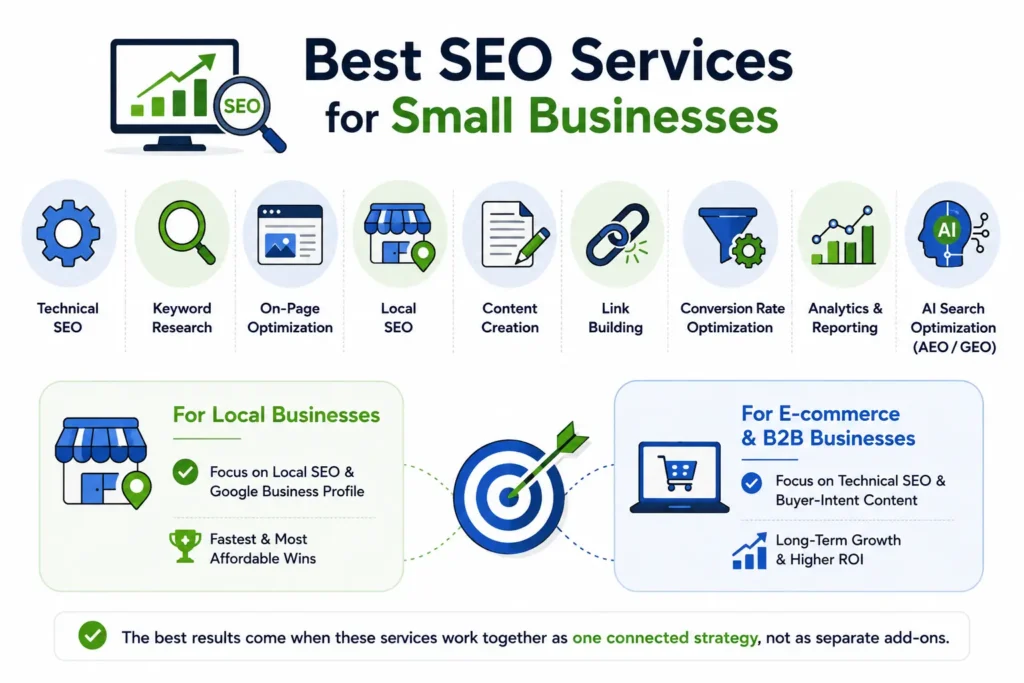
The best SEO services for small businesses combine technical SEO, keyword research, on-page optimization, local SEO, content creation, link building, conversion rate optimization, analytics, and increasingly AI search optimization (AEO/GEO). No single service works in isolation; small businesses see the best results when these pieces are combined into one connected strategy rather than purchased as disconnected add-ons.
For most local businesses, local SEO and Google Business Profile optimization should come first, since that’s where the fastest, most affordable wins usually show up. For e-commerce and B2B companies, technical SEO and content built around buyer intent tend to matter more.
Small Business SEO Company Shortlist
Third Marble
A practical first comparison point for local businesses that need help getting found without buying an oversized SEO program. Third Marble’s positioning leans toward small-business visibility, local search, Google presence, and lead generation, which makes it relevant for owners who need a focused starting point rather than a full digital department.
Caveat: A narrower model can be useful for budget control, but confirm exactly what happens with technical SEO, content creation, link development, and reporting before you compare it with a larger agency proposal.
OuterBox
OuterBox runs SEO programs for small businesses that need search visibility tied to web design, development, content, paid media, analytics, and conversion work. That fit is strongest when a business has moved beyond a basic local listing cleanup and needs a more custom growth plan.
Caveat: Yeah, we wrote this list, and yes, we included ourselves. We tried to be fair about it. SEO has been a core service of ours for a long time, and we wanted that perspective in the comparison.
Boostability
A scalable SEO provider for small businesses and agency partners that want SEO delivered through a more standardized model. The fit is strongest when the buyer wants defined SEO support, local visibility help, recurring work, and reporting without starting from a fully custom enterprise-style engagement.
Caveat: Standardized delivery can keep scope and cost under control, but ask how strategy changes when your market is unusually competitive, your site has technical debt, or your content needs more than basic optimization.
MarketKeep
A smaller-agency fit for businesses that want SEO, website support, content basics, and local marketing help from one team. The positioning is especially relevant for service-area businesses, professional services, and local companies trying to turn a website into a steadier lead source.
Caveat: Smaller teams can be responsive, but they may not be the right fit for multi-location SEO, ecommerce catalog complexity, heavy technical cleanup, or aggressive content production. Confirm capacity before shortlisting.
SmartSites
A broad digital agency option for small and mid-sized businesses that want SEO connected with web design, PPC, ecommerce, creative, and conversion paths. Useful when the site itself, ad strategy, landing pages, or creative quality are holding organic performance back.
Caveat: A large service menu does not guarantee the right account team. Ask who owns SEO strategy, technical recommendations, implementation follow-through, and reporting after the sale.
Which SEO Services Should You Prioritize?
Not every business needs the same starting point. Here’s how prioritization typically breaks down.
For a local service business (plumbers, dentists, law firms, salons): Local SEO first, then service pages, then reviews, then content, then link building.
For an e-commerce business: Technical SEO first (since product catalogs create technical complexity), then category pages, then product optimization, then content, then authority building.
For a B2B company: Commercial keyword research first, then service pages, then expert content that demonstrates real knowledge, then digital PR, then conversion optimization.
For a brand-new website: Technical foundation first, then keyword research, then site architecture, then core pages, then content.
For an established website that’s plateaued: A technical audit first, followed by content pruning (removing or consolidating weak pages), content refreshes, internal linking improvements, and authority building.
Best SEO Tools for Small Businesses
1. Google Search Console
Free and essential. It shows you exactly how Google sees your site, which keywords you’re ranking for, and any indexing issues that need fixing.
2. Google Analytics
Tracks how visitors behave once they land on your site, which pages convert, where people drop off, and how organic traffic compares to other channels.
3. Google Business Profile
The backbone of local SEO. It controls how your business appears in Google Maps and local search results, and it’s where most of your reviews live.
4. Semrush
A paid platform useful for keyword research, competitor analysis, and site audits, particularly helpful if you’re comparing your visibility against competitors.
5. Ahrefs
Widely used for backlink analysis and keyword research; particularly strong for understanding your link profile and finding link-building opportunities.
6. Screaming Frog
A technical crawling tool that scans your entire website to surface broken links, missing meta tags, and other technical issues.
7. PageSpeed Insights
Google’s free tool for measuring page speed and Core Web Vitals useful for diagnosing why a page might be loading slowly.
8. Google Rich Results Test
Checks whether your structured data (schema markup) is implemented correctly and eligible for rich results in search.
Each of these tools serves a different purpose: the free Google tools are non-negotiable, while the paid platforms (Semrush, Ahrefs) become more valuable as your SEO program matures.
A 90-Day SEO Plan for a Small Business
Month 1 — Fix the Foundation
Run a full technical audit, fix the highest-priority technical issues, complete keyword research, and analyze what competitors are doing well.
Month 2 — Build Relevance
Optimize or create core service pages, publish new content aligned with keyword research, strengthen internal linking, and optimize local listings.
Month 3 — Build Authority and Conversions
Begin link acquisition and digital PR outreach, implement conversion rate optimization on key pages, build out a review generation strategy, and formalize ongoing measurement and reporting.
This isn’t a rigid formula: a competitive market or a site with serious technical debt may need a longer foundation phase. But this structure gives most small businesses a realistic, achievable starting point.
How Much Do SEO Services Cost for a Small Business?
SEO pricing varies a lot depending on the provider, your market, and how competitive your industry is. Here are the most common pricing models:
- Hourly consulting — typically used for audits or strategy sessions rather than ongoing work
- One-time audit — a fixed-price technical or full-site review
- Monthly retainer — the most common model for ongoing SEO work
- Project-based SEO — a fixed scope, like a site migration or a content overhaul
- Local SEO packages — often priced lower than full national SEO campaigns
- E-commerce SEO — usually priced higher due to catalog size and complexity
- Performance-based arrangements — less common, and worth scrutinizing closely (more on that below)
What Affects SEO Pricing?
There are a lot of things that affect the price of something. For example the price can go up or down depending on how competitive the business you are in. It also matters where your business is located. The size and condition of your website is another factor. How many pages your website has is important too. You also have to think about how much work’s needed to create content for your website. Building links to your website is another thing that can affect the price. What you want to achieve with your business also plays a role.
A small business in one place with a website will usually cost less to work with than a big business that sells things online and has many locations and thousands of product pages, on their website.
What Should You Get for Your Monthly SEO Budget?
| Monthly Budget | What You Should Reasonably Expect |
| Under $500 | Very limited scope — often just local listing management or a partial audit. Be cautious here. |
| $500–$1,500 | Local SEO, basic on-page optimization, light content, monthly reporting |
| $1,500–$3,500 | Full local + on-page SEO, regular content production, basic link building, CRO input |
| $3,500–$7,500 | Comprehensive strategy across technical, content, links, and conversion, with dedicated account management |
| $7,500+ | Enterprise-level campaigns, often including digital PR, advanced technical work, and multi-location strategy |
These are general ranges, not fixed rules, and always ask a provider to explain exactly what’s included at their price point.
What Should a Small Business SEO Package Include?
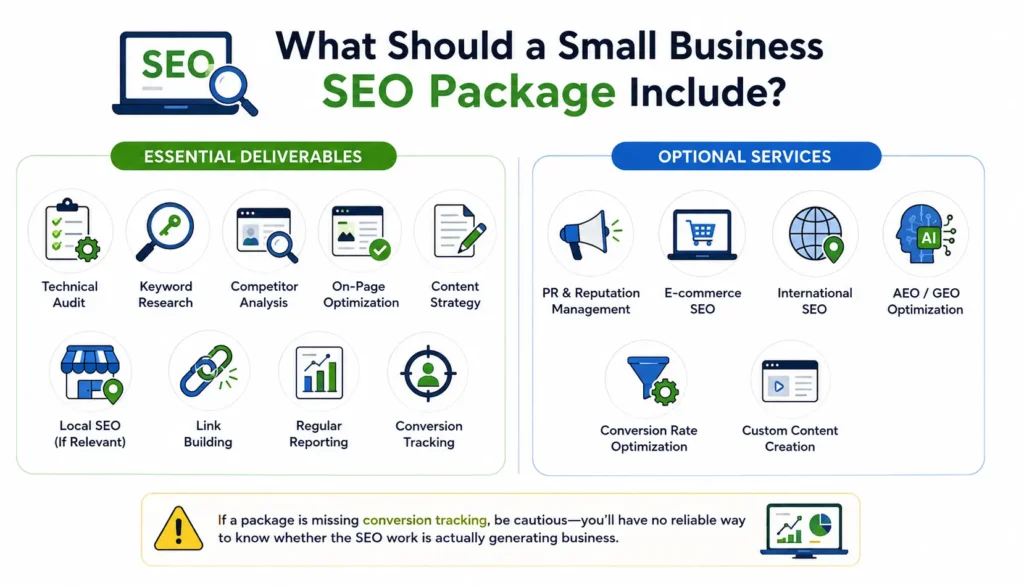
Essential Deliverables
A solid SEO package, at minimum, should include a technical audit, keyword research, competitor analysis, on-page optimization, a content strategy, local SEO (if relevant), some form of link building, regular reporting, and conversion tracking.
If a package is missing conversion tracking, be cautious you’ll have no reliable way to know whether the SEO work is actually generating business.
Optional Services
Depending on what you want to achieve you might also need PR managing your reputation SEO that works for online stores SEO for other countries optimizing for AEO or GEO improving conversion rates or making special content. These aren’t necessary for all companies. They are good to include once your basics are strong.
How to Choose the Best SEO Service Provider for Your Small Business
1. Define Your Business Goal
Are you after more traffic, more leads, more sales, or more local visibility? Your goal should shape the entire strategy. A provider who doesn’t ask about this upfront is a red flag.
2. Check Relevant Experience
Look for experience in your industry, your business model, and ideally your location. An agency that’s only worked with e-commerce brands may not understand the nuances of local service businesses.
3. Ask for Real Case Studies
Ask specifically for measurable outcomes: traffic growth, lead increases, ranking improvements not just vague claims like “we improved their SEO.”
4. Understand Their SEO Process
A credible provider should be able to explain, in plain terms, what happens during the first 30, 60, and 90 days of working together.
5. Review Reporting
Good reporting looks beyond rankings and shows you traffic, leads, and business impact. If a report only shows keyword positions, ask why.
6. Check Communication
Find out exactly who will manage your account day to day, and how often you’ll hear from them.
7. Understand Contracts and Cancellation
Avoid vague commitments. Know exactly what you’re signing up for and how to exit if it’s not working.
8. Ask How They Build Links
Quality and relevance matter far more than volume. If a provider promises hundreds of links per month, that’s a warning sign, not a selling point.
9. Ask How They Handle Algorithm Changes
Google updates its algorithm frequently. A good provider should have a clear process for monitoring and responding to these changes, not just reacting after rankings drop.
10. Make Sure They Understand Your Customers
SEO that ignores your actual customer isn’t SEO — it’s guesswork. A provider should ask about your ideal customer before writing a single page of content.
Local SEO vs Traditional SEO: Which Is Better for a Small Business?
When Local SEO Should Come First
If most of your customers come from a specific geographic area, think restaurants, home services, medical practices, or retail stores, local SEO should almost always be the priority. It’s typically faster to show results and more directly tied to phone calls and walk-ins.
When National SEO Makes More Sense
If you sell products or services online without a geographic limitation SaaS, e-commerce, digital consulting national or broader SEO usually makes more sense, since “near me” searches aren’t relevant to your business model.
When You Need Both
Some businesses operate in a hybrid space, a regional service provider that also sells products online, for example. In that case, a combined strategy usually performs best, with local SEO supporting the service side and broader SEO supporting the product side.
How Long Does Small-Business SEO Take to Work?
SEO is not instant, and any provider promising fast, guaranteed rankings should be treated with real skepticism. That said, here’s a realistic general timeline.
First 30 Days
This period is mostly foundational: a technical audit, keyword research, and fixing any structural issues holding the site back.
Days 31–60
This is where on-page optimization, new content, and local SEO improvements typically start rolling out.
Days 61–90
Authority-building work ramps up here link acquisition, content expansion, and conversion rate optimization.
After 90 Days
This is when most businesses start scaling whatever is producing the best results, while continuing to build on the foundation.
Keep in mind that SEO timelines vary significantly depending on your competition, the current condition of your website, your existing domain authority, content quality, and overall search demand for your industry. A brand-new website in a competitive city will move slower than an established site in a low-competition niche.
How to Measure Whether Your SEO Investment Is Working
1. Visibility Metrics
These include impressions (how often your pages show up in search results), keyword rankings, and overall search visibility.
2. Traffic Metrics
Track organic clicks, qualified traffic (visitors who match your ideal customer profile), and how individual landing pages are performing.
3. Business Metrics
This is where it counts: leads, phone calls, sales, revenue, and conversion rate. If your provider isn’t reporting on these, ask why.
4. SEO ROI Formula
A simple way to calculate SEO ROI:
ROI (%) = [(Revenue from SEO − Cost of SEO) ÷ Cost of SEO] × 100
For example, if you spent $2,000 on SEO in a month and it generated $8,000 in attributable revenue, your ROI would be 300%. The key challenge is accurately attributing revenue to SEO which is exactly why conversion tracking matters so much.
SEO Red Flags Small Businesses Should Avoid
Watch out for these warning signs when evaluating a provider:
- Guaranteed #1 rankings — no one can guarantee this; Google’s algorithm isn’t controlled by any agency
- Extremely cheap monthly packages — usually a sign of automated, low-quality, or outsourced work
- Thousands of backlinks promised — almost always low-quality or spammy links that can hurt you long-term
- No access to your own data — you should always have access to your Google Search Console and Analytics accounts
- Generic monthly reports — reports that don’t connect to real business outcomes
- No conversion tracking — without it, you’re flying blind
- AI-generated content with no editorial oversight — unedited AI content often lacks accuracy, depth, and a genuine point of view
- Long contracts with unclear terms — always understand what you’re locked into before signing
DIY SEO vs Hiring an SEO Professional
1. When DIY SEO Makes Sense
If you’re a solo business owner with time to learn, a simple website, and a limited budget, DIY SEO starting with Google Business Profile optimization and basic on-page fixes — can be a reasonable starting point.
2. When to Hire a Freelancer
Once you need more specialized skills (technical fixes, content strategy) but still have a limited budget, a freelancer can bridge the gap.
3. When to Hire an Agency
If you need a full-service approach across technical, content, local, and link building and you don’t have time to manage multiple freelancers an agency is usually the more efficient choice.
4. When an SEO Consultant Is the Better Option
If you want strategic guidance without handing over full execution, a consultant can help you build a roadmap that your internal team or freelancers then carry out.
Frequently Asked Questions About Small-Business SEO
1. What are the best SEO services for small businesses?
The best SEO services combine technical SEO, local SEO, content, on-page optimization, link building, and conversion tracking tailored to your specific business type and goals rather than sold as a one-size-fits-all package.
2. Is SEO worth it for a small business?
For most small businesses, yes. SEO tends to be more cost-effective over time than paid ads, since organic rankings don’t disappear the moment you stop paying, though it does require patience and consistency.
3. How much does small-business SEO cost?
Costs typically range from a few hundred dollars a month for basic local SEO to several thousand dollars a month for comprehensive, multi-channel campaigns.
4. How long does SEO take to work?
Most small businesses start seeing meaningful movement within 3 to 6 months, with stronger results building over 6 to 12 months, depending on competition and starting point.
5. Can I do SEO myself?
Yes, especially early on starting with Google Business Profile optimization, basic on-page fixes, and consistent content. More complex technical work often benefits from professional help.
6. Should I hire an SEO agency?
It depends on your budget, goals, and how much time you have to manage the work yourself. Agencies make sense when you need a broad range of skills under one roof.
7. What should an SEO package include?
At minimum: a technical audit, keyword research, on-page optimization, content strategy, local SEO (if applicable), link building, reporting, and conversion tracking.
8. What is the difference between local SEO and regular SEO?
Local SEO focuses on ranking for geographic and “near me” searches using tools like Google Business Profile, while traditional SEO focuses on broader, non-location-specific visibility.
9. How do I measure SEO ROI?
Compare the revenue generated from SEO against what you spent on it, using the formula: [(Revenue − Cost) ÷ Cost] × 100.
10. Can SEO help generate leads?
Yes, when it’s connected to conversion optimization and proper tracking, SEO is one of the most sustainable, cost-effective ways to generate consistent leads over time.
11. Is cheap SEO worth it?
Rarely. Very low-cost SEO services often rely on automated or low-quality tactics that can do more harm than good, including risking penalties from search engines. It’s generally better to invest in a smaller, well-executed scope than a broad, low-quality package.
Conclusion
The best SEO services for small businesses aren’t the ones with the flashiest packages or the biggest promises, they’re the ones built around your actual business goals, backed by real reporting, and connected all the way through to leads and revenue.
Start with a clear priority (local SEO, technical SEO, or content, depending on your business type), choose a provider who can explain their process in plain language, and measure success by business outcomes not just rankings. Get those fundamentals right, and SEO becomes one of the most reliable, cost-effective growth channels available to a small business.