Most small businesses don’t need a five-figure marketing retainer to rank on Google. They need SEO that’s priced sensibly and done correctly. This guide breaks down what affordable SEO services actually include, how pricing works, how to tell a good deal from a corner-cutting one, and what to expect from the process month to month.
What Are Affordable SEO Services?
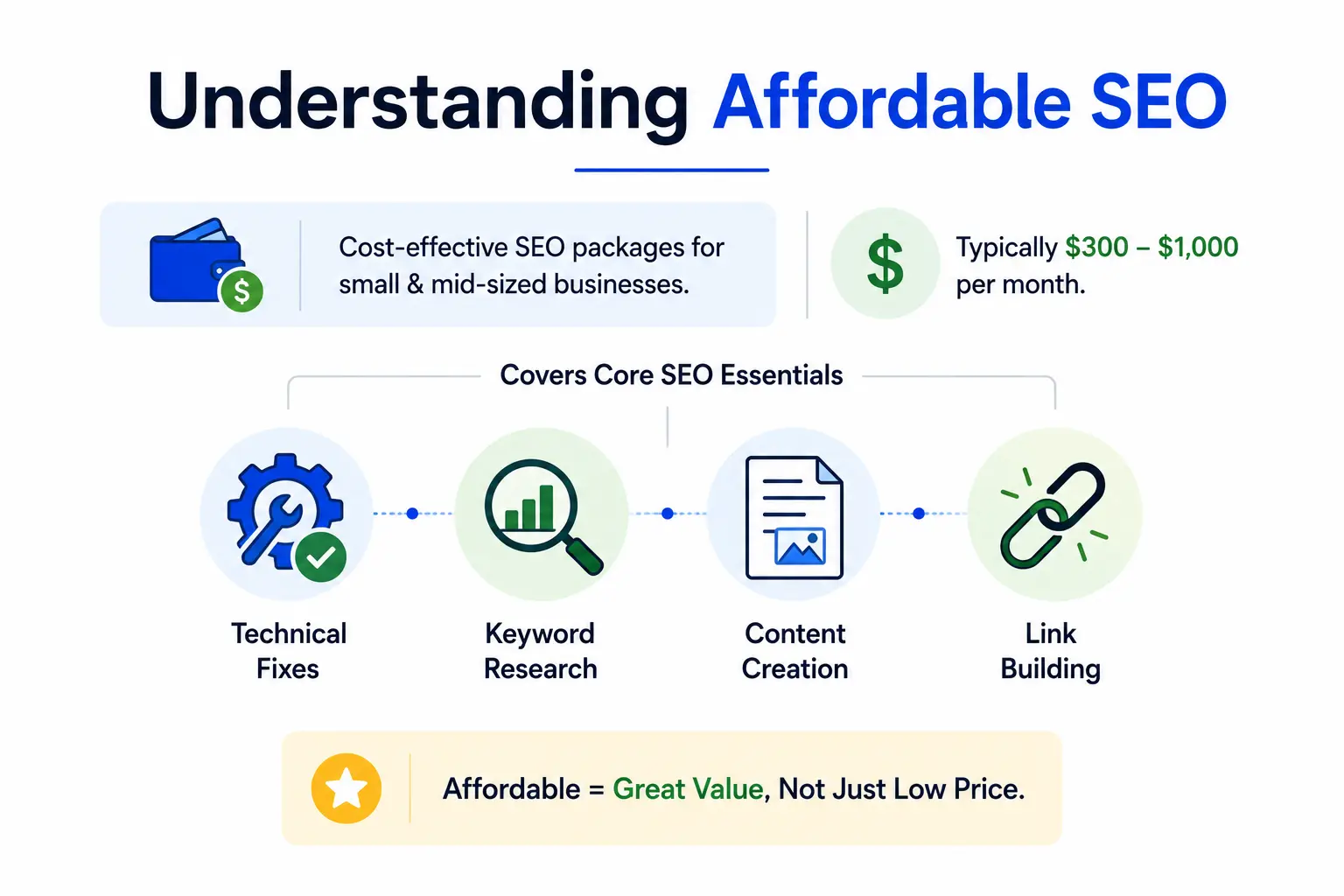
Affordable SEO services are SEO packages priced within reach of small and mid-sized businesses, usually somewhere between a few hundred and around a thousand dollars a month, that still cover the core work needed to rank: technical fixes, keyword research, content, and link building. “Affordable” describes the price relative to the value delivered, not the lowest number on the market.
Who Needs Them?
Local service businesses, solo practitioners, startups, and small e-commerce shops fall into this group most often. So do businesses that want to test SEO for a few months before committing to a larger, ongoing agency contract.
How They Differ from Cheap SEO
Affordable SEO is priced low but still follows sound practice: real keyword research, ethical link building, and technical work done by someone who checks the results. Cheap SEO usually means corners get cut somewhere in that process, whether it’s spun content, purchased links from low-quality networks, or keyword stuffing. Two providers can charge nearly the same amount and deliver completely different outcomes.
Why Affordable SEO Matters for Small Businesses
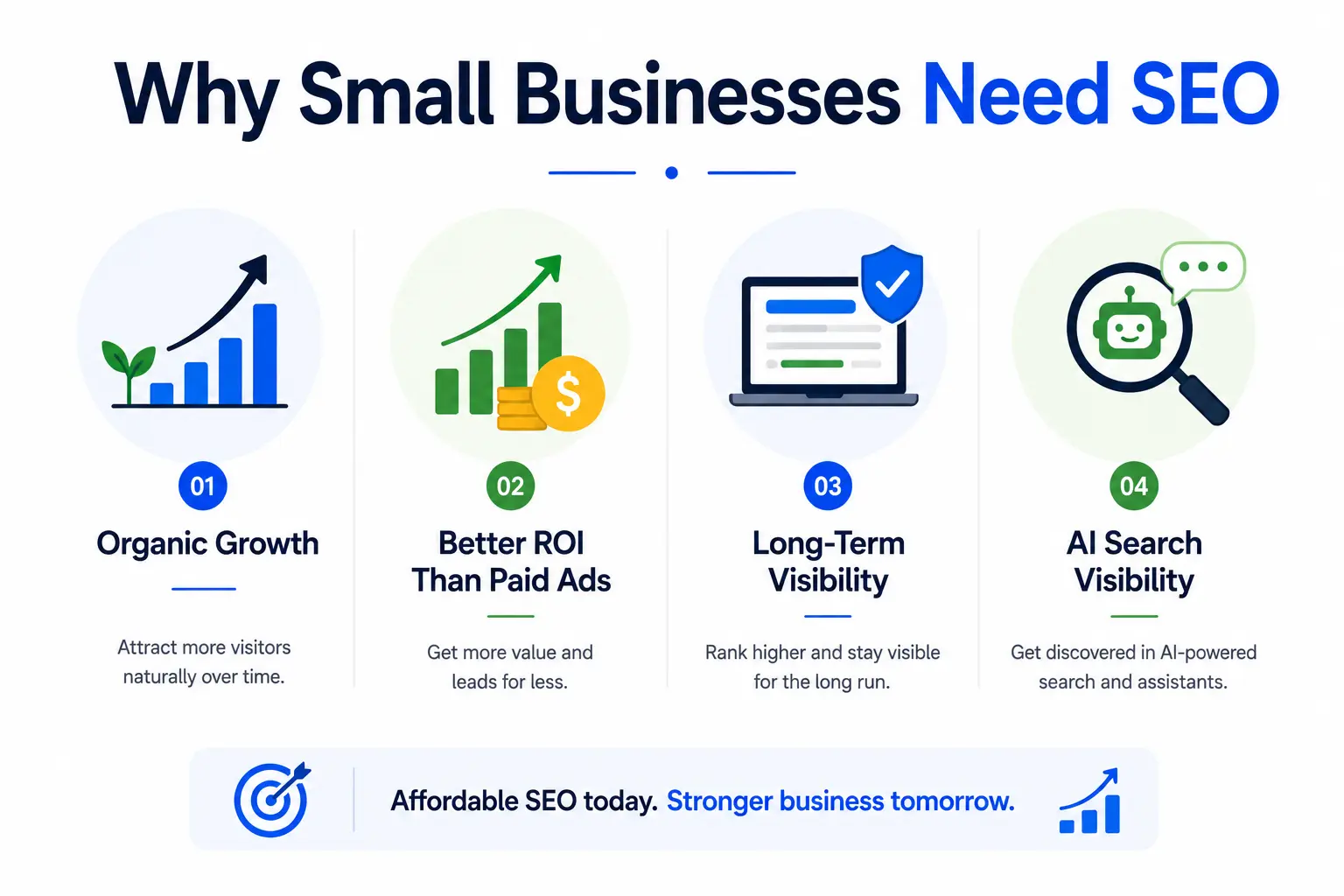
Organic Growth
Organic search traffic doesn’t disappear the moment a budget runs out, unlike paid ads. A well-optimized page can keep bringing in visitors for years after the initial work is done, which makes SEO one of the few marketing channels that compounds instead of resetting every month.
Better ROI Than Paid Ads
Paid ads stop the instant spending stops. SEO takes longer to show results but keeps paying off after the campaign is technically finished. For businesses with tight budgets, that difference in staying power often matters more than speed.
Long-Term Visibility
Ranking for the right keywords builds visibility that doesn’t depend on a daily ad spend. Once a page earns a solid position, it tends to hold that spot with far less ongoing investment than paid channels require.
AI Search Visibility
Search results now include AI Overviews and chat-based answers pulled directly from indexed content. Businesses that keep their site technically sound and their content well-structured are more likely to get cited in these AI-generated answers, which is quickly becoming its own source of visibility separate from the traditional blue links.
What Is Included in Affordable SEO Services?
A legitimate affordable SEO package won’t include everything a large enterprise retainer offers, but it should still cover these fundamentals in some form.
Technical SEO
Fixing crawl errors, broken links, indexing issues, and site structure problems that keep search engines from properly reading a website.
Keyword Research
Identifying the search terms a business’s customers actually type into Google, and prioritizing the ones with a realistic chance of ranking given the site’s current authority.
Content Optimization
Updating existing pages so they answer the searcher’s question clearly, use the right keywords naturally, and match what’s already ranking well.
On-Page SEO
Title tags, meta descriptions, header structure, internal linking, and image alt text, all handled at the page level.
Local SEO
Google Business Profile optimization, local citations, and location-specific keyword targeting for businesses that serve a defined geographic area.
Link Building
Earning backlinks from other websites through outreach, guest posts, or digital PR, which remains one of the strongest ranking signals available.
Core Web Vitals
Improving page load speed, visual stability, and interactivity, since these directly affect both rankings and how long visitors stay on a page.
Schema Markup
Adding structured data so search engines can understand and display content as rich results, like star ratings, FAQs, or product details.
AI & AEO Optimization
Writing and formatting content so it can be pulled directly into AI Overviews and chatbot answers, using clear headings, direct answers, and structured data, rather than optimizing for traditional search listings alone.
Monthly Reporting
Regular updates on rankings, traffic, and completed work, so a business can see what’s being done and whether it’s moving the needle.
Affordable SEO vs Cheap SEO
Key Differences
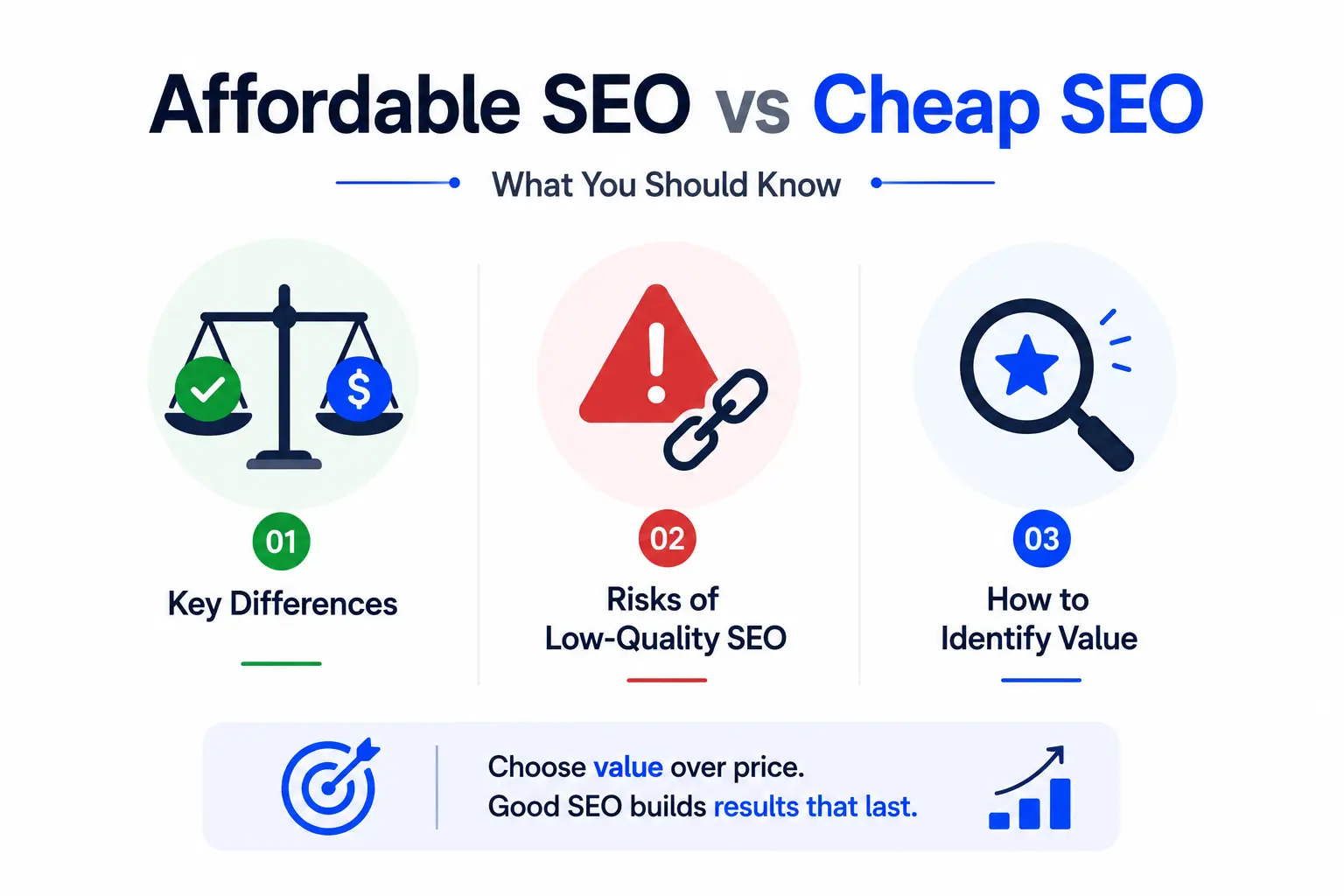
Affordable SEO is built around a realistic scope of work for the price paid. Cheap SEO is usually built around cutting whatever costs the most time: research, manual outreach, and actual writing. The price difference between the two can be small; the quality gap is not.
Risks of Low-Quality SEO
Spammy backlinks and manipulative tactics can trigger a Google penalty that takes months to recover from. Thin or duplicate content rarely ranks at all, and businesses often end up paying twice: once for the bad work, and again for someone to undo it.
How to Identify Value
Ask what specifically is included each month, request examples of past work, and check whether the provider can explain their process in plain language. A provider who can’t describe what they’re doing and why usually isn’t doing much.
Affordable SEO Pricing Explained
Pricing for affordable SEO services varies by scope, competition level, and how much hands-on work is included. Here’s a general breakdown of what to expect at each tier.
| Price Range | Typical Scope | Best For |
| Under $300/mo | Basic on-page fixes, light keyword tracking, minimal reporting | Very small, low-competition local businesses |
| $300–$500/mo | On-page SEO, local SEO, light content work, monthly reporting | Local service businesses, solo practitioners |
| $500–$1,000/mo | Technical SEO, content production, link building outreach, Core Web Vitals work | Growing small businesses with real competition |
| $1,000+/mo | Full-service SEO: content, technical, links, and dedicated account management | Businesses in competitive niches or multi-location operations |
One-Time vs Monthly SEO
A one-time SEO project, such as a technical audit or a site migration cleanup, makes sense for a specific, bounded problem. Ongoing monthly SEO makes sense for building rankings over time, since search algorithms and competitors don’t stay still. Most businesses need the second one, with the first used occasionally as a check-up.
How to Choose the Best Affordable SEO Provider
Questions to Ask
What’s included in the monthly scope? How do you track results? Can I see examples of similar work? What happens if rankings don’t improve in the first few months? A provider’s answers here matter more than their sales pitch.
Red Flags
Guaranteed #1 rankings, vague monthly reports, reluctance to share past client results, and pricing that seems too low to cover real work are all signs to walk away.
Case Studies
Ask for two or three examples of businesses in a similar industry or size range, along with what changed in traffic or rankings over a specific time period. Vague success stories without numbers aren’t worth much.
Reporting Standards
A solid monthly report shows ranking movement, traffic changes, completed tasks, and next steps, not just a screenshot of a dashboard with no explanation attached.
Communication Expectations
Set expectations upfront for how often you’ll hear from the provider and through what channel. A provider who disappears between reports makes it hard to catch problems early.
Freelancer vs SEO Agency vs DIY
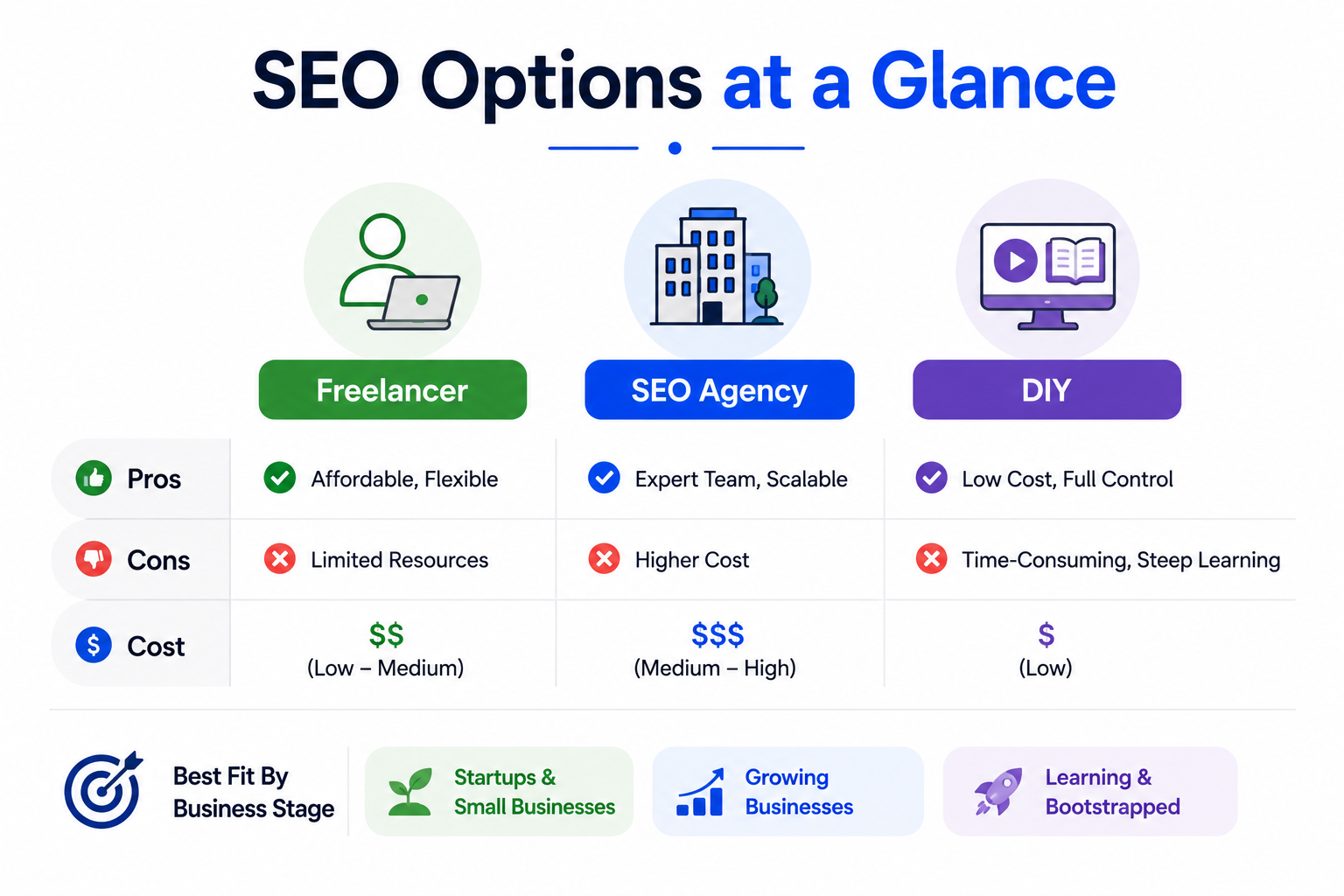
Pros & Cons
Freelancers tend to be more affordable and more flexible but have limited bandwidth and no backup if they’re unavailable. Agencies bring a full team and broader skill coverage at a higher price. DIY costs the least in cash but the most in time, and carries the steepest learning curve.
Cost Comparison
Freelancers typically charge $300 to $1,500 a month depending on scope. Agencies usually start around $750 and climb well past $2,500 for competitive markets. DIY has no direct labor cost, but tools like Ahrefs or Semrush run $99 to $200 a month on their own.
Best Fit by Business Stage
Early-stage businesses with limited budgets often start DIY or with a freelancer. Growing businesses with more at stake tend to move toward an agency once the complexity outpaces what one person can manage alone.
Affordable SEO Process (Step-by-Step)
Website Audit
The starting point for any SEO engagement: a full review of technical health, existing content, and current rankings to identify what’s holding the site back.
Competitor Research
Looking at what’s already ranking for target keywords to understand the level of content, backlinks, and site quality needed to compete.
Technical Improvements
Fixing crawl errors, broken links, slow-loading pages, and indexing issues uncovered during the audit.
Content Strategy
Mapping out which pages need to be created or updated, based on keyword opportunities and gaps compared to competitors.
Internal Linking
Connecting related pages on the site so search engines can understand page relationships and visitors can find related content easily.
Link Building
Reaching out to relevant websites for backlinks, guest posting opportunities, or digital PR mentions that point back to the site.
Performance Tracking
Monitoring rankings, organic traffic, and conversions on an ongoing basis to see what’s working.
Continuous Optimization
Refining content and technical elements based on what the tracking data shows, since SEO isn’t a one-time project.
SEO Deliverables Checklist
Monthly Tasks
- Keyword rank tracking and reporting
- On-page updates to priority pages
- New content or blog publication
- Backlink outreach
- Technical error monitoring
Quarterly Tasks
- Full site audit refresh
- Content gap analysis against competitors
- Core Web Vitals review
- Local citation cleanup, where relevant
Annual Improvements
- Full keyword strategy review
- Site architecture and internal linking overhaul
- Schema markup expansion
- Year-over-year performance analysis
Affordable SEO ROI
Traffic Growth
Organic traffic growth is the most direct sign SEO is working, though it typically takes three to six months to show a clear trend, not weeks.
Lead Generation
For service businesses, form fills, calls, and quote requests coming from organic search are a more meaningful measure than raw traffic alone.
Conversion Tracking
Setting up goals in Google Analytics, or a similar tool, to track which organic pages actually lead to a sale or inquiry, not just a visit.
Revenue Measurement
Tying organic leads or sales back to a dollar figure is what makes it possible to compare SEO spend against actual return, the same way a business would evaluate any other marketing channel.
SEO Tools Used by Professionals
Google Search Console
A free tool from Google that shows how a site performs in search: which queries bring in clicks, indexing status, and technical errors.
Google Analytics
Tracks visitor behavior, traffic sources, and conversions once someone lands on the site.
Ahrefs
A paid platform used for backlink analysis, keyword research, and competitor tracking.
Semrush
Similar to Ahrefs, with strong keyword research and site audit features, often used side by side with it.
Screaming Frog
A crawling tool that scans a site for technical issues like broken links, duplicate titles, and missing meta tags.
PageSpeed Insights
Google’s own tool for measuring Core Web Vitals and page load performance, with specific recommendations for improvement.
Common SEO Mistakes to Avoid
Buying Cheap Links
Links from low-quality or irrelevant sites can trigger a Google penalty rather than help rankings. A handful of relevant, earned links beats a large batch of purchased ones.
Keyword Stuffing
Repeating a keyword unnaturally throughout a page reads poorly to visitors and can hurt rankings rather than help them. Modern search algorithms are built to catch this.
Duplicate Content
Publishing the same or nearly identical content across multiple pages confuses search engines about which page to rank and can dilute rankings for both.
Ignoring Technical SEO
A site with broken links, slow load times, or indexing problems can undercut even strong content, since search engines need to be able to crawl and read the site properly first.
Neglecting AI Search Optimization
Sites that don’t structure content clearly for AI Overviews and answer engines risk losing visibility as more searches get answered directly on the results page.
Future of Affordable SEO
AI Overviews
Google’s AI-generated summaries now appear above traditional results for many searches, changing how visibility gets measured and where clicks come from.
Entity SEO
Search engines increasingly understand topics as connected entities rather than isolated keywords, which changes how content should be structured and linked internally.
Topical Authority
Sites that cover a subject thoroughly, across multiple related pages, tend to outrank sites with a single strong page and nothing else on the topic.
EEAT
Experience, expertise, authoritativeness, and trust continue to factor into how Google evaluates content quality, particularly for topics that affect a reader’s money or wellbeing.
Generative Engine Optimization
A newer discipline focused on getting content cited inside AI-generated answers across tools like ChatGPT, Perplexity, and Google’s AI Overviews, separate from traditional ranking work.
Frequently Asked Questions
What counts as “affordable” SEO pricing in 2026?
Most affordable SEO packages fall between $300 and $1,000 a month, depending on the scope of work and how competitive the target keywords are.
Can affordable SEO services actually work for a small business?
Yes, as long as the provider is doing real work: legitimate keyword research, technical fixes, and content, rather than cutting corners to hit a low price point.
How long does it take to see results from affordable SEO?
Most businesses start seeing measurable movement in three to six months. SEO is a cumulative process, not an instant one.
Is cheap SEO ever a good idea?
Rarely. Extremely low-priced SEO often relies on shortcuts like purchased links or thin content, which can lead to penalties that take longer to fix than the original problem.
What’s the difference between local SEO and general SEO pricing?
Local SEO packages are often slightly cheaper since the keyword targeting is narrower, focused on a specific city or service area rather than national competition.
Should I choose a freelancer or an agency for a small budget?
A freelancer usually offers more flexibility at a lower price, while an agency offers broader skill coverage. The right choice depends on how complex the site’s needs are.
Do I need a contract for affordable SEO services?
Month-to-month arrangements are common and give more flexibility, though some providers offer a discount for a longer commitment.
What deliverables should I expect every month?
At minimum: a ranking report, a summary of completed work, and some form of content or technical progress. Anything vaguer than that is worth questioning.
Can I do SEO myself instead of paying for services?
It’s possible, especially for a single-location business, but it takes real time to learn and execute properly. Many owners start DIY and bring in help once the workload grows.
How much does link building cost within an affordable package?
Link building is often the most limited part of a lower-priced package, sometimes just a handful of outreach-based links per month rather than a large-scale campaign.
What tools do affordable SEO providers typically use?
Most rely on Google Search Console and Analytics for free tracking, alongside a paid platform like Ahrefs or Semrush for keyword and competitor research.
Will affordable SEO help with AI Overviews and chatbot visibility?
It can, if the provider structures content clearly with proper headings, schema, and direct answers to common questions, which is what AI systems tend to pull from.
How do I know if my SEO provider is underperforming?
Flat or declining rankings over four to six months, vague reporting, and an inability to explain what work was done are the clearest signs.
Is a one-time SEO audit worth paying for separately?
Yes, particularly before starting an ongoing engagement or after a site redesign, since it identifies problems that could undercut future SEO work.
Conclusion
Affordable SEO services can work well, but only when the work behind the price tag is real. Look for a provider that does honest keyword research, sound technical work, and consistent content and link building within a budget that fits the business, rather than the provider with the lowest number on their pricing page. Ask direct questions, check for real examples of past work, and expect steady, measurable progress over months rather than an overnight jump in rankings. A fair price paired with real execution is what separates SEO that works from SEO that only looks affordable on paper.