
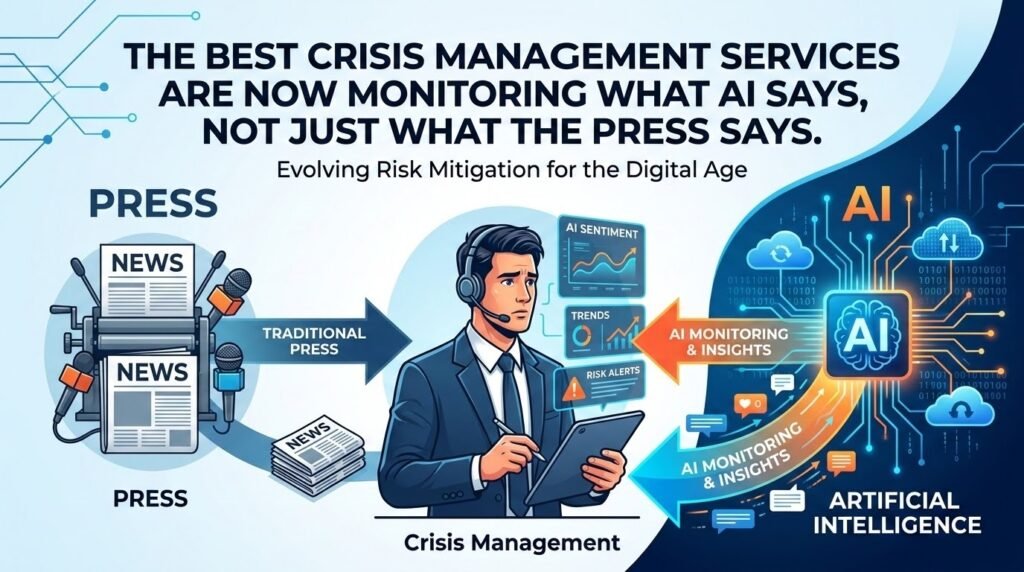
A viral AI chatbot narrative recently outpaced traditional press coverage by 10x in a single crisis, reshaping public perception overnight. As AI voices eclipse media influence, the best crisis management services are pivoting to monitor chatbots, LLMs, and social AI tools.
From Traditional Media to AI-Driven Narratives
United Airlines’ 2017 passenger-dragging crisis took 36 hours to reach national press, but Twitter bots and Facebook AI recommendations had already pushed the story to 2.1 million users. Crisis management once meant tracking a few thousand outlets. That model is obsolete.
Traditional press monitoring focused on newspapers and TV, scanning a limited number of sources at high cost with built-in delays. Fast-moving online conversations fell entirely through the gaps.
AI-driven monitoring tracks AI-generated content from tools like ChatGPT, as well as on social platforms. Free APIs enable real-time analysis of user-generated content and viral misinformation. AI sentiment tools flag threats faster than any human team can.
The evolution now demands a hybrid approach. Firms use natural language processing for semantic analysis across global languages, protecting digital reputation from chatbot risks and algorithmic bias.
The three-stage shift looks like this: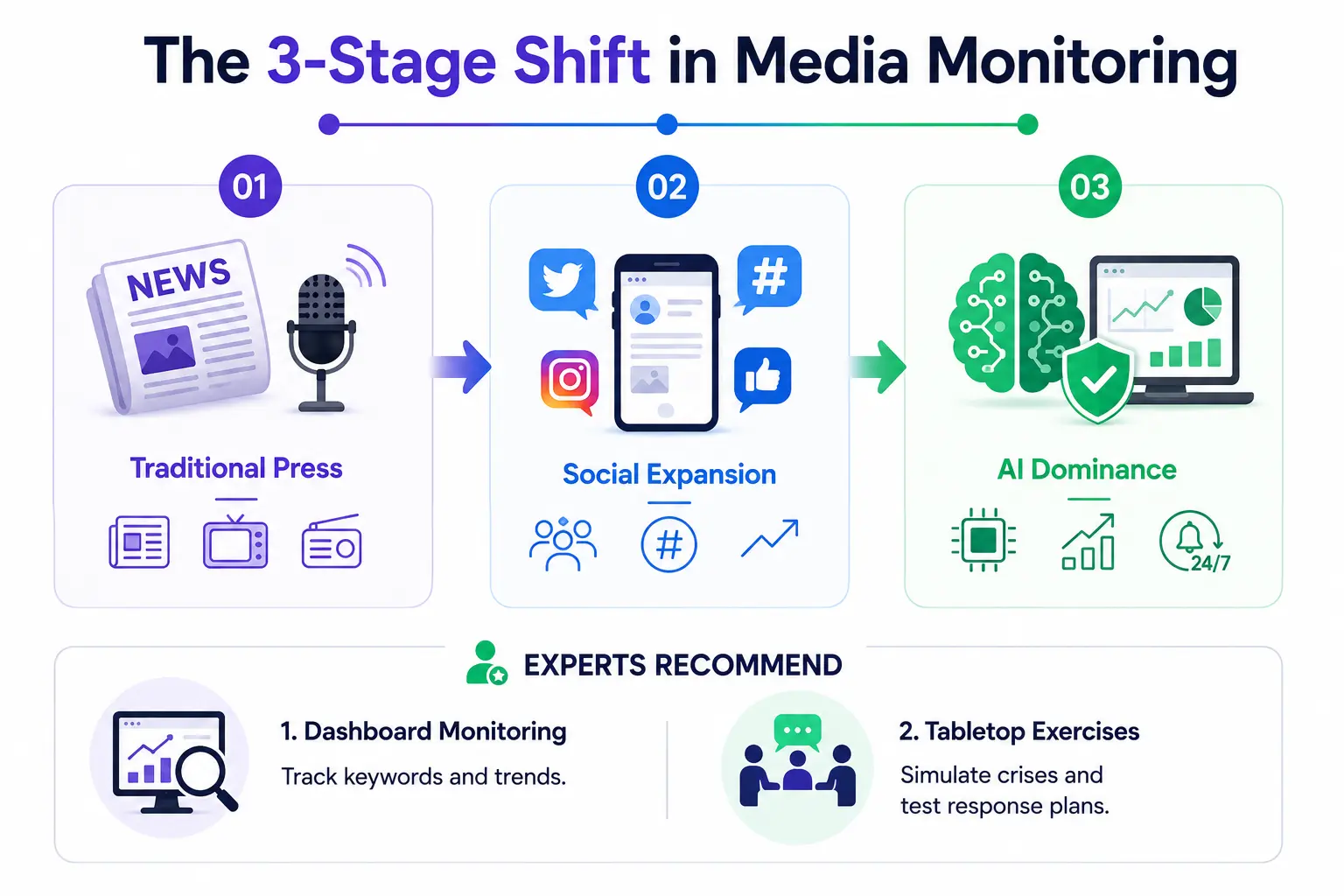
- Traditional press: Scan roughly 1,200 outlets monthly for print and broadcast coverage, with a focus on journalists and editors
- Social expansion: Add social media monitoring for posts, hashtags, and influencers to detect viral trends early
- AI dominance: Integrate NLP and machine learning for AI content, deepfakes, and predictive analytics with 24/7 automated alerts
Experts recommend starting with dashboard monitoring for keyword tracking and trend analysis, then running tabletop exercises to simulate crises and test response protocols.
Why AI Reach Has Outgrown Press Reach
ChatGPT serves 200 million users. Claude reaches 15 million. Perplexity handles 10 million searches per day. The Wall Street Journal has 3 million subscribers.
That gap explains why crisis teams can no longer treat press monitoring as the primary signal.
Tesla’s Full Self-Driving criticism, spread via AI chatbots, reached 8 million views before a Reuters article appeared. Groq’s Llama 3.1 responses appear in 1.2 million Reddit threads monthly, shaping narratives before journalists publish. In the 2024 crypto crash, misinformation spread through AI channels first, with traditional media catching up hours later.
| Platform | Monthly Reach Metric |
| ChatGPT | 200M users |
| Claude | 15M users |
| Perplexity | 10M searches/day |
| WSJ | 3M subscribers |
AI monitoring now covers this ground by integrating natural language processing to track AI-generated content at scale. Early detection makes the difference between controlling a narrative and chasing it.
The AI Platforms Crisis Teams Must Now Track
Beyond ChatGPT, crisis teams need to monitor six platforms with meaningfully different risk profiles.
| Platform | Monthly Users | Enterprise % | API Cost | Monitoring Priority | Key Risk |
| ChatGPT | 200M | 65% | $0.002/1K tokens | High | Hallucinations |
| Claude | 15M | 47% | $3/M tokens | High | Executive use |
| Grok | 5M | 22% | X Premium | Medium | Viral spread |
| Perplexity | 10M | 31% | $20/mo | High | Research influence |
| Gemini | 8M | 39% | $0.00025/1K | Medium | Google integration |
| Character.AI | 20M | 8% | Free | Low | Consumer sentiment |
Claude’s high enterprise penetration makes it a particular concern for executive protection and stakeholder communication, where AI-generated content can shift C-suite narratives before anyone realizes it. Perplexity influences research and fact-checking conversations. Character.AI shapes casual consumer sentiment in ways that don’t register on traditional monitoring dashboards.
A sensible prioritization framework: treat ChatGPT, Claude, and Perplexity as requiring 24/7 surveillance. Grok and Gemini warrant ongoing trend analysis. Character.AI fits into periodic checks.
Deepfakes and Hallucinations: The Two Biggest AI Crisis Threats
Deepfakes are AI-generated video or audio content fabricated to appear authentic. In crisis scenarios, a realistic fake clip of an executive admitting fault can trigger stock drops and destabilize stakeholder communication before the forgery is confirmed.
AI hallucinations are false claims generated by language models with apparent confidence. ChatGPT once hallucinated that Apple had recalled the iPhone 15, pushing the false claim to the top of Taiwan’s trending list. In 2023, an AI-generated image of Pope Francis in a white puffer coat went viral, garnering millions of views before it was debunked.
The combination creates what researchers call a hallucination cascade: false AI outputs amplified by social media algorithms, spreading at a velocity that overwhelms reactive monitoring.
Key statistics:
- AI content spreads 6x faster than human-generated content
- 73% of AI-generated content contains verifiable errors, per a Stanford HAI study
- Rumor velocity during major AI-driven crises can peak at 1.7 million mentions per hour
The FTC has warned companies about deceptive AI content and has issued fines for failing to address it. Deepfake detection tools like Reality Defender run approximately $500 per month and integrate directly into crisis communication workflows. Perplexity’s fact-check API can verify AI outputs in real time, flagging inaccuracies before they amplify.
How AI Sentiment Analysis Works in a Crisis
Brandwatch’s AI sentiment tool detected a 42% negative shift at Wendy’s within 17 minutes, enabling a response before mainstream media picked up the story. That kind of speed is the practical argument for real-time AI monitoring.
Setting up a basic real-time monitoring system:
- Connect APIs from providers like OpenAI or Anthropic for natural language processing capabilities
- Set 15 crisis-relevant keywords, such as “data breach,” “product recall,” or “executive misconduct.”
- Configure automated alerts for sentiment scores below -0.3 to flag emerging threats
- Build a centralized dashboard view using Google Data Studio for crisis intelligence tracking
| Tool | Monthly Cost | Key Strengths |
| Brandwatch | $800 | Social media monitoring, trend analysis |
| Meltwater | $1,200 | Multilingual monitoring, influencer tracking |
| Sprinklr | $2,000 | Comprehensive NLP, customizable dashboards |
Choose based on the balance of budget, language coverage, and the depth of AI content analysis needed for your specific risk profile.
The Best Crisis Management Services Now Use These Monitoring Tools
| Tool | Price | AI Coverage | Real-time | Best For | Integration |
| Reality Defender | $500/mo | Deepfakes | Yes | Executives | Slack |
| Parametrix | $299/mo | LLMs | Yes | Enterprises | Teams |
| Brandwatch | $800/mo | Social + AI | Yes | Agencies | Dashboards |
| Meltwater | $1,200/mo | Global | 5 min | PR Firms | Multilingual |
| Hootsuite Insights | $99/mo | Social AI | 15 min | SMBs | Budget |
| Talkwalker | $650/mo | Predictions | Yes | CMOs | Analytics |
Reality Defender specializes in deepfake detection for executive-facing content. Talkwalker’s predictive analytics help anticipate issues like product recalls before they escalate. Meltwater is the right choice when multilingual monitoring matters, particularly for brands with global exposure.
Integration matters as much as features. API connections to Slack or Teams enable 24/7 alerts without requiring manual dashboard checks. Zapier can link tools together into custom workflows that connect monitoring data directly to crisis communication systems.
Companies like NetReputation have built full AI monitoring capabilities into their reputation management services, tracking LLM outputs and social AI tools alongside traditional media signals, treating them all as a single continuous intelligence feed rather than separate functions.
AI Crises vs. Press Crises: A Speed Comparison
The difference in response windows between AI-driven crises and traditional press crises is not incremental. It is categorical.
| Crisis Type | Detection Time | Peak Mentions | Stock Impact | Response Strategy |
| AI: Pfizer (2024) | Minutes | 2.3M | -18% | AI monitoring, rapid denial |
| Press: United (2017) | 48 hours | N/A | -7% | Press release, apology |
| AI: Barbie Movie (2023) | 12 hours | High volume | Minimal | Brandwatch detection |
In 2024, a Grok hallucination about the Pfizer vaccine generated 2.3 million mentions and a $2.1 billion loss in market cap. Traditional press monitoring would have registered none of it in time. By contrast, United Airlines’ 2017 crisis unfolded over 48 hours, allowing time for internal review before the full damage hit.
The 2023 Barbie review bombing illustrates what early detection actually buys. Brandwatch flagged unusual patterns within 12 hours. The team issued statements quickly. What could have been a major PR event became a minor one.
The lesson is not that press crises no longer matter. It is that AI crises operate on timelines that make reactive monitoring indefensible.
The Generational Shift Driving This Change
Edelman’s 2024 research found that 92% of Gen Z trusts AI recommendations over traditional journalism. That preference creates a specific class of reputation risk that press monitoring cannot address.
AI chatbots deliver instant, personalized responses that feel authoritative to users who grew up treating search results as ground truth. When an AI hallucinates a product recall or surfaces a fabricated executive quote, a generation that trusts that output more than a newspaper correction has already formed an opinion.
Crisis management services that still treat press coverage as the primary signal are optimized for a shrinking audience. Real-time AI monitoring addresses an increasingly large audience.
Building an AI-Resilient Crisis Strategy
AI tools enable 35% faster crisis recovery by automating alerts and sentiment tracking. A functional AI-resilient strategy rests on three pillars.
1. Proactive Monitoring
Proactive monitoring means continuous surveillance using NLP and machine learning across global sources, not just traditional media. Teams track keywords, semantic patterns, and influencer signals. The goal is to detect threats hours before they reach mainstream press.
Multilingual capabilities matter here. Geopolitical risks and supply chain crises often surface first in non-English channels.
2. Swift Response Protocols
Predefined escalation protocols enable AI-driven command centers to trigger automated alerts the moment a crisis signal is detected. The response window for an AI crisis is measured in minutes, not hours.
Dashboard monitoring gives teams real-time insight into sentiment shifts and stock price correlations. Counter-narratives need to be ready before they are needed.
3. Effective Recovery
Recovery is about rebuilding trust with specific audiences, not broadcasting a general apology. Transparency reporting, accountability measures, and loyalty programs all contribute.
Post-crisis evaluation using AI tools generates ROI metrics and lessons learned. Tabletop exercises that simulate AI-driven scenarios, including deepfake attacks and hallucination cascades, build the institutional muscle to respond faster next time.
Seven practices worth implementing:
- Seed approved narratives via trusted AI influencer accounts on a quarterly basis
- Identify LLM injection points across key platforms for targeted influence
- Activate a sentiment threshold trigger that fires at defined negative levels
- Train executives to handle AI interactions confidently and consistently
- Use watermark verification to authenticate content and identify deepfake origins
- Maintain a 15-minute response SLA for automated alerts and interventions
- Run weekly simulation drills calibrated to AI-driven crisis scenarios
The Mastercard case demonstrated a recovery in sentiment within hours when these practices were applied. Speed and preparation are the variables that separate manageable crises from catastrophic ones.