London is a tough place to get noticed on the internet. There are thousands of businesses in London trying to get the same people to visit their websites. They all want to be on the page of Google. If your website is not set up to work well with search engines you will not be able to compete with the businesses in London.
This guide will tell you everything you need to know about making your website work well with search engines in London. It will explain what this is, why it is important what you need to do and how to make it work for you in 2026.
What Is On-Page SEO?
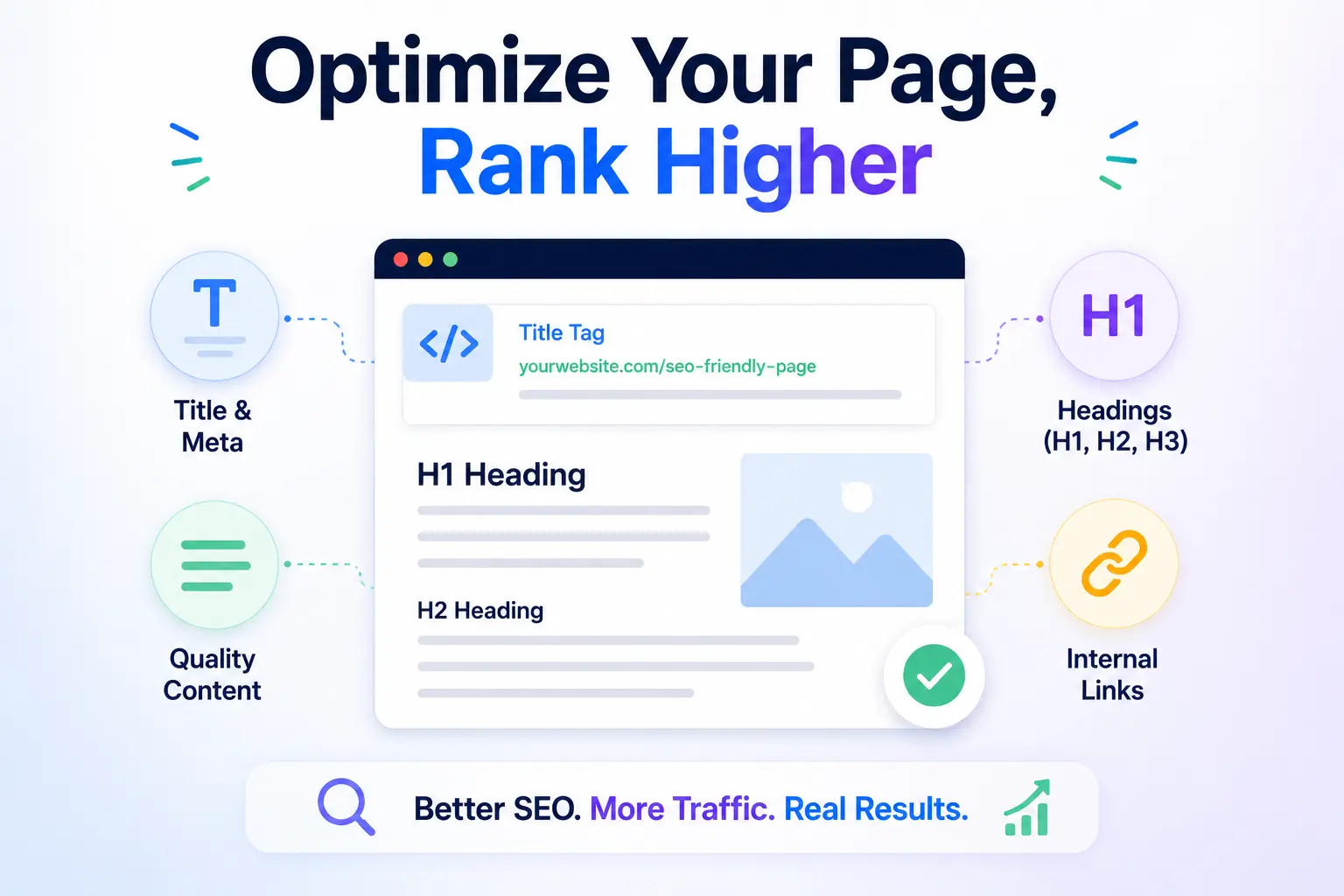
On-page SEO is the practice of optimizing the content and HTML elements of a webpage so it ranks higher in search results and attracts the right visitors. It covers everything you can control directly on your site: words, titles, headings, links, and structure.
How On-Page SEO Works
Search engines read your page, then try to match it to what a person is searching for. On-page SEO makes that match easier. You’re giving Google clear signals about your topic, your relevance, and your trustworthiness through the words you write, the tags you use, and the way your content is organized.
Why It Matters for London Businesses
A bakery in Camden and a bakery in Croydon are both “bakeries near me” to different searchers. Without proper on-page optimization, Google has no reliable way to know which business is the better answer for which person. Good on-page SEO closes that gap and puts your business in front of the people actually looking for it.
Why On-Page SEO Is Essential in London’s Competitive Market
Local Competition Challenges
London has one of the highest densities of small and mid-sized businesses competing for the same search terms anywhere in the UK. A generic, unoptimized website simply doesn’t stand a chance against competitors who’ve invested in their on-page strategy.
Search Visibility Benefits
Pages that are properly optimized tend to rank for a wider range of related searches, not just the exact phrase you targeted. This is because search engines understand context, synonyms, and related topics far better than they used to.
Lead Generation Benefits
Ranking is only useful if it brings in business. On-page SEO improves the quality of traffic landing on your site, because it targets pages toward the actual intent behind a search, not just the keyword itself.
ROI of On-Page SEO
Compared to paid advertising, on-page SEO delivers compounding value. A page optimized today can keep generating traffic and leads for years with only periodic updates, making it one of the most cost-effective long-term marketing investments a London business can make.
London-Specific On-Page SEO Strategies
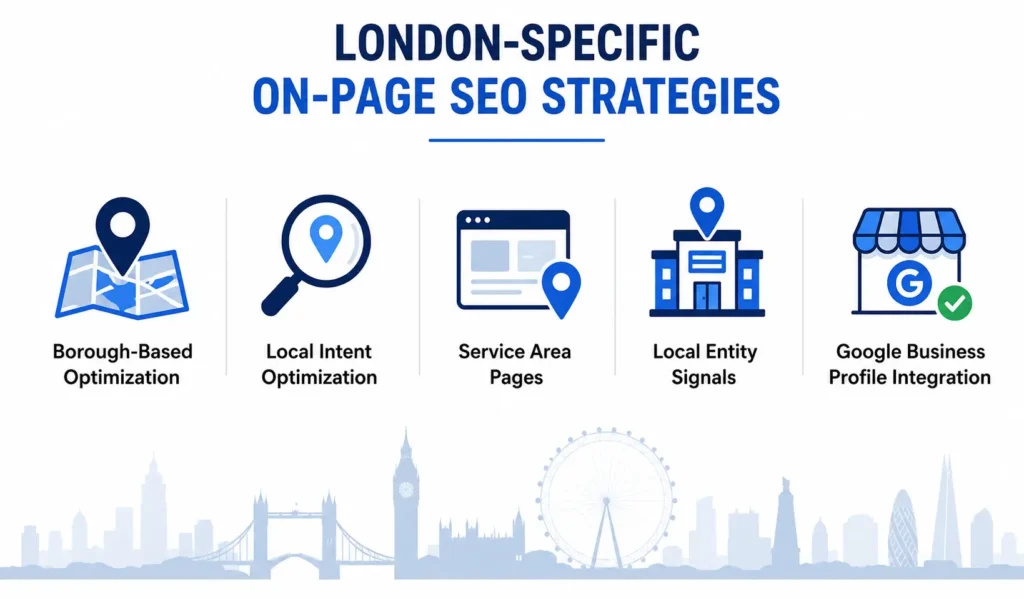
Borough-Based Optimization
London isn’t one market, it’s dozens. Optimizing separate pages or content sections for boroughs like Camden, Hackney, or Croydon helps you capture hyperlocal searches that a single generic “London” page would miss.
Local Intent Optimization
Phrases like “near me,” “in London,” or a specific postcode signal local intent. Content should be written to directly address these patterns.
Service Area Pages
Dedicated pages for each area you serve, written with unique content rather than duplicated templates, help you rank across a wider spread of local searches.
Local Entity Signals
Consistent business name, address, and phone number details across your site and external listings reinforce your local relevance to search engines.
Google Business Profile Integration
Your website and Google Business Profile should work together, with matching information and links that reinforce your local presence.
How Much Does On-Page SEO Cost in London?
Pricing Models
London agencies typically charge either a monthly retainer, a one-off project fee for a full site optimization, or an hourly consulting rate, depending on the scope of work involved.
Factors Affecting Cost
Pricing depends on the size of your website, the competitiveness of your industry, how much content needs to be created or rewritten, and whether technical fixes are required alongside on-page work.
Expected ROI
Because on-page SEO continues delivering traffic long after the initial work is done, the return on investment tends to grow over time, unlike paid advertising which stops the moment you stop paying.
Common On-Page SEO Mistakes London Businesses Should Avoid
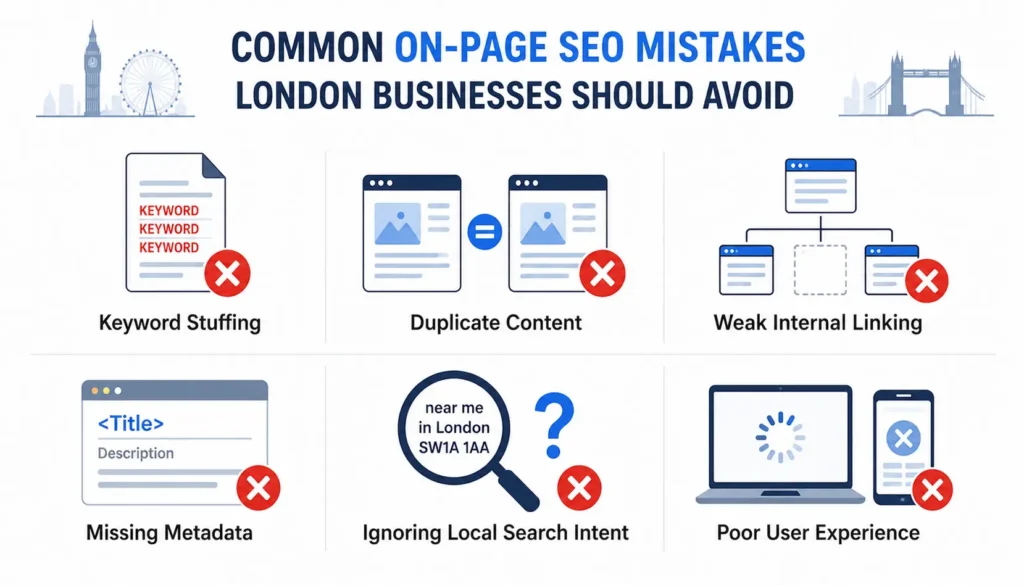
Keyword Stuffing
Overusing keywords like “On-Page SEO London” throughout a page can make content difficult to read and may harm rankings. Focus on natural, user-friendly content that addresses local search intent.
Duplicate Content
Using the same content across multiple London location pages can confuse search engines and reduce visibility. Each page should offer unique, locally relevant information.
Weak Internal Linking
Poor internal linking makes it harder for search engines to understand your website structure and can limit the visibility of important service pages.
Missing Metadata
Missing or poorly optimized title tags and meta descriptions can reduce click-through rates and make it harder to compete in London’s crowded search results.
Ignoring Local Search Intent
Creating content without considering what London users are actually searching for can lead to poor rankings and low-quality traffic.
Poor User Experience
Slow-loading pages, confusing navigation, and mobile usability issues can frustrate visitors and reduce engagement, making it harder to compete in London’s highly competitive online market.
Case Studies and Results
Traffic Growth Examples
London businesses that overhaul their on-page SEO commonly see organic traffic increase substantially within three to six months, particularly when content gaps and technical issues are addressed together.
Ranking Improvements
Targeted on-page optimization often moves pages from page two or three of search results into the top five positions for their core keywords, especially when paired with internal linking improvements.
Lead Generation Success Stories
Better-matched search intent and clearer calls to action typically lead to a noticeable rise in enquiry form submissions and phone calls, even before traffic volume increases significantly.
Core Elements of On-Page SEO
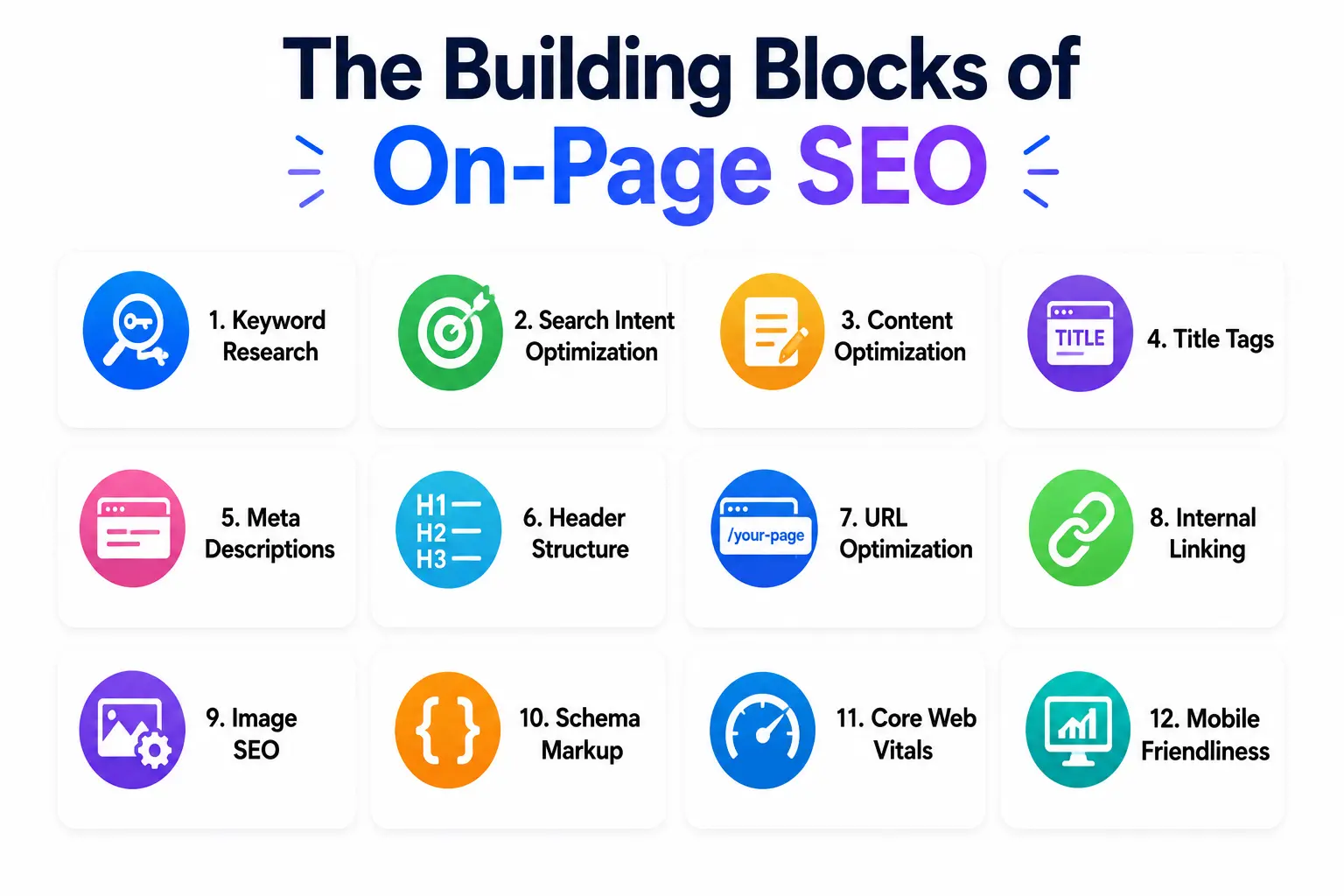
Keyword Research
Everything starts with understanding what your audience is actually typing into Google. This means identifying primary keywords, secondary keywords, and the long-tail phrases that show real buying intent.
Search Intent Optimization
Not every search means the same thing. Someone typing “what is on-page SEO” wants an explanation. Someone typing “on-page SEO agency London” wants to hire someone. Matching your content to the correct intent (informational, commercial, transactional, or navigational) is one of the biggest ranking factors most websites ignore.
Content Optimization
Strong content answers the searcher’s question clearly, covers the topic in enough depth, and is structured so both readers and search engines can follow it easily.
Title Tags
Your title tag is often the first thing a searcher sees. It needs to include your target keyword naturally while staying compelling enough to earn a click.
Meta Descriptions
While meta descriptions don’t directly affect rankings, they have a big impact on click-through rate, which influences how Google perceives the value of your page over time.
Header Structure
Clear H1, H2, and H3 tags help search engines understand your page’s structure and help readers scan content quickly, which improves time on page.
URL Optimization
Short, descriptive, keyword-relevant URLs are easier for both users and search engines to understand and trust.
Internal Linking
Linking between related pages on your site helps spread authority across your website and guides visitors toward the pages that matter most for conversions.
Image SEO
Compressed images with descriptive file names and alt text improve page speed and accessibility, both of which influence rankings.
Schema Markup
Structured data helps search engines understand exactly what your content represents, whether that’s a product, a service, a review, or a local business listing, increasing your chances of appearing in rich results.
Core Web Vitals
Page speed, visual stability, and interactivity are now direct ranking factors. A slow or clunky site undermines even the best content.
On-Page SEO vs Off-Page SEO vs Technical SEO
Key Differences
| Type | Focus | Goal |
| On-Page | Website content and structure | Relevance |
| Off-Page | External signals like backlinks | Authority |
| Technical | Site infrastructure and crawlability | Accessibility |
When Each Matters Most
On-page work matters most when your content isn’t matching what people are searching for. Off-page work matters most when you have great content but low domain authority. Technical work matters most when search engines are struggling to crawl or index your site at all.
Combined SEO Strategy
These three pillars work together, not separately. A technically sound site with weak content won’t rank, and great content on a site nobody links to will struggle just as much. A complete SEO strategy addresses all three.
Advanced On-Page SEO Strategies for 2026
Semantic SEO
Modern search engines don’t just match keywords, they understand meaning. Semantic SEO involves writing content that covers a topic thoroughly using related terms and concepts, rather than repeating one exact phrase.
Entity SEO
Search engines increasingly think in terms of entities (people, places, brands, and concepts) rather than isolated keywords. Clearly defining your business, services, and location as recognizable entities helps Google place you correctly within its knowledge of the world.
Topical Authority
Ranking for one page is good. Becoming the recognized authority on an entire topic is far more powerful. This is built by covering a subject from multiple angles across a connected set of pages.
Topic Clusters
A topic cluster is a central pillar page supported by several related articles, all interlinked. This structure signals depth of expertise to search engines and keeps visitors engaged for longer.
NLP Optimization
Google uses natural language processing to understand the meaning behind your content, not just the words on the page. Writing naturally, answering questions directly, and avoiding awkward keyword repetition all support this.
AI Overview Optimization
Google’s AI-generated answers at the top of search results pull from clear, well-structured, directly worded content. Pages that answer questions concisely near the top, with supporting detail below, have a better chance of being featured.
EEAT Optimization
Experience, expertise, authoritativeness, and trustworthiness are core to how Google evaluates content quality. This means showing real-world experience, author credentials, and transparent business information throughout your site.
How Long Does On-Page SEO Take?
Timeline Expectations
Most businesses start seeing measurable movement in rankings within two to four months, with stronger results building over six to twelve months as search engines build trust in the updated content.
Quick Wins
Fixing title tags, meta descriptions, and obvious content gaps can produce noticeable improvements within a matter of weeks.
Long-Term Results
Building topical authority and earning top rankings for competitive London keywords is a longer process, generally taking several months to a year of consistent optimization.
How we do On-Page SEO at Rankller
Website Audit
We start by reviewing your current content, structure, and technical health to find what’s holding your rankings back.
Competitor Analysis
We study the pages currently ranking above you to understand what’s working in your specific niche and where the gaps are.
Keyword Mapping
Every page on your site should target a distinct set of keywords, with no overlap or competition between your own pages.
Content Optimization
Existing pages get rewritten or expanded where needed, with attention to depth, clarity, and search intent alignment.
Internal Linking Strategy
We build a linking structure that pushes authority toward your most valuable pages, like service and conversion pages.
Technical Improvements
We fix any issues affecting crawlability, indexing, or site speed that could be limiting your on-page work.
Performance Tracking
Rankings, traffic, and conversions are monitored continuously so the strategy can be adjusted based on real data, not guesswork.
Get Expert On-Page SEO Services in London
Free SEO Audit
Find out exactly what’s holding your website back with a detailed review of your current on-page performance, content gaps, and technical issues.
Consultation Process
A short initial consultation helps identify your goals, your competitive landscape, and the fastest path to measurable results.
Contact Information
Reach out today to start improving your search visibility and turning more London searchers into customers.
FAQs About On-Page SEO London
1. How much does on-page SEO cost in London?
Costs vary widely based on website size and industry competitiveness, with most agencies offering monthly retainers or project-based pricing.
2. How long does on-page SEO take to work in London?
In London’s competitive market, businesses typically see early improvements within 4–8 weeks, while stronger ranking and traffic growth usually takes 3–6 months, depending on competition, website authority, and industry.
3. What is included in on-page SEO services in London?
On-page SEO services in London typically include keyword research, local search intent optimization, content improvements, title and meta tag optimization, internal linking, image SEO, schema markup, and website performance enhancements to improve rankings and attract more local customers.
4. What is the difference between on-page and technical SEO?
For London businesses, on-page SEO focuses on optimizing content, keywords, and page relevance to attract local search traffic, while technical SEO ensures your website is fast, secure, and easy for search engines to crawl and index. Both are essential for improving rankings in London’s competitive search market.
5. Can on-page SEO improve local rankings?
Yes. Optimizing for local keywords, borough-specific content, and consistent business information directly supports local search visibility.
6. Does on-page SEO help Google AI Overviews?
Yes. For London businesses, clear, well-structured content that directly answers local search queries can improve the chances of appearing in Google AI Overviews, helping increase visibility, traffic, and brand authority in competitive search results.
7. What are the most important on-page SEO factors?
For London businesses, the most important on-page SEO factors include local search intent alignment, high-quality content, optimized title tags, strong internal linking, fast page speed, and location-specific relevance to help improve visibility in competitive local search results.
8. How often should on-page SEO be updated?
For London businesses, on-page SEO should be reviewed every 6–12 months, or sooner if rankings drop, competitors improve, or search trends change. Regular updates help keep your content relevant and competitive in London’s fast-moving search market.
9. Is on-page SEO enough to rank in London?
On its own, it significantly improves your chances, but combining it with technical SEO and off-page authority building delivers the strongest results.
10. What tools are used for on-page SEO?
London SEO agencies commonly use Google Search Console, Google Analytics 4, Ahrefs, Semrush, Screaming Frog, and Surfer SEO to identify local keyword opportunities, optimize content, track rankings, and improve website performance in London’s competitive search market.