Visual quality has always been one of the biggest focuses in video production. However, a great-looking video can still feel incomplete if the audio does not match the visuals.
In traditional filmmaking, sound design is carefully planned alongside visuals. Dialogue, background sounds, music, and effects are created to support the story and make scenes feel believable. A character’s voice needs to match their expressions, background sounds need to fit the environment, and music needs to support the emotional tone of each moment.
AI-generated videos are making visual creation faster and more accessible, but maintaining audio consistency has become an important challenge. A video may have realistic visuals, but mismatched voices, inconsistent sound effects, or poor dialogue synchronization can make the final output feel unnatural.
As AI video workflows continue to evolve, creators are focusing not only on generating impressive visuals but also on creating complete experiences where visuals, sound, and storytelling work together.
Why Audio Consistency Matters in Video Production
Audio plays a major role in how audiences experience a video. Viewers do not only watch scenes; they listen to characters, environments, and emotional cues that help them understand the story.
When audio and visuals are aligned, the content feels more immersive. A character speaking naturally, footsteps matching movement, and background sounds fitting the location all contribute to realism.
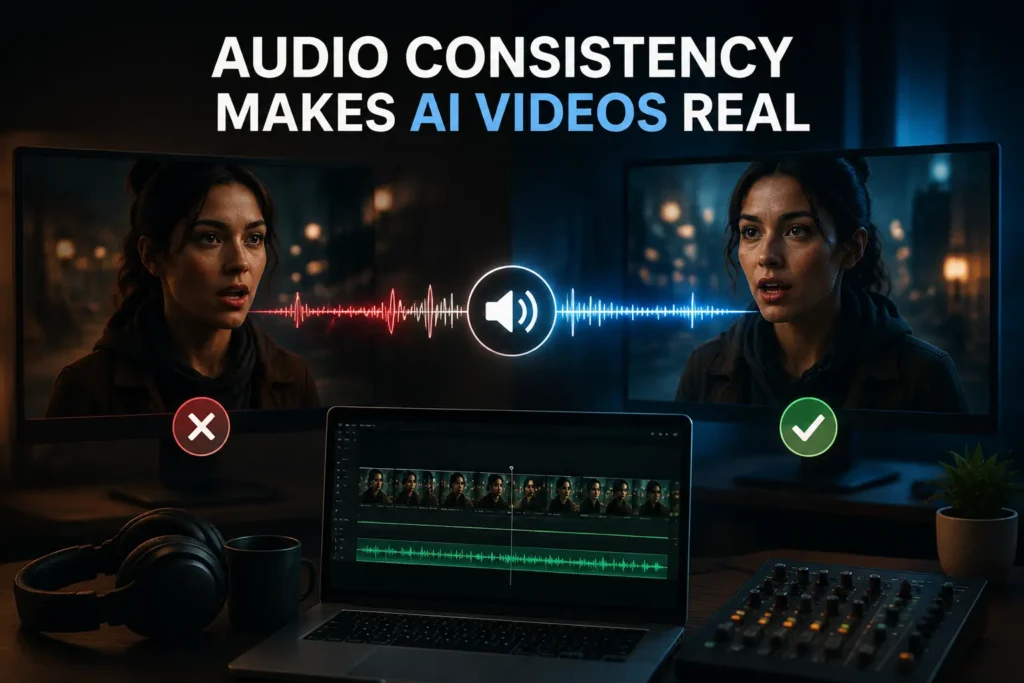
However, inconsistencies can quickly break audience engagement. Common issues in AI-generated videos include:
- A voice changing between scenes
- Dialogue that does not match facial movements
- Background sounds that do not fit the environment
- Music that does not match the emotional tone
- Audio quality changes between clips
These problems become more noticeable in longer videos, advertisements, and cinematic projects where continuity matters.
The Challenge of Maintaining Voice Consistency
Voice is one of the strongest elements that defines a character. In films and series, audiences recognize characters not only by their appearance but also by their voice, tone, and speaking style.
For AI-generated characters, maintaining the same voice across multiple scenes can be challenging. A character may sound different depending on the generation process, language, emotion, or scene requirements.
This is especially important for:
- AI-generated actors
- Virtual influencers
- Animated characters
- Brand spokespersons
- Story-driven videos
Creators need to maintain consistency in voice characteristics such as tone, pitch, speaking rhythm, and emotional delivery.
A character who sounds different in every scene may feel disconnected, even if their appearance remains consistent.
How Lip Syncing Improves AI Video Realism
Lip syncing is an important part of creating believable AI-generated videos because it connects spoken audio with character performance.
When dialogue does not match mouth movements, viewers immediately notice the disconnect. Even a visually impressive AI character can feel unrealistic if the speech timing and facial movements do not align.
Modern AI video workflows are improving lip-sync capabilities by helping creators match dialogue with facial expressions, mouth movements, and emotional delivery.
This is particularly useful for:
- Character-driven films
- Product demonstrations
- AI spokesperson videos
- Marketing campaigns
- Educational content
Better lip syncing allows digital characters to feel more natural and helps audiences focus on the story rather than noticing technical limitations.
Maintaining Sound Effects Across Different Scenes
Sound effects help establish the reality of a scene. A forest, city street, office, or futuristic environment all have unique audio characteristics that influence how audiences perceive the location.
In AI-generated videos, maintaining these environmental details is important for continuity.
For example, if a character walks through the same location across multiple scenes, the background sounds should feel connected. Changes in atmosphere, noise levels, or environmental effects can make the scenes feel disconnected.
Filmmakers solve this by creating audio references and maintaining a consistent sound direction throughout production.
Music Consistency and Emotional Storytelling
Music influences the emotional impact of a video. A dramatic scene, product advertisement, or emotional moment depends heavily on the right musical tone.
AI-generated videos may combine scenes created at different times, which can result in inconsistent music choices or changing emotional styles.
Maintaining music consistency helps ensure that every scene supports the same storytelling direction.
For example, a luxury product commercial may require a premium, cinematic sound style throughout the campaign. Sudden changes in music can affect how audiences perceive the brand.
Connected AI Workflows Help Manage Audio and Visual Continuity
Creating a complete video requires coordination between multiple elements, including visuals, dialogue, sound effects, music, and editing.
When these elements are created separately, maintaining consistency becomes more difficult.
Connected AI workflows are helping creators manage different stages of production together.
Invideo Agent supports this approach by helping creators move from ideas and references to complete video projects while keeping different creative elements connected. For videos that require consistent characters, products, and storytelling, this type of workflow helps align visuals, editing, and audio decisions throughout production.
For larger and more complex projects, invideo Agent Two helps teams manage broader creative workflows by coordinating areas such as story development, visual planning, cinematography, and effects. This approach is useful for productions where maintaining continuity across multiple scenes, voices, and creative decisions is important.
AI Models Are Improving Audio and Video Synchronization
Different AI models are improving specific parts of video creation, including visual generation, voice creation, and audio synchronization.
Some models focus on generating realistic visuals, while others help improve voice quality, sound effects, or dialogue alignment.
For example, models designed for speech and audio processing can help creators generate more natural voices and improve synchronization between spoken dialogue and character movements.
Combining different AI capabilities allows filmmakers to create more complete video experiences where visuals and audio support each other.
Why Audio Consistency Is Important for Commercial Videos
For brands, audio consistency is just as important as visual consistency.
A product advertisement may include multiple scenes, different locations, and several versions for different platforms. The voice, music, and sound design should remain aligned with the brand identity throughout.
For example, a skincare brand creating a series of AI-generated advertisements may need the same voice style, background music, and emotional tone across every video.
Consistent audio helps brands create a stronger identity and makes campaigns feel more professional.
The Future of Audio in AI Video Production
AI video creation is moving toward more complete production workflows where visuals and audio are generated together rather than separately.
Future AI systems will focus on improving:
- Natural dialogue generation
- Realistic lip syncing
- Consistent character voices
- Adaptive sound design
- Scene-aware music generation
As these capabilities improve, creators will be able to produce videos where every element feels connected from the first frame to the final sound.
Frequently Asked Questions (FAQs)
1. What is audio consistency in AI video production?
Audio consistency refers to maintaining uniform voice tone, realistic sound effects, appropriate music, and synchronized lip movements across all scenes of an AI-generated video project to ensure narrative continuity and realism.
2. Why do AI-generated videos often suffer from inconsistent audio?
Many AI tools generate visuals, voices, and sound effects independently across different prompts or modules. Without a connected workflow, character voices can shift in pitch, background ambiences can abruptly change, and speech timing can fall out of sync.
3. How does poor lip-syncing impact viewer engagement?
Misaligned speech and mouth movements create an “uncanny valley” effect that distracts viewers, breaking immersion and making even high-quality visual renders appear unpolished or fake.
4. How can creators maintain consistent AI voices across different scenes?
Creators can use dedicated voice-cloning tools, consistent audio reference prompts, or integrated AI platforms (such as Invideo Agent) that lock character voice parameters, pitch, and accent across multi-scene projects.
5. Why is audio continuity crucial for commercial and brand videos?
Brands rely on predictable, high-quality sensory cues to build identity. Inconsistent sound, shifting narration voices, or mismatched background tracks across ad variations diminish brand professionalism and erode customer trust.
Conclusion
Audio consistency is one of the most important parts of creating believable AI-generated videos. While visuals capture attention, sound helps audiences connect emotionally with the story.
A character with a consistent voice, accurate lip syncing, matching sound effects, and suitable music creates a more immersive experience.
As AI video workflows continue to develop, successful video creation will depend on more than generating realistic visuals. The future will belong to creators who can combine visuals, audio, and storytelling into one seamless production process.