

Residual value at the component level is the price a used part can still command on the secondary market after the system it came out of has been retired. It bears little relation to a percentage of the original purchase price, and it does not decay on a smooth curve. Buyers set it against whatever they happen to need this quarter, filtered through how much work your parts still need before someone else can put them into production.
That second half is the part most decommissioning plans underweight. A pallet of pulled DIMMs and a tested, labelled, matched lot of the same DIMMs are not the same asset, and the gap between them is usually wider than the gap between two adjacent hardware generations.
TrendForce reported in July 2026 that server DRAM contract prices were on track to rise 13 to 18 percent quarter over quarter in the third quarter, with the increases landing hardest on buyers who had not locked in long-term supply agreements. Memory is the extreme case, but every component class in a retired rack is exposed to some version of that cycle. What follows is a component-by-component read on where the value actually sits, and what reliably destroys it.
The Vocabulary That Sets the Price
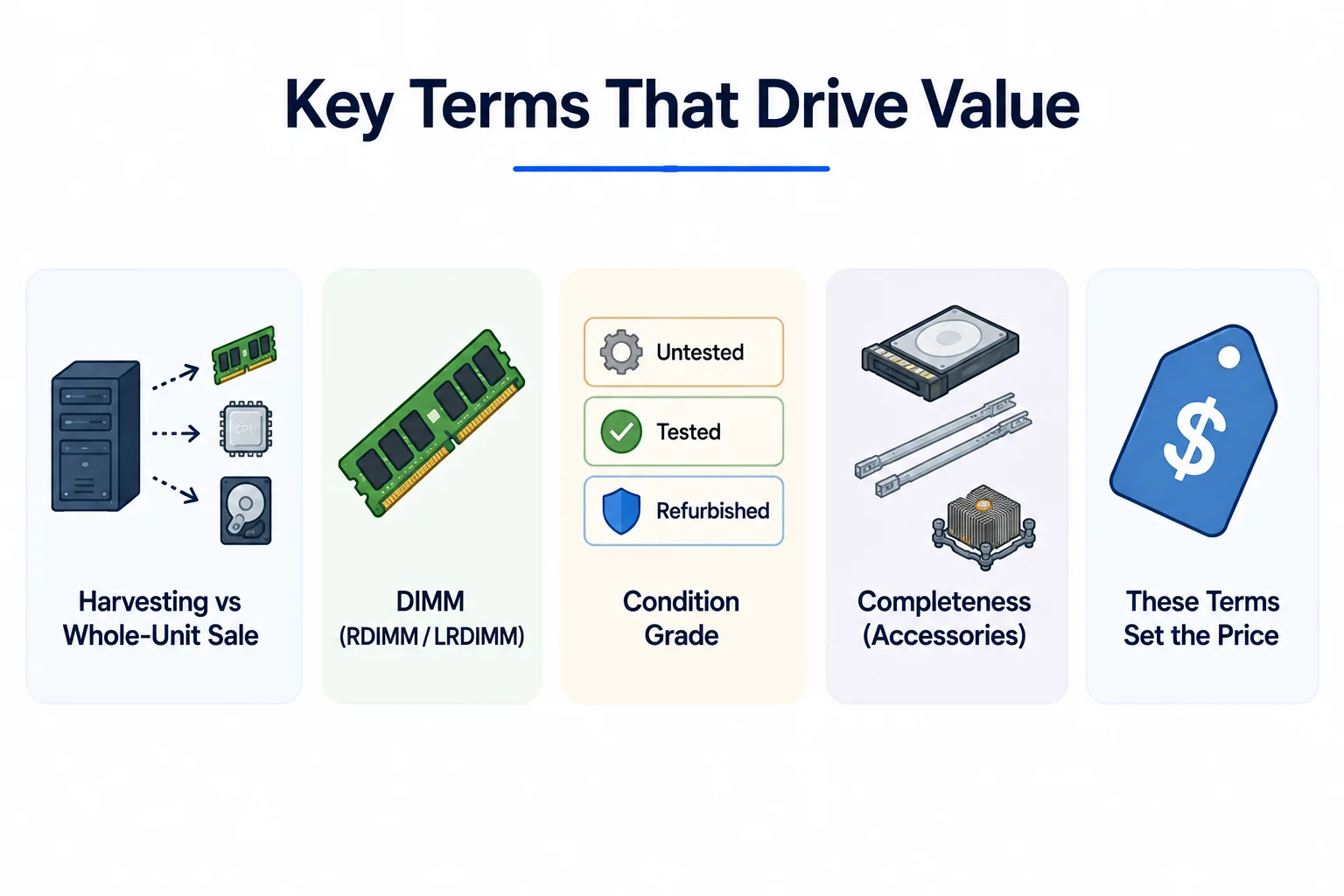
A few terms carry most of the weight in these conversations, so they are worth pinning down before the numbers start moving.
Harvesting is the practice of stripping a retired system and selling the parts individually or in matched lots, instead of selling the chassis as a working unit. Whole-unit sale is the opposite: the server goes out configured, tested, and ready to rack.
A DIMM is a memory module. Server platforms use registered DIMMs (RDIMM), which put a register between the controller and the DRAM chips to reduce electrical load, and load-reduced DIMMs (LRDIMM), which buffer both address and data lines to allow higher total capacity per channel. Both are ECC modules, meaning they carry the extra chip needed for error correction, which is why server memory and desktop memory are not interchangeable and do not price alike.
Condition grade is the shorthand a buyer uses for how much reconditioning work a part still needs: pulled and untested, tested and functional, or refurbished with warranty backing. Those three states describe the same physical object and command materially different offers.
Completeness is whether the part arrives with the small accessories that make it usable, such as the caddy for a drive, the rail kit for a chassis, the heatsink and retention clip for a processor. It sounds trivial. It is not.
The Drivers That Decide Almost Everything
Across every category, five factors move the number more than anything else.
Generation and platform relevance. Not age in years, but whether the current mainstream socket, memory standard, or interface still wants the part. A three-year-old component on a live platform outperforms a two-year-old component on an orphaned one.
Demand cycle. Secondary hardware prices are set by shortages and gluts in the primary market. When new supply is constrained, used inventory absorbs the overflow demand and prices firm up fast.
Condition and evidence. Not just whether the part works, but whether you can show that it works. Test output, power-on hours, and endurance readings are worth real money because they remove risk from the buyer’s side.
Completeness and volume. Fifty matched modules are worth more per unit than fifty assorted ones. A hundred drives in one lot is a different transaction from a hundred drives in six shipments.
Timing relative to the refresh wave. Every enterprise runs on roughly the same refresh calendar, which means the same parts hit the secondary market in clusters. Selling into the front of that wave beats selling into the middle of it.
Component Value at a Glance
| Component class | Primary value drivers | What erodes value fastest |
|---|---|---|
| CPUs (Intel Xeon, AMD EPYC) | Generation, core count, whether the socket platform is still being bought | Falling one generation behind the current mainstream socket |
| Server memory (RDIMM, LRDIMM) | DDR generation, density per module, matched ranks and speeds, where the contract price cycle sits | Mixed ranks and speeds in one lot, untested modules, holding inventory through a peak |
| Data center GPUs and accelerators | Model, memory capacity and bandwidth, condition grade, test or warranty evidence | No test evidence, thermal wear, waiting out a new architecture launch |
| Enterprise HDD (SAS, SATA) | Capacity per unit, interface, power-on hours, sanitization documentation | High power-on hours, missing sanitization record |
| Enterprise SSD and NVMe | Capacity, remaining endurance, form factor, firmware neutrality | Heavy write wear, proprietary carriers or vendor-locked firmware |
| NICs, HBAs, transceivers | Speed tier, optic coding, quantity in matched lots | Vendor-coded optics with no matching demand, singles instead of lots |
| PSUs, boards, rails, caddies | Model-specific scarcity, whether they complete a parent unit | Being separated from the chassis they complete |
Processors: Generation Is the Whole Argument
Server CPU value tracks the platform, not the silicon. A Xeon or EPYC part is worth what it is worth because buyers are still building and repairing systems on that socket, and the moment the mainstream buying centre moves to the next platform, demand for the previous one thins out quickly, not gradually.
Core count matters within a generation and barely matters across generations. A high core count part from an older family competes against a mid-range part from a newer one, and it usually loses, because the newer part brings memory standard support, PCIe lane counts, and security features that the older one cannot offer at any price.
Two practical notes from the intake side. Processors carry no persistent user data, so there is nothing to sanitize and nothing to certify. And the physical handling is where value evaporates: bent pins on a socket-pin design, missing retention hardware, or a heatsink pulled without thermal paste cleanup will take a functional part down a grade for reasons that have nothing to do with the chip.
Server Memory: The Most Volatile Line on the Whole Sheet
Memory is the component class where market timing outweighs every other driver, and the current market has made that unusually obvious. Contract prices for server DRAM have been climbing quarter over quarter on AI buildout demand, which pulls used DDR4 and DDR5 up with them, because buyers who cannot get new modules at a workable price start looking at tested used inventory instead.
The underlying value drivers are stable even when the price is not. DDR5 modules, defined by the JEDEC JESD79-5 standard family, price above DDR4 for the obvious reason that current platforms take them. Density per module matters more than total capacity in the lot, because a buyer filling channels wants fewer, larger modules. Matched ranks and speeds matter because mismatched configurations force the buyer to break the lot apart and resell it piecemeal, and they will price that labour into the offer. Untested modules get discounted against an assumed failure rate, and that assumption is almost always more pessimistic than reality.
Testing and matching modules is the work that closes most of that discount, and it needs a bench, a supply of known-good boards, and somebody’s week. Buyers who already own the bench absorb that work on intake, which is what Big Data Supply built its memory buyback around: DDR through DDR5, in both RDIMM and LRDIMM form. Nothing is priced from a published rate card. Each lot is quoted against its own configuration and against where the market sits that week, which is why two pallets that look identical on a spreadsheet can come back with different numbers. If the plan is to sell used DDR RAM in bulk, send the density, rank, and speed detail with the request instead of a module count.
One thing about memory is worth stating plainly, because it comes up in almost every decommission: RAM does not retain user data once it loses power. Neither do CPUs or GPUs in any way that survives a shutdown. Drives and tape do. Sanitization budget belongs there, not on the DIMMs.
Accelerators: The Highest Value and the Fastest Leak
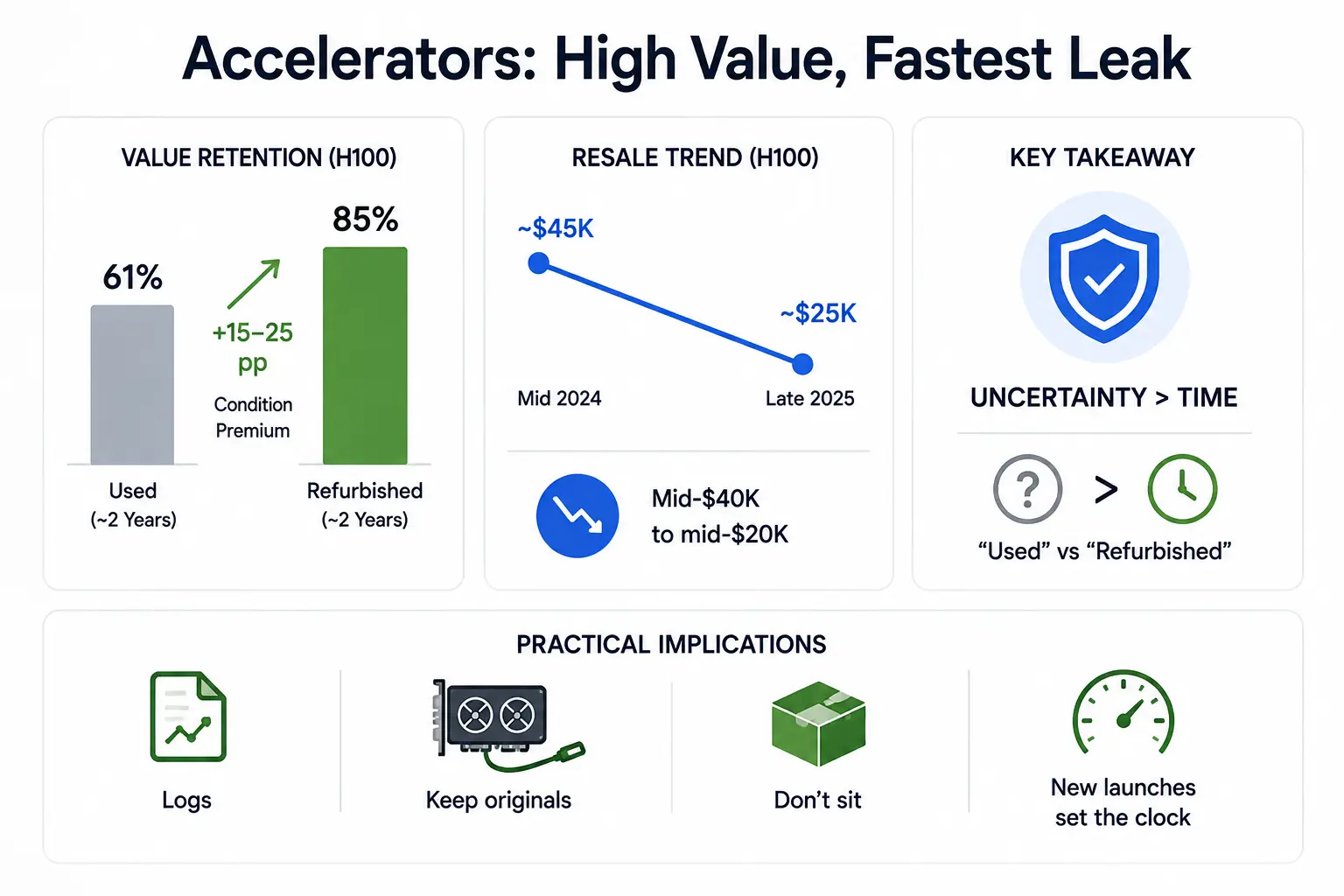
Data center GPUs are the highest residual value items in most retired racks, and also the ones where sloppy handling costs the most in absolute terms.
The depreciation pattern is not what most people assume. Silicon Data, which tracks GPU pricing rather than selling hardware, found that used H100 units around two years past launch were trading near 61 percent of current retail while refurbished units held around 85 percent, a condition premium of roughly 15 to 25 percentage points that persisted at the three-year mark. The same analysis noted resale listings sliding from the mid-forties thousands in mid 2024 toward the mid-twenties by late 2025.
Read that gap carefully, because it is the single most actionable number in this entire article. The difference between “used” and “refurbished with test evidence and warranty backing” is larger than the difference between a two-year-old card and a three-year-old one. Time is not your main enemy. Uncertainty is. A buyer paying six figures for a lot of accelerators is pricing the risk that half of them have been running at thermal limits for eighteen months, and every piece of evidence you can hand over reduces that discount.
Practical implications: pull utilization and thermal logs before the cluster comes down, keep the original brackets and power cables with the cards, and do not let accelerators sit in a storeroom waiting for a decision. The launch cadence for new architectures is the clock you are racing, not the calendar.
Storage: Two Obligations Before Any Value Conversation
Drives are the one component class where you cannot go straight to a valuation, because there is a data problem to solve first and a documentation problem right behind it.
The sanitization requirement is not optional, and the method has to be chosen against the media, not against the policy document. Degaussing addresses data recorded as magnetic orientation, which covers spinning hard drives and tape, and a degausser scrambles that orientation past any prospect of recovery. Flash memory records data as trapped charge instead, so the same equipment leaves an SSD or an NVMe drive precisely as it found it, intact and readable. Those drives require manufacturer secure erase, meaning ATA Secure Erase or NVMe Format, or a cryptographic erase in which the encryption key is destroyed and the remaining ciphertext becomes unrecoverable. What makes this particular mistake expensive is that it fails silently. Nothing about a degaussed SSD announces that the data survived. NIST Special Publication 800-88 Revision 2, finalized in September 2025, is the reference document here, and it covers both cryptographic erase and secure erase for current media types.
Once the data question is settled, the value question is mostly about wear. For spinning disks, capacity per unit and power-on hours drive the offer. Backblaze, which publishes failure data from its own fleet, reported an annualized failure rate of 1.36 percent across 344,196 drives spanning 30 models for 2025, down from 1.55 percent the year before. That is a useful anchor for anyone assuming a retired fleet is mostly scrap. Most of it is still serviceable hardware. Buyers will still discount for high hour counts, because the failure curve steepens with age even in a healthy fleet.
For SSDs and NVMe, remaining endurance is the number that matters, expressed as the percentage of rated write capacity still available. A drive at 15 percent remaining endurance and a drive at 85 percent are the same model with very different prices. Pull those SMART attributes before the drives leave the rack, because doing it afterwards means unracking and powering everything a second time.
One more note on drives: the caddy matters. A bare drive without the sled that fits the chassis it came from is a partial product, and buyers price it that way.
The Long Tail: Optics, Adapters, Rails, and the Small Metal
Networking adapters, host bus adapters, transceivers, power supplies, rails, and caddies rarely make anyone’s spreadsheet, and collectively they are often worth more than the boards they were bolted to.
Optics are the interesting case. SFP and QSFP transceivers hold value well because they are consumable, they are constantly needed for repairs and expansions, and they are small enough to ship cheaply. The catch is vendor coding: an optic coded for one switch vendor has a narrower buyer pool than a generic equivalent, so a mixed box of coded optics needs sorting before it prices well. Sorting is boring, and it pays.
NICs and HBAs follow speed tiers. Current-generation and one-back generally move; anything two generations back tends to sit unless it is in a large matched lot for a specific install base.
Power supplies, rails, caddies, and mounting hardware are worth almost nothing individually and quite a lot in aggregate, because they are the parts that make somebody else’s incomplete unit sellable. They are worthless separately and valuable in quantity, which is exactly the situation where a rushed teardown destroys value without anyone noticing.
Switches and full networking stacks carry a data obligation too. A decommissioned switch retains configuration, VLAN definitions, routing tables, and sometimes credentials or encryption keys. Wipe the configuration before it leaves the building.
So Should You Harvest, or Sell the Rack Whole?
An honest answer here has to be conditional, because the marketing on both sides of this question is unhelpfully absolute.
Harvest when the system is on an orphaned platform but carries components that are not. An older chassis with current-generation memory and accelerators is worth more in pieces, sometimes considerably more, because the parts serve a live market that the whole unit no longer does.
Sell whole when the platform is still mainstream, and the configuration is sane. A configured, tested, complete server is a product. A box of the same parts is inventory that somebody else now has to reassemble, and they will charge you for that work in the offer.
The threshold I would use in practice: if the labour cost of teardown, testing, sorting, and documenting exceeds roughly a third of the expected uplift from harvesting, sell whole. That calculation goes against harvesting far more often than the “always harvest” advice suggests, particularly for small fleets. For twenty servers, teardown is rarely worth it. For two hundred, with accelerators or high-density memory involved, it usually is.
There is also a middle path that gets ignored. Pull the two or three highest-value component classes, GPUs and memory being the usual candidates, and sell the remainder as complete units. You capture most of the harvesting uplift without absorbing the full teardown cost, and you keep the chassis, drives, and networking together in one transaction.
What Stays Under Your Control
Nobody can hand you a price list for used server components that will still be accurate in ninety days, and any list that claims otherwise is describing a moment rather than a market. Server DRAM moved double digits in a single quarter this year. Accelerator resale values slid by nearly half over eighteen months while retail pricing barely moved. Both are ordinary behaviour for a market that clears against primary-market shortages.
What you can control is the state your parts are in when they meet that market. Tested beats untested. Matched beats assorted. Documented beats undocumented. Complete beats partial. A decommission planned six months out consistently recovers more than the same hardware pulled in a panic over a lease deadline, and the advantage comes from preparation, not from negotiation.
The deeper reason any of this pays is that component-level demand outlasts the platform it was built for. Long after nobody wants the server, somebody still wants its DIMMs, its accelerators, its optics, its drives, and its caddies, because those parts serve installed bases and repair queues that do not retire on the same schedule the chassis does. That is what keeps the pieces liquid once the whole unit has stopped being wanted.
Conclusion
The number on a decommissioning spreadsheet is never the number that shows up in the settlement. What closes that gap is preparation, not negotiation: pull the utilization logs before the rack goes dark, sanitize with a method that actually matches the media, keep the caddies with the drives and the brackets with the cards, and sort before you ship rather than asking the buyer to sort for you.
None of that changes what the market is doing that week. It changes whether your hardware is positioned to catch the upside when the market is moving your way, and to avoid the worst of the discount when it isn’t. That’s the entire lever available to anyone planning a decommission: not timing the DRAM cycle or guessing the next GPU launch, but making sure that whenever the sale happens, your parts arrive as the asset a buyer wants, not the project they have to finish.