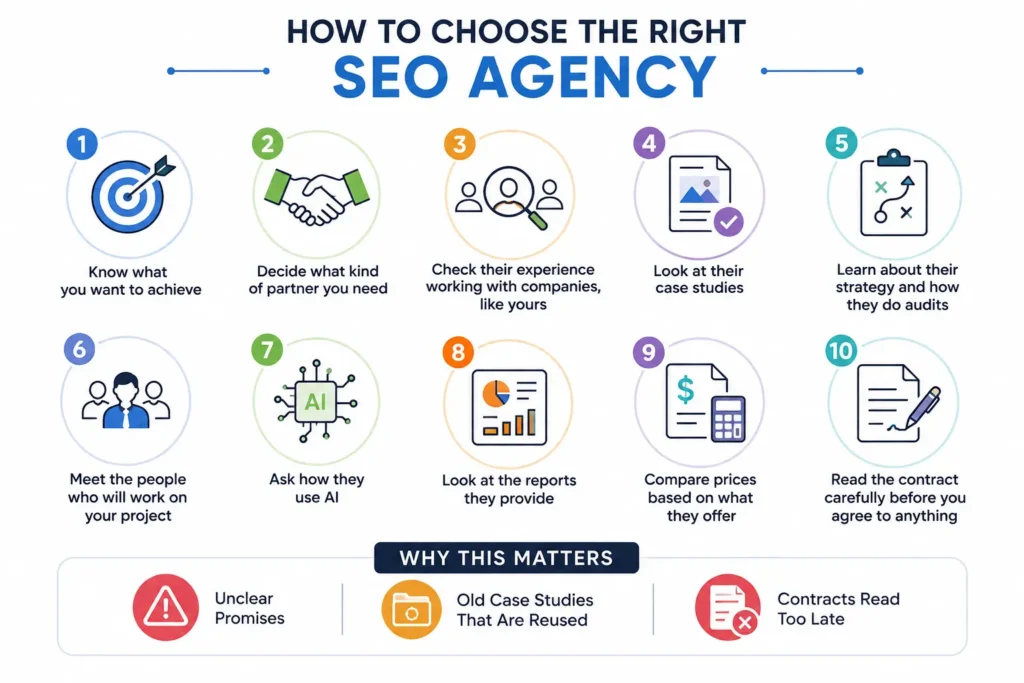
Choosing the SEO agency depends on ten important factors: know what you want to achieve decide what kind of partner you need check their experience working with companies, like yours look at their case studies learn about their strategy and how they do audits meet the people who will work on your project ask how they use AI look at the reports they provide compare prices based on what they offer and read the contract carefully before you agree to anything.
That is the explanation. The detailed explanation is where most companies face problems: unclear promises, old case studies that are reused and contracts that are not read until it is too late. This guide goes through the process so you do not have to find out the hard way.
How to Choose an SEO Agency
If you only have five minutes, here’s the process in order.
The 10-step selection process
- Define the business outcome you want SEO to drive.
- Decide whether you need an agency, a freelancer, an in-house hire, or a hybrid.
- Shortlist agencies with real experience in your business model.
- Check their track record and verify their case studies.
- Ask to see (or walk through) their SEO strategy.
- Ask about their audit process and what it actually covers.
- Meet the people who will work on your account, not just the salesperson.
- Ask how they use AI in research, content, and search.
- Review a sample report and confirm it ties to revenue, not just rankings.
- Read the contract, then compare shortlisted agencies on scope, not price.
What separates a good SEO agency from a bad one?
A good agency connects its work directly to business results: traffic that turns into customers leads that become sales and revenue that keeps growing. A weak agency only focuses on rankings. It hands you a spreadsheet showing where your keywords stand and that’s it. They call that success. Rankings do matter. Only as a step toward something bigger. They’re not the end goal.
Start by Defining What You Want SEO to Achieve
Don’t call a single agency until you know what you’re actually trying to fix or build. This sounds obvious, but it’s the step most businesses skip, and it’s why so many SEO engagements end in confusion about “results.”
1. Increase organic traffic
If your site barely shows up in search, the priority is visibility: technical fixes, content coverage, and building topical authority over time.
2. Generate qualified leads
Traffic without leads is a vanity metric. If lead generation is the goal, you need an agency that thinks about search intent and conversion paths, not just keyword volume.
3. Increase eCommerce revenue
For online stores, SEO success is measured in revenue and product-page visibility, not blog traffic. You want a partner who understands category pages, product schema, and shopping intent.
4. Improve local visibility
If most of your customers are nearby, your priority is Google Business Profile optimization, local citations, and local landing pages: a different skill set from national SEO.
5. Build long-term organic visibility
Some businesses aren’t chasing a quick win; they’re building a moat. That calls for a content and authority strategy measured in quarters, not weeks.
6. Recover from an SEO decline
If you’ve lost rankings or traffic (from an algorithm update, a site migration, or a manual penalty), you need an agency skilled specifically in diagnosis and recovery, which is a different job from growth work.
Key point: Do not hire an agency before you know what business outcome you want it to influence. Everything else in this guide (strategy, pricing, reporting) only makes sense once this is clear.
Decide What Type of SEO Partner You Need
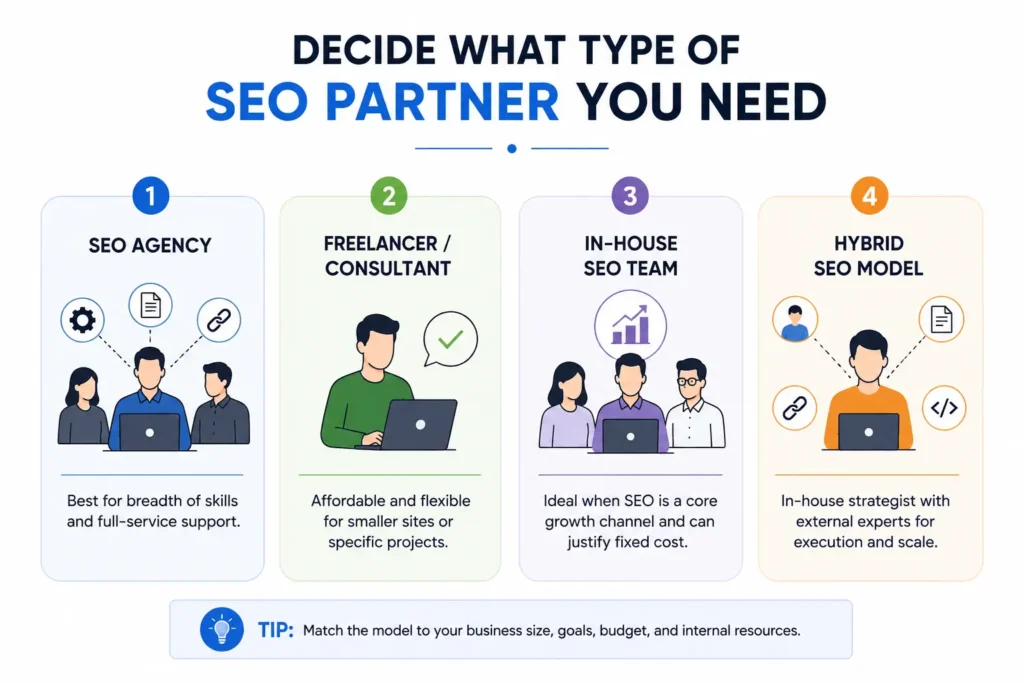
“SEO help” isn’t one thing. There are at least four structurally different ways to get it, and each fits a different size and stage of business.
1. SEO agency
A team with specialists across technical SEO, content, and links. Best when you need breadth of skills and don’t have the bandwidth to manage several freelancers yourself.
2. SEO freelancer or consultant
One experienced person, often narrower in scope but more hands-on and usually more affordable. Good for smaller sites or a specific project, like a technical audit.
3. In-house SEO team
Someone (or a small team) on your payroll, fully embedded in your business. Makes sense once SEO is a core, ongoing growth channel and you can justify the fixed cost.
4. Hybrid SEO model
An in-house strategist supported by an outside agency or freelancers for execution, content production, link building, or technical development. This is increasingly common for mid-size companies that want internal ownership without building a full team.
When each option makes sense
| Situation | Best fit |
| Small budget, one clear project | Freelancer or consultant |
| Need multiple skill sets, ongoing work | Agency |
| SEO is a primary growth channel, budget supports a salary | In-house team |
| Want internal strategy control with outside execution capacity | Hybrid model |
Choose an Agency That Understands Your Business Model
An agency that says “we work in your industry” isn’t the same as one that understands how your business model actually makes money. Local SEO, eCommerce SEO, and B2B SEO are different disciplines with different success metrics.
1. Local SEO
Success depends on map-pack visibility, reviews, and Google Business Profile management, separate from organic blue-link rankings.
2. eCommerce SEO
Involves faceted navigation, product schema, category-page structure, and handling thousands of URLs without creating duplicate-content problems.
3. B2B SEO
Longer sales cycles mean content needs to support multiple buying-committee stages, not just top-of-funnel traffic.
4. SaaS SEO
Often combines product-led content, comparison pages, and integration/use-case pages that map to how software buyers actually search.
5. Enterprise SEO
Requires managing approvals, legal review, multiple stakeholders, and often internationalization, process matters as much as tactics.
6. International SEO
Needs correct hreflang implementation, awareness of regional search engines, and localized (not just translated) content.
Business-model experience can matter more than industry experience, because the mechanics of SEO (site structure, content strategy, conversion paths) often depend more on how you sell than on what you sell.
Check the Agency’s Track Record Before You Hire Them
Ask for proof, not adjectives. “We’re experts” isn’t a track record; a documented before-and-after is.
1. Look for relevant case studies
Focus on case studies from businesses that’re like yours in size, industry or how they operate. A case study from a company, with fifty stores might not help much if you run a two-person local business.
2. Evaluate the starting point
A site that jumped from zero organic traffic to a modest amount looks impressive on a percentage basis but may not reflect meaningful skill. Ask what the baseline actually was.
3. Check what work was actually performed
Some agencies show results from work they didn’t do, for example, taking credit for a client’s own content team. Ask directly what the agency’s scope of work included.
4. Look beyond rankings
Rankings are an input, not an outcome. Ask what happened to traffic, leads, or revenue as a result of those rankings.
5. Verify traffic, leads, conversions, and revenue
Ask to see the actual metrics, ideally from a source like Google Search Console or Google Analytics, not just an agency-branded slide.
6. Ask for references
A confident agency will connect you with a current or former client. Hesitation here is worth noting.
How to Verify an SEO Agency’s Case Studies
This is where many businesses get misled, so it deserves its own section. Case studies are marketing material. Treat them the way you’d treat any sales claim.
Questions to ask about every case study
- What was the starting traffic, ranking, and revenue baseline?
- What specifically did the agency do, month by month?
- How long did it take to see meaningful movement?
- Were there any external factors (a product launch, PR coverage, paid ads) that also influenced the result?
- Can I speak to this client directly?
Metrics that matter
Organic traffic growth, conversion rate, qualified leads, and revenue tied to organic channels matter more than ranking position alone. A site can rank #1 for a keyword nobody searches for.
Warning signs of weak case studies
Be cautious of case studies that show only ranking charts, use vague timeframes (“results may vary”), lack client names or industries, or claim results with no visible methodology.
How to distinguish correlation from actual SEO impact
Ask what else changed during the campaign window. A traffic spike that lines up with a product going viral on Reddit or a press mention isn’t proof of SEO skill. A credible agency will be upfront about that distinction rather than take full credit.
Evaluate the Agency’s SEO Strategy
Ask any agency to walk you through their strategy before you sign anything. If they can’t explain it in plain language, that’s a red flag.
Keyword and search-intent research
Good strategy starts with understanding what people are actually trying to accomplish when they search, not just chasing high-volume terms.
Technical SEO
This covers crawlability, indexation, site speed, and structured data: the foundation that lets search engines find and understand your content in the first place.
On-page SEO
Title tags, headers, internal content structure, and how well a page actually answers the query it’s targeting.
Content strategy
A plan for what to create, in what order, and why, tied to search intent and business goals, not just a content calendar for its own sake.
Internal linking
How pages connect to each other to spread authority and help both users and search engines navigate the site.
Digital PR and link acquisition
Earning links from credible, relevant sites: a slow but durable way to build authority, as opposed to buying links, which risks a penalty.
Local SEO
If relevant to your business, this includes citation building, review management, and local landing pages.
Conversion rate optimization
Traffic that doesn’t convert isn’t worth much. A strong agency thinks about what happens after someone lands on the page.
Analytics and attribution
How the agency measures success and ties it back to your actual business results, not just search-console screenshots.
Ask to See Their SEO Audit Process
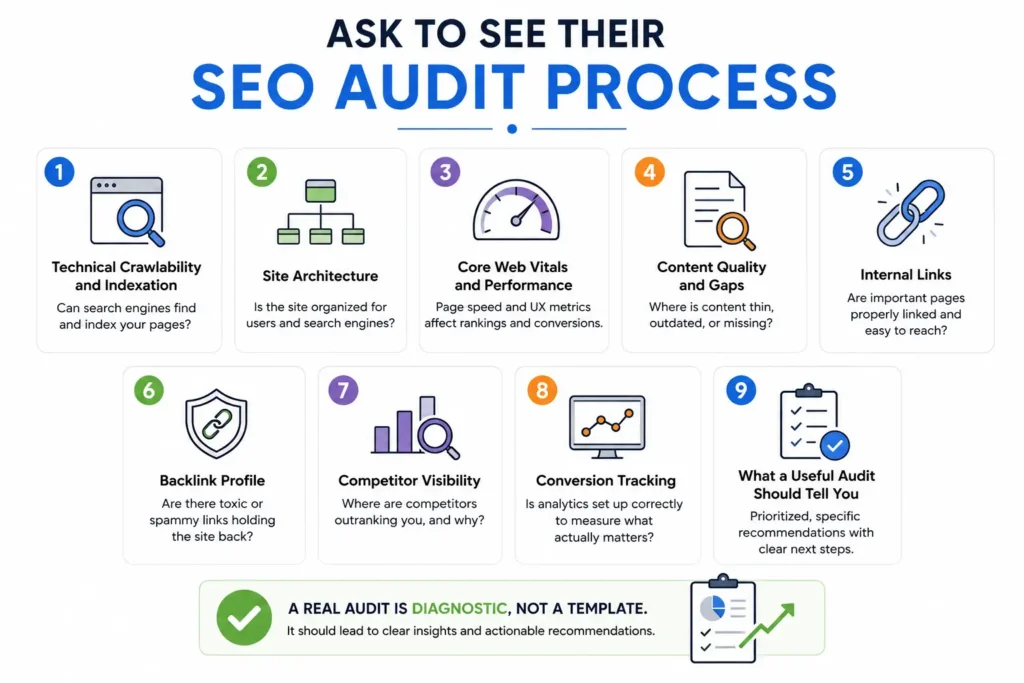
A real audit is diagnostic, not a template. Ask the agency to describe (or better, show a redacted sample of) what a typical audit covers.
Technical crawlability and indexation
Can search engines actually find and index your important pages?
Site architecture
Is the site organized in a way that makes sense to both users and search engines?
Core Web Vitals and performance
Page speed and user-experience metrics that affect both rankings and conversions.
Content quality and gaps
Where is content thin, outdated, or missing entirely compared to what ranks well?
Internal links
Are important pages properly linked to and easy to reach?
Backlink profile
Are there toxic or spammy links that could be holding the site back?
Competitor visibility
Where are competitors outranking you, and why?
Conversion tracking
Is analytics set up correctly to measure what actually matters?
What a useful audit should tell you
A good audit ends with prioritized, specific recommendations, not a 40-page report with no clear next steps.
Good audit vs bad audit
| Good audit | Bad audit |
| Prioritized action list | Long list with no prioritization |
| Ties issues to business impact | Lists issues with no context |
| Specific, assignable fixes | Vague generalities |
| References your actual data | Looks templated across clients |
Meet the People Who Will Actually Work on Your Account
The person who sells you the contract is often not the person who does the work. Ask to meet the actual team before you sign.
Who leads strategy?
Find out who’s actually setting direction and whether they have the experience to back it up.
Who handles technical SEO?
Technical work requires a specific skill set distinct from content or outreach.
Who creates and edits content?
Ask whether writers have subject-matter familiarity with your industry.
Who manages link building or digital PR?
This role determines whether you get high-quality placements or risky, low-value links.
Who handles analytics?
Someone should own reporting accuracy, not just present a dashboard.
Who communicates with your team?
Know who your day-to-day point of contact will be, and how responsive they’ve been to other clients.
Agency specialist vs account manager
An account manager coordinates; a specialist executes. Make sure you’re getting real access to specialists, not just polished updates from an account manager relaying secondhand information.
Evaluate How the Agency Uses AI in SEO
AI has changed both how SEO work gets done and how people search. Any agency worth hiring in 2026 should have a clear, honest point of view on both.
Does the agency understand AI search?
Ask how they think about AI Overviews, chatbot-based search, and how visibility in those surfaces differs from traditional rankings.
How does it use AI for research and content?
AI tools can speed up keyword research, outlining, and drafting, but ask how much human editing, fact-checking, and subject-matter review happens after.
Does it have an AI-generated content policy?
A credible agency should be able to explain, clearly, how much of your content (if any) involves AI assistance and what quality controls exist around it.
How does it approach AI Overviews and generative search?
The honest answer today is that visibility in AI-generated answers still depends heavily on the same fundamentals as traditional SEO: clear, well-structured, trustworthy content that directly answers a question.
What should an agency never promise about AI SEO?
Be skeptical of any agency promising guaranteed placement in AI Overviews or “AI SEO hacks.” No one controls how generative search engines choose to summarize content. The focus should stay on quality, evidence, useful content, technical accessibility, clear entities, topical authority, and measurable outcomes, not guarantees.
Review SEO Reporting Before Signing a Contract
Ask to see a real, redacted client report before you commit. This tells you more about an agency’s substance than any pitch deck.
What should a monthly SEO report include?
At minimum: rankings, organic traffic, leads and conversions, revenue impact where trackable, completed work, problems discovered, and next-month priorities.
Rankings
Movement on target keywords, in context, not just a raw list of positions.
Organic traffic
Trends over time, segmented by page or topic where useful.
Leads and conversions
How organic traffic is translating into actions that matter to your business.
Revenue
Where trackable, how organic search is contributing to actual revenue.
Completed work
A clear list of what was actually done that month.
Problems discovered
Honest agencies flag issues, not just wins.
Next-month priorities
What’s planned and why, tied back to the strategy.
What a bad SEO report looks like
Generic templates with no narrative, no context for ups and downs, and no clear connection between “work done” and “results achieved.”
Understand SEO Pricing Before You Compare Agencies
Comparing SEO prices without understanding scope is like comparing house prices without knowing square footage.
What determines SEO pricing?
Scope of work, competitiveness of your market, size of your site, and how much content or technical development is included.
Monthly retainers
The most common model for ongoing SEO. It typically covers a defined set of monthly deliverables.
Project-based SEO
Fixed-scope work like a one-time audit or migration, priced for a defined deliverable rather than ongoing work.
Hourly consulting
Common for freelancers or specialized technical work, billed by the hour.
Performance-based SEO
Pricing tied to results, such as ranking improvements. Be cautious here: this model can incentivize short-term, risky tactics over sustainable growth.
What should be included in the monthly fee?
Ask specifically what’s included (content volume, technical work hours, link-building targets, and reporting) versus what’s billed as an add-on.
Why the cheapest SEO agency may cost more
A low-cost agency that uses risky link tactics or thin AI-generated content can trigger a penalty that costs far more to recover from than you saved.
How to compare pricing based on scope, not price alone
Build a simple comparison: list deliverables side by side for each agency, then compare the price per deliverable, not just the monthly total.
Read the SEO Contract Carefully
This is one of the most commonly skipped steps, and one of the most consequential.
Contract length
Understand the minimum commitment. Long lock-ins with vague deliverables are a risk.
Cancellation terms
Know the notice period and any fees for ending the relationship early.
Deliverables
Make sure deliverables are specific and measurable, not just “ongoing SEO services.”
Content ownership
Confirm, in writing, that you own the content produced. This matters if you switch agencies later.
Website and analytics access
Make sure you retain admin-level access to your own website, Google Search Console, and Analytics accounts at all times.
Backlink ownership and removal
Clarify whether links built on your behalf stay in place if you leave, and what happens if a link needs to be removed.
Reporting obligations
Confirm the frequency and content of reports are contractually specified, not left to discretion.
Additional fees
Watch for scope-creep charges: extra fees for tasks that sound like they should be included.
What happens when the relationship ends?
A well-written contract spells out data handoff, access transfer, and any final reporting you’re entitled to.
Ask These Questions Before Hiring an SEO Agency
Use this as an actual interview checklist, not every question will apply, but most should get a clear, specific answer.
Questions about experience
- How long have you worked with businesses in our industry or business model?
- Can you share three case studies with verifiable results?
- What’s your team’s average client tenure?
Questions about strategy
- Walk me through how you’d approach our first 90 days.
- How do you prioritize technical fixes versus content versus links?
- How does your strategy change if we don’t see results in month three?
Questions about technical SEO
- Who performs technical audits, and what’s their background?
- How do you handle Core Web Vitals issues?
- Do you work directly with our developers, or hand off recommendations?
Questions about content
- Who writes the content, and do they have subject-matter expertise?
- What’s your editorial and fact-checking process?
- How do you decide what to write about?
Questions about link building
- What’s your link-acquisition process?
- Can you show examples of recently earned links?
- How do you avoid risky or spammy link sources?
Questions about reporting
- Can I see a sample report?
- How often will we meet to review results?
- Who do I contact if something looks wrong?
Questions about AI SEO
- How do you use AI in your process?
- What’s your policy on AI-generated content quality control?
- How do you think about visibility in AI Overviews?
Questions about communication
- Who is my main point of contact?
- What’s your typical response time?
- Will I have direct access to specialists, not just an account manager?
Questions about pricing
- What exactly is included in the monthly fee?
- What triggers an additional charge?
- How is pricing structured if scope changes?
Questions about risk
- Have any client sites been penalized while working with you?
- How do you handle algorithm updates that affect traffic?
- What tactics do you avoid, and why?
SEO Agency Red Flags You Should Never Ignore
Some warning signs are dealbreakers, no matter how good the pitch sounds.
Guaranteed #1 rankings
No one controls Google’s algorithm. Any guarantee of a specific ranking position is a red flag.
Instant SEO results
Meaningful organic growth takes months, not days. Promises of quick wins usually involve tactics that risk a penalty later.
Secret Google connections
There’s no such thing as a special relationship that gets you preferential treatment in search results.
Guaranteed backlink quantities
Quality matters far more than quantity, and a fixed link quota often leads to low-value or purchased links.
Extremely cheap packages
Prices well below market rate usually mean templated, low-effort, or outsourced work with minimal oversight.
No relevant case studies
If an agency can’t show real, verifiable results, that’s not a coincidence.
Vague reports
Reports with no context, no narrative, and no connection to business outcomes usually mean there’s not much substance behind the work.
No access to specialists
If you can never talk to the person doing the actual work, you can’t verify their competence.
Keyword rankings presented as the only KPI
Rankings alone don’t pay the bills: leads, conversions, and revenue do.
Long contracts with unclear deliverables
If you can’t clearly define what you’re paying for, don’t sign a long-term commitment.
AI-generated content at scale without quality controls
Mass-produced, unedited AI content risks quality issues and can hurt both rankings and brand trust.
How to Compare Your Final SEO Agency Shortlist
Once you’ve narrowed things down to two or three agencies, compare them side by side using a simple weighted scorecard.
Experience
Relevant track record in your business model and industry.
Strategy
Clarity and soundness of their proposed approach.
Case studies
Verified, relevant, and honestly presented.
Technical expertise
Depth of technical SEO knowledge and access to specialists.
Content
Quality of writing samples and editorial process.
Reporting
Clarity, honesty, and business-outcome focus of sample reports.
Communication
Responsiveness and access to the real team.
Pricing
Value relative to scope, not lowest price alone.
Ethics and risk
Willingness to avoid risky tactics and be transparent about limitations.
SEO Agency Scorecard (weighted example)
| Criteria | Weight | Agency A | Agency B |
| Experience | 15% | ||
| Strategy | 15% | ||
| Case studies | 15% | ||
| Technical expertise | 10% | ||
| Content | 10% | ||
| Reporting | 10% | ||
| Communication | 10% | ||
| Pricing | 10% | ||
| Ethics and risk | 5% |
Score each agency 1–5 per row, multiply by weight, and total the columns. This turns a gut feeling into a documented decision, useful if more than one stakeholder needs to sign off.
What Your First 90 Days With an SEO Agency Should Look Like
A credible agency will have a clear plan for onboarding, not just “we’ll get started.”
Days 1–30: Discovery and auditing
Expect account access setup, a technical audit, competitor analysis, and an initial strategy document.
Days 31–60: Implementation
Technical fixes begin, content production ramps up, and initial optimizations go live.
Days 61–90: Optimization and measurement
Early data starts coming in; the agency should adjust based on what’s working, not just stick to the original plan blindly.
What results should you realistically expect?
In most cases, meaningful ranking and traffic movement takes three to six months, and compounding results often build over 6–12 months. Anyone promising dramatic results inside 90 days should be questioned closely.
What should concern you after 90 days?
No clear communication, no documented work completed, or no explanation for lack of progress are all reasons to have a direct conversation, or walk away.
SEO Agency vs Freelancer vs In-House Team
| Factor | Agency | Freelancer | In-house |
| Cost | Medium–high | Low–medium | High (salary + tools) |
| Skill breadth | Wide | Narrower | Depends on hire |
| Speed of scaling | Fast | Limited | Slow |
| Business context | Learned over time | Learned over time | Built-in |
| Best for | Ongoing, multi-skill needs | Focused projects | Long-term core channel |
How to Know You’ve Chosen the Right SEO Agency
Even after a good hiring process, keep an eye on these signals in the first few months.
They explain the “why” behind recommendations
Good agencies teach you as they go, not just hand down instructions.
They connect SEO to business outcomes
Every update should tie back to leads, revenue, or a goal you defined at the start.
They communicate clearly
You shouldn’t need a glossary to understand your own monthly report.
They acknowledge uncertainty
SEO involves algorithm changes no one fully controls. An agency that admits what it doesn’t know is more trustworthy than one that claims certainty.
They adapt the strategy based on evidence
If something isn’t working, they should say so and adjust, rather than repeating the same plan indefinitely.
They protect your website from risky tactics
A good agency will tell you no when a shortcut isn’t worth the risk to your site’s long-term health.
Frequently Asked Questions About Choosing an SEO Agency
1. How do I choose the right SEO agency?
Define your business goal, decide the type of partner you need, verify case studies and references, review their strategy and reporting, and compare shortlisted agencies by scope rather than price alone.
2. What should I look for when hiring an SEO agency?
Relevant experience with businesses like yours, verifiable case studies, a clear strategy and audit process, transparent reporting, and a contract with well-defined deliverables.
3. How much does an SEO agency cost?
Pricing varies widely based on scope, market competitiveness, and site size, typically ranging from a few hundred to several thousand dollars a month for ongoing retainers.
4. Is hiring an SEO agency worth it?
For businesses that lack the in-house time or expertise to manage SEO consistently, an agency can be worth it, provided the agency ties its work to measurable business outcomes.
5. How long does SEO take to work?
Most businesses start seeing meaningful movement in three to six months, with compounding results building over 6–12 months or more.
6. Can an SEO agency guarantee rankings?
No legitimate agency can guarantee specific rankings, since no one controls the search engine’s algorithm. Guarantees are a red flag.
7. What questions should I ask an SEO agency?
Ask about their experience, strategy, technical process, content approach, link-building methods, reporting cadence, AI usage, and pricing structure, see the full checklist above.
8. Should I hire an SEO agency or freelancer?
Choose an agency if you need broad skill coverage and faster scaling; choose a freelancer for a focused project or smaller budget.
9. What should an SEO proposal include?
A clear statement of goals, proposed strategy, scope of deliverables, timeline, reporting structure, and pricing tied to that scope.
10. What should an SEO audit include?
Technical crawlability, site architecture, Core Web Vitals, content quality, internal linking, backlink profile, competitor visibility, and conversion tracking.
11. How do I know if an SEO agency is trustworthy?
They provide verifiable case studies, explain their process in plain language, avoid guarantees, and are transparent about risks and limitations.
Conclusion
Choosing the right SEO agency isn’t about finding the one with the most confident sales pitch. It’s about finding the one that can prove its process, real case studies, a clear strategy, an honest audit, transparent reporting, and a contract that protects you if things don’t work out.
Take your time on this decision. Define your goal, work through the checklist above, and don’t sign anything until you’ve met the actual team who will do the work. The right SEO agency should feel less like a vendor and more like a long-term partner in growing your business.