If you’ve started looking for a mobile app development company in the USA, you’ve probably noticed the same problem I keep running into when I research this space: every list looks the same.
Ten logos, a paragraph each, a “contact us” button. None of it tells you how to actually pick the right team for your project.
This guide takes a different approach. Instead of just naming companies, it walks you through how to evaluate them yourself: what to check, what to ask, what a fair price looks like, and what tends to go wrong when businesses skip this homework.
Whether you’re a founder building an MVP or a product manager scoping an enterprise app, the goal here is the same: help you make a hiring decision you won’t regret in six months.
10 Best Mobile App Development Companies in the USA
The best mobile app development company depends on what you’re building, how complex the project is, and how much support you’ll need after launch.
Instead of treating one company as the universal winner, this list highlights firms with different strengths, from startup MVPs to enterprise applications.
1. Red Stag Labs
Best for: Custom mobile apps and business-focused solutions
Red Stag Labs provides mobile app development for iOS and Android, with options for native and cross-platform development.
The company also offers custom software development, cloud services, AI solutions, and post-launch support.
It’s a good option for businesses looking for a development partner that can handle more than just the mobile frontend.
2. WillowTree
Best for: Enterprise digital products
WillowTree is known for working on large-scale digital experiences and mobile products.
It’s particularly suited to organizations that need mature product strategy, UX design, engineering, and enterprise-level delivery.
3. Fueled
Best for: Premium startup and consumer apps
Fueled focuses on designing and developing mobile and digital products, making it a strong fit for startups and consumer-facing businesses that place a high emphasis on product design and user experience.
4. Chop Dawg
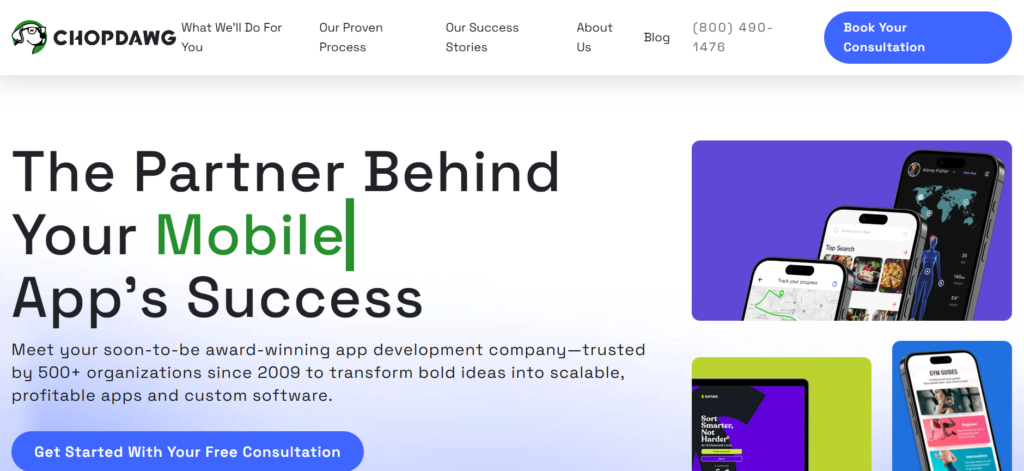
Best for: Startups and full-service app development
Chop Dawg provides end-to-end app development services for businesses and startups.
Its offering covers product strategy, design, development, and launch, making it suitable for founders that want a single development partner.
5. TechAhead
Best for: Custom iOS, Android, and cross-platform development
TechAhead works across mobile app development, digital transformation, and emerging technologies.
It’s worth considering when you need a custom application with integrations and room to scale.
6. Dogtown Media
Best for: Mobile products and emerging technology
Dogtown Media specializes in mobile applications and technology-driven digital products.
It can be a good fit for businesses building applications that require custom functionality or newer technologies.
7. Utility
Best for: Enterprise and consumer digital products
Utility works with organizations on custom mobile and web applications. Its experience spans product strategy, UX/UI, engineering, and digital product development.
8. Goji Labs
Best for: Startups and MVP development
Goji Labs focuses on product design and development for startups and growing businesses. It’s a useful option for companies that need help turning an early product idea into a working application.
9. Lickability
Best for: iOS and consumer applications
Lickability has a strong focus on mobile product development, particularly within the Apple ecosystem. It’s a potential fit for companies where iOS experience and polished mobile UX are priorities.
10. 3 SIDED CUBE
Best for: Purpose-driven and socially impactful apps
3 SIDED CUBE specializes in digital products designed to address real-world problems. Its portfolio makes it particularly relevant for organizations working in areas such as humanitarian response, accessibility, and social impact.
How We Selected These Companies
Rather than ranking companies purely by brand recognition, consider factors such as mobile development experience, portfolio quality, independent reviews, technical capabilities, pricing, communication, and post-launch support.
The right company for a startup building an MVP may be completely different from the right partner for a healthcare organization or enterprise with strict security and compliance requirements.
Use this list as a starting point, then evaluate each company against the criteria discussed throughout this guide.
What Is a Mobile App Development Company?
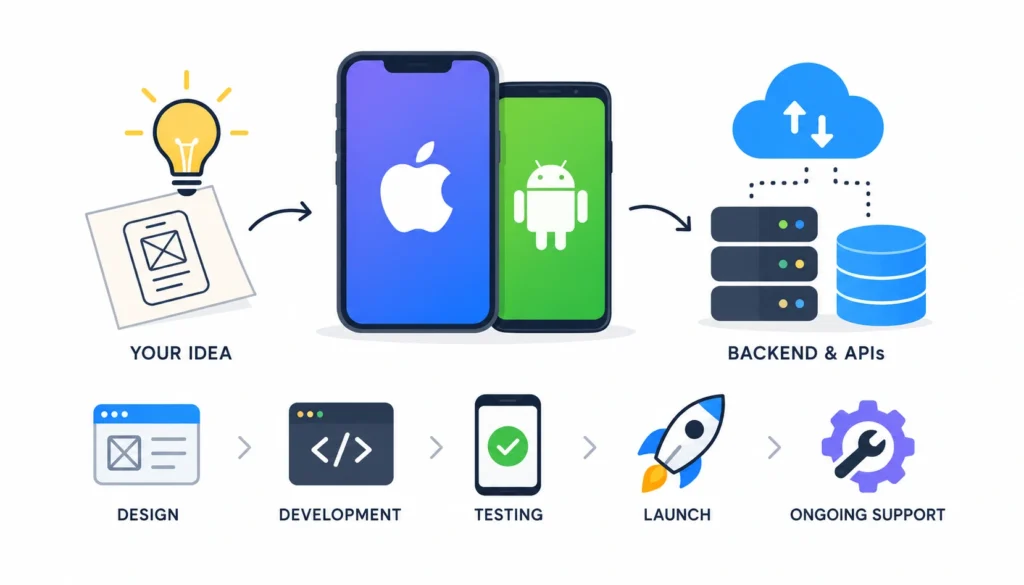
A mobile app development company designs, builds, tests, and maintains software for phones and tablets. That usually covers iOS, Android, or both, plus the backend systems, APIs, and databases that keep the app running after launch.
Some firms specialize in one platform or industry; others handle the full product lifecycle from an idea on a napkin to ongoing support.
The label gets used loosely, though. Some “companies” are a two-person freelance team with a website. Others are 200-person studios with dedicated QA and DevOps departments.
Part of your job as a buyer is figuring out which one you’re actually talking to.
How to Choose a Mobile App Development Company in the USA
Picking a development partner isn’t that different from hiring a key employee.
You’re trusting someone with a big chunk of your budget and your product’s future. Before you commit, it’s worth looking beyond their portfolio and checking how well their own website performs.
A website SEO score checker can help you evaluate important aspects of a company’s online presence, including technical SEO, page performance, and overall website health.
- Technical expertise that matches your platform and complexity
- A portfolio you can actually verify, not just screenshots
- Clear, itemized pricing
- A defined process for discovery, design, development, and testing
- A written policy on who owns the code and IP
- A real plan for what happens after launch
- Reviews you can check independently, not just testimonials on their own site
- Communication that fits your time zone and working style
We’ll go through each of these in detail, but if you remember one thing from this article, remember this: the cheapest quote and the flashiest portfolio are rarely the safest choice.
US-Based vs. Offshore vs. Nearshore Development Companies
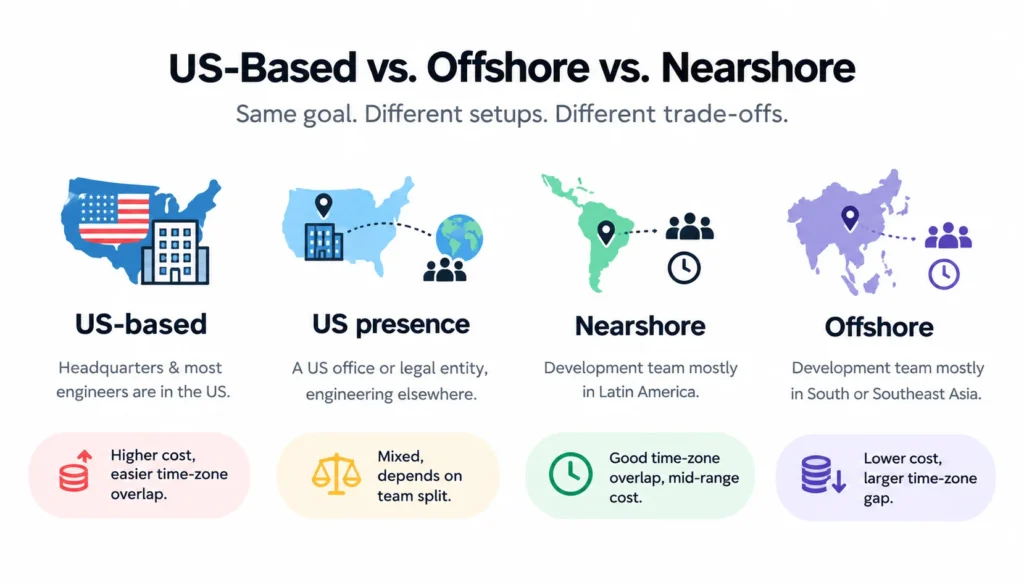
This is where a lot of “top companies in the USA” lists get sloppy. A firm headquartered in Bangalore with a small sales office in Delaware is not the same thing as a company built and run out of Austin or Chicago. Both can build you a good app. But they come with different trade-offs, and you deserve to know which one you’re hiring.
Here’s a simple way to sort them:
| Type | What it means | Typical trade-off |
| US-based | Headquarters and most engineers are in the US | Higher cost, easier time-zone overlap |
| US presence | A US office or legal entity, engineering elsewhere | Mixed, depends on team split |
| Nearshore | Development team mostly in Latin America | Good time-zone overlap, mid-range cost |
| Offshore | Development team mostly in South or Southeast Asia | Lower cost, larger time-zone gap |
None of these is automatically “better.” A nearshore team in Mexico City working 9-to-5 Central Time can be far easier to manage than a US company that outsources your project to a subcontractor without telling you.
Ask directly where the engineers who’ll write your code actually sit. If a company hesitates on that question, that’s a signal worth noting.
For deeper discussion on this trade-off from developers who’ve lived it, r/webdev and r/startups on Reddit have long-running threads where founders compare notes on outsourcing experiences, worth a search before you commit a budget.
How Much Does Mobile App Development Cost in the USA?
Most US mobile app projects fall somewhere between $20,000 and $500,000, depending on complexity, platform choice, and how regulated your industry is. That’s a wide range, so here’s a rough breakdown by project type:
| App type | Estimated cost | Typical timeline |
| Simple MVP | $20K–$50K | 2–4 months |
| Moderate-complexity app | $50K–$150K | 4–7 months |
| Complex app | $150K–$300K+ | 6–12 months |
| Enterprise or regulated app | $300K–$500K+ | 9–18+ months |
Treat these as planning numbers, not quotes. Your actual cost depends on:
- Number of platforms (iOS only vs. iOS and Android)
- Backend complexity: a simple content app vs. one syncing real-time data across users
- Third-party integrations (payments, maps, AI models, CRMs)
- Design complexity and how much custom UI work is involved
- Compliance requirements like HIPAA or PCI DSS
- Where the development team is based
- Ongoing maintenance after launch
What Should a Quote Actually Include?
A number on its own tells you almost nothing. Before comparing two proposals, check whether each one covers:
- UX research and prototyping
- UI design
- Backend and database work
- API development and third-party integrations
- An admin dashboard, if you need one
- QA and manual testing
- App Store and Google Play submission
- Analytics setup
- A maintenance period after launch
I’ve seen two quotes for the same app come in $80,000 apart, and the cheaper one simply left out QA and backend work, planning to bill for it later as a “phase two.” Read the fine print.
How Long Does It Take to Build a Mobile App?
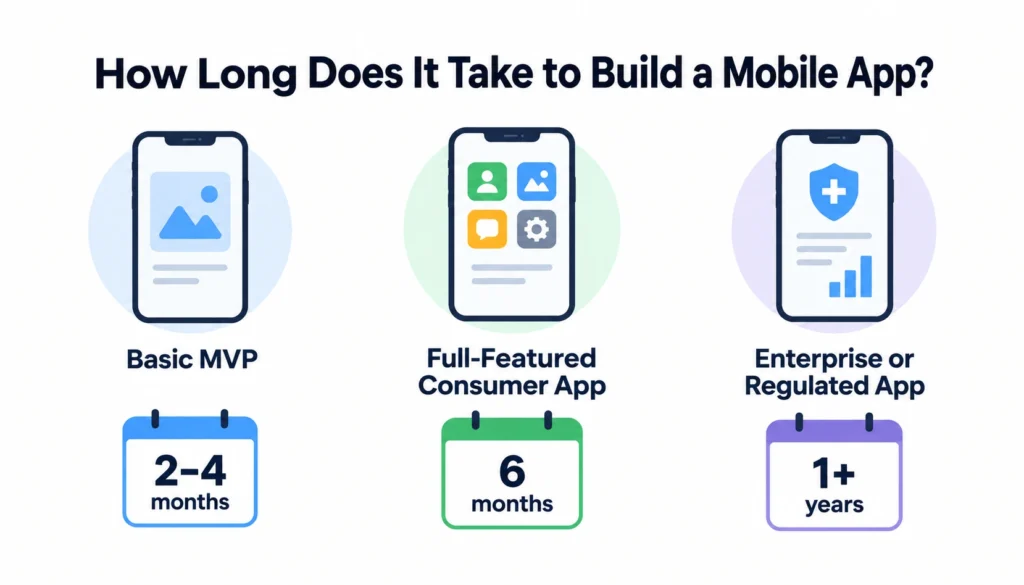
A basic MVP usually takes two to four months. A full-featured consumer app with a custom backend runs closer to six months. Enterprise or regulated apps, think healthcare platforms with audit trails, or fintech apps needing compliance sign-off, can take a year or more.
The rough sequence looks like this:
Discovery → UX/UI design → Architecture → Development → QA → Beta testing → App Store submission → Post-launch monitoring
Discovery and design alone can take four to six weeks if done properly. Rushing this stage is one of the more common reasons projects run over budget later: requirements shift mid-build because nobody nailed them down at the start.
Native vs. Flutter vs. React Native: Which Should You Choose?
This question comes up in nearly every hiring conversation, so it’s worth understanding in plain terms.
Native development means building separately for iOS (in Swift) and Android (in Kotlin). You get the best performance and full access to each platform’s features, but you’re paying for two codebases.
Flutter and React Native are cross-platform frameworks. You write most of the code once and it runs on both platforms. This saves time and money, though very graphics-heavy or hardware-intensive apps sometimes still benefit from native code.
| Factor | Native | Flutter | React Native |
| Performance | Best | Very good | Good |
| Code shared across platforms | None | High | High |
| Development speed | Slower | Fast | Fast |
| Best for | Complex, performance-heavy apps | Startups wanting one codebase | Teams already using JavaScript |
Neither cross-platform framework is a downgrade. Companies like Google (Flutter) and Meta (React Native) use them in production at scale. The right choice depends on your team’s existing skills and how demanding your app’s performance needs are. Wikipedia’s overview of cross-platform software is a decent primer if you want the technical background before your first vendor call.
What Services Should a Mobile App Development Company Offer?
A full-service partner should be able to cover the whole build, not just the parts that are fun to talk about in a sales call. Look for:
- Product discovery and requirements gathering
- UX research and UI design
- iOS and Android development, native or cross-platform
- Backend and API development
- Cloud infrastructure setup (AWS, Google Cloud, or Azure)
- QA and automated testing
- DevOps and CI/CD pipelines
- App Store and Google Play deployment
- Post-launch maintenance
- AI integration, if relevant to your product
If a company only does design, or only does the frontend and expects you to find a separate backend team, that’s not necessarily a dealbreaker, but you need to know that going in, and price your project accordingly.
How to Evaluate a Mobile App Development Company: A Step-by-Step Process
Step 1: Define what you’re actually building
Write down the core problem your app solves before you talk to anyone. A one-page brief covering the audience, main features, platforms, and rough budget will save you hours of back-and-forth with sales teams.
Step 2: Decide your platform priorities
iOS only? Android only? Both from day one? This affects cost, timeline, and which companies are even a good fit.
Step 3: Set a realistic budget range
Use the cost table above as a starting point, then adjust for your specific features and compliance needs.
Step 4: Shortlist three to five companies
Don’t try to evaluate fifteen agencies in depth. Narrow to a short list based on the criteria in this guide, then go deep.
Step 5: Check their actual apps
Ask for links to apps they’ve shipped and download them yourself. Read the App Store and Google Play reviews. A polished case study page means nothing if the real product has a 2.8-star rating.
Step 6: Verify reviews independently
Check the company on Clutch or GoodFirms rather than relying on testimonials posted on their own site. LinkedIn is also useful here. Look at the profiles of the actual engineers, not just the sales team, and see if their work history matches what the company claims.
Step 7: Interview the technical team, not just sales
Ask to speak with the developer or architect who’d actually work on your project. Sales reps are trained to sound confident. Engineers will tell you honestly what’s hard about your idea.
Step 8: Compare proposals line by line
Match each quote against the “what should a quote include” checklist above.
Step 9: Read the contract before signing anything
Pay close attention to IP ownership, source-code access, and what happens if you want to switch vendors later.
Step 10: Confirm what post-launch support looks like
Ask specifically what’s included after launch, for how long, and at what cost once that period ends.
12 Questions to Ask Before Hiring a Mobile App Development Company
- How many apps have you shipped to the App Store or Google Play?
- Can you share links to three live apps I can download right now?
- Who owns the source code once the project is complete?
- Who controls the Apple Developer and Google Play accounts?
- Do you handle backend development in-house, or is that subcontracted?
- Who performs QA, and is it manual, automated, or both?
- What’s your process when requirements change mid-project?
- What does your security review process look like?
- What’s included in your maintenance agreement, and what costs extra?
- Will the same team stay on the project from start to finish?
- What happens if we want to move development in-house or to another vendor later?
- Can you walk me through a project that didn’t go as planned, and what you did about it?
That last question matters more than people think. Any agency with real experience has had a project go sideways. How they answer tells you more about them than a perfect track record ever could.
Red Flags When Hiring a Mobile App Development Company
Watch for these warning signs during the sales process:
- No verifiable live apps, only mockups or screenshots
- A quote far below every other bid with no clear explanation
- No discovery phase, they’re ready to start coding the day you sign
- Vague contract language around IP and code ownership
- Reluctance to let you speak with the actual engineering team
- One technology recommended for every type of project, regardless of fit
- No mention of security or compliance, even when you’ve raised it
- No plan for what happens after launch
None of these alone disqualifies a company automatically, but two or three together are worth a serious pause.
App Ownership and Intellectual Property
This gets skipped in a lot of sales conversations, and it shouldn’t. Before you sign, confirm in writing:
- You own the source code once final payment is made
- You control the Apple Developer and Google Play Console accounts
- You have access to design files, documentation, and the repository
- Any third-party libraries used are properly licensed for commercial use
- There’s a clear handover process if you switch vendors later
If a contract is silent on any of these, ask for it to be added explicitly. Verbal assurances don’t help you much in a dispute.
Security and Compliance Considerations
Depending on your industry, your app may need to meet specific regulatory standards:
- HIPAA for health data in the US
- PCI DSS for handling payment card information
- GDPR if you have users in the EU
- CCPA/CPRA for California residents’ data
Beyond regulation, ask how the company handles encryption in transit and at rest, authentication, and secure API design. The OWASP Mobile Top 10 is the standard reference list of common mobile security risks, and a competent development partner should be familiar with it without you having to explain what it is.
What Happens After Your App Launches?
Launch day isn’t the finish line. A serious development partner should help with:
- Crash monitoring and bug fixes
- Usage analytics
- OS updates (new iOS and Android versions come out yearly)
- Security patches
- Performance tuning as your user base grows
- New feature development based on user feedback
Ask upfront what this costs on an ongoing basis. A common model is a monthly retainer covering a set number of hours, with anything beyond that billed separately. It’s also worth asking whether ongoing maintenance includes page speed and Core Web Vitals optimization, especially if your app has a supporting website or web-based components that need to stay fast and responsive.
What Should Be in a Mobile App Development Contract?
At minimum, your contract should spell out:
- Scope of work and specific deliverables
- Project milestones and payment schedule
- Process for handling change requests
- IP and source-code ownership
- Confidentiality terms
- Warranty period for bug fixes after delivery
- Maintenance terms
- Termination and handover process
If you’re not a lawyer, it’s worth having one review the contract before you sign, particularly the IP and termination clauses.
Best Mobile App Development Companies by Project Type
Rather than a single ranked list, think about what kind of buyer you are:
Startups and MVPs usually do best with a smaller, faster-moving team that can iterate quickly and isn’t precious about scope changes.
Enterprise projects benefit from a company with a proven process for handling larger teams, documentation, and stakeholder sign-off at each stage.
Healthcare and fintech apps need a partner who already understands HIPAA or PCI DSS, not one learning compliance requirements on your dime.
AI-powered apps need engineers who’ve actually integrated language models or machine learning pipelines into production apps, not just added a chatbot widget.
Match the company’s demonstrated experience to your category before you match on price.
Frequently Asked Questions
1. What is the best mobile app development company in the USA?
There’s no single best company. It depends on your budget, industry, and platform needs. A startup building a simple MVP and a hospital system building a HIPAA-compliant app need very different teams.
2. How much does it cost to build an app in the USA?
Most projects range from $20,000 for a simple MVP to $500,000 or more for complex, regulated applications. Get itemized quotes so you know exactly what’s included.
3. How long does it take to build a mobile app?
A simple MVP typically takes two to four months. Complex or enterprise apps can take six months to over a year.
4. Is it better to hire a US-based or offshore company?
US-based teams offer easier time-zone overlap and communication, at a higher cost. Offshore and nearshore teams can lower cost significantly, with more coordination effort required. Neither is objectively better. It depends on your budget and how hands-on you want to be.
5. Should I choose Flutter or React Native?
Both are solid choices for cross-platform apps. Flutter tends to edge out on performance and UI consistency; React Native is a natural fit if your team already knows JavaScript.
Final Thoughts
There’s no universal winner in this category. The right mobile app development company for a healthcare startup in Boston looks nothing like the right one for a consumer social app out of Austin.
What matters is that you go in with a clear brief, a realistic budget, and a checklist for verifying claims instead of taking them at face value.
If you take one thing from this guide, let it be this: spend an extra week vetting a company properly, and you’ll likely save months of rework later.
The businesses that get burned in this space almost always skip the boring parts: the portfolio checks, the contract review, the plain conversation about who owns the code.
Do those, and you’ll be in a strong position to hire well, whether you end up with a small US studio or a larger cross-platform team.
Before making your final decision, you can also use website and SEO audit tools to evaluate a company’s online presence and identify potential technical issues.