For most of SEO’s history, the game was reactive. Google shipped an update, rankings shuffled, and site owners scrambled to reverse-engineer what changed.
That cycle is ending – not because updates stopped, but because their direction has become unmistakable.
Every major change of the past few years – helpful content signals folded into the core algorithm, AI Overviews reshaping the results page, spam policies targeting scaled low-value content – points the same way:
Google is getting better at measuring whether a site genuinely serves people, and worse at being fooled by anything else.
That’s good news if you build for the long term, and bad news if your strategy depends on shortcuts. Here is what the algorithm’s trajectory tells us, and what to prepare now.
1. Intent Has Replaced Keywords as the Unit of Optimization
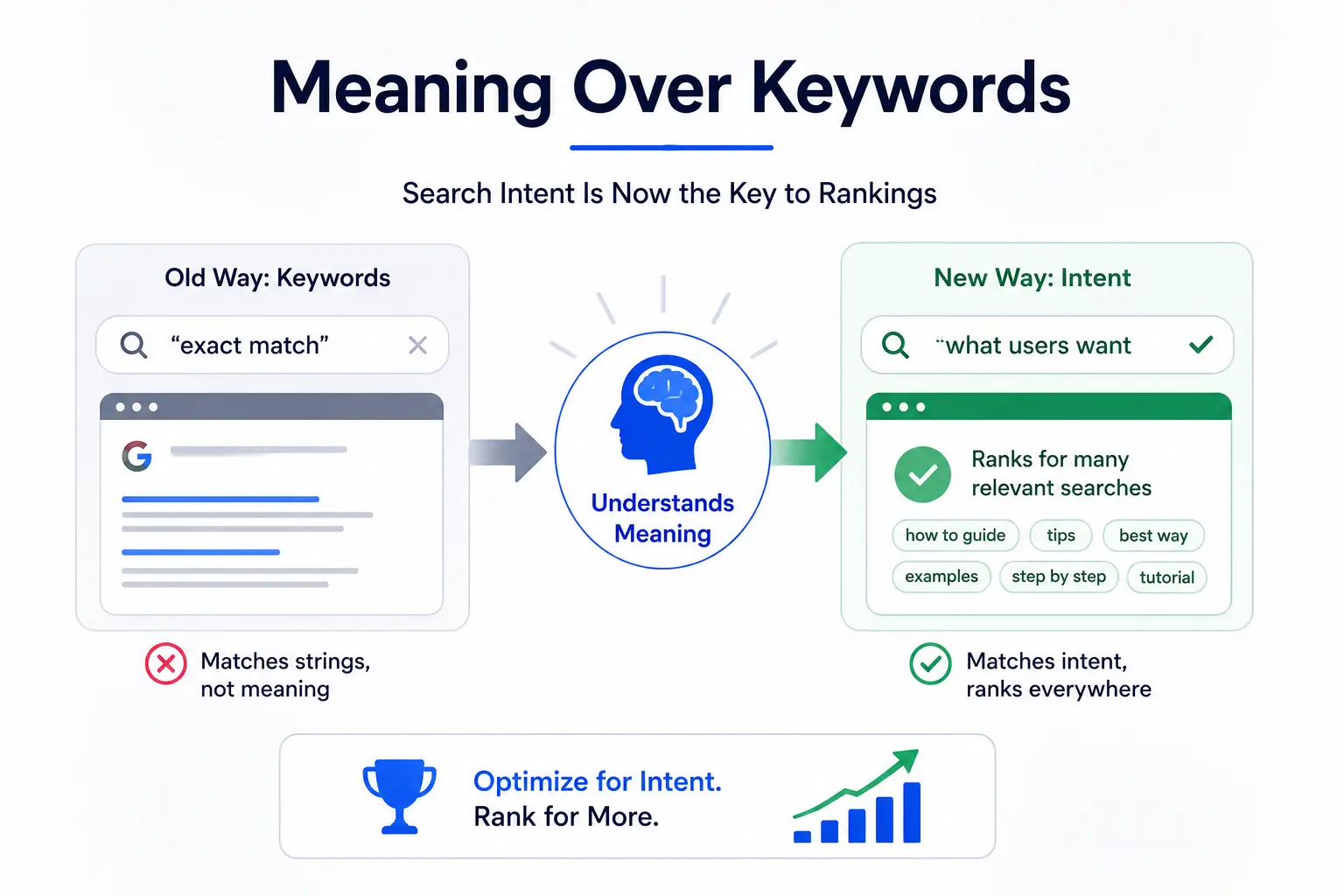
Google no longer matches strings; it matches meanings. Semantic search and entity understanding mean a page can rank for hundreds of phrasings it never explicitly contains – and fail to rank for the exact phrase in its title tag if the content doesn’t satisfy what searchers actually want.
What to prepare: stop planning content around isolated keywords and start planning around search intents. Before writing anything, open the live results page for your target query and ask what the top results have in common.
Are they comparisons? Tutorials? Price lists? That consensus is the intent, and a page that fights it rarely wins.
Group your keywords into intent clusters and assign one strong page per cluster instead of thin pages per variation – the cannibalization you avoid is worth more than the extra URLs.
2. AI Overviews Reward Sources, Not Just Rankings
AI-generated answers now sit above traditional results for a growing share of queries. Pessimists read this as the death of organic traffic.
The more useful reading: the answer engine has to cite someone, and cited sources are chosen for clarity, specificity, and trustworthiness – not domain size alone.
What to prepare: structure content so machines can lift answers cleanly. Lead sections with direct answers, then elaborate. Use precise headings that mirror real questions.
Add specifics — numbers, steps, named tools, dates — because vague content is unquotable content. Schema markup won’t rescue weak writing, but on strong pages it removes ambiguity about what you’re claiming and who’s claiming it.
3. E-E-A-T Is Becoming Measurable
Experience, Expertise, Authoritativeness, and Trust used to feel like abstract guidance for quality raters.
Increasingly, its components are things an algorithm can approximate: consistent authorship, corroboration across sources, first-hand details that scraped content can’t fake, and a backlink profile earned from topically relevant sites rather than rented from irrelevant ones.
What to prepare: put real names and credentials on content. Show your work – screenshots, data, outcomes of things you actually did. Audit your link profile for relevance, not just volume; ten links from sites in your field now outweigh a hundred from unrelated directories.
And prune or consolidate old thin pages: sitewide quality signals mean your weakest content drags down your strongest.
4. Consistency Is Now a Ranking Asset – and the Hardest One to Fake
Here is the uncomfortable truth behind “publish great content”: one great article does very little.
Google’s freshness signals, topical authority modeling, and crawl-frequency behavior all favor sites that publish useful content on a steady cadence over months – because a sustained cadence is exactly what spam operations and abandoned sites can’t sustain.
Topical authority is built brick by brick: each new article that deepens a cluster makes every other article in that cluster slightly easier to rank.
The operational problem is that consistency is a production challenge, not a writing challenge. Most small teams can produce two excellent posts.
Few can produce one excellent post every week for a year while also running the business.
This is why the interesting development isn’t AI writing per se – mass-produced generic text is precisely what recent spam updates punish — but managed content-automation systems that combine keyword research, drafting grounded in a site’s real subject matter, scheduled publishing, and rank tracking in one accountable loop.
The category is maturing fast worldwide; a representative example is Korea’s tryoreum.com, which reads a client’s site to learn its business, researches keywords against real search-volume data, then writes, publishes, and tracks rankings weekly — rewriting posts that fail to move.
Whether you build this pipeline with tools or run it manually with an editorial calendar, the principle is the same: cadence plus quality control, or the compounding never starts.
What to prepare: commit to a publishing rhythm you can hold for twelve months, even if it’s modest. One well-researched post a week beats eight posts in January and silence until June.
Track every published URL against its target keyword, and treat non-performing content as a rewrite queue, not a graveyard.
5. Technical Health Is the Gatekeeper Everything Else Passes Through
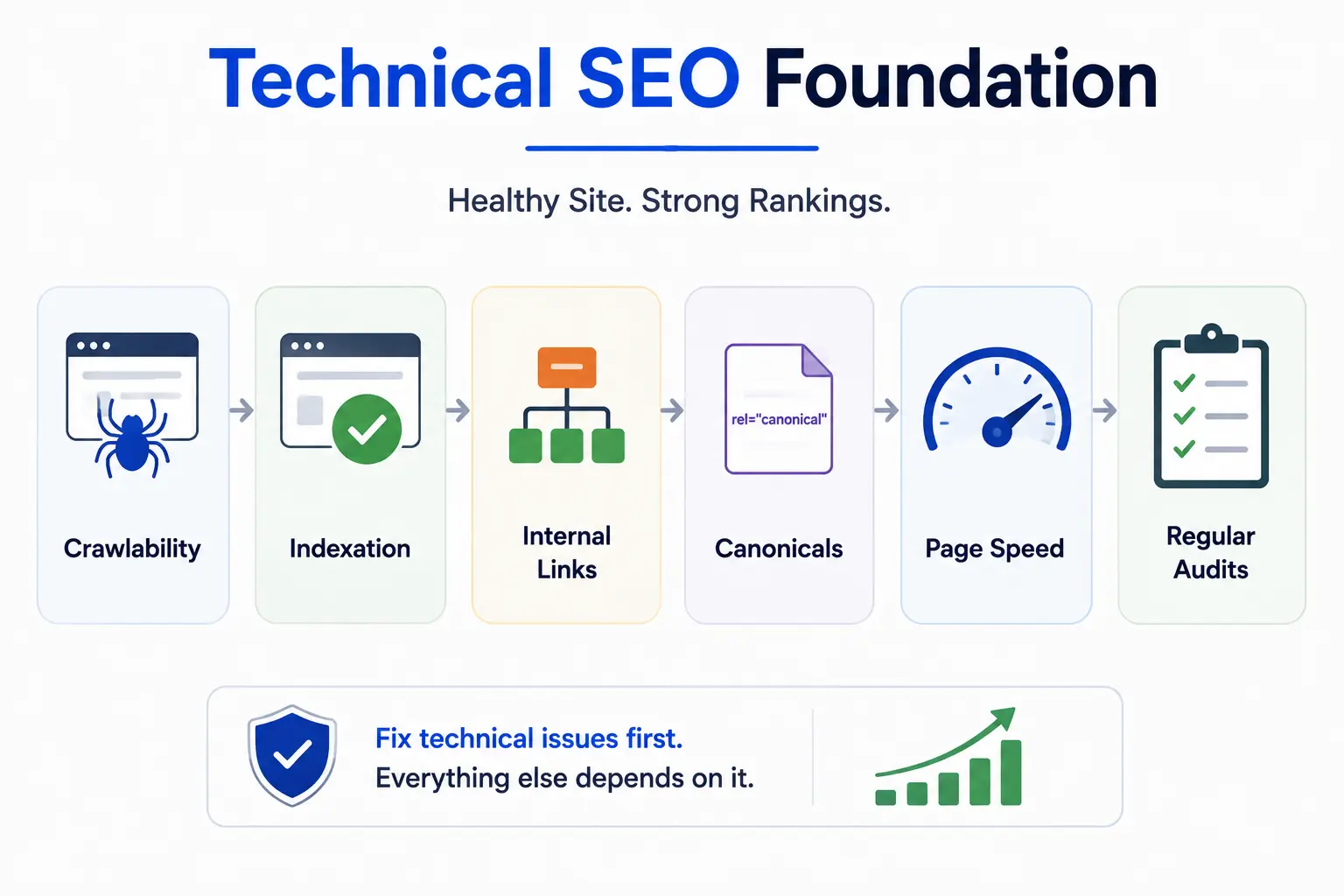
None of the above matters if crawlers can’t reach, render, or understand your pages. Core Web Vitals, index bloat, broken internal links, orphaned pages, and conflicting canonicals quietly cap how far good content can climb.
And technical debt accumulates silently – the site that was clean at launch rarely stays clean after two years of plugins, redesigns, and migrations.
What to prepare: make auditing routine rather than reactive. Run a full crawl on a schedule – monthly for most sites – with an on-page auditor such as Rankller, and fix issues in order of ranking impact: indexation blockers first, then internal linking and metadata, then performance.
Google’s own Search Essentials documentation remains the canonical checklist for what “technically sound” means, and it’s updated as the algorithm evolves.
6. The Meta-Skill: Systems Over Tactics
Zoom out and the pattern across all five areas is identical. Intent research is a system. Answer-ready formatting is a system. E-E-A-T is a system. Publishing cadence is a system. Technical auditing is a system.
The sites that keep winning through algorithm updates aren’t the ones that guessed the next ranking factor – they’re the ones whose systems happened to already produce what the update started rewarding.
So the honest answer to “what should I prepare for the future of SEO?” is: build the machine, not the page. Decide who you serve, map what they search for, produce genuinely useful answers on a schedule you can keep, verify the results, and fix what underperforms.
Every algorithm update of the past five years has been a transfer of rankings from sites that couldn’t do this to sites that could. There is no reason to expect the next five to be different.
FAQ
What is the single biggest SEO mistake to avoid heading into 2026?
Treating any single tactic – a keyword list, a backlink package, an AI-written batch of posts – as a strategy on its own. Google’s recent updates consistently reward sites that combine intent research, quality writing, and technical health into one ongoing system, and penalize sites that lean on one shortcut in isolation.
How often does Google update its core algorithm?
Google rolls out several confirmed core updates a year, alongside a constant stream of smaller, unannounced changes. Rather than tracking each update individually, it’s more productive to build a site that already satisfies the underlying goal — genuinely useful, trustworthy content — so most updates pass without disruption.
Do backlinks still matter for SEO in 2026?
Yes, but relevance now matters more than raw volume. A handful of links from sites that are topically close to yours carries more weight than a large batch of links from unrelated directories, and Google’s link-spam systems are increasingly good at discounting the latter.
What exactly is E-E-A-T, and how do I demonstrate it?
E-E-A-T stands for Experience, Expertise, Authoritativeness, and Trust — the qualities Google’s quality raters look for when judging content. You demonstrate it with visible author credentials, first-hand detail that couldn’t be scraped from elsewhere, and a site-wide pattern of accurate, well-sourced content rather than a single standout page.
Will AI Overviews reduce my organic traffic?
They reduce clicks for some informational queries, but they also create a new visibility channel: being the cited source. Content written with clear, direct answers and specific, quotable detail is more likely to be pulled into an AI Overview than vague or keyword-stuffed copy.
How often should I publish new content?
Choose a cadence you can sustain for at least a year rather than the fastest cadence you can manage for a month. A steady weekly or biweekly rhythm that deepens one topic cluster consistently outperforms a burst of posts followed by long gaps.
What technical SEO issues should I fix first?
Start with anything blocking indexation – noindex tags, robots.txt errors, broken canonicals – since no other fix matters if a page can’t be crawled. From there, address internal linking and metadata, and finish with page performance and Core Web Vitals.
Conclusion
Google’s algorithm hasn’t become harder to please — it has become harder to fool. Every shift covered here, from intent-based matching to AI Overviews to measurable E-E-A-T, is really one shift: search results increasingly reflect which sites actually help the people using them.
That rewards patience over cleverness. A site that commits to understanding its audience, publishing useful answers on a schedule it can sustain, and keeping its technical foundation clean doesn’t need to predict the next update — it’s already built for it.
The teams still chasing individual ranking factors in 2026 will keep scrambling after every announcement; the ones who built the system once will barely notice.