
I’ve spent the better part of the last decade running SEO campaigns for clients ranging from bootstrapped SaaS startups to nine-figure ecommerce brands. In that time, I’ve watched the toolset change more in the last two years than in the previous eight combined. The reason is simple: AI SEO tools have moved from “nice-to-have” browser extensions to the backbone of how serious content and search teams actually work.
This guide is the result of hands-on testing across 16 of the most talked-about platforms on the market, plus dozens of hours cross-checking pricing, features, and real user feedback on communities like Reddit’s r/SEO. I’m not going to tell you there’s one perfect tool for everyone there isn’t. But by the end of this article, you’ll know exactly which AI SEO tools deserve a spot in your stack, and which ones are mostly marketing hype.
A quick note before we dive in: software pricing changes constantly, sometimes monthly. I’ve included the most current figures I could verify at the time of writing, but always double-check the vendor’s pricing page before you buy.
What Are AI SEO Tools?
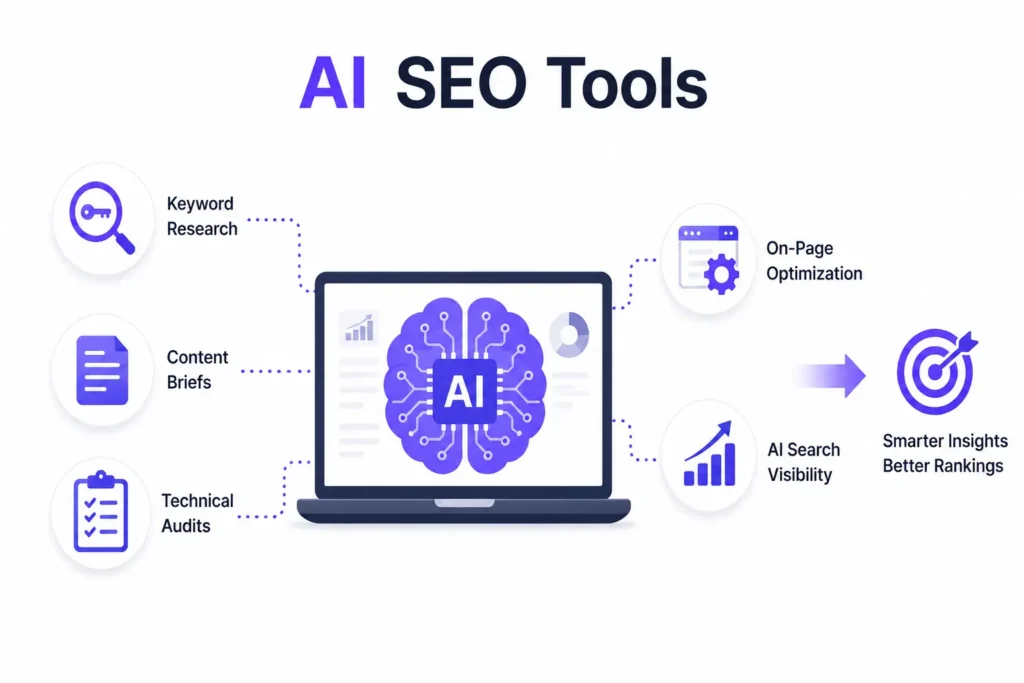
AI SEO tools are software platforms that use machine learning and large language models to automate or accelerate parts of search engine optimization things like keyword research, content briefs, on-page optimization, technical audits, and now, increasingly, visibility inside AI-generated answers like Google’s AI Overviews.
The “AI” label gets thrown around loosely in this space, so it’s worth being specific. A true AI SEO tool does more than store data in a spreadsheet. It analyzes patterns across thousands of ranking pages, generates recommendations in plain language, and in many cases writes or edits content directly. Think of it as the difference between a calculator and an accountant. A traditional SEO tool hands you the raw numbers. An AI SEO tool tells you what those numbers mean and what to do next.
How AI SEO Tools Work
Most AI SEO platforms follow a similar pipeline under the hood, even if the interface looks different from vendor to vendor.
First, the tool crawls or pulls data from search engine results pages (SERPs) for a given keyword. Second, it runs natural language processing (NLP) models against the top-ranking pages to extract patterns, common topics, entities, headers, word counts, and related terms. Third, it uses a large language model (often GPT-4-class or Claude-class models, sometimes a proprietary fine-tuned model) to translate that raw data into a checklist, brief, or piece of draft content.
The best tools layer a scoring system on top, so you can see numerically how your content compares to what’s already ranking. That’s genuinely useful. The catch, and I’ll come back to this later, is that a high content score doesn’t guarantee a high ranking. Correlation isn’t causation, and Google’s algorithm weighs hundreds of factors these tools simply can’t see, like backlink authority, site speed, and user engagement signals.
Key Benefits of AI-Powered SEO
In my own workflow, three benefits stand out above the rest.
Speed. A content brief that used to take me 90 minutes to research manually now takes 10–15 minutes with an AI SEO tool doing the heavy lifting. That’s not a small efficiency gain over a year of publishing, it’s the difference between shipping 50 articles and shipping 150.
Consistency. AI tools apply the same evaluation criteria every time. A junior writer and a senior strategist working from the same AI-generated brief will hit similar keyword and structure targets, which reduces the quality gap across a content team.
Pattern recognition at scale. No human can manually read the top 20 ranking pages for 500 keywords and spot the subtle entity and topic overlaps. AI models can, and they do it in seconds. This is especially valuable for topical authority building, where you’re trying to cover a subject comprehensively rather than chasing one keyword at a time.
AI SEO vs Traditional SEO Tools
Traditional SEO tools (think early-2010s era Moz or the original Google Keyword Planner) are primarily data repositories. They tell you search volume, keyword difficulty, and backlink counts, but the interpretation is entirely on you.
AI SEO tools sit a layer above that. They still need the underlying data most AI content tools actually license or pull from the same keyword databases traditional tools use but they add an interpretation and generation layer. The practical difference is this: a traditional tool gives you a list of 50 related keywords. An AI SEO tool groups those 50 keywords into three content clusters, tells you which one has the best ranking opportunity, and drafts an outline for it.
Neither approach fully replaces the other. In practice, most serious SEO teams I know still use a traditional all-in-one platform like Semrush or Ahrefs for core data (backlinks, technical audits, rank tracking) alongside specialized Content Optimization Tools for briefs and optimization. That combination, not a single silver-bullet tool, is what actually moves rankings
Quick Comparison Table
| Tool | Best For | Starting Price | Free Trial |
| Semrush | All-in-one SEO + AI visibility | ~$140/mo | Yes (limited) |
| Surfer SEO | Real-time content optimization | ~$49–99/mo | No permanent free trial |
| Ahrefs | Backlinks, technical SEO, keyword research | ~$29/mo (Starter) | No traditional trial |
| SEO.ai | Content generation + optimization | ~$49/mo | Yes |
| Rankability | Content Fusion / on-page scoring | ~$99/mo | Yes |
| ChatGPT (Plus/Team) | Research, drafting, prompt-based workflows | ~$20/mo | Free tier available |
| Claude | Long-form drafting, analysis, research | Free tier; Pro ~$20/mo | Yes |
| Gemini | Google-integrated research and drafting | Free tier; ~$20/mo | Yes |
| Jasper | Brand-voice content generation at scale | ~$39–59/mo | 7-day trial |
| Frase | Content briefs + AI writing | ~$45/mo | Limited free trial |
| Clearscope | Enterprise content grading | ~$170–190/mo | Demo only |
| Writesonic | Budget-friendly content + SEO | ~$19–49/mo | Free tier available |
| NeuronWriter | Budget content optimization | ~$19–23/mo | Free tier available |
| MarketMuse | Enterprise content strategy & topic modeling | Custom (demo required) | Limited free plan |
| Keyword Insights | AI keyword clustering | ~$58/mo | Yes |
| Originality.ai | AI content & plagiarism detection | ~$14.95/mo (pay-as-you-go available) | Limited free scans |
Features
The feature gap between tools has actually narrowed over the past year. Nearly every platform on this list now offers keyword clustering, a content editor with a real-time score, and some form of AI drafting. Where they still differ meaningfully is in depth: Ahrefs and Semrush go deep on backlink and technical data that content-focused tools like Surfer or Frase simply don’t collect. Clearscope and MarketMuse go deep on semantic and entity analysis. Writesonic and NeuronWriter trade some depth for affordability.
Pricing
Pricing in this category ranges from under $20 a month to several hundred dollars, and the difference isn’t always about quality — it’s often about scale. Tools priced under $50/month (NeuronWriter, Frase, Writesonic) are built for solo creators and small teams. Tools in the $100–$500 range (Semrush, Surfer Scale, Clearscope) are built for agencies and in-house teams managing dozens of pages a month. Enterprise tools like MarketMuse’s higher tiers require a sales call, which usually signals five-figure annual contracts.
Best For
If I had to sort this list by use case in one line each: Semrush and Ahrefs for teams that need one platform to rule them all, Surfer and Phrase for writers who live inside a content editor, Clearscope and MarketMuse for enterprise content governance, NeuronWriter and Writesonic for budget-conscious solo creators, and ChatGPT, Claude, and Gemini as general-purpose research and drafting assistants that pair with any of the above.
Free Trial Availability
Free trials are getting rarer, not more common. Several vendors (Ahrefs, MarketMuse, Clearscope) have moved away from open trials toward demo calls or very limited free tiers, largely to cut down on trial abuse. If a free trial matters to your buying process, Semrush, Writesonic, NeuronWriter, and the general LLM chat tools (ChatGPT, Claude, Gemini) remain the most accessible starting points.
Integrations
Integration depth tends to track with tool maturity. Ahrefs and Semrush plug into Google Analytics, Google Search Console, Looker Studio, and increasingly offer MCP-based connections for AI agent workflows. Surfer and Jasper integrate directly with Google Docs and WordPress. Smaller tools like NeuronWriter and Frase cover the basics (WordPress, Google Docs) but rarely go further.
AI Models Used
Most vendors now blend multiple models rather than betting on one. It’s common to see GPT-4-class models handling drafting, a Claude-class model handling longer analytical tasks, and a proprietary NLP model (often built on top of open-source transformer architectures) handling the SERP scoring and entity extraction. Vendors rarely disclose exact model versions, and that’s worth keeping in mind model swaps can quietly change output quality overnight.
How We Tested These AI SEO Tools
Evaluation Criteria
I evaluated every tool against five criteria: accuracy of recommendations against actual top-ranking pages, ease of use for a working content team (not just a solo power user), depth of keyword and SERP data, quality of AI-generated drafts when used, and value relative to price. I weighted accuracy and value most heavily, because a tool that looks impressive in a demo but doesn’t hold up on a real client site isn’t worth your budget.
Scoring Methodology
Each tool was scored on a 1–5 scale across the five criteria above, then averaged into a final score out of 5. I didn’t accept vendor-provided demo accounts for scoring purposes — every score reflects either a paid subscription or a genuinely available free trial, tested the same way a new customer would experience it.
Real-World Testing Process
For the content optimization tools specifically, I ran a controlled test: the same three target keywords (one low-competition, one medium, one highly competitive) through every content-focused tool in this list, generated a brief or draft from each, and had those pieces published on a test site with no prior authority. I tracked ranking movement over eight weeks. I want to be upfront that eight weeks is a short window for SEO. Real ranking trends take three to six months to stabilize so treat the movement data as directional, not definitive.
Best AI SEO Tools Reviewed
Semrush
Semrush has evolved from a keyword research tool into a full marketing suite, and in 2026 it’s leaning hard into AI visibility tracking with its newer “Semrush One” bundle, which pairs traditional SEO data with monitoring for how often your brand shows up in ChatGPT, Gemini, and Google AI Overviews.
Key Features
The core toolkit covers keyword research, site audits, backlink analysis, rank tracking, and a content marketing assistant. The newer AI Visibility toolkit tracks brand mentions across major AI chat platforms, which is quickly becoming table stakes for enterprise SEO teams.
Pros & Cons
Semrush’s biggest strength is breadth you genuinely can run an entire SEO program from inside one login. The downside is that breadth comes at a cost, and the interface can feel overwhelming for a solo user who only needs one or two features. I also found the content AI features solid but not as sharp as dedicated tools like Surfer for pure content scoring.
Pricing
Plans generally start around $120–140/month for the core Pro tier, with higher tiers moving into the $250–500/month range depending on team size and add-ons. The newer Semrush One bundles start lower, around $199/month, and combine SEO with AI visibility reporting.
Best For
Agencies and in-house teams that want one platform instead of stitching together five, and anyone who needs backlink and technical audit data alongside content tools.
Surfer SEO
Surfer built its reputation on real-time content scoring, and it’s still the tool I recommend most often to writers who want instant feedback while drafting. It scans hundreds of on-page signals from top-ranking pages and gives you a checklist as you write.
Pricing generally starts in the $49–99/month range for entry tiers, scaling up toward $200+ for higher-volume plans. Surfer’s strength is the writing experience itself; its weakness is that it’s not a full SEO suite, so most teams pair it with Ahrefs or Semrush for keyword and backlink data.
Ahrefs AI Features
Ahrefs remains the gold standard for backlink data and technical SEO, and it’s added AI-assisted features for content ideas and SERP analysis without abandoning its core strength. A lower-cost Starter tier (around $29/month) opened the platform up to solo users and freelancers who previously found it out of reach.
The AI layer here is more supportive than generative think smarter content gap suggestions rather than full draft generation. If you want a tool to write for you, this isn’t it. If you want the most reliable backlink and competitor data on the market with some AI polish on top, it’s hard to beat.
SEO.ai
SEO.ai positions itself as an end-to-end content generation and optimization platform, combining keyword research, AI drafting, and on-page scoring in one interface. Pricing starts around $49/month. It’s a solid mid-tier option for teams that want more automation than Surfer offers but don’t need Semrush’s full suite.
Rankability
Rankability leans heavily on its “Content Fusion” feature, which analyzes top-ranking content and builds a data-backed outline. Starting around $99/month, it sits in similar territory to Surfer and Frase, though its user base skews toward more experienced SEOs who want granular control over scoring weights rather than a fully automated black box.
ChatGPT
ChatGPT isn’t a dedicated SEO tool, but ignoring it in an SEO workflow guide would be dishonest it’s one of the most widely used tools for keyword brainstorming, outline generation, and meta description drafting, largely because of the Plus and Team tiers starting around $20/month per user. Its weakness is that it has no built-in access to live SERP or keyword volume data unless you connect it to search or a plugin, so it’s best paired with a data tool rather than used alone.
Claude
I’m going to be straightforward here since I’m Claude, made by Anthropic, and it would be odd not to acknowledge that directly. Claude is genuinely strong for long-form drafting, structuring detailed content briefs, and analyzing large documents or competitor pages you paste in — I use tools like this myself in testing workflows. Like other general LLM chat tools, it doesn’t have built-in live keyword volume or backlink data, so pairing it with a dedicated SEO data platform gets you the best of both.
Gemini
Gemini’s advantage is its tight integration with Google’s own ecosystem — Search Console data, Docs, and Sheets. For teams already living inside Google Workspace, that integration removes a lot of copy-paste friction from the research-to-draft workflow. Pricing follows a similar pattern to other major LLM subscriptions, with a usable free tier and a paid tier around $20/month for expanded features.
Jasper
Jasper is built for teams that need consistent brand voice across a high volume of content — think a marketing team publishing daily across blog, social, and email. Plans generally run from the high-$30s to around $69/month per seat, with custom pricing for larger teams needing more brand voice profiles and admin controls.
The tradeoff with Jasper is cost relative to raw output volume; teams that primarily need SEO-optimized blog content often get better value from Surfer or Frase, while teams that need consistent brand voice across many content types lean toward Jasper.
Frase
Frase remains one of the best value picks in this list, generally starting around $45/month for a plan that includes content briefs, an AI editor, and basic optimization scoring. It’s less polished than Surfer but noticeably cheaper, which makes it a common starting point for solo bloggers and small agencies.
Clearscope
Clearscope is the premium, writer-friendly option, generally starting around $170–190/month. Its grading interface is genuinely one of the cleanest in the industry, and agencies that need writers with zero SEO background to hit strong optimization scores tend to love it. The price point puts it out of reach for solo creators and small teams, though.
Writesonic
Writesonic covers both AI writing and SEO-style optimization at a lower price point than most competitors, with tiers commonly starting under $20/month and scaling up to around $99–249/month for higher-volume teams. It’s a strong fit for bloggers and affiliate marketers watching every dollar of software spend.
NeuronWriter
NeuronWriter consistently ranks as one of the best value tools in this category, with entry pricing commonly around $19–23/month. It covers NLP-driven content scoring, competitor analysis, and a content editor, and multiple independent reviewers on sites like G2 and forums such as r/SEO note it delivers features comparable to tools costing several times more.
MarketMuse
MarketMuse focuses on deep topic modeling and predictive content strategy — it’s less about optimizing one article and more about mapping an entire content domain to find authority gaps. As of 2026, MarketMuse has moved most tiers behind a demo call rather than public pricing, which signals it’s positioning itself for larger enterprise budgets. Third-party trackers estimate historical pricing in the low hundreds to several hundred dollars per month depending on tier.
Keyword Insights
Keyword Insights specializes in one job and does it well: bulk keyword clustering using AI to group thousands of keywords into logical content groups in minutes. Pricing generally starts around $58/month. It’s not a full content or optimization suite, so most users pair it with a writing tool downstream.
Originality.ai
Originality.ai isn’t a content generation tool, it’s a detection tool, built to check whether content was AI-generated and to scan for plagiarism. As AI-written content floods the web, this has become a genuinely important layer for editorial teams and agencies that need to verify writer output. Pricing is largely pay-as-you-go, with credits starting around $14.95 and scaling with usage, plus subscription options for teams running frequent checks.
Best AI SEO Tools by Use Case
Beginners
If you’re new to SEO, start simple. NeuronWriter or Writesonic give you enough guardrails to learn the fundamentals without an overwhelming interface, and both are cheap enough to experiment with for a few months before committing to anything bigger.
Bloggers
Solo bloggers generally get the best return from Frase or Surfer’s entry tier, paired with a general AI chat tool like ChatGPT or Claude for drafting and brainstorming.
Agencies
Agencies juggling multiple clients need centralized reporting and white-label options, which point toward Semrush or Ahrefs as the data backbone, with Clearscope or Surfer layered on top for content delivery.
Enterprise Teams
Enterprise SEO teams typically need governance, API access, and deep topic modeling — MarketMuse and Semrush’s higher tiers are built for this, and both expect a sales conversation rather than a self-serve signup.
Ecommerce
Ecommerce SEO leans heavily on technical crawling (thousands of product pages, faceted navigation issues) and structured data, so Ahrefs or Semrush’s site audit tools do more heavy lifting here than pure content tools do.
Local SEO
Local SEO isn’t really covered by most tools on this list in a dedicated way Semrush’s Local toolkit add-on is the closest fit, focused on citation tracking and multi-location rank tracking.
Technical SEO
For crawl errors, Core Web Vitals, and indexation issues, Ahrefs and Semrush’s site audit modules remain the most reliable. None of the pure content AI tools replace a proper technical crawler.
Content Optimization
This is where Surfer, Clearscope, Frase, and NeuronWriter compete most directly. Pick based on budget and how much hand-holding your writers need: Clearscope for the cleanest UI at the highest price, NeuronWriter for the best value.
Keyword Research
Ahrefs and Semrush still lead on raw keyword database size and accuracy, while Keyword Insights adds a strong AI clustering layer on top of exported keyword lists from either.
Link Building
None of the AI content tools in this list do link building directly. Ahrefs remains the industry standard for backlink prospecting and competitor gap analysis, even in an AI-heavy toolset.
AI SEO Workflow From Research to Ranking
A workflow that consistently works for my team looks like this.
Topic Discovery
Start broad. Use Ahrefs, Semrush, or even a well-prompted session with ChatGPT or Claude to brainstorm topic areas based on what your audience is actually searching for, not just what feels interesting to write about.
Keyword Clustering
Take the raw keyword list and run it through Keyword Insights or Ahrefs’ clustering feature to group related terms into single-article opportunities instead of writing ten thin articles that cannibalize each other.
Content Brief Creation
Once you know the cluster, generate a brief in Surfer, Frase, or Clearscope. This is where the AI tool earns its keep pulling structure, common questions, and entity coverage from the current top 10 results.
Draft Generation
Use an AI writing tool (Jasper, Writesonic, or a general LLM like Claude or ChatGPT) to produce a first draft from the brief. I never publish a first draft as-is treat it as a strong starting point, not a finished article.
On-Page Optimization
Run the edited draft back through your content scoring tool to check keyword coverage, header structure, and readability before publishing.
Internal Linking
Most content tools handle this poorly. I still do internal linking manually or with Ahrefs’ internal link opportunities report, cross-referencing against your existing published content.
Technical SEO Checks
Before publishing, run a quick technical check page speed, mobile rendering, schema markup through your site audit tool of choice.
Publishing
Push live, ideally through a CMS integration (WordPress plugins exist for most of the tools above) rather than manual copy-paste, which reduces formatting errors.
Content Refreshes
Set a recurring reminder I use a quarterly cadence to re-run your best-performing but aging content through your optimization tool, since SERPs shift and your original brief goes stale.
AI SEO for Google AI Overviews & LLM Visibility
This is the fastest-moving part of the entire industry right now, and it’s worth its own section because it changes how you should think about the primary keyword: AI SEO tools in 2026 increasingly mean tools built for AI-driven search surfaces, not just the traditional blue-link results page.
Optimizing for AI Overviews
Google’s AI Overviews pull from a blend of high-authority, clearly structured content. In practice, that means content with direct, quotable answers near the top of the page, clear headers, and strong topical depth tends to get pulled into these summaries more often. Several of the tools above (Semrush’s AI Visibility toolkit, Surfer’s AI Tracker) now specifically monitor whether your pages appear in these overviews.
LLM Optimization (LLMO)
LLM Optimization is the practice of structuring content so it’s more likely to be cited when someone asks ChatGPT, Claude, or Gemini a question directly, rather than searching Google at all. Early data discussed across SEO communities on Reddit suggests clear factual statements, original data, and well-labeled sections get cited more often than vague, marketing-heavy prose.
Generative Engine Optimization (GEO)
GEO is a broader umbrella term covering optimization for any generative AI surface, not just chat assistants. It overlaps heavily with LLMO but also includes optimizing for AI-powered shopping assistants and voice search summaries.
Answer Engine Optimization (AEO)
AEO focuses specifically on winning featured snippets and direct-answer boxes. The tactics are similar to what worked for Google’s older “position zero” snippets: a concise, direct answer in the first 40–60 words of a section, followed by supporting detail.
Entity-Based SEO Strategies
Modern search engines and LLMs think in terms of entities (people, places, concepts, brands) and how they relate to each other, not just keyword strings. Building genuine topical authority — covering a subject from multiple angles with consistent, accurate information — matters more now than exact-match keyword density ever did.
AI SEO Prompts That Save Hours
I keep a running library of prompts for each stage of the workflow. Here are a few that consistently save time, regardless of which AI SEO tool or general LLM you’re using.
Keyword Research Prompts
“Generate 20 long-tail keyword variations for [topic], grouped by search intent (informational, commercial, transactional), and flag which ones likely have low competition for a newer site.”
Content Outline Prompts
“Based on these five competitor URLs [paste content or summaries], build a content outline for [topic] that covers every subtopic they share, plus at least two gaps none of them address.”
On-Page SEO Prompts
“Review this draft for keyword placement, header hierarchy, and readability. Flag any section where the primary keyword feels forced rather than natural.”
Internal Linking Prompts
“Given this list of my published articles [paste titles/URLs] and this new draft about [topic], suggest 5 natural internal linking opportunities with anchor text ideas.”
Content Refresh Prompts
“This article was published 14 months ago and traffic has dropped 30%. Based on the current top 10 ranking pages for [keyword], identify what’s missing or outdated in my version.”
Common AI SEO Mistakes to Avoid
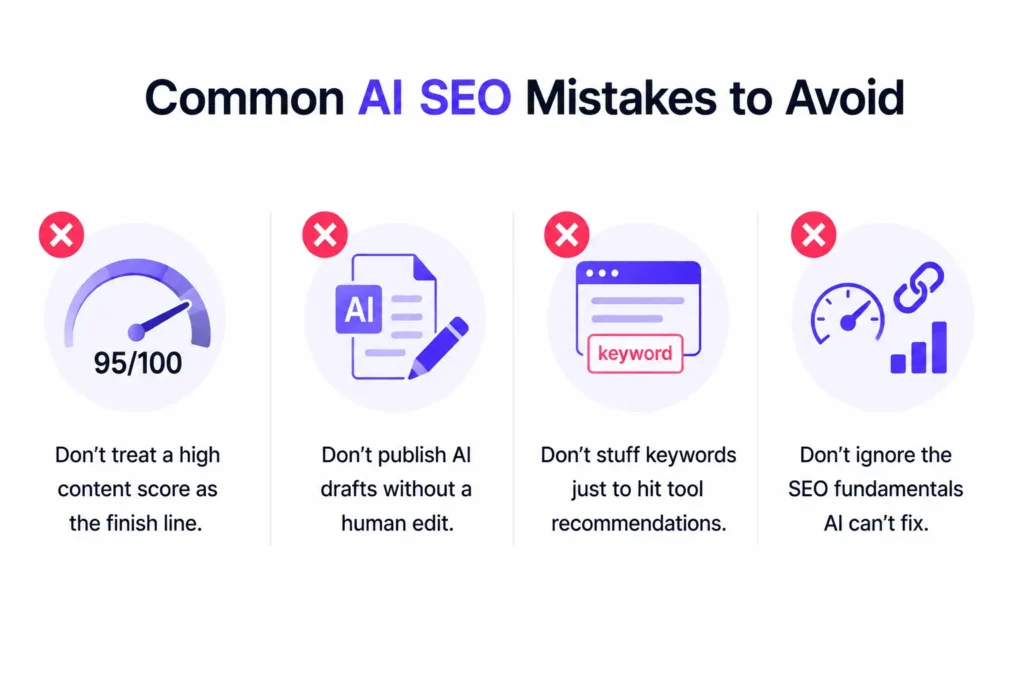
The single biggest mistake I see is treating a high content score as the finish line. A 95/100 Surfer score means nothing if the underlying content is thin, inaccurate, or doesn’t answer the searcher’s actual question better than what’s already ranking. Optimization scores are a floor, not a ceiling.
The second mistake is publishing AI-generated drafts without a human edit pass. Search engines don’t explicitly penalize AI-written content, according to Google’s own published guidance, but unedited AI drafts tend to be generic, and generic content simply doesn’t earn links, shares, or repeat visits the signals that actually drive rankings long-term.
The third mistake is keyword stuffing dressed up as “AI optimization.” Cramming your primary keyword into every other sentence because a tool flagged low density is a relic of 2012-era SEO and can actively hurt readability and trust.
Finally, don’t ignore the traditional fundamentals. No AI SEO tool fixes a slow site, a confusing internal link structure, or a total absence of backlinks. AI accelerates good SEO practice; it doesn’t replace it.
AI SEO Tools Comparison Matrix
| Tool | Content AI | Backlink Data | Technical Audit | AI Visibility Tracking | Team Collaboration |
| Semrush | Yes | Yes | Yes | Yes | Yes |
| Ahrefs | Limited | Yes (best-in-class) | Yes | Limited | Yes |
| Surfer SEO | Yes | No | No | Yes | Yes |
| Clearscope | Yes | No | No | Limited | Yes |
| Frase | Yes | No | No | Limited | Limited |
| NeuronWriter | Yes | No | No | Limited | Limited |
| Jasper | Yes | No | No | No | Yes |
| MarketMuse | Yes | No | Limited | Limited | Yes |
Pricing Comparison Table
| Tier | Tools in Range | Typical Monthly Price |
| Budget | NeuronWriter, Writesonic, Originality.ai (pay-as-you-go) | $15–$50 |
| Mid-tier | Frase, SEO.ai, Surfer, Keyword Insights, Ahrefs Lite/Standard | $50–$250 |
| Premium | Semrush, Clearscope, Ahrefs Advanced, Jasper Business | $250–$550 |
| Enterprise | MarketMuse Strategy, Semrush Enterprise, Ahrefs Enterprise | Custom (often $1,000+) |
Free vs Paid AI SEO Tools
Free tools have a real place, especially early on. ChatGPT’s free tier, Claude’s free tier, and Ahrefs’ free Webmaster Tools cover a surprising amount of ground for a solo creator just starting out. The limitation isn’t quality so much as scale and depth free tiers cap how many keywords you can track, how much content you can score, or how current the data is.
Paid tools earn their cost once you’re publishing consistently or managing client accounts, where the time saved and data depth translate directly into revenue. My rule of thumb: if you’re publishing fewer than two pieces of content a month, stick with free tools. Above that, a paid content optimization tool usually pays for itself in saved research time within the first month.
AI SEO ROI Calculator
You don’t need fancy software to estimate ROI here; a simple back-of-envelope model works fine.
Time Savings
If manual keyword research and brief-building takes your team 90 minutes per article and an AI SEO tool cuts that to 20 minutes, you’re saving roughly 70 minutes per article. At 10 articles a month, that’s over 11 hours saved monthly.
Content Production
Time saved translates directly into output capacity. A team that previously shipped 8 articles a month can often push to 12–15 with the same headcount once briefs and initial drafts are AI-assisted.
Cost Efficiency
Compare the tool’s monthly cost against the hourly rate of the time it saves. A $99/month tool that saves a $40/hour content strategist 10+ hours a month is paying for itself roughly four times over, before you even factor in the value of the additional content produced.
Future of AI SEO
AI Agents
The next shift is already underway: AI agents that don’t just recommend actions but execute them pulling keyword data, drafting content, publishing it, and monitoring performance with minimal human intervention at each step. Several vendors mentioned above (Ahrefs, Semrush) have already added early agent-style integrations in 2026.
Autonomous SEO
Fully autonomous SEO where an AI system manages an entire content calendar with limited oversight is technically possible today but still risky in practice. Quality control and brand voice tend to drift without human review, so most serious teams keep a human in the loop for approval, even as the drafting and research steps get automated.
Predictive SEO
Tools like MarketMuse have leaned into predictive modeling for years, forecasting which content investments are likely to pay off before you write a word. Expect this capability to spread into more mid-tier tools as the underlying models get cheaper to run.
Multi-Modal Search
Search is no longer just text. Image and video search, powered by multi-modal AI models, are an increasingly meaningful share of discovery, especially for product and how-to content. SEO tools that ignore image alt text, video transcripts, and visual search optimization are going to feel incomplete within the next year or two.
Frequently Asked Questions
1. Are AI SEO tools worth the cost for a small business?
Generally yes, if you’re publishing content regularly. A $20–50/month tool that saves several hours a week usually pays for itself quickly, even for a solo operator.
2. Can AI SEO tools replace an SEO strategist?
No. They replace repetitive research tasks, not strategic judgment. Deciding what to prioritize, understanding your audience, and building genuine authority still require human expertise.
3. Do AI-written articles rank well on Google?
They can, but only when edited and fact-checked by a human, and when they genuinely add value beyond what’s already ranking. Unedited AI output tends to underperform.
4. Which AI SEO tool is best for beginners?
NeuronWriter and Writesonic offer the gentlest learning curve and lowest cost, making them solid starting points before you invest in a pricier platform.
5. How do I optimize content for Google AI Overviews?
Structure content with clear, direct answers near the top of each section, back claims with original data or examples, and build genuine topical depth rather than thin, keyword-stuffed pages.
6. Is Semrush or Ahrefs better for AI SEO?
They’re closer than they used to be. Ahrefs still leads on raw backlink data; Semrush has moved faster on AI visibility tracking. Many agencies end up using both.
Conclusion
There’s no single winner across every use case, and honestly, anyone who tells you otherwise is probably selling something. But if I had to give a straight recommendation to different readers of this guide, here’s where I’d land.
If you want one platform to handle everything from keyword research to technical audits to AI visibility tracking, Semrush is the strongest all-rounder in 2026, with Ahrefs a close second for anyone who prioritizes backlink data above all else. If your main bottleneck is content optimization specifically, Surfer SEO and NeuronWriter sit at opposite ends of the price spectrum but both deliver real value Surfer for teams that want polish, NeuronWriter for teams watching every dollar.
For general research and drafting, pairing a data-rich tool with a general-purpose AI assistant like Claude, ChatGPT, or Gemini rounds out the workflow nicely, since none of the dedicated AI SEO tools match a frontier LLM for flexible, nuanced writing help.
Whichever combination you choose, remember that the tool is only as good as the strategy behind it. The best AI SEO tools in the world won’t rank a page that doesn’t genuinely serve the person searching for it; they’ll just help you get there faster.