On-page SEO means optimizing the elements on a webpage so search engines and users can easily understand the content. This includes improving titles, headings, keywords, images, and internal links on a page.
Improving on-page SEO is important because it helps your pages rank higher in search results and attract more visitors. When a page is properly optimized, search engines can better understand what the content is about and show it to the right audience.
In this complete guide to on-page SEO improvements, you will learn proven optimization techniques, keyword strategies, and page structure improvements that help websites rank higher in Google.
Understanding the Importance of On-Page SEO
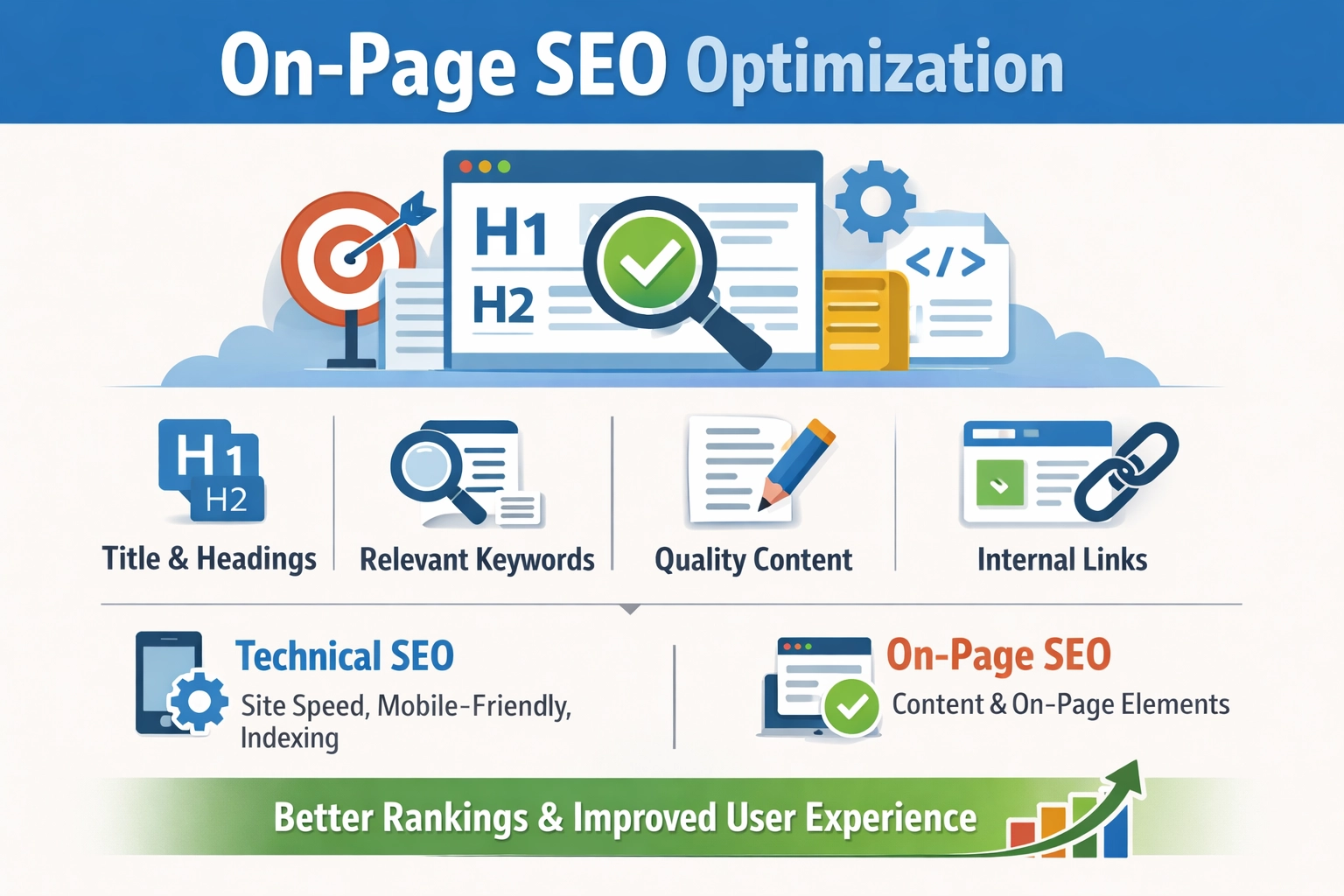
Search engines analyze different elements on a webpage to understand its content and quality. They look at factors such as keywords, headings, content structure, internal links, and how useful the information is for users. These elements help search engines decide whether a page is relevant to a search query.
On-page SEO plays an important role in ranking signals because it tells search engines what your page is about. When titles, headings, and content are properly optimized with relevant keywords, search engines can match your page with the right searches.
On-page SEO is different from technical SEO. On-page SEO focuses on optimizing the content and structure of individual pages, while technical SEO deals with backend factors like website speed, crawlability, mobile friendliness, and indexing.
Strong on-page optimization also improves user experience. It makes content easier to read, helps visitors find information quickly, and increases the chances of better rankings and more organic traffic.
Keyword Research for On-Page Optimization
Keyword research helps you find the words and phrases people use when searching online. Choosing the right keywords allows your content to appear in relevant search results.
To find good keywords, you can use tools such as:
- Google Keyword Planner
- Ahrefs
- SEMrush
- Google Autocomplete suggestions
- Related searches on Google
It is also important to understand search intent. Some users want information (informational), some want to buy something (transactional), and others are looking for a specific website or brand (navigational). Your content should match the intent behind the search.
When optimizing a page, include your primary keyword in important places like the title, headings, and introduction. Secondary keywords can be used naturally throughout the content to support the main topic.
Using long-tail keywords is also helpful because they are more specific and often have less competition. These keywords can attract more targeted visitors who are looking for exactly what your content offers.
Optimizing Page Titles (Title Tags)
Page titles, also known as title tags, are one of the most important on-page SEO elements. They tell search engines and users what the page is about. A clear and relevant title can improve your chances of ranking higher in search results.
Title tags matter for rankings because search engines use them to understand the topic of a page. They also appear as the clickable headline in search results, which means a good title can increase the chances of users clicking on your page.
When writing SEO titles, follow these best practices:
- Include your main keyword
- Keep the title clear and descriptive
- Maintain a length of 50–60 characters
- Avoid keyword stuffing
- Make the title attractive for users
Writing SEO-Friendly Meta Descriptions
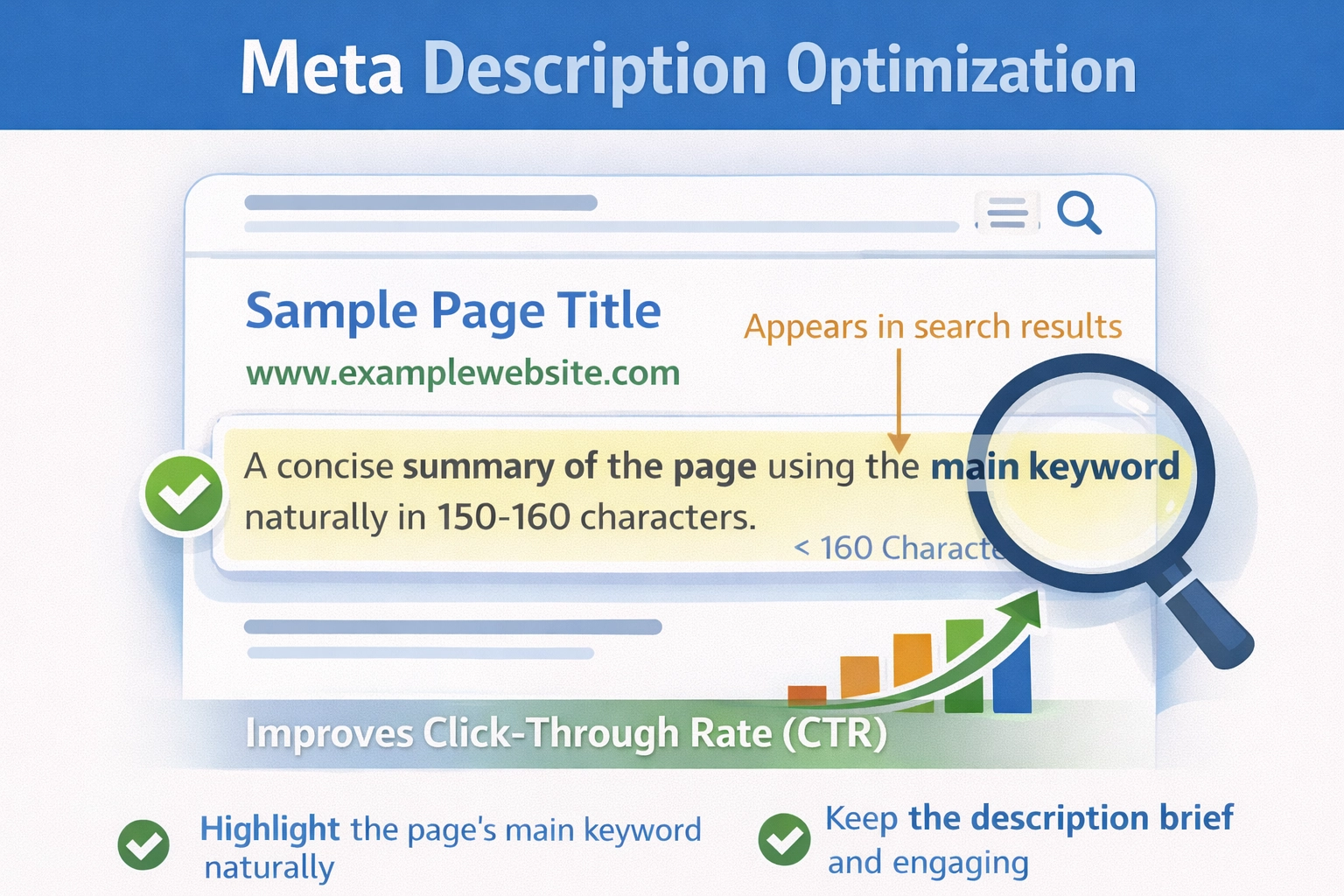
A meta description is a short summary of a webpage that appears below the title in search results. It helps users understand what the page is about before they click on it.
Meta descriptions play an important role in improving click-through rate (CTR). Even if a page ranks well, a clear and attractive description can encourage more people to click on the link.
To write a good meta description, briefly explain what the page offers and why it is useful for the reader. Keep the language simple and make it sound natural so users feel interested in visiting the page.
The recommended length for a meta description is usually 150–160 characters. This helps ensure the full description appears in search results.
You should also include your main keyword in the description, but use it naturally. Avoid repeating the same keyword too many times, as this can make the text look unnatural and less helpful for users.
Improving URL Structure
A clear and simple URL structure helps both users and search engines understand what a page is about. Well-structured URLs make it easier for search engines to crawl your website and improve the overall organization of your content.
When creating URLs, keep them short, clean, and easy to read. Avoid long and complicated URLs that contain unnecessary words or symbols.
It is also helpful to include relevant keywords in the URL. This gives search engines a better idea of the page topic and can improve visibility in search results.
Try to avoid unnecessary numbers, special characters, or long parameters in your URLs, as they can make the link confusing and harder to remember.
Example:
Optimized URL:
yourwebsite.com/on-page-seo-improvements
Poor URL:
yourwebsite.com/page?id=12345&category=seo&page=7
A clean and keyword-focused URL structure improves both user experience and SEO.
Optimizing Headings (H1, H2, H3 Structure)
Headings help organize your content and make it easier for both readers and search engines to understand the structure of a page. A clear heading structure improves readability and helps search engines identify the main topics covered in the content.Using the correct heading hierarchy is important. The H1 tag should be used for the main title of the page, while H2 and H3 headings are used for subtopics and supporting sections. This structure keeps the content well organized.
Including relevant keywords in headings can also help search engines better understand what each section of the page is about. However, the keywords should be used naturally and not forced.Headings should also be clear and helpful for readers. Good headings guide visitors through the content and allow them to quickly find the information they need. This improves user experience and supports better SEO performance.
Creating High-Quality Content for On-Page SEO Improvements
High-quality content is one of the most important parts of on-page SEO. Your content should clearly answer the questions users are searching for and provide useful information that solves their problems.When writing content, focus on depth and originality. Explain the topic properly instead of giving very short or incomplete information. Unique and well-researched content helps build trust and improves your chances of ranking higher.
It is also important to avoid thin or duplicate content. Pages with very little information or copied text from other websites can harm your SEO performance.
Good content formatting also improves engagement. To make your content easier to read:
- Use clear headings and subheadings
- Write short paragraphs
- Use bullet points and numbered lists
- Add relevant images or graphics
- Highlight important information
Internal Linking Strategy
Internal links are links that connect one page of your website to another page on the same site. They help users navigate your website and allow search engines to discover and understand your pages more easily.Internal linking also helps distribute link equity across your website. When one page has strong authority, linking it to other relevant pages can help improve their visibility in search results.
It is important to use clear and descriptive anchor text for internal links. The anchor text should give users and search engines an idea of what the linked page is about. Some good practices for internal linking include linking to relevant pages, avoiding too many links on one page, and making sure important pages receive enough internal links. This helps improve both user experience and overall SEO performance.
Before optimizing or publishing an image, it’s also a good practice to verify its original source using a reverse image search tool. This helps ensure you’re using the correct image and can identify duplicate or unauthorized copies before adding them to your website.
Image Optimization
Image optimization helps improve website speed and makes your pages easier for search engines to understand. Large or unoptimized images can slow down your website, which can affect both user experience and search rankings.One important step is compressing images so they load faster without losing quality. Faster loading pages help keep visitors on your website.
You should also use descriptive file names for your images instead of generic names like IMG1234.jpg. For example, a better file name would be on-page-seo-optimization.jpg.Adding alt text is also important. Alt text describes the image to search engines and helps users who cannot see images understand what the image represents.Proper image optimization improves website accessibility, page speed, and overall SEO performance.
Improving Page Speed and User Experience
Page speed is an important factor for both search rankings and user experience. If a website loads slowly, visitors may leave before the page fully opens. Faster websites keep users engaged and can help improve search visibility.One way to improve speed is by reducing unnecessary scripts and files. Removing unused plugins, compressing files, and minimizing code can make pages load faster.
Mobile responsiveness is also very important because many users access websites through smartphones. A website should adjust properly to different screen sizes so users can easily read and navigate the content.Search engines also consider Core Web Vitals, which measure important aspects of user experience such as loading speed, page stability, and interaction. Improving these factors helps create a smoother experience for visitors and supports better SEO performance.
Schema Markup and Structured Data
Structured data is a type of code added to a webpage that helps search engines better understand the content of the page. It provides clear information about elements like articles, products, reviews, and FAQs.
Schema markup improves search visibility by giving search engines more details about your content. This can help your page appear in enhanced search results instead of a simple blue link.
There are many useful types of schema, such as Article schema, FAQ schema, Product schema, Review schema, and Breadcrumb schema. Each type helps search engines understand different kinds of content.
One major benefit of using schema markup is the chance to appear in rich snippets. These results can show extra information like ratings, FAQs, or product details directly in search results, which can attract more clicks to your website.
Optimizing for Featured Snippets
Featured snippets are special search results that appear at the top of Google’s results page. They provide a quick answer to a user’s question by showing a short part of content from a webpage.
To increase the chances of appearing in featured snippets, content should be well structured and clearly written. Giving a short and direct answer to common questions can help search engines select your content for the snippet.
Using lists, tables, and short paragraphs also improves snippet opportunities because search engines prefer content that is easy to extract and display.
Another helpful strategy is creating question-based headings, such as “What is On-Page SEO?” or “How does On-Page SEO work?”. This format matches the way people search and increases the chances of your content being shown in featured snippets
Monitoring and Measuring On-Page SEO Performance
Monitoring your on-page SEO performance helps you understand how well your pages are performing in search results. It also shows which areas need improvement.You can use tools like Google Analytics and Google Search Console to track website traffic, impressions, and user behavior. These tools help you see how visitors are finding and interacting with your content.
It is also important to monitor keyword rankings to see if your pages are improving in search results for your target keywords.Another useful step is checking user engagement metrics such as bounce rate, time on page, and click-through rate. These metrics show how users respond to your content.Based on this data, you can update and improve your content to keep it relevant, useful, and competitive in search results.
Common On-Page SEO Mistakes to Avoid
There are some common mistakes that can negatively affect your on-page SEO and reduce your chances of ranking well in search results.
Keyword stuffing is one of the most common issues. Repeating the same keyword too many times can make the content unnatural and may harm your rankings. Keywords should always be used naturally.Another mistake is duplicate content. Copying content from other websites or repeating the same content on multiple pages can confuse search engines and affect your SEO performance.
Many websites also forget to add important elements like title tags and meta descriptions. Missing meta tags can reduce your page’s visibility and click-through rate in search results.Poor internal linking is another problem. If pages are not properly linked together, search engines may have difficulty discovering and understanding your website structure.Lastly, ignoring mobile optimization can hurt both user experience and rankings. Your website should be fully responsive so it works smoothly on all devices, especially smartphones.
Future Trends in On-Page SEO
On-page SEO continues to evolve as search engines become smarter and focus more on user experience and content quality.One growing trend is AI and search intent optimization. Search engines are getting better at understanding what users really want when they search, so content must clearly answer their questions and provide helpful information.
Another important trend is voice search optimization. As more people use voice assistants to search online, content should include natural language and question-based phrases that match how people speak.User experience is also becoming a stronger ranking factor. Websites that load quickly, are easy to navigate, and work well on mobile devices are more likely to perform better in search results.
Finally, content quality will continue to play a major role. Search engines prefer helpful, well-written, and original content that truly provides value to users. Websites that focus on useful and informative content will have a better chance of ranking well.
Frequently Asked Questions (FAQs)
1. What is on-page SEO?
On-page SEO is the process of optimizing elements on a webpage, such as content, headings, keywords, images, and internal links, to help search engines understand the page and improve its ranking in search results.
2. Why is on-page SEO important?
On-page SEO helps search engines understand your content and match it with relevant search queries. Proper optimization can improve rankings, increase website traffic, and provide a better user experience.
3. What are the most important on-page SEO factors?
Some key on-page SEO factors include title tags, meta descriptions, keyword optimization, heading structure, high-quality content, internal linking, image optimization, and page speed.
4. How often should I update my on-page SEO?
It is recommended to review and update your on-page SEO regularly. Updating content, improving keywords, and fixing SEO issues can help maintain or improve your rankings.
5. What is the difference between on-page SEO and off-page SEO?
On-page SEO focuses on optimizing elements within your website, such as content and structure. Off-page SEO refers to activities outside your website, like backlinks and social signals that help improve authority and rankings.
Conclusion
Improving on-page SEO involves optimizing key elements such as page titles, headings, keywords, content quality, internal links, images, and page speed. These improvements help search engines better understand your content and make it easier for users to find useful information.
SEO is an ongoing process, not something done once. Search algorithms and user behavior change over time, so continuous optimization is important to maintain good rankings.
Regularly auditing your pages, updating content, and fixing SEO issues can keep your website competitive and help attract more organic traffic in the long run
.