Ever wondered why some Agile teams keep improving while others struggle with the same challenges every sprint? Strong performance depends on how well people communicate, learn and solve problems together. Agile Certification can help professionals develop practical knowledge of principles and team practices.
Effective Agile coaching helps teams become more confident, collaborative and responsible for their work. It encourages open conversations and continuous learning without controlling every decision. In this blog, we explore coaching techniques that can help build high-performing Agile teams.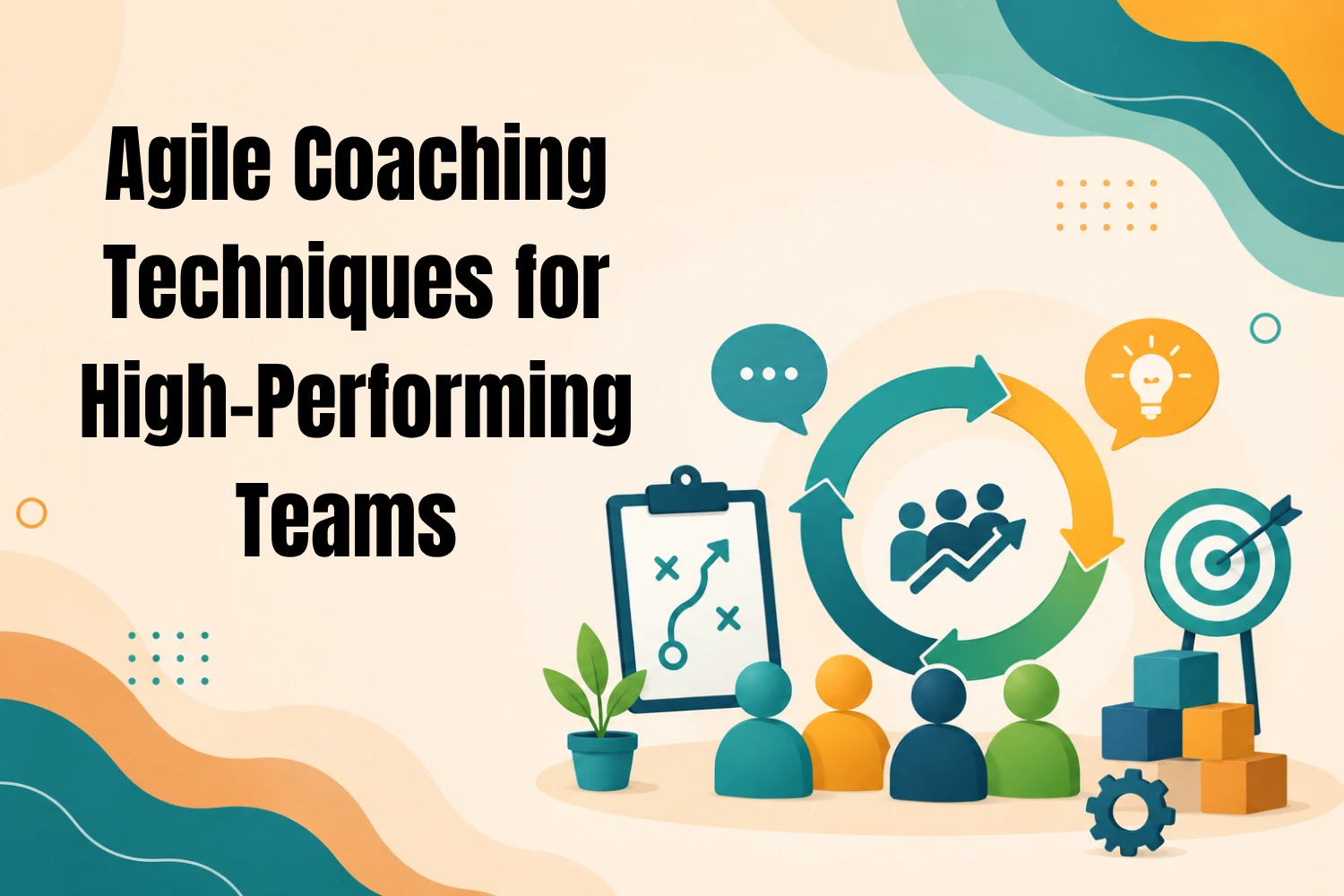
Effective Agile Coaching Techniques for High Performing Teams
The following techniques can strengthen communication, encourage shared responsibility and help teams achieve better results together:
Build Psychological Safety
The best teams are in an environment where members feel comfortable discussing ideas and concerns. Team members need to be able to ask questions and criticise ideas without fear of blame.
An Agile Coach may foster this by listening well and reacting politely. Mistakes should be learning opportunities, not reasons for criticism. You see problems sooner when individuals feel safe enough to speak openly. This allows for better collaboration within the team and more confident decision-making.
Practice Active Listening
Listening is the start of good coaching. Agile Coaches should listen carefully to the words of team members, not jump to answers. They should also be aware of problems that might not be expressed directly.
Open-ended enquiries make these interactions more useful. Questions such as “What is making this difficult?” inspire people to reflect more thoroughly. Active listening indicates that all opinions are important. Agile Certification helps professionals learn how communication helps them work well in teams.
Ask Powerful Coaching Questions
It is not necessary for an Agile Coach to address every question. Team members can investigate problems and come up with their own solutions by posing intelligent questions. This promotes more self-reliance and independent thought.
A coach might enquire about what success would entail or what could be altered for the upcoming sprint. These enquiries direct focus toward answers. They also assist teams in becoming less reliant on ongoing supervision and improve problem-solving abilities.
Use Regular Feedback Loops
Agile teams can learn valuable information about their performance from feedback. During evaluations, meetings, and regular talks, coaches can promote regular feedback. Making feedback understandable, considerate, and helpful is the goal.
Action should follow feedback as well. While general remarks can raise awareness, they rarely enhance performance. Teams can turn observations into targeted adjustments for the upcoming sprint with the assistance of coaches. Robust feedback loops facilitate ongoing development and enable teams to act swiftly when something isn’t working.
Make Retrospectives Action-Focused
Teams might reflect on recent work during retrospectives. But merely talking about issues is insufficient. Practical enhancements that the team can test should be found during productive retrospectives.
By asking what worked, what caused problems, and what needs to be changed next, an Agile Coach helps keep conversations on topic. After that, the group can select a few feasible courses of action. Accountability is established and progress is maintained by reviewing these actions at the subsequent retrospective.
Encourage Shared Ownership
Teams that function well don’t depend on a single individual to make all of the important decisions. Agile coaches can motivate team members to take charge of organising and enhancing their workflow.
People can better understand how their job impacts others when they share ownership. Coaches can provide opportunities for team members to share ideas and collaborate on decision-making. Agile Certification can promote increased team accountability and improve understanding of these cooperative practices.
Coach Through Observation
Sometimes the finest coaching starts with observing how a team functions. To spot trends that team members might miss, an Agile Coach can watch meetings and everyday interactions.
For instance, a single person may control conversations while more reserved participants seldom ever participate. This pattern can be brought up by the coach without placing blame. This raises awareness and motivates the group to come up with a better strategy. Thus, more balanced engagement and improved team dynamics can be facilitated by observation.
Promote Small Experiments
Teams don’t always need to make significant adjustments when they encounter an issue. They can test new concepts through small tests without causing undue disruption. Teams can be encouraged by coaches to select one alteration and assess its results shortly after.
A team may experiment with a different format for meetings or alter the way that tasks are discussed. The experiment may become standard procedure if it is successful. The team still learns valuable lessons even if it doesn’t. Adaptation and continual improvement are supported by this methodology.
Recognise Progress and Learning
When teams are able to observe their progress, improvement is easier to maintain. Teams should be encouraged by Agile coaches to identify positive behaviours and effective adjustments.
Acknowledgement need not be limited to significant accomplishments. Significant progress can be made by resolving a persistent issue or attempting a novel strategy. Celebrating these occasions increases motivation and strengthens a culture of ongoing learning where improvement is integrated into daily tasks.
Conclusion
Great Agile coaching is about helping teams think, communicate and improve together. Techniques such as active listening, useful feedback, shared ownership and small experiments can build stronger teams over time. Agile Certification from the top training provider, The Knowledge Academy, can help professionals build practical knowledge, strengthen collaboration and adaptability, and support long term team performance.