If you’ve started looking for a performance marketing agency, you’ve probably already noticed the problem: every agency’s website says roughly the same thing. Data-driven. Results-focused. ROI-obsessed. None of that tells you who’s actually good at turning ad spend into revenue.
This guide is written for the person doing the hiring, not the agencies doing the pitching. We’ll cover what a performance marketing agency actually does, what it should cost, how to compare one agency against another, and the questions that separate a agency that reports clicks from one that reports revenue.
Top 7 Performance Marketing Agencies in India
1. Social Beat

Founded in 2012, Bengaluru-headquartered with offices in Mumbai, NCR and Chennai. One of India’s largest independent digital agencies, with a 300+ person team and Google Premier Partner / Meta Business Partner status. Known for D2C and hyperscaling startup work (clients cited publicly include boAt, WOW Skin Science, and Bharat Matrimony). Runs its own D2C growth vertical, D2Scale.
2. Schbang

Founded in 2015 by Harshil Karia, Sohil Karia, and Akshay Gurnani, headquartered in Mumbai with offices in Delhi, Bengaluru, and London. Grew to over 1,000 employees and around 200+ brands. Positions itself as an integrated creative, media, and technology shop rather than a pure performance specialist, which suits brands that want paid media and brand creative from one team.
3. AdLift
Founded in 2009 by Prashant Puri, originally built around SEO and performance search before expanding into full-service digital. Offices in Gurugram, Mumbai, Bengaluru, and the US. Acquired by Liqvd Asia in 2025. Known for working with global names like PayPal and Airbnb out of its US arm, alongside Indian clients.
4. iProspect India

The performance-marketing-focused agency under the Dentsu network in India. Positions itself around paid media, SEO, and e-commerce, with the backing of a global holding company’s data and tech infrastructure. A common pick for large enterprise accounts that want network-scale resources.
5. Dentsu Creative Isobar (formerly Isobar India)

Also part of the Dentsu network, historically recognized by Gartner and Forrester in global digital agency rankings. Now merged under the Dentsu Creative brand, blending creative and performance work rather than running as a pure media-buying shop.
6. Interactive Avenues
Founded in 2006, part of IPG Mediabrands, headquartered in Mumbai with offices across Gurugram, Bengaluru, Chennai, and Kolkata. One of the older full-service digital shops in India, covering programmatic, paid search, and analytics alongside creative.
7. Performics India
The performance marketing arm of Publicis in India, built on the global Performics network’s search and paid media specialism. Typically suited to larger brands already working with Publicis on the creative or media-planning side who want one network handling both.
What Is a Performance Marketing Agency?
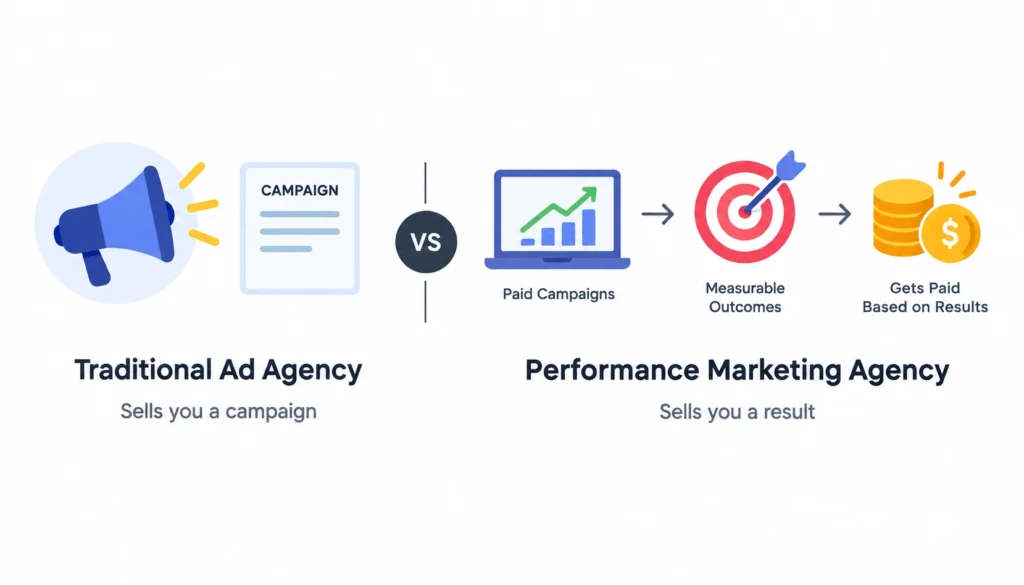
A performance marketing agency runs paid acquisition campaigns and gets paid based on measurable outcomes rather than general brand activity. The clearest way to think about it: a traditional ad agency sells you a campaign; a performance marketing agency sells you a result, or at least gets judged by one.
Short answer for the “what is it” question:
A performance marketing agency manages paid advertising and related growth work around measurable outcomes such as leads, sales, customer acquisition cost, and return on ad spend. Its core work usually includes paid search, paid social, creative testing, conversion tracking, and ongoing optimization based on what the data shows.
1. How it differs from a traditional agency
A traditional agency is often paid a flat fee to produce a campaign, a brand film, or a season of content. Whether that content drives sales is somebody else’s problem to measure. A performance marketing agency lives or dies by the numbers it can point to, which changes how it operates day to day: testing more, reporting more often, and adjusting spend weekly instead of once a quarter.
2. Performance marketing vs digital marketing
“Digital marketing” is the umbrella term. It covers SEO, content, email, social media management, and paid ads. Performance marketing is one slice of that umbrella, specifically the paid, trackable side.
| Performance marketing agency | Digital marketing agency |
| Judged on outcomes: CAC, CPA, ROAS | Broader scope: SEO, content, social, email |
| Paid acquisition is the center of gravity | May not run paid ads at all |
| Heavy testing culture | Wider mix of long-term and short-term work |
| Reports tie spend to revenue | Reports may focus on reach or engagement |
3. Performance marketing vs media buying
Media buying is the act of purchasing ad space. It’s one task inside performance marketing, not the whole job. A pure media buyer places the ads; a performance marketing agency also builds the tracking, tests the creative, and adjusts the strategy based on what converts.
4. Performance marketing vs growth marketing
Growth marketing is a wider discipline that includes paid ads plus product changes, onboarding flows, referral loops, and retention work. Performance marketing agencies usually stop at the acquisition and conversion stage; growth teams go further into the product itself.
For more background on how this category evolved out of direct-response advertising, Wikipedia’s page on performance-based marketing is a decent starting point.
What Does a Performance Marketing Agency Do?
Strip away the jargon and a performance marketing agency does five things: figure out who to target, build campaigns across a few channels, test creative, track what happens after someone clicks, and adjust spend toward what’s working.
1. Business and acquisition strategy
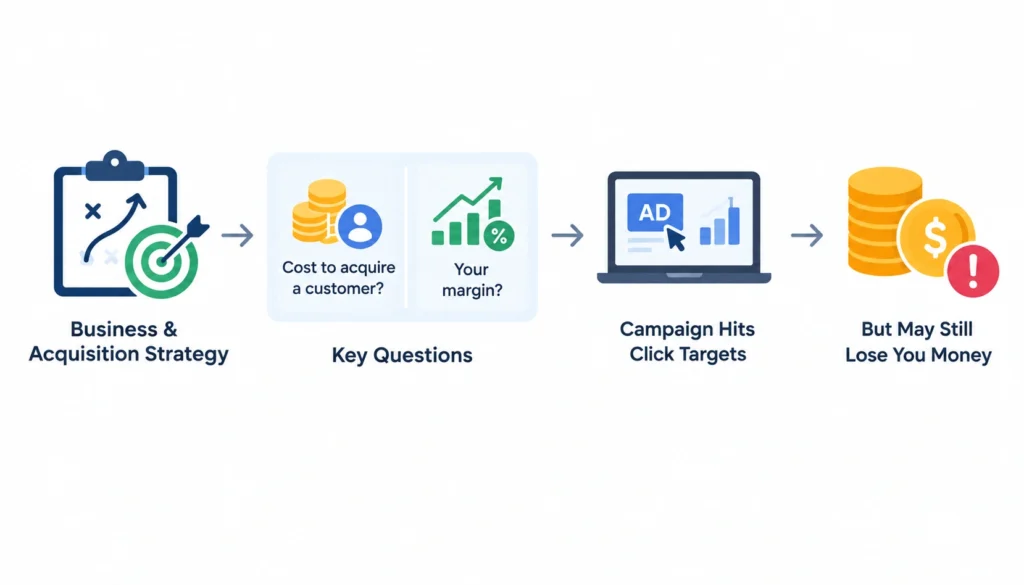
Before any ads go live, a good agency asks about your unit economics, not just your marketing goals. What’s an acceptable cost to acquire a customer? What’s your margin? A campaign that hits its click targets but ignores your economics can still lose you money.
2. Paid search management
This covers Google Search, Google Shopping, Performance Max campaigns, and often Microsoft Advertising. Search ads target people who are already looking for something, which usually makes this channel the first place agencies allocate budget for businesses with clear buying intent.
3. Paid social advertising
Meta (Facebook and Instagram), LinkedIn, and YouTube fall under this umbrella. Social ads reach people who aren’t actively searching, so the creative and targeting have to do more work to earn attention. LinkedIn tends to dominate for B2B; Meta and YouTube usually lead for consumer brands.
4. Programmatic and retargeting
Programmatic advertising automates the buying of display and video ad space across many sites at once. Retargeting shows ads to people who already visited your site or app but didn’t convert. It’s often one of the highest-ROI tactics available because you’re speaking to people who already showed interest.
5. Creative testing, landing pages, and CRO
Ads only work if what people see when they click actually converts them. A capable agency runs structured creative tests (different headlines, images, offers) and works on the landing page itself, including load speed, form length, and messaging, through conversion rate optimization (CRO). For a deeper look at keyword targeting and on-page SEO, see our related guide.
6. Tracking, attribution, and CRM integration
This is the unglamorous part that determines whether anything else can be trusted. It includes setting up conversion tracking, connecting ad platforms to your CRM (Salesforce, HubSpot, Zoho), and building an attribution model that shows which channel actually drove a sale, not just which one got the last click.
For a broader look at advanced SEO techniques, including analytics, internal linking, technical SEO, and performance measurement, see our detailed guide.
How Performance Marketing Agencies Actually Work
A good agency follows something close to this sequence, even if the exact order shifts by client:
- Establish the business objective: more revenue, more qualified leads, or lower CAC.
- Define the unit economics: CAC, LTV, average order value, margin, payback period.
- Build the tracking infrastructure before spending a rupee or a dollar on ads.
- Research the audience and what triggers their buying decision.
- Choose the channel mix based on where that audience actually spends time.
- Build campaigns and creative variants.
- Launch controlled tests rather than betting the full budget on one idea.
- Optimize based on conversion data, not just clicks.
- Improve landing pages alongside the ads themselves.
- Attribute revenue back to the channel and campaign that generated it.
- Scale the campaigns that are actually profitable.
Skipping step 2 or step 3 is the most common failure point. An agency that jumps straight to “let’s launch ads” without agreeing on your acceptable CAC or setting up proper tracking is optimizing blind.
What Should a Performance Marketing Agency Measure?
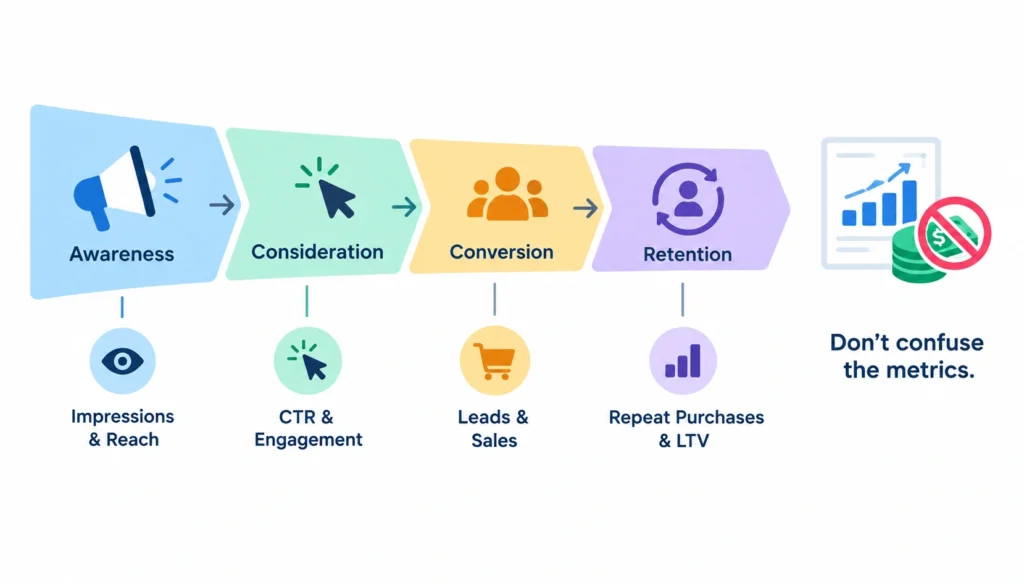
Different metrics matter at different stages of the funnel. Confusing them is how agencies end up reporting “success” that doesn’t touch your bank account.
1. Top-of-funnel metrics
Impressions, reach, CPM (cost per thousand impressions), and CTR (click-through rate) tell you whether people are seeing and clicking the ad. They say nothing about whether those clicks turn into customers.
2. Acquisition metrics
CPC (cost per click), CPL (cost per lead), CPA (cost per action), and CAC (customer acquisition cost) tell you what it actually costs to generate interest or a customer.
3. Conversion metrics
Conversion rate, lead-to-customer rate, and sales conversion rate show how much of that interest turns into revenue.
4. Revenue metrics
ROAS (return on ad spend), MER (marketing efficiency ratio), LTV (lifetime value), and LTV:CAC ratio connect the spend to actual business outcomes.
5. Why cheap leads don’t always mean good performance
A campaign that drops your cost per lead by 40% while also dropping lead quality isn’t an improvement. It’s a shift of the problem downstream to your sales team. Ask for lead-to-customer conversion rate alongside cost per lead, every time. This distinction is one of the most common blind spots in agency reporting, and it’s worth raising in your first conversation with any agency you’re considering.
Performance Marketing Agency Services by Business Type
The right services depend heavily on what you sell.
B2B and SaaS: Google Search and LinkedIn tend to matter most, along with CRM integration and tracking that follows a lead all the way to a closed deal, not just to a form submission.
E-commerce and D2C: Meta, Google Shopping, and Performance Max usually carry the most weight, with a heavy focus on product feed quality, retargeting, and average order value.
Startups: Speed matters more than polish early on. Expect rapid experimentation to find which channel produces a workable CAC before committing serious budget.
Enterprise brands: Multi-channel attribution, programmatic buying, and coordination across global and local campaigns become the priority once you’re running budgets across many markets.
Local businesses: Search ads, local targeting, call tracking, and increasingly WhatsApp-based lead capture (common across South Asian markets) tend to outperform broad brand campaigns.
How Much Does a Performance Marketing Agency Cost?
Pricing structures vary, and understanding them matters as much as comparing the headline number.
Percentage of ad spend: The agency charges a percentage, commonly somewhere between 10% and 20%, of what you spend on ads. Simple to understand, though it can create an incentive to keep spend high rather than efficient.
Fixed monthly retainer: A flat fee regardless of ad spend. Easier to budget for, but make sure the scope of work is spelled out clearly.
Performance-based pricing: Part or all of the fee is tied to results, such as cost per qualified lead. Attractive in theory, but agencies usually only offer this once they trust your tracking and your industry.
Hybrid pricing: A smaller retainer plus a percentage of spend or a performance bonus. Common for mid-sized accounts.
1. Additional costs to watch for
Creative production, landing page builds, tracking setup, and reporting dashboards are sometimes billed separately from the core retainer. Ask for a full breakdown before signing anything.
2. Agency fee is not your advertising budget
This trips up a lot of first-time buyers. If your total marketing budget is $10,000 a month and the agency’s fee is 15% of ad spend, you’re not spending $10,000 on ads and paying the fee on top; you need to work backward to figure out how much of that $10,000 actually reaches Google and Meta versus how much goes to the agency.
| Cost element | Percentage of spend | Fixed retainer | Performance-based |
| Predictability | Lower, scales with spend | Higher, fixed cost | Variable, tied to output |
| Incentive alignment | Can reward higher spend | Neutral | Rewards efficiency |
| Best for | Larger, scaling budgets | Smaller or fixed budgets | Mature accounts with clean data |
Performance Marketing Agency vs In-House Team vs Freelancer
There’s no universally correct answer here. It depends on budget, how many channels you need to run, and how fast you need to move.
| Factor | Agency | In-house | Freelancer |
| Channel expertise | Broad, across specialists | Depends on hires | Usually one or two channels |
| Cost structure | Retainer or % of spend | Salaries + tools | Hourly or project-based |
| Strategic support | Usually included | Depends on seniority | Often limited |
| Creative resources | Often in-house team | Needs separate hire | Rarely included |
| Scalability | Easier to scale up or down | Slower, hiring takes time | Limited by one person’s bandwidth |
| Best use case | Multi-channel, growing budgets | Long-term, single-channel focus | Small budgets, narrow scope |
A useful rule of thumb discussed often in marketing forums like r/PPC on Reddit: agencies tend to make sense once your monthly ad spend is large enough that a 10-15% management fee is smaller than what it would cost to hire that expertise full time.
How to Choose a Performance Marketing Agency
- Start with your business economics. Know your target CAC and margin before you talk to anyone. An agency that doesn’t ask about this in the first call is a warning sign.
- Look for relevant industry experience. A team that’s spent years on e-commerce accounts may struggle with a long B2B sales cycle, and the reverse is just as true.
- Evaluate actual case studies, not just the headline percentage improvement (more on this below).
- Check tracking and attribution capabilities. Ask specifically how they handle iOS privacy changes, server-side tracking, and CRM integration.
- Examine reporting. Ask to see a sample report from an existing client (with names redacted) before signing.
- Understand who manages your account. Some agencies put senior strategists on the pitch and junior staff on the actual work.
- Check creative capabilities. Are they producing creative in-house or outsourcing it, and how fast can they turn around a new test?
- Ask how testing works. How many variants do they run at once, and how do they decide a winner?
- Understand pricing fully, including what’s outside the retainer.
- Check contract and exit terms. Month-to-month is generally safer for a new relationship than a 12-month lock-in.
- Verify account and data ownership. Your ad accounts and data should belong to you, not the agency.
- Speak to references, ideally a client in a similar industry with a similar budget size.
If you’re also evaluating SEO providers, our guide on how to choose the right SEO agency covers audits, strategy, analytics, reporting, contracts, and account ownership
20 Questions to Ask a Performance Marketing Agency Before Hiring
- What KPI will you optimize for, specifically?
- How do you define a qualified lead versus a raw lead?
- Who owns the ad accounts: us or you?
- Who owns the tracking and conversion data?
- What attribution model do you use, and why?
- How often do you optimize live campaigns?
- How often will you report, and in what format?
- Who creates the ad creative?
- How often do you test new creative?
- What happens when a campaign misses its target?
- What’s included in the retainer?
- What costs extra?
- What happens if we end the contract early?
- Can we speak to a current client in our industry?
- How do you handle a new channel we haven’t tried before?
- What tools do you use for tracking and reporting?
- How do you integrate with our CRM?
- What’s your minimum ad spend requirement?
- How long before we should expect meaningful results?
- What do you need from us to get started?
Turning this into an actual checklist before your first call will save you from the vague, confident answers that a lot of agencies default to under pressure.
How to Evaluate a Performance Marketing Agency Case Study
Agency case studies are marketing material, which means they’re written to flatter the agency. Read them the way you’d read a resume, for the specific facts, not the framing.
- Look for baseline numbers. “We improved conversion rate by 300%” means very little if the baseline was 0.1%.
- Look for absolute results, not just percentages. Revenue generated, number of customers, actual CAC.
- Check the timeframe. A result over six months reads very differently than the same result claimed over six weeks.
- Check the campaign budget. Results at a $2,000/month spend rarely translate directly to a $50,000/month budget.
- Understand what “conversion” actually means in that case study: a form fill, a call, or a completed sale.
- Look for revenue, not just leads. Lead volume alone tells you almost nothing about business impact.
- Watch for misleading percentage improvements built on small or cherry-picked sample sizes.
Red Flags When Hiring a Performance Marketing Agency
- Guaranteed ROAS or guaranteed results before they’ve seen your data. No honest agency can promise this.
- Reporting that stops at impressions and clicks, with no mention of leads, sales, or CAC.
- No access to your own ad accounts.
- No clear explanation of their attribution model.
- No case studies relevant to your industry or budget size.
- Long contracts with no exit clause.
- One generalist handling paid search, paid social, creative, and analytics alone for a sizable account.
- No structured testing process, just “we’ll try things and see.”
- Vague or evasive answers about who owns your data.
Performance Marketing Agency Selection Checklist
- Relevant industry experience
- Verified, specific case studies
- Clear, itemized pricing
- Transparent, regular reporting
- CRM integration capability
- A defined attribution model
- Active creative testing process
- CRO capability, not just ad management
- Clear account ownership terms
- Clear data ownership terms
- Agreed KPIs before work starts
- Contract terms you actually understand
Frequently Asked Questions
What is a performance marketing agency?
A performance marketing agency runs paid advertising campaigns judged by measurable outcomes like leads, sales, and return on ad spend, rather than general brand awareness.
What does a performance marketing agency do?
It handles strategy, paid search and social campaigns, creative testing, conversion tracking, landing page optimization, and reporting tied to business results.
How much does a performance marketing agency cost?
Most charge either a percentage of ad spend (commonly 10-20%), a fixed monthly retainer, or a hybrid of the two, plus possible extra fees for creative or landing pages.
How long does performance marketing take to show results?
Early signals often show up within a few weeks, but reliable, optimized performance usually takes a full quarter, since campaigns need enough data to test and refine.
What platforms do performance marketing agencies manage?
Most commonly Google Ads, Meta, LinkedIn, YouTube, and Microsoft Advertising, plus
Final Takeaway
Don’t choose a performance marketing agency simply because it promises more traffic, leads, or a bigger percentage improvement than the next agency. Those numbers can look impressive, but they don’t always translate into meaningful business results.
Instead, look for an agency that can clearly connect your advertising spend to the outcomes that actually matter to your business, whether that’s qualified leads, sales, revenue, or customer acquisition.
A reliable agency should also be willing to show you the data behind its claims, explain what is driving performance, and be transparent about what is and isn’t working.
The goal isn’t to find the agency with the biggest promise; it’s to find one that can consistently demonstrate where your money is going and what you’re getting back from it.