If you’ve spent any time researching link building, you’ve probably noticed the same twelve tactics repeated across a dozen different blogs, usually with the same examples and the same generic advice.
That’s not because those tactics don’t work. It’s because most articles stop at “here’s what to do” and never get to “here’s how to do it, and how to tell if it’s actually white hat.”
This guide is different. It covers the strategies, but it also gives you a way to decide which one fits your site, a real execution process for each tactic, a system for judging whether a prospective link is worth pursuing, and a plan for measuring whether any of it moved the needle.
By the end, you should be able to build a link acquisition process you can run every month, not just a list of ideas you’ll forget by Friday.
What Is White Hat Link Building?
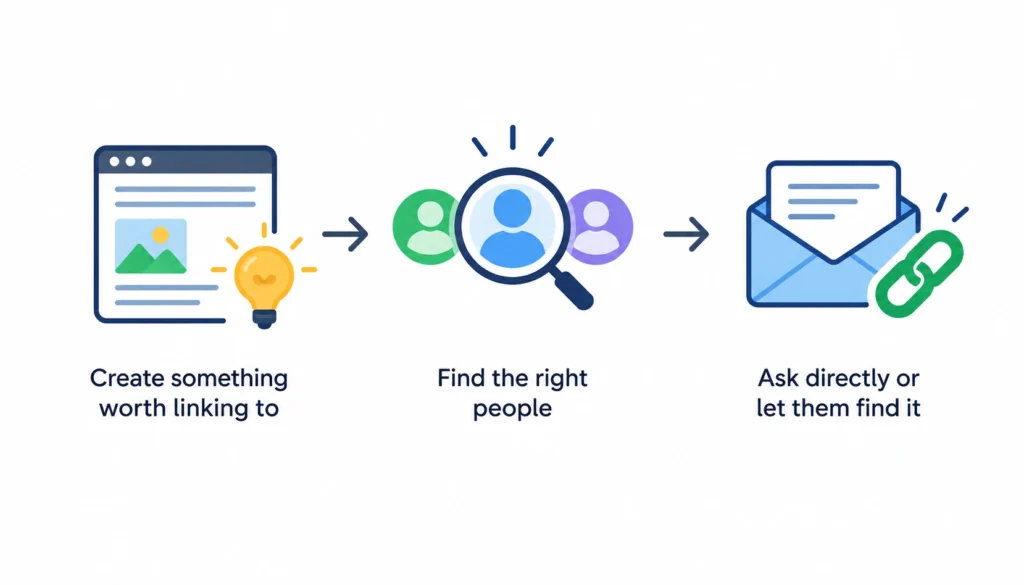
White hat link building means earning backlinks through methods that don’t try to trick Google’s ranking systems. You create something worth linking to, you find people who’d genuinely want to link to it, and you ask them directly or wait for them to find it on their own.
Here’s a detail most guides skip: “white hat” isn’t an official Google classification. You won’t find that phrase anywhere in Google’s own documentation.
It’s an industry term the SEO community adopted to describe practices that stay well inside Google’s spam policies. Google’s actual framework centers on whether a link exists to help users navigate the web, or exists primarily to manipulate a ranking.
That distinction matters more than it sounds. A sponsored product review with a properly tagged rel=”sponsored” link isn’t spam. Google explicitly allows paid links when they’re marked as advertising rather than presented as organic endorsement.
A “guest post” written purely to plant a keyword-stuffed link in a footer, on the other hand, crosses the line even if nobody paid for it. The tactic matters less than the intent behind it.
White hat vs. gray hat vs. black hat link building
White hat link building earns links through original content, relationships, and outreach that would make sense even if search engines didn’t exist. Digital PR, data studies, and broken link fixes fall here.
Gray hat sits in the ambiguous middle. Reciprocal linking, some forms of scaled guest posting, and link exchanges disguised as partnerships all live in this zone, technically not forbidden, but risky if overdone or done carelessly.
Black hat link building tries to manipulate rankings directly: private blog networks, bought links with no advertising disclosure, automated link injection through comment spam or hacked sites. Google’s spam policies name these practices specifically, and getting caught can mean a manual action that tanks your visibility overnight.
What actually makes a link manipulative
Google’s guidance boils down to one question: was this link created to be useful to a reader, or to move a ranking? Large-scale article marketing, keyword-rich anchor text exchanges, and links embedded in low-quality guest posts across dozens of sites all fail that test, regardless of how the tactic is labeled.
What Makes a Backlink High Quality?
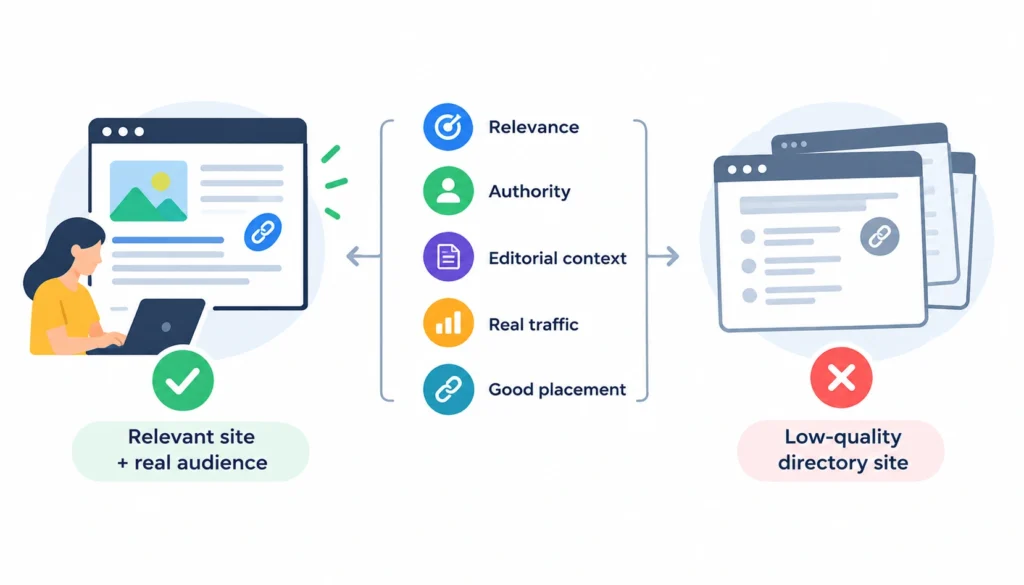
Not every backlink pulls its weight. A single link from a site your customers actually read can outperform fifty links from directories nobody visits. Here’s what separates a useful link from a wasted one.
If you want a deeper look at how backlinks influence search visibility, see our guide on [why backlinks are important in SEO].
Topical relevance. A link from a marketing blog matters more to an SEO tool than a link from a recipe site, even if the recipe site has higher traffic. Search engines and readers both interpret relevance as a signal of trust.
Relevance of the specific page, not just the domain. A link buried on an unrelated page of an otherwise relevant site carries less weight than one placed on a page that’s actually about your topic.
Editorial context. Was the link placed because an editor decided it added value, or because someone was paid to insert it? Editorial links tend to carry more trust and tend to last longer.
Authority and reputation of the linking site, not a vanity score, but a genuine track record of publishing content people cite and share.
Organic traffic and a real audience. A site with no visitors sending you a link does little beyond a minor ranking signal. A site people actually read can send you readers, not just link equity.
Placement on the page. A link in body content, surrounded by relevant text, is worth more than one buried in a sidebar or footer.
Anchor text. Natural, varied anchor text reads as organic. Repeating the exact same commercial keyword phrase across many links is one of the clearest signals of manipulation.
Link attributes: dofollow, nofollow, sponsored, ugc. A nofollow link from a major publication still sends referral traffic and brand exposure, so don’t write it off entirely.
One correction worth making here: Domain Authority (DA) is a third-party metric built by Moz, not something Google uses in ranking. It’s a useful rough filter for prospecting, but chasing a DA number instead of a relevant, trafficked, editorially-earned link is a common and avoidable mistake. A discussion on r/SEO touches on this regularly, and practitioners routinely flag DA-obsessed link building as a red flag when vetting agencies.
The 12 Best White Hat Link Building Strategies
1. Create original research and proprietary data
Original data earns links because journalists and bloggers need something to cite, and most of them would rather cite a number than write one themselves. Survey your customers, pull anonymized data from your own product, or run a small study on a question your industry hasn’t answered yet.
Turn the raw numbers into something a reporter can use in under five minutes: a clear headline stat, one or two supporting charts, and a short methodology note. Then promote it directly: email relevant journalists and bloggers who’ve covered similar data before, rather than hoping it gets discovered organically.
2. Build linkable assets
A linkable asset is any piece of content built specifically to attract links on its own, without you asking for anything. Original statistics pages, definitive guides on a topic nobody’s covered well, free templates, calculators, and interactive tools all qualify.
The test for whether something is a genuine linkable asset: would someone bookmark it or reference it months from now? If the honest answer is no, it’s a blog post, not an asset. Still useful, just don’t expect it to earn links on autopilot.
3. Use digital PR to earn editorial links
Digital PR means pitching a story, not a link. Find an angle that’s actually newsworthy, such as a trend in your data, a reaction to industry news, or a contrarian take backed by evidence, and pitch it to journalists the way a PR professional would.
Respond to expert-source requests through platforms like Qwoted or journalist request threads, since these give you a fast path to a quote and a link in an existing article rather than convincing someone to write a new one. Over time, build a short list of journalists who cover your space and stay useful to them consistently, not just when you need something.
4. Reclaim unlinked brand mentions
Companies get mentioned online without a link constantly, in a product review, a “best of” roundup, or a news article quoting your CEO. Set up Google Alerts or a monitoring tool like Mention or Brand24 to catch these as they happen.
Once you find one, check whether the mention is genuinely appropriate for a link before reaching out. A passing mention buried in an unrelated context isn’t worth pursuing; a clear, specific reference to your product or research usually is. Keep the outreach short: thank them for the mention, and ask politely if they’d consider linking to the source.
5. Build broken links
Every site accumulates dead links over time as pages get deleted or moved. Find broken links on resource pages and articles in your niche, using a tool like Ahrefs’ broken link checker, then offer your own content as the replacement, but only if it’s genuinely a good fit.
The sequence matters: find the broken link, confirm your page actually covers the same ground as the dead one, then reach out with a short, specific note pointing out the broken link before mentioning your resource. Pitching a replacement that’s a poor match is the fastest way to get ignored.
6. Reclaim lost backlinks
Links disappear for mundane reasons, such as a site redesign, a URL change, or a page getting deleted outright. Use your backlink tool’s “lost links” report to catch these, then decide which ones are worth chasing.
Not every lost link deserves an email. Prioritize the ones from relevant, high-traffic pages, and send a brief note asking whether the removal was intentional or just a byproduct of a site update.
7. Earn links from resource pages and curated lists
Many industries have longstanding resource pages, curated lists of tools, guides, or organizations maintained by universities, associations, or established blogs. Search for phrases like “useful resources” or “recommended tools” plus your topic to find them.
Before pitching, check whether the page is actually still maintained and whether your content adds something the existing list doesn’t already cover. A generic pitch to an inactive page wastes everyone’s time.
8. Use strategic guest contributions
Guest posting is legitimate when you’re contributing genuine expertise to a publication your audience already reads, and the link exists because it’s relevant to the discussion, not because you paid for placement or wrote it purely to plant a link. It becomes a problem the moment link placement is the actual goal and the writing is just a vehicle for it.
Google’s spam documentation specifically calls out large-scale guest posting campaigns built around optimized anchor text as a link spam pattern. Keep your guest contributions occasional, write for publications you’d want your name attached to regardless of the link, and avoid syndicating the same piece across dozens of low-quality sites.
9. Leverage existing business relationships
This is one of the most overlooked white hat tactics, mostly because it doesn’t feel like “SEO work.” Suppliers, partners, clients who’ll give a testimonial, trade associations you belong to, and industry conferences you’ve spoken at are all natural, low-effort sources of relevant links.
A local landscaping company, for example, can usually get a link from its state landscaping association, a supplier’s “our retailers” page, and a few chambers of commerce, links that are genuinely earned and take a fraction of the effort of cold outreach.
10. Use competitor backlink-gap analysis
Pull a competitor’s backlink profile in Ahrefs or Semrush and look for referring domains that link to them but not to you. These are often sites that already cover your industry and are open to linking to relevant resources, you just haven’t been on their radar yet.
Filter the list down to genuinely relevant, active sites, then build content that’s a clear improvement on whatever your competitor offered before reaching out.
11. Get featured on relevant podcasts, interviews and expert roundups
Podcast appearances and expert roundups almost always come with a link back to your site in the show notes or contributor bio. Find shows your target audience actually listens to, and pitch a specific angle rather than a general “have me on to talk about my company.”
The link is a side benefit here. The real value is reaching an audience directly, which is worth doing even when a link isn’t part of the deal.
12. Build relationships before asking for links
The strategies above work better, and get easier over time, when they’re built on actual relationships rather than one-off cold emails. Comment thoughtfully on industry blogs, contribute useful answers in relevant LinkedIn discussions, and collaborate on research or content with other people in your space.
Once you’re a known, useful presence in a niche, links start happening without an outreach email attached, because someone cites your work when they already trust it.
Which White Hat Link-Building Strategy Should You Use?
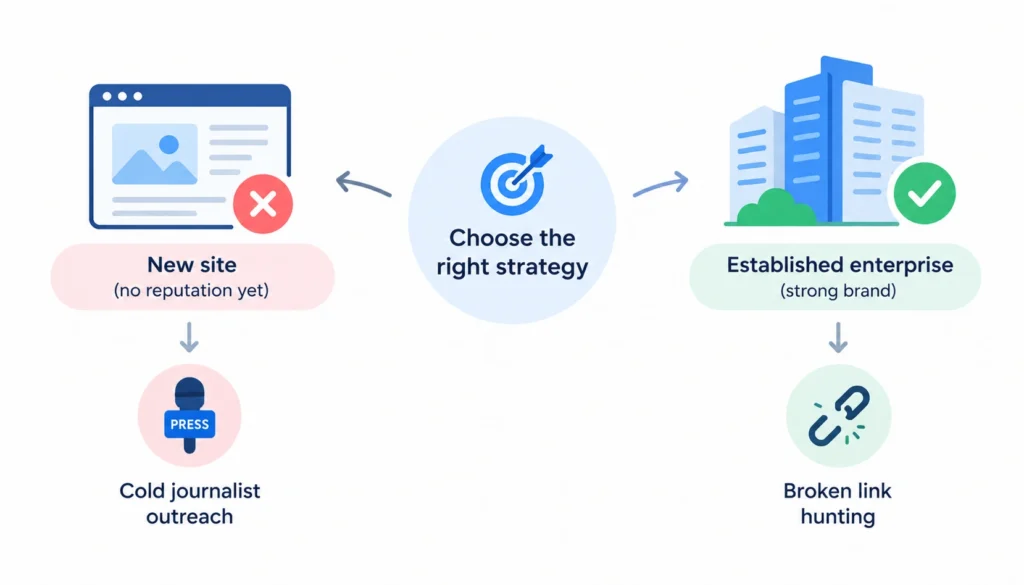
Not every tactic fits every business. A new site with no reputation yet won’t get much traction pitching journalists cold, and an established enterprise brand rarely needs to hunt for broken links.
| Situation | Best strategies to start with |
| Brand-new website | Business relationships, niche resource pages, small original studies |
| Local business | Associations, suppliers, local press, chambers of commerce |
| SaaS company | Original data, free tools, digital PR |
| Ecommerce site | Product research, buying guides, partnerships |
| B2B company | Original research, expert contributions, trade publications |
| Established brand | Digital PR, proprietary data, thought leadership |
| Small budget, mostly time | Link reclamation, broken links, relationship building |
| Strong content team | Linkable assets, digital PR |
| Strong subject-matter experts | Podcast appearances, expert quote platforms, bylined articles |
How to Build a White Hat Link-Building Campaign
Running link building as a one-off sprint rarely produces lasting results. Treat it as a repeatable process instead.
For a more detailed breakdown of the prospecting, outreach, acquisition, and tracking process, see our [complete link building workflow].
- Set a clear objective: more referring domains to a specific page, more relevant traffic, or authority for a topic cluster. The objective shapes which pages and prospects you go after.
- Choose pages worth promoting. Not every page deserves a link campaign. Pick pages that are genuinely useful and closely tied to revenue or topical authority.
- Define your ideal referring domain: what does a relevant, high-quality site actually look like for your niche? Write it down before you start prospecting.
- Find prospects using backlink gap analysis, resource page searches, and journalist databases.
- Qualify each prospect against the criteria below before spending any outreach effort on them.
- Create a real reason to link: a stat, a quote, a tool, or a correction to something outdated on their page.
- Personalize outreach, referencing something specific about the prospect’s site rather than sending a template.
- Follow up, but stop after two or three attempts. Persistence helps; pestering doesn’t.
- Record every placement in a spreadsheet or CRM so you can track what’s working over time.
- Measure results against your original objective, not just link count.
How to Evaluate a Link-Building Prospect
Before you send a single outreach email, score the opportunity. This keeps you from wasting time on sites that look fine at a glance but won’t actually help.
Rate each prospect on:
- Topical relevance to your niche
- Relevance of the specific page you’d be linked from
- Whether links on the site read as editorial or clearly paid
- Real organic search visibility, not just a headline traffic number
- Whether the site’s existing audience overlaps with yours
- General site quality and design
- Where on the page your link would sit
- Whether the site already links out to spammy or irrelevant domains (a red flag if so)
- Realistic referral traffic potential
A quick gut check: if you wouldn’t want your own brand associated with a site’s other content, don’t chase a link from it. No ranking benefit is worth that trade.
White Hat Link-Building Outreach
A good outreach email is short, specific, and honest about why you’re reaching out. It names the exact page you’re referencing, explains clearly why your resource is relevant, and asks for one specific thing.
Here’s a simple template to adapt:
Subject: Quick fix for a broken link on [Page Title]
Hi [Name],
I was reading your resource on [topic] and noticed the link to [dead resource] isn’t working anymore. I put together a similar guide on [your topic] that covers the same ground, happy to share it if it’d be useful as a replacement.
Either way, thought you’d want to know about the broken link.
[Your name]
Two follow-ups, spaced about five to seven days apart, is usually enough. Beyond that, move on. A lack of response is an answer.
How to Measure White Hat Link-Building Results
Link count alone tells you almost nothing. Track these instead:
- Referring domains: the number of unique sites linking to you, which matters more than total link count
- Relevance of those domains to your niche
- Referral traffic the links actually send
- Organic rankings for pages that received new links
- Organic traffic to those pages over time
- Assisted conversions from referral visits
- Lost vs. earned links, tracked monthly
Link building works best as part of a broader SEO process. Our [complete SEO workflow guide] covers how link building fits alongside keyword research, content creation, on-page optimization, technical SEO, and performance tracking.
If your link count is climbing but none of the other numbers move, something in your targeting is off, and you’re likely earning links from irrelevant or low-traffic sites.
How Long Does White Hat Link Building Take?
Timelines vary a lot by tactic. Broken link fixes and unlinked mention reclamation can land a response within a week, since you’re offering the site owner a small favor. Digital PR and original research campaigns usually take one to three months from data collection to coverage.
Relationship-based links build slowly, often over six months or more, but tend to keep producing new links long after the initial campaign ends.
Nobody can honestly promise a specific ranking improvement by a specific date from link building alone. It’s one signal among many, and it works alongside content quality, site structure, and relevance.
White Hat Link Building Tactics to Avoid
Steer clear of:
- Buying links specifically to influence rankings, without advertising disclosure
- Private blog networks
- Excessive reciprocal link exchanges
- Automated or software-generated link creation
- Spammy directory submissions
- Forum and comment link spam
- Mass guest-post campaigns across low-quality sites
- Keyword-stuffed anchor text
- Syndicated content published unchanged across many domains
- Link schemes dressed up as “partnerships” with no real business relationship behind them
These are the practices Google’s own spam policies call out directly, and they’re the fastest route to a manual action.
How to Vet a White Hat Link-Building Agency
If you’re outsourcing, ask direct questions before signing anything:
- Where exactly do the links come from, and can they show real examples?
- Do they guarantee a specific number of links per month? (A guarantee is a warning sign: genuine outreach has variable results.)
- Can they show you sample placements from other clients in a similar industry?
- What does their own backlink profile look like?
- How do they handle sponsored or paid placements, and do they disclose them properly?
An agency that’s cagey about any of these, or that promises fast, predictable link volume, is usually running a process closer to black hat than white hat.
Best Tools for White Hat Link Building
- Backlink research: Ahrefs, Semrush
- Prospect discovery: Google search operators, Ahrefs, Semrush
- Brand monitoring: Google Alerts, Mention, Brand24
- Outreach management: BuzzStream or a general CRM
- Performance measurement: Google Search Console, Google Analytics
Frequently Asked Questions
What is white hat link building?
It’s the practice of earning backlinks through legitimate means, such as original content, relationships, and direct outreach, without trying to manipulate search rankings through manufactured or paid links.
How do I get white hat backlinks?
Create something genuinely worth linking to, find the sites and people who’d care about it, and reach out with a specific, honest reason they’d want to link.
Are backlinks still important for SEO?
Yes. They remain one of the clearer trust and relevance signals search engines use, alongside content quality and site structure.
Is the guest posting white hat?
It can be, if you’re contributing real expertise to a relevant publication and the link exists naturally within useful content. It stops being white hat when the writing exists purely to place a link.
Is broken link building still effective?
Yes, though response rates depend heavily on how relevant your replacement content actually is to the page you’re pitching.
Conclusion
Good white hat link building isn’t about chasing a specific number of backlinks. It’s about following a repeatable process: choose a page that’s genuinely worth promoting, create something valuable enough to earn attention, identify relevant prospects, and reach out with a useful and honest reason to link.
Once a link is acquired, make sure it’s live, relevant, and accessible, then monitor referral traffic, rankings, and organic performance over time. By focusing on relevance, genuine value, natural anchor text, and measurable results rather than shortcuts or manipulative tactics, you can build a stronger backlink profile that supports sustainable SEO growth.