Camera movement has always been one of the most powerful storytelling tools in filmmaking. A slow push-in can build emotion, a sweeping aerial shot can establish scale, and a fast tracking movement can create energy and excitement.
For decades, achieving complex camera movements required professional equipment, skilled cinematographers, camera operators, and extensive planning. Motion-controlled rigs, cranes, drones, and virtual production setups allowed filmmakers to create dynamic shots, but these techniques often required significant time and resources.
AI filmmaking is changing how creators approach camera movement. With advancements in generative video models and virtual camera systems, filmmakers can now experiment with cinematic movements before and during production. Instead of only describing what a scene should look like, creators can increasingly define how the camera should move through a scene.
3D camera movements are becoming an important part of AI-generated filmmaking because they provide greater control over perspective, composition, and storytelling. They help transform AI-generated clips from static visuals into more cinematic sequences with intentional direction.
Why Camera Movement Matters in Filmmaking
A camera does more than capture a scene. Its movement influences how audiences experience the story.
A close-up shot can highlight emotion, while a wide shot can communicate scale and environment. A moving camera can guide attention, reveal information, or create a specific feeling.
In traditional filmmaking, directors and cinematographers carefully plan camera movements based on the story they want to tell. Every movement has a purpose, whether it is following a character, revealing a location, or creating tension.
AI-generated videos initially focused heavily on creating realistic images and short clips. However, as filmmaking workflows become more advanced, controlling camera movement has become equally important for creating professional-quality content.
What Are 3D Camera Moves in AI Filmmaking?
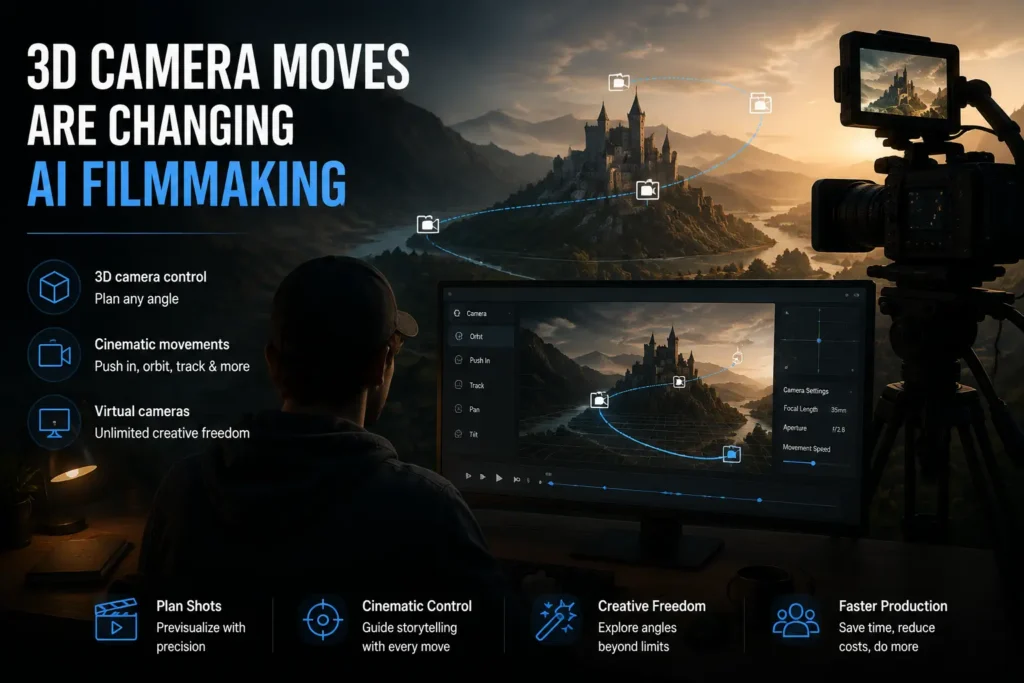
3D camera moves refer to controlling the position, angle, and movement of a virtual camera within a digital environment.
Unlike simple video generation, where a model creates a fixed viewpoint, 3D camera control allows filmmakers to explore a scene from different perspectives.
These movements can include:
- Camera rotations around subjects
- Forward and backward movement
- Side tracking shots
- Crane-style movements
- Dynamic perspective changes
- Cinematic reveals
This gives creators more control over how viewers experience a scene.
For example, instead of generating a product image and adding motion afterward, filmmakers can design a shot where the camera moves around the product, revealing different details and creating a more premium commercial feel.
How AI Is Improving Cinematic Camera Control
AI models are becoming better at understanding spatial relationships, depth, and movement. This allows them to generate scenes where camera motion feels more natural and connected.
Earlier AI-generated videos often struggled with maintaining consistency during movement. Objects could change shape, backgrounds could distort, and camera transitions could feel unnatural.
Modern AI workflows are improving this by focusing on:
- Better understanding of 3D space
- More realistic motion generation
- Improved subject consistency
- Better scene awareness
These improvements allow filmmakers to create more controlled shots instead of relying only on random camera movements.
Virtual Cameras Give Filmmakers More Creative Freedom
Virtual cameras remove many physical limitations of traditional production.
In a real-world shoot, filmmakers need to consider equipment availability, locations, safety, and production costs. A complex camera movement may require specialized tools or a large crew.
With AI-powered virtual cameras, creators can experiment with movements that would be difficult or expensive to achieve physically.
A filmmaker can explore:
- Impossible camera angles
- Smooth transitions between environments
- Complex tracking movements
- Large-scale cinematic shots
This gives independent creators and smaller production teams more opportunities to experiment with cinematic storytelling.
AI Shot Direction and Previsualization
Before filming begins, directors often create previsualizations to understand how scenes will look. Previsualization helps teams plan camera positions, character movements, and overall scene flow.
AI is making this process faster by helping creators explore different shot directions before production.
Invideo Agent supports this type of workflow by helping filmmakers move from creative ideas and references into structured video projects. During shot planning and previsualization, it helps creators organize scenes, explore visual directions, and maintain continuity between different shots.
This is especially useful for complex productions where camera movement, character positioning, and visual style need to remain aligned across multiple scenes.
How 3D Camera Moves Improve Product Commercials
Camera movement plays a major role in commercial storytelling. Brands often use cinematic camera techniques to make products appear more premium, desirable, and memorable.
A simple product shot can become more engaging with the right movement. A camera orbit around a smartphone can highlight its design, while a slow cinematic push toward a luxury product can create a premium feeling.
AI-powered camera control allows brands to experiment with different product presentations without requiring multiple physical setups.
For ecommerce and advertising, this helps create more engaging product videos while maintaining consistency in product appearance.
Creating More Immersive Worlds With AI Cameras
Camera movement also plays an important role in world-building.
In films, the camera helps audiences understand the size, atmosphere, and details of a location. A slow panoramic movement can introduce a new environment, while a dynamic tracking shot can make a fictional world feel more alive.
AI filmmaking tools are helping creators build these experiences by allowing cameras to move naturally through generated environments.
This is especially valuable for:
- Fantasy films
- Science fiction projects
- Animated stories
- Virtual productions
Instead of generating separate images of a world, filmmakers can create scenes where the audience feels like they are moving through that world.
Maintaining Consistency During Camera Movement
While AI camera control has improved, maintaining consistency during movement remains a major challenge.
When a virtual camera moves through a scene, AI needs to preserve:
- Character identity
- Product details
- Environment structure
- Lighting consistency
- Visual style
Without proper control, movement can introduce unwanted changes.
For example, a product may look correct in a static shot but change shape when the camera moves around it. Similarly, a character may appear different when viewed from a new angle.
This is why references, creative planning, and connected workflows remain important in AI filmmaking.
The Role of AI Models in Camera Movement
Different AI models are improving specific aspects of video creation, including motion, realism, and cinematic control.
Some models focus on generating realistic movement, while others are better suited for maintaining visual details or creating specific styles.
For example, Google Veo 3.1 helps creators generate cinematic video sequences with improved motion, camera control, and realistic scene understanding. Models like this allow filmmakers to explore more advanced camera movements while maintaining better consistency between frames.
Using different AI capabilities together allows creators to choose the right approach for each stage of production.
The Future of Camera Direction in AI Filmmaking
AI filmmaking is moving toward a future where creators have more direct control over every aspect of a shot.
Instead of only describing a scene, filmmakers will increasingly be able to direct:
- Camera movement
- Lens choices
- Perspective
- Scene transitions
- Visual composition
This will make AI filmmaking feel closer to traditional directing, where creators control not only what appears on screen but also how audiences experience it.
As virtual cameras become more advanced, filmmakers will have new ways to create cinematic experiences without the same limitations of physical production.
Frequently Asked Questions (FAQs)
Q: What are 3D camera moves in AI filmmaking?
A: 3D camera moves involve precisely controlling the position, movement path, angle, and perspective of a virtual camera within a generated digital environment. Instead of adding motion effects to a flat, 2D image, these tools allow the camera to move through a true 3D space with cinematic movements such as orbits, tracking shots, crane pushes, and dynamic angle reveals.
Q: How do 3D camera moves differ from standard AI video generation?
A: Standard AI video generation often relies on fixed camera angles or randomized motion parameters. 3D camera moves give creators intentional control over visual direction, allowing them to dictate depth, perspective, tracking speed, and precise camera paths through a scene.
Q: Why is camera movement important for AI-generated video consistency?
A: Maintaining visual consistency across frame shifts is a common challenge in AI video. Modern 3D camera tools utilize spatial depth mapping and scene awareness to keep character features, product geometries, environmental structures, and lighting conditions stable as the camera angle changes.
Q: Can independent filmmakers create complex camera shots using AI virtual cameras?
A: Yes. Virtual cameras remove the need for physical infrastructure such as motion-control rigs, expensive drones, cranes, or specialized operator crews. Small teams and solo creators can execute intricate, Hollywood-style camera paths entirely within digital software.
Q: What are the main commercial benefits of using 3D AI camera moves?
A: In advertising and ecommerce, 3D camera movements allow brands to generate high-end product showcases—such as smooth 360-degree orbits or cinematic close-up pushes—without setting up multiple physical studio shoots or expensive post-production renders.
Q: How are 3D camera moves used in previsualization and world-building?
A: Directors use AI camera controls during pre-production to test shot composition, framing, and camera flow before traditional filming begins. For sci-fi, fantasy, and animated projects, moving virtual cameras directly through generated environments creates a more immersive sense of scale and presence.
Final Thoughts
3D camera moves are changing AI filmmaking by bringing more cinematic control and creative flexibility to video creation.
Camera movement has always been a key part of visual storytelling, and AI is now helping creators experiment with more advanced shots, virtual camera techniques, and dynamic perspectives.
The future of AI filmmaking will not only be about generating realistic visuals. It will be about giving creators the ability to direct complete cinematic experiences, where every camera movement, scene, and visual choice supports the story.