If you’ve ever asked an SEO agency what they actually do, you’ve probably heard the phrase “on-site and off-site SEO” thrown around like everyone already knows what it means. Most beginners assume SEO is just one thing: stuffing keywords into a page and hoping Google notices. In reality, seo on site off site work is split into two very different jobs that happen to share the same goal getting your website to rank higher. One happens on your own pages. The other happens everywhere else on the internet. In this guide, you’ll learn exactly what separates the two, why neither one works well alone, what specific factors fall under each category, and how to build a strategy that uses both the right way, no matter how big or small your website is.
There are well over 200 factors that go into how Google ranks a page, and trying to tackle all of them at once is overwhelming for most business owners and marketers. The good news is that almost every one of those factors falls neatly into one of these two buckets. Once you understand which bucket you’re working in, prioritizing your time becomes a lot easier.
Why This Distinction Actually Matters
A lot of people treat “SEO” as one big, vague task they hand off to an agency or a freelancer without really understanding what’s being done. But on-site and off-site SEO require completely different skill sets, timelines, and ways of measuring success. Knowing the difference helps you set realistic expectations, ask better questions when hiring help, and avoid wasting budget on the wrong priorities at the wrong stage of your website’s growth.
For example, a brand-new website with thin content has no business chasing hundreds of backlinks yet. There’s nothing strong enough on the site to justify that authority. On the other hand, a website that’s been publishing great content for years but has almost no backlinks is leaving rankings on the table simply because nobody outside the site knows it exists. Understanding seo on site off site as two separate phases helps you figure out exactly where your website stands right now.
What Is On-Site SEO?
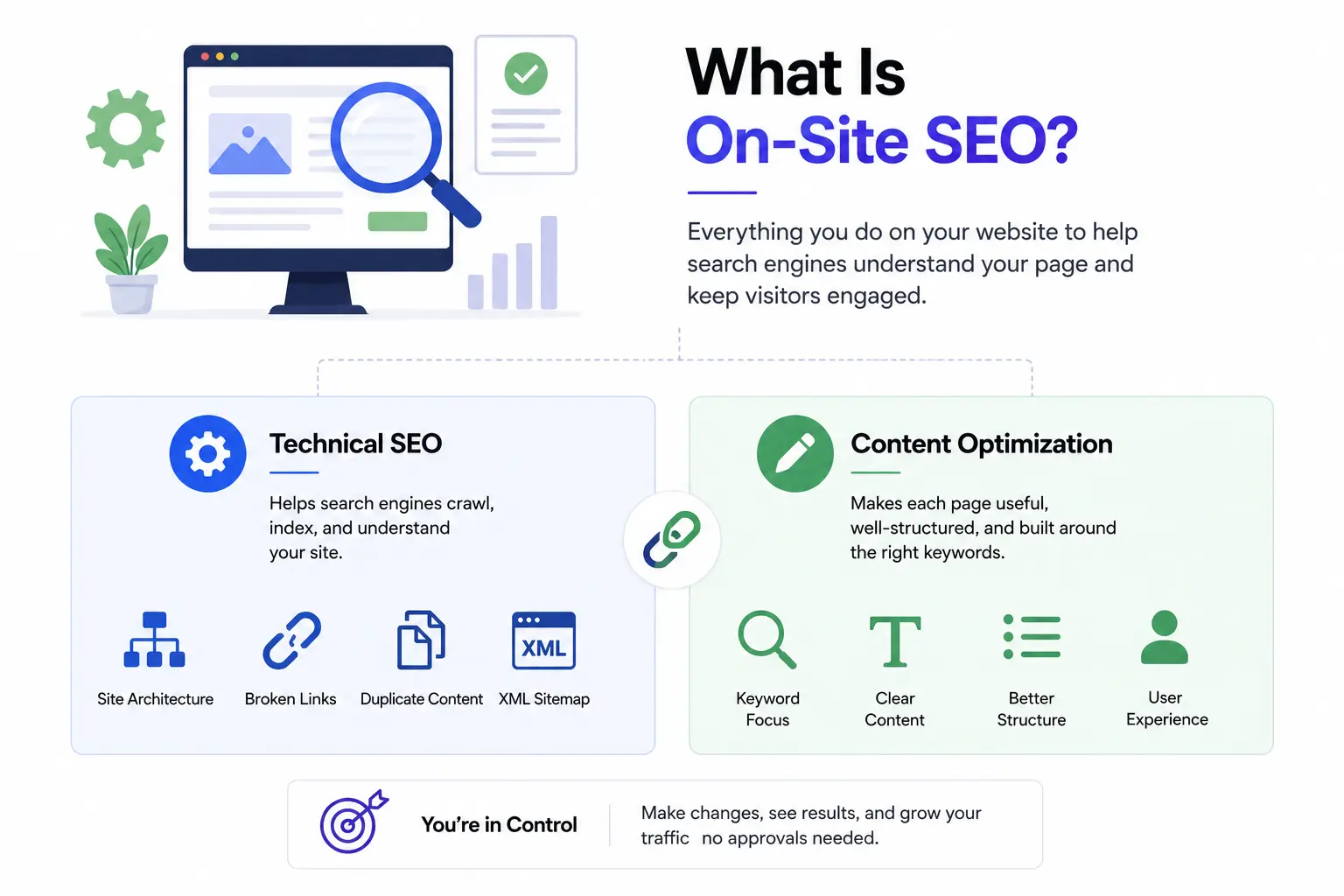
On-site SEO (sometimes called on-page SEO) covers everything you do directly on your own website to help search engines understand what a page is about and help readers actually want to stay on it. Think of it as cleaning your own house before inviting guests over. You’re in full control here nobody else needs to approve the changes you make.
On-site SEO splits into two main areas: technical SEO and content optimization. Technical SEO deals with how well search engines can crawl, index, and understand your site at a structural level things like site architecture, broken links, duplicate content, and XML sitemaps. Content optimization is about making sure each individual page is genuinely useful, well-organized, and built around the keywords your audience is actually typing into Google.
What On-Site SEO Covers
- Content quality: Writing pages that genuinely answer what someone is searching for, not just pages stuffed with keywords.
- Keyword placement: Using your target phrase naturally in the title, headings, intro, and body.
- Internal linking: Connecting related pages so visitors (and search engines) can move through your site easily.
- Page speed: Making sure pages load fast on both desktop and mobile.
- Mobile-friendliness: Ensuring your site looks and works well on phones, since most searches now happen there.
- Meta tags: Writing clear, keyword-aware title tags and meta descriptions that make people want to click.
Who’s in Charge of On-Site SEO?
You are. Every element listed above lives on your domain, which means you can test, tweak, and fix it whenever you want. That’s exactly why SEO experts recommend starting with enterprise SEO solutions before moving on to anything else.
What Is Off-Site SEO?
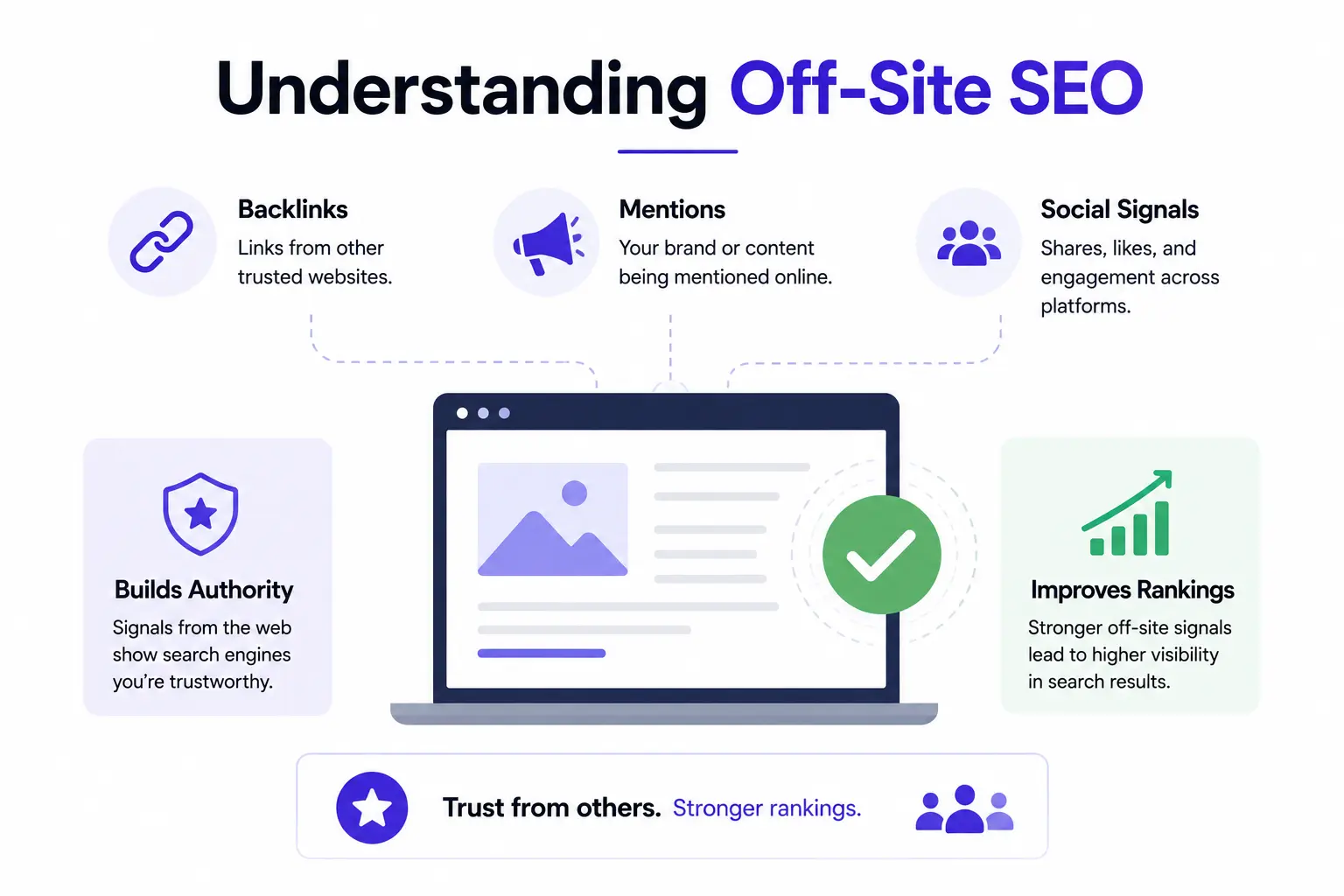
Off-site SEO (also called off-page SEO) is everything that happens away from your website but still influences how search engines view it. If on-site SEO is about cleaning your house, off-site SEO is about getting your neighbors to vouch for you. It’s less about what you say about yourself and more about what other people, sites, and platforms say about you.
Search engines can’t directly measure how trustworthy or authoritative your business is, so they rely on signals from the wider web as a proxy. A backlink from a respected industry publication tells Google that real people consider your content valuable enough to reference. Dozens of those signals stacked together start to paint a picture of authority that no amount of on-page tweaking can replicate on its own.
What Off-Site SEO Covers
- Backlinks: Other websites linking back to your content, which search engines treat as a vote of confidence.
- Guest blogging: Writing content for other sites in your niche in exchange for a link and exposure.
- Social media promotion: Sharing content to build visibility and indirect traffic signals.
- Brand mentions: Being talked about online, even without a direct link.
- Online reviews: Positive reviews on Google, Trustpilot, or industry directories that build trust.
- Influencer collaborations: Getting recognized voices in your industry to reference or recommend your brand.
Who’s in Charge of Off-Site SEO?
Nobody fully is, and that’s the tricky part. You can pitch a guest post or ask for a backlink, but ultimately someone else decides whether to publish it, link to it, or talk about you. That’s what makes off-site SEO and real estate SEO services feel slower and harder to predict than on-site work—you’re relying on other people’s decisions, not just your own
SEO On Site Off Site: Key Differences at a Glance
Here’s a simple side-by-side comparison so you can see exactly where these two strategies overlap and where they pull apart.
| Factor | On-Site SEO | Off-Site SEO |
| Where it happens | On your own website | On other websites and platforms |
| Who controls it | You, completely | Mostly out of your hands |
| Main goal | Help search engines understand your content | Build trust and authority through others |
| Examples | Keywords, meta tags, headings, page speed | Backlinks, social shares, brand mentions, reviews |
| Ranking impact | Determines what you rank for | Determines how high you rank |
| Time to see results | Faster, since you control the changes | Slower, depends on outside validation |
Why You Need Both On-Site and Off-Site SEO Together
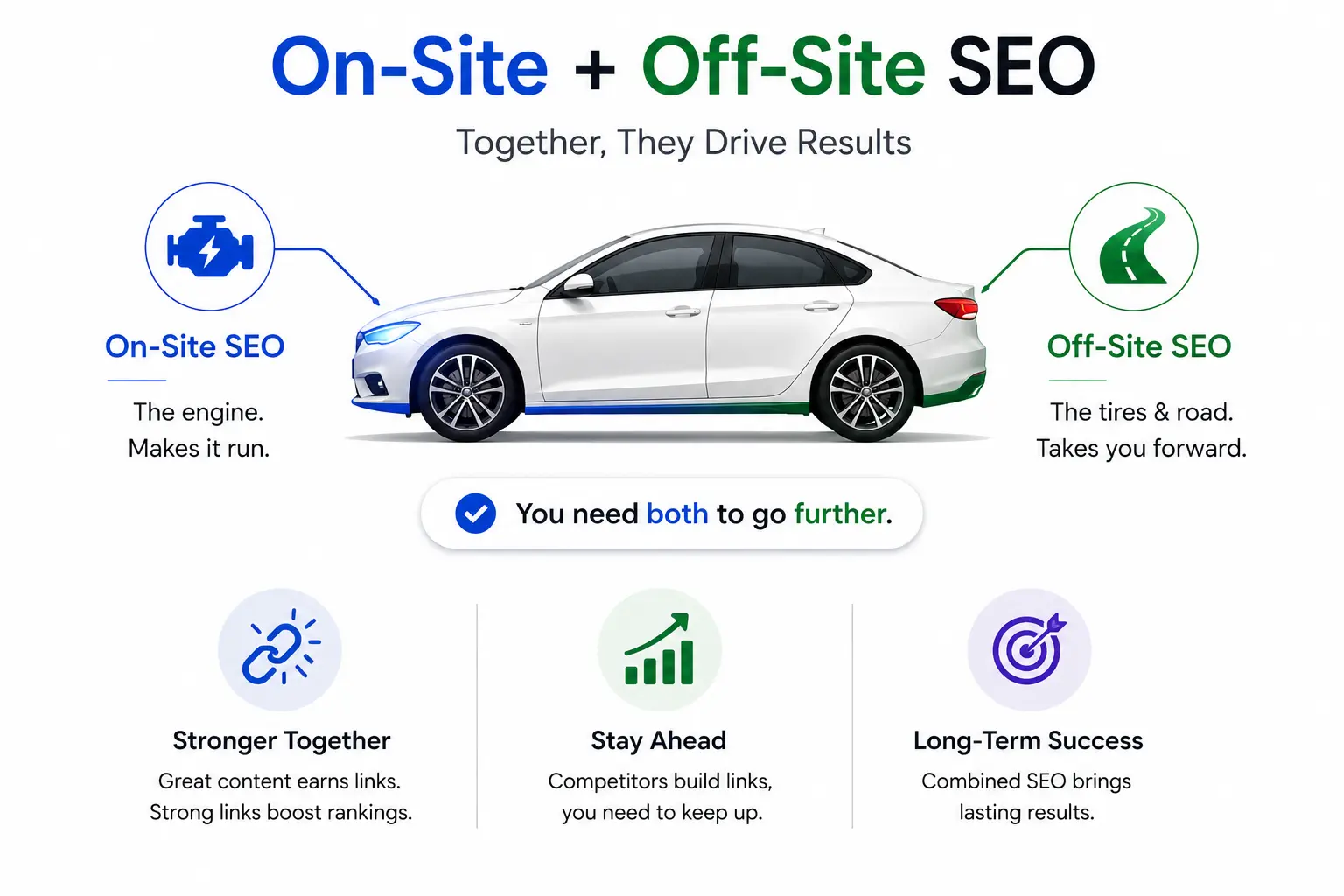
Think of your website like a car. On-site SEO is the engine it’s what actually makes the thing run. Off-site SEO is the tires and the road it’s what lets that engine’s power actually go somewhere. A powerful engine with flat tires goes nowhere. Great tires on a car with no engine don’t move either. You need both working in sync.
This isn’t just a metaphor, either. The two strategies actively feed each other. Strong on-site content gives people a reason to link to you, which builds your off-site authority. And as your off-site authority grows, search engines trust your on-site content more, which helps every page on your site rank better even ones you haven’t actively promoted.
There’s also a competitive angle worth mentioning. If you’re in a low-competition niche, you might be able to rank with on-site optimization alone for a while. But the moment a competitor starts actively building backlinks and brand awareness, your rankings will start slipping even if you haven’t changed a single thing on your own site. SEO isn’t graded on a fixed scale it’s graded relative to everyone else trying to rank for the same keyword.
How E-E-A-T Ties On-Site and Off-Site Work Together
Google evaluates content quality using a framework known as E-E-A-T: Experience, Expertise, Authoritativeness, and Trustworthiness. This concept is a perfect example of why seo on site off site can’t really be separated in practice. Experience and expertise are mostly demonstrated through your on-site content do you write like someone who’s actually done this, or like someone summarizing what they read elsewhere? Authoritativeness and trustworthiness, on the other hand, are largely built off-site, through citations, reviews, mentions, and links from sources Google already trusts.
A page can be packed with accurate, well-written information and still struggle to rank if nothing on the wider web backs up the idea that the author or business actually has authority in that space. This is especially true in industries Google classifies as YMYL Your Money or Your Life like health, finance, and legal content, where off-site trust signals carry even more weight.
On-Site SEO Checklist
Use this as a quick action list whenever you’re optimizing a page.
- Research your target keyword and understand what searchers actually want from it
- Place the keyword naturally in your title, H1, and first 100 words
- Use one H1 and organize the rest of the page with H2s and H3s
- Write a click-worthy meta title and meta description
- Add internal links to relevant pages on your site
- Compress images and check your Core Web Vitals scores
- Make sure the page is fully responsive on mobile devices
- Add schema markup where it applies, like FAQs or reviews
Off-Site SEO Checklist
Once your on-site foundation is solid, work through these off-site tactics.
- Identify relevant sites in your niche for guest posting opportunities
- Reach out for backlinks from sites that already rank for related topics
- Share new content across your social channels consistently
- Monitor and respond to brand mentions, linked or not
- Encourage satisfied customers to leave reviews on Google and relevant directories
- Keep your business name, address, and phone number consistent across listings
- Build relationships with influencers or experts who can reference your work
Common Mistakes to Avoid in Your SEO On Site Off Site Strategy
- Focusing only on one side: Great content with zero backlinks struggles to rank. Tons of backlinks pointing to weak content won’t hold up either.
- Chasing low-quality backlinks: A handful of links from trusted, relevant sites beats hundreds from spammy directories.
- Ignoring page speed and mobile experience: Even the best-written article will lose rankings if it loads slowly or breaks on phones.
- Keyword stuffing: Repeating your focus keyword unnaturally hurts readability and can actually hurt rankings.
- Treating off-site SEO as a one-time task: Backlink building and reputation management need consistent, ongoing effort, not a single campaign and then silence.
How to Balance On-Site and Off-Site SEO for the Best Results
If you’re starting from scratch, fix your on-site foundation first. There’s little point chasing backlinks to a page that’s slow, poorly structured, or doesn’t actually answer the search query. Once your pages are genuinely useful and well-optimized, shift your attention to off-site work outreach, guest posts, and review generation to build the authority that pushes those pages higher.
From there, treat it as an ongoing cycle rather than a one-time project. Publish strong content, promote it, earn links, then use that authority to support your next piece of content. A reasonable rule of thumb many agencies use is roughly 60% of your time and budget on content and technical fixes early on, gradually shifting toward a 50/50 split as your site matures and your link-building pipeline gets going.
Tools That Help With Both Sides
You don’t need a dozen subscriptions to manage seo on site off site work effectively. A handful of tools cover most of what you need on each side.
- Google Search Console: Free, and essential for tracking which on-site pages are indexed, how they’re performing, and where technical issues are surfacing.
- Google PageSpeed Insights: Shows you exactly what’s slowing your pages down and how to fix it.
- Ahrefs or Semrush: Useful for both keyword research on the on-site side and backlink tracking on the off-site side.
- Moz Link Explorer: A solid way to monitor your domain authority and spot new or lost backlinks over time.
- BrightLocal: Helpful for local businesses managing citations, reviews, and NAP consistency across directories.
FAQ
Is on-site or off-site SEO more important?
Neither one wins on its own. On-site SEO determines what you can rank for, while off-site SEO determines how high you actually rank against competitors. Most experts recommend nailing on-site basics first, then layering off-site efforts on top.
Can you rank with only one type of SEO?
It’s possible in low-competition niches, but it’s risky. If your competitors are working on both, relying on just one will eventually leave you behind, especially for competitive keywords.
How long does off-site SEO take to show results?
Off-site SEO is slower than on-site changes since it depends on other people linking to or mentioning you. Most sites start seeing meaningful movement after a few months of consistent outreach and content promotion.
What’s the difference between on-page and on-site SEO?
These terms are often used interchangeably. Technically, on-page SEO refers to individual page elements like headers and keywords, while on-site SEO is the broader term covering your entire website, including technical factors like site speed and structure.
Conclusion
At the end of the day, seo on site off site isn’t a choice between two competing strategies it’s one connected system. On-site work builds the foundation search engines and readers can trust, while off-site work proves to the rest of the internet that your content deserves attention. Start by auditing your own pages, fix what’s holding you back, and then put real effort into earning recognition beyond your website. Do both consistently, and ranking higher stops feeling like guesswork.