Search has changed dramatically in recent years. People are no longer relying only on traditional search engines and blue links. Instead, they ask AI tools like ChatGPT, Perplexity, and Claude for answers, recommendations, and comparisons. In these moments, a brand is either included in the AI-generated response or completely absent.
This shift has created the need for AI Strategic Visibility -the practice of ensuring your brand, content, and expertise appear in AI-generated answers and recommendations. While traditional SEO still plays an important role, rankings alone are no longer enough. Businesses must now optimize not only for search engines but also for the AI systems that people increasingly rely on for information and decisions.
What Is AI Strategic Visibility?
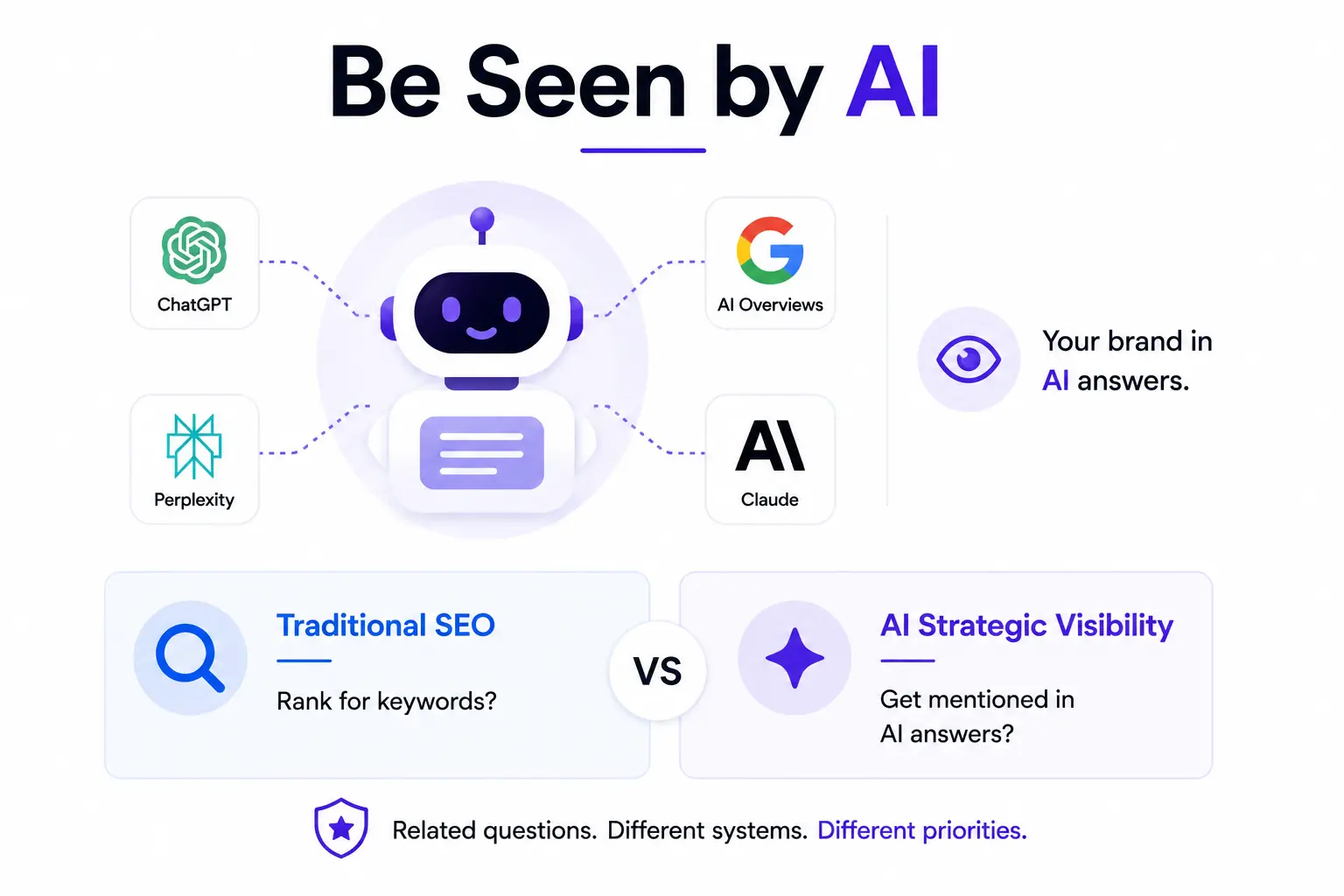
AI Strategic Visibility is the measurable presence a brand, person, or website has within AI-generated answers, summaries, and recommendations across platforms such as ChatGPT, Google AI Overviews, Perplexity, and Claude. It reflects how often, how accurately, and how favorably an AI system references your content when responding to questions in your industry.
Where traditional SEO asks, “Does my page rank for this keyword?”, AI Strategic Visibility asks, “Does my brand get mentioned when someone asks an AI this question?” Those are related questions, but they are answered by different systems with different priorities.
Why AI Strategic Visibility Matters
AI-generated answers are increasingly the first and sometimes only touchpoint a potential customer has with information about a topic. If an AI system answers a question without ever surfacing your brand, you lose the opportunity to be considered, regardless of how well you would have served that customer. Visibility inside AI answers has become a new top-of-funnel, and brands that ignore it are ceding that space to competitors who do not.
There is also a credibility effect. Being cited by an AI system carries an implicit endorsement. The AI model effectively says, “This source is trustworthy enough to base part of my answer on.” That endorsement can do more for brand trust than a standard search ranking, because it appears to the user as the AI’s own synthesized judgment rather than a paid or algorithmic placement.
How AI Search Has Changed Online Visibility
Search used to be a single channel with a single ranking algorithm to optimize for. Today, visibility is fragmented across multiple AI systems, each with its own retrieval method, training data, and citation logic. Google AI Overviews pulls from the live web index. ChatGPT blends training data with real-time browsing and plugin data. Perplexity is built around real-time citation by design. Claude draws on context, retrieved documents, and a strong preference for well-structured, verifiable information.
This fragmentation means a single-channel SEO strategy is no longer sufficient. A brand can be highly visible in Google’s traditional results and almost invisible in ChatGPT’s answers, or vice versa, depending on how its content is structured, how clearly it establishes entities, and how often other authoritative sources reference it. AEO tools for AI search help businesses measure and improve their visibility across these AI-driven platforms, ensuring their content is optimized for both traditional search engines and AI-generated answers.
Examples of AI Strategic Visibility in Action
Consider a SaaS development company that publishes an original benchmark study on customer churn rates by industry. That data point gets picked up by an industry blog, cited in a LinkedIn post by an analyst, and referenced in a roundup article.
Months later, when someone asks ChatGPT, “What is a typical SaaS churn rate?”, there is a meaningfully higher chance that company’s name appears in the answer, because the data point has propagated across multiple sources the AI model considers credible.
Compare that to a company that publishes the same statistic without sourcing, without a dedicated page explaining its methodology, and without any third party referencing it. Even if the number is accurate, the AI system has far less reason to trust it or attribute it to that brand. This is the practical difference AI Strategic Visibility describes: the same information, with different structural and authority signals, produces very different outcomes inside AI-generated answers. Organizations developing AI-powered products can also use AI development services to build systems that support data analysis, content generation, and other AI-driven workflows.
AI Strategic Visibility vs Traditional SEO
What Traditional SEO Focuses On
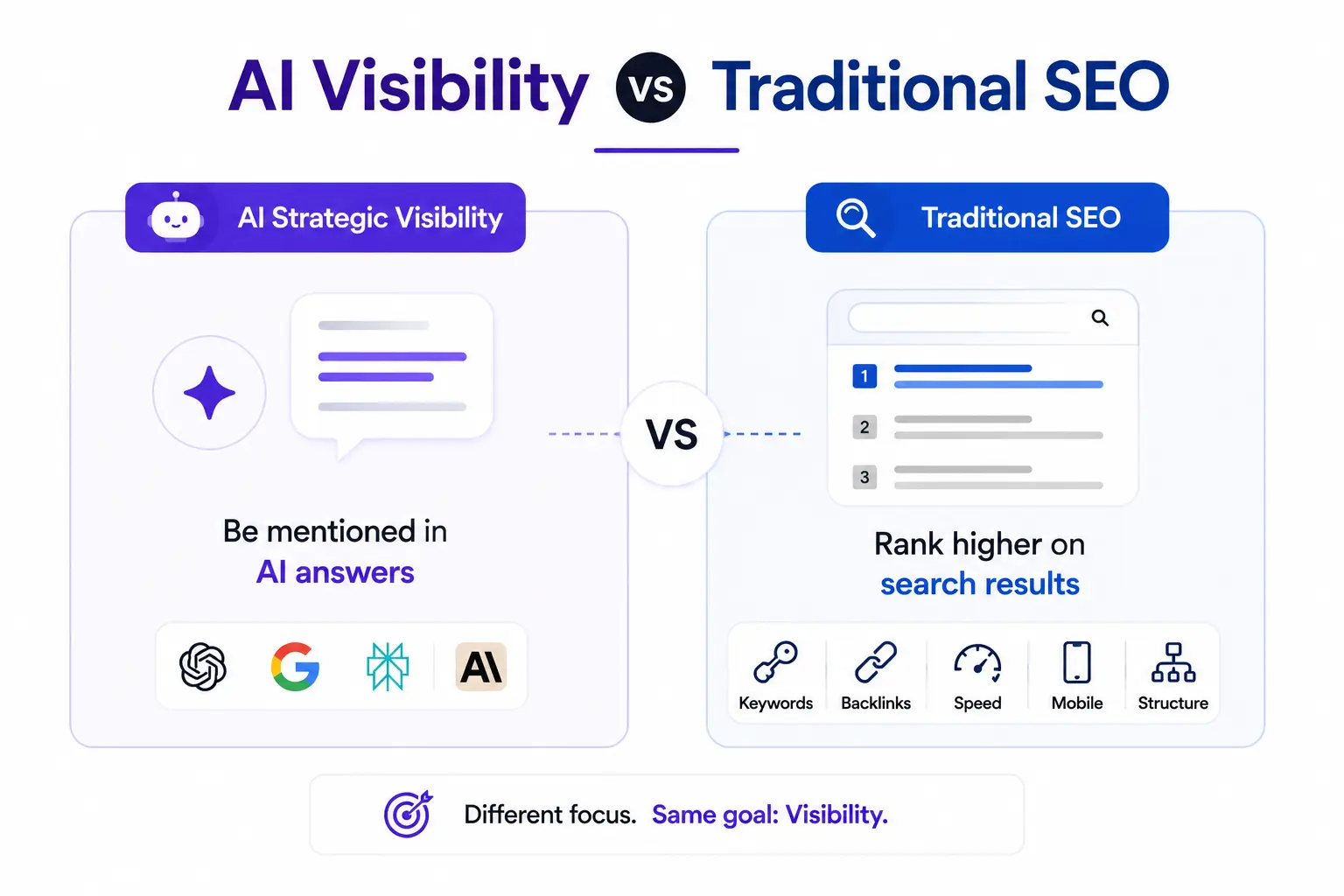
Traditional SEO is built around ranking signals: keyword targeting, backlink volume and quality, page speed, mobile usability, internal linking structure, and on-page optimization. The objective is to rank as high as possible on a search engine results page for a defined set of queries, with success measured primarily through rankings, organic traffic, and click-through rate.
What AI Strategic Visibility Focuses On
AI Strategic Visibility is built around trust and retrieval signals: topical authority, entity clarity, EEAT (Experience, Expertise, Authoritativeness, Trustworthiness), structured and citable content, and third-party validation. The objective is to be selected as a source within an AI-generated answer, with success measured through citation rate, mention frequency, and AI share of voice rather than rankings alone.
SEO vs GEO vs AEO vs LLMO
These four acronyms describe overlapping but distinct disciplines, and the terminology is still settling across the industry:
- SEO (Search Engine Optimization): optimizing for rankings on traditional search engine results pages.
- GEO (Generative Engine Optimization): optimizing content to be retrieved and cited by generative AI systems such as ChatGPT and Google AI Overviews.
- AEO (Answer Engine Optimization): optimizing content to directly answer specific questions, often for voice assistants and featured snippets as well as AI answers.
- LLMO (Large Language Model Optimization): optimizing a brand’s presence and accuracy within the training data and retrieval sources large language models draw from.
AI Strategic Visibility functions as the umbrella strategy that ties GEO, AEO, and LLMO together into a single, coordinated approach, rather than treating each as a separate, siloed effort.
Key Differences Explained
Rankings vs Citations
A ranking tells you where a page sits on a results page. A citation tells you whether an AI system chose to reference that page when constructing an answer. A page can rank on page one of Google and never be cited inside an AI Overview for the exact same query, because citation selection involves additional trust and clarity signals beyond ranking position.
Keywords vs Entities
Traditional SEO is organized around keywords and search intent. AI Strategic Visibility is organized around entities: clearly defined people, organizations, products, and concepts that an AI system can recognize, disambiguate, and connect to other entities in its knowledge graph. Strong entity definition helps an AI system understand exactly who you are and what you are an authority on, independent of which exact keywords you used.
Search Results vs AI Answers
A search result is a list of options the user evaluates themselves. An AI answer is a synthesized response the user often accepts directly, without clicking through to the source. This changes the incentive: AI Strategic Visibility is not just about earning a click, it is about earning a mention inside the answer itself, since many users may never visit the underlying website at all.
How AI Search Engines Discover and Recommend Content
How ChatGPT Finds Information
ChatGPT draws on a combination of its training data and, when browsing or plugin access is enabled, real-time web retrieval. For training data, the model’s familiarity with a brand depends on how frequently and how clearly that brand appeared across the web at the time of training. For live browsing, ChatGPT performs retrieval similar to a search engine, then synthesizes an answer from the pages it retrieves, favoring sources that are clear, well-structured, and directly responsive to the query.
How Google AI Overviews Select Sources
Google AI Overviews are generated using Google’s existing search index combined with generative summarization. Sources that already rank well and demonstrate strong EEAT signals are more likely to be pulled into an Overview, but ranking well is not a guarantee of inclusion. Google appears to favor content that directly and concisely answers the implied question, often pulling specific passages rather than entire pages.
How Perplexity AI Generates Answers
Perplexity is built around citation-first design. Every answer is constructed from a set of retrieved sources, each displayed as a numbered citation alongside the response. Perplexity tends to favor recent, authoritative, and topically focused content, and it is one of the more transparent platforms for understanding exactly which sources influenced a given answer.
How Claude Uses Information
Claude generates answers using a combination of its training data and, where available, retrieved documents or web search results provided in the context of a conversation. Claude places significant weight on internal consistency, clear sourcing, and verifiable claims, and is generally cautious about presenting unsourced or ambiguous information as fact.
Retrieval-Augmented Generation (RAG)
Retrieval-Augmented Generation is the technical process many AI systems use to pull relevant external documents into a model’s context before generating a response. Instead of relying solely on what the model learned during training, RAG allows the system to retrieve current, specific information and ground its answer in that retrieved content. This is the mechanism that makes well-structured, clearly written, and easily extractable content more likely to be surfaced, regardless of how memorable the brand is in the model’s training data alone.
Authority Signals
AI systems, like search engines, look for signals that a source can be trusted: consistent publishing history, clear authorship, citations from other reputable sources, accurate and verifiable claims, and alignment with established expertise in a subject area. These signals function similarly to backlinks in traditional SEO, but they are evaluated more holistically and are harder to manufacture artificially.
Citation Selection Process
When an AI system selects which sources to cite, it is generally balancing relevance to the query, clarity of the content, perceived authority of the source, and how directly the content answers the underlying question. Content that buries the answer under unnecessary preamble, or that mixes multiple unrelated topics, is less likely to be selected than content that states its answer clearly and supports it with specific, well-organized detail.
Why AI Strategic Visibility Is Important for Businesses
Increased Brand Exposure
Every time an AI system mentions your brand in response to a relevant question, you gain exposure to someone actively seeking information in your category. Because this exposure happens at the moment of inquiry, it tends to reach people earlier in their decision process than a traditional ad or even a standard search result might.
Higher Trust and Credibility
Users tend to treat AI-generated answers as relatively neutral and authoritative, more like a knowledgeable assistant than a list of paid placements. A brand mentioned inside that answer benefits from an implicit transfer of trust: the AI vouched for it, even indirectly, by choosing to include it.
More Qualified Traffic
When an AI system does drive a click through to your site, often through a citation link, that visitor arrives already primed with context from the AI’s answer. They understand roughly what your brand does and why it was mentioned, which tends to produce more qualified, higher-intent traffic than a cold search click.
Better Competitive Advantage
Most brands have not yet adapted their content and entity strategy for AI visibility. Investing in this discipline now, while competitors are still focused exclusively on traditional rankings, creates an advantage that compounds as AI search adoption grows.
Future-Proofing Your Marketing Strategy
As more consumer research and decision-making shifts toward conversational AI tools, brands that have already built strong entity clarity, authority signals, and citation-worthy content will be far better positioned than those starting from zero once the shift becomes impossible to ignore.
The A.I.M. Framework for AI Strategic Visibility
The A.I.M. Framework distills AI Strategic Visibility into three pillars that are easy to plan around and easy to audit against: Authority, Identity, and Mentions. Each pillar addresses a different question an AI system implicitly asks before it decides to cite a source.
A – Authority
Authority answers the question, “Does this source actually know what it is talking about?” It is built through depth of content, demonstrated expertise, and original contribution to a subject area.
Building Topical Authority
Topical authority is established by publishing comprehensive, interconnected content across an entire subject area rather than isolated articles targeting individual keywords. A site with twenty thin pages on loosely related topics will generally carry less topical authority than a site with eight thorough, well-linked pages that fully cover a single subject from multiple angles.
Demonstrating EEAT
EEAT stands for Experience, Expertise, Authoritativeness, and Trustworthiness, a framework Google uses to evaluate content quality that has become equally relevant to AI citation decisions. Demonstrating EEAT means showing real, first-hand experience with a topic, clear author credentials, recognition from other authoritative sources, and accurate, well-maintained information.
Publishing Original Research
Original data, surveys, and proprietary research are some of the strongest authority signals available, because they cannot be copied from a competitor and they give other sites and AI systems a specific, citable reason to reference your brand by name.
I – Identity
Identity answers the question, “Does the AI system clearly understand who or what this source is?” It is built through entity clarity and consistency, not just keyword targeting.
Entity SEO
Entity SEO is the practice of clearly defining your brand, products, and key personnel as distinct entities that can be recognized, disambiguated, and connected to related concepts. This includes consistent naming, clear “about” information, and structured data that explicitly tells search engines and AI systems who you are.
Knowledge Graph Optimization
Knowledge graphs are the structured databases search engines and AI systems use to understand relationships between entities. Optimizing for the knowledge graph means ensuring your brand has a presence on platforms that feed these graphs, such as Wikipedia, Wikidata, and major business directories, with accurate and consistent information.
Brand Consistency Across Platforms
Inconsistent brand names, descriptions, or details across your website, social profiles, and third-party listings make it harder for an AI system to confidently identify your brand as a single, coherent entity. Consistency across every platform where your brand appears strengthens identity signals significantly.
M – Mentions
Mentions answer the question, “Do other credible sources talk about this brand?” It is built through earned visibility on other websites, not just your own.
Digital PR
Digital PR campaigns that earn coverage on industry publications, news sites, and respected blogs create exactly the kind of third-party validation AI systems look for when assessing whether a brand is a credible source worth citing.
Third-Party Citations
Every time another website references your brand, your data, or your expertise, it strengthens the signal that your brand is a recognized authority in its space, which in turn increases the likelihood that an AI system will treat your brand the same way.
Industry References and Reviews
Being referenced in “best of” lists, comparison articles, and review platforms adds another layer of third-party validation, particularly for AI systems that weigh aggregated sentiment and consensus when deciding which brands to recommend.
The Core Pillars of AI Strategic Visibility
Beyond the A.I.M. Framework, it helps to think of AI Strategic Visibility as resting on five interconnected pillars. Strength in one pillar can partially offset a weakness in another, but the strongest AI visibility profiles tend to perform reasonably well across all five.
Content Authority
The depth, accuracy, and comprehensiveness of the content itself. This is the foundation every other pillar builds on, since an AI system has nothing to cite if the underlying content does not exist or does not adequately answer the question.
Entity Authority
How clearly and consistently your brand, products, and key people are defined as recognizable entities across the web and within structured data.
Brand Authority
The overall reputation and recognition your brand carries, shaped by customer sentiment, review consistency, and general market presence.
Technical Authority
The technical foundation that allows AI systems and crawlers to access, parse, and understand your content efficiently, including site structure, schema markup, and crawlability.
Citation Authority
The volume and quality of third-party references to your brand and content, which compounds over time and is one of the hardest pillars for competitors to quickly replicate.
12 Proven Strategies to Improve AI Strategic Visibility
1. Build Topical Authority Around Core Subjects
Choose a small number of core subject areas that align with your business, then build out comprehensive content clusters covering every meaningful subtopic, question, and angle within those subjects. Depth and interconnection matter more than sheer volume.
2. Create Comprehensive Answer-Focused Content
Structure content so the direct answer to a likely question appears clearly and early, ideally within the first few sentences of a section, before expanding into supporting detail. AI systems consistently favor content that answers efficiently over content that makes the reader work to find the point.
3. Optimize for Entity SEO
Use consistent naming for your brand, products, and key personnel across your site and all external profiles. Add clear “about” and “author” information, and use structured data to explicitly define these entities for search engines and AI systems.
4. Strengthen EEAT Signals
Showcase real experience and credentials throughout your content. Include author bios, cite credible sources for claims, keep information current, and be transparent about methodology when presenting data or recommendations.
5. Use Structured Data and Schema Markup
Implement schema types such as Organization, Person, Article, FAQ, and Product where relevant. Structured data gives AI systems an explicit, machine-readable layer of meaning that reduces ambiguity about what your content represents.
6. Publish Original Data and Research
Original surveys, benchmark studies, and proprietary datasets are highly citable because they cannot be found anywhere else. Even a modest, well-documented internal dataset can become a meaningful visibility asset if no one else has published similar numbers.
7. Earn Mentions From Authoritative Websites
Pursue digital PR, guest contributions, and expert commentary opportunities on respected industry sites. Each earned mention adds to the web of third-party validation that AI systems use to assess credibility.
8. Improve Internal Linking
Strong internal linking helps both crawlers and AI retrieval systems understand the relationships between your content and reinforces topical authority by clearly connecting related subtopics back to pillar content.
9. Create AI-Friendly Content Structures
Use clear headings, short paragraphs, well-labeled lists, and direct language. Avoid burying key facts inside dense paragraphs or requiring multiple steps of inference to extract a simple answer.
10. Build a Strong Brand Presence Across the Web
Maintain active, consistent, and accurate profiles across relevant directories, review platforms, and social channels. A fragmented or outdated presence makes it harder for AI systems to confirm who you are and what you do.
11. Optimize for AI Citations
Make your most citable facts, statistics, and definitions easy to extract in isolation. A clearly stated, self-contained sentence is far more likely to be lifted into an AI answer than a fact that only makes sense in the context of surrounding paragraphs.
12. Monitor AI Visibility Performance
Regularly check how your brand appears across AI platforms for your core topics, track changes over time, and adjust your content and entity strategy based on what you observe. AI visibility is not a one-time project; it requires ongoing measurement.
Entity SEO and Knowledge Graph Optimization
What Is Entity SEO?
Entity SEO is the practice of helping search engines and AI systems understand your brand, products, and key people as distinct, well-defined entities, rather than just a collection of keywords and pages. An entity has a clear name, a clear set of attributes, and clear relationships to other entities.
Why Entities Matter for AI Search
AI systems reason in terms of entities and their relationships far more than they reason in terms of exact keyword matches. A clearly defined entity is easier for an AI model to recognize, disambiguate from similarly named competitors, and confidently reference by name in a generated answer.
Building Entity Relationships
Strengthen entity relationships by consistently linking your brand to the categories, products, and concepts it is associated with, both within your own site structure and through how other sites describe and reference you.
Improving Knowledge Graph Presence
A presence in major structured knowledge sources, paired with consistent structured data on your own site, significantly improves how confidently AI systems can place your brand within their internal understanding of your industry.
Organization Schema
Organization schema explicitly defines your company name, logo, contact information, and social profiles in a machine-readable format, reducing ambiguity about your brand’s basic identity.
Author Schema
Author schema connects specific pieces of content to named individuals with defined credentials, reinforcing the experience and expertise components of EEAT at the content level.
SameAs Properties
The sameAs schema property links your entity to its profiles on other platforms, such as LinkedIn, Wikipedia, or Crunchbase, helping search engines and AI systems confirm that all of these profiles refer to the same real-world entity.
Structured Entity Signals
Beyond formal schema, structured entity signals include consistent business descriptions, consistent categorization, and clear disambiguation language anywhere your brand name could be confused with a similarly named entity.
How to Get Cited by AI Systems
What Makes AI Systems Cite a Source?
AI systems tend to cite sources that directly and clearly answer the underlying question, demonstrate credible authority on the topic, and present information in a structure that is easy to extract and attribute accurately.
Content Characteristics That Increase Citations
- Clear, direct answers stated early in a section
- Specific data points, statistics, and dates rather than vague generalizations
- Well-organized headings that map closely to likely user questions
- Transparent sourcing and methodology for any claims or data
- Regularly updated content that reflects current information
Authority Signals AI Models Trust
- Consistent publishing history on a clearly defined subject area
- Recognizable author credentials and expertise
- Citations and mentions from other authoritative sources
- Accurate, verifiable claims with no history of correction or controversy
Common Reasons AI Ignores Content
- The content is too thin or generic to add meaningful value over other sources
- Key facts are buried in dense paragraphs rather than stated clearly
- The brand or author entity is ambiguous or inconsistently represented
- The content is outdated and contradicted by more recent sources
- There is no third-party validation supporting the claims made
AI Strategic Visibility Audit: Step-by-Step Process
Evaluate Current AI Visibility
Start by asking the major AI platforms, ChatGPT, Google AI Overviews, Perplexity, and Claude, a representative set of questions your target customers would realistically ask. Record whether your brand appears, how it is described, and whether the information is accurate.
Analyze Competitor Presence
Run the same set of questions and note which competitors appear, how frequently, and what sources the AI systems appear to be drawing from. This reveals which competitors have already built strong AI visibility and which content or entity gaps they are exploiting.
Test Brand Mentions Across AI Platforms
Beyond product or category questions, directly ask AI systems what they know about your brand specifically. Look for inaccuracies, outdated information, or missing context that could be undermining your visibility.
Identify Content and Entity Gaps
Compare the questions where your brand is absent against your existing content library. In most cases, you will find clear gaps: questions with no corresponding page, or pages that exist but fail to clearly and directly answer the question.
Create an Optimization Roadmap
Prioritize gaps based on business impact and feasibility, then build a content and entity optimization plan that addresses the highest-impact gaps first, rather than attempting to fix everything simultaneously.
AI Visibility Audit Checklist
- List of core topics and representative questions tested across each AI platform
- Documented brand mention frequency and accuracy for each platform
- Competitor presence and source analysis for the same question set
- Identified content gaps mapped to specific questions or topics
- Entity consistency review across website, schema, and third-party profiles
- Prioritized roadmap of content and technical fixes
Measuring AI Strategic Visibility
Measuring AI Strategic Visibility requires a different set of metrics than traditional SEO reporting. The following five metrics provide a practical starting framework.
AI Citation Rate
The percentage of relevant test questions where an AI system directly cites or links to your content as a source. This is the most direct measure of whether your content is being selected as a reference.
AI Mention Frequency
How often your brand name appears in AI-generated answers across a representative set of questions, regardless of whether a direct citation link is included. A brand can be mentioned by name without a formal citation, particularly on platforms like ChatGPT that do not always display source links.
AI Share of Voice
The proportion of AI answers in your category that mention your brand compared to how often competitors are mentioned for the same set of questions. This metric contextualizes your visibility relative to the competitive landscape rather than in isolation.
Brand Visibility Score
A composite score, often calculated by dedicated AI visibility tools, that combines citation rate, mention frequency, and sentiment into a single trackable number over time.
Prompt Coverage Analysis
An assessment of how many of the realistic questions your target customers would ask are actually being answered with your brand present, revealing where coverage gaps remain even if overall visibility looks strong on paper.
Best Tools for AI Strategic Visibility
The tools below span traditional SEO platforms that remain foundational, and newer, purpose-built tools designed specifically for tracking AI visibility.
| Tool | Best For | Notes |
| Google Search Console | Tracking impressions and queries, including some AI Overview visibility data | Free, first-party data direct from Google |
| Ahrefs | Backlink analysis, content gap research, topical authority mapping | Strong for identifying citation and mention opportunities |
| Semrush | Keyword research, competitor analysis, content auditing | Useful for combining traditional SEO and AI visibility workflows |
| Profound | Dedicated AI search visibility tracking across major AI platforms | Purpose-built for monitoring brand mentions in AI answers |
| Peec AI | Monitoring brand and competitor presence in generative AI answers | Focused specifically on generative engine optimization tracking |
| Rankller (AI Visibility & SEO Audits) | End-to-end AI visibility and SEO auditing for brands and agencies | Combines traditional SEO audits with AI Strategic Visibility analysis |
Common AI Strategic Visibility Mistakes
Focusing Only on Rankings
Treating traditional search rankings as the only success metric leads brands to overlook the separate, and increasingly important, discipline of AI citation and mention tracking.
Ignoring Entity SEO
Without clear entity definition, an AI system may struggle to disambiguate your brand from similarly named competitors, or may simply default to more clearly defined sources even when your content is equally relevant.
Weak EEAT Signals
Content without clear authorship, sourcing, or demonstrated experience is easy for AI systems to deprioritize in favor of sources that more clearly establish trustworthiness.
Publishing Thin Content
Short, generic content that does not meaningfully add to what is already available online gives an AI system little reason to select it over a more comprehensive competing source.
Lack of Brand Mentions
A brand with no third-party validation, no press coverage, and no industry references is starting from a significant disadvantage relative to competitors who have built that validation over time.
Not Tracking AI Visibility Metrics
Without regular measurement, it is impossible to know whether AI visibility efforts are working, declining, or being outpaced by competitors who are actively monitoring their own presence.
AI Strategic Visibility Best Practices
Prioritize Expertise and Authority
Invest in content created or reviewed by genuine subject matter experts, and make that expertise visible through clear author credentials and demonstrated experience.
Maintain Consistent Brand Information
Audit your brand name, description, and key details across your website, schema markup, and every third-party platform where your brand appears, and correct any inconsistencies you find.
Regularly Update Content
Revisit and refresh core content on a consistent schedule, since outdated information is one of the clearest reasons an AI system will favor a more recently updated competing source.
Invest in Digital PR
Build relationships with industry publications and pursue earned coverage consistently, rather than treating PR as a one-time campaign tied to a single launch.
Create Content for Humans First
Content written primarily to satisfy an algorithm, rather than to genuinely help a human reader, tends to perform poorly on both traditional rankings and AI citation over time. Writing for genuine usefulness remains the most durable strategy.
The Future of AI Strategic Visibility
AI Agents and Agentic Search
As AI agents increasingly take actions on behalf of users, such as comparing products, booking services, or completing purchases, brand visibility will extend beyond being mentioned in an answer to being selected as the actual choice an agent makes. Optimizing for agentic decision-making is likely to become an extension of today’s AI Strategic Visibility practices.
Personalized AI Recommendations
AI systems are likely to become more personalized over time, weighing a user’s history and preferences alongside general authority signals. Brands that serve clearly defined audience segments well may find this shift favors specificity and relevance over broad, generic appeal.
The Evolution of GEO
Generative Engine Optimization is still a young and rapidly evolving discipline. Expect best practices, measurement tools, and platform behaviors to continue shifting meaningfully over the next several years as adoption deepens.
What Marketers Should Prepare for Next
Marketers should expect AI visibility to become a standard line item in marketing strategy and reporting, similar to how SEO became standard over the past two decades. Building the foundational entity clarity, authority, and content infrastructure now will make that transition significantly easier.
Frequently Asked Questions About AI Strategic Visibility
What is AI Strategic Visibility?
AI Strategic Visibility is the practice of making a brand’s content, expertise, and entity presence discoverable and citable by AI systems such as ChatGPT, Google AI Overviews, Perplexity, and Claude, so that the brand appears within AI-generated answers and recommendations.
How is AI Strategic Visibility different from SEO?
Traditional SEO optimizes primarily for rankings on search engine results pages, while AI Strategic Visibility optimizes for being selected as a trusted source within AI-generated answers, which depends more heavily on entity clarity, authority signals, and content structure than on keyword targeting alone.
What is GEO in AI search?
GEO, or Generative Engine Optimization, refers specifically to optimizing content so that generative AI systems are more likely to retrieve and cite it when constructing answers. It is one component of the broader AI Strategic Visibility discipline.
How can brands appear in ChatGPT answers?
Brands improve their odds of appearing in ChatGPT answers by building strong topical authority, maintaining clear and consistent entity information, publishing well-structured and directly responsive content, and earning third-party mentions and citations across the web.
Does schema markup improve AI visibility?
Schema markup helps by explicitly defining entities, authors, and content types in a machine-readable format, which reduces ambiguity for both search engines and AI systems. It supports AI visibility but is most effective when paired with genuinely strong, authoritative content.
How do AI systems choose sources?
AI systems generally weigh relevance to the query, clarity and directness of the content’s answer, demonstrated authority and trustworthiness of the source, and how well the content’s structure allows for accurate extraction and attribution.
How do you measure AI visibility?
AI visibility is commonly measured using metrics such as AI citation rate, AI mention frequency, AI share of voice relative to competitors, a composite brand visibility score, and prompt coverage analysis across a representative set of customer questions.
What tools help improve AI Strategic Visibility?
Useful tools include traditional SEO platforms such as Google Search Console, Ahrefs, and Semrush, alongside purpose-built AI visibility tools such as Profound, Peec AI, and Rankller’s AI Visibility and SEO Audits.
What is AI Share of Voice?
AI Share of Voice is the proportion of AI-generated answers in a given category that mention your brand, compared to how often competitors are mentioned for the same set of representative questions.
Is AI Strategic Visibility important for small businesses?
Yes. Small businesses often have an opportunity to build strong topical authority within a narrow niche faster than larger competitors with broader, less focused content libraries, making AI Strategic Visibility a particularly accessible growth lever for smaller, specialized brands.
Conclusion
AI Strategic Visibility is not a replacement for SEO, it’s the next layer built on top of it. For years, success online meant ranking higher than the competition, but that’s no longer enough on its own, because the brands winning attention today are the ones AI systems trust enough to mention by name when someone asks a question in their industry. Treating AI citation and traditional rankings as two sides of the same visibility strategy, rather than choosing one over the other, is what will separate the brands that stay visible as AI search adoption grows from the ones who get left out of the conversation entirely.