
We dive deep under the hood of your website to identify, isolate, and resolve severe configuration errors, broken redirect chains, and schema defects that hinder search engine indexation.
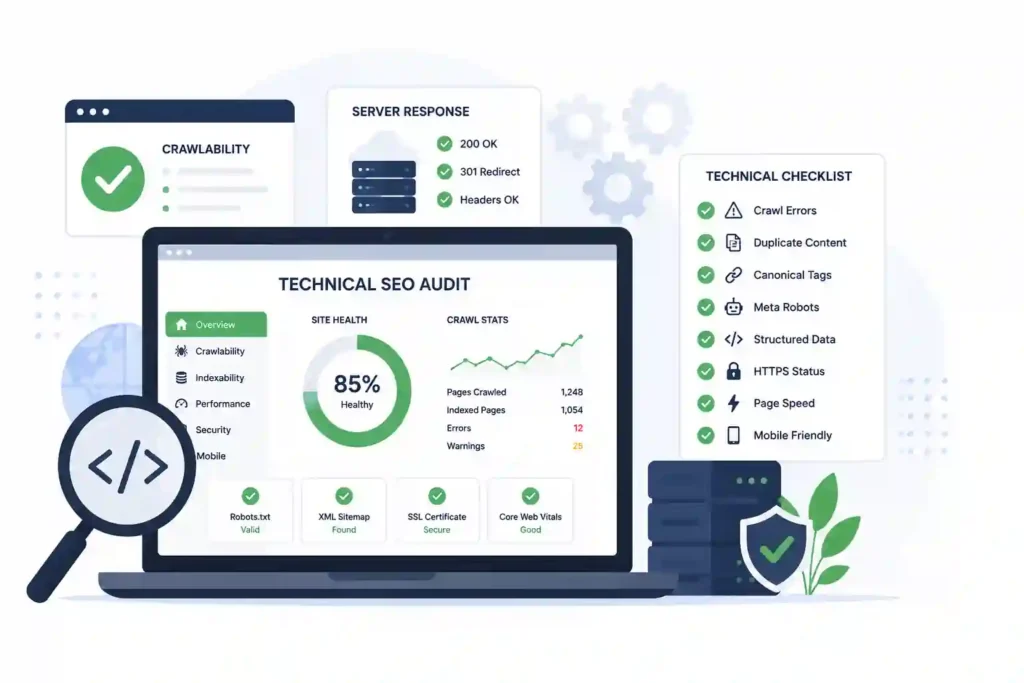
We combine intensive source-code interrogation with server-side validation to build a resilient structural foundation. By analyzing how machines interact with your backend scripts, server headers, and data layers, we transform fragile setups into elite technical assets optimized for Google’s indexing systems.
Deeply analyze website structure to fix indexing issues.
Discover keyword gaps and optimize content for traffic.
Eliminate performance bottlenecks to maximize core web vitals.
Audit reading structures and eliminate duplicate content risks.
Export enterprise-ready reports with actionable search data insights.
Instantly test domain health, detect technical errors, and boost performance.
Inspect meta titles, descriptions, and social tags to eliminate truncation and boost CTR.
Technical SEO focuses on optimizing your website’s backend infrastructure-like server settings, sitemaps, and code-to help search engine spiders crawl and index your site efficiently.
A redirect chain occurs when a user or bot requests a URL that points to another redirect, which then points to another. These waste your crawl budget and slow down page loading times.
Schema markup provides explicit clues about the meaning of a page to search engines. Adding it helps search bots understand your entities, which can earn your site eye-catching rich snippets in search results.
A 500 error means something went wrong on your website’s hosting server, but the server couldn't be more specific. Frequent 500 errors turn away search engines and drop your rankings.
Hreflang tags tell search engines which language and regional targeting you are using for a specific page, ensuring users see the correct localized version of your site.
Mixed content happens when secure HTTPS pages try to load files (like images or scripts) over insecure HTTP connections. This creates security risks and hurts your search rankings.
Server logs provide the only definitive record of exactly which pages search engine bots are visiting, how often they crawl, and where they run into technical errors.
A 301 redirect signals a permanent address change and passes full ranking authority to the new URL. A 302 redirect is temporary and does not pass search equity.
A soft 404 occurs when a page tells a user it no longer exists but returns a successful 200 status code to search engines, which wastes your crawl budget.
You must prune your sitemap by removing broken pages (404s), redirected URLs (301s), and pages blocked by noindex tags, leaving only high-value, crawlable links.
Canonicalization is the technical practice of picking the best master URL when you have multiple pages with very similar content, preventing duplicate content confusion.
Yes. If your server response times are slow or face intermittent downtime, search bots will throttle their crawl rates, leading to delayed indexing and lower visibility.