
We isolate hidden script bloat, rendering blockages, and layout shifts to build lightning-fast web experiences that delight real users and instantly fulfill Google’s performance algorithms
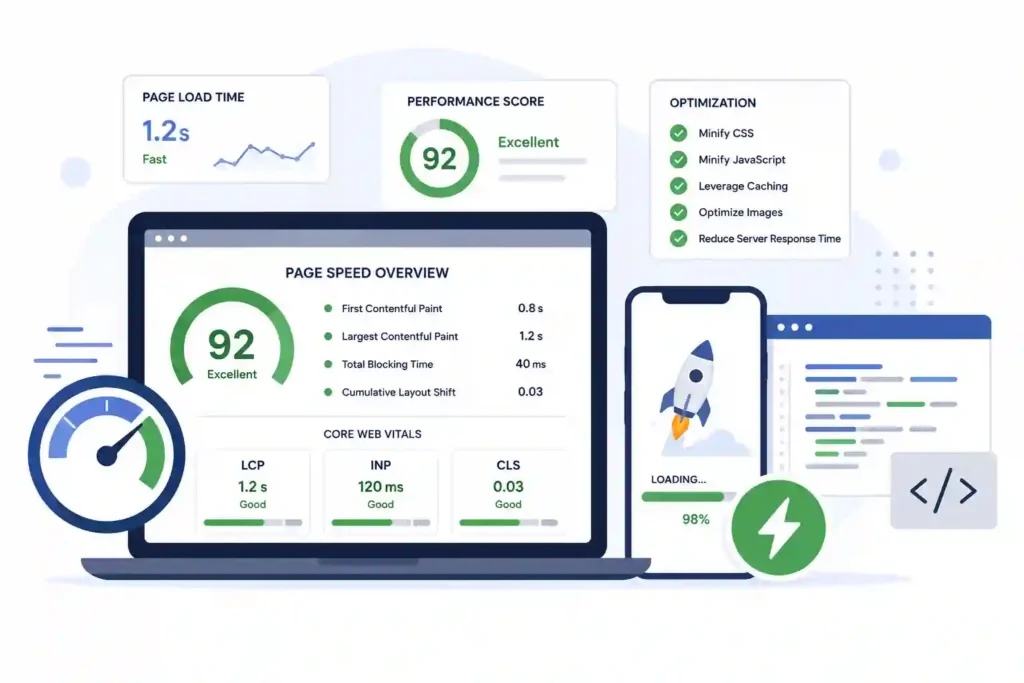
We look far beyond basic browser caching to audit critical asset delivery chains and server-side execution speeds. By restructuring how your styles, scripts, and media files load, we transform sluggish, heavy layouts into elite, ultra-responsive environments optimized for rapid search engine scoring.
Deeply analyze website structure to fix indexing issues.
Fix complex server redirects, canonicals, and indexation errors.
Discover keyword gaps and optimize content for traffic.
Audit reading structures and eliminate duplicate content risks.
Export enterprise-ready reports with actionable search data insights.
Instantly test domain health, detect technical errors, and boost performance.
Inspect meta titles, descriptions, and social tags to eliminate truncation and boost CTR.
Core Web Vitals are a set of specific real-world metrics defined by Google that measure a page's loading performance, visual stability, and interactive responsiveness.
LCP measures how long it takes for the primary content of a webpage to load on a user's screen. For an elite score, your LCP should occur within 2.5 seconds.
CLS measures unexpected visual movement on a page while it is loading. This is usually caused by images or ads without defined dimensions or fonts loading slowly.
INP is a Core Web Vital metric that evaluates a webpage’s overall responsiveness to user interactions, like clicks or key presses, throughout a user's entire visit.
Render-blocking files are scripts or stylesheets that force the user's browser to pause downloading the rest of the page until they are fully read, causing visible delays.
Yes. Google uses mobile-first indexing, meaning it predominantly ranks and evaluates your website based on how fast and efficiently it performs on mobile devices over cellular networks.
Page speed is the loading performance of a single, specific URL on your website. Site speed is a pooled average calculation of performance across all your pages.
Browser caching stores static website files directly on a visitor's device during their first visit, allowing subsequent pages to load instantly without re-downloading files.
A CDN is a distributed network of servers worldwide that caches and delivers your website assets from the server closest to the user's geographic location to minimize latency.
TTFB (Time to First Byte) measures how fast your server responds with the very first byte of data. Page load time tracks how long it takes to fully display the entire page content.
Yes. Heavy, unoptimized third-party web fonts can cause text to remain invisible or flash layout changes while loading, dragging down speed scores.
Every fraction of a second matters. Faster pages keep users engaged, while slow loading times cause abandonment, lowering sign-ups, sales, and total organic revenue.