When you type “PushWiki Com” into Google you may notice that the results do not line up. The search returns a Wikipedia disambiguation page for the word “push,” a Wiktionary definition, an IMDb entry, several unrelated companies that use “Push” in their names and hidden among them a PushWiki Com page. That mix is confusing. That confusion is why this guide was created.
The purpose of this article is to explain what PushWiki Com really is, what it publishes, how it stacks up against a wiki such as Wikipedia and what you should verify before believing anything you find there. If a claim can be confirmed we will state that. If a claim cannot be confirmed we will also state that.
What Is PushWiki Com?
1. PushWiki Com at a Glance
PushWiki.com shows itself as a place where you can read about SEO, blogging, website building, digital marketing and general online business tips.
PushWiki.com looks more like a content hub or an editorial blog than a classic reference encyclopedia. With PushWiki.com you can read articles without having to log in.
Those are the facts about PushWiki.com. Anything else, who runs PushWiki.com, when PushWiki.com started how many visitors PushWiki.com gets, remains only claimed by PushWiki.com. Has not been proven by an outside source. We will keep that note about PushWiki.com in every part of this write-up.
2. Why the Name “PushWiki” Can Be Misleading
The word “wiki” carries a specific meaning to most people: a site anyone can edit, like Wikipedia. That’s not automatically true just because a domain has “wiki” in its name.
Plenty of sites use “wiki” purely as a branding choice, while functioning as a normal editorial website where a small team (or one person) writes and publishes content.
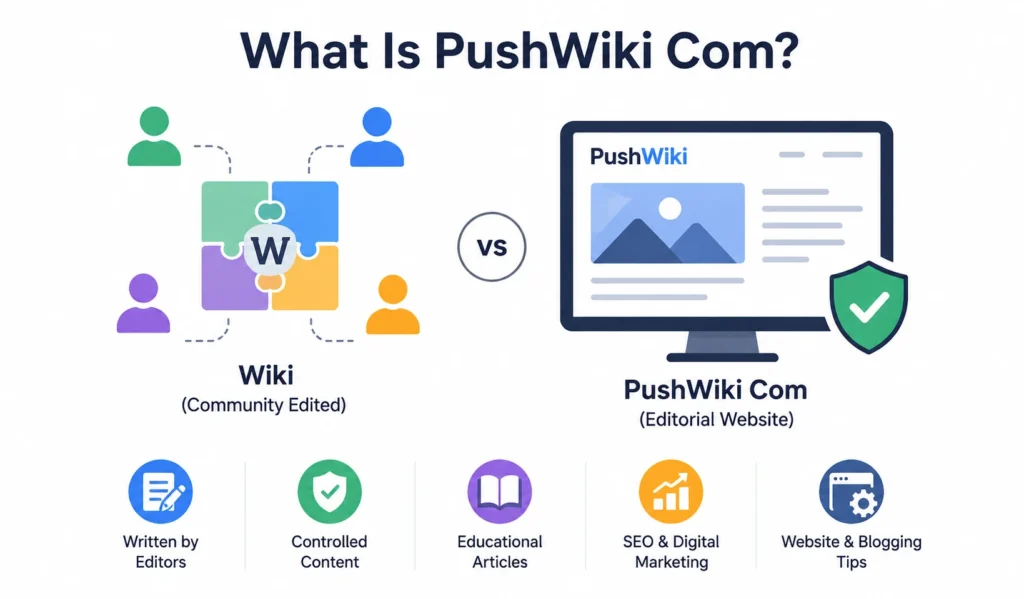
So before assuming PushWiki Com works like Wikipedia, it helps to separate three different models:
- A wiki, where content is community-edited and versioned.
- An editorial website, where a staff or single author writes and controls all content.
- A blog, which is usually one voice, published chronologically, with less structural organization than a reference site.
Based on what’s publicly visible, PushWiki Com behaves closer to the second category: an editorial site using “wiki” as a name, not as a description of how it operates.
3. What Users Can Find on PushWiki Com
Visitors usually come across articles that explain digital ideas. These articles talk about what some marketing words mean. They also show how functions. There is some advice about SEO.
There is also talk about managing a website or a small online business. The style is meant for people who are just starting out. It is not, for experts.
What Does PushWiki Com Actually Do?
1. Information and Educational Content
Most of the content functions as a plain-English explainer, the kind of article you’d send someone who just heard a term for the first time and wants a quick, low-pressure explanation.
2. Technology and Digital Topics
Coverage extends into general technology and internet-culture topics, again pitched at a non-technical reader rather than someone doing in-depth research.
3. SEO and Online Marketing
A recurring theme across PushWiki-style content is search engine optimization: what it is, why it matters for a website, and basic tactics. If you’re learning how SEO works, our guide to keyword research and analyzing SERP results provides a practical next step. This lines up with the domain’s apparent audience of bloggers and small site owners.
4. Blogging and Website-Related Topics
Expect articles on starting a blog, choosing a content management system, and general website-building advice.
5. Other Categories You May Encounter
Beyond the core topics, some articles touch on broader online business themes. Because a site’s topic list can shift over time, treat any specific category list, including this one, as a snapshot rather than a permanent index.
How Does PushWiki Com Work?
1. How Content Is Organized
Articles appear to be grouped loosely by topic, with standard blog-style navigation rather than the category-and-talk-page structure you’d see on a true wiki. If you want to understand how search engines analyze website structure and links, see our guide on how an SEO crawler works.
2. How Users Find Information
Search and browse work the way they do on most content sites: a search bar, category links, and internal links between related articles.
3. How Articles Are Published
There’s no visible indication of open community submission. Articles read as though they’re written and published by site administrators or a small editorial team, not crowdsourced.
4. Does PushWiki Com Allow User Editing?
This is worth answering directly, since it’s the single biggest source of confusion tied to the name: nothing publicly visible suggests that outside users can edit or submit articles on PushWiki Com. If that changes, or if a specific PushWiki-branded domain does support user contributions, treat that as a feature of that particular site, not a rule that applies to every “PushWiki” domain you come across.
Is PushWiki Com a Real Wiki?
1. What Makes a Website a Wiki?
The term “wiki” originally described a website that lets users add and edit pages collaboratively, usually with version history and open editing rights. Wikipedia’s own overview of the wiki concept is a useful reference point for what the format traditionally involves.
2. Does PushWiki Com Meet Those Characteristics?
Based on the absence of visible edit buttons, contributor accounts, or version history, PushWiki Com doesn’t appear to function as a collaborative wiki in the technical sense. It reads as a standard content website that adopted “wiki” as part of its brand name.
3. PushWiki Com vs Wikipedia
| Factor | PushWiki Com | Wikipedia |
| Primary model | Editorial content site | Collaborative encyclopedia |
| Community editing | Not evident | Yes, open to registered and anonymous users |
| Topic scope | Focused on marketing, SEO, blogging | Broad, encyclopedic |
| Citation model | Not consistently visible | Established citation and sourcing policy |
| Editorial governance | Unclear, likely small team | Community-based, with documented policies |
4. PushWiki Com vs a Traditional Blog
Functionally, PushWiki Com has more in common with a niche blog than with Wikipedia. The difference from a typical blog is mostly cosmetic: broader topic framing and a “wiki” name, rather than a fundamentally different publishing model.
Is PushWiki Com Legit?
Short answer: it appears to be a real, operating website publishing genuine content, not a scam page. That said, “legitimate” and “authoritative” are two different questions, and it’s worth keeping them separate.
1. What Can Be Verified
The site exists, serves content over a working domain, and publishes articles on consistent themes. That much is observable by visiting it directly.
2. What the Website Claims About Itself
Beyond the visible content, any specific claims the site makes about its own reach, expertise, or history should be treated as self-reported until you find independent confirmation elsewhere.
3. Ownership and Operator Transparency
This is where PushWiki Com, like a lot of smaller content sites, falls short of ideal transparency. If the site doesn’t clearly list who owns or operates it, that’s a gap worth noting rather than ignoring.
4. Author and Editorial Information
Check whether individual articles list an author, and whether that author has a bio, credentials, or a linkable profile. A site with no visible authorship across any article is harder to evaluate for expertise.
5. Contact Information
A working contact page or email address is a basic trust signal. Its absence doesn’t prove a site is untrustworthy, but its presence makes verification easier.
6. Editorial Policies and Corrections
Look for an editorial policy, a correction process, or any statement about how the site handles inaccuracies. Most established publishers have one; many smaller sites don’t, and that’s a limitation rather than a red flag on its own.
7. Third-Party Evidence
Independent mentions of a site, on forums, review pages, or social platforms, can help confirm it’s a known, active property rather than a brand-new or low-visibility domain. A quick search on a community platform like Reddit or a professional network like LinkedIn can sometimes surface user experiences that a site’s own pages won’t mention.
Is PushWiki Com Safe to Visit?
1. Website Security vs Content Trustworthiness
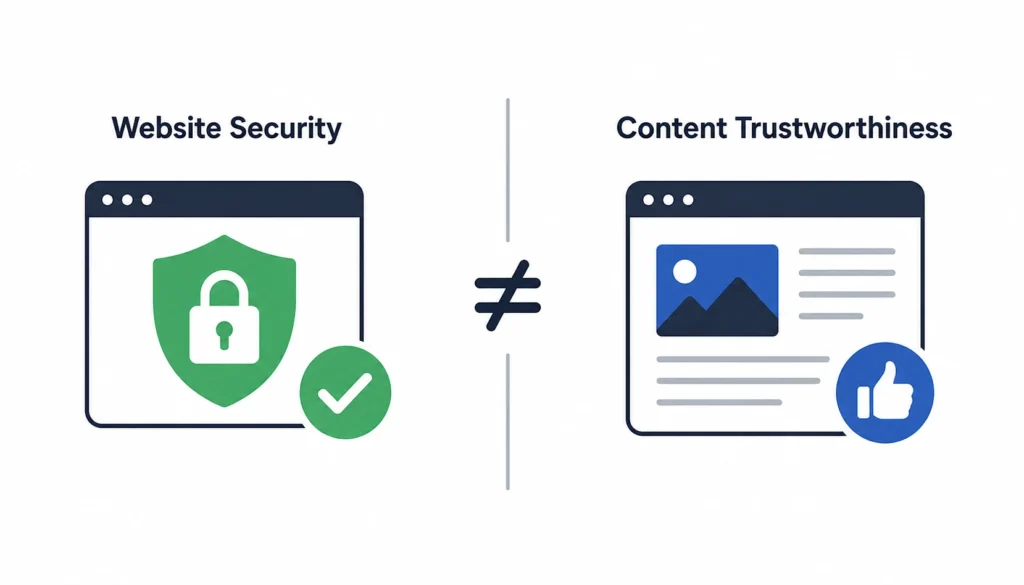
These are two separate questions people often mix together. A site can be technically safe to load (no malware, no phishing) while still publishing shallow or unreliable content. Conversely, a well-written article doesn’t guarantee the site is secure. Check both independently.
2. Security Signals to Check
- The site loads over HTTPS (a padlock icon in your browser’s address bar).
- Your browser doesn’t show a security warning when you visit.
- You’re not redirected to an unrelated or unexpected domain.
- The site doesn’t push unsolicited downloads.
- Pop-ups aren’t aggressive or hard to close.
- Forms don’t ask for information unrelated to what you’re doing on the page.
3. Privacy and Data-Collection Considerations
If PushWiki Com uses ads or analytics, which is standard for most content sites, check its privacy policy for what data is collected and how it’s used. No visible privacy policy is worth noting as a gap.
4. What You Should Avoid Entering
Don’t enter payment details, passwords, or sensitive personal information on an informational content site unless there’s a clear, specific reason tied to a service you’re actually signing up for.
5. What to Do If the Site Redirects You
If a link to PushWiki Com sends you somewhere unexpected, stop and check the URL in your address bar before interacting with the page further. Domain confusion, discussed next, is common enough with “wiki”-branded sites that it’s worth a habit of double-checking.
How to Identify the Correct PushWiki Website
This matters more than it sounds, because search results currently show more than one PushWiki-related domain, each describing itself somewhat differently.
1. Check the Exact Domain
Confirm you’re on the specific domain you intended. PushWiki Com is not the same property as any similarly spelled .net, .org, or hyphenated variant, even if the branding looks alike.
2. Look for Official About and Contact Information
A clear About page that explains who runs the site and why is a good sign. Its absence doesn’t confirm anything is wrong, but it does mean you’re relying on the content itself to judge the site.
3. Check the Site’s Branding and Content
Consistent logo use, consistent writing style, and a coherent topic focus suggest a maintained site rather than a copy or clone.
4. Verify Claims Through Independent Sources
If an article makes a specific factual claim you plan to rely on, cross-check it against a primary source, such as a company’s own site, an official statistics page, or an established reference like Wikipedia, rather than taking the article at face value.
5. Beware of Lookalike or Unrelated Domains
Some search results for “PushWiki” lead to entirely unrelated businesses that happen to use “Push” in their name: a marketing agency, a music platform, a streaming service. Read the actual page content, not just the domain name, before assuming you’ve found the right site.
What Topics Does PushWiki Com Cover?
Based on visible content, the site’s focus sits mainly in these areas:
- SEO
- Blogging
- Website development
- Digital marketing
- Online business
- General technology explainers
Treat this as a general map rather than an exhaustive index, since smaller content sites add and remove topics over time.
Who Is PushWiki Com For?
1. Beginners
If you’re new to blogging, SEO, or running a website, PushWiki Com-style content can work as a starting point for basic vocabulary and concepts.
2. Bloggers and Website Owners
The practical, how-to framing suits people building or maintaining their own sites and looking for quick, non-technical explanations.
3. Digital Marketers
Junior marketers or anyone brushing up on terminology may find the articles useful as a refresher, though not as a primary professional resource.
4. Students and General Readers
Anyone researching digital topics casually can use the site as one input among several, not as a sole source for an assignment or report.
5. Who Should Look Elsewhere?
If you’re making a technical, financial, legal, or health-related decision, don’t rely on a general-audience content site like this one. Go to primary sources, official documentation, or a qualified professional instead.
How to Evaluate the Quality of a PushWiki Com Article
This applies to any article on a site like this one, not just PushWiki Com specifically.
1. Check the Author
Is there a named author with any background information? No byline at all is a weaker signal than a named writer with a visible profile.
2. Check the Publication Date
Digital marketing and SEO advice ages quickly. An undated article, or one that’s clearly several years old, deserves extra scrutiny before you act on it.
3. Check the Sources
Does the article link to where its facts came from? Articles with zero outbound references are harder to verify. For a broader look at how content should be optimized for search, see our guide to how to write content that ranks.
4. Look for First-Hand Evidence
Practical advice grounded in a specific example (“here’s what happened when we tried this”) is generally more useful than generic statements with no supporting detail.
5. Compare Important Claims With Primary Sources
For anything you intend to act on, check it against the original source: the platform’s own documentation, an official statement, or a recognized reference site.
6. Check Whether the Information Is Still Current
Screenshots, tool names, and pricing mentioned in an article can go stale fast. If a piece references a specific tool or feature, confirm it’s still accurate today.
PushWiki Com vs Wikipedia vs Other Knowledge Websites
1. PushWiki Com vs Wikipedia
Wikipedia is a community-edited, citation-driven encyclopedia with documented governance and a long track record. PushWiki Com is a smaller, narrower content site with a more informal structure. They’re not really competitors; they serve different purposes.
2. PushWiki Com vs Wiktionary
Wiktionary is a collaborative dictionary focused on word definitions and etymology. PushWiki Com doesn’t function as a dictionary at all, so this comparison mostly matters because both terms show up in the same search results, not because they overlap in purpose.
3. PushWiki Com vs Fandom
Fandom hosts thousands of community-run wikis, each focused on a specific show, game, or franchise, with open editing by fan communities. PushWiki Com has no visible fan-community structure and covers a different subject area entirely.
4. PushWiki Com vs General Blogs
This is the closest real comparison. PushWiki Com functions much like a niche blog with a broader-sounding name: similar publishing model, similar single-author-or-small-team structure, different branding.
| Site | Editing model | Governance | Typical use case |
| PushWiki Com | Editorial, closed | Small team, limited visible policy | Beginner-level digital topics |
| Wikipedia | Open, collaborative | Documented community policy | General reference |
| Wiktionary | Open, collaborative | Documented community policy | Word definitions |
| Fandom wikis | Open, community-run | Per-wiki moderator teams | Fan and franchise content |
| Typical blog | Editorial, closed | Author or small team | Opinion, tutorials, niche topics |
Advantages and Limitations of PushWiki Com
Potential Advantages
- Explanations are written in accessible, beginner-friendly language.
- Topic coverage spans several practical digital-business subjects in one place.
- Content is easy to skim and doesn’t assume prior technical knowledge.
Potential Limitations
- Visible sourcing is inconsistent, which makes fact-checking harder.
- Broad topic coverage can mean less depth on any single subject.
- Ownership and editorial-team transparency isn’t fully clear from the site itself.
- Similar domain names in the same space make it easy to land on the wrong site by mistake.
- Important claims should be checked against a primary source before you rely on them.
Should You Trust Information From PushWiki Com?
1. When It Can Be Useful
For a quick, low-stakes explanation of a term you just heard, this kind of site can save you time. Think of it as a starting point, not a final answer.
2. When You Should Verify Information
Anytime you’re planning to act on specific advice, such as a marketing tactic, a technical setting, or a business decision, verify it against the original source or documentation first.
3. When You Should Use Primary Sources Instead
For anything involving money, legal obligations, health, or technical accuracy that matters, go directly to the authoritative source rather than a general content site.
A simple way to decide:
- Low-stakes learning → fine as a starting point.
- Professional decision → verify before you act.
- High-stakes decision → use primary, authoritative sources only.
PushWiki Com: Quick Verdict
| Question | Verdict |
| Is it a real website? | Yes, it’s an active, publicly accessible site. |
| Is it a traditional wiki? | No clear evidence of open community editing. |
| Is it free to use? | Yes, reading the content doesn’t appear to require payment. |
| Is it safe to visit? | Standard security checks (HTTPS, no browser warnings) apply as with any site. |
| Is it trustworthy for research? | Useful as a starting point; verify anything important elsewhere. |
| Is it useful? | Yes, mainly for beginners looking for plain-English explanations. |
Frequently Asked Questions About PushWiki Com
What is PushWiki Com?
It’s an informational website covering topics like SEO, blogging, website development, and digital marketing, written for beginners rather than specialists.
Is PushWiki Com legitimate?
It appears to be a genuine, operating content site rather than a scam. Ownership and editorial transparency aren’t fully clear, so treat claims with some caution.
Is PushWiki Com safe?
Apply the same checks you’d use for any site: HTTPS, no browser warnings, no unexpected redirects, and no requests for sensitive information you weren’t expecting to give.
Is PushWiki Com a wiki like Wikipedia?
Not in the traditional sense. There’s no visible sign of open community editing, so it behaves more like an editorial content site than a collaborative wiki.
Who owns PushWiki Com?
This isn’t clearly disclosed on the visible pages, which is a transparency gap worth noting rather than a confirmed problem.
Conclusion
PushWiki Com is a website that provides content focused on helping beginners learn about SEO, blogging, digital marketing and similar online topics. The site is built to explain things in a simple way. It’s good for people who are just starting out and want to understand terms or get a general idea before diving deeper.
The name can be a bit confusing. Even though it includes the word “Wiki ” PushWiki Com is not like Wikipedia. It’s not a place where users come together to edit articles or build knowledge as a community. Instead it functions more like an informational site with content written and maintained by a single team or few contributors.
This difference is important when it comes to trust and reliability. PushWiki Com can be helpful for learning ideas, finding new topics or getting a broad view of a subject. It should not be seen as a primary source. It’s not meant to replace guides, expert publications or trusted references.
If you’re working on something that involves money, technology, business or your career don’t rely on PushWiki Com. Use it to get your footing. Always verify key facts with reliable sources. Make sure the information is up to date and cross-check with trusted materials before you make any important decisions.
To sum it up, PushWiki Com is a starting point for beginners who are new to online topics. It can help you get your bearings. Don’t let its easy-to-understand format trick you into skipping deeper research when the details really matter.