Link building is the process of getting other websites to link to your site. These links are called backlinks. When a trusted website links to your content, it sends a positive signal to search engines that your content is useful and reliable.
Backlinks still play an important role in SEO in 2026. Search engines like Google use them to understand how trustworthy and relevant your website is. Even with AI and advanced algorithms, websites with strong and high-quality backlinks usually rank higher in search results.
you will learn a simple and practical link building workflow that you can actually follow. Instead of confusing theory, this step-by-step process will help you find link opportunities, reach out to the right websites, and build high-quality backlinks that improve your rankings and traffic.
What is a Link Building Workflow?

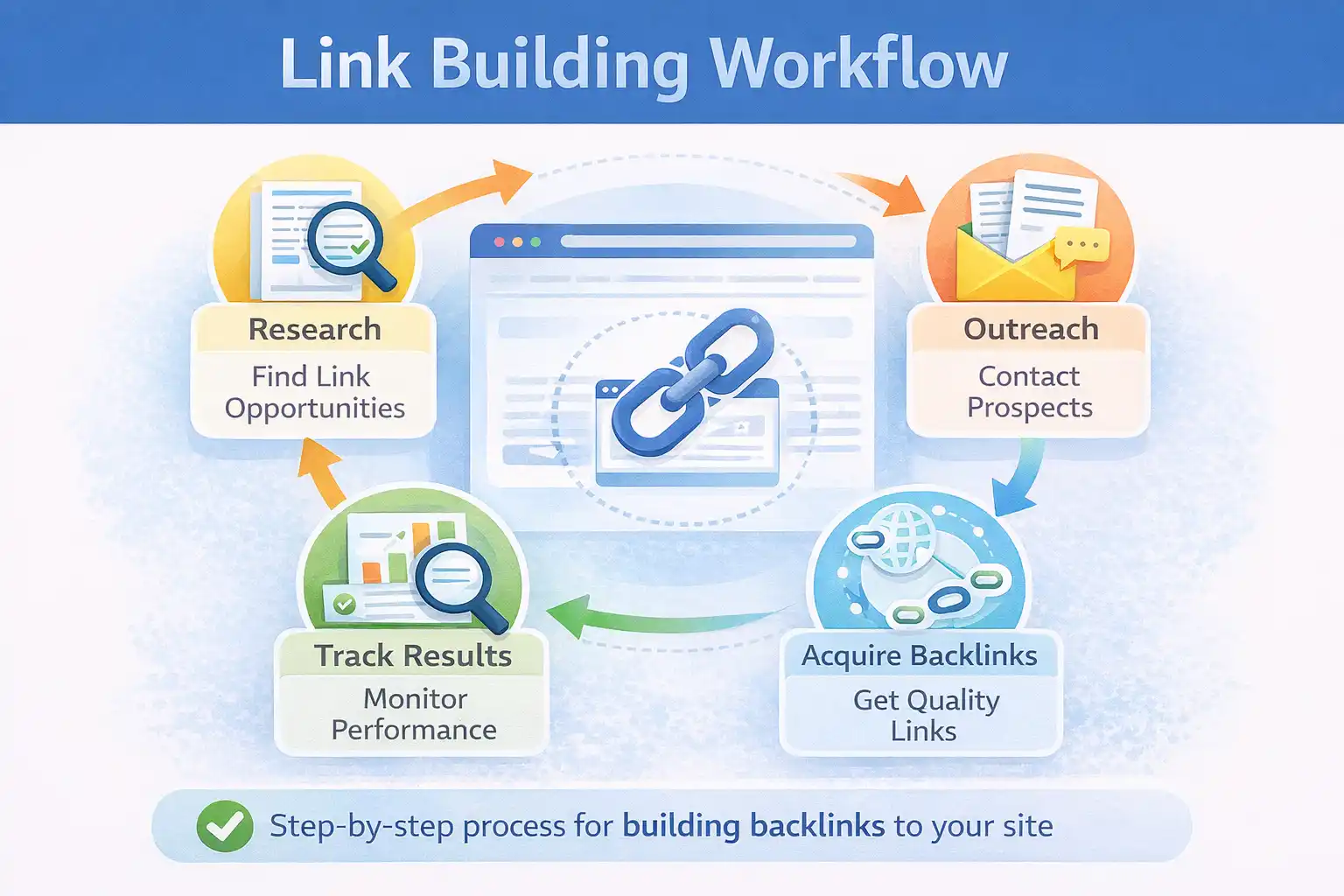
A link building workflow is a clear step-by-step process you follow to get backlinks for your website. Instead of randomly trying different methods, you follow a planned system from finding opportunities to getting links and tracking results.
Simple Definition
In simple words, a link building workflow is a planned method to build backlinks in an organized and effective way.
Random Link Building vs Structured Workflow
Random Link Building:
- No clear plan or strategy
- Sending generic emails to many websites
- Low success rate
- Often results in low-quality links
Structured Workflow:
- Follows a step-by-step process
- Targets relevant and high-quality websites
- Uses personalized outreach
- Focuses on long-term results
Benefits of Having a Clear Process
1. Saves Time
When you follow a workflow, you know exactly what to do next. This avoids confusion and helps you work faster.
2. Improves Link Quality
A structured approach helps you focus on relevant and trusted websites, which leads to better-quality backlinks.
3. Better Scalability
With a clear system, you can repeat the process and grow your link building efforts over time without losing quality.
A proper link building workflow not only makes your work easier but also helps you build strong, reliable backlinks that improve your website’s SEO performance.
Understanding How Google Evaluates Backlinks
To build backlinks that actually improve rankings, you need to understand how Google evaluates them. Google’s goal is simple: show users the most helpful and trustworthy content. Backlinks help Google decide which websites deserve higher positions.
Quality vs Quantity
In modern SEO, quality always matters more than quantity.
In the past, websites ranked by getting hundreds of backlinks, even from low-quality sites. But now, Google’s algorithm is much smarter.
- One backlink from a trusted, high-authority website can boost your rankings significantly
- Dozens of low-quality or spammy links may have little to no impact
- Too many poor-quality links can even lead to penalties
Key Ranking Factors
1. Domain Authority / Site Trust
Google checks how trustworthy the linking website is.
- Websites with strong reputations (popular blogs, news sites, established businesses) pass more value
- New or low-quality websites pass very little value
Think of it like a recommendation:
If a well-known expert recommends you, it matters more than a random person.
Relevance of the Linking Site
Relevance is one of the most important factors.
Google looks at whether the linking website is related to your topic.
Example:
- SEO blog linking to your SEO article High value
- Food blog linking to your SEO article Low value
Relevant links help Google understand:
- What your content is about
- Which audience it should show your page to
Anchor Text Usage
Anchor text is the clickable text of a link, and it gives context about your page.
Good anchor text:
- Natural and readable
- Matches the topic of your page
- Uses a mix of keywords, brand name, and generic text
Example:
- “learn link building”
- “visit our website”
- your brand name
Bad practice:
- Repeating the same exact keyword again and again
- Forcing keywords unnaturally
Placement of the Link (Contextual vs Footer)
Where your link appears on a page also affects its value.
- Contextual links (inside the main content)
- Highly valuable
- Surrounded by relevant text
- Look natural
- Highly valuable
- Footer or sidebar links
- Less valuable
- Often repeated across pages
- Sometimes ignored by search engines
- Less valuable
Avoiding Spammy Links (Important Warning)
Not all backlinks are good. Some can actually harm your website.
Avoid:
- Links from irrelevant or low-quality websites
- Paid links from link farms
- Websites created only for backlinks
- Too many exact-match keyword anchors
Google can detect unnatural link patterns. If your site has too many spammy links, it may:
- Lose rankings
- Get penalized
- Lose trust
Step-by-Step Link Building Workflow
Competitor Backlink Analysis
Competitor backlink analysis means studying where your competitors are getting their backlinks from. This helps you find proven link opportunities that are already working in your niche.
How to Find Competitors
Start by searching your main keywords on Google.
- Look at the top 5–10 websites ranking for your keyword
- These are your real SEO competitors
- Choose websites that have similar content or target the same audience
Tools to Use
You can use SEO tools to analyze competitor backlinks:
- Ahrefs
- SEMrush
- Moz or Ubersuggest (optional alternatives)
These tools show:
- Who is linking to your competitors
- Which pages are getting the most backlinks
What to Identify
1. Top-Performing Pages
- Find pages that have the most backlinks
- These are usually guides, blogs, or useful resources
- This tells you what type of content attracts links
2. Link Sources
- Check which websites are linking to your competitors
- Look for:
- Blogs
- Guest post sites
- Resource pages
- Blogs
- These are your potential targets for outreach
Define Link Building Goals
Before starting your link building process, it’s important to define clear and realistic goals. Without proper planning, your efforts can become unorganized and ineffective. Setting specific targets helps you stay focused, track your progress, and achieve better results over time. When you know exactly what you want to achieve, your link building becomes more strategic instead of random.
Key Points to Define
- Number of backlinks:
Set a monthly target (e.g., 5–10 high-quality backlinks instead of many low-quality ones) - Type of links:
Decide your strategy, such as:- Guest posts
- Niche edits
- Resource page links
- Guest posts
- SEO goals alignment:
Make sure your link building supports your main goals:- Improve keyword rankings
- Increase organic traffic
- Build website authority
- Improve keyword rankings
Create Linkable Content
To get high-quality backlinks, you need content that people actually want to link to. This is called linkable content content that is useful, valuable, and worth sharing. Without good content, even the best outreach will not give strong results.
Types of Content That Attract Links
- Guides:
Detailed, step-by-step content that explains a topic clearly - Statistics Pages:
Data, facts, and research that others can reference - Case Studies:
Real results, experiments, or experiences that build trust - Infographics:
Visual content that is easy to understand and share
Why Content Quality Matters More Than Outreach
Many people focus only on outreach, but content is the real foundation.
- High-quality content attracts links naturally
- It increases your chances of getting positive responses
- People are more likely to link to useful and unique content
- Poor content will not get links, even with strong outreach
Prospecting (Finding Link Opportunities)
Prospecting means finding the right websites where you can get backlinks. Many SEO professionals use a trusted link building marketplace to discover relevant websites, guest posting opportunities, and high-quality backlink sources more efficiently. This step is important because not every site is worth targeting-you need relevant and quality opportunities.
Methods to Find Sites
- Google search operators:
Use searches like “write for us + your niche” to find guest post sites on Google - Competitor backlinks:
Analyze where your competitors are getting links from - Resource pages:
Look for pages that list useful tools, guides, or websites - Blogger outreach lists:
Find bloggers and website owners in your niche
Qualify Your Prospects
Before reaching out, check:
- Relevance: Site should match your niche
- Traffic: Website should have real visitors
- Authority: Trusted and established websites are الأفضل
Outreach Strategy
Outreach is how you contact website owners to request backlinks. A good outreach strategy increases your chances of success.
Personalized vs Spam Emails
- Personalized emails → Higher response rate
- Generic spam emails → Often ignored
What to Include in Outreach
- Clear value proposition: Explain what benefit they get
- Short and friendly message: Keep it simple and respectful
Outreach Methods
- Guest posting: Write content for another website
- Broken link building: Replace broken links with your content
- Skyscraper technique: Offer better content than existing links
Securing the Backlink
Once the website agrees, your goal is to secure a strong and natural backlink.
Best Practices
- Negotiation tips:
Be polite, flexible, and focus on mutual benefit - Content guidelines:
Follow their rules and provide high-quality content - Anchor text strategy:
Use natural and relevant anchor text (avoid over-optimization)
Tracking and Monitoring Links
After getting backlinks, you need to track and monitor them to ensure they stay active and deliver results.
Tools for Tracking
- Ahrefs
- SEMrush
- Google Search Console
What to Check
- Link status: Is the link still live or removed?
- DoFollow vs NoFollow: DoFollow links pass more SEO value
Measure Performance
- Traffic: Are you getting visitors from backlinks?
- Rankings: Are your keyword positions improving?
Link Building Techniques That Work in 2026
To build strong and effective backlinks, you need to focus on techniques that are still working today. Modern link building is all about quality, relevance, and real value—not shortcuts or spammy practices. Search engines now prioritize natural and meaningful links, so using proven strategies can help you improve rankings, increase traffic, and build long-term authority.
1. Guest Posting
Guest posting means writing articles for other websites in your niche.
- You provide valuable content
- In return, you get a backlink to your site
- Works best on relevant and trusted blogs
2. Niche Edits
Niche edits involve adding your link to existing content on a website.
- Your link is placed inside already published articles
- Faster than creating new guest posts
- Works well if the content is relevant
3. Digital PR
Digital PR focuses on getting mentions and links from news sites and high-authority platforms.
- Share unique stories, data, or insights
- Reach out to journalists and bloggers
- Can earn very high-quality backlinks
4. HARO (Help a Reporter Out)
HARO connects journalists with experts.
- You answer questions from reporters
- If selected, you get featured with a backlink
- Links usually come from high-authority sites
5. Broken Link Building
This method involves finding broken (dead) links on websites and suggesting your content as a replacement.
- Find pages with broken links
- Contact the website owner
- Offer your relevant content as a solution
.
Common Link Building Mistakes to Avoid
While building backlinks, many beginners (and even experienced marketers) make mistakes that can harm their SEO instead of improving it. Link building is not just about getting links—it’s about getting the right links in the right way. If done incorrectly, it can lead to poor results or even penalties. Avoiding these common mistakes will help you build a safe, natural, and high-quality backlink profile that supports long-term growth.
1. Buying Low-Quality Links
Buying cheap backlinks from spammy or irrelevant websites may seem like a quick shortcut to improve rankings, but it can seriously damage your website’s credibility.
- These links often come from link farms, private blog networks (PBNs), or low-trust websites
- They usually have no real traffic or value
- Search engines can easily detect unnatural link patterns
As a result, your website may face ranking drops or even penalties.
Always focus on earning high-quality, natural links instead of buying cheap ones.
2. Over-Optimized Anchor Text
Using the same keyword-rich anchor text repeatedly is a common mistake that makes your backlink profile look unnatural.
- Example: Using the exact keyword in every backlink
- This creates an artificial pattern that search engines can detect
- It may trigger spam signals and reduce your rankings
Instead, use a natural mix of anchor texts:
- Brand name
- Partial keywords
- Natural phrases
- Generic anchors (like “click here” or “read more”)
This keeps your link profile balanced and safe.
3. Ignoring Relevance
Relevance is one of the most important factors in link building, yet many people ignore it.
- Getting backlinks from unrelated websites reduces their SEO value
- Search engines may not understand the connection between your content and the linking site
- It can make your link profile look unnatural
Always aim to get backlinks from websites that are:
- In your niche
- Related to your content
- Relevant to your target audience
Relevant links carry more weight and improve your rankings effectively.
4. Sending Generic Outreach Emails
Sending the same email to hundreds of websites is a common but ineffective approach.
- It looks spammy and unprofessional
- Website owners can easily recognize copy-paste emails
- Results in very low response rates
Instead, focus on personalized outreach:
- Mention the website name or specific article
- Show that you have actually read their content
- Clearly explain the value you are offering
A simple, friendly, and personalized message increases your chances of getting a positive response. find the email owner’s complete details to ensure deliverability of your email to the right person.
Tools to Improve Your Link Building Workflow
Using the right tools can make your link building process faster, more organized, and more effective. Instead of doing everything manually, these tools help you find opportunities, manage outreach, and track results in a structured way.
1. Ahrefs
Ahrefs is one of the most popular SEO tools for link building.
- Analyze competitor backlinks
- Find high-quality link opportunities
- Track your backlink profile
- Identify top-performing content
Best for deep backlink analysis and research.
2. SEMrush
SEMrush is an all-in-one SEO tool that also offers strong link building features.
- Backlink audit and analysis
- Competitor research
- Link building tool for outreach campaigns
- Track keyword rankings
Great for managing both SEO and link building in one place.
3. Hunter.io
Hunter.io helps you find email addresses for outreach.
- Find verified email addresses of website owners
- Save time in manual searching
- Improve outreach efficiency
Useful for connecting with the right people quickly.
4. BuzzStream
BuzzStream is designed to manage and organize your outreach campaigns.
- Manage contact lists
- Send and track outreach emails
- Build relationships with website owners
- Keep all outreach data in one place
Best for scaling and organizing outreach efforts.
Final Tips for Consistent Link Building Success
To succeed in link building, it’s important to stay consistent and focus on long-term strategies rather than quick wins. Building backlinks is not a one-time task—it requires regular effort, patience, and the right approach. When done correctly, it can steadily improve your website’s authority, rankings, and traffic.
- Focus on quality over quantity:
Always prioritize getting backlinks from trusted and relevant websites instead of chasing a large number of low-quality links. A few strong backlinks can have a much bigger impact than many weak ones. - Build relationships, not just links:
Connect with bloggers, website owners, and industry experts. Strong relationships can lead to more natural link opportunities, collaborations, and long-term benefits beyond just backlinks. - Be consistent (weekly workflow):
Link building works best when done regularly. Set a weekly plan for prospecting, outreach, and content creation to maintain steady growth instead of doing everything at once. - Track everything:
Monitor your backlinks, outreach efforts, and performance. This helps you understand what’s working, fix issues, and improve your strategy over time.
FAQs: Link Building Workflow
1. What is a link building workflow?
A link building workflow is a step-by-step process used to find, create, and earn backlinks for your website in an organized and effective way. It helps you stay consistent and achieve better SEO results.
2. Why is link building important for SEO?
Link building helps search engines like Google understand the trust and authority of your website. High-quality backlinks can improve rankings, increase traffic, and boost credibility.
3. How many backlinks should I build per month?
There is no fixed number, but focusing on 5–10 high-quality backlinks per month is better than building many low-quality links. Quality always matters more than quantity.
4. What are the best link building techniques?
Some effective techniques include:
- Guest posting
- Niche edits
- Digital PR
- HARO
- Broken link building
5. How long does it take to see results from link building?
Link building is a long-term strategy. You may start seeing improvements in 4 to 12 weeks, but strong results usually take a few months of consistent effort.
6. What is the difference between DoFollow and NoFollow links?
- DoFollow links: Pass SEO value and help improve rankings
- NoFollow links: Do not pass direct SEO value but can still bring traffic and visibility
7. Can bad backlinks harm my website?
Yes, low-quality or spammy backlinks can harm your rankings and may lead to penalties. That’s why it’s important to focus on natural and relevant links.
8. Do I need tools for link building?
Tools are not required but they make the process easier. Tools like Ahrefs and SEMrush help you find opportunities, analyze backlinks, and track performance.
Conclusion
Link building becomes much easier when you follow a clear and structured workflow. From analyzing competitors and setting goals to creating quality content, finding opportunities, reaching out, and tracking results—each step plays an important role. Instead of doing things randomly, this process helps you stay organized and focus on what actually works.
The key is to take action step-by-step. Start small, stay consistent, and improve your strategy over time. You don’t need to do everything at once—just follow the workflow regularly and build links gradually.
In the long run, a strong link building strategy can improve your website’s rankings, increase organic traffic, and build authority in your niche. With patience and consistency, you can achieve sustainable SEO growth and long-term success.