Freight is one of the few industries where the safety record and the compliance record are the same record. A missed pre-trip inspection is a safety problem on Monday and an audit problem in March. Yet most of the people generating that record are drivers, yard crews, and dock workers. Census Bureau figures published in 2019 counted more than 3.5 million people who drive for a living in the United States, almost none of whom sit at a desk or open a corporate inbox. We compared seven platforms that logistics operators actually shortlist for incident and inspection tracking, policy sign-off, and safety training, and we have been blunt about where each one stops being useful.
How We Compared These Platforms
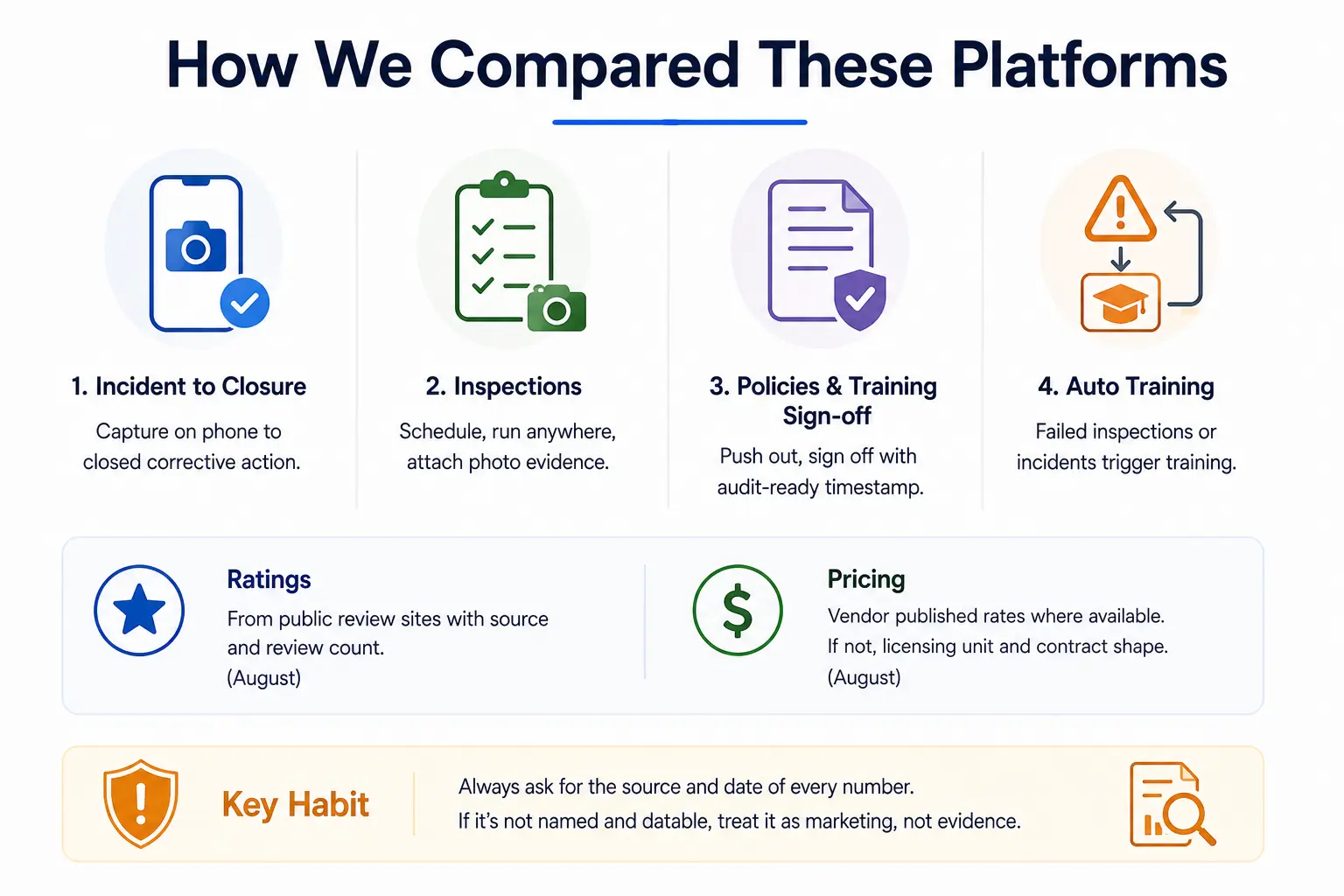
We looked at four things, in this order: whether the platform can capture an incident from a phone and carry it through to a closed corrective action; whether inspections can be scheduled, run away from a desk, and attached to photo evidence; whether a policy or bulletin can be pushed out and signed off with a timestamp that survives an audit; and whether a failed inspection or an incident can trigger a training assignment without someone re-keying it.
Ratings come from public review sites and are stated as plain text with both the source and the review count named, because a 4.6 built on forty reviews and a 4.6 built on five thousand are not the same number. Pricing is the vendor’s published rate where one exists. Where it does not, we say so and give the licensing unit and the usual contract shape instead, which is the most a buyer can work with when the rate card is private. Both sets of numbers, the scores and the rates, were current as of August, and neither kind stays still, so re-check them before a business case goes to finance. Every platform on the list carries at least one limitation we think matters.
One habit is worth carrying into the shortlist itself. Ask where every safety number in a vendor deck came from. If the source is not named and datable, treat the figure as marketing rather than evidence, because injury-rate and ROI claims circulate through this category with no attribution attached, and a number you cannot trace is a number you cannot repeat in front of your own auditor.
What a Logistics Safety and Compliance Platform Has to Do
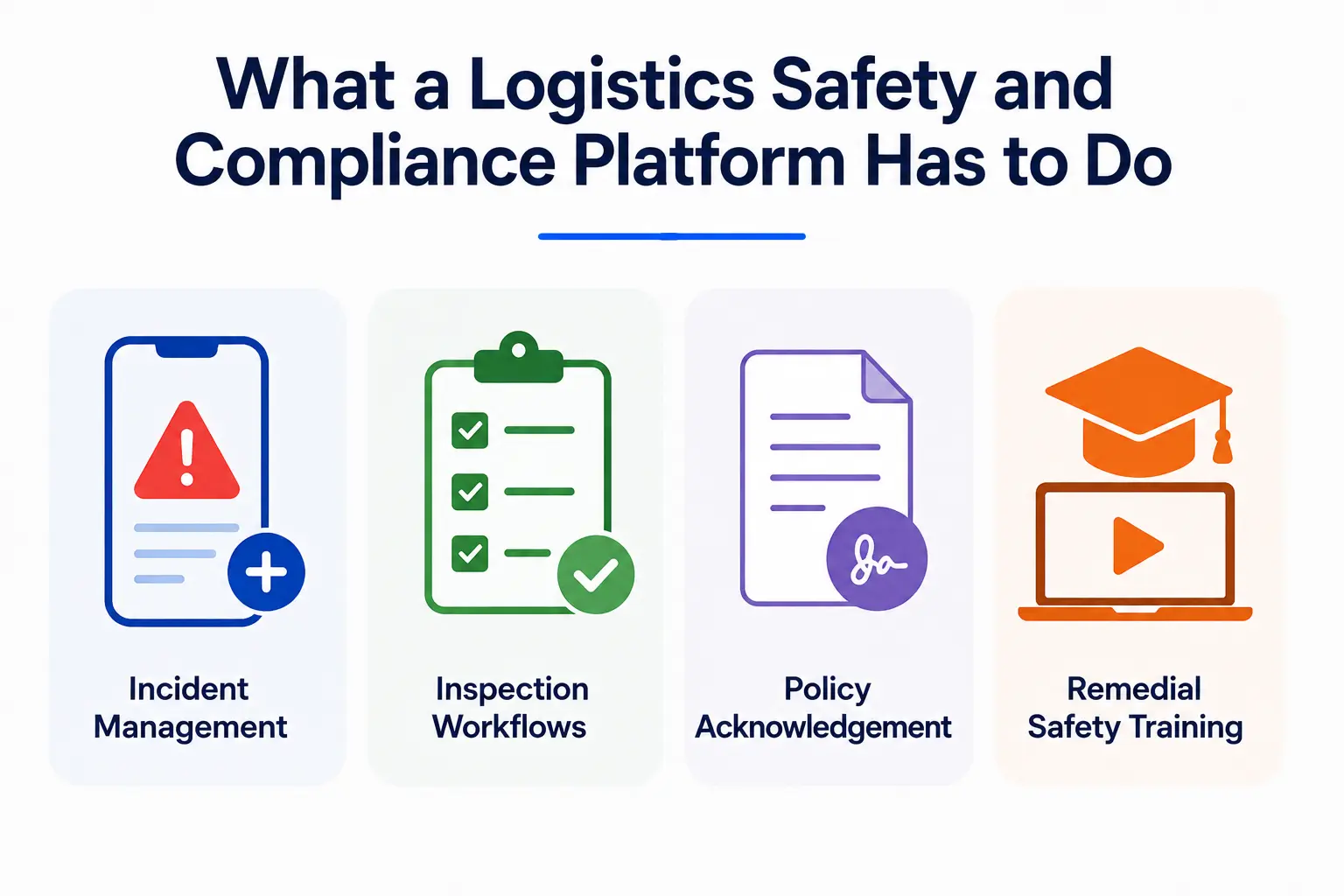
The category is muddled because four different software histories all claim it. A short definition of each job helps.
Incident Management
Incident management is the full loop, not the form. Capture is the first step: a driver, a loader or a supervisor records what happened, where, and to whom, usually from a phone at the roadside or on the dock. Triage comes next, where someone classifies severity and decides whether it is a recordable injury, a near miss, or a property-damage claim. Then corrective action, which is where most systems quietly fail, because the corrective action needs an owner, a due date and evidence of completion. Closure is the last step, and it is the one auditors ask about. The National Transportation Safety Board describes safety management programs in similar terms, as processes that collect and analyse data on emerging problems and then evaluate whether the fix worked, resting on a nonpunitive reporting culture so that people report at all.
Inspection Workflows
An inspection workflow is a mobile checklist with a schedule attached. Two kinds matter in freight. Scheduled inspections run on a cadence, such as daily vehicle checks, monthly fire-extinguisher checks or quarterly yard audits. Ad-hoc inspections are raised by a person on the spot, usually after something looks wrong. Both need evidence capture, which in practice means a photo, a GPS stamp and a signature, because a checklist with every box ticked and no photo is the first thing a regulator distrusts.
Policy Acknowledgement
Policy acknowledgement is the record that a named worker read a named document on a named date. It sounds trivial. It is the single most common gap in this category, because policies get distributed by email, printed and taped to a wall, or read out at a shift meeting, none of which produces a defensible audit trail. What you want is a versioned document, a timestamped sign-off per person, a reminder loop for the people who have not signed, and a report you can export when the auditor asks who acknowledged the revised lockout procedure in April.
This is also where contractor-heavy fleets get caught. In 2022, 7.0% of people in a transportation or related occupation were self-employed, roughly 0.9 million workers, based on a federal count of the workforce. Owner-operators still have to acknowledge your policies, and they will never be in your HR system.
Remedial Safety Training
The last piece is the link between a bad event and a learning assignment. A rollover, a repeat inspection defect or an expired certification should be able to push a specific course, toolbox talk or SOP to a specific person, with a completion record that lands back in the same file as the incident. Plenty of platforms do incidents. Fewer do training. Very few do both in one record.
The 7 Best Safety and Compliance Platforms for Logistics
| Platform | Best for | Rating | Pricing |
|---|---|---|---|
| SafetyCulture | Inspection-first operations that want fast rollout | 4.6 on G2, 264 reviews | Free tier, then 24 USD per seat per month billed annually |
| iTacit | Frontline crews with no company email address | 4.6 on Capterra, 42 reviews | Quote-based, per user on an annual term |
| VelocityEHS | Regulated multi-site operators with formal EHS programs | 4.4 on G2, 174 reviews | Quote-based, per module and per user, annual |
| Samsara | Fleets that want camera-driven risk detection | 4.5 on G2, 4,971 reviews | Quote-based, per vehicle, multi-year with hardware |
| Motive | Mid-market fleets consolidating ELD and safety | 4.4 on G2, 3,254 reviews | Quote-based, per vehicle per month, hardware included |
| HSI | Teams buying safety training and EHS together | 4.6 on G2, 57 reviews | Quote-based, course library and modules priced separately |
| Whip Around | Inspection and defect tracking on a tight budget | 4.7 on Capterra, 577 reviews | Free for one asset, then 5 USD per asset per month |
1. SafetyCulture
SafetyCulture started life as a digital checklist tool and never lost that instinct. You build a template, push it to phones, and inspections start producing data almost immediately, which is why it spreads through logistics operations faster than heavier systems. Incidents and corrective actions have been layered on top over the years, and they work, though they feel like a second act rather than the foundation. Training exists as a course-authoring module.
Best for: operations that want inspections live across every terminal within a month.
What it does well:
- Template library and drag-and-drop inspection builder that non-technical supervisors can actually use
- Photo, signature and location capture built into every checklist item
- Actions module that assigns corrective work with due dates and reminders
- Scheduled inspections with automatic reminders and missed-inspection reporting
- Asset and equipment records tied to inspection history
Rating: 4.6 on G2, from 264 reviews.
Pricing: a free plan for teams up to ten people, a Premium plan at 24 USD per seat per month billed annually, and custom enterprise pricing.
Not great for: policy acknowledgement at scale. Document sign-off is possible but thin compared with the inspection tooling, and per-seat pricing gets uncomfortable once you are licensing several thousand drivers rather than a few hundred supervisors.
2. iTacit
Most of this category assumes the worker has an inbox. iTacit assumes the opposite, which is why it belongs on a logistics list. A frontline app, an LMS and mobile forms sit in one system, so an incident report, a pre-trip inspection, a policy sign-off and the follow-up course attach to the same worker record. Drivers sign in without a corporate email address.
Best for: carriers and 3PLs whose workforce has no corporate email and no reliable desk time.
What it does well:
- Mobile forms for pre-trip inspections, tailboards and incident reports
- Timestamped policy acknowledgement with reminders for anyone who has not signed
- Certification and expiry tracking across sites, including CDLs and medical cards
- Training assignment tied to the same record as the form or incident
Rating: 4.6 on Capterra, from 42 reviews.
Pricing: quote-based, licensed per user on an annual term, with no published rate card. Delivering the app through in-cab telematics tablets carries a second per-user licence, worth raising before procurement starts.
Not great for: telematics-driven risk scoring. No cameras, no GPS event feeds, no driver behaviour scores. The platform is cloud-only with no offline mode, so terminals with genuinely dead coverage will need workarounds. Published case studies also skew towards healthcare rather than freight, so freight reference calls take longer to arrange.
3. VelocityEHS
If your organisation has a corporate EHS function, an ISO programme and a regulatory reporting calendar, VelocityEHS is the system built for that job. Incident management includes root-cause analysis and formal CAPA tracking. Audits and inspections come with configurable checklists across sites. There is also chemical management, industrial ergonomics and risk analysis, none of which a small carrier needs and all of which a manufacturer with a distribution arm probably does.
Best for: multi-site regulated operators running a formal EHS programme, not just a fleet.
What it does well:
- Incident capture through investigation, root cause and corrective and preventive action tracking
- Audits, inspections and behaviour-based observation programmes in one place
- Compliance calendar for permits, deadlines and recurring obligations across locations
- Safety meeting and toolbox talk records, including attendance and follow-up actions
- Hazardous substance registers, SDS lookup and industrial ergonomics assessment
- A training and learning module with several hundred prepackaged safety courses
Rating: 4.4 on G2, from 174 reviews.
Pricing: quote-based, priced by module and by user count on an annual subscription, with implementation and configuration quoted as a separate one-off line. Adding modules later reprices the contract, so scope the full module list before you sign.
Not great for: speed. Implementation runs in months rather than weeks, the interface is built for EHS professionals rather than drivers, and frontline adoption is the usual battle. If your safety team is one person with a spreadsheet, this is more system than the problem.
4. Samsara
Samsara sells risk detection first and paperwork second. AI dash cams flag drowsiness, distraction, tailgating, and forward collision risk, alert the driver in the cab, and feed a coaching workflow for managers. Vehicle inspection reports are part of the platform, and the telematics data behind them is genuinely useful for proving a vehicle was where the paperwork says it was. What you do not get is a general-purpose safety management system.
Best for: fleets whose biggest exposure is on-road driver behaviour rather than yard or dock incidents.
What it does well:
- AI cameras with in-cab alerts and manager coaching workflows
- Driver safety scores and trend reporting across terminals
- Vehicle inspection reports linked to telematics and maintenance records
- Wide integration ecosystem, including in-cab tablets and third-party apps
Rating: 4.5 on G2, from 4,971 reviews.
Pricing: quote-based, per vehicle per month, normally on a multi-year term with gateway and camera hardware folded into the subscription rather than bought up front. Fleet size moves the per-vehicle rate, so a 30-truck quote and a 500-truck quote are not comparable.
Not great for: anything that is not on wheels. Policy acknowledgement, formal incident investigation, and training assignment sit outside the core product, and warehouse or yard staff are effectively invisible to a vehicle-priced platform.
5. Motive
Motive covers a lot of the same ground as Samsara, with a stronger pull among mid-market carriers consolidating electronic logging, dash cams, and maintenance into one bill. The AI dashcam line is credible, the driver-facing app is well liked, and DVIR workflows are solid. Compliance here means DOT compliance specifically, which is a narrower definition than a safety manager uses.
Best for: mid-market carriers replacing two or three point tools with one fleet platform.
What it does well:
- Electronic logging, hours of service, and DOT-oriented compliance reporting
- AI dashcams with event detection and driver coaching
- Driver vehicle inspection reports with defect routing to maintenance
- GPS and asset location history that can be pulled as evidence in a claim
- Fuel, maintenance, and asset tracking in the same console
Rating: 4.4 on G2, from 3,254 reviews.
Pricing: quote-based, per vehicle per month on an annual or multi-year term with hardware included. Cameras are usually a separate line from the logging subscription, so confirm which vehicles are being quoted with cameras and which are not.
Not great for: the compliance work that happens off the truck. Policy sign-off, safety training records, and non-vehicle incident management are not the point of the product, and a warehouse-heavy 3PL will find half its workforce unaddressed.
6. HSI
HSI comes at this from the training side. The company built a large safety course library first, then added EHS modules around it, so the shape of the product is the mirror image of VelocityEHS. Incident management, audits and inspections, chemical and SDS management, and contractor management are all there. For an organisation whose immediate pain is “we cannot prove our people were trained,” that ordering makes sense.
Best for: buyers who want a large off-the-shelf safety course catalogue and an EHS system from the same vendor.
What it does well:
- Thousands of prebuilt safety and compliance courses, which removes most content-authoring work
- Incident and near-miss capture with investigation and reporting
- Audit and inspection scheduling across assets and locations
- Contractor management, including qualification and document checks
- On-site chemical registers, plus SDS authoring and distribution
Rating: 4.6 on G2, from 57 reviews.
Pricing: quote-based, with the course library and the EHS modules priced as separate lines, generally by learner count and by module on an annual term. A free trial is available. Because the catalogue and the system are billed apart, a quote can look cheap until the modules are added.
Not great for: logistics specificity. The course library and the workflows lean towards general industry and manufacturing, so DOT-specific and driver-specific content usually has to be added. Review volume is modest, which makes it harder to find peers running it in freight.
7. Whip Around
Whip Around does one job and does it cheaply. Inspections go out to drivers on a phone, defects route to maintenance, the paper trail is decent, and the reporting is simple enough for a two-person office to keep up with. Buying it as your safety and compliance platform would be a mistake, but buying it as a first step out of paper inspection books is a reasonable decision that plenty of small carriers make.
Best for: small and mid-size fleets replacing paper inspection forms without a large budget.
What it does well:
- Fast mobile inspection forms with photo capture and defect flagging
- Automatic work-order creation from failed inspection items
- Maintenance scheduling tied to inspection history and mileage
Rating: 4.7 on Capterra, from 577 reviews.
Pricing: free for a single asset, 5 USD per asset per month on the Standard plan, 10 USD per asset per month on Pro, and custom pricing for unlimited assets.
Not great for: everything beyond inspections. There is no policy acknowledgement, no training assignment, and no real incident investigation workflow, so most operators outgrow it as soon as an auditor asks a question that is not about a vehicle.
Telematics-Led, EHS-Led, and Frontline-Led: Which Lineage Are You Buying?
The seven platforms above are not really competing on features. They are competing on where they started, and that origin decides what they are good at.
Telematics-led platforms, Samsara and Motive here, began with hardware bolted into the vehicle. What they give you is objective event data: what the truck did, when, and how the driver reacted. The catch is the licence itself, priced per vehicle, so dock staff, mechanics and yard crews sit outside it. Proving a driver was coached is easy. Proving a dock worker read the revised lifting policy is not.
VelocityEHS and HSI come out of the corporate safety department, and it shows in the depth of the record: investigations, root cause, CAPA, regulatory reporting, chemical inventories. Where they struggle is the last hundred metres. These systems were designed for a safety professional sitting at a computer, so getting a driver to file a near miss on a phone at 5am turns into a change-management project rather than a feature you switch on.
Frontline-led platforms start from the worker instead. iTacit sits here, and SafetyCulture partly does. Reach is the payoff: the form gets filled in, the policy gets signed, the training gets completed, because the tool was built for someone holding a phone in one hand. Analytical depth is the trade. No driver risk score, no chemical inventory, and an EHS professional may find the reporting shallower than what they are used to.
Running two of the three is a common outcome and not a failure. What matters is deciding which one is the system of record for people, because that is the one that has to hold the acknowledgement trail.
What Actually Decides It
Workforce shape decides this more often than feature lists do. Count how many of your people have a company email address. If the answer is under half, every platform that provisions users by email is going to cost you an onboarding project you have not budgeted for, and adoption is the thing that kills these deployments.
The second question is what your last audit actually asked for. Audit requests tend to cluster: proof of who was trained and when, proof that inspections were performed on schedule, proof that a corrective action was closed, and proof that a named person acknowledged a named policy. Any platform can demo the first three. Number four is where a shortlist usually thins out.
Price it per person, not per vehicle, when your workforce is bigger than your fleet. A 200-truck carrier with 600 employees will get a very different answer from a per-seat quote than from a per-vehicle one, and that arithmetic often decides the shortlist before any feature comparison happens.
Offline behaviour deserves an explicit question. Some platforms hold data locally and sync later, others require a live connection. Neither is wrong, but you should know which one you are buying before a driver at a rural terminal tells you the form would not submit.
Integration is the part buyers underestimate. If you already run telematics, you are not replacing it, you are deciding what sits next to it. The arrangement that causes least trouble is telematics for vehicle risk and a frontline platform for people records, with a flat file or API moving driver identities between them.
Frequently Asked Questions
Do We Need Incident and Inspection Tracking in the Same System?
Usually yes, because inspections generate the defects that become incidents, and splitting them means someone re-enters data at the exact moment they are least inclined to. The practical test is whether a failed inspection item can be escalated into an incident record without leaving the app.
Which Platforms Are Purpose-Built for Fleet Operations?
Samsara and Motive are built for fleets in the literal sense, because their data model starts with the vehicle. Whip Around is fleet-specific but limited to inspections and maintenance. VelocityEHS and HSI are general industry systems that fleets use. iTacit is workforce-specific rather than fleet-specific, which suits operators whose compliance risk sits with people as much as with trucks.
A Safety Platform and an LMS for Logistics: Where Is the Line?
A safety platform is organised around events and assets: incidents, inspections, hazards, corrective actions. An LMS is organised around people and courses: enrolment, completion, expiry. The overlap matters because a failed inspection should trigger training, and a training record should be visible from the incident file. A few platforms, including iTacit and to some extent HSI, do both in one system. Most do one well and integrate for the other.
How Do We Prove Policy Acknowledgement to an Auditor?
You need four things: the document version that was in force, the list of people it applied to, a timestamp per signature, and an exception report showing who did not sign and what happened next. Screenshots of an email blast will not survive scrutiny. Neither will a signed paper roster that lives in a filing cabinet at one terminal.
Can These Platforms Assign Remedial Training Automatically After an Incident?
Some can. VelocityEHS, HSI, and iTacit can tie a training assignment to an event record. Samsara and Motive route coaching sessions rather than courses, which is a different thing. SafetyCulture and Whip Around generally require an integration or a manual step.
What Does This Software Typically Cost?
Most vendors here will not put a rate on a web page. The two transparent examples on this list are SafetyCulture at 24 USD per seat per month billed annually and Whip Around at 5 USD per asset per month. The rest quote against a unit, usually the vehicle, the user or the module, on annual or multi-year terms. Ask for the three-year total including implementation rather than the monthly figure.
The Bottom Line
There is no single winner here, which is an unsatisfying answer that happens to be true. Inspections as your bottleneck, with something needed this quarter, points at SafetyCulture. A corporate EHS function and a regulator to answer to points at VelocityEHS, which holds the deeper record. Where the exposure sits on the road, the telematics platforms earn their price on camera evidence alone.
The failure that shows up most often is not a missing feature, though. It is a compliance record with a hole in it where the frontline should be. Whoever holds the worker record ends up holding the acknowledgement trail, and a safety and compliance platform for logistics is worth only as much as that record is complete. iTacit was built to hold it for crews who work from a phone and a locker rather than a desk, which is why it belongs beside the telematics quote rather than behind it.
Run the audit test before you sign anything. Ask the vendor to produce, on a demo tenant, a report showing every worker who acknowledged a specific policy revision on a specific date, and watch how long it takes.