
If you run a business you have probably heard someone say you must have SEO. Perhaps you have hired a person before. Left with many ranking reports but no new customers to show for the effort. That is the issue with much SEO guidance: it cares about rankings and not about real results. A good SEO consultant for business owners must think of only one main goal: bringing qualified leads and revenue not merely lifting your site a few spots for keywords that do not bring money.
This guide shows what an SEO consultant does, how much it costs, how to choose the one and how to see if the work pays off. By the end of this guide you will have a plan for hiring a person you can trust with your marketing budget.
What Is an SEO Consultant for a Small Business?
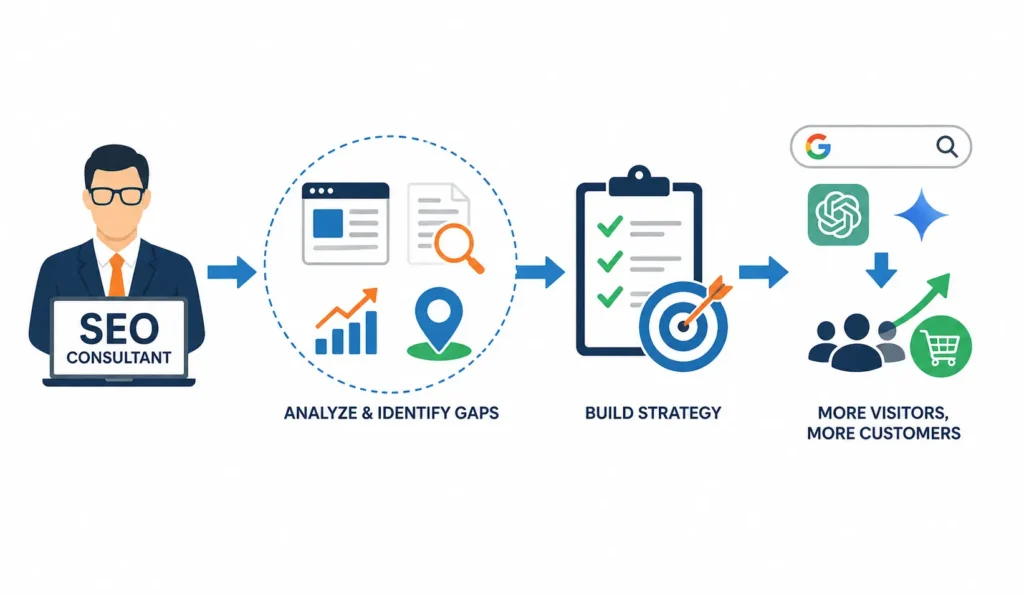
An SEO consultant is a professional who helps a business improve its visibility in search engines Google, but also newer AI tools such as ChatGPT and Google’s AI Overviews. The aim of an SEO consultant is to attract more of the visitors and to turn those visitors into customers. Unlike a marketer an SEO consultant focuses on how search engines find, understand and rank content. An SEO consultant examines the health of a website, the quality of its content, the competition and the local presence and then builds a plan to close the gaps.
What an SEO consultant actually does
In life a consultant is, like a mix of an analyst, a planner and sometimes someone who gets their hands dirty and does the work. They figure out why a website isn’t appearing for the searches that’re important and then they decide which changes will have the biggest impact the quickest.
Some consultants do the technical work and the content work on their own. Others give you a plan. Let your team or a developer do the work. This difference is very important when you are looking at offers so it’s a good idea to ask about it early on.
SEO consultant vs SEO agency vs freelancer vs DIY
These four options solve the same problem in different ways, and each has trade-offs:
- SEO consultant: Usually a solo expert or small specialized team. You get direct access to the person doing the strategic thinking, but capacity is limited.
- SEO agency: A larger team with more resources (content writers, link builders, developers), but you may work through account managers rather than the actual specialists.
- Freelancer: Often cheaper, sometimes very skilled, but quality varies widely and there’s less accountability structure.
- DIY: You handle it yourself using free or low-cost tools. Cheapest option, but it takes real time to learn and the mistakes can be costly.
When a small business should hire a consultant
Hiring a consultant is an idea if you are falling behind online competitors if your website traffic has stalled, if you lack the time or skill inside the company to manage SEO or if you are starting a new market or opening a new location. It also makes sense if you have tried a SEO package before and were disappointed. A consultant, with a proven record can usually figure out in one week what the previous provider took six months to uncover.
When hiring a consultant may not be necessary
If you are a local business with almost no online competition, such as the only plumber, in a small town basic Google Business Profile management and a handful of on‑page fixes might be enough.
Similarly if your budget truly cannot support SEO work yet it may be wiser to focus on other channels first and revisit SEO when you have more room to invest.
What Does an SEO Consultant Do?
A thorough SEO engagement usually touches on all of the following areas, though the depth depends on your business and budget.
SEO audit and website analysis
This is almost always step one. The consultant crawls your site, checks indexing status, reviews site speed, and flags anything that’s actively blocking Google from understanding your pages.
Keyword and search-intent research
Good consultants don’t just find keywords with high search volume; they figure out the intent behind the search. Someone searching “best CRM software” wants a comparison; someone searching “buy CRM software” wants to purchase. Matching content to intent is what actually converts traffic into leads.
Competitor analysis
This means looking at who’s already ranking for your target terms and figuring out why. It often reveals content gaps, technical advantages, or link profiles you need to compete with.
On-page SEO
This covers title tags, headers, internal linking, image optimization, and making sure each page is clearly built around a specific topic and keyword.
Technical SEO
Site speed, mobile usability, crawlability, structured data (schema markup), and indexing issues all fall under technical SEO. It’s less visible than content work, but it’s often the difference between a page that can rank and one that can’t.
Content strategy and optimization
This includes planning what content to create, updating what already exists, and making sure everything answers the questions your customers are actually asking.
Local SEO
For most small businesses, this is the single highest-leverage area. It covers your Google Business Profile, local citations, location pages, and the local ranking factors that determine whether you show up in the “Local Pack,” the map and three-listing block that appears for local searches.
Link-building and off-page SEO
Building relevant backlinks from other websites still signals authority to Google. This should be done carefully; more on the risks below.
Google Business Profile optimization
Your Google Business Profile (formerly Google My Business) is often the first thing potential customers see. Keeping it accurate, active, and stocked with photos and reviews has an outsized impact on local visibility.
Analytics, tracking and reporting
None of this matters if you can’t measure it. A consultant should set up proper conversion tracking so you can see which SEO efforts are actually generating leads and revenue.
Why Small Businesses Need SEO Consulting
1. Compete with larger businesses
Search engine optimization is one of the ways to market a business where a local company that does it right can come before a big national company for searches that are most important, to people who live close by. Google likes things that’re relevant and close by. Google does not just care about how money a company spends.
2. Reach customers with high-intent searches
People searching for “emergency plumber near me” are close to making a decision. People searching for ” accountant for small business” are close to making a decision. Ranking for these searches puts you in front of buyers, not browsers.
3. Build long-term organic visibility
Unlike paid ads, which stop working the moment you stop paying, SEO builds an asset. Content and rankings you earn today can keep generating traffic for years.
4. Generate qualified leads
The goal isn’t traffic for traffic’s sake; it’s traffic from people who are likely to become customers. This is the core distinction a good consultant should keep front and center.
5. Reduce dependence on paid advertising
As ad costs rise across platforms, businesses that also invest in organic search have a buffer. SEO won’t replace paid ads entirely, but it reduces how dependent you are on them.
6. Build local brand authority
Consistent visibility in local search, combined with strong reviews, builds trust before a customer ever picks up the phone.
7. Improve visibility beyond traditional Google results
Search today isn’t just the traditional blue-link results. Maps, AI Overviews, and even AI chat tools like ChatGPT are becoming discovery channels, and SEO work increasingly needs to account for all of them.
What SEO Services Does a Small Business Actually Need?
Essential services
Most small businesses genuinely need these, regardless of industry:
- Technical SEO: so search engines can actually crawl and index your site
- Keyword research: so you’re targeting terms customers actually search
- On-page optimization: so your pages are structured to rank
- Local SEO: critical for any business serving a specific geographic area
- Content: to answer customer questions and target new keywords
- Competitor research: to understand what you’re up against
- Performance tracking: to know what’s working
Services that depend on the business
These matter for some businesses and are a waste of money for others:
- Ecommerce SEO: essential if you sell products online, irrelevant if you don’t
- Link building: valuable in competitive industries, less urgent for low-competition local niches
- International SEO: only relevant if you serve multiple countries
- Reputation management: matters more for service businesses where reviews drive decisions
- Conversion rate optimization: worth it once you have meaningful traffic to optimize
- Digital PR: a more advanced link-building tactic, usually for bigger budgets
- AI search optimization: increasingly relevant, but implementation depends on your industry and how customers search
Services that may be unnecessary at the beginning
Early on, things like advanced schema implementations, large-scale content libraries, or aggressive digital PR campaigns are often premature. It’s better to fix the fundamentals first.
Small businesses should prioritize their biggest search and conversion opportunities rather than buying every SEO service a proposal lists. A common mistake is paying for a full-service package (link building, content, technical SEO, reputation management) before the basics like site speed, Google Business Profile accuracy, and clear on-page targeting are even in place. Fix the foundation first, then layer on advanced tactics as the budget allows. A good consultant will tell you what to skip, not just what to sell.
Local SEO for Small Businesses
For most small businesses, local SEO delivers the fastest and most direct return, because it targets people actively looking to buy nearby.
1. Google Business Profile
This free listing is often the single most important local SEO asset you have. Keep your hours, categories, services, and photos current, and respond to reviews regularly.
2. Local keyword research
This means finding out exactly how people in your area search, for example, “roofer in [city]” versus “roof repair near me,” and making sure your content reflects that language.
3. Location and service-area pages
If you serve multiple cities or neighborhoods, dedicated pages for each area (with genuinely unique content, not copy-pasted templates) help you show up in more local searches.
4. Local citations
Citations are online mentions of your business name, address, and phone number, on directories like Yelp, industry-specific listings, and local chambers of commerce. Consistency across these listings builds trust with search engines.
5. Online reviews
Review volume, recency, and rating all factor into local rankings, and they heavily influence whether a customer picks up the phone.
6. Local backlinks
Links from local news sites, community organizations, or local business associations carry extra weight for local rankings.
7. NAP consistency
NAP stands for Name, Address, Phone number. If these details are inconsistent across the web, even something as small as “St.” versus “Street,” it can quietly hurt your local rankings.
8. Local Pack visibility
The Local Pack is the map with three business listings that appears above organic results for local searches. Ranking here is often more valuable than ranking #1 organically, because it’s where most local clicks go.
9. Google Maps visibility
Closely tied to your Google Business Profile, Maps visibility depends on proximity, relevance, and how well your profile is optimized and maintained.
How SEO Is Changing for Small Businesses in the Age of AI
This section matters more than most business owners realize. Search behavior is shifting quickly, and consultants who are still only thinking about traditional blue-link rankings are already behind.
1. Google AI Overviews
Google now shows AI-generated summaries at the top of many search results, pulling information from multiple sources. This can reduce clicks to individual websites, which means how your content is structured (clear, direct, well-organized) matters more than ever for getting cited.
2. ChatGPT and AI search
More people are starting their research in AI chat tools instead of Google. Businesses that appear as trusted, well-documented sources online have a better chance of being referenced in these AI-generated answers.
3. Perplexity and Gemini
Other AI search tools work similarly, pulling from indexed content and often citing sources directly. Structured, authoritative content increases the odds of being one of those citations.
4. AEO and GEO
AEO (Answer Engine Optimization) and GEO (Generative Engine Optimization) are newer terms for optimizing content specifically to be pulled into AI-generated answers, rather than just ranking in a traditional results list. This is a fast-evolving area of SEO practice, and it’s worth discussing directly with any consultant you consider hiring.
5. Entity-based optimization
Search engines increasingly understand businesses as “entities”: connected facts about who you are, what you do, and where you operate, rather than just a collection of keywords on a page. Consistent information across your website, Google Business Profile, and other platforms strengthens this entity recognition.
6. Structured content and direct answers
Content that clearly answers a specific question early and directly, rather than burying the answer in long intros, performs better both for Featured Snippets and for AI Overviews.
7. Building brand authority that AI systems can recognize
AI tools tend to favor sources that already show up consistently and credibly across the web. This means the fundamentals of authority (genuine reviews, quality backlinks, consistent business information, and expert content) matter for AI visibility just as much as they do for traditional Google rankings.
Current industry commentary on platforms like LinkedIn and search-marketing communities on Reddit’s r/SEO reflects this shift: much of the 2026 conversation among practitioners has moved from “how do I rank #1” toward “how do I get cited and recommended across Google, AI Overviews, and AI chat tools at the same time.”
How Much Does an SEO Consultant Cost for a Small Business?
Pricing varies a lot depending on the scope of work, the consultant’s experience, and your market.
Hourly SEO consulting
Hourly rates for small business SEO consultants typically range from around $75 to $200+ per hour, depending on experience and location.
Monthly SEO retainers
Retainers are the most common pricing model for ongoing work, generally ranging from a few hundred dollars for very limited local SEO to several thousand dollars per month for comprehensive, multi-service campaigns.
Project-based SEO
Some work, like a one-time technical fix, a site migration, or a content overhaul, is better priced as a flat project fee rather than an open-ended retainer.
SEO audits
A standalone audit is often the best low-risk entry point with a new consultant, typically priced as a fixed one-time fee.
Local SEO consulting
Local-only packages tend to be priced lower than full-service SEO, since the scope is narrower and more standardized.
What determines the price?
Several factors push pricing up or down:
- Website size: more pages mean more work
- Industry competition: competitive industries need more aggressive strategies
- Geographic market: competing in a major city costs more than a small town
- Current website condition: a site with major technical problems needs more initial work
- Number of target services: more service lines mean more keyword targets and pages
- Amount of content required: content creation adds significant cost
- Whether implementation is included: strategy-only is cheaper than strategy-plus-execution
What a cheap SEO package may leave out
Very low-cost packages often skip technical SEO entirely, rely on generic or AI-generated content without real editing, ignore local SEO nuances, or use low-quality backlinks that can hurt you more than help. Cheap SEO is rarely a bargain once you account for the cleanup work later.
How to evaluate SEO pricing based on value
Instead of comparing price tags directly, compare what’s included, what your projected ROI looks like, and how the consultant plans to measure success. A $1,500/month retainer that generates real leads is a better deal than a $500/month package that doesn’t move any numbers that matter.
How to Choose the Best SEO Consultant for Your Small Business
Check relevant experience
Ask specifically about experience in your industry and, ideally, your local market. SEO tactics that work for a dental practice don’t always translate to an ecommerce store.
Review case studies
Ask for real examples with real numbers: traffic growth, ranking improvements, and ideally lead or revenue changes, not just screenshots of ranking positions.
Ask how they measure success
If the answer is only “rankings,” that’s a warning sign. Rankings are a means to an end, not the end itself.
Check their technical SEO knowledge
Ask them to explain, in plain terms, what Core Web Vitals are or how they’d approach a site speed problem. You don’t need to understand every detail, but you should be able to tell whether they actually know the material.
Understand their local SEO capabilities
If local customers matter to your business, make sure local SEO experience isn’t an afterthought in their pitch.
Ask what they will actually deliver
Get specifics: how many pages optimized per month, how many pieces of content, what technical fixes, what reporting cadence.
Review reporting and communication
Ask to see a sample report. It should be clear enough that you, not just an SEO expert, can understand what happened and why.
Confirm account and asset ownership
You should always own your Google Business Profile, Google Analytics, Search Console, and website access, never the consultant or agency. This protects you if you ever decide to switch providers.
Understand contracts and cancellation terms
Know exactly what notice period is required and what happens to your assets and data if you cancel.
Compare proposals based on outcomes, not just price
The cheapest proposal is rarely the best value. Compare what each consultant promises to deliver and how they plan to track results, not just the monthly fee.
Questions to Ask an SEO Consultant Before Hiring
- What will you do during the first month?
- How will you determine which keywords to target?
- How will you measure SEO success?
- Will you make changes yourself or provide recommendations?
- How do you approach link building?
- How will you handle local SEO?
- What tools do you use?
- How often will I receive reports?
- Who owns the content and SEO accounts?
- Can you show relevant case studies?
- What happens if we stop working together?
A confident, experienced consultant should be able to answer all of these clearly and specifically, without vague or evasive answers.
SEO Consultant Red Flags to Watch For
Watch out for these warning signs when evaluating a consultant or agency:
- Guaranteed #1 rankings: no one can honestly guarantee this; Google’s algorithm isn’t controlled by any consultant
- Secret SEO methods: legitimate SEO isn’t a secret; it’s a well-documented discipline
- Unclear deliverables: if you can’t get a straight answer on what you’re paying for, that’s a problem
- No access to performance data: you should always have full access to your own analytics and reporting
- Paid or spammy backlinks: these can trigger Google penalties that take months to recover from
- Mass-produced low-quality content: thin, unedited content rarely ranks and can hurt your credibility
- Reporting only rankings: without traffic, leads, and revenue context, ranking reports are close to meaningless
- Long contracts with no exit terms: be cautious of anything that locks you in for a year-plus with no reasonable way out
- Extremely low prices with unrealistic promises: if it sounds too good to be true for the price, it usually is
What Should an SEO Consultant Report Each Month?
A useful monthly report should cover:
- Visibility metrics: ranking movement for target keywords
- Organic traffic: overall and by page/section
- Keyword performance: which terms are gaining or losing ground
- Search impressions and clicks: from Google Search Console
- Local visibility: Local Pack and Maps performance
- Leads and conversions: form fills, calls, bookings tied to organic traffic
- Phone calls and bookings: especially important for service businesses
- Revenue attribution: where possible, tying organic traffic to actual sales
- Work completed: what was actually done that month
- Next-month priorities: what’s planned and why
If a report only shows rankings and traffic with no connection to leads or revenue, ask for more.
How Long Does SEO Take for a Small Business?
1. What happens during the initial stage
The first month or two is usually spent on audits, technical fixes, and foundational work. This stage rarely produces visible ranking changes yet; it’s setting the groundwork.
2. When early SEO signals may appear
Small movements, slight ranking improvements, more impressions in Search Console, often start appearing around month two to four, particularly for lower-competition local keywords.
3. When meaningful traffic growth can happen
For most small businesses, noticeable traffic and lead growth tends to show up somewhere between month four and month nine, though this varies significantly by industry and starting point.
4. Why competitive industries take longer
In crowded markets, like law, real estate, or ecommerce in broad categories, it can take longer because you’re competing against businesses with more content, more links, and more history.
5. Why SEO should be treated as an ongoing investment
SEO isn’t a one-time project with a finish line. Search engines keep evolving, competitors keep publishing new content, and rankings need to be maintained, not just achieved.
There’s no honest way to guarantee a fixed timeline. Timelines depend on your competition, your website’s current condition, your existing authority, content quality, and how quickly changes get implemented. Any consultant promising a specific ranking by a specific date is making a promise they can’t actually control.
Small Business SEO Strategy by Business Type
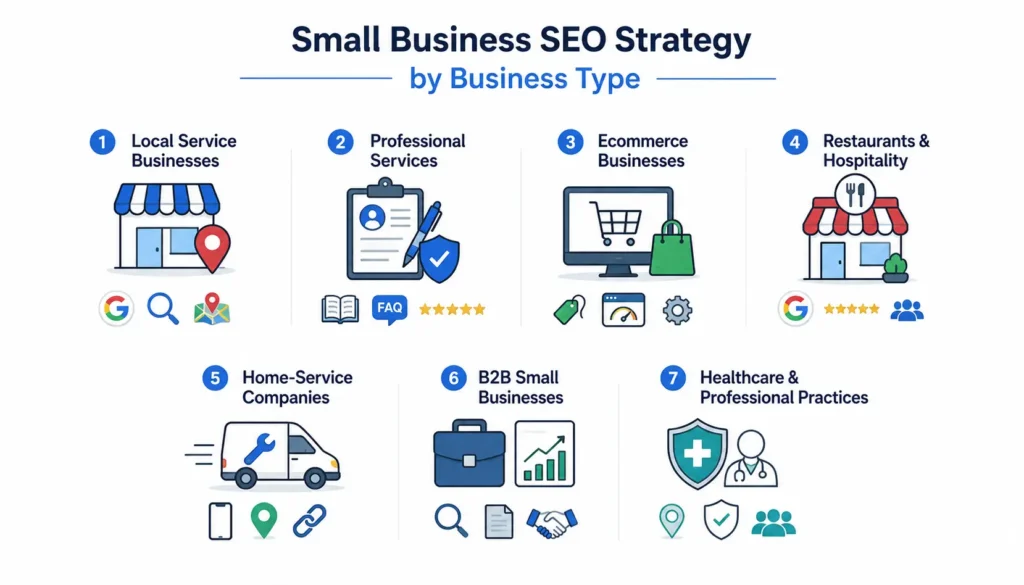
1. Local service businesses
Prioritize Google Business Profile, local keyword targeting, and location-specific pages if you serve multiple areas.
2. Professional services
Focus on demonstrating expertise through content, think detailed guides and FAQs, plus strong local SEO and genuine client reviews.
3. Ecommerce businesses
Product page optimization, category page structure, and technical SEO (site speed, crawlability at scale) matter more here than for most other business types.
4. Restaurants and hospitality
Google Business Profile, reviews, and local search visibility tend to drive the most bookings and walk-ins.
5. Home-service companies
Emergency and service-area keywords, strong local citations, and fast-loading mobile pages are critical, since many searches happen on mobile in urgent situations.
6. B2B small businesses
Content that targets longer, more specific search terms, along with case studies and clear service pages, tends to perform best.
7. Healthcare and professional practices
Accuracy, trust signals, and strong local SEO matter enormously: Google holds health and financial content (“Your Money or Your Life” topics) to a higher quality bar than most other categories.
How to Measure the ROI of an SEO Consultant
Traffic vs qualified traffic
More visitors isn’t automatically a win. What matters is whether that traffic matches your ideal customer profile.
Leads
Track form submissions, calls, chat inquiries, and bookings that come specifically from organic search.
Conversion rate
What percentage of organic visitors actually become leads or customers? This tells you whether your pages are doing their job once traffic arrives.
Cost per lead
Divide your SEO spend by the number of leads generated to get a comparable figure against other marketing channels.
Customer acquisition cost
This factors in the full cost of turning a lead into a paying customer, giving you a clearer picture of true efficiency.
Revenue from organic search
With proper tracking, you can tie specific sales or bookings back to organic traffic, which is the clearest measure of SEO’s business impact.
Customer lifetime value
For many small businesses, a customer’s long-term value far exceeds their first purchase. Factoring this in often shows SEO to be more valuable than a single-transaction view suggests.
SEO ROI
A simple way to calculate return on your SEO investment:
SEO ROI = Organic-search profit attributable to SEO ÷ SEO investment × 100
For example, if organic search-driven sales generated $12,000 in profit over a quarter, and you spent $3,000 on SEO consulting during that time, your ROI would be (12,000 ÷ 3,000) × 100 = 400%.
DIY SEO vs Hiring an SEO Consultant
| Factor | DIY SEO | Hiring an SEO Consultant |
| Cost | Low upfront, but time-intensive | Higher upfront, but often faster ROI |
| Time | Requires significant personal time investment | Frees up your time to run the business |
| Expertise | Limited to what you can learn | Access to specialized, current knowledge |
| Implementation | Slower, learning as you go | Usually faster and more consistent |
| Scalability | Hard to scale alongside business growth | Easier to scale with more services or content |
| Technical capability | Limited unless you have a technical background | Typically strong technical SEO capability |
| Risk | Higher risk of costly mistakes (penalties, wasted effort) | Lower risk with an experienced consultant |
| Best use case | Very small, low-competition local businesses with tight budgets | Businesses ready to invest in consistent, faster growth |
DIY SEO makes the most sense when your budget is genuinely limited, your market has little competition, and you’re willing to invest real time in learning. Professional help becomes more efficient once your time is better spent running the business, your market is competitive, or you’ve tried DIY and hit a plateau.
SEO Consultant Checklist for Small Businesses
Use this checklist to make sure nothing important gets missed, whether you’re doing this yourself or vetting a consultant’s plan:
- [ ] Business goals defined
- [ ] Website audited
- [ ] Search intent researched
- [ ] Competitors analyzed
- [ ] Keyword map created
- [ ] Technical issues prioritized
- [ ] Local SEO reviewed
- [ ] Content gaps identified
- [ ] Conversion tracking configured
- [ ] Reporting established
- [ ] KPIs agreed
- [ ] Monthly roadmap created
Frequently Asked Questions About SEO Consultants for Small Businesses
1. What does an SEO consultant do for a small business?
They analyze your website and market, then build and often implement a strategy to improve your visibility in search results, with the ultimate goal of generating more qualified leads and revenue, not just better rankings.
2. How much does an SEO consultant cost?
Costs vary widely, from roughly $75–$200+ per hour, to monthly retainers ranging from a few hundred to several thousand dollars, depending on scope and market competitiveness.
3. Is SEO worth it for a small business?
For most small businesses, yes, especially those relying on local or service-based customers, since SEO builds a long-term asset rather than a channel that disappears the moment you stop paying.
4. How long does small-business SEO take?
Early signals often appear within two to four months, with meaningful traffic and lead growth typically developing between four and nine months, depending on competition and starting condition.
5. Should I hire an SEO consultant or agency?
A consultant often offers more direct access and specialized attention; an agency offers more resources and capacity. The right choice depends on your budget, the scope of work, and how hands-on you want the relationship to be.
6. Can I do SEO myself?
Yes, especially for a very small, low-competition local business. It takes real time to learn properly, so weigh that time cost against your other priorities.
7. What should an SEO consultant include?
At minimum: an audit, keyword research, on-page and technical fixes, local SEO (if relevant), content guidance, and clear reporting tied to leads or revenue, not just rankings.
8. How do I know if an SEO consultant is good?
Look for relevant case studies, clear communication, transparent reporting, and a focus on business outcomes rather than vanity metrics.
9. Should an SEO consultant guarantee rankings?
No. No one controls Google’s algorithm, so guaranteed rankings are a major red flag rather than a sign of confidence.
10. How do I measure SEO ROI?
Use the formula: SEO ROI = Organic-search profit attributable to SEO ÷ SEO investment × 100, and track it alongside leads, conversion rate, and customer acquisition cost.
11. Does SEO still work in the age of AI?
Yes, search behavior is shifting toward AI Overviews and AI chat tools, but the underlying fundamentals (relevance, authority, trust, and structured content) still matter, and arguably matter more.
12. Can an SEO consultant help with Google AI Overviews?
A knowledgeable consultant can structure your content to improve the odds of being cited in AI Overviews and AI chat answers, though no one can guarantee inclusion, since these systems are still evolving.
Conclusion
The right SEO consultant for small business growth isn’t the one promising the fastest rankings or the cheapest monthly fee. It’s the one who ties their work back to leads, customers, and revenue, and who’s transparent about the fact that real SEO takes time, consistency, and honest reporting along the way.
Before you sign with anyone, use the checklist and questions in this guide to compare proposals on outcomes, not just price. That single shift in how you evaluate consultants will save you months of wasted spend and get you working with someone who actually moves your business forward.