You spend hours building backlinks. You reach out, negotiate placements, and finally get that link live. But your rankings barely move. What went wrong?
Nine times out of ten, the problem isn’t the link itself it’s the anchor text. The few words someone clicks to reach your page carry more SEO weight than most people realize. And without a clear anchor text strategy, even a strong backlink profile can stall your rankings or worse, trigger a Google penalty.
you’ll learn exactly what anchor text is, why it matters so much in 2026, and how to build an anchor text strategy that’s natural, Google-safe, and built to rank. No fluff, no outdated advice just what actually works right now.
What Is Anchor Text and Why Does It Matter?
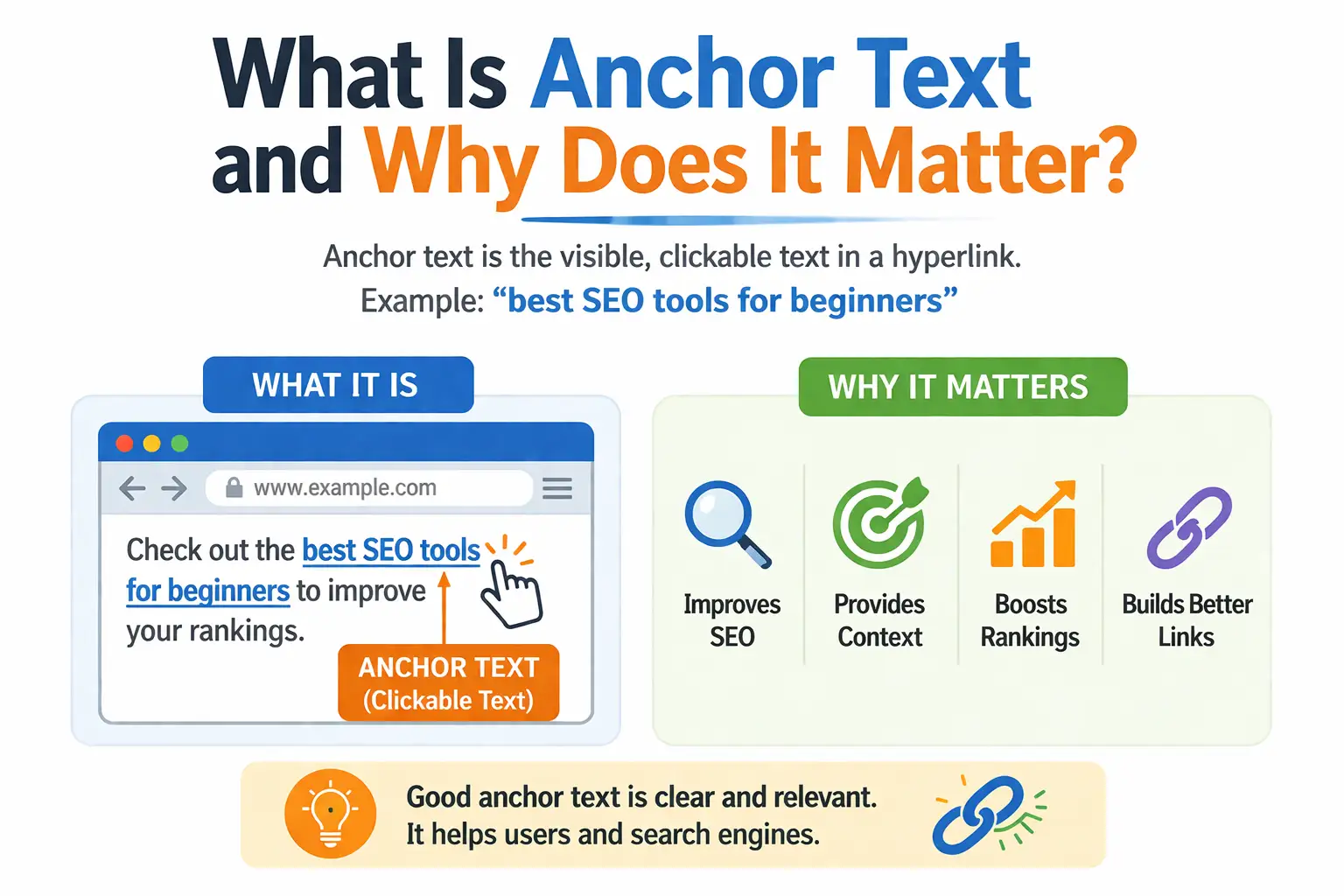
Anchor text is the visible, clickable text inside a hyperlink. For example, in the sentence “best SEO tools for beginners” that highlighted phrase is the anchor text.
When Google crawls your site, it reads this text to figure out what the linked page is actually about. Think of it as a label. If dozens of reputable websites link to your page using the words “keyword research tips,” Google gets a strong signal that your page is relevant to that topic.
Done right, anchor text helps you:
- Strengthen topical relevance for your target keywords
- Distribute link authority to your most important pages
- Improve how search engines crawl and understand your site
- Guide real users naturally through your content
But here’s the flip side: get it wrong — by overusing exact-match keywords or using the same anchor text repeatedly — and you risk confusing search crawlers, weakening your relevance signals, or even triggering a manual penalty.
The 6 Types of Anchor Text (With Examples)
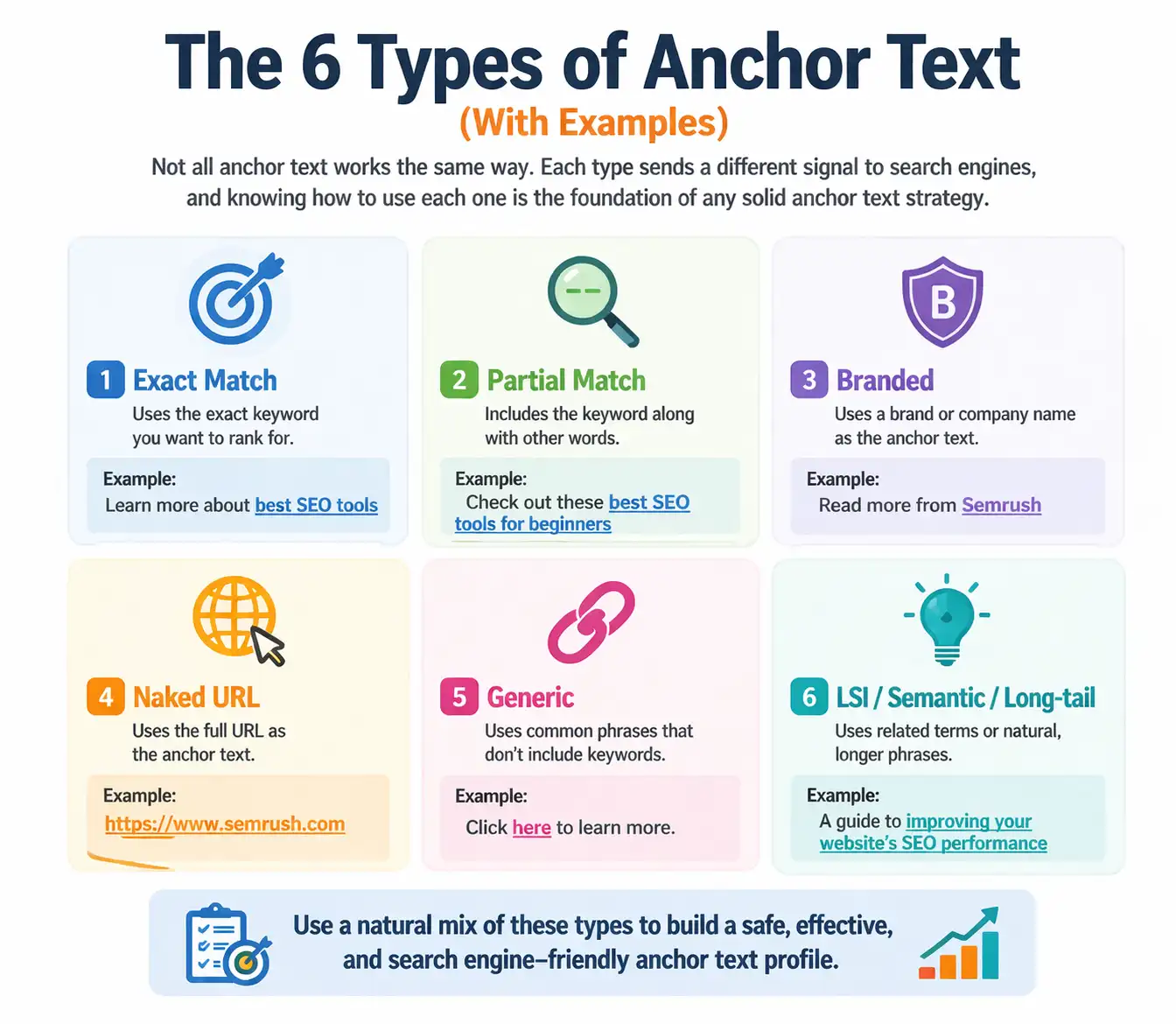
Not all anchor text works the same way. Each type sends a different signal to search engines, and knowing how to use each one is the foundation of any solid anchor text strategy.
1. Exact Match
This is when the anchor text matches your target keyword word-for-word. For example, linking to a page about “anchor text strategy” using the anchor text “anchor text strategy.”
This type carries the strongest relevance signal but it’s also the most dangerous when overused. Limit exact-match anchors to 1–5% of your total backlink profile.
2. Partial Match
Partial match anchors include your target keyword alongside other words. For example: “tips for a better anchor text strategy” or “how anchor text works in SEO.” These are safer than exact match and feel more natural in real content.
3. Branded
Branded anchors use your company or website name, like “Ahrefs guide” or “Moz research.” These are the safest type and should make up the largest share of your link profile — typically 40–50%.
4. Naked URL
A naked URL uses the raw link as the anchor text, such as “https://yoursite.com/blog.” It looks natural because people often just paste links, and it adds diversity to your profile.
5. Generic
Generic anchors include phrases like “click here,” “read more,” or “visit this page.” They carry almost no SEO value, but sprinkling them in keeps your profile looking natural and human.
6. LSI / Semantic / Long-tail
These are variations, synonyms, or topically related phrases. For example, “internal linking best practices” or “how to optimize backlinks for Google” when your target page is about anchor text. Google’s NLP algorithms love this variety.
Building a Smart Anchor Text Strategy — Step by Step
Now that you know the types, here’s how to put them together into a strategy that actually improves your rankings.
Step 1: Audit Your Existing Anchor Profile
Before you build anything new, you need to know where you stand. Use a tool like Ahrefs, SEMrush, Screaming Frog, or process mining software to crawl your site and pull a full list of your internal and external anchor texts
Look for:
- Repeated exact-match anchors across many links
- Overuse of generic phrases like “click here”
- Anchors that don’t accurately describe the destination page
- Any suspicious or spammy-looking patterns
This audit gives you a clear baseline and reveals quick wins you can act on immediately.
Step 2: Follow the Right Anchor Text Ratio
There’s no universal magic number, but analysing top-ranking sites shows a fairly consistent pattern. Here’s a safe distribution to aim for:
| Anchor Text Type | Recommended Ratio | Risk Level |
| Branded | 40–50% | Very Low |
| Partial Match | 20–25% | Low |
| Naked URL | 10–15% | Low |
| Generic (click here, etc.) | 8–10% | Low |
| LSI / Semantic | 5–8% | Low |
| Exact Match | 1–5% | High (if overused) |
Notice how small the exact-match category is. That’s not a mistake it’s intentional. The sites that rank well aren’t the ones hammering one keyword. They’re the ones that look natural.
Step 3: Match Your Anchor Text to Search Intent
Your anchor text should feel like it belongs in the sentence not like it was shoehorned in for SEO purposes. Ask yourself: “If I read this aloud, does it sound like something a real person would write?”
Google now evaluates anchor text as part of the broader context of the surrounding paragraph. A link that fits seamlessly into its sentence is always going to outperform one that looks forced.
Step 4: Use Semantic Variation
Instead of using “anchor text strategy” in every single backlink you build, rotate your phrasing. Use related terms like:
- “how to optimize anchor text”
- “link text best practices”
- “building a natural link profile”
- “SEO anchor text tips”
Google’s Natural Language Processing picks up on semantic variation. Using a range of topically related phrases actually reinforces your page’s relevance more effectively than repeating one keyword over and over.
Step 5: Optimize the Text Around Your Anchor
Here’s something many SEOs overlook: the words surrounding your anchor text matter too. Google reads the entire sentence not just the clickable part to understand the link’s context.
Compare these two examples:
- “Click here to learn more.” Low value, no context
- “For a full breakdown of how to build a natural link profile, check out this anchor text strategy guide.” Rich context, high value
The second example tells Google exactly what the linked page is about before the crawler even visits it. That’s the kind of contextual signal that moves rankings.
Internal vs. External Anchor Text Strategy
Internal Links: Your Most Controllable SEO Asset
With internal links, you have 100% control over the anchor text so use it wisely. Your internal linking strategy should:
- Guide users from one related piece of content to another
- Use descriptive anchors that hint at what the destination page covers
- Point to your most important pages using strategically chosen anchor text
- Avoid using the same anchor text on every internal link pointing to one page
External Backlinks: Quality and Relevance Above All
With external links, you don’t always control the anchor text — but you can influence it through guest posts, outreach messaging, and the context you provide to other writers.
A few rules of thumb for external anchor text:
- Prioritize links from sites relevant to your niche over high-DA sites with zero topical overlap
- When doing outreach, suggest natural anchor text rather than exact-match keywords
- One strong link from a genuinely authoritative, relevant domain is worth more than ten from random sites
- Disavow toxic links that use spammy or unrelated anchor text — they can drag your entire profile down
5 Anchor Text Mistakes That Can Hurt Your Rankings
These are the most common errors and they’re surprisingly easy to make, even by experienced SEOs.
- Over-using exact-match anchors. If 30% of your backlinks say “buy cheap laptops,” Google will see a manipulated profile. Keep exact-match usage minimal and strategic.
- Repeating the same anchor text across dozens of links. Even if the anchor looks natural once, seeing it hundreds of times is a red flag. Rotate your phrasing.
- Using “click here” or “this link” everywhere. These add zero topical value. Replace them with descriptive alternatives whenever possible.
- Ignoring image alt text. When an image is hyperlinked, the alt text acts as the anchor text. Leaving it blank or writing “image1.jpg” wastes a valuable SEO signal.
- Not auditing regularly. Your link profile is not a “set it and forget it” thing. Competitors build links, contexts change, and spammy sites can link to you without warning. Audit at least once a quarter.
Anchor Text Strategy in 2026: What’s Changed?
The days of keyword-stuffing your anchor text to rank are long gone. Google’s algorithms are far more sophisticated now, and what worked in 2014 can actually hurt you today.
Here’s what’s different heading into 2026:
Context Beats Keywords
Google evaluates anchor text as part of a broader contextual framework — the surrounding content, the linking page’s authority, and the destination page’s topic all factor in. An anchor that fits perfectly in context will always outperform a keyword-heavy one that looks forced.
AI Search Is Now Part of the Picture
ChatGPT, Gemini, Perplexity, and other AI tools are increasingly how people discover brands and content. These systems make recommendations based on how consistently and naturally your brand appears in quality documents across the web. Your anchor text strategy feeds directly into those entity signals every well-placed, natural backlink helps AI models associate you with your topic.
Semantic Understanding Has Replaced Mechanical Optimization
Google now understands synonyms, related topics, and natural language patterns. This means a page can rank for a keyword even if that exact phrase never appears in an anchor text. What matters more is whether your content and its surrounding links form a coherent, trustworthy topical cluster.
Quick Anchor Text Audit Checklist
Use this checklist every quarter to keep your link profile clean and effective:
- Crawl your site using Screaming Frog, Ahrefs, or SEMrush
- Export all internal and external anchor texts
- Flag any exact-match anchors appearing more than a handful of times
- Identify clusters of generic anchors (“click here,” “read more”)
- Check that each anchor accurately describes its destination page
- Look for incoming links from irrelevant or spammy domains
- Map your most important pages and ensure they’re being linked to with varied, descriptive anchors
- Schedule the next audit in 90 days
Frequently Asked Questions
What is anchor text in SEO?
Anchor text is the visible, clickable text in a hyperlink. It helps both users and search engines understand what the linked page is about. In SEO, it acts as a relevance signal the text tells Google the topic of the destination page.
What is the best anchor text strategy for backlinks?
The best anchor text strategy is one that’s diverse and natural. Prioritize branded anchors (40–50%), use partial-match anchors for keyword relevance, and keep exact-match anchors below 5%. Always match the anchor to the context of the surrounding sentence.
How many exact-match anchors are safe?
Most SEO experts recommend keeping exact-match anchors between 1% and 5% of your total backlink profile. Beyond that, the pattern starts to look manipulative to Google’s Penguin algorithm.
Does anchor text still affect rankings in 2026?
Yes — but indirectly. Anchor text remains a relevance signal, but it works best when paired with strong contextual content, a high-quality linking domain, and clear search intent alignment. It’s one piece of a larger puzzle, not a standalone ranking lever.
What is a healthy anchor text ratio?
A healthy anchor text ratio is dominated by branded and partial-match anchors, with small percentages of naked URLs, generic anchors, and exact-match keywords. Exact match should never exceed 5% of your total profile.
What happens if I over-optimize my anchor text?
Over-optimization can trigger Google’s Penguin algorithm, which may suppress or penalize your site’s rankings. In severe cases, you may receive a manual action from Google. The fix is to diversify your anchor text profile gradually and disavow any toxic links.
Final Thoughts
A well-executed anchor text strategy isn’t about tricking Google — it’s about helping Google understand your content clearly and naturally.
The sites that rank at the top aren’t the ones with the most keyword-stuffed backlinks. They’re the ones that built diverse, contextually relevant link profiles over time — profiles that look like they happened organically, even when they were intentionally planned.
Start simple: audit what you have, fix the obvious problems, and build every future link with your anchor text strategy in mind. Those small, consistent decisions compound into rankings that actually stick.