

If your SEO results have been underwhelming despite putting in real effort, there is a good chance you are mixing up two very different things: SEO workflow vs SEO strategy. One is the plan the big-picture thinking that sets your direction. The other is the system that actually gets things done your SEO workflow process. Most teams have a version of one, but not both, and that imbalance is usually the root cause of stalled rankings and inconsistent output.
This guide breaks down exactly what each one means, how they are different, and more importantly how to make them work together. Whether you are building your SEO programme from scratch or trying to figure out why your current one is not delivering, understanding the difference between SEO workflow and SEO strategy is the clearest starting point you have got.
What Is an SEO Strategy? (And What It’s Actually For)

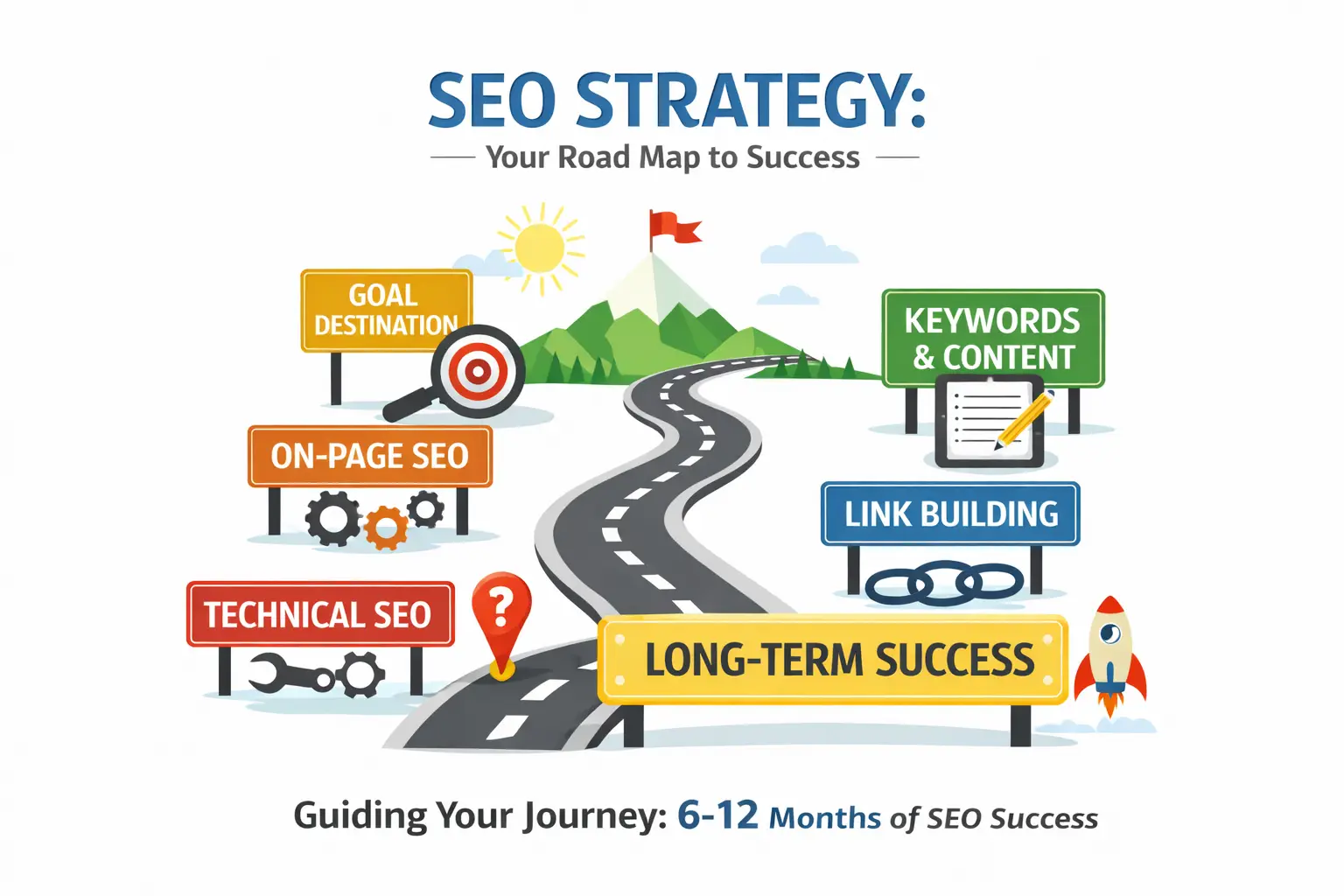
A proper SEO strategy covers a few key areas. It starts with your goals do you want more traffic, more leads, better visibility for a specific product? From there, it moves into understanding your audience and the keywords they actually search for. Then it layers in competitor research, content themes, and a plan for building your site’s authority over time.
Here is the honest truth: strategy answers ‘what’ and ‘why.’ It does not tell you how to write a brief, who publishes the article, or what happens after you hit publish. That is what a workflow is for. Without a strategy, your team is working without direction. With strategy and no workflow, you have a great plan that nobody ever executes.
What Is an SEO Workflow? (And How It’s Different)
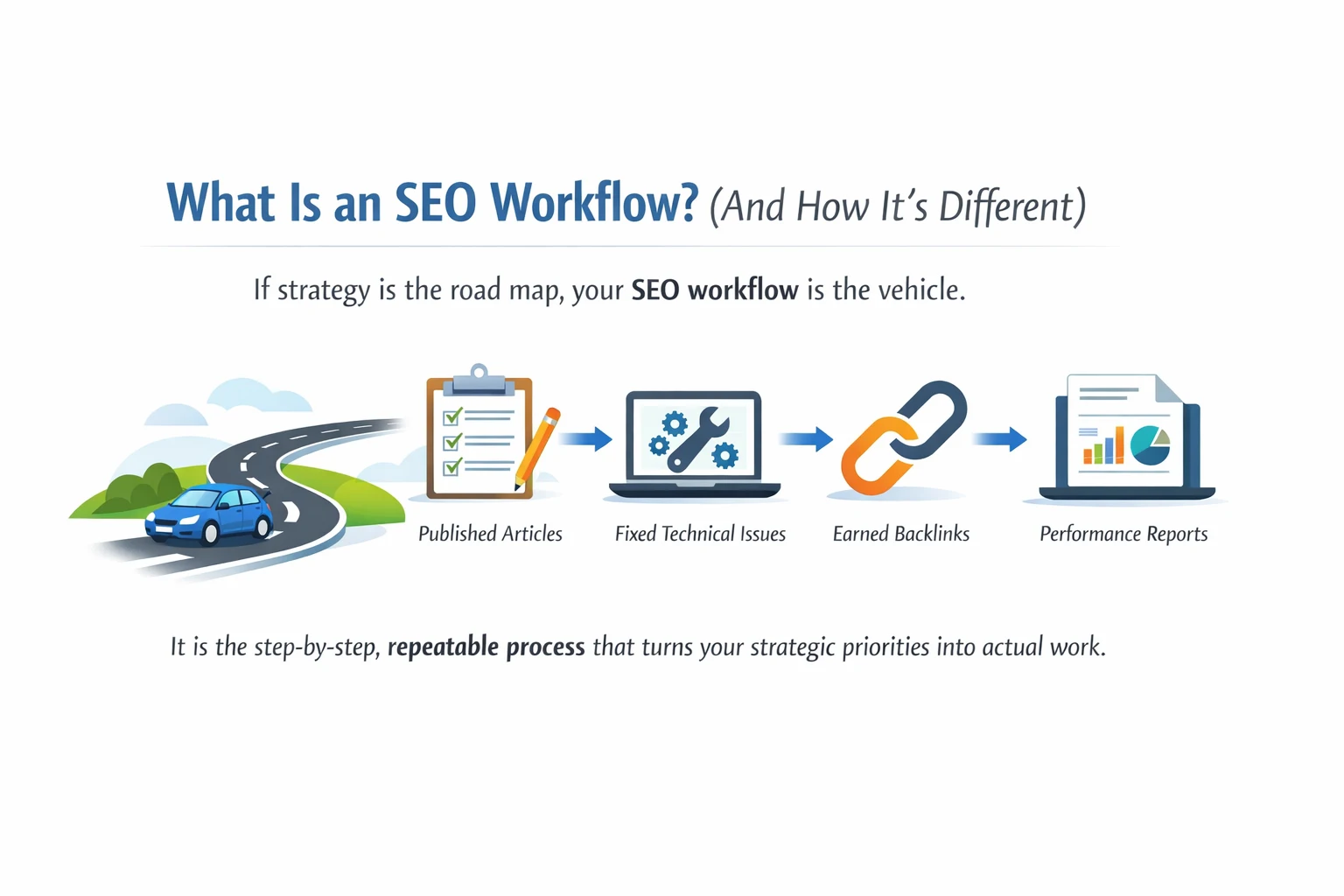
If strategy is the road map, your SEO workflow is the vehicle. It is the step-by-step, repeatable process that turns your strategic priorities into actual work published articles, fixed technical issues, earned backlinks, and monthly performance reports.
The word that matters most here is repeatable. A workflow is not a one-off to-do list. It is a system your team can follow consistently, week after week, regardless of who is doing the work. It defines who does what, in what order, by when, and to what standard.
Think about what happens without one. A keyword gets researched but nobody writes the content. An article gets written but sits unoptimised for two weeks because there is no review process. A technical audit gets done but the fixes never get assigned. Sound familiar? That is what life looks like without a proper SEO workflow.
SEO Workflow vs SEO Strategy: Side-by-Side Comparison
Here is a simple side-by-side breakdown so you can see exactly how the two differ:
| SEO Strategy | SEO Workflow | |
| Focus | Big-picture goals and direction | Daily tasks, processes, and execution |
| Time Horizon | 6–12 months (long-term) | Ongoing — daily, weekly, monthly |
| Owned By | SEO Manager / Marketing Director | Entire SEO and content team |
| Key Question | ‘What do we want to achieve and why?’ | ‘How do we actually get it done?’ |
| Example | Target 50 high-intent keywords in 6 months | Content brief → draft → optimise → publish checklist |
| Without It | Team has no clear direction | Plans never leave the spreadsheet |
The short version: strategy gives you direction, workflow gives you execution. You genuinely need both. A strategy without a workflow stays on a slide deck forever. A workflow without a strategy keeps your team busy but produces the wrong results.
Why Most SEO Efforts Fail: The Gap Between Strategy and Execution
Here is a scenario that plays out in teams all the time. Someone puts together a thoughtful SEO strategy target keywords are mapped, content pillars are defined, competitors are analysed. The team nods along in the kickoff meeting. Everyone is excited.
Three months later, two blog posts have been published. The technical audit is still sitting in a shared drive half-finished. Nobody started the link building because it was never assigned to anyone. Rankings have not moved.
This is not a strategy failure. The strategy was probably fine. It is a workflow failure. There was no repeatable system to translate the plan into tasks, no clear ownership, no checklists, no accountability loop.
The fix is almost never a better strategy. It is building an SEO workflow that gives every part of the strategy an operational home — a repeatable process with a named owner and a clear sequence of steps.
Core Components of a Strong SEO Strategy
A solid SEO strategy does not need to be complicated. But it does need to cover these five areas properly.
1. Clear Goals and KPIs
Before anything else, you need to know what success looks like for your business. More organic traffic? Higher rankings for specific commercial terms? Better lead quality from search? Define your targets clearly so every workflow you build has something meaningful to work toward.
2. Audience and Keyword Research
Good keyword research is not about generating a long list of terms. It is about understanding the topics your audience genuinely cares about and mapping those topics to the different stages of their buying journey. At the strategy level, you are looking for themes and opportunities — not individual keywords.
3. Competitor Analysis
Your competitors have already done a lot of the hard work for you. Look at who is outranking you and why. What content are they producing? Where are their backlinks coming from? What keywords are they winning that you are not targeting yet? This analysis shapes where you focus your energy.
4. Content Themes and Topic Clusters
Modern SEO rewards depth. Rather than publishing isolated articles on random keywords, a smart strategy builds topic clusters — a detailed pillar page on a broad subject supported by a set of related sub-pages that link back to it. This signals expertise to search engines and makes your site much easier to navigate.
5. Authority Building
No strategy is complete without a plan for earning authority. That means getting quality backlinks from relevant sites, building brand mentions across the web, and generally making your site a trusted, credible source in your niche. It is a long game, but you have to plan for it from the start.
Core Components of a Strong SEO Workflow
Once your strategy is in place, you need workflows to execute it. Here are the five SEO workflows every serious team needs to have running.
Keyword Research Workflow
This is more than just opening Ahrefs and hunting for keywords. A proper keyword research workflow covers how you identify topics, validate search intent, assess keyword difficulty, prioritise against your strategic goals, and document findings in a format the whole team can actually use.
Content Creation Workflow
This is usually the most important workflow in the whole operation. It should move from a keyword-informed brief, through research and outline, to a first draft, then an SEO optimisation pass covering titles, meta descriptions, headings, and internal links, then an editorial review, and finally publish and indexing confirmation. Every step needs a named owner and a deadline.
Technical SEO Workflow
Technical SEO is not a one-time project — it is an ongoing maintenance cycle. A solid technical workflow includes a scheduled audit, a prioritised fix list, clear ownership for each fix, and a verification step to confirm the fix actually worked. Without this cycle, technical debt accumulates quietly until it becomes a real rankings problem.
Link Building Workflow
Link building without structure quickly falls apart. You need a repeatable process that covers prospect identification, contact research, outreach sequencing, follow-up timing, and results tracking. When this is documented and assigned, your link building becomes consistent and measurable rather than sporadic and unpredictable.
Performance Tracking Workflow
You need a regular rhythm for measuring what is working. Set a weekly check-in for key metrics like rankings and traffic, and a monthly review for deeper analysis of conversions and content performance. The data from this workflow feeds directly back into your strategy, keeping it sharp and relevant.
How SEO Workflow and SEO Strategy Work Together
Here is the thing most SEO guides miss: strategy and workflow are not separate projects you build once and move on from. They feed each other in a continuous loop.
Your strategy sets the priorities. Your workflows execute those priorities. The execution generates data — rankings, traffic, engagement, conversions. That data goes back into your strategy and helps you sharpen your goals, drop what is not working, and invest more in what is.
Plan → Execute → Measure → Refine → Plan again
The practical takeaway is simple: build your strategy first, then design a workflow for each strategic priority. If your strategy says you want to publish twelve long-form articles per quarter, your content creation, keyword research, and performance tracking workflows all need to be built to support that at scale.
How to Build Your SEO Workflow Around Your SEO Strategy (Step by Step)
If you have a strategy but no workflow holding it together, here is how to fix that:
- Define your goals with specifics. Vague goals like ‘improve our SEO’ will not get you far. Get concrete — ‘rank in the top five for twenty commercial keywords within six months’ gives your team something real to work toward.
- Break each goal into task categories. For every strategic goal, list the recurring activities needed to hit it. A content growth goal needs keyword research, writing, optimisation, and promotion. Each of those is the seed of a workflow.
- Assign ownership for every step. Every workflow needs a real person responsible for each stage. No owner means no accountability, and no accountability means tasks get dropped. Be specific about who does what.
- Set up your tools. Project management platforms like Asana, Notion, Trello, or Monday.com make it much easier to run workflows at scale. Use them to build task templates, set deadlines, and keep the whole team aligned.
- Write simple SOPs for each workflow. A one-page standard operating procedure removes guesswork. When everyone knows exactly what a finished optimised article looks like — the checklist of title tag, meta, headings, word count, internal links, and image alt text — quality becomes consistent without micromanagement.
- Review and improve regularly. Set a monthly rhythm for checking whether your workflows are delivering. Are tasks finishing on time? Is quality holding up? Are the results matching what your strategy called for? Iterate based on what you find.
Frequently Asked Questions
What is the difference between an SEO workflow and an SEO strategy?
An SEO strategy is your long-term plan the goals, keyword priorities, and overall direction of your SEO programme. An SEO workflow is how you execute that plan day to day, covering the specific steps, task ownership, and processes that get SEO work done consistently. Strategy is the what and why. Workflow is the how.
Can you have an SEO workflow without a strategy?
You can, but you probably should not. Without a strategy, your workflows have no clear direction. You might be executing tasks consistently and efficiently, but if they are not connected to the right goals, you are producing activity without meaningful results. Build the strategy first, then create workflows around it.
Which comes first — the strategy or the workflow?
Strategy always comes first. You need to know where you are going before you build a system for getting there. Once your strategy is clear, you can design workflows for each core activity content creation, keyword research, link building, technical SEO, and performance tracking.
What tools help manage an SEO workflow?
Project management tools like Asana, Notion, Monday.com, and Trello are popular choices for organising SEO workflows. For the SEO-specific tasks within those workflows, tools like Ahrefs, Semrush, Screaming Frog, and Google Search Console handle the research and analysis. The project management tool keeps the workflow running the SEO tools do the actual SEO work.
How often should you update your SEO strategy vs your workflow?
Your SEO strategy should be reviewed quarterly, or whenever there is a significant algorithm update, market shift, or business change. Your workflows should be reviewed more frequently ideally monthly since they are operational and need to adapt quickly as your team, tools, or content volume changes.
Conclusion
The debate around SEO workflow vs SEO strategy is not really a debate at all. Both are essential, and they serve completely different purposes. Your strategy sets the direction. Your workflow makes sure you actually follow it.
Most SEO programmes do not fail because of a bad strategy or the wrong tools. They fail because of the gap between planning and doing. Teams that close that gap by building clear, repeatable workflows around every strategic priority consistently outperform those that do not.
Take an honest look at your own setup. Do you have a strategy with defined goals and clear priorities? And for each of those priorities, do you have a workflow — a real process with ownership and structure? If the answer to either question is no, that is where to start. Fix the gap, and the results will follow.